1488
THE ROLE OF E-TRUST IN ACHIEVING E-LOYALTY:
AN EXPLORATORY STUDY ON JORDANIAN CUSTOMERS
USING SHOPPING WEBSITES
MOHAMMAD ATWAH AL-MA’AITAH,ADEL ODEH AL-HASHEM
Al-Balqa Applied University, Department of MIS, Jordan E-mail: [email protected], [email protected]
ABSTRACT
This study aimed to identify the state of electronic trust and its impact on electronic loyalty in the Hashemite Kingdom of Jordan. The study population consisted of Jordanian customers using shopping websites and utilized a questionnaire that was developed based on prior research and managed electronically to collect data. A convenience sample consisting of 386 individuals was used and the data was analyzed using SPSS and PLS techniques. The major findings revealed that there is a significant impact of e-trust dimensions(Credibility, Integrity and Orientation to Resolve Problems) on e-loyalty to shopping websites in the Jordanian context. The study additionally provides a list of recommendations for online retailers, such as offering precise and sufficient information on their websites and imploring the Jordanian Government to implement deterrent laws against the exploitation of customers using e-selling sites.
Keywords:Credibility, Integrity, Orientation to resolve problems, Benevolence, E- loyalty.
1. INTRODUCTION
In recent years, many organizations have begun gravitating towards e-commerce, moving much of their business online and utilizing websites or social media tools while putting increasing focus on their online presence. Many of these businesses see initial success that is subsequently challenged and sometimes diminished by determinate factors such as lack of environmental and cultural understanding and skills, technical problems, inadequate standards, and strong competition[1][2]. Businesses in Jordan continue to lose customers and profitability in part due to a lack of socio-cultural encouragement of the use of online services and poor implementation of electronic laws supported by the Jordanian Government. Undoubtedly, if these businesses became more efficient in earning the loyalty of their customers, they would not lose them so quickly and this trend could be shifted. Recognizing this, many organizations seek to maintain customer e-loyalty through applying strategies such as focusing on customization, website design, contact interactivity and improved internet security. Many studies have confirmed that e-trust is an essential component for the construction of e-loyalty ([3]; [4]; [5]) .This study
sought to further investigate the role of e-trust in achieving customer e-loyalty and to identify the extent of e-trust that Jordanian customers have for shopping websites.
2. GENERAL BACKGROUND AND
LITERATURE REVIEW
2.1 E-trust
1489 provide electronic payment services through mobile applications, such as Dinark, Jordanpost, Trustfintech, and Mahfazti [9]. However, despite the fact that150% of Jordanians own mobile phones, payments through mobile applications in 2016 and 2017 amounted to only 182JD and 258 JD respectively, indicating that the rate of use of these services in Jordan is continually low[10].
E-trust can be defined as the extent of customers’ confidence in online interactions [11]. [12] identified and listed some of the main drivers for enhancing website trust. The first of these is ensuring security and privacy. The second is introducing reliable and unbiased information about business processes, such as prices, delivery time, and accessibility, and the last is fulfillment of services after sales, payments and item returns. After reviewing many related studies conducted in the Jordanian context, we found that the concept of e-trust in Jordan has not been comprehensibly studied by previous researchers
.
[13] described the difficulty of initiating e-trust due to its dependence on cumulative, interrelated factors, such as security, privacy, word-of-mouth, knowledge, and quality of information. [5] also stressed that electronic trust is at the heart of all transactions carried out through websites. [14],[15] believe that the concept of e-trust is an essential variable of internet banking acceptance. [16] argued that trust has a positive impact on users’ perceived value of and attitudinal intentions to use online banking. [17] defined integrity, a key component of e-trust, as having a sense of honesty and truthfulness regarding some actions. Brilliant and [4] recommended that online businesses increase focus on earning customer trust as it leads to greater loyalty of customers to their websites.
2.2 E-loyalty
Loyalty of customers is an increasingly critical factor that has an important effect on business sustainability and growth [18]. As recent decades have seen many businesses shift their services online, the need for these businesses to focus on improving factors that will increase customer loyalty is ever more crucial to their success. [19] agreed that website quality and online support has a great effect on customer loyalty. Moreover, [20] stated that positive word of mouth plays a noteworthy role in generating loyalty.
[21] defined loyalty as the deep commitment of a customer to remain loyal to a service provider. [22] describes e-loyalty as customer loyalty towards an e-service. [23] defined e-loyalty as a customer’s intention to purchase from
a given company website, and resist changing to a different company website.
Prior researchers have studied customer loyalty in online services and identified various drivers leading to the achievement of customer loyalty to online services. We have summarized these drivers in Table (1) below:
Table (1): Customers E-loyalty Drivers
Drivers
Source
Commitment [24]Satisfaction [25]; [2];[18]
Trust [26]; [27]; [28]; [29]
Service quality [30]; [29]
Perceived Risk [31];[28] 2012; [29]
As shown by Table (1), multiple drivers affect customer loyalty to e-services. This study will focus on describing factors of e-trust, incorporating distinctive dimensions in light of the scarcity of research regarding e-trust in the Jordanian context. Moreover, it will highlight the importance of e-trust as an essential factor for the construction of e-loyalty, which is critical for customer retention. [32] estimated that acquiring new customers is up to five times costlier than keeping existing customer, making the question of how to obtain customer e-loyalty in an increasingly electronic world a critical one for company efficiency and success.
3. RESEARCH MODEL
1490
Figure(1): Proposed Model
The following sections will explain and expand upon each of the model dimensions and synthesize the study hypotheses.
3.1 Credibility
The concept of credibility has two essential components: the believability of the information source and believability of the information itself. The use of websites and the internet in e-commerce transactions has greatly increased the difficulty of determining the credibility of sources and the truthfulness of information. The digital age has come with a fast and significant increase in the number of available information resources, making verifying credibility more complex. Accordingly, online resources often must increase their qualifications and expertise to prove credibility to consumers [33]. Many online tools have likewise appeared to help customers evaluate online information through examining the accuracy, authority, objectivity, currency, and coverage or scope of the information and/or its source [34]. [35] defined credibility as the extent to which one partner believes that the other partner has the necessary expertise and capabilities to perform the job in an effective and efficient manner. As the concept of credibility itself is very broad, we will depend on the previous definition for the purpose of this research. Proving credibility plays an important role in shifting customers’ attitude and behavior towards adopting e-banking services[36].
H01: Credibility has a significant impact on e-loyalty.
3.2 Integrity
[37]refer to integrity as an ethical concept that implies that the other party will respect their promises and commitments. Other researchers, such
as [38], define integrity as the capability and commitment of another party to protect the safety of transactions and the privacy of information. According to [39], integrity is an ethical belief, not associated to knowledge or skills. [13] stressed that perceived security, privacy, and quality of information are also important factors affecting consumer loyalty on the web, all of which are factors likewise influenced by company integrity. [40] argue that e-loyalty and long-term consumer relationships can be achieved when customers believe that the vendor is reliable and has integrity and a customer has assurance that company representatives are truthful. [36] state that integrity refers to the perception of customers that service providers will consistently abide by the agreed upon terms. Hence company integrity increases the degree of consumer e-trust in vendors which in turn leads to long-term customer relationships and high rates of customer retention.
H02: Integrity has a significant impact on e-loyalty.
3.3Benevolence
[39] defined benevolence as the extent to which customers believe vendors will provide their services without being controlled or observed by another party. [41] argues that the concept of benevolence indicates that the supplier will take care of the customer and provide them with excellent service regardless of variability in their own profit margin. In short, benevolence is the confidence that a business is primarily concerned with customer well-being [42]. [43] argue that customer loyalty increases with perceived company benevolence. Therefore, adopting benevolence mechanisms is an effective way of enhancing customer loyalty, and should be considered by managers. This factor may be especially critical in the digital age, as many online businesses underestimate the importance of personal touch and feeling valued to customers and consequently neglect developing their perceived benevolence.
H03: Benevolence has a significant impact on e-loyalty.
3.4 Orientation to Resolve Problems
1491 problems will increase general acceptance of and participation in online trade. Consequently, customer loyalty and retention will also increase [36].
H04: Orientation to resolve problems has a significant impact on e-loyalty.
4. THE MEASUREMENT
This study aims to investigate the effect of
these four dimensions of e-trust on e-loyalty. To achieve this, extensive related literature has been reviewed in order to further define the study model and the study variables.
4.1 Instrument Development
An online questionnaire consisting of 20 items was developed to collect the necessary data. It contains two main constructs: e-trust and e-loyalty. The measures concerning e-trust were adopted from [5], while e-loyalty measurement were developed from [18]. Ten academics provided their judgment on the questionnaire as well as their notes on how best to align these items with the study objectives. The completed questionnaire was distributed throughout Facebook groups to individuals using online shopping websites. Of these 386 questionnaires have been collected and deemed valid for statistical analysis.
4.2 Study Population and Sample
The study population consisted entirely of individuals participating in online shopping through website providers for such service in Amman, Jordan. A convenience sample has been used to collect data.
4.3 Instrument Reliability
The Cronbach Alpha Coefficient was used to determine the reliability of each construct. The results are shown in Table(2).
Table (2) Reliability Test (Cronbach Alpha Coefficient)
The Variable The Dimension Cronbach Alpha
E-trust
Credibility 0.769
Integrity 0.799
Benevolence 0.822
Orientation to
resolve problems 0.797
E-loyalty
0.768
Summarizing the results appearing in Table (2), we note that all Cronbach Alpha values are greater than 0.70 for each construct. Accordingly, the questionnaire items can be considered consistent and suitable for this study [44].
4.4 Multicollinearity
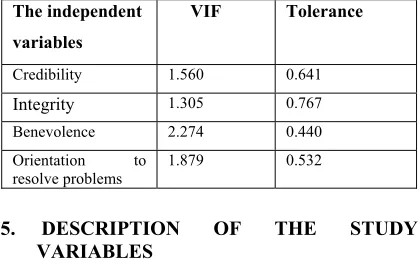
Multicollinearity was used to check for linkage between independent constructs. As shown in Table (3),all the results are acceptable as the tolerance-value for the variables is that greater than 0.01 and less than 1 in each case. In addition, the values of VIF are less than 5 [44].
The independent variables
VIF Tolerance
Credibility 1.560 0.641
Integrity 1.305 0.767
Benevolence 2.274 0.440
Orientation to
resolve problems
1.879 0.532
5. DESCRIPTION OF THE STUDY
VARIABLES
[image:4.612.313.523.450.583.2]1492
5.1 Credibility
Table (4):Credibility Construct Results Mean and Standard Deviation
No Questions Mean Standard
deviation
Importance level
Rank
C1 Online shopping websites that I used have expertise
in doing their jobs 2.90 .987
Low
3
C2 Online shopping websites that I used do their jobs
efficiently 3.22 .985
Mid
2
C3 I believe shopping websites I purchase from will
keep promises they make 3.59 .957
Mid
1
Average 3.23 Mid
As seen in the above table, the credibility construct achieved a middle level average (3.23), demonstrating that people in Jordan do not trust e-shopping sites to a high degree as of yet. The question (C1) resulted in a low-level mean (2.90), which is a concerning indication of public mistrust in online expertise. It is unlikely that people will
continue to shop online if they believe that online shopping sites do not have the necessary experience to provide the services required by customers. Online shopping websites should consider the accuracy and authority of the information presented on their websites and follow advanced criteria to increase their credibility to customers accordingly.
5.2 Integrity
Table (5): Integrity Construct Results Mean and Standard deviation
No Questions Mean Standard
deviation
Importance level
Rank
I1 I believe online shopping websites that I use have
security features to protect users 2.84 .983
Low 3
I2 I feel secure putting my individual information on
online shopping websites that I use 2.95 .978
Low 2
I3 I can use online shopping websites safely
3.50 .940 Mid 1
Average 3.09 Mid
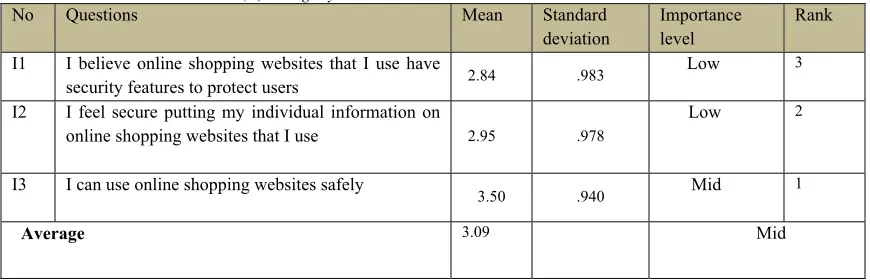
Table (5) shows that the integrity construct achieved a middle level average (3.09) reflecting the perspective of electronic shopping site customers. This result is not sufficient to increase the number of customers engaged in online shopping. Moreover, two of the three questions, I1 [image:5.612.86.521.126.253.2] [image:5.612.85.520.379.519.2]
1493
5.3 Benevolence
Table (6): Benevolence Construct Results Mean and Standard deviation
No Questions Mean Standard
deviation
Importance level
Rank
B1 Online shopping websites that I use usually adapt
in response to technological improvement 2.83 .940
Low 3
B2 I feel that online shopping websites that I use are always looking to develop based on consumer needs
3.05 .995
Mid 1
B3 Online shopping websites that I use have a design
that shows consideration and value of its users 3.04 1.00 Mid 2
Average 2.97 Low
Table (6) show that the benevolence construct achieved a low level average (2.92) which implies that Jordanian customers feel that online shopping
sites undervalue the customer experience and seek to maximize profit without response to customer needs.
5.4 Orientation to Resolve Problems
Table (7): Orientation to Resolve Problems Construct Results Mean and Standard deviation
No Questions Mean Standard
deviation
Importance level
Rank
OR1 Online shopping websites that I use give
attention to the problems of their customers 3.39 .940 Mid 2
OR2 In the case of a problem, I believe it would be easy to make a claim with online websites that I use
2.95 .995
Low 3
OR3 I did not face any problems while using online
shopping websites 3.62 1.00
Mid 1
Average 3.32 Mid
Table (7) shows that the orientation to resolve problems construct achieved a middle level average (3.32),indicating that venders relying on e-commerce should enhance customer confidence that they have the ability and drive to solve
problems that may be encountered by customers, such as return or replacement of non-satisfactory goods. Moreover, as noted from the low-level score of question OR2, customers do not believe it will be easy to make a claim if a problem is encountered
5.5 E-loyalty
Table (8): E-loyalty Construct Results Mean and Standard deviation
No Questions Mean STD Importance Rank
EL1 As long as the present situation continues, I doubt that I would switch the online shopping websites that I use
3.71 .903 Mid 2
EL2 I like using the online shopping websites I do
business with 3.39 .935
Mid 4
El3 I say positive things about online shopping
websites that I use 3.85 .914
Mid 1
El4 I always recommend the online shopping
websites that I use to anyone seeking advice 3.66 .961
Mid 3
El5 I believe that online shopping websites that I use
do their job well 3.22 .994
Mid 5
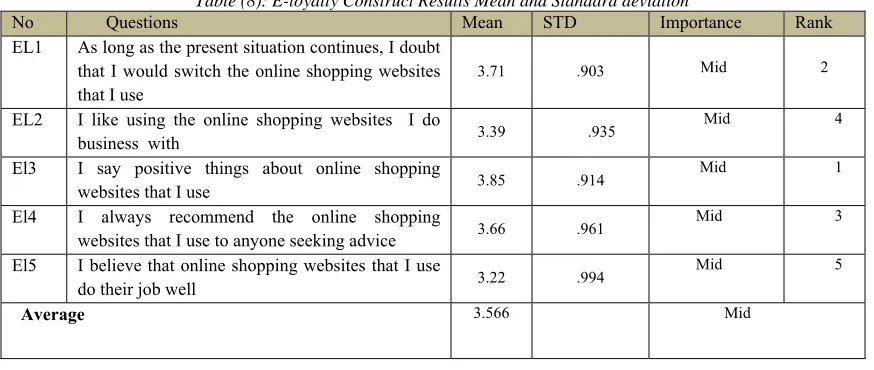
[image:6.612.86.520.114.297.2] [image:6.612.90.516.323.471.2] [image:6.612.85.522.556.741.2]1494 Table (8) shows that the e-loyalty construct achieved a middle level average (3.566), implying that many Jordanian customers have little loyalty to their online shopping sites and may change at any time, without significant justification. This trend puts increased pressure on vendors and in many cases prevents them from expanding new services.
6. MEASUREMENT MODEL RESULTS
6.1 Testing Research Hypotheses
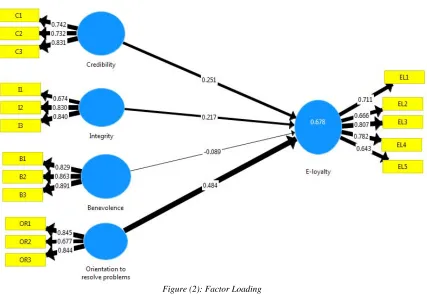
The PLS algorithm was used to test the research hypotheses. Before this test, the model convergent validity was investigated as shown in figure (2).
In regard to factor loading, the item loadings for all items of the constructs range from 0.643 to 0.891, which passed the cut-off value of .50. Moreover, the composite reliability values were investigated and achieved acceptable values greater than .70 as shown in figure (3).
[image:7.612.94.521.330.625.2]1495
Figure(3): Composite Reliability.
The amount of variance explained by R² provides an indication of the model fit as shown in figure (3). Where the R² value was 0.67, E-trust dimensions explained 0.67% of e-loyalty of
customers to online shopping websites. Path coefficients and P values were investigated as shown in figure (4).
1496 Table (9) presents the results of testing the
hypotheses. As shown in Table (9), three of the hypotheses were supported and one rejected
.
Table (9): The Path Coefficient and Hypotheses Results
H# Path Coefficient
(β)
T Statistics P value The results
H1 0.251** 2.720 0.007 Supported
H2 0.217** 2.188 0.029 Supported
H3 -0.089 1.184 0. 237 Not Supported
H4 0.484** 5.592 0.000 Supported
The results show that credibility has a significant impact on customer e-loyalty (The path coefficients of relationships was 0.251, with t value >2 and P value <= 0.05).Moreover, integrity has a significant impact on customer e-loyalty (The path coefficients of relationships was 0.217, with t value >2 and P value <= 0.05).However, benevolence does not have a significant impact on customer e-loyalty (The path coefficients of relationships was -0.089, with t value <2 and P value not less than or equal to 0.05). Finally, orientation to resolve problems has a significant impact on the customer e-loyalty (The path coefficients of relationships was 0.484, with t value >2 and P value <= 0.05).
7. CONCLUSIONS AND RECOMMENDATIONS
The results of the study show that customer trust in shopping websites in Jordan remains at a middle level. Therefore, businesses using websites must follow systematic and scientific methods that contribute to improving customer confidence in the services they provide. The orientation to resolve problems construct achieved the highest arithmetic average in regard to customer satisfaction and e-trust, but it remains a relatively low number with room for much improvement. E-sellers should develop clear policies on all transactions executed through their websites. In addition, feedback should be collected about the purchasing processes carried out through the website and deficiencies should be dealt with seriously. Solving post-sales problems also helps to improve customer trust in online shopping websites.
The credibility construct achieved the second highest score, also a middle arithmetic average, but is still weak in the Jordanian context. To address this, online shopping sites should increase their expertise in job performance and provide services more efficiently. Moreover, these vendors should
not make promises of services they cannot provide, as this will affect their credibility as perceived by their customers and the reputation of the company. Some shopping websites are committed to providing information and services as advertised, but many are not, and it is often difficult to discriminate between these. Therefore, control agencies should be implemented on these sites to verify the validity of the information presented and the services provided, as a high number of fraud sites will discourage the use of e-commerce in the Jordanian business environment. Very few government ministries follow shopping websites and advertisements through social networking sites to ensure the authenticity and safety of products. However, employing official departments in each ministry to follow these sites according to their specialty would significantly help to reduce website fraud and increase public e-trust in online credibility.
The third construct was integrity, which also achieved a middle arithmetic average but likewise did not reach the desired level. To increase perceived company integrity, online sellers should use advanced security tools on their websites to protect users from hackers, particularly during the electronic payment process. Biometric characteristics could be used to ensure authentication. A comprehensive strategy for user information security and privacy should be developed to increase customer confidence and thus increase their use of e-shopping sites. [45] and [29] confirmed that as customers become more aware of information security procedures and policies and the purchasing process becomes more secure, the intention to use online shopping website will increase.
[image:9.612.85.526.163.235.2]1497 their customers’ needs. Many strategies may be used by e-sellers to increase company benevolence, such as customization, website design, conducting preliminary studies on market needs, and continually searching for modern technological techniques that can be offered to customers. Jones(2010) argued that Web 2.0 acts as an essential element in the running and delivery of promotion and entrepreneurship. It enables consumers and supports supplementary channels for communication, feedback, and participation in determining product and service.
The e-loyalty construct also achieved middle level averages, indicating that most Jordanian customers switch between online shopping websites without reliable loyalty to a single provider. E-sellers in Jordan should investigate relevant factors that could affect customer e-loyalty and subsequently act on these factors to increase customer loyalty to their sites. This study explored the role of e-trust on customer e-loyalty in Jordan. Four dimensions of e-trust were selected, and the results of the study indicated that credibility, integrity, and orientation to resolve problems have significant impacts on e-loyalty to shopping websites in the Jordanian context. The results also show that benevolence does not significantly affect customer e-loyalty in Jordan. Therefore, Jordanian e-businesses using websites and social media outlets to advertise their products should focus on the former three factors to enhance customer e-trust which leads to increased customer e-loyalty. The aforementioned results are agreed with the research of , [26];[27], [28],[29]. A list summarizing the recommendations to online retailers proposed based on the results of the research is as follows:
ONLINE RETAILERS SHOULD:
1- Offer precise and sufficient information on their websites.
2- Select employees with sufficient expertise to perform professionally and efficiently. 3- Allow customers to submit complaints and
provide feedback in an easy and user-friendly manner.
4- Increase the level of information security and use the latest available technologies. 5- Study and understand customer behavior
in the Jordanian context.
6- Increase interactivity with customers via electronic channels such as Web2.0.
7- Focus on satisfying customers' desires and requirements.
8- Implore the Jordanian government to implement deterrent laws against the exploitation of customers by e-selling sites.
9- Establish a business association for owners of electronic sales sites to organize and monitor e-commerce.
10- Study other factors that may affect customer electronic loyalty in the Jordanian and Arab contexts.
REFRENCES:
[1] Sigala,M.(2018), Implementing social customer relationship management: A process framework and implications in tourism and hospitality, International Journal of Contemporary Hospitality Management, Vol. 30, Issue: 7, pp.2698-2726.
[2] Al-ma’aitah, M.(2017), The Drivers of ERP Cloud Computing from an Institutional Perspective, Journal of Theoretical and Applied Information Technology, Vol.95, No, 19, pp:5142-5157.
[3] Anderson, E. and Srinivasan, S. (2003), E-satisfaction and e-loyalty: A contingency framework. Psychology Marketing, pp: 123– 138. Available at: https://doi.org/10.1002/mar.10063.
[4] Achya, A., and Brilliant, M. (June, 2013), The impact of satisfaction and trust on loyalty of e-commerce customers, Asian marketing Journal, 5(1), 51-58.
[5] Mansour, k.(2016), An analysis of business’ acceptance of internet banking: an integration of e-trust to the TAM ,Journal of Business & Industrial Marketing, Vol. 31 Issue: 8, pp.982-994, https://doi.org/10.1108/JBIM-10-2016-271.
[6] Jae Choi, Derek L. Nazareth, (2014) . Repairing trust in an e-commerce and security context: an agent-based modeling approach, Information Management & Computer Security, Vol. 22 Issue: 5, pp.490-512, https://doi.org/10.1108/IMCS-09-2013-0069. [7] Merriless, B. and Fry, M.(2003), E-trust: the
1498 [8] Anderson, R.E. and Swaminathan, S. (2011),
Customer satisfaction and loyalty in e-markets: a PLS path modeling approach, Journal of Marketing Theory and Practice, Vol. 19 No. 2, pp. 221-34.
[9]http://www.cbj.gov.jo/Pages/viewpage.aspx?pag eID=168.
[10] http://alrai.com/article/10394437.
[11] Reichheld, F.F. and Schefter, P. (2000), Eloyalty: Your secret weapon on the Web, Harvard Business Review, 78(4), 105-114. [12] Urban, L.G., Sultan, F. and Qualls, W.J.
(2000), Placing trust at the center of your Internet Strategy, Sloan Management Review, Fall, pp. 39-48.
[13] Hong-Youl Ha. (2004), Factors influencing consumer perceptions of brand trust online, Journal of Product & Brand Management, Vol. 13 Issue: 5, pp.329-342, https://doi.org/10.1108/10610420410554412. [14] Pauline W.J. van Esterik-Plasmeijer, W. Fred
van Raaij. (2017), Banking system trust, bank trust, and bank loyalty, International Journal of Bank Marketing, Vol. 35 Issue: 1, pp.97-111, https:// doi.org/10.1108/IJBM-12-2015-0195.
[15] Page, C. and Luding, Y. (2003), “Bank managers’ direct marketing dilemmas – consumers’ attitudes and purchase intention”, The International Journal of Bank Marketing, Vol. 21 No. 3, pp. 147-163.
[16] Alsajjan, B. and Dennis, C. (2010), Internet banking acceptance model: across – market examination, Journal of Business Research, Vol. 63 No. 9, pp. 0148-2963.
[17] Ssonko , D.(2010), Ethics, Accountability, Transparency, Integrity and Professionalism in the Public Service: The Case of Uganda , Cotonou, Republic of Benin –12 to16 April. [18] Yong Liu,Y, Deng,S and Chen, X. (2015)
,The impacts of unique service resources and habit on e-service loyalty in a highly
competitive market, Journal of Systems and Information Technology, Vol. 17 Issue: 4, pp.336-350.
[19] Sterne, J. (1996). Customer service on the internet. Building relationships, increasing loyalty and staying competitive. John Wiley & sons, Inc. Hoboken JR.
[20] Sallam, M. (2014), The Effect Of Corporate Image On Wom: The Role Of Customer Satisfaction And Trust. International Journal of Economics, Commerce and Management, Vol. III, Issue 12, pp:331-340.
[21] Oliver, R.(1999). Whence customer Loyalty? Journal of marketing, 63(special issue),pp: 33-44.
[22] Sousa, R.(2012), The moderating effect of channel use on the quality loyalty relationship in multi-channel e-services, International Journal of Quality & Reliability Management, Vol. 29, Issue: 9, pp.1019-1037.
[23] Lin Xiao, Zixiu Guo, John D’Ambra, Bin Fu.(2016), Building loyalty in e-commerce: Towardsa multidimensional trust-based framework for the case of China, Program, Vol. 50 Issue: 4,pp.431-461, https://doi.org/10.1108/PROG-04-2016-0040. [24] Gustafsson, A., Johnson, M. and Roos, I.
(2005), The effects of customer satisfaction, relationship commitment dimensions, and triggers on customer retention, Journal of Marketing,Vol. 69 No. 4, pp. 210-18.
[25] Harris, L. and Goode, M. (2004), The four levels of loyalty and the pivotal role of trust: a study of online service dynamics, Journal of Retailing, Vol. 80 No. 2, pp. 139-58.
[26] Cyr, D, Kindra, G. Dash, S.(2008), Web site design, trust, satisfaction and e-loyalty: the Indian experience", Online Information Review, Vol. 32, Issue: 6, pp:773-790. [27] Jin, B, Park, J and Kim, J. (2008), Cross
cultural examination of the relationships among firm reputation, e-satisfaction, e-trust, and e-loyalty", International Marketing Review, Vol. 25 Issue: 3, pp.324-337.
[28] Kesharwani,A and Bisht,S. (2012),The impact of trust and perceived risk on internet banking adoption in India: An extension of technology acceptance model, International Journal of Bank Marketing, Vol. 30, Issue: 4, pp.303-322.
[29] Namahoot,K and Laohavichien,T. (2018), Assessing the intentions to use internet banking: The role of perceived risk and trust as mediating factors, International Journal of Bank Marketing, Vol. 36, Issue: 2, pp.256-276.
[30] Zeithaml, V., Berry, L. and Parasuraman, A. (1996), The behavioral consequences of service quality, Journal of Marketing, Vol. 60 No. 2, pp. 31-46.
[31] Murray ,K.(2016),The Impact of Services Versus Goods on Consumers' Assessment of Perceived Risk and Variability, Journal of the Academy of Marketing Science 18(1):51-65. [32] Chaffey, D. (2009), Business and
1499 implementation and practice. 4th ed. Financial Times. Prentice-Hall, Harlow.
[33] Metzger ,M and Flanagin ,A. (2013),Credibility and trust of information in online environments: The use of cognitive heuristics , Journal of Pragmatics 59 , pp: 210—220.
[34] Metzger, M.J. (2007),Making sense of credibility on the Web: models for evaluating online information and recommendations for future research. J. Am. Soc. Inform. Sci. Technol. 58 (13), 2078--2091.
[35] Bories, D. (2007), La confiance dans les relations acheteurs vendeurs: le rôle modérateur du cycle de vie relationnel, available at: www.escp-eap.net/conferences/marketing/2007-cp/. [36] Romadhoni ,B ., Hadiwidjojo , D and Aisjah,
S.(2015), Relationship between E-Service Quality, E-Satisfaction, E-Trust, Commitment In Building Customer E-Loyalty: A Literature Review, International Journal of Business and Management Invention, Vol.4, Issue.2 . pp:1-9.
[37] Isaac, H. and Volle, P. (2008), E-Commerce: de la Stratégie a` laMise en OEuvre Opérationnelle, Pearson Education, NJ. [38] Janouri, F. and Gharbi, J.E. (2008),
Affrontement entre le risque perçu et le capital marque dans la formation de la confiance dans un site marchand, available at: www.esscpeap.
net/conferences/marketing/2008-cp/Materiali/Paper/Fr/Janouri-Gharbi.pdf. [39] Carole, H and Senior, L. (2005) Benevolence,
Integrity and Ability: A Survey of Italian SMEs and Banks, Institute for Small Business & Entrepreneurship, 12(5) 1-14.
[40] Damtew,K and Pagidimarri, V.(2013), The role of “trust” in building customer loyalty in insurance sector- A study, Vol 14, Issue 4, pp: 82-93.
[41] Gefen, D. (2002), Reflections on the dimensions of trust and trust worthiness among online consumers, The Database for Advances Information Systems, Vol. 33 No. 3.
[42] Chen and Dhillon. (2005), E-Manufacturing and E-Service Strategies in Contemporary Organizations, IGI Global Book Series Advance in E-business Research.
[43] Vlachos, P., Krepapa, A. and Tsamakos, A.(2014), Curvilinear Effects of Corporate Social Responsibility and Benevolence on
Loyalty, Corporate Reputation Review, Vol. 16, No. 4, pp. 248–262.
[44] Hair, J. F., Jr, Black, B., Babin, B. J., Anderson, R. E., and Tatham, R. L. (2006). Multivariate data analysis, 6th Edi. Upper Saddle River, NJ: Prentice Hall.
[45] Chocarro, R, Cortiñas, M. and Villanueva, M.(2015), Customer heterogeneity in the development of e-loyalty", Journal of Research in
Interactive Marketing, Vol. 9 Issue: 3, pp.190-213.