814
MULTI-GROUP ANALYSIS OF FACTORS DETERMINING
USER’S COMMITMENT IN MOBILE SOCIAL NETWORK
GAMES
1SAE BOM LEE, 2SEOKHUN KIM
1Reserarch Professor. Kyung Hee University, Big Data Research Center, South Korea
2Professor. Pai Chai University, Department of Electronic Commerce, South Korea
E-mail: 1[email protected], 2[email protected](Corresponding Author)
ABSTRACT
Social Network Game genre is a game in which people connect to each other by utilizing a mobile platform, and interact with each other while enjoying related contents. It has now become a popular game. The purpose of this study is to find significant factors that have effects on the commitment of M-SNGs. We also conduct multi-group comparison test to study the difference in factors of models between 2012 and 2016. We use structural equation model analysis with SmartPLS 3.0 and compare models of different times. This study is to give academicians and practitioners insight about its effects and implications. The results showed that there was a significant difference between the two groups only in the relationship between competition-commitment and social interaction-commitment. This study is to give academicians and practitioners insight about its effects and implications.
Keywords: Mobile Social Network Game, Commitment, Social Factors, Social-Game Factors, Game Factors
1. INTRODUCTION
Social Network Game (SNG) is a game that actively uses the connections of users formed through the Social Network Services (SNS). SNG is a service that combines the advantages of Social Network Services with the fun of games. With the spread of SNS such as Facebook, SNG market has also grown rapidly. As a representative characteristic of SNG, “social” characteristics are given priority. SNG has a game design that allows existing users to naturally attract other users, and design games to limit the use of games without friends.
The expansion of mobile social network game (SNG) with the appearance of smartphone. M-SNGs are defined that mobile game utilizing the user’s contacts belonging to mobile messenger based SNS such as Kakaotalk. M-SNGs are played through social network from mobile and are typically characterized by multiplayer and asynchronous game play mechanics [1]. For example, users can see whose playing and instantly get in on the action. Also, users can check top their friends’ best scores and dominate the leaderboard.
The biggest feature of M-SNG is not human-computer interaction of existing mobile games. It is a Human and Human Interaction system that interacts with users through SNS platform. That is, the user can communicate with each other based on the SNS by transmitting the item to the other party or sending a game invitation message while executing the game [2]. Therefore, this study focuses on the interactions among users, so it is assumed that users will not simply play games for fun, but they will commit to games by the relationships and influences among other users.
815 Since 2015, however, there have been a lot of games being released, the weakness of one game has been weakening, and too many people have started to feel tired due to too many (game related) mobile messages. Because of this, the influence of M-SNG is not the same as before.
This study developed model to explain why people are immersed in M-SNGs. A dependent variable is commitment. Independent variables are classified into three groups (game factors, social-game factors, and social factors). M-SNGs began in 2012, and have become popular and have embedded in our daily lives at 2016. There are differences in the behavior of users’ commitment when M-SNGs came out, compared to when it was popularized. The purpose of this study is to make a comparative study of game user’s behavior between 2012 and 2016.
2. THEORETICAL BACKGROUD AND HYPOTHESES
2.1 Commitment
M-SNGs are not a game that takes a long time, unlike online games. It is playing with the restriction of the time within limit of 5 minutes or less. Playing M-SNGs require a high concentration in a short time. Therefore, this study uses a commitment than flow. Commitment refers to whether the players feel psychologically attached to the game and want to continue playing the game long-term [4]. The commitment experience was proposed by Hoffman and Novak [5] as an essential concept to understand consumer navigation behaviors in the online environment such as World Wide Web (WWW). They emphasized that the frequent visits of the web site are high when the internet user's immersion is high and that they should make full use of the immersion to make successful marketing activities. Commitment refers to a state in which the present state of experience is felt as an optimal experience, which is called order or balance of consciousness [5].
Existing studies about SNGs and M-SNGs that have studied item purchase [6], free to play [7], flow experience [8], acceptance [9-10] and continuous intention to use [11]. Most existing studies research the adoption of game using TAM (technology acceptance model) and a lot of studies focus on the SNGs running on PC such as Facebook game [12]. However, this study focus on commitment of M-SNGs in the state of game experience unlike previous studies. In this study, we define that the more individuals are connected,
the longer the time to concentrate on the game, the more immersed in the social network game.
2.2 Playfulness
When users are playing a game, users feel playfulness, difficulty to the game, and completion of the game [9, 13-14]. Playfulness is defined as the degree of curiosity that users acquire while interacting with each other through technology [15]. The playfulness is that the user will have access to the technique for a certain period of time, and when the state continues, the user will continue the activity with the joy and joy of using it. Therefore, this study assumes that the individual's playfulness obtained through the SNG has a positive effect on the M-SNG usage commitment.
H1: Playfulness will positively affect the
commitment of M-SNG.
2.3 Design Aesthetics
The design elements of the game have increased in value as a representative element of the game. Some research has shown that users are pleased if aesthetic senses are met, as well as the need to play games [16-17]. Cyr et al [17] research that user satisfy design aesthetics such as game characters, music, and background design, they feel pleasure of the game.
In M-SNG, character design of game, background music, and simple game UI are important. In this study, we will see that users make a positive evaluation about the game through the design elements felt in the game and it affects the feeling of commitment of the game. In this study, playfulness and design are set as game elements based on existing research.
H2: Design Aesthetics will positively affect the
commitment of M-SNG.
2.4 Competition
Socio-game factors are the unique features M-SNGs. It has features to combination of social factors and game factors. Competition, social interaction, and social identity are contained in socio-game factors.
816 M-SNG can compete with friends who have real relationships with each other through competing games. You can see the rankings of friends who are already playing together in real time, which raises not only the scoring but also the high score competition. And when you raise the heat like this, the user's average skill level and level naturally reach to the high level, and the competition is burned even more.
Lin et al. [14] study suggests that pleasure increases by providing stimuli that cause missions or competition in the game. In the M-SNG game, message delivery and systematic factors that encourage users to compete in the high rankings and scoring among the users induce the individual to immerse themselves in the game by stimulating the user to use the game and stimulating the fun. In other words, this study argues that this behavior positively affects the pleasure and motivation to play the game stimulating the user's competitive psychology.
H3: Competition will positively affect the
commitment of M-SNG.
2.5 Social Interaction
Interactivity has been suggested as a potential factor that influences the perceived-enjoyment-related construct [18]. Moon and Kim [15] also suggested that instant feedback to user stimuli leads to increased enjoyment and flow. Players usually want close interaction with the other users and game system in order to gain a playful experience. Competition and social interactivity have positive impact on two mediating variables like as enjoyment and motivation.
Interaction refers to the state in which two or more individuals come together and communicate by emotionally influencing each other [19]. Interactions that occur within a game are activities in which multiple users interact with each other through chat rooms and interact with one another in order to perform a mission. However, in M-SNGs, it is difficult to engage in a chat room or a mutual opinion because it is not a game in which a long period of time is invested like a general online game. To complement this, the 'Heart / Clover Message' is continuously exchanged among the users, as shown in the following figure, causing mutual interaction. The 'heart message' is not simply an item that operates a social network game, but rather a medium for sustaining interactions among users. As the amount of messages is increased, the amount of messages exchanged by
users around the game increases, and the interaction increases.
In this study, we hypothesized that systematic factors such as messages that cause SNG interaction have a positive effect on commitment in M-SNG.
H4: Social Interaction will positively affect the
commitment of M-SNG.
2.6 Social Identity
Social identity reflects one’s conception of self in terms of the relationship to another person or group [20]. According to Kelman [21], an individual's identity is defined as occurring when he or she maintains or grows to a position where he or she is satisfied and has an influence on another person or group. Zhou et al. [22], social status reflects the concept of self in a relationship that occurs within an individual or a group, and argues that the greater the influence of an individual or group within the group, the higher the participation in the community.
On the first screen of a social network game, a list of participants, scores, and rankings of participants participating in the game are displayed. Also, once a week, the users who are in the top level within the game receive the rewards. In this study, we argue that the higher the score and rank of the participating SNG, the more influence the user has on the game, and the higher the level of the user, the longer the user will stay in the game. In other words, the score and the rank obtained in the game are not a simple list, but it is claimed that the value of the individual and the influence within the group are given. This study describes social identity is a status of M-SNGs such as score, ranking, and level. Therefore, H5 is as follows.
H5: Social Identity will positively affect the
commitment of M-SNG.
2.7 Subjective Norm
Social factors are a factor explaining the influence of groups or others in using M-SNG games. The purpose of this study is to investigate the influence of the user on the others in the group, social pressure, and to divide the factors into subjective norm and critical mass.
817 Subjective norm reflects the effect of significant others’ opinions on a user’s behavior. Zhou et al. [22] suggest that if an individual or group that has a strong influence on him or her is invited to participate in an online community, then the individual will participate in the community even if the group does not have a positive perception. In other words, as the activities taking place within the group are diversified, the influence of the other person is stronger than the will of the individual himself / herself.
In this study, 'invitation message' will be explained. The invitation message forms a communication between users by sending a message to the user who is not using the game and inducing the use. The game user sends an invitation message to a user who has not yet played the game to stimulate motivation for participating in the game. The more individuals who receive the message, the greater the immersion of the game due to the influence of the public on the participation of the game. In addition, if a user who sends an invitation message has a strong influence on him / herself, he / she will use it because of his / her influence even if the user can not recognize the game. Therefore, H5 is as follows.
H6: Subjective norm will positively affect the
commitment of M-SNG.
2.8 Critical Mass
Previous studies have examined that the effects of network externality on IT adoption and innovation [13]. According to Metcalfe's law, when a user increases a certain level gradually and then goes beyond a critical mass, the cost increases exponentially and thereafter, the value of the group increases rapidly. The greater the number of users who use a product or service, the higher the value of the use and the externality (or effect) of the network.
In order to explain these characteristics, this study will be described as a variable called a critical mass. Perception of critical mass is rapidly strengthened as more people participate in M-SNGs. Therefore, in this study, we try to establish that the more users who use M-SNG, the more influence on individual's SNG commitment.
H7: Critical Mass will positively affect the
commitment of M-SNG.
3. RESEARCH MODEL
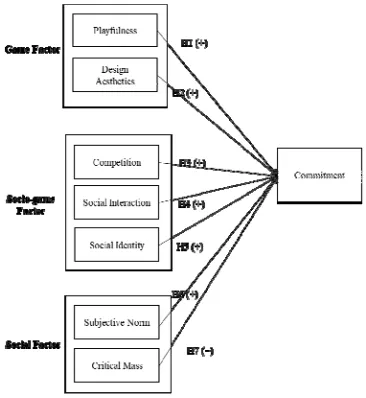
The purpose of this study is to investigate how gaming factors, socio-game factors, and social factors affect the immersion of users of social network games for those who have used social network games based on KakaoTalk, a mobile messenger in Korea.
The main element of the social network game is a game that combines social attributes. It is a mutually supportive and growing structure, and it has a strong infectivity due to its characteristics of inviting friends and enjoying it together. In addition, the game is constantly played through user interaction, and interaction between users is possible without accessing the game at the same time. Social property is a characteristic of social network game, and it is a base factor that not only enjoys pleasure and fulfillment by executing quests like general game and compensates accordingly, but also keeps motivation to be. Based on this research, this study aims to add social aspects of social network games as well as games.
[image:4.612.317.500.391.590.2]Based on the above literature review, following model is proposed figure 1.
Figure 1: Research Model
4. METHODS
818 users and Kakaotalk users in Korea. Most participants are university students because M-SNGs are the most popular game in twenties. Initial data was collected total of 197 participants from October to November, 2012. Second data was collected total of 190 participants from April to May, 2016.
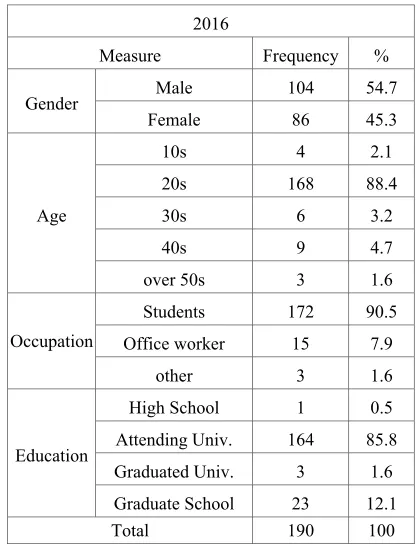
Table 1 summarized the profiles of the respondents for 2012. Table 2 summarized the profiles of the respondents for 2016 using SPSS 18.0. Table 1 showed that 50.3% of males and 49.7% of females participants. The age range of 57.4% in 20s, and 37.1% in 10s. In the occupation, 93.5% of students were the most. Table 2 showed that 54.7% of males and 45.3% of females participants. The age range of 88.4% in 20s. In the occupation, 90.5% of students were the most.
[image:5.612.320.529.114.388.2]Table 1. Results of demographic analysis for 2012
Table 2. Results of demographic analysis for 2016
4.1 Measurements
The questionnaires of game factors were developed from the literature [11, 15, 23]. The scale items for Socio-game factors were developed from Chang [8] and Lin et al. [14]. The scale items for Social factors were developed from Hsu and Lu [13]. Likert scale, ranging from “disagree strongly” (1) to “agree strongly” (7).
5. RESULTS
5.1 Measurement Model
The validity of the measure model is evaluated by investigating convergent validity, reliability and discriminant validity using SamrtPLS 3.0.
First, we evaluated the internal consistency reliability. The traditional standard for internal consistency is Cronbach’s alpha. The Cronbach's alpha value satisfies the reference value of 0.7 or more in both 2012 and 2016 models.
Second, composite reliability (CR) and average variance extracted (AVE) values were verified to evaluate convergent validity. The outer loading values of the indicators were also checked. In general, the outer loading value is 0.7 or more, and 2012
Measure Frequency %
Gender Male 99 50.3
Female 98 49.7
Age
10s 73 37.1
20s 113 57.4
30s 2 1.0
40s 3 1.5
over 50s 6 3.0
Occupation
Students 184 93.5 Office worker 4 2.0
others 9 4.5
Education
High School 77 39.1 Attending Univ. 109 55.3 Graduated Univ. 9 4.6 Graduate School 2 1.0
Total 197 100
2016
Measure Frequency %
Gender Male 104 54.7 Female 86 45.3
Age
10s 4 2.1
20s 168 88.4
30s 6 3.2
40s 9 4.7
over 50s 3 1.6
Occupation
Students 172 90.5 Office worker 15 7.9
other 3 1.6
Education
High School 1 0.5 Attending Univ. 164 85.8 Graduated Univ. 3 1.6 Graduate School 23 12.1
819 the CR value is 0.7 or more. The AVE value is 0.5 or more [24]. All criteria were met as in Appendix 1 and 2.
Finally, we tested the discriminant validity, whose purpose is to identify if the constructs differ from each other [24]. The square root of each construct AVE value must be greater than the highest correlation with other constructs by comparing the square root of each construct AVE value with the latent variable correlation. The results of the discriminant validity analysis are shown in Appendix 3 and 4.
5.2 Structural model
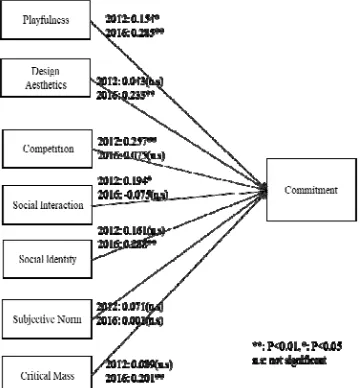
[image:6.612.90.272.335.529.2]Reliability and validity were verified through measurement model analysis and structural model analysis was conducted through Smart PLS 3.0. The results of the structural model analysis are shown in Figure 2 and Table 3.
Figure 2: The Results of Research Model
Table 3. Results of Hypotheses test
2012 2016
Path E.S p-Values E.S p-Values
PL->COM 0.154 0.020 0.285 0.000
DA->COM 0.043 0.531 0.233 0.004
CP->COM 0.257 0.000 0.075 0.338
SI->COM 0.194 0.022 -0.075 0.378
SO->COM 0.161 0.084 0.288 0.001
SN->COM 0.071 0.291 0.001 0.985
CM->COM 0.089 0.168 0.201 0.002
First, the results for the 2012 model are as follows. Playfulness affects commitment (b = 0.154) and competition has a positive impact on commitment (b = 0.257). Also, social interaction has an effect on commitment (b = 0.194). H1, H3 and H4 were supported.
Second, the results for the 2016 model can be summarized as follows. Four hypotheses were adopted among the seven hypotheses. Playfulness affected the commitment positively (b=0.285). Therefore, H1 was supported. Design Athletics affected the commitment positively (b=0.233) and H2 was supported. Social Identity affected the commitment positively (b=0.288). The effect of critical mass on commitment was statistically significant (b=0.201). Therefore, H7 was supported.
5.3 Multi-group Analysis
We use multi-group analysis with SmartPLS 3.0 and compare two models of different times (t1 and t2). The results of the multi-group comparison test indicated shown as Table 4. To verify whether the difference in path coefficient between groups is statistically significant, we performed the analysis using the formula proposed by Chin et al [25].
[image:6.612.90.285.554.726.2]The results showed that there was a significant difference between the two groups only in the two relationships. The impact of the engagement on the commitment was high in the 2012 M-SNG users, which was statistically significant. On the other hand, for users in 2016, there was no impact on the commitment. In addition, the path that social interaction affects commitment is statistically significant. In other words, it means that users felt stronger social interaction with M-SNG in 2012 than in 2016.
Table 4. Results of Multi-group Analysis
Path Path Coefficients-diff P-values
PL->COM 0.130 0.915
DA->COM 0.190 0.964
CP->COM 0.181 0.035
SI->COM 0.269 0.011
SO->COM 0.127 0.844
SN->COM 0.070 0.233
[image:6.612.317.520.557.710.2]820
6. DISCUSSION
The purpose of this study was to investigate the factors affecting commitment to M-SNG. We wanted to analyze the difference between 2012 when M-SNG was popular and 2016 when M-SNG was not popular. The analysis of structural model analysis is as follows.
First, Game Factors were stronger in 2016 than in 2012. Game factors include playfulness and Design Aesthetics. In both 2012 and 2016, playfulness has a positive impact on commitment. It seems that users play a more important role in the playfulness of M-SNG in 2016 than in 2012. Design Aesthetics was also adopted only in 2016. In recent years, users seem to be more immersed in games that take advantage of the game's own characteristics.
Second, Secondly, competition and social interaction were adopted in 2012 for socio-game factor, and only social identity was adopted in 2016. This shows that at the time of the M-SNG in 2012,
the interaction and competition between
acquaintances became important. On the other hand, in 2016, it is important that their game rank and game status in M-SNG is important.
Third, social factors were all rejected in 2012 and only critical mass was adopted in 2016. In the fortress's M-SNG game, it seems that the more users, the more immersed.
Finally, the difference between the groups by year was found only in Hypothesis 3 and Hypothesis 4. While competition and interaction between acquaintances were important at the time of M-SNG in 2012, M-SNG reflects that the two factors are rather unimportant in recent years as fashion disappears. Therefore, if we look at the results of the 2016 structural model, we need to focus on the structure and design elements of the game itself that can improve the quality of the game, induce it through marketing to make it more accessible to people, it means that you have to structure well.
In M-SNG games, users are able to send heart messages to each other. They often spend days and nights without heartbeat, and they often feel disagreeable, so interaction factors seem to be low. Mobile games have a much larger number of games released compared to the past, and the number of games played by users is relatively small. Users who have encountered various games have been choosing their favorite games based on their own experiences, and recently they are interested in mid-core games that require more time and effort than
casual games. So it seems that the socio-game factor is not affected in 2016.
7. CONCLUSIONS
This study has the following implications in terms of academic or practical. First, we studied commitment. It is significant that the factors that have the greatest influence on the commitment of M-SNG are identified. Second, the main determinants of commitment are 2012 and 2016, with significant differences in competition and social interaction. Recently, user feel that game factors are more important. Game production companies will need to consider factors to raise interest. Third, there are implications that the research model was created and empirically tested to understand the behavior of users on SNG. M-SNG companies have to develop an appropriate strategy based on the variables presented in this study.
However, the limitations of this study were to compare the year by the analysis of the difference between groups, and to look at from a long-term point of view that users in 2012 and users in 2016 are not the same. In addition, other demographic factors (gender, age, use experience, etc.) are also important factors but not analyzed in this study. Therefore, in future research, it is necessary to examine the demographic factors and the control factors or the difference between groups according to the game. In addition, it is also necessary to examine the various factors that can influence commitment.
ACKNOWLEGEMENT
This work was supported by the research grant of Pai Chai University in 2018.
REFERENCES:
[1]Wikipedia,
https://en.wikipedia.org/wiki/Social-network_game
[2]J.Y. Han, S.B. Lee, S.C. Lee, and Y.H. Suh,
“Effects of Social Factors and Game Factors on Commitment of Mobile Social Network Games”, Journal of the Korean Society for Quality
Management, Vol. 44, No.3, pp.601-616.
[3]E. J. Song, “Social Network Game”, NET Term,
2013
[4]A. Uysal, “Commitment to Multiplayer Online
821
Computers with Human Behavior, Vol.61, 2016,
pp. 357-363.
[5]D. L. Hoffman and T. P. Novak, Marketing in
Hypermedia Computer-Mediated Environments:
Conceptual Foundations”, Journal of Marketing,
Vol. 60, No. 3, 1996, pp.50-68.
[6]J.M. Kim, Y.J. Lee, and H.W. Lee, “Factors on
the Intention to Purchase Charged Items in
Mobile Social Network Game”, Journal for the
Korea Contents Association, Vol.14, 2014,
pp.165-178
[7] D.H. Min, and G.W. Oh, “A Characterization
of Game Elements for Monetization in Mobile
Social Game”, Korea Society for Computer
Game, Vol. 26, 2013, pp. 87-98.
[8]C.C. Chang, “Examining Users’ Intention to
Continue Using Social Network Games: A Flow
Experience Perspective”, Telematics and
Information, Vol.30, 2013, pp. 311-321.
[9]D.H. Shin and Y.J. Shin, “Why Do People Play
Social Network Games?”, Computers in Human
Behavior, Vol. 27, 2011, pp. 852-861
[10] E. Park, S. Baek, J. Ohm, and H.J. Chang,
“Determinants of Player Acceptance of Mobile Social Network Games: An Application of Extended Technology Acceptance Model”, Telematics and Informatics, Vol.31, 2013, pp. 3-15.
[11] D.H. Shin, “The Evaluation of User
Experience of The Virtual World in Relation to
Extrinsic and Intrinsic Motivation”,
International Journal of Human Computer Interaction, Vol.25, 2011, pp.530-533
[12] J.H. Chen, K.S. Shen, and M.Y. Ma, “The
Functional and Usable Appeal of Facebook SNS
Games”, Internet Research, Vol. 22, 2012, pp.
467-481
[13] C.L. Hsu, and H.P. Lu, “Why Do People Play
Online Games? An Extended TAM with Social
Influences and Flow Experience”, Information
& Management, Vol.41, 2004, pp. 853-868.
[14] H. Lin, Y. Wang, and C. Chou, “Hedonic a
nd Utilitarian Motivations for Physical Game Sy
stems Use Behavior”, International Journal of
Human-Computer Interaction, Vol.28, 2012, pp
. 445-455.
[15] J. Y. Moon, and Y. G Kim, "Extending the
TAM for a World-Wide-Web context.", Inform
ation & Management, Vol. 38, No. 4, 2001, pp. 217-230.
[16] V.H. Hans, "Factors Influencing the Usage
of Websites: the Case of a Generic Portal in Th
e Netherlands." Information & Management, Vo
l. 40, No. 6, 2003, pp. 541-549.
[17] D. Cyr, H. Milena, and I. Alex, "Design A
esthetics Leading to M-loyalty in Mobile Comm
erce.", Information & Management, Vol. 43, No
. 8, 2006, pp. 950-963.
[18] H-Y. Wang, and Y-S. Wang, “Gender Diff
erences in the Perception and Acceptance of On
line Games”, British Journal of Educational Tec
hnology, Vol. 39, 2008, pp. 787–806.
[19] K. Y. Lin, and H. P. Lu, “Why People Use
Social Networking Sites: An Empirical Study I ntegrating Network Externalities and Motivatio
n Theory.” Computer in Human Behavior, Vol.
27, No.3, 2011, pp. 1152-1161
[20] R.P. Bagozzi, and K.-H. Lee, “Multiple
Routes for Social Influence: the Role of
Compliance, Internalization, and Social
Identity”, Social Psychology Quarterly, Vol. 65,
2002, pp. 226-247
[21] H.C. Kelman, “Compliance, Identification,
and Internalization Three Processes of Attitude
Change”, The Journal of Conflict Resolution, V
ol.2, No. 1, 1958, pp. 51-60.
[22] T. Zhou, H. Li, and Y. Liu, “The Effect of
Flow Experience on Mobile SNS Users’ Loyalt y”, Industrial Management & Data Systems, Vo l. 110, No. 6, 2010, pp. 930-946.
[23] T. Zhou, “Understanding Online Communi
ty User Participation: A Social Influence Perspe
ctive”, Internet Research, Vol. 21, 2011, pp.
67-81
[24] J. F. Hair, C.M. Ringle, and M. Sarstedt, “
PLS-SEM: Indeed a Silver Bullet”, Journal of
Marketing Theory and Practice, Vol. 19, No. 2, 2011, pp.139-152.
[25] W.W. Chin, B.L. Marcolin, and P.R. Newste
d, “A Partial Least Squares Latent Variable Mo deling Approach for Measuring Interaction Effe cts: Results from a Monte Carlo Simulation Stu dy and an Electronic-Mail Emotion/Adoption St
udy.” Information Systems Research, Vol. 14, N
822
Appendix 1. The results of measurement model for 2012
b2012
Factors Indicators Estimate Cronbach Alpha CR AVE
Playfulness
PL1 0.890
0.887 0.930 0.815
PL2 0.923
PL3 0.894
Design Aesthetics
DA1 0.913
0.904 0.940 0.838
DA2 0.897
DA3 0.937
Competition
CP1 0.920
0.907 0.941 0.843
CP2 0.920
CP3 0.913
Social Interaction
SI1 0.922
0.905 0.941 0.841
SI2 0.942
SI3 0.886
Subjective Norm
SN1 0.894
0.889 0.931 0.818
SN2 0.919
SN3 0.900
Social Identity
SO1 0.947
0.924 0.952 0.868
SO2 0.924
SO3 0.924
Critical Mass
CM1 0.926
0.888 0.931 0.817
CM2 0.923
CM3 0.861
Commitment
COM1 0.897
0.907 0.942 0.844
COM2 0.947
823
Appendix 2. The results of measurement model for 2016
2016
Factors Indicators Estimate Cronbach Alpha CR AVE
Playfulness
PL1 0.884
0.830 0.895 0.741
PL2 0.797
PL3 0.897
Design Aesthetics
DA1 0.914
0.874 0.922 0.887
DA2 0.908
DA3 0.856
Competition
CP1 0.936
0.924 0.952 0.868
CP2 0.945
CP3 0.914
Social Interaction
SI1 0.918
0.897 0.936 0.830
SI2 0.946
SI3 0.869
Subjective Norm
SN1 0.837
0.872 0.922 0.797
SN2 0.923
SN3 0.916
Social Identity
SO1 0.963
0.957 0.972 0.921
SO2 0.967
SO3 0.949
Critical Mass
CM1 0.944
0.936 0.959 0.887
CM2 0.958
CM3 0.923
Commitment
COM1 0.937
0.916 0.947 0.856
COM2 0.943
824
Appendix 3. Results of discriminant validity in 2012
COM CP CM DA PL SO SI SN
COM 0.919
CP 0.471 0.918
CM 0.315 0.265 0.904
DA 0.350 0.304 0.266 0.916
PL 0.367 0.426 0.331 0.359 0.903
SO 0.450 0.355 0.276 0.301 0.165 0.932
SI 0.413 0.203 0.190 0.415 0.113 0.509 0.917
SN 0.345 0.213 0.192 0.287 0.131 0.500 0.455 0.905
Appendix 4. Results of discriminant validity in 2016
COM CP CM DA PL SO SI SN
COM 0.925
CP 0.491 0.932
CM 0.435 0.344 0.942
DA 0.482 0.395 0.250 0.893
PL 0.499 0.570 0.203 0.353 0.861
SO 0.499 0.421 0.405 0.339 0.240 0.960
SI 0.392 0.395 0.334 0.404 0.292 0.668 0.911