International Journal of Computer Applications (0975 – 8887) Volume 39– No.9, February 2012
A Modeling and Detection of Deadlock in Early
Stage of System using UML
Gufran Ahmad Ansari
College of Computer,
Department of Information Technology Qassim University, Saudi Arabia.
ABSTRACT
As we know there is an increasing demand from the software industry to develop software model which can communicate and exchange information concurrently in multiprogramming environment. This is very difficult to find and eliminate concurrency problem like deadlock in a large and complex system. There is a need of model to identify and recognize concurrency problem such as deadlocks in the early stage in system and design model to get rid of these kinds of problems. In this paper author proposed a UML model for detecting the concurrency in early stage of design system. The author has also proposed a sequence diagram, activity diagram and use case diagram for the above model.
Keywords
UML class model, Deadlock detection, Software, Concurrency
1. INTRODUCTION
Unified Modeling Language (UML) is a well-known software modeling language and it is accepted by the academia as well as by the software industry people. It has also become a standard language for software analysis and design [1]. The modeling is an advance way of thinking about the scientific research problems in a well organized manner in real-world ideas. Some important model systems are designed and explained in [2, 3, 4,]. UML is a combination of good engineering practices that has proved to be successful in modeling a software design of difficult or complex systems. Modeling is very helpful to understand the process of input and output of system [5]. Recently, Saxena & Ansari proposed a different UML models which are based on specific domain [6, 7, 8]. These models are very helpful to understand the “UML modeling and design concepts”. A lot of literature is available on modeling problems by the use of UML but limited research papers are available in literature to finding the deadlock in multiprogramming environment through UML applications. The deadlock is situation where a process or set
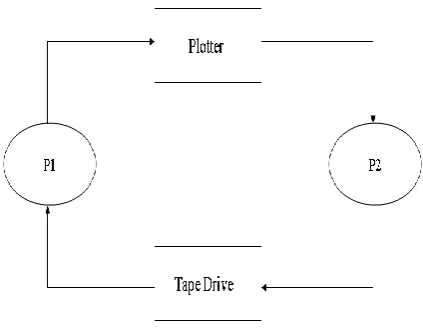
[image:1.595.322.534.269.433.2]of processes is blocked, waiting for some resources that is holded by some other process [9].
Fig. 1 Deadlock Situation
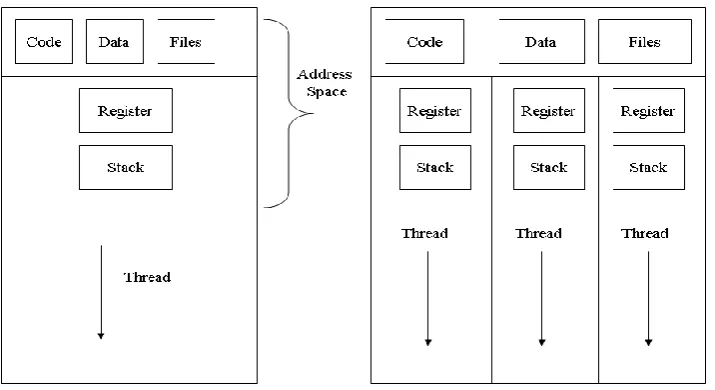
Fig. 2 Single and multi-thread processes
A thread is sometimes called as light weight process. Process is a dynamic entity that is a program in execution. A process is a sequence of instruction execution. Concurrency introduces the need for communication between executing threads, which is need to synchronize their operations and shared memory communication, which ensures that the shared resources are accessed individually and appropriately [12]. Monitoring and authentication usually consists of examination for communication faults such as deadlocks, infinite loops,
lovelocks and other communication pitfalls. As model-based software development practices are getting more popularity [13, 14], resource and communication deadlock models are considered in message communication systems. Most deadlock models in distributed systems are resource models [15, 16].The author proposed a model for the detection of concurrency problems that is based on design models expressed in UML [17].
1.1
UML Process
Process can be explained in the form of collection or block of instructions of program, macro subprogram or subroutine. To explain this process there is a need of processing elements.
The processing element are defined as stereotype and generally used to handle the concurrent processes. The given Fig. 3 shows the UML process and the processing unit.
(a) UML Process (b) Processing Unit Fig. 3 UML Process & Processing Unit
2.
UML
CLASS
MODEL
FOR
DETECTION OF DEADLOCK
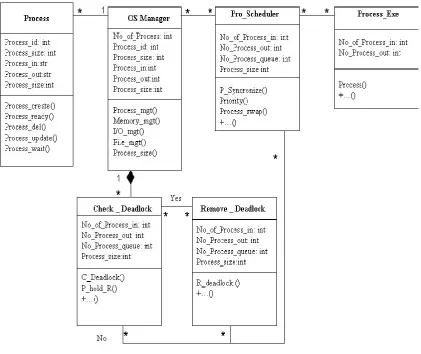
The class model for detection of deadlock in a system is designed with the help of UML concepts and is shown below in Fig. 4. The complete system for detection of deadlock is
International Journal of Computer Applications (0975 – 8887) Volume 39– No.9, February 2012
Fig. 4 UML Class Model for Deadlock Detection
The Process class is associated with OS Manager. Process class has multiple associations with OS Manager and OS Manager has a single association with the Process. Similarly OS Manager Class has a multiple association with Pre_Scheduler class and pre_Scheduler also have a multiple association with OS Manager. Check_Deadlock and Remove_Deadlock classes inherit from OS Manager. OS Manager Class has a single association with Check_Deadlock and Remove_Deadlock classes while Check_Deadlock and Remove_Deadlock classes have multiple associations with OS Manager Class. Check_Deadlock and Remove_Deadlock classes also have multiple associations. The Check_Deadlock and Remove_Deadlock classes also have multiple associations with Pre_Scheduler class and Pre_Scheduler classes also have multiple associations with Check_Deadlock and
Remove_Deadlock class. Process_Exe class has a multiple association with Pre_Scheduler class and Pre_Scheduler class also has multiple associations with Process_Exe class.
3. UML ACTIVITY DIAGRAM FOR
DETECTION OF DEADLOCK
Fig. 4 UML Activity Diagram for Deadlock Detection
According to the activity diagram a number of jobs want to run in a CPU. The operating systems manage all jobs which are willing to run. The operating system manager first check for the deadlock, if deadlock is found then first it removes deadlock and wait till the processes are not removed from resources which are holded by the other process. If the process is not holding any resource of the other process, then the process processed jobs and wait for the next job.
5.
SEQUENCE
DIAGRAM
FOR
DETECTION OF DEADLOCK
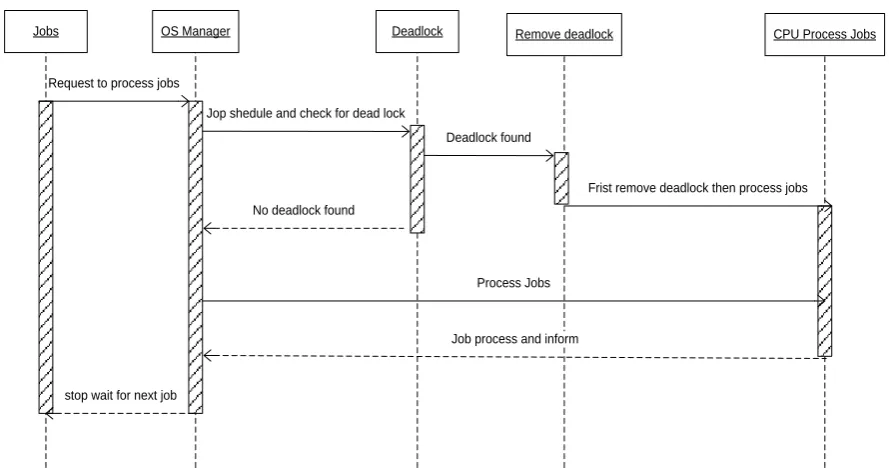
A sequence diagram is made up of objects and messages. The given sequence diagram below show the detection of deadlock in a system. It has five major objects which are shown on the top of the diagram through the rectangular box with the underlined class name. The five objects are jobs, OS Manager, Deadlock, Remove deadlock and CPU Process Jobs.
Jobs OS Manager
Request to process jobs
Deadlock
Jop shedule and check for dead lock
Remove deadlock CPU Process Jobs
Deadlock found
Frist remove deadlock then process jobs
No deadlock found
Process Jobs
Job process and inform
[image:4.595.78.523.499.735.2]International Journal of Computer Applications (0975 – 8887) Volume 39– No.9, February 2012
The communication of information between two objects is represented by an arrow and the massages on that arrow. In a sequence diagram an object is shown at the top of the diagram with underline and vertical lines shows the life of the object. According to the sequence diagram a number of jobs requests OS Manager to execute? OS Manager schedules all jobs and checks for the deadlock. If any process is holding the resources of the other process, then first free the resources of other processes and then jobs can be executed other wise it can not be executed, it goes in deadlock situation. If process is not holding the resources of other jobs, then OS Manger sends to execute a job and waits for the next jobs.
6. CONCLUSION
From the above work it is concluded that UML is a powerful modeling language which is used to represent the scientific research problem. In this paper author has done a complete modeling for finding out the deadlock situation in a system. The UML model is very efficient and useful for the software developers who develop high quality software’s and avoids the deadlock situation in a system. This UML model is flexible and easily extendible.
7
.
ACKNOWLEDGEMENTS
Author is very grateful to Prof. Dr. Khaled Bin Abdul Rahman Al Hamoudi, Rector of the Univesity and Dean College of Computer Qassim University Saudi Arabia for providing the excellent and tremendous research facility in the College of Computer.
8. REFERENCES
[1] G., Booch, J.Rumbaugh, and I Jacobson. 1999. “The Unified Modelling Language User Guide”, Addison-Wesley, Reading, MA.
[2] Grady Booch. 1994. "Object-Oriented Analysis and Design with Applications", second Edition, Addison-Wesley.
[3] Graig Larman 1998. "Applying UML and Pattern" Prentice Hall.
[4] Ansari, G.A., “A Domain Oriented Modeling of Indian Education System through UML” the Icfai Journal of Systems Management (IJSM) (ICFAI Press India), Vol. VIII; No.3; August, 2010.
[5] Lieberherr, K., Holland, I., and. Rie, Al. “Object-oriented programming: An objective sense of style”, Proc. OOPSLA’88 as ACMSIGPLAN 23, 11, pp.323–33.1198.
[6] V. Saxena and G. A. Ansari,“ UML Modeling & Protection of Domain Based System”, International Journal of Computer Science and Network Security (IJCSNS), Vol. 8, No. 7, pp.338-344.,2008.
[7] V. Saxena and Ansari, G.A. “ UML Modeling for Patient
Registration System” International Conference on Quantitative Methods, Operations and Information Technology for Managerial Decision Making ICQMOIT-2008, 24-25 Oct. at IBS, Hyderabad, India,2008.
[8] V. Saxena and Ansari, G.A.,Ajay Pratap. “Enhancing Security through UML”, International Journal of Computer Sciences, Software Engineering and Electrical Communication Engineering".Vol.2,(1), pp 31-36, 2011.
[9] A. Silberschatz, et. all 2008. “Operating System Concepts”. John Wiley India Pvt., Ltd. 6th
edition.
[10] Downey, A. B.2008. The Little Book of Semaphores,. Green Tea Press, 2nd Edition.
[11] Crowley. 2006 “Operating Systems: A Design-Oriented Approach” Tata McGraw – Hill.
[12] Pender, T.2003 UML Bible, Wiley.
[13] Object Management Group (OMG) 2007. "UML 2.1.1, Superstructure Specification".
[14] Nariman Mani, Vahid Garousi, Behrouz H. Far “Monitoring Multi-Agent System for Deadlock Detection Based on UML Models” 978-1-4244-1643-1/08, IEEE, 2008.
[15] V.Gligor and S. Shattuck "Deadlock detection in distributed systems," IEEE Trans. Soft. Eng. pp. 435-440, 1980.
[16] K. M. Chandy, J.Misra .and L. M. Haas." Distributed Deadlock Detection."ACM Trans. on Computer Systems, vol. 1, pp. 144-156, 1983.
[17] OMG 2005. UML Profile for schedulibility, Performance and Time Specification. Adopted Specification http://www.omg.org/docs/formal/05-01-02.pdf