ISSN(Online): 2319-8753 ISSN (Print): 2347-6710
I
nternational
J
ournal of
I
nnovative
R
esearch in
S
cience,
E
ngineering and
T
echnology
(An ISO 3297: 2007 Certified Organization)
Vol. 5, Issue 6, June 2016
DWT based Novel Image Denoising by
Exploring Internal and External Correlation
Arun Kumar.R1, Sakthidasan.K2, Balasubramanian. T3
PG Scholar, Dept of ECE, Adhiparasakthi Engg College, Melmaruvathur, India 1&3,
Assistant Professor, Dept of ECE, Adhiparasakthi Engg College, Melmaruvathur, India2
ABSTRACT: Removing noise from the original image is still a challenging problem for researchers. In this paper, we build the internal and external data cubes to finding the similar patches from the noisy and web images respectively. We proposed two-stages using different filtering approaches for reducing noise. By combining the internal and external de-noising patches, we obtain a preliminary de-noising result. In the second stage, we propose reducing noise by filtering of external and internal cubes, respectively, on transform domain. In this stage, the preliminary de-noising result not only enhances the patch matching accuracy but also provides reliable estimates of filtering parameters. The final de-noising image is obtained by fusing the external and internal filtering results process. The proposed system shows the obsolete de-noising results with the accurate measurements, and its compared with existing BM3D result, Low-rank based result, EPLLg result, EPLLs .
KEYWORDS: Image de-noising, external correlations, internal correlations, Discrete wavelet transforms (DWT)
I. INTRODUCTION
Digital image plays an important role in our daily life and in the area of research and technology. When the digital image is transmitted from one place to another place, during the transmission noise is added into the image. Any form of signal processing having image as an input and output is called image processing. Image processing is a method to perform some operations on an image, in order to get an enhanced image or to extract some useful information from it. It is a type of signalprocessing in which input is an image and output may be image or characteristics/features associated with that image [1-3]. There are two types of methods used for image processing namely, analogue and digital image processing.The purpose of image processing is divided
into 5 groups. They are Visualization, Image sharpening and restoration, Image retrieval, Measurement of pattern, Image Recognition.
ISSN(Online): 2319-8753 ISSN (Print): 2347-6710
I
nternational
J
ournal of
I
nnovative
R
esearch in
S
cience,
E
ngineering and
T
echnology
(An ISO 3297: 2007 Certified Organization)
Vol. 5, Issue 6, June 2016
In this paper Section II describes the related work. Section III illustrate the results and discussions. Section IV concludes the paper.
II. RELATED WORK
De-An Huanget al [6], have proposed novel self-learning based image decomposition framework. Based on the recent success of sparse representation, the proposed framework first learns an over-complete dictionary from the high spatial frequency parts of the input image for reconstruction purposes.
Madison Gray McGaffin et al [7] have proposed image de-noising algorithms for edge preserving regularization that play to the strengths of GPUs, the exemplar of this parallelism trend. By avoiding operations like inner products or complex preconditioners and minimizing memory usage, the proposed GCD algorithms provide impressive convergence rates. The additional increase in performance provided by Nesterov’s first-order acceleration is exciting.
Xianhua Zeng et al [10], have proposed a two-dimensional image de-noising model, namely, the Dictionary Pair Learning (DPL) model, and we design a corresponding algorithm called the Dictionary Pair Learning on the Grassmann-manifold (DPLG) algorithm.
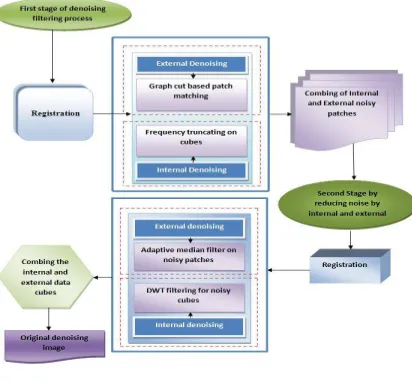
Fig. 1. Proposed Method
Given a noise free image
P
0 (the superscript o denotes original), its noisy versionP
is produced asN
P
P
0
(1)Where N is the additive zero-mean independent identically distributed (i.e.) Gaussian noise with variance
2. We aim to recover, the estimated noise free version of P, with the help of web images.ISSN(Online): 2319-8753 ISSN (Print): 2347-6710
I
nternational
J
ournal of
I
nnovative
R
esearch in
S
cience,
E
ngineering and
T
echnology
(An ISO 3297: 2007 Certified Organization)
Vol. 5, Issue 6, June 2016
A. Correlated Image Retrieval and Registration
The local features such as SIFT are usually of different scales and overlapped with each other. We believe the inclusion relationship among local features provides a natural way to construct visual phrases for geometric verification.Previous learning based de-noising methods ignore content priors in a noisy image, which limits improvement in de-noising performance. Therefore, we adopt content-based image retrieval technology, specifically the scale invariant feature transform (SIFT) based method proposed in to retrieve correlated images from a large-scale database, as our external dataset. Since a large scale SIFT feature may cover multiple small scale SIFT features. After matching all the visual groups extracted from the noisy image with those extracted from candidate images, we obtain a set of correlated images
}
P
,...,
P
,
P
{
1r 2r kr .For more details; please refer to [26]. Note that, to reduce the impact of noise in feature extraction, we discard some key-points with low contrast.B. Graph Based Optimization Method-External De-Noising using Baseline Method:
An intuitive method is to use
2 distances as the matching criterion. Lett
i
x
i,
y
i,
z
i
be the translation vector (in col, row, and image number directions) of thet
i patch from the noisy image to the reference images. We want to find the optimal translation for each patch by minimizing the following function:)),
(
,
(
E(t)
i ii
t
Y
X
D
(2)Where
D
(
X
i,
Y
(
t
i))
is
2 distance of patch Pi and the candidate patch Q with translationt
i . Note that the mean values of all the candidate patches and the noisy query have been removed to reduce illumination effect.The translation vectors are obtained by minimizing the following energy function:
) , ( )) ( , ( ) ( ) , ( j N j i i
iD Xi Y ti S t t
t
E
(3)
Where
D
(
X
i,
Y
(
t
i))
is the same as that defined in Eq. 3S
(
t
i,
t
j)
is the smoothness term, β is a weighting parameter to adjust the effect of the smooth constrain and (i, j) ∈ N denotes that theI
thandj
thpatch are neighboring patches. In this paper, N is a four connected grid. The smooth term S penalizes the differences of neighboring translation vectors,defined as
0 ), , 1 min( , 1 2
)
,
(
titj ifzizjj i
t
t
S
(4)
C. Second Stage Reducing Noise by Filtering Process
The first stage de-noising result
I
1st has greatly reduced the noise. Therefore it could help to improve the de-noising performance in the second stage. A similar strategy is proposed in BM3D [2] and have achieved significant gain compared with the first stage noising result. In this section, we will first introduce Wiener filtering in image de-noising, and then apply it to our internal and external de-noising scheme.D. De-Noising by Dwt Process
ISSN(Online): 2319-8753 ISSN (Print): 2347-6710
I
nternational
J
ournal of
I
nnovative
R
esearch in
S
cience,
E
ngineering and
T
echnology
(An ISO 3297: 2007 Certified Organization)
Vol. 5, Issue 6, June 2016
wavelet functions whereas wavelets have an associated scaling function
(
t
)
and wavelet function
(
t
)
. The set ofscaling functions can be written as
(
t
)
[
1(
t
),
2(
t
),...
r(
t
)]
T, where
(
t
)
is called the multi scaling function. Likewise, the Multi wavelet function is defined from the set of wavelet functions asT
r
t
t
t
t
)
[
(
)
(
)...
(
)]
(
1
2
.Where,
T
is denoted as the vector response and r can be arbitrarily large (where r=2) [31]. The multi wavelet relation of low pass filter and high pass filter is as follows.(5)
(6)
Where,
H
kis the low pass filter coefficient andG
kis the high pass filter coefficient. The speed error of the IPMSM drive system is applied as an input to the multi wavelet network, so that the error gets decomposed. In multi wavelet transform, the decomposition produces --two low-pass sub-bands, two high-pass sub-bands and two sets of wavelet coefficients for the each level of decomposition. This transformation detects and extracts disturbance features in the form of low and high frequency information. Multi scaling functions and Multi wavelet functions available in multi wavelets led to better decomposition of error in each level of decomposition.E. De-Noising by Exploring External Correlations
The noise in ~
I
1stis assumed to be greatly attenuated. Therefore, for each patch ~
P
1stin ~
I
1st, we can directly retrieve
its k2-NN patches
{
Q
1,
Q
2,...,
Q
k}
from the external image set{
P
1r,
P
2r,...,
P
kr}
using the baseline method described in Sec. V-A. These patches{
q
1r,
q
2r,...,
q
rk}
(in vector format) can be regarded as sample realizations of0
P
Note that DC components of{
q
1,
q
2,...,
q
k}
and p are removed before patch matching to reduce illumination effects. Therefore, the matrix R is estimated as:III. RESULT AND DISCUSSION
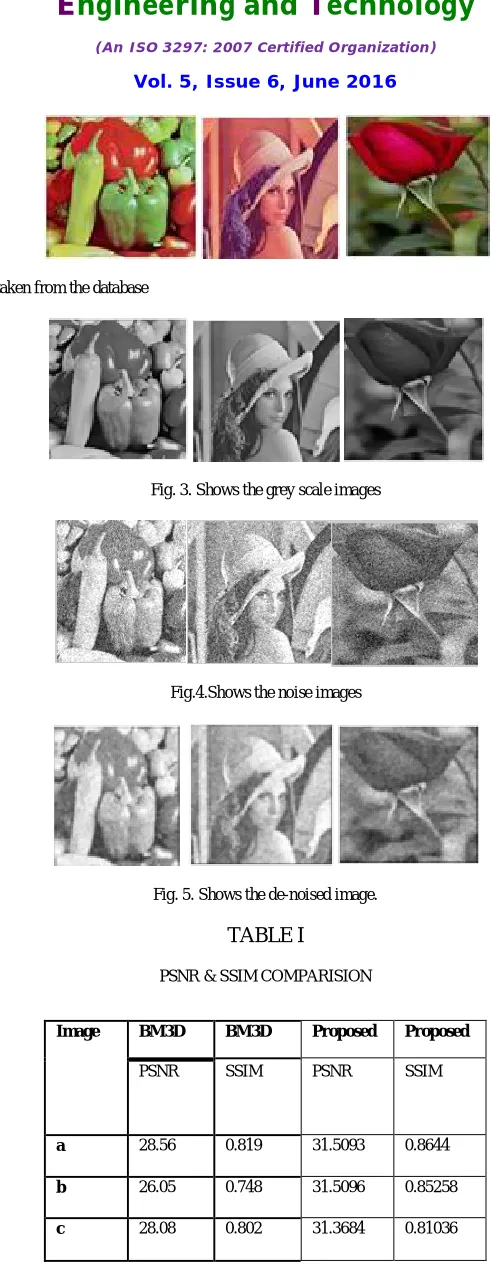
Our proposed DWT method performance is analyzed by comparing the existing technique such as BM3D, LOW RANK, EPLLg and EPLLs with our proposed technique. The sample image which is utilized in the image de-noising is given below in figure 2 to figure 5.the PSNR value of the proposed DWT based de-noising technique is compared with the existing BM3D, Low-rank, EPLLg, EPLLs.
10
(
2
)
2
)
(
nk
R
kt
k
t
10
(
2
)
2
)
(
nk
L
kt
k
ISSN(Online): 2319-8753 ISSN (Print): 2347-6710
I
nternational
J
ournal of
I
nnovative
R
esearch in
S
cience,
E
ngineering and
T
echnology
(An ISO 3297: 2007 Certified Organization)
Vol. 5, Issue 6, June 2016
Fig. 2.Shows the sample images taken from the database
Fig. 3. Shows the grey scale images
Fig.4.Shows the noise images
Fig. 5. Shows the de-noised image.
TABLE I
PSNR & SSIM COMPARISION
From the table it has been shown that the PSNR value of the proposed technique is higher than the existing techniques.
Image BM3D BM3D Proposed Proposed
PSNR SSIM PSNR SSIM
a 28.56 0.819 31.5093 0.8644
b 26.05 0.748 31.5096 0.85258
ISSN(Online): 2319-8753 ISSN (Print): 2347-6710
I
nternational
J
ournal of
I
nnovative
R
esearch in
S
cience,
E
ngineering and
T
echnology
(An ISO 3297: 2007 Certified Organization)
Vol. 5, Issue 6, June 2016
Similarly the SSIM values of the proposed dwt and existing BM3D method was compared.
The SSIM value of the proposed techniques gives higher performance ratio than the existing technique
IV. CONCLUSION
We have proposed two stages of different filtering approaches. In the first stage external de-noising part, a graph-cut based patch matching accuracy. The internal de-noising part is performed on similar noisy patches by filtering in the transform domain. In the second stage reducing noise by filtering process. Then, to improve the second stage de-noising result; we have proposed DWT for filtering on noisy cubes in internal de-de-noising. By combining the internal and external de-noising patches, we obtain the final de-noising result. The experimental results demonstrate that our proposed de-noising method achieve competitive performance than other existing methods.
REFERENCES
[1] Daniel J. Strauss, Tanja Teuber, Gabriele Steidl, Farah I. Corona–Strauss, “Exploiting the Self–Similarity in ERP Images by Nonlocal Means for Single–Trial Denoising”, IEEE Transactions, 2015.
[2] Camille Sutour, Charles-Alban Deledalle, and Jean-François Aujol, “Adaptive Regularization of the NL-Means: Application to Image and Video Denoising”, IEEE transactions on image processing, vol. 23, no. 8,2014.
[3] Linlin Xu, Jonathan Li, “SAR Image Denoising via Clustering-Based Principal Component Analysis”, IEEE transactions on geoscience and
ISSN(Online): 2319-8753 ISSN (Print): 2347-6710
I
nternational
J
ournal of
I
nnovative
R
esearch in
S
cience,
E
ngineering and
T
echnology
(An ISO 3297: 2007 Certified Organization)
Vol. 5, Issue 6, June 2016
[4] Linlin Xu, Fan Li, Alexander Wong, David A. Clausi ,“ Hyperspectral Image Denoising Using a Spatial–Spectral Monte Carlo Sampling Approach”, IEEE journal of selected topics in applied earth observations and remote sensing, vol. 8, no. 6, june 2015.
[5] Xuande Zhang, Xiangchu Feng, and Weiwei Wang, " Two-Direction Nonlocal Model for Image Denoising”, IEEE transactions on image processing, vol. 22, no. 1, 2013.
[6] De-An Huang, Li-Wei Kang, Yu-Chiang Frank Wang, “Adaptive Regularization of the NL-Means: Application to Image and Video Denoising”, IEEE transactions on image processing, vol. 23, no. 8,2014.
[7] Madison Gray McGaffin, d Jeffrey A. Fessler, “Edge-Preserving Image Denoising via Group Coordinate Descent on the GPU”, IEEE
transactions on image processing, vol. 24, no. 4, november 2015.
[8] Ling Shao, Ruomei Yan, Xuelong Li, Fellow, Yan Liu “From Heuristic Optimization to Dictionary Learning: A Review and Comprehensive Comparison of Image Denoising Algorithms”, IEEE transactions on cybernetics, vol. 44, no. 7, 2014.
[9] Wangmeng Zuo, Lei Zhang, and Weiwei Wang, Chunwei Song, David Zhang " Gradient Histogram Estimation and Preservation for Texture Enhanced Image Denoising”, IEEE transactions on image processing, vol. 23, no. 6, 2014