doi:10.1155/2010/808403
Research Article
Parameter Identification and
Synchronization of Dynamical System by
Introducing an Auxiliary Subsystem
Haipeng Peng,
1, 2, 3Lixiang Li,
1, 2, 3Fei Sun,
1, 2, 3Yixian Yang,
1, 2, 3and Xiaowen Li
11Information Security Center, State Key Laboratory of Networking and Switching Technology,
Beijing University of Posts and Telecommunications, P.O. Box 145, Beijing 100876, China
2Key Laboratory of Network and Information Attack and Defence Technology of Ministry of Education,
Beijing University of Posts and Telecommunications, Beijing 100876, China
3National Engineering Laboratory for Disaster Backup and Recovery, Beijing University of
Posts and Telecommunications, Beijing 100876, China
Correspondence should be addressed to Lixiang Li,li [email protected]
Received 23 December 2009; Revised 27 April 2010; Accepted 29 May 2010
Academic Editor: A. Zafer
Copyrightq2010 Haipeng Peng et al. This is an open access article distributed under the Creative Commons Attribution License, which permits unrestricted use, distribution, and reproduction in any medium, provided the original work is properly cited.
We propose a novel approach of parameter identification using the adaptive synchronized observer by introducing an auxiliary subsystem, and some sufficient conditions are given to guarantee the convergence of synchronization and parameter identification. We also demonstrate the mean convergence of synchronization and parameters identification under the influence of noise. Furthermore, in order to suppress the influence of noise, we complement a filter in the output. Numerical simulations on Lorenz and Chen systems are presented to demonstrate the effectiveness of the proposed approach.
1. Introduction
PEcondition 11,15or linear independence LIconditions 10, should be matched to guarantee that the estimated parameters converge to the true values12.
In the following, we explore a novel method for parameter estimation by introducing an auxiliary subsystem in adaptive synchronized observer instead of Lyapunov’s direct method and LaSalle’s principle. It will be shown that through harnessing the auxiliary subsystem, parameters can be well estimated from a time series of dynamical systems based on adaptive synchronized observer. Moreover, noise plays an important role in parameter identification. However, little attention has been given to this point. Here we demonstrate the mean convergence of synchronization and parameters identification under the influence of noise. Furthermore, we implement a filter to recover the performance of parameter identification suppressing the influence of the noise.
2. Parameter Identification Method
In the master-slave framework, consider the following master system:
˙
xiθifix gix, i1,2, . . . , n, 2.1
where x x1, x2, . . . , xn is the state vector, θi is the unique unknown parameter to be
identified, and fi, gi : Rn → R are the nonlinear functions of the state vector xin the ith
equation.
In order to obtain our main results, the auxiliary subsystem is needed
˙
γ−Lγ fx, 2.2
whereLis a positive constant.
Lemma 2.1. Iffxis bounded and does not converge to zero ast → ∞, then the stateγof system
2.2is bounded and does not converge to zero, whent → ∞.
Proof. Iffxis bounded, we can easily know thatγ is bounded16. We suppose that the stateγ of system2.2converges to zero, whent → ∞. According to LaSalle principle, we have the invariant set γ 0, then ˙γ 0; therefore, from system2.2, we get fx → 0 ast → ∞. This contradicts the condition thatfxdoes not converge to zero ast → ∞. Therefore, the stateγdoes not converge to zero, whent → ∞.
Based on observer theory, the following response system is designed to synchronize the state vector and identify the unknown parameters.
Theorem 2.2. If Lemma 2.1 holds, then the following response system 2.3 is an adaptive synchronized observer for system2.1, in the sense that for any set of initial conditions,yi → xi andθi → θiast → ∞.
˙
yigix fixθi
yi−xi
−Li−kiγi2t
,
˙
θikiγit
xi−yi
,
˙
γit −Liγi fix,
whereyi,θiare the observed state and estimated parameter ofxiandθi, respectively, andkiandLiare positive constants.
Proof. From system2.3, we have
˙
yigix fixθi
yi−xi
−Li γitθ˙i. 2.4
Leteiyi−xi,θiθi−θi,wit eit−θiγit, and note that ˙θi0; then
˙
wit −Liei fixθi γitθ˙i−γ˙itθi−γitθ˙i −Li
wit γitθi
fixθi−γ˙itθi
−Liwit θi
−Liγit fix−γ˙it
.
2.5
Sinceγitis generated by2.3, then
˙
wit −Liwit. 2.6
Obviously,wit → 0 ast → ∞.
From ˙θikiγitxi−yiand ˙θi0, we have
˙
θiθ˙i−θ˙i −kiγitei
−kiγit
wit γitθi
.
2.7
Let us focus on the homogeneous part of system2.7, which is
˙
θi −kiγi2tθi. 2.8
The solution of system2.8isθit θi0e−
t
0kiγi2sds. From the lemma, we know thatγit
does not converge to zero. According to Barbalat theorem, we have0tkiγi2sds → ∞ast → ∞; correspondingly,θi → 0 ast → ∞, that is, the system ˙θi −kiγi2tθi is asymptotically
stable.
Now from the exponential convergence of wit in system 2.6 and asymptotical
convergence of θi in system 2.8, we obtain that θi in system 2.7 are asymptotical
convergent to zero.
Finally, fromwit → 0,θit → 0, andγitbeing bounded, we conclude thatei
wi γiθ → 0 are global asymptotical convergence.
The proof ofTheorem 2.2is completed.
Note 1. Whenfix 1 andθiis the offset, in this condition no matterxis in stable, periodic,
Note 2. When the system is in stable state, parameter estimation methods based on adaptive synchronization cannot work well10. For this paper, when the system is in stable state, such thatfix → 0 ast → ∞, which leads to the lemma not being hold, so system2.3cannot be
directly applied to identify the parameters. Here, we supplement auxiliary signalsiin drive
system2.1, such thatfixdoes not converge to zero ast → ∞. Then the master system
becomes
˙
xiθifix gix si, 2.9
and the corresponding slave system can be constructed as
˙
In doing so, synchronization of the system and parameters estimation can be achieved.
3. Application of the Above-Mentioned Scheme
To demonstrate and verify the performance of the proposed method, numerical simulations are presented here. We take Lorenz system as the master system17, which is described by
˙
where the parametersa,b, andcare unknown, and all the states are measurable. Whena10,
b28,c8/3, Lorenz system is chaotic.
We construct the slave systems as follows:
0 2 4 6 8 10 12 14 16 18 20
−40
−30
−20
−10
0 10 20 30 40 50 60
t
f1 ,f2 ,f3
a
0 2 4 6 8 10 12 14 16 18 20
−40
−30
−20
−10
0 10 20 30 40 50 60
t
a
,
b
,
c
b
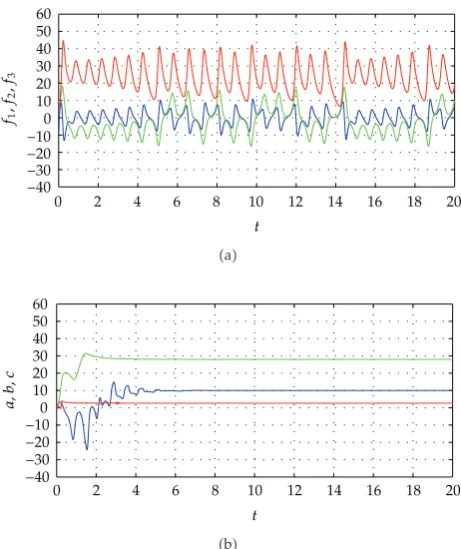
Figure 1:aThe curves off1, f2, f3 x2−x1, x1, x3;bIdentified results ofa,b,cversus time.
When the Lorenz system is in chaotic state, all states off1, f2, f3 x2−x1, x1, x3
are not convergent to zero ast → ∞seeFigure 1a. Then according toTheorem 2.2, we realize that not only the synchronization can be achieved but also the unknown parameters
a,b, andccan be estimated at the same time.
Figure 1ashows the curves off1, f2, f3 x2−x1, x1, x3. All parametersa10,
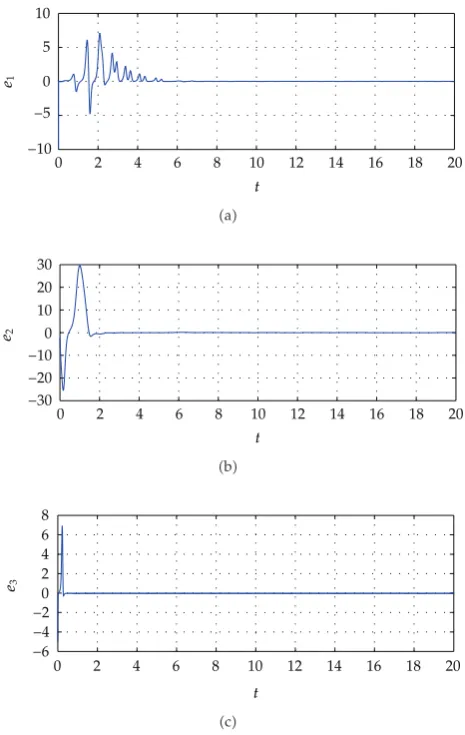
b 28, andc 8/3 are estimated accurately and depicted inFigure 1b. Figures2a–2c
display the results of synchronization for systems3.1and3.2, where the initial conditions of simulation arex10, x20, x30 10,2,5,k1, k2, k3 100,1,10, andy10 y20
y30 0, L1L2L31.
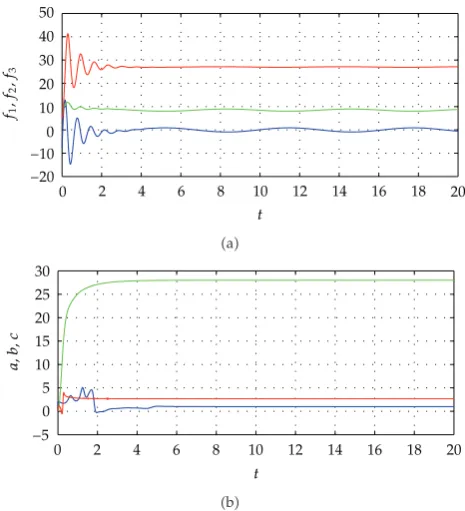
When a 1,b 28, andc 8/3, the states of Lorenz system are not chaotic but convergent to a fixed point.Figure 3ashows the curves off1, f2, f3 x2−x1, x1, x3. In
this case, as displayed inFigure 3a,f1 x2−x1convergence to zero ast → ∞.Figure 3b
depicts the estimated results of parametersa,b, andc. From Figure 3b, we can see that parameters b 28, and c 8/3 have been estimated accurately. However, the parameter
a1 cannot be estimated well. According to the analysis of Note2, we add an auxiliary signal
ssintin the first subsystem of master system3.1and we obtain ˙x1 ax2−x1 sint,
such that all states of f1, f2, f3 x2 −x1, x1, x3do not converge to zero as t → ∞.
The curves ofx2−x1, x1, x3 are shown inFigure 4a. Correspondingly, we add signal
s sintin the first subsystem of slave system3.2and we have ˙y1 x2−x1a y1 −
x1−L1 k1γ12t sint; then all parameters a 1, b 28, andc 8/3 are estimated
0 2 4 6 10 12 14 16 18 20
−10
−5
10
0 5
t
e1
8
a
0 2 4 6 8 10 12 14 16 18 20
−30
−20
−10
0 10 20 30
t
e2
b
0 2 4 6 8 10 12 14 16 18 20
−6
−4
−2
0 2 4 6 8
t
e3
c
Figure 2:aThe curve ofe1;bThe curve ofe2;cThe curve ofe3.
In recent years, more novel chaotic systems are found such as Chen system18, L ¨u system19, and Liu system20. Let us consider the identification problem for Chen system. We take Chen system as the master system, which is described by
˙
x1ax2−x1,
˙
x2bx2 x1−ax1−x3x1,
˙
x3x1x2−cx3,
3.3
where the parametersa,b, andcare unknown, and all the states are measurable. Whena35,
We construct the slave systems as follows:
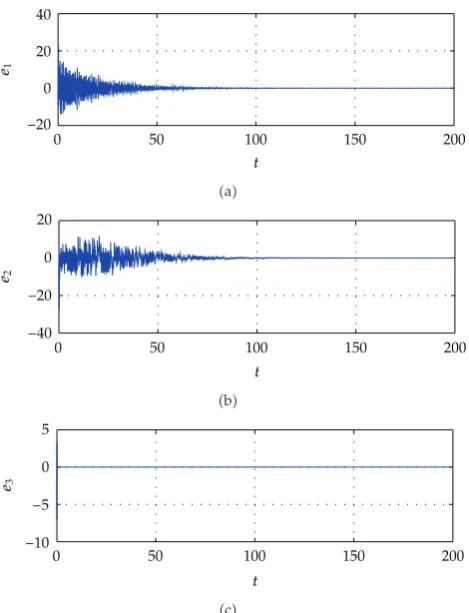
Figures5and6show the synchronization error and identification results, respectively, and where x10, x20, x30 1,3,7,k1, k2, k3 1,2,3, and y10, y20, y30 0,0,0,L1, L2, L3 3,5,7.
From the simulation results of Lorenz and Chen system above, we can see that the unknown parameters could be identified. It indicates that the proposed parameter identifier in this paper could be used as an effective parameter estimator.
4. Parameter Identification in the Presence of Noise
Noise plays an important role in synchronization and parameters identification of dynamical systems. Noise usually deteriorates the performance of parameter identification and results in the drift of parameter identification around their true values. Here we consider the influence of noise. Suppose that there are addition noise in drive system2.1.
˙
xiθifix gix ηi, i1,2, . . . , n, 4.1
whereηiis the zero mean, bounded noise.
0 50 100 150 200
−20
0 20 40
t
e1
a
0 50 100 150 200
−40
−20
0 20
t
e2
b
0 50 100 150 200
−10
−5
0 5
t
e3
c
Figure 5:The curves ofe1,e2, ande3.
We have ˙wi−Liwit ηi; then
dEwi
dt −LiEwit E
ηi
,
dEθi
dt E
−kiγitwi
E−kiγi2θi
,
4.3
ηiis independent tofix, gix, andγit, and note thatEηi 0; then
dEwi
dt −LiEwit,
dEθi
dt −kiγit
Ewi γitE
θi
.
4.4
0 50 100 150 200
−10
0 10 20 30 40
t a
a
0 50 100 150 200
0 5 10 15 20 25 30
t b
b
0 50 100 150 200
0 1 2 3
0.5 1.5 2.5 3.5
t c
c
Figure 6:Identified results ofa,b,cversus time.
FromTheorem 4.1, we know that thatEθi → 0 ast → ∞, which means that the
estimated values for unknown parameters will fluctuate around their true values. As an illustrating example, we revisit the Lorenz system3.1and its slave systems3.2, and we assume all the subsystems3.1are disturbed by uniformly distributed random noise with amplitude ranging from−100 to 100.Figure 7ashows that the estimated parametersa,b, andcfluctuate around their true values.
To suppress the estimation fluctuation caused by the noise, it is suitable to use mean filters. Here we introduce the following filter:
θ
t 0θsds
t . 4.5
0 5 10 15 20
−5
10 15 20 25 30
0 5
t
a
,
b
,
c
a
0 5 10 15 20
−5 10 15 20 25 30
0 5
t
a
,
b
,
c
b
Figure 7:aIdentified results ofa,b,cin presence of noises;bIdentified results ofa,b,cin presence of
noises and with filters.
5. Conclusions
In this paper, we propose a novel approach of identifying parameters by the adaptive synchronized observer, and a filter in the output is introduced to suppress the influence of noise. In our method, Lyapunov’s direct method and LaSalle’s principle are not needed. Considerable simulations on Lorenz and Chen systems are employed to verify the effectiveness and feasibility of our approach.
Acknowledgments
Thanks are presented for all the anonymous reviewers for their helpful advices. Professor Lixiang Li is supported by the National Natural Science Foundation of China Grant no. 60805043, the Foundation for the Author of National Excellent Doctoral Dissertation of PR ChinaFANEDD Grant no. 200951, and the Program for New Century Excellent Talents in University of the Ministry of Education of ChinaGrant no. NCET-10-0239; Professor Yixian Yang is supported by the National Basic Research Program of China973 Program Grant no. 2007CB310704and the National Natural Science Foundation of ChinaGrant no. 60821001.
References
1 L. M. Pecora and T. L. Carroll, “Synchronization in chaotic systems,”Physical Review Letters, vol. 64, no. 8, pp. 821–824, 1990.
3 A. Maybhate and R. E. Amritkar, “Dynamic algorithm for parameter estimation and its applications,” Physical Review E, vol. 61, pp. 6461–6470, 2000.
4 C. Tao, Y. Zhang, G. Du, and J. J. Jiang, “Estimating model parameters by chaos synchronization,” Physical Review E, vol. 69, Article ID 036204, 5 pages, 2004.
5 H. D. I. Abarbanel, D. R. Creveling, and J. M. Jeanne, “Estimation of parameters in nonlinear systems using balanced synchronization,”Physical Review E, vol. 77, no. 1, Article ID 016208, 14 pages, 2008.
6 D. Ghosh and S. Banerjee, “Adaptive scheme for synchronization-based multiparameter estimation from a single chaotic time series and its applications,”Physical Review E, vol. 78, Article ID 056211, 5 pages, 2008.
7 L. Li, H. Peng, X. Wang, and Y. Yang, “Comment on two papers of chaotic synchronization,”Physics Letters A, vol. 333, no. 3-4, pp. 269–270, 2004.
8 M. Chen and J. Kurths, “Chaos synchronization and parameter estimation from a scalar output signal,”Physical Review E, vol. 76, Article ID 027203, 4 pages, 2007.
9 L. Li, Y. Yang, and H. Peng, “Comment on Adaptive Q-Slag, anticipated, and completetime-varying synchronization and parameters identification of uncertain delayed neural networks,”Chaos, vol. 17, no. 3, Article ID 038101, 2 pages, 2007.
10 W. Yu, G. Chen, J. Cao, et al., “Parameter identification of dynamical systems from time series,” Physical Review E, vol. 75, Article ID 067201, 4 pages, 2007.
11 J. Slotine and W. Li,Applied Nonlinear Control, Prentice-Hall, Upper Saddle River, NJ, USA, 1991.
12 F. Sun, H. Peng, Q. Luo, L. Li, and Y. Yang, “Parameter identification and projective synchronization between different chaotic systems,”Chaos, vol. 19, no. 2, Article ID 023109, 2009.
13 D. Yu and A. Wu, “Comment on “Estimating Model Parameters from Time Series by Autosynchro-nization”,”Physical Review Letters, vol. 94, Article ID 219401, 1 pages, 2005.
14 S. Wang, H. Luo, C. Yue, and X. Liao, “Parameter identification of chaos system based on unknown parameter observer,”Physics Letters A, vol. 372, no. 15, pp. 2603–2607, 2008.
15 M. Chen and W. Min, “Unknown input observer based chaotic secure communication,”Physics Letters A, vol. 372, no. 10, pp. 1595–1600, 2008.
16 X. X. Liao,Theory and Application of Stability for Dynamical Systems, National Defense Industry Press, Beijingm, China, 2000.
17 E. N. Lorenz, “Deterministic non-periodic flows,”Journal of the Atmospheric Sciences, vol. 20, no. 1, pp. 130–141, 1963.
18 G. Chen and T. Ueta, “Yet another chaotic attractor,”International Journal of Bifurcation and Chaos, vol. 9, no. 7, pp. 1465–1466, 1999.
19 J. L ¨u, G. Chen, and D. Cheng, “A new chaotic system and beyond: the generalized Lorenz-like system,”International Journal of Bifurcation and Chaos, vol. 14, no. 5, pp. 1507–1537, 2004.