Volume 2, No. 5, Sept-Oct 2011
International Journal of Advanced Research in Computer Science
RESEARCH PAPER
Available Online at www.ijarcs.info
Design and Development of a New Algorithm for Efficient Multimodal Transportation
Mrs. T.Santha*
Research Scholar, Ph.D(PT),DCSE,BU Head, School of IT & Science, GRD CS,
Coimbatore,India
Dr. T. Devi
Head i/c, Department of Computer Applications Bharathiar University,
Coimbatore , India [email protected]
Abstract: Mathematical techniques are used to solve the multimodal transportation problem and the objective function of the mathematical model is used to determine the minimum cost and minimum time of delivery of goods over a multimodal transport system. While applying mathematical models and optimization techniques for the multimodal transportation problem, it has been found that there is no readymade modeling technique that is available which can be readily used to represent the features of multimodal transportation problem. This paper concentrates on the study and analysis of multimodal transportation problem and proposes an algorithm to improve the efficiency and effectiveness of the solution for multimodal transportation problem.
Keywords : Multimodal transport, Shortest path, Breakpoint.
I. INTRODUCTION
In International Business, as transportation cost is more than 30 percent of the logistics cost, operating efficiently makes good economic sense. Even though there are methodologies to solve transportation problem, in reality, to apply these methodologies, softwares for specific countries, especially for developing countries need to be developed. Multimodal Transportation is a transportation system involving more than one mode of transport such as a combination of truck, railcar, aeroplane or ship in succession to each other [1]. Softwares such as Oracle Logistics Management (OLM) include few of the features of the multimodal transportation problem (MMTP) as a part of the enterprise resource planning packages. But they do not provide the answers for all the logistics decision queries such as logistics mode selection, selection of ports, direct delivery and optimal transportation strategy. In Indian environment, the details on the roads, rail paths, air routes and sea routes are not completely digitized. Hence the software that may be available for the western world cannot be directly applied to Indian environment. There is no automation tool that supports decision making in logistics planning. Transport infrastructure is continuously upgraded and the real time information on blockages of transport and new enhancement of transports are not available over the web.
While applying mathematical models and optimization techniques for the multimodal transportation problem, it has been found that there is no readymade modeling technique that is available which can be readily used to represent the features of multimodal transportation problem. For example, if a network structure is used to represent the MMTP, then between two nodes, there exist four different modes of transportation, thus leading to a maximum of four edges connecting two nodes representing the cities. In case of more than one flight or one train connecting two cities, these four edges may further increase. Thus, it becomes very complex to represent the MMTP in a simple network structure. When a representation omits significant effects, then important system behavior remains unexplained.
This paper deals with design and development of an algorithm for solving MMTP-aiming minimum time or minimum cost. Section 2 describes multimodal transportation and Section 3 describes solving multimodal transportation. The algorithm has been applied to find minimum time and minimum cost taken to travel from source to destination. The possible routes due to breakpoint and different modes of travel within the city corresponding to the breakpoint are also discussed.
II. MULTIMODAL TRANSPORTATION
Multimodal Transportation plays a key role in transporting goods in industrial supply chain. In multimodal transportation, a transport system is usually operated by one carrier with more than one mode of transport under the control or ownership of one operator. Multimodal transportation is the transportation of goods under a single contract but performed with atleast two different means of transport. In a container line which operates both a ship and a rail system of double stack trains, the carrier is liable for the entire carriage even though it is performed with several different means of transport such as rail, sea and road [1].
A. Multimodal Transport Model:
In case of private transport such as private car, the concept of a transport service is less clear. The main point is that the driver provides transport for himself: the driver as service provider and the passenger are the same person. The car-driver determines the quality of the vehicle and of the service during the trip, while the authorities determine the quality of the network used.
Figure 1 Layer model of the transportation system
Multimodal transport implies that more than one transport service is used for making a trip, being combinations of private transport and public transport services or combinations of public transport services. The concept of international multimodal transport covers the door to door movement of goods under the responsibility of a single transport operator [3].
The aim of transport network design is to determine a network that has an optimal performance given a specific design objective. There is a set of decision variables that determine the characteristics of the network, while on the other hand there is an objective against which the performance of the network is evaluated. Furthermore, there might be a set of constraints that limit the set of possible solutions. The type of decision variables, and thus the characteristics of the design problem, depends on the method used to describe the network. The most common case found in literature is a description using nodes and links, while for public transport networks lines are also used as decision variables [4].
It is obvious that the number of possible solutions increases more than exponentially with the size of the problem, which makes it a hard problem to solve. It has been shown that the network design problem in its simplest form is NP-complete, that is, no algorithm exists that can solve the network design problem in acceptable computation time, except of course for small networks [5]. It is clear that if the decision variables may have more values than just being included in the network or not, for instance, accounting for the number of lanes that are available, then the combinatorial nature strongly increases. The design problem is split into sub-problems which is solved in a sequential order leading to stepwise procedure. An exception can be found in modules for airline networks [6].
A transport service consists of service components and transport means, which are provided and operated; Service components, which include all components, not related to the transport means, such as in the case of public transport services: the service network, ticketing, and providing information [7]. In the case of private transport the traveler himself takes care of these aspects. Transport means, the vehicles used to provide transportation. They should be provided for and should be operated for the specific
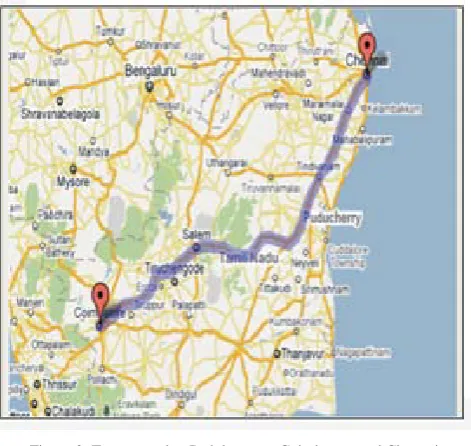
services; Operating transport means, which is taken care of by the driver and might be performed by either the traveller himself, a fellow traveller, or by a professional driver; Providing transport means, which can be done by the traveller himself, by a rental service, or by a public transport company. For a specific part of the trip providing transport means might include parking in case of private vehicles [8]. More number of Multimodal Transportation paths could be generated within India. By considering the transport between Coimbatore and Chennai, time cost effective analysis of multimodal transportation has been carried out.
[image:2.595.316.558.191.651.2]Figure 2 Transportation Path between Coimbatore and Chennai
Figure 3 Transportation Path between Bangalore and Pune
The Fig.2 shows the transportation path between Coimbatore and Chennai. Fig. 3 shows the transportation path between Bangalore and Pune.
III. ALGORITHM FOR SOLVING MMTP –
[image:2.595.320.556.199.422.2]Let S denotes the starting city and F denotes the final city. Then a basic model of the multimodal transport can be in the form as shown in Fig.4.
S Start
A A point within source city
Mode2 Through one mode of transport
B A point within destination city
[image:3.595.34.270.103.288.2]F Final
Figure 4 A basic model of the problem with minimum nodes
[image:3.595.319.559.177.295.2]The point A may be different locations depending on mode 1, say for train service if starting point of transportation is Coimbatore, point A may be railway station. In order to calculate the time based solution when minimum time is the ultimate goal irrespective of cost, user is given choices to select one among the various modes for each edge connecting S to A, A to B, B to F. These different modes of travel lead to different routes between the source S and final destination F as given in Fig.5.
Figure 5 Different routes based on different modes of transport
The algorithm developed aiming minimum cost is as shown in Fig.6
G0
repeat
:= 0 and initialize the graph
evaluate population P(t) s = source
r = destination
// looping for finding shortest path for cost based
If there is a neighbor to this node then calculate the minimum cost among
neighbours. i = choose node
Pi = Pi + i // i will be the minimum cost node attached in graph
Until the destination is reached r
Figure 6 Algorithm to identify the optimum path based on minimum cost
A. Aiming Minimum Cost:
In addition to the above calculation, if there is a breakpoint from the source to destination (Fig.7), the softwaregoes for assignment problem, which is assigning an
[image:3.595.45.268.423.524.2]alternate mode of transportation within the source to destination. For example in Figure 5, the source is Bangalore and the destination is Coimbatore. The shortest path is calculated and the optimum mode of transportation is displayed. In addition to the above calculation, if there is a break, say at Hosur, then the system will calculate the best optimum mode of transport to reach the destination and the extra time and cost related to the assignment mode is displayed, also the corresponding map generation gets displayed.
Figure 7 Breakpoint on the path connecting Source and Destination
B. Assigning a City on the Path - User’s Preference:
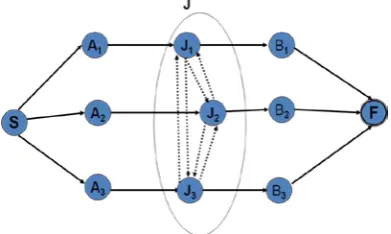
Once the breakpoint i.e. a city on the path connecting source and destination is chosen by the user, then after reaching the city, there is a chance of choosing one among different modes of transport. The point J may be different locations depending on modes of travel, say for train service if breakpoint J is Bangalore, Ji, a point in city J may be railway station (Fig.6). In order to calculate the time based solution when minimum time is the ultimate goal irrespective of cost, user is given choices to select one among the various modes for each edge connecting S to <Ai, Ji> <Ji , Jj >, <Jj , Bj>, < Bj , F> . These different modes of travel lead to different routes between the source S and final destination F as given in Fig. 9.
Figure 8 Different points in the city corresponding to breakpoint
[image:3.595.329.547.497.624.2] [image:3.595.35.283.573.715.2] [image:3.595.340.536.646.763.2]IV. SOLVING MMTP – AIMING MINIMUM TIME OR MINIMUM COST
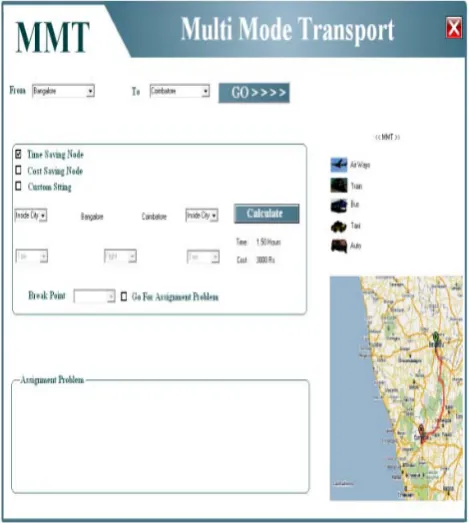
The module corresponding to solving MMTP aiming minimum time or minimum cost has 3 options that a user can choose. They are: time saving, cost saving and custom setting. When the time saving option is chosen, the prototype works to identify the route to transport goods from source city to destination city with minimum time. The advantage of this module is that it also considers the time involved in transferring goods within the source city, say from ‘godown’ to ‘railway station’, ‘or’ ‘godown’ to ‘airport’; and transferring goods within the destination city, say from ‘airport’ to ‘godown’ or ‘railway station’ to ‘godown’ using the mode ‘road’. It displays the minimum time and the corresponding cost associated with that route for transporting. Similarly the ‘cost saving module’ aims for identifying the route from source city to destination city with minimum cost and it displays the minimum cost and the corresponding time associated with that route for transporting. There is a third option ‘custom setting’ in the prototype where the user can give a breakpoint at a city in the route connecting source city to destination city and the user can choose a mode of transport within that city.
A check on whether that mode of transportation is available or not within that city is done and if that mode is not available, then the unavailability is reported. If available, then the corresponding time and cost of the route are calculated.
A software prototype has been developed using Visual
Programming concepts. Fig.10 shows the map
[image:4.595.316.561.55.327.2]corresponding to the path from source to destination. Fig.11 shows the screenshot aiming the minimum cost of the path from source to destination with the map. The map gets displayed as in Fig.12 corresponding to the source and the destination and the modes of transport that has been chosen for the inland, between source and destination and the outland by the user.
[image:4.595.316.565.359.650.2]Figure 10 Screenshot showing the map
Figure 11 Screenshot showing the objective function as minimum cost
.
Figure 12 Screenshot showing the user custom setting
V. CONCLUSIONS
[image:4.595.37.272.501.763.2]VI. REFERENCES
[1]. Muller G, 1995, Intermodal Freight Transportation, 3rd
[2]. Schoemaker Th.J.H., Koolstra K., Bovy P.H.L., 1999, Traffic in the 21st century - a Scenario analysis for the Traffic market in 2030, Weijnen M.P.C., E.F. ten Heuvelhof, The infrastructure playing field in 2030, pp. 175-194, Delhi University Press, Delhi.
Edition, Eno Transportation Foundation.
[3]. Bielli M., Boulmakoul A And Mouncif H, 2006, Object modeling and Path Computation for multimodal travel systems, European Journal of Operational Research, December.
[4]. Bousquet Aurelie, 2007, Routing Strategies Minimizing Travel Times within Multimodal Urban Transport Networks.
[5]. Johnson D.S., Lenstra J.K., Rinnooy Kan A.H.G., 1978, The Complexity of the Network Design Problem Networks, No. 8, pp. 279-285
[6]. Aykin T, 1995 Networking policies for hub-and-spoke systems with application to the Air Transportation System, Transportation Science, Vol. 29, No. 3, pp. 201-221.
[7]. Jean-Claude Thill, 2001, Geographic Information Systems in Transportation Research.
[8]. VAN NES R., 2002 , Design of Multimodal Transport and Networks – A hierarchical Approach, TRAIL Thesis Series, Trail Research School, The Netherlands.
Short Biodata of the Author
Santha Thirupathi received her post graduation from P.S.G. College of Arts and Science, Coimbatore in 1987 and M.Phil. from Bharathiar University in 1991. She is presently working as Professor and Head, School of IT and Science, Dr.G.R.D. College of Science, Coimbatore. She has more than two decades of teaching and research experience. Her research centres on Computer applications and optimisation techniques, multimodal transportation and computer simulation. She is currently pursuing Ph.D in Computer Science in School of Computer Science and Engineering.