Volume 3, No. 7, Nov-Dec 2012
International Journal of Advanced Research in Computer Science
RESEARCH PAPER
Available Online at www.ijarcs.info
ISSN No. 0976-5697
iQuality of Service in MANET using End-to-End Delay and Bandwidth Estimation
Munesh Dutt*
Dept. of Computer Science & Engineering JanNayak Chaudhary DeviLal VidyaPeeth
Sirsa,India [email protected]
Krishan Kumar
Dept. of Computer Science & Engineering JanNayak Chaudhary DeviLal VidyaPeeth
Sirsa,India [email protected]
Abstract: In this paper, an ATTENTIVE ROUTING Protocol that provides MANET routing based on End to end Delay, Capacity Estimation and multi node- disjoint path between a given source and destination is proposed.Attentive routing has many adventages such as band width estimation (active bandwidth & passive bandwidth)Better channel load sharing. Better usage of resources available in the each node. Better fault tolerance it provide better Q.O.S
Keywords: QoS,MANET,Attentive Routing,end-to-end delay,bandwidth .
I. INTRODUCTION
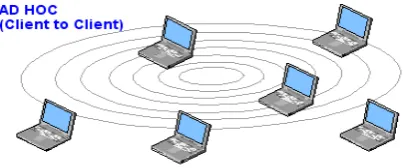
Ad hoc networks are autonomous, self-organized, wireless, and mobile networks. They do not require setting up any fixed infrastructure such as access points, as the nodes organize themselves automatically to transfer data packets and manage topology changes due to mobility. Many of the current contributions in the ad hoc networking community assume that the underlying wireless technology is the IEEE 802.11 standard due to the broad availability of interface cards and simulation models.
Figure : 1.1 MANET Architecture
This standard provides an ad hoc mode, allowing mobiles to communicate directly. As the communication range is limited by regulations, a distributed routing protocol is required to allow long distance communications. However, this standard has not been targeted especially for multi hop ad hoc operation, and it is therefore not perfectly suited to this type of networks. Nowadays, several applications generate multimedia data flows or rely on the proper and efficient transmission of sensitive control traffic.
These applications may benefit from a quality of service (QOS) support in the network. That is why this domain has been extensively studied and more and more QOS solutions are proposed for ad hoc networks. However, the term QOS is vague and gathers several concepts. Some protocols intend to offer strong guarantees to the applications on the transmission characteristics, for instance bandwidth, end to end delay, packet loss, or network load. Other solutions, which seem more suited to a mobile environment, only select the best route among all possible choices regarding the same criteria. In both cases, an accurate evaluation of the capabilities of the routes is necessary. Most of the current
QOS proposals leave this problem aside, relying on the assumption that the link layer protocols are able to perform such an evaluation. However, they are not. The resource evaluation problem is far from being trivial as it must take into account several phenomena related to the wireless environment but also dependent on less measurable parameters such as the node mobility. The IEEE 802.11-based networks have been able to provide a certain level of quality of service (QOS) by the means of service differentiation, due to the IEEE 802.11e amendment. Such an evaluation would, however, be a good asset for bandwidth-constrained applications. In multi-hop ad hoc networks, such evaluation becomes even more difficult. Consequently, despite the various contributions around this research topic, the estimation of the available bandwidth still represents one of the main issues in this field.
II. RELATEDWORKS
A lot of works is directed towards identification of multiple paths based on fault tolerance and load sharing [1]. The research is direct towards the multipath for the purpose of Q.O.S provision [2], [3]. In MANET, node sending multiple packets along multiple paths reaches the destination node in out of order. Therefore, it increases further overhead and delay for re-sequencing. [4]. the issue of load balancing in multi path source routing for MANET in addresses [5], [6].It provide, an Ad hoc mode, requiring no base station, and allowing mobile to communicate directly (accessing mechanism is DCF) [7]. Many bandwidth estimation techniques have been proposed for wired networks and detailed survey of the different techniques is proposed. [8].The remaining bandwidth of a link is the product of the link capacity by one minus the link utilization factor [9].The IEEE802.11 DCF throughputs with markov chain model, in the assumption of finite number of terminals and ideal channel conditions. But the result can only fit for academic analysis, not for online application [10].Bandwidth is fundamental component of providing QOS so accurate bandwidth estimation is more difficult [11 - 14]
A. Problem Description
only number of hop and it will not consider. Channel load. Resources available in the each node Fault tolerance. QOS aware based routing protocols consider either B.W or end to end delay it will not providing the better Q.O.S.
III. PROPOSEDSYSTEM
A. Attentive Routing In Ieee802.11-Based Manet:
ATTENTIVE ROUTING is a highly adaptive, distributed routing algorithm based on the principle of link-reversal. It provides multiple loop-free paths from source to destination. The key design concept of ATTENTIVE ROUTING is to localize control messages to a small set of nodes in the neighborhood of the topological changes. The protocol consists of three basic functions: Route creation, Route maintenance and Route erasure.
To establish and maintain routes the protocol creates a directed a-cyclic graph (DAG), which is based on a “height” metric. This height differs per destination and thus there is one DAG per destination.
For a node to initiate a route, it broadcasts a QUERY to its neighbors. This is re-broadcasted through the network until it reaches the destination or a node that has a route to the destination. This node replies with an UPDATE that contains its height with respect to the destination, which is propagated back to the source. Each node receiving the UPDATE sets its own height to one greater than that of the neighbor that sent it. When the last downstream link fails, a node generates a new reference level which results in the propagation of that reference level by neighbors, thus coordinating an effective and structured reaction. Links are reversed to reflect the change in adapting to the new reference level. The effect of this reversal is the same as changing the direction of links when a node has no downstream links.
Timing is very important in ATTENTIVE ROUTING because the earlier mentioned “height” metric is time-dependent (it depends on the logical time of a link failure). Because of this time dependence, ATTENTIVE ROUTING requires all nodes having a common clock (some sort of timing protocol or an external clock e.g. GPS). ATTENTIVE ROUTING’s metric is a quintuple existing of the following elements: The logical time of the link failure, the unique ID of the node that defined the new reference level, a reflection indicator bit, a propagation ordering parameter and, the unique ID of the node.
The reference level is represented by the first three elements. Every time a node loses its last downstream link due to a failure a new reference level is defined. The route erasure phase involves flooding a broadcast “clear packet” through the network to erase invalid routes.
Because ATTENTIVE ROUTING uses inter nodal co-ordination it can be quite instable. In the case where multiple sets of nodes are concurrently detecting partitions, erasing routes and building new ones based on each other, there can be oscillations, these oscillations are temporary and routes will ultimately converge.
B. Design & Implementation:
a. Attentive Routing:
In ATTENTIVE ROUTING module provide the routing the packet based on the active band width and end to end delay so, it will reduce the traffic, effective utilization of the channel& resources and increasing the through put.
ATTENTIVE ROUTING is a highly adaptive, distributed routing algorithm based on the principle of link-reversal. It provides multiple loop-free paths from source to destination. The key design concept of ATTENTIVE ROUTING is to localize control messages to a small set of nodes in the neighborhood of the topological changes.
The protocol consists of three basic functions: a) Route creation
b) Route maintenance c) Route erasure.
To establish and maintain routes the protocol creates a directed a-cyclic graph (DAG), which is based on a “height” metric (see figure). This height differs per destination and thus there is one DAG per destination.
Figure: 13.1 Route creation and (b) Route Maintenance in Attentive
For a node to initiate a route, it broadcasts a QUERY to its neighbors. This is re-broadcasted through the network until it reaches the destination or a node that has a route to the destination. This node replies with an UPDATE that contains its height with respect to the destination, which is propagated back to the source. Each node receiving the UPDATE sets its own height to one greater than that of the neighbor that sent it.
Figure:2
Timing is very important in ATTENTIVE ROUTING because the earlier mentioned “height” metric is time-dependent (it depends on the logical time of a link failure). Because of this time dependence, ATTENTIVE ROUTING requires all nodes having a common clock (some sort of timing protocol or an external clock e.g. GPS). ATTENTIVE ROUTING’s metric is a quintuple existing of the following elements:
a) The logical time of the link failure.
b) The unique ID of the node that defined the new reference level.
c) A reflection indicator bit.
d) A propagation ordering parameter and. e) The unique ID of the node.
The reference level is represented by the first three elements. Every time a node loses its last downstream link due to a failure a new reference level is defined. The route erasure phase involves flooding a broadcast “clear packet” through the network to erase invalid routes.
Because ATTENTIVE ROUTING uses inter nodal co-ordination it can be quite instable. In the case where multiple sets of nodes are concurrently detecting partitions, erasing routes and building new ones based on each other, there can be oscillations, these oscillations are temporary and routes will ultimately converge.
Table: 1
Path. No
No. Of. hop
Available B.W in path
Data Rate
Max Data rate
selected Path
1 4 0.5 0.125
0. 25
Path 2
2 4 1 0.25
3 5 0.2 0.04
4 6 0.7 0.1166667
Figure: 3
b. Example Calculation:
If we want to send the data from Node A to Node E means, there are two paths are available one is ACHE and AFGHE. The routing protocol chooses the path based on the end to end delay and capacity estimation.
Attentive Routing Algorithm
INPUT:PATH.
No_OF_HOP,AVAILABLE_BANDWIDTH_IN_PATH OUTPUT : MX,I
a) for i ←0, i ≤n, i ←i + 1 do
b) data rate[i] ← available b.w in path[i]/no.of.hop[i] c) end for
d) mx=maxvalue (data rate [0], data rate [1]…data rate[no of path])
e) for i ←0, i ≤n, i ←i + 1 do f) If data rate[i] eq Mx then g) return i
h) break i) End if j) end for
c. Attentive Routing Properties:
For the creation of routes a directed a-cyclic graph is used (DAG).QUERIES are sent and replied with UPDATES between nodes to create DAG(s).A DAG is formed using height metrics.When links go down nodes get new reference levels (heights) and links are reversed to notify the source.All nodes need to have a common clock.ATTENTIVE ROUTING provides multiple routes to destinations.Routes from source to destination may not be optimal (not the shortest routes).
d. End to End Delay:
In this module, end to- end delay based on per-hop delays, further it is based on CSMA/CA is generally used as a MAC protocol in ad hoc networks. Hence, the contention delay at each node plays an important role and contributes to the major part of end-to-end delay. In this module focus on contention delays along a path and try to minimize it.
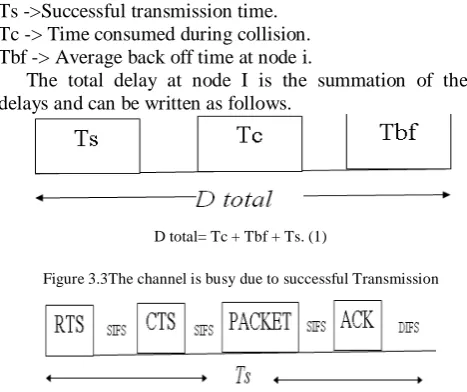
Ts ->Successful transmission time. Tc -> Time consumed during collision. Tbf -> Average back off time at node i.
The total delay at node I is the summation of these delays and can be written as follows.
D total= Tc + Tbf + Ts. (1)
Figure 3.3The channel is busy due to successful Transmission
Succ Tx = RTS + SIFS + CTS + SIFS + Packet load + SIFS + ACK + DIFS
Figure 3.4 The Channel is busy due to collision
Ch busy = RTS + DIFS
The overhead due to transmitting the data frame T over = TACK + DIFS + 3SIFS + TRTS + TCTS
DIFS -> Distributed Interface Space SIFS -> Short Interface Space RTS -> Request-To-Send CTS -> Clear-To-Send ACK --> Acknowledgment
e. Bandwidth Estimation:
In this module, Available bandwidth evaluation has generated several contributions in the wired and wireless networking communities. Several classifications of these solutions may be imagined. We chose to separate them into the following two categories.
f. Active Bandwidth Estimation Techniques:
A detailed survey of the different techniques to evaluate the available bandwidth in wired networks is accessible. Most of these techniques measure the end-to-end available bandwidth by sending packets of equal size from a source to a receiver. The source increases gradually the probe packet emission rate. Measurements of the characteristics of this particular flow are performed at the receiver’s side and then converted into an estimation of the end-to-end available bandwidth. Several protocols such as fall into this category. They mainly differ in the way they increase the packet sequence rate and in the metrics measured on the probing packet flow. It is worth noting that, with these techniques, the probing traffic may influence existing flows.
Propose to detect the presence of congestion by monitoring probe packets’ delay. Whenever this delay gets larger than the theoretical maximum delay, the medium suffers from congestion. They propose a method to compute the medium utilization from such measure- ments and then derive the channel capacity from this channel usage ratio. Based on the TOPP method, the authors of DietTOPP evaluate the accuracy of such techniques in wireless networks. This system shows that both the probe packet size and the volume of cross-traffic have a stronger impact on the measured bandwidth in this environment than in wired
networks. These techniques are, therefore, also very sensitive to the measurement parameters and easily lead to inaccurate results in a wireless environment. The active techniques cited above present, in addition, two major drawbacks regarding multi hop ad hoc networks. First, when many nodes need to perform such an evaluation for several destinations, the amount of probe packets introduced in the network becomes important. It may, thus, interact with the data traffic and with other probes, modifying other estimations. Second, an end-to-end evaluation technique may not be as reactive as a local technique in a mobile context. When updating routes in response to node mobility or to a change in the available resources, local detection and reconstruction may be more efficient in several situations.
g. Passive Bandwidth Estimation Techniques:
A dynamic bandwidth management scheme for single-hop ad hoc networks is proposed. In this solution, one node in the network hosts the Bandwidth Manager process, which is responsible for evaluating the available bandwidth in the cell and for allocating the bandwidth to each peer. Each node may ask the Bandwidth Manager for an exclusive access to the channel during a proportion of time using dedicated control messages. As the topology is reduced to a single cell, the available proportion time-share is computed by this entity considering that the total load is the sum of the individual loads.
The available fraction of time may then be translated into an available bandwidth by considering the capacity of the wireless link, called total bandwidth in this system, which is deduced from a measurement of the data packets’ throughput. This approach can be considered as passive as very few control packets are exchanged, usually of small size. However, this solution is adapted to network topologies where all the nodes are within communication range but cannot be directly used in multi hop ad hoc networks. Even if the election, the synchronization, and the maintenance of several Bandwidth Managers may represent a significant cost in large distributed networks, similar measurements may be employed. When a node desires to estimate the bandwidth available in its vicinity, the intuitive approach consists in monitoring the channel over a given time period and to deduce from this observation the utilization ratio of the shared resource. The method proposed in uses such technique and adds a smoothing factor to hide transient effects. The QOS routing protocol.
Designed in this system is based on a simple estimation of the available bandwidth by each node and does not consider any interfering nodes.QOS-AODV [8] also performs such a per-node ABE. The evaluation mechanism constantly updates a value called Bandwidth Efficiency Ratio (BWER), which is the ratio between the numbers of transmitted and received packets. The available bandwidth is simply obtained by multiplying the BWER value by the channel capacity. This ratio is broadcasted among the one-hop neighbors of each node through Hello messages.
(BRuIT). This protocol’s ABE mechanism takes into account the fact that, with the IEEE 802.11 standard, the carrier sense radius is larger than the transmission range. In other words, emitters share the bandwidth with other nodes they cannot communicate with.
Experimental studies have shown that this carrier sense radius is at least twice the communication radius. To address this issue, each node regularly broadcasts to all its immediate neighbors’ information about the total band- width it uses to route and emit flows (deduced from applications and routing information) and its estimated available bandwidth. It also transmits similar information concerning all its one-hop neighbors, propagating such information at a two-hop distance.
Each node then performs admission control based on this two-hop neighborhood knowledge. When the carrier sense radius is equal to twice the communication radius, the authors have shown the two hops communication represents the best compromise between estimation accuracy and cost. Making the same observation, Yaling and Kravets proposed the Contention.
Aware Admission Control Protocol (CACP). In this framework, each node first computes its local proportion of idle channel time by monitoring the radio medium. Then, the authors propose three different techniques to propagate this information to the greatest number of nodes within the carrier sense area.
First, similarly to BRuIT, they propose to include the information in Hello messages to reach the two-hop neighborhood. Second, they propose to increase the nodes’ transmission power; however, this emission power is often limited by regulations and this technique may therefore only be applicable when power control is used for regular transmissions. Finally, receiving nodes can also reduce their sensitivity in order to decode information coming from farther away, which depends on the quality of electronics and on the signal modulation. Similarly to, the authors also point out the existence of interflow contention. When a flow takes a multi hop route, successive routers contend for channel access for frames belonging to the same flow. It is thus important to take into account at least the route length when performing admission control. Ideally, the exact
Figure: 3.5. A typical unfair scenario in which asymmetric conditions degrade sender-based evaluations
Interactions between nodes along a path should be identified and considered. Finally, the AAC protocol, proposed in, makes each node consider the set of potential contenders as a single node. It measures the activity period durations and considers that any such period can be seen as a frame emission of the corresponding length. With this
mechanism, collisions and distant emissions are also considered when computing the medium occupancy. Based on this measurement, each node is able to evaluate its available bandwidth. It exchanges this information with its neighbors to compute the bandwidth on each link, a link being defined as a pair of nodes. This value is defined as the minimum between the available bandwidths of both ends. AAC also takes into account the intra flow contention problem mentioned above.
C. System Modules:
a. End to End:
In this module, end to- end delay based on per-hop delays, which is based on CSMA/CA is generally used as a MAC protocol in ad hoc networks. Hence, the contention delay at each node plays an important role and contributes to the major part of end-to-end delay. In this module focus on contention delays along a path and try to minimize it.
Node can be divided into three components which are as follows:
Ts ->Successful transmission time. Tc -> Time consumed during collision. Tbf -> Average back off time at node i.
The total delay at node I is the summation of these delays and Can be written as follows.
D total= Tc + Tbf + Ts.
b. Bandwidth Estimation:
In this module, Available bandwidth evaluation has generated several contributions in the wired and wireless networking communities. Several classifications of these solutions may be imagined. We chose to separate them into the following two categories
c. Active Approaches:
The techniques that rely on the emission of dedicated end-to-end probe packets to estimate the available bandwidth along a path.
A detailed survey of the different techniques to evaluate the available bandwidth in wired networks is accessible. Most of these techniques measure the end-to-end available bandwidth by sending packets of equal size from a source to a receiver. The source increases gradually the probe packet emission rate. Measurements of the characteristics of this particular flow are performed at the receiver’s side and then converted into an estimation of the end-to-end available bandwidth. Several protocols such as follows. They mainly differ in the way they increase the packet sequence rate and in the metrics measured on the probing packet flow.
and easily lead to inaccurate results in a wireless environment.
The active techniques cited above present, in addition, two major drawbacks regarding multi hop ad hoc networks. First, when many nodes need to perform such an evaluation for several destinations, the amount of probe packets introduced in the network becomes important. It may, thus, interact with the data traffic and with other probes, modifying other estimations. Second, an end-to-end evaluation technique may not be as reactive as a local technique in a mobile context. When updating routes in response to node mobility or to a change in the available resources, local detection and reconstruction may be more efficient in several situations.
d. Passive Approaches:
The techniques that identify only local information i.e. identify the utilization of the bandwidth. A typical example of such approaches is a node monitoring the channel usage by sensing the radio medium. These mechanisms are usually transparent, but they may exchange information via one-hop broadcasts, as such information can be piggybacked in the Hello messages used by many routing protocols to discover the local topology.
A dynamic bandwidth management scheme for single-hop ad hoc networks is proposed. In this solution, one node in the network hosts the Bandwidth Manager process, which is responsible for evaluating the available bandwidth in the cell and for allocating the bandwidth to each peer. Each node may ask the Bandwidth Manager for an exclusive access to the channel during a proportion of time using dedicated control messages. As the topology is reduced to a single cell, the available proportion time-share is computed by this entity considering that the total load is the sum of the individual loads.
The available fraction of time may then be translated into an available bandwidth by considering the capacity of the wireless link, called total bandwidth in this system, which is deduced from a measurement of the data packets’ throughput. This approach can be considered as passive as very few control packets are exchanged, usually of small size. However, this solution is adapted to network topologies where all the nodes are within communication range but cannot be directly used in multi hop ad hoc networks. Even if the election, the synchronization, and the maintenance of several Bandwidth Managers may represent a significant cost in large distributed networks, similar measurements may be employed. When a node desires to estimate the bandwidth available in its vicinity, the intuitive approach consists in monitoring the channel over a given time period and to deduce from this observation the utilization ratio of the shared resource. The method proposed in uses such technique and adds a smoothing factor to hide transient effects. The QOS routing protocol.
Designed in this system is based on a simple estimation of the available bandwidth by each node and does not consider any interfering nodes. QOS-AODV [8] also performs such a per-node ABE. The evaluation mechanism constantly updates a value called Bandwidth Efficiency Ratio (BWER), which is the ratio between the numbers of transmitted and received packets.
The available bandwidth is simply obtained by multiplying the BWER value by the channel capacity. This ratio is broadcasted among the one-hop neighbors of each
node through Hello messages. The bandwidth available to a node is then inferred from these values as the minimum of the available bandwidths over a closed single-hop neighbor- hood. QOS AODV, therefore, considers not only the possibility to send a given amount of data but also the effect of the emissions of a node on its neighborhood. In [9], Chaudet and Lasso us proposed a bandwidth reservation protocol called Bandwidth Reservation under In Terferences influence (BRuIT). This protocol’s ABE mechanism takes into account the fact that, with the IEEE 802.11 standard, the carrier sense radius is larger than the transmission range. In other words, emitters share the bandwidth with other nodes they cannot communicate with.
Experimental studies have shown that this carrier sense radius is at least twice the communication radius. To address this issue, each node regularly broadcasts to all its immediate neighbors’ information about the total band- width it uses to route and emit flows (deduced from applications and routing information) and its estimated available bandwidth. It also transmits similar information concerning all its one-hop neighbors, propagating such information at a two-hop distance.
Each node then performs admission control based on this two-hop neighborhood knowledge. When the carrier sense radius is equal to twice the communication radius, the authors have shown that two hop communications represents the best compromise between estimation accuracy and cost. Making the same observation, Yaling and Kravets proposed the Contention Aware Admission Control Protocol (CACP). In this framework, each node first computes its local proportion of idle channel time by monitoring the radio medium. Then, the authors propose three different techniques to propagate this information to the greatest number of nodes within the carrier sense area. First, similarly to BRuIT, they propose to include the information in Hello messages to reach the two-hop neighborhood.
Second, they propose to increase the nodes’ transmission power; however, this emission power is often limited by regulations and this technique may therefore only be applicable when power control is used for regular transmissions. Finally, receiving nodes can also reduce their sensitivity in order to decode information coming from farther away, which depends on the quality of electronics and on the signal modulation. Similarly to, the authors also point out the existence of intra flow contention. When a flow takes a multi hop route, successive routers contend for channel access for frames belonging to the same flow. It is thus important to take into account at least the route length when performing admission control.[15-20]
IV. CONCULUSIONANDFUTUREENHANCEMENT
This paper provides better service based on End to end
Delay, Capacity Estimation and multi node-disjoint path between a given source and destination. Its performance increases in terms of QOS success ratio and throughput.
As future works, we plan to focus on Data management Routing. First, in our current system estimate do not make difference between the large volume of data and small volume of data so, In fuure routing algorithm will consider the data volume for selecting the path.
data consider the both capacity estimation and end to end delay.
V. REFERENCES
[1]. M.K. Marina and S.R. Das, “On-demand Multipath Distance Vector Routing for Ad Hoc Networks”, Proceedings of 9th IEEE International Conference on Network Protocols (ICNP), pp. 14-23, 2001
[2]. A.M. Abbas and Ø. Kure, “CQSR: A Correlation Aware Quality of Service Routing in Mobile Ad hoc Networks”, Proceedings of 3rd IEEE International Conference and Exhibition on Next Generation Mobile Applications, Services and Technologies (NGMAST), pp. 363-368, 2009
[3]. A.M. Abbas and Ø. Kure, “A Probabilistic Quality of Service Routing in Mobile Ad hoc Networks”, Proceedings of 1st IEEE International Conference on Networked Digital Technologies (NDT), pp. 269-273, 2009.
[4]. K.C. Leung, and V.O.K. Li, “Flow Assignment and Packet Scheduling for Multi path Networks”. Journal of Communication and Networks, Vol. 5, No. 3, pp.230-239, 2003
[5]. S. Prasad, A. Schumacher, H. Haanpaa, and P. Orponen, “Balanced Multi path Source Routing”, Proceedings of International Conference on Information Networking (ICOIN), pp. 315-324, 2007.
[6]. L. Zhang, Z. Zhao, Y. Shu, L. Wang, O.W., and W. Yang, “Load Balancing of Multi path Source Routing in Ad hoc Networks”, Proceedings of IEEE International Conference on Communications (ICC), Vo. 5, pp.3197-3201, 2002
[7]. IEEE Computer Society LAN MAN Standards Committee. Wireless LAN Medium Access Protocol (MAC) and Physical Layer (PHY) Specification, IEEE STD 802.11-1997. The Institute of Electrical and Electronics Engineers, New York, NY, 1997
[8]. Ravi Prasad, Margaret Murray, Constantinos Dovrolis, and K. Claffy, “Bandwidth estimation: metrics, measurement techniques, and tools,” IEEE Network, 17(6), pp.27–35, November 2003
[9]. Manthos Kazantzidis and Mario Gerla, “End-to-end versus Explicit Feedback Measurement in 802.11 Networks,” Proc. The Seventh IEEE Symposium on Computers and Communications (ISCC 2002), Taormina, Italie, July 2002.
[10]. G. Bianchi, “Performance Analysis of the IEEE 802.11 Distributed Coordination Function,” IEEE Journal of Selected Areas in Telecommunications, Wireless series, 2000, 18(3), pp.535-547.
[11]. L. Hanzo (II.), R. Tafazolli, “Throughput Assurances Through Admission Control for Multi-hop MANETs”, Proc. 18th IEEE Int. Sump on Personal, Indoor and Mobile Radio Communications(PIMRC), Athens, Greece, September 2007, pp. 1–5.
[12]. L. Chen, W.B. Heinzelman, “QOS-Aware Routing Based on Bandwidth Estimation for Mobile Ad hoc Networks”, IEEE Journal on Selected Areas in Communications, 23, (3), March 2005, pp. 561–572.
[13]. Y. Yang, R. Kravets, “Contention-aware admission control for ad hoc networks”, IEEE Transactions on Mobile Computing, 4, (4), August 2005, pp. 363–377.
[14]. I.D. Chakeres, E.M. Belding-Royer, J.P. Macker, “Perceptive Admission Control for Wireless Network Quality of Service”, Elsevier Ad hoc Networks, 5, (7), September 2007, pp. 1129–1148.
[15]. R. Prasad, M. Murray, C. Dovrolis, K. Claffy, “Bandwidth estimation: metrics, measurement techniques, and tools”, IEEE Network, 17, (6), 2003, pp. 27–35.
[16]. I. Glover; P. Grant, Digital Communications 2/e, Pearson Education Ltd., 2004.
[17]. H. Zafar, D. Harle, I. Andonovic, Y. Khawaja, “Performance Evaluation of Shortest Multipath Source Routing Scheme”, IET Communications in Special Issue on Wireless Ad hoc Networks, 3, (5), May 2009, pp. 700– 713.
[18]. Q. Chen, F. Schmidt-Eisenlohr, D. Jiang, M. Torrent-Moreno, L. Delgrossi, H. Hartenstein, “Overhaul of IEEE 802.11 modelling and simulation in ns-2”, Proc. 10th ACM Symposium on Modelling, Analysis, and Simulation of Wireless and Mobile Systems, Chania, Greece, October 2007, pp. 159–168.
[19]. NS-2 (The Network Simulator 2),