ABSTRACT
SWINSON, LISA SESSOMS. Exploring Charter School Administrators’ Perceptions of the Support of Their Authorizer: A Mixed Methods Study. (Under the direction of Dr. Timothy Drake and Dr. Lance Fusarelli.)
Unlike traditional public schools, charter schools often have little contact with a local education agency and must handle administrative tasks typically completed at the district level, including financial management, recruitment and hiring of personnel, data collection and reporting, and various recordkeeping and support functions (Bickmore & Dowell, 2011; Campbell & Gross, 2008). Leadership at the level of the school has been shown to influence student achievement and school organizational factors, including the learning climate of the school and the professional capacity of staff (Leithwood, Seashore Louis, Anderson, & Wahlstrom, 2004; Sebastian & Allensworth, 2012). In order for the school to succeed, the charter school must run a successful school that delivers the goals outlined in its charter and the authorizer must provide oversight and assistance to help ensure that the school delivers.
The purpose of this mixed methods study is to investigate the extent to which charter school administrators perceive that their authorizer, the North Carolina Department of Public Instruction (NCDPI), supports their efforts to be compliant in academic, governance,
Exploring Charter School Administrators’ Perceptions of the Support of Their Authorizer: A Mixed Methods Study
by
Lisa Sessoms Swinson
A dissertation submitted to the Graduate Faculty of North Carolina State University
in partial fulfillment of the requirements for the degree of
Doctor of Education
Educational Administration and Supervision
Raleigh, North Carolina 2018
APPROVED BY:
Dr. Timothy Drake Dr. Lance D. Fusarelli
Committee Co-chair Committee Co-chair
BIOGRAPHY
Lisa Swinson has been an educator for over 20 years. She began her career as an elementary teacher in Pitt County. After obtaining her Master’s Degree in Elementary Education and becoming a Nationally Board Certified Teacher, Lisa decided to leave the classroom after 9 enjoyable years of classroom teaching. Then for one year, she aided teachers at one of the state’s lowest performing schools as a Team Reviewer with the NC Department of Public Instruction State Assistance Team. Lisa then worked as curriculum director at a Title I school in Wilson County. After obtaining her K-12 Administrators
Certification, Lisa continued to work at that Title I school, but switched roles as the principal. After 6 years, she yearned to be a change agent at the state level and became an education consultant for the North Carolina Department of Public Instruction. Currently, Lisa is pursuing her Doctorate in Educational Leadership at NCSU.
DEDICATION
I dedicate this study to my husband and children who understood that Sundays were my day to work in the library. I also dedicate this to my mom and sister who encouraged me throughout the process. Finally, to my classmates and colleagues who were great
ACKNOWLEDGMENTS
TABLE OF CONTENTS
LIST OF TABLES ... ix
LIST OF FIGURES ... x
CHAPTER 1: INTRODUCTION ... 1
Purpose Statement ... 5
Subjectivity Statement ... 7
CHAPTER 2: LITERATURE REVIEW ... 8
Charter School Administrators ... 8
Charter School Authorizers ... 11
North Carolina’s Charter Authorizer ... 18
CHAPTER 3: METHODOLOGY ... 27
Research Design ... 27
Conceptual Framework ... 28
Setting and Participants ... 30
Data Collection ... 37
Instrumentation ... 37
Semi-structured Interview ... 37
Interview Protocol Development ... 38
Procedures ... 38
Data Analysis ... 40
Reliability and Validity ... 41
Limitations ... 42
CHAPTER 4: FINDINGS ... 46
Analysis of Quantitative Data ... 47
Analysis of Qualitative Data ... 52
Experiences Working with NCDPI Employees ... 52
Inconsistency with NCDPI employees’ knowledge of charter laws and policies ... 52
Uncertainty of who to contact at DPI ... 53
Fear of being reprimanded ... 54
OCS as a different entity than NCDPI ... 56
Support in Academics ... 56
Support in Finances... 58
Support in School Operations ... 60
Support in Governance ... 62
Other Sources of Support ... 65
Overall Perception of Support from NCDPI ... 66
More face-to-face interactions with NCDPI employees ... 66
Communication amongst DPI employees need improvement ... 67
Experiences Working with Charter Administrators ... 67
Theodore ... 68
Claire ... 69
Denise ... 70
Vanessa ... 71
Rudy ... 74
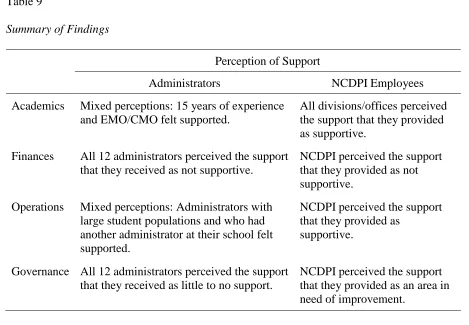
Summary of the Findings ... 75
Research Question 1 ... 76
Support in academics ... 76
Support in finances ... 78
Support in school operations ... 78
Support in governance ... 79
Research Question 2 ... 79
Support in academics ... 79
Support in governance ... 80
Support in operations ... 80
Support in finances ... 80
Chapter Summary ... 81
CHAPTER 5: DISCUSSION ... 83
Findings and Conclusions ... 85
Finding 1: Charter School Administrators Have Unique Needs ... 85
Finding 2: Need for More Face-to-Face Interactions ... 88
Finding 3: A Desire to Improve Practices ... 90
Finding 4: The EMO/CMO Advantage ... 91
Implications ... 92
Implications for Charter School Authorizers ... 93
Implications for Institutions of Higher Learning ... 95
Future Research ... 96
Summary ... 97
REFERENCES ... 99
APPENDICES ... 109
Appendix A ... 110
Appendix B ... 124
Appendix C ... 128
Appendix D ... 129
Appendix E ... 130
Appendix F ... 136
Appendix G ... 137
LIST OF TABLES
Table 1 Number of Charter School Authorizers by Type 2011-2015 ... 13
Table 2 North Carolina Office of Charter School Staff Data 1996-2018 ... 21
Table 3 Profiles of Charter School Administrator Participants ... 32
Table 4 Profiles of 6 NCDPI Employee Participants ... 35
Table 5 Perception of Charter Administrators Needs Being Met ... 49
Table 6 Characterization of Interactions with OCS Staff ... 50
Table 7 OCS Responsiveness to Questions/Concerns ... 50
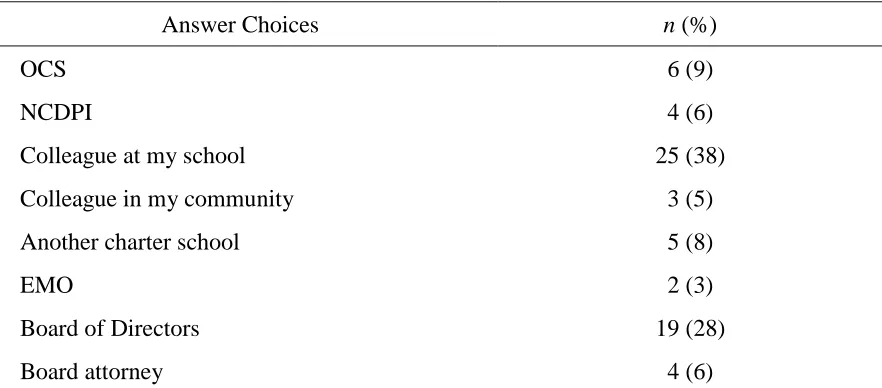
Table 8 Ranking of Who Charter Administrators Would Turn to with a Major Concern ... 51
LIST OF FIGURES
CHAPTER 1: INTRODUCTION
Although the Elementary and Secondary Education Act is the vehicle by which Congress sets federal policies for public K-12 schools, each state creates laws and policies that govern charter schools. Experience with public charter schools across the country suggests that there are five primary ingredients of a successful public charter school environment in a state, as demonstrated by strong student results: (a) supportive laws and regulations, including both the types of laws and regulations and how they are implemented; (b) quality authorizers; (c) effective charter support organizations, such as state charter associations and resource centers; (d) outstanding school leaders and teachers; and (e) engaged parents and community members (National Alliance for Public Charter Schools [NAPCS], 2017). For this study, I focused on the second primary ingredient—the quality of one state authorizer, the North Carolina Department of Public Instruction (NCDPI)—based on how charter school administrators perceive the level of support that NCDPI provides them.
Charter schools are publicly funded schools that are exempt from many government regulations. Individual charter schools are considered part of the public school landscape; indeed, most of their fiscal base derives from tax-levy dollars (Buckley & Schneider, 2009; Fabricant & Fine, 2012; Fusarelli, 2002; Hays, 2013; Lockwood, 2004). Charter schools are typically operated by private entities, including nonprofit organizations or for-profit
outcomes will improve school performance; and (b) that high levels of autonomy will allow schools to better meet student needs and, as a result, improve performance (Gleason, 2016; U.S. Department of Education, 2004). According to the U.S. Department’s Office of Innovation and Improvement:
The promise charter schools hold for public school innovation and reform lies in an unprecedented combination of freedom and accountability. Underwritten with public funds but run independently, charter schools are free from a range of state laws and district policies stipulating what and how they teach, where they can spend their money, and who they can hire and fire. In return, they are held strictly responsible for their academic and financial performance. (U.S. Department of Education, 2004, p. 1) The charter establishing a school is a contract that details the school’s mission, its program and goals, the population it serves, and the ways it will assess success or failure (Buckley & Schneider, 2009; NCDPI, 2017). As outlined in state charter laws, charters are granted for fixed lengths of time and renewal is contingent upon a review by the authorizer.
When the charter school movement began in the early 1990s, one key set of players received little attention: the public entities that “sponsor” or “authorize” these
schools, monitoring schools’ compliance with applicable laws, providing technical assistance, and evaluating schools’ performance (Palmer & Gau, 2003; Vergari, 2001). Among the various states, different entities can authorize charter schools. Depending on state law, the range of authorizer organizations varies. In the United States, Local Education Agencies (LEAs) made up the largest group of authorizers in the country, followed by, in order from greatest to least, Higher Education Institutions (HEIs), State Education Agencies (SEAs), nonprofit organizations (NFPs), Independent Chartering Boards (ICBs), and non-educational government entities (NEGs; Chen, 2016; National Association of Charter School Authorizers [NACSA], 2015; Weil, 2009; Ziebarth, Palmer, & Shutz, 2016). The role of the authorizer is believed to be pivotal to the success of the charter school movement (Palmer & Gau, 2005; Vergari, 2000).
Although there is much debate about the proper roles and responsibilities of “quality” authorizing (NACSA, 2015; Palmer & Gau, 2003; U.S. Department of Education, 2007), the research literature varies regarding what constitutes a “quality” authorizer. The U.S.
Department of Education, for example, established six practices of quality authorizers: (a) build a strong organization; (b) develop strong talent pool; (c) select for quality; (d) support new school operators; (e) provide meaningful and transparent oversight; and (f) hold schools accountable for meeting performance goals (U.S. Department of Education, 2007). In
applicant schools, (c) Authorizers can work closely with schools without becoming beholden to them, (d) Authorizers must consider both individual school and system performance when decided whether to cancel a contract, and (e) Authorizers must actively recruit a diverse set of providers (Lake & Hill, 2006).
In addition to this variation in the definition of a “quality” authorizer, there has been little research done on the relationship between the authorizer and the charter schools themselves, especially as it relates to the building leader. The No Child Left Behind Act of 2002 created a more tightly coupled educational policy system that emphasized aligned accountability systems and curriculum frameworks as a means of improving student achievement, which increased demand for coordinated communication and distribution of resources across the system (Firestone, 2009; Johnson & Chrispeels, 2010). This need for coordination has placed the district at the forefront because federal and state accountability mandates hold districts increasingly responsible for improving teaching and learning (Hightower, Knapp, Marsh, & McLaughlin, 2002; Johnson & Chrispeels, 2010). After 30 years of focus on schools as the unit of change, policymakers now recognize that schools are embedded in systems and that the relationship between a district and its sites may be crucial to improvement (Chrispeels, Burke, Johnson, & Daly, 2010; Johnson & Chrispeels, 2010).
Gross, 2008; Dressler, 2001). An important question that has not been addressed in the research literature, however, is the extent to which a charter school authorizer might support charter schools and their administrators in following the law and completing these additional management responsibilities.
Purpose Statement
The purpose of this mixed methods study was to examine charter school administrators’ perceptions regarding the support that its authorizer, NCDPI, provides, paying particular attention to governance, academic, operational, and financial compliance laws. North Carolina offers a unique context in which to study the relationship between authorizer and charter school. Unlike other states, North Carolina has a single authorizer (NCDPI, 2017). Additionally, North Carolina has been rated as a quality authorizer by NACSA, scoring a perfect 12 out of 12 on their rating scale (NACSA, 2015). North Carolina also delegates charter school management to the NCDPI. After a recent election, NCDPI is now led by new state superintendent Mark Johnson who, the News and Observer reported, “favors [the] expansion of charter schools” (Editorial Board, 2016, “State Superintendent,” para. 1). Additionally, a new director of charter schools was hired, Dave Machado, who expressed in an Office of Charter Schools Weekly Newsletter “an effort to better serve charter schools” (NCDPI, 2016).
schools in North Carolina. In the second phase of the analysis, I conducted semi-structured interviews with a sample of 12 (n=12) charter school administrators and six (n=6) NCDPI staff to help explain the quantitative results. More specifically, I explored the perceptions of charter school administrators by conducting individual interviews at various charter schools throughout the state. Data from individual interviews, fieldnotes, and documents were analyzed to discover patterns, themes, and categories using the research questions as a framework (Patton, 2002). Additionally, I interviewed NCDPI staff to explore their perceptions of the level of support that they provide to charter school administrators. The focus of this study was the relationship between charter school administrators and their authorizer, but because there is little written on this topic I drew upon the research literature that examines the relationship between traditional public school administrators and central office leadership to inform this analysis plan (Honig, 2012; Honig & Rainey, 2014; Johnson & Chrispeels, 2010).
The research questions guiding this inquiry were:
1. To what extent do charter school administrators perceive that NCDPI supports their efforts to be compliant in academics, governance, operations, and finances? 2. To what extent does NCDPI perceive that they support charter schools’ efforts to
be compliant in academics, governance, operations, and finances?
I chose to use a mixed methods approach to examine these research questions because the fundamental principle of mixed methods research is to combine methods in a manner that considers the strengths and weaknesses of each individual method (DeCuir-Gunby, 2008).
state of North Carolina. A desired outcome of this study was to assess charter school administrators’ perceptions of the support that they receive from their authorizer, NCDPI.
Subjectivity Statement
I am a licensed principal who was an administrator at a charter school in North Carolina for 6 years. I often attended professional development sessions and conferences that NCDPI sponsored and perceived the support that I was provided as adequate. My school employed an outside vendor for support in finances and academics. Another source of support that I utilized was the NCDPI website. I was familiar with the website because I worked on the NCDPI State Assistance Team a year prior to becoming an administrator.
I was also a consultant at the NCDPI’s Office of Charter Schools. I worked closely with administrators in regions 1, 2, and 4. During the NC State Board of Education monthly meetings, I presented data to assist the board in making decisions regarding charter school renewals, requests to expand grade levels, or increase student enrollment and amendments to the school’s charter. One of my roles in the office was to conduct charter renewal site visits to schools across the state. In this role, I interacted with and visited over 100 charter schools. Moreover, as a former employee at NCDPI, I was familiar with which divisions/offices worked closely with charter schools and was able to connect with those employees because of my previous position at the department.
CHAPTER 2: LITERATURE REVIEW
As stated in the introduction, this study aims to help inform the practices of charter school authorizers by comparing the support that charter school administrators perceive they are receiving from the authorizer with the support that the authorizer perceives they are providing to the charter school administrator. Missing from the current charter school literature is an explanation of the relationship between charter school administrators, charter school authorizers, and charter school performance. This review of literature focuses on the relationship between charter school administrators and their authorizer, charter school leadership, and charter school authorizers.
Charter School Administrators
unique responsibilities involved in the administration and management, it has been clear that these schools require experienced, highly skilled leaders.
The autonomy of charter schools allows for a variety of leadership structures. Most charter schools are led by a principal or director. Most states do not require charter school leaders to be licensed or require any specific qualifications such as a bachelor’s degree. Charter leaders may be called principals, deans, headmasters, directors, or heads of schools. Surveys of directors and founders of charter schools cite several major reasons for
establishing charter schools, including (a) autonomy in educational programming, (b) a desire to serve a special student population, (c) realization of an educational vision, (d) a desire to provide a better teaching and learning environment, (e) instructional innovation, (f) a desire to involve parents, and (g) the autonomy to develop nontraditional relationships with the community (Fusarelli, 2002).
Unlike their district school counterparts, charter school administrators not only serve as the instructional leader of their school, but they manage the budget, recruit board
Principals of charter schools may or may not emerge from traditional educational leadership programs and theoretically may not be adequately prepared to successfully perform the tasks associated with the principal (Deal, Hentschke, & Kecker, 2005; Dressler, 2001). Traditional school leadership training programs are not designed to prepare charter leaders for the responsibilities that go beyond those of a district school principal (Hess & Kelly, 2005). Most states lack a formal or systematic strategy to develop a talent pipeline or management system for the next generation of charter leaders (Bloomberg & Nathan, 2008). Leadership development can entail tremendous sacrifice and be an expensive and time-consuming endeavor (Bloomberg & Nathan, 2008). For example, one nationally recognized charter school leadership preparation program, Building Excellent Schools, requires
participants to relocate to another city for a year or be away from home for as many as 100 nights during a year-long training period (Fellowship Calendar, 2017).
Research findings show that leaders who have gone through traditional principal training programs lack confidence in financial management, while those who have
backgrounds in financial management lack confidence in core educational leadership (Hays, 2013; Palmer & Gau, 2003). Campbell and Gross (2008) suggest expanding specialized charter leadership training programs because they are more carefully tailored to the needs of charter school directors. The authors also suggest creating more local mentoring and
problem-solving opportunities for leaders from different types of schools (Campbell & Gross, 2008).
programs and approximately 60% is former public school principals, while 13% has non-education backgrounds (Campbell & Gross, 2008). Charter leaders are much more likely than traditional principals to be women, and on average, more racially and ethnically diverse (Luekens, 2004). Finally, charter school principals earned much less than traditional public school administrators, with annual salaries of $54,000 in charter schools compared to $69,000 in traditional public schools (Luekens, 2004).
In short, this review suggests that the autonomy of charter schools allows for a variety of leadership structures and charter school leaders are not often prepared in their trainings. What has not been studied is the relationship between charter school leaders and their authorizer. In the next section, I review the roles of charter authorizers, the differences in practices of authorizers, and the types of charter authorizers.
Charter School Authorizers
The original vision for charter schools came in 1988 from Albert Shanker, the
In 2014-2015, there were 1,050 authorizers that oversaw 6,716 charter schools serving more than 2.5 million students (NACSA, 2015).
Researchers have been paying an increasing amount of attention to the role of charter authorizers (NACSA, 2015; NAPCS, 2017; Palmer & Gau, 2003, 2005). In 2003, the first national study of authorizers concluded that, except for those sponsoring only a few schools (typically local school boards), many were doing an adequate job (Palmer & Gau, 2003). In 2006, a national study examined authorizer type and found great variability among
authorizers, with some doing their jobs well and others exercising less oversight. This study also found that independent state charter boards and nonprofit organizations generally did a better job than other authorizers (U.S. Department of Education, 2007).
The differences in authorizing practices and authorizing capacity are crucial in the authorizers’ priority and ability to hold their schools accountable for the flexibility and freedom they are given over traditional public schools (Chen, 2016). There is a debate about which types of authorizing agencies have the proper incentives to fulfill their roles of
granting and monitoring of charters schools, as well as being accountability gatekeepers (Zimmer et al., 2014). Charter school authorizers have three main responsibilities: (a) review applications for new charter schools and determine whether the proposed schools will be granted a charter; (b) monitor approved charter schools based upon the content of their charter, as well as state and federal laws; and (c) make decisions regarding the renewal or revocation of charter schools.
quite different from their core activities: universities and nonprofit agencies, for example, may have no prior experience relevant to the tasks of authorizing, overseeing, and supporting charter schools; school districts may be more likely to have relevant expertise (Zimmer et al., 2014). The most effective authorizers are often state-level groups, universities, or larger school districts that have been able to create an adequate infrastructure, including staff dedicated to charter issues (Palmer & Gau, 2005).
Charter laws vary across a number of dimensions, including the type of agencies that can authorize charter schools (Zimmer et al., 2014). Across the United States and the District of Columbia, legislatures have permitted six different types of public entities to serve as charter school authorizers: (a) school districts (LEAs); (b) state boards of departments of education (SEAs); (c) non-educational government entities (NEGs); (d) colleges and universities (HEIs); (e) separate state-level public boards (ICBs); and (f) not-for-profit organizations (NFPs) (Palmer, 2007; Vergari, 2001; Zimmer et al., 2014). Table 1 highlights the breakdown of charter authorizers across the nation.
Table 1
Number of Charter School Authorizers by Type 2011-2015
Authorizer Type 2010- 2011 2011- 2012 2012- 2013 2013- 2014 2014- 2015 % change 2011-2015
HEI 49 46 43 47 45 -8%
ICB 8 10 14 15 17 113%
LEA 857 859 882 944 950 11%
NEG 2 2 3 3 3 50%
NFP 20 20 19 19 17 -15%
SEA 19 20 18 18 18 -5%
Total 955 957 979 1,046 1,050 10%
NACSA’s latest national annual survey found that 90% of more than 1,000 active authorizers were LEAs, 4.4% of authorizers were HEIs, and fewer than 2% fell in the ‘other’ authorizing categories (NACSA, 2015). School districts have the most direct experience with the day-to-day operation of public schools and all that it entails. Some district authorizers have embraced charter schools an integral component of their school improvement plans while others use them to handle “problem” students or to relieve overcrowding (Palmer, 2007). Moreover, school districts that have embraced the charter school reform view charter schools as a distraction from other reform initiatives and as an unreasonable burden on school district budgets and personnel (Vergari, 2001). In a 2015 national survey, NACSA reported that many districts have not developed the capacity to effectively oversee charter schools in addition to their other duties. Contrarily, Denver’s district officials have partnered with charter schools and have created a School Performance Framework that measures tests scores, academic growth, student engagement, enrollment rates, and parental satisfaction (Osborne, 2016).
Colleges and universities are permitted to authorize charter schools in nine states. They may face political pressures from the governor and/or state legislature to assume an active role in the charter school arena (Brown, 2006). In Michigan, public HEIs were slow to embrace charters because of pressure from unions and local boards, but pressure from their governor was a key factor in their decision to become authorizers (Palmer, 2007). On the other hand, some public universities have entered chartering for educational reasons. For example, survey data revealed that Ball State University in Indiana was motivated in part by political pressure, but also by the belief that chartering would advance its mission and create research opportunities (Palmer, 2007).
Separate state-level charter boards, which are appointed by one or more public government officials, authorize charter schools in six states and the District of Columbia: the Arizona State Board for Charter Schools, the Colorado Charter School Institute, the District of Columbia Public Charter School Board, the Florida School of Excellence Commission, the Idaho Public Charter School Commission, the South Carolina Public Charter School District, and the Utah State Charter Board (Palmer, 2007). Additionally, the Massachusetts, North Carolina, and Texas state boards of education are considered strong state level charter school authorizers (Palmer, 2007). Some believe they are more likely than other authorizers to have the interest, knowledge, and “will” to take chartering seriously and can focus exclusively on high-quality authorizing practices and decisions (Palmer, 2007). The board members have the sole mission of authorizing schools under the supervision of their appointing entities (Chen, 2016).
schools and to the public. They, like local school districts, bring extensive experience and understand the day-to-day operations of schools. State Boards and departments of education may be less than enthusiastic about charter schools based on philosophical and political reasons (Vergari, 2001). Board and staff members often view charter schools with a skeptical eye because they are not often familiar and are sometimes skeptical of the flexibilities that charter schools have with regard to education policies (Weil, 2009). Moreover, charter schools place new burdens on state departments of education, frequently without a commensurate increase in capacity for meeting the new obligations (Vergari, 2001). For example, in 2011, North Carolina Senate Bill 8 removed the provision that previously limited the number of charter schools operating at any given time to 100 schools. During an
interview with a local news station, Senator Richard Stevens, a supporter of the bill, expressed that “the lifting of the cap would offer more options to more students who aren’t being served well in existing schools” (Leslie, 2011, para. 4).
NACSA, the CRPE, and the U.S. Department of Education (DOE) have each
established their own research-based criteria for “quality” authorizing, but there is still policy debate about the best types of authorizers (Palmer & Gau, 2003; Zimmer et al., 2014).
Rebeca Gau (2006) examined all previous research related to authorizers and extracted four criteria that appear essential for authorizers to do their jobs well:
1. Data-driven decision making and rigorous, objective selection, and renewal processes.
2. Sound working relations between authorizer and school. 3. Skilled personnel.
Central Office Support
In this dissertation, I focus on the second of these criteria: sound working relations between authorizer and school. To date, there is little research on the relationship between charter school authorizers and their charter schools, particularly with respect to the support authorizers might provide those schools. In the research literature, support often refers to aid or assistance or the addition of strength to that which cannot stand on its own (Lee, Smith Perry, & Smylie, 1999). Sustained, job-embedded supports may be fundamental to helping administrators build their capacity for instructional leadership (Honig, 2012). Unlike charter school administrators, traditional public school leaders have the support of central office staff who provide support through online resources, school site visits, and workshops. In exchange for greater autonomy from various state and district policies and greater flexibility in
decision making (Bickmore & Dowell, 2011), charter schools usually have no contact with local central office education agencies and must handle administrative tasks typically completed at the district level, including financial management, recruitment and hiring of personnel, data collection and reporting, and various recordkeeping and support functions (Luekens, 2004).
provides school leaders support with professional development, connecting administrators to sources of expertise, creating new structure or tools, and building a data use culture (Grissom et al., 2017). In addition, district-provided professional development, which was almost always job-embedded, had a statistically significant relationship with principal’s time spent on such instructional leadership tasks such as observing classroom instruction and engaging with teachers outside of the classroom to improve instruction (McAdamis, 2010).
Instructional leadership represents a set of work practices that administrators come to integrate into their ongoing work through sustained support for each integration over time; arrangements such as on-site coaches and other professional development that takes place in schools as a part of principal’s regular day seem fundamental to administrators learning such practices (Honig, 2012).
In this dissertation, I build upon this research on the relationship between public school administrators and central offices to examine the relationship between charter school authorizers and charter school leaders. North Carolina offers a unique context in which to study this relationship because it has a single authorizer, NCDPI, with a focus on supporting school leaders. In the next section I briefly review North Carolina’s charter legislation.
North Carolina’s Charter Authorizer
located. The ultimate authorizing power for all charters was given to the State Board of Education (SBE). Charter schools are accountable to the SBE for ensuring compliance with all charter laws and policies. After the SBE approval process has concluded, it signs a charter agreement with each charter nonprofit board that outlines the responsibilities and
expectations of the charter school (Appendix A). According to the NCDPI website, the following outlines the work of the department:
NCDPI is charged with implementing the state’s public school laws and the SBE’s policies and procedures governing pre-kindergarten through 12th grade public education. The elected State Superintendent of Public Instruction leads the
Department and functions under the policy direction of the State Board of Education. The areas of support include curriculum and instruction, accountability, finance, teacher and administrator preparation and licensing, professional development and school business support and operations. (NCDPI, 2017)
Since, 1996, North Carolina’s legislation has evolved. In 2015, an advisory board to the SBE, the North Carolina Charter School Advisory (NCCSAB) board, was established. The NCCSAB’s powers and duties are to make recommendations to the SBE on the adoption of rules regarding all aspects of charter school operation; review applications and make recommendations to the SBE for final approval of charter applications; make
recommendations to the SBE on actions regarding renewals, non-renewals, and revocations; and undertake any duties and responsibilities as assigned by the SBE (Charter Schools Advisory Board, 2017).
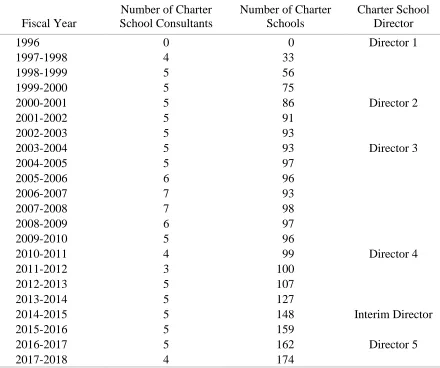
schools (Table 2), causing the office to limit the support provided. In the September 17, 2015 edition of the Weekly Office of Charter Schools Newsletter, Adam Levinson, the interim director, explained,
OCS will no longer assign consultants to be the single point of contact for each charter school; instead, OCS will provide services to the charter community based on areas of work with a lead/primary contact for each. OCS also will no longer visit each school annually; as part of our new work stream focused on ‘Risk Assessment,’ schools will only receive site visits as needed to address high risk issues or if required by the Renewal process. (NCDPI, 2015)
The Weekly Office of Charter Schools Newsletter is the primary source of
communication from NCDPI to charter school administrators. Each charter school designates one person, usually the lead administrator, employed at the school to receive the newsletter. The newsletter contains updates, action items, information, and celebrations that are pertinent to charter school leaders. Archived newsletters can be found on the OCS website.
During its June 2016 monthly meeting, the NCSBE named Dave Machado the OCS Executive Director. Although he was the lead administrator of a North Carolina charter school for 11 years, “Machado has no education degrees and no experience in political posts . . . But he says he brings a record of leading a successful team” (Helms, 2016, para. 29). According to the OCS website, the office consists of an executive director, assistant director and two consultants (Office of Charter Schools, 2018).
updated as the charter movement evolves (National Association of Charter School Authorizers, 2017). NACSA’s practices are often cited in research and are used in many states as legislators discuss charter school policy (Palmer, 2007). Members of the NCCSAB refer to NACSA practices as they make recommendations to the SBE to amend North Carolina charter policies. In 2015, North Carolina received a score of 12 out of a possible 12 points for adhering to the Essential Practices of Quality Authorizers (NACSA, 2015).
Table 2
North Carolina Office of Charter School Staff Data 1996-2018
Fiscal Year
Number of Charter School Consultants
Number of Charter Schools
Charter School Director
1996 0 0 Director 1
1997-1998 4 33
1998-1999 5 56
1999-2000 5 75
2000-2001 5 86 Director 2
2001-2002 5 91
2002-2003 5 93
2003-2004 5 93 Director 3
2004-2005 5 97
2005-2006 6 96
2006-2007 7 93
2007-2008 7 98
2008-2009 6 97
2009-2010 5 96
2010-2011 4 99 Director 4
2011-2012 3 100
2012-2013 5 107
2013-2014 5 127
2014-2015 5 148 Interim Director
2015-2016 5 159
2016-2017 5 162 Director 5
2017-2018 4 174
The NAPSC established 17 criteria for quality authorizers. Measuring Up to the Model: A Ranking of State Charter Public School Laws (NAPSC, 2015) is the first report to
measure each state’s charter school law and focus on strengthening authorizers. Ranked 14th out of the 44 states that have charter schools, North Carolina’s positive score was based on there not being a cap for charter growth and that there is a fair amount of autonomy, having a virtual school application, and accountability to charter schools. NAPSC highlighted
potential areas of improvement that include ensuring equitable operation funding and access to capital funding and facilities (NASPC, 2015).
Non-profit boards seeking to open a charter school choose the organizational structure of their school. Seventy-six percent of charter schools (131 out of 174) in North Carolina have an independent structure in which the non-profit board did not employ the assistance of an Educational Management Organization (EMO) or Charter Management Organization (CMO). EMOs are for-profit and have corporate staffs outside the school building making decisions for individual schools in the day-to-day operations of these schools (Buckley & Schneider, 2009). CMOs are nonprofit organizations that operate a network of charter schools with a common mission or instructional design and shared central office support (Farrell, Wohlstetter, & Smith, 2012). In 2015, two unique EMOs began operation in North Carolina after the NCSBE approved two virtual charter schools to begin operation in 2015. EMOs and CMOs provide schools with funding and other resources.
Charter Schools (NCOCS) to implement an annual Performance Framework (Appendix B) to capture each charter school’s operational, financial, governance, and academic data trends over time. In 2016, the NCSBE’s Strategic Plan showed the following results from the Performance Framework: 76.9% of North Carolina charter schools met or exceeded all operational goals, 88.5% met expected financial standards, and 84.6% of all charter schools met expected operational standards (NCSBE, 20176). NCOCS defines the Performance Framework:
The performance framework focuses on Goal 2.4 of the North Carolina State Board’s Strategic Plan to “Increase the number of charter schools meeting academic,
operational, and financial goals.” The Performance Framework, an annual assessment of charter schools, serves as the standard mechanism for reporting on progress toward achievement of these goals. The Framework provides a consolidated view of each charter school’s performance relative to a list of academic, operational, and financial requirements. The academic elements of the Framework are all standard indicators provided by the State accountability system. The operational and financial elements of the Framework are all required by statute, State Board policy, or the Charter Agreement. (NCDPI, 2017)
state and local conferences. In an effort to provide charter school specific professional development, regional huddles were established to deliver periodic refresher training for charter school leaders and their staff on topics such as lotteries, teacher evaluation, and updates to charter school laws. In 2014, a mandatory planning year was implemented for newly approved charter school boards.
In 2015, legislation established the NCOCS to be administratively located in the Department of Public Instruction (DPI) subject to the supervision, direction, and control of the SBE (Charter Schools, 2016). Although NCOCS was established and located at DPI, the legislation specifically established that NCOCS would serve as staff to NCCSAB and provide technical assistance and guidance to charter schools, and nonprofit corporations seeking to operate charter schools. In light of the legislation, NCOCS began to provide weekly electronic newsletter communications to charter school leaders and stakeholders. Additionally, in 2014, the NCCSAB began to invite continually low-performing charter school boards and the school administrators to their meetings to provide support (NCDPI, 2015).
In 2014, the NCOCS created a planning year for all newly approved charter school boards to prepare for their first school year. NCOCS provides trainings on information that is relevant to opening a successful charter school. Throughout the planning year, the boards are assigned very specific tasks whose aim is to strengthen the governing board. The tasks may include creating policies, a school calendar, board self-assessments and plans for enrollment.
charters, and schools that either had their charters revoked or not renewed by the State Board of Education. Most of charter school closures have been the result of financially-related issues. Figure 1 shows the percentage and reasons for charter school closure.
Figure 1. Reasons for charter school closure 1997-2017. Adapted from “Report to the North
Carolina General Assembly Annual Charter Schools” Report G.S. 115C-218.110(b), North Carolina Department of Public Instruction (2017).
Importantly, charter school leaders have expressed mixed reviews regarding the support that they receive from the SBE. During its May 2017 monthly board meeting, Union Academy Charter School’s principal referred to her school as a sports team, referring to the SBE as the “team owners” and the staff of the various divisions as the “head coaches.” She explained that “head coaches” always provided great information for schools and parents through site visits, phone calls, the SBE website, and weekly newsletters (NCSBE, 2017).
22%
2%
40% 11%
25%
Relinquishment prior to opening Delayed opening denied Relinquishment prior to opening Nonrenewal
CHAPTER 3: METHODOLOGY Research Design
Mixed methods research is defined as research in which the investigator collects and analyzes data, integrates the findings, and draws inferences using both qualitative and quantitative approaches or methods in a single study or program of inquiry (DeCuir-Gunby & Shutz, 2016). I chose to use a mixed methods approach to examine these research
questions because the fundamental principle of mixed methods research is to combine methods in a manner that considers the strengths and weaknesses of each individual method (DeCuir-Gunby, 2008). Mixing both kinds of data within one study is grounded in the fact that neither quantitative nor qualitative methods are sufficient, by themselves, to capture the trends and details of a situation. When used in combination, quantitative and qualitative methods complement each other and allow for a more robust analysis, taking advantage of the strengths of each (Greene, Caracelli, & Graham, 1989). There are five reasons for
conducting mixed methods research: triangulation, complementarity, development, initiation, and expansion (Greene et al., 1989). For this research, I focused on development, which involved using quantitative and qualitative methods sequentially, with one method informing the development of the other.
researcher visualize the sequence of the data collection, the priority of either method, and the connecting and mixing points of the two approaches within a study (Ivankova, Creswell, & Stick, 2006). The visual representation portrays the sequence of the research activities in the study and indicates that the quantitative phase, the term QUALITATIVE is capitalized, of the study informed the qualitative phase. The visual also shows the connecting points between the quantitative and qualitative phases and the related products, as well as specifies the place in the research process where the integration or mixing of the results of both quantitative and qualitative phases occurs (Ivankova et al., 2006). The visual representation for this study can be found in Appendix C.
In this study, I first analyzed quantitative data from the North Carolina Office of Charter Schools Satisfaction Survey. Next, I collected the qualitative data through individual semi-structured interviews with charter school administrators and DPI employees. In this second phase, the qualitative data were analyzed to help elaborate on the quantitative results obtained in the first phase. The qualitative data and their analysis refine and explain those statistical results by exploring participants’ views in more depth (Creswell, 2003; Ivankova et al., 2006).
Conceptual Framework
emphasized three major themes: (a) cognitive development is rooted in social interactions and mediated by abstract symbols, which he referred to as tools; (b) the tools are not created in isolation but rather are products of the sociocultural evolution of an actively involved individual; and (c) learning is viewed as a developmental or genetic process (Peer & McClendon, 2002).
From Vygotsky’s original writings, a teacher or “more knowledgeable other” played a key role in supporting learning, where he or she assists, models, discusses, and supports an activity to increase the learner’s understanding and independent performance (Knapp, 2008; Marsh & Farrell, 2015). Other scholars further developed this idea of a mentor-apprentice relationship as a “model of instruction that works to make thinking visible . . . [by] showing the apprentice how to do a task and helping the apprentice to do it” (Marsh & Farrell, 2015, p. 273). A mentor offers not only specific domain knowledge—the concepts, facts, and routines within a content area—but also strategies (“tricks of the trade”) and meta-cognitive strategies (Marsh & Farrell, 2015).
The zone of proximal development (ZPD) is a major concept in Vygotsky’s work. This zone is defined as the distance between what one can achieve alone and what one can achieve with help (Knapp, 2008). This idea emphasized that humans develop higher
cognitive levels when the gaps in their thinking and problem solving are supported by adults, peers, or more capable others (Peer & McClendon, 2002). This support, called scaffolding, supports development in such a way that what can be done collaboratively now will be accomplished independently at a later date (Peter & McClendon, 2002).
authentic practice, and dialogue; opportunities for joint work; and development and use of tools (Gallucci, 2008; Honig & Ikemoto, 2008; Knapp, 2008). This study focused on the following dimensions: opportunities for joint work and development and use of tools. These dimensions were used to frame my understanding of the charter school administrator’s perception of the support that they receive and the perception of the support that NCDPI consultants perceive they are providing. NCDPI consultants help monitor each charter school’s financial, academic, and operational performance annually, and does a
comprehensive review as part of considering whether to grant charter renewals or determine what level of support is needed. Thus, NCDPI consultants serve as mentors in providing professional development and technical assistance to assist administrators with the state’s financial, academic, and operational laws and policies.
Setting and Participants
The Weekly Office of Charter Schools Newsletter is the primary source of communications from NCDPI to North Carolina charter school administrators.
The second group in this study consisted of charter school administrators in the 2017-2018 school year. Because the results of the survey were anonymous, the administrator may or may not have completed the 2016 satisfaction survey. One hundred seventy-four charter school administrators were invited, through email, to participate in the study. Twelve (12) North Carolina charter school administrators were chosen based on their years of experience, school’s geographical location, organization of school, and student demographics. Semi-structured interviews took place at the administrators’ school site to discuss their perceptions of the support that they receive from the NCDPI.
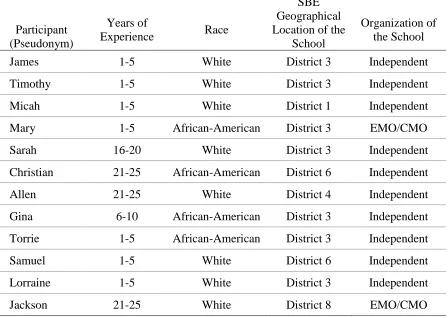
An overview of the charter administrators that participated in the semi-structured interviews can be found in Table 3. The number of years of experience leading a charter school in North Carolina varied among the charter school administrators. The number of years ranged from 1–5 years of experience to 20-25 years of experience. The NCSBE has eight education regions that are categorized by geographical location. Regions 1, 3, 4, 6, and 8 were represented in this study (see Appendix D).
James: James is an administrator of a K-12 school in District 3 serving
approximately 1,300 students. His ethnicity is White and his years of experience as a charter administrator in North Carolina range from 1 to 5 years. He has a Master’s Degree in
Table 3
Profiles of Charter School Administrator Participants
Participant (Pseudonym)
Years of
Experience Race
SBE Geographical Location of the
School
Organization of the School
James 1-5 White District 3 Independent
Timothy 1-5 White District 3 Independent
Micah 1-5 White District 1 Independent
Mary 1-5 African-American District 3 EMO/CMO
Sarah 16-20 White District 3 Independent
Christian 21-25 African-American District 6 Independent
Allen 21-25 White District 4 Independent
Gina 6-10 African-American District 3 Independent
Torrie 1-5 African-American District 3 Independent
Samuel 1-5 White District 6 Independent
Lorraine 1-5 White District 3 Independent
Jackson 21-25 White District 8 EMO/CMO
Timothy: Timothy is an administrator of a K-8 school in District 3 serving
approximately 350 students. His ethnicity is White and his years of experience as a charter school administrator in North Carolina ranges from 1 to 5 years. Prior to becoming a charter school administrator, he spent 12 years in an elementary classroom. Three percent of his students qualify for free or reduced lunch. He explained that his students bring their lunches and parents provide transportation.
administrator in North Carolina ranges from 1 to 5 years. He has a Master’s degree in Education. Seventy percent of his students qualify for free or reduced lunch. He noted that the school provides bus transportation as well as lunches to students who qualify for free or reduced lunches.
Mary: Mary is an administrator of a K-8 school in District 3 serving approximately 700 students. Her ethnicity is African American and her years of experience as a charter administrator in North Carolina range from 1 to 5 years. She has a Master’s Degree in Education and 67% of her students qualify for free or reduced lunch. Her school provides lunch to students who qualify for free or reduced lunches and her board uses the services of an Educational Management Organization.
Sarah: Sarah is an administrator of a K-12 school in District 3 serving approximately 1,100 students. Her ethnicity is White and her years of experience as a charter administrator in North Carolina ranges from 15 to 20 years. She has a Master’s Degree in Education and 16% of her students qualify for free or reduced lunch. She noted that although the school is beginning to receive applications from diverse population, the board, as well as
administrative staff, would like for the student population to be more diverse. The school does not offer transportation or meals.
Christian: Christian is an administrator of a K-12 school in District 5 serving
Allen: Allen is an administrator of a K-6 school in District 4 serving approximately 300 students. His ethnicity is White and his years of experience as a charter administrator in North Carolina ranges from 20 to 25 years. He has a Master’s Degree in Education and 52% of his students qualify for free or reduced lunch. Students who qualify for free and reduced lunch also received a voucher to purchase school uniforms.
Gina: Gina is an administrator of a K-5 school in District 4 serving approximately 130 students. Her ethnicity is African-American and her years of experience as charter administrator in North Carolina range from 6 to 10 years. She has a Master’s Degree in Education and 95% of her students qualify for free or reduced lunch. She noted that her school’s demographics are not reflective of the neighborhood in which the school is located. The school offers transportation and meals to all of their students.
Torrie: Torrie is an administrator of a K-12 school in District 3 serving
approximately 1,200 students. Her ethnicity is African American and her years of experience as a charter administrator in North Carolina ranges from 1 to 5 years. She has a Master’s Degree in Education and 72% of her students qualify for free or reduced lunch. She added that when she joined the school it was noncompliant in many areas. Transportation and meals are provided for her students.
Samuel: Samuel is an administrator of a K-2 school in District 6 serving
approximately 300 students. His ethnicity is White and his years of experience as a charter administrator in North Carolina range from 1 to 5 years. He has a Master’s Degree in Education and 98% of his students qualify for free or reduced lunch. His school’s
Lorraine: Lorraine is an administrator of a K-8 school in District 3 serving
approximately 500 students. Her ethnicity is White and her years of experience as a charter administrator in North Carolina range from 1 to 5 years. She has a Doctorate Degree in Education and 5% of his students qualify for free or reduced lunch. She further noted that there is at least one college educated parent in each of her students’ households.
Jackson: Jackson is an administrator of a K-12 school in District 8 serving approximately 1,300 students. His ethnicity is Caucasian and his years of experience as a charter administrator in North Carolina ranges from 20 to 25 years. He has a Master’s Degree in Business and 14% of his students qualify for free or reduced lunch. He explained that his school’s demographics were reflective of the local school districts.
The third group consisted of staff from NCDPI (Table 4). The staff members support all public schools in North Carolina; help the NCDPI monitor each charter school’s financial, academic, and operational performance annually; and conduct a comprehensive review as part of considering whether to grant charter renewals or determine what level of support is needed. Policies and guidelines that guide the support that is provided are discussed in monthly state school board meetings. Support is provided through emails, webinars, school site visits, phone calls, and workshops.
Table 4
Profiles of 6 NCDPI Employee Participants
Ethnicity (n) Gender (n)
Range of Years of Experience at NCDPI
White (6) Male (2)
Female (4)
Six NCDPI employees were interviewed to discuss the perceptions of the support that they provide to charter administrators. These employees work in the six departments that provide support to charter school administrators and who also attend quarterly risk assessment meetings with OCS to provide assessments of all charter schools. At these meetings, each department shares updates regarding reports and data that is specific to their area of support. If a school is deficient in any area OCS and that department creates a plan for support that may include a site visit, email, or phone call.
Theodore: Theodore has over 20 years of experience in his profession. He has been employed with NCDPI for 4 years. He noted that his division/office works with charter schools in the area of finances. Prior to working a NCDPI, he worked at another government state government agency.
Claire: Claire has 12 years of experience in her profession. She has been employed with NCDPI for 2 years. She explained that her division/office works with charter schools in the area of academics. Prior to working a NCDPI, she worked at a school in another state.
Denise: Denise has 12 years of experience in her profession. She has been employed with NCDPI for 6 years. She explained that her division/office works with charter schools in the area of academics. Prior to working at NCDPI, she worked in two local school districts.
Vanessa: Vanessa has 25 years of experience in his profession. She has been
employed at DPI for 2 years. She noted that his division/office works with charter schools in the area of academics. Prior to working at NCDPI, she worked a local school district and another state government agency.
Clifford: Clifford has 15 years of experience in his profession. He has been
the area of academics. Prior to working at NCDPI, he worked in a corporation in another state.
Rudy: Rudy has 15 years of experience in his profession. She has been employed at DPI for 2 years. She noted that her division/office works with charter schools in academics, governance, and operations. Prior to working at NCDPI, she worked at a charter school.
Data Collection Instrumentation
There were two instruments used in this study. In the fall of 2016, a 10-item Office of Charter Schools Satisfaction Survey (see Appendix E) was sent to all 174 NC charter school administrators. A link was sent by NCOCS to all North Carolina charter school
administrators on October 21, 2016 soliciting their participation in the Satisfaction Survey. NCOCS collected the data anonymously. The survey and survey data are both public documents. At a response rate of 41%, 71 charter school administrators completed the survey. The survey questions were designed to capture the areas in which charter school administrator needs were being met and areas that needed to be improved. For the qualitative component, a semi-structured interview schedule featuring broad, open-ended questions was used. This approach allowed me to ask each charter school administrator and NCDPI
employee the same questions but remain flexible in order to cater to their individual experiences (DeCuir-Gunby & Shutz, 2016). All interviews were audio-recorded and transcribed. See Appendices F and G for the interview questions.
Semi-structured Interview
open-ended, and were informed by a sociocultural perspective (Honig, 2012; Knapp, Marsh, & Farrell, 2015). Interviews provide “in-depth responses about people’s experiences,
perceptions, opinions, feelings and knowledge” (Patton, 2002, p. 4). The researcher conducted 16 semi-structured interviews with study participants to gather information regarding the perception that charter school administrators have regarding the support that they receive from their authorizer. Additionally, employees of the authorizer were
interviewed regarding their perception of the support that they provide charter school administrators. The interviews were recorded and transcribed for analysis.
Interview Protocol Development
The content of the interview protocol was grounded in the quantitative results from the first phase of the study. The goal of the qualitative phase to was to explore and elaborate on the results of the survey (Creswell & Plano Clark, 2011). Because the NCSBE
Performance Framework is an annual report card for all charter schools, I wanted to explore what areas of the framework charter school administrators perceived that they received support in from NCDPI. Additionally, I wanted to explore the administrators’ overall perception of support and discover whether they utilized outside support. Ten open-ended questions explored the topic of support.
Procedures
NCDPI. After analyzing the results, I determined that there was a need to conduct individual interviews with charter administrators, as well as NCDPI employees, to get a better
understanding of their perception of support.
In terms of process, I sent an email to all 174 North Carolina charter school
administrators informing them of the research project and soliciting their participation in the study. The email briefly described the study, including its goals, purpose, and design. After receiving interest from 22 charter administrators, a purposeful sample of 12 administrators were chosen based on the following public information: their years of experience, school’s geographical location, type of school, and student demographics. This is public information that is housed on the NCDPI website as well as the individual school websites of the
administrators. The demographic information was used in an effort to obtain a diverse sample which includes varied years of experience, varied demographic locations, and varied
governance structures of the schools (independent governing board, educational management organization, etc.). Selected participants were emailed a consent form in which they were asked if they would be interested in participating in the research project. The consent forms were signed on the day of the interview and later stored in a secure, locked cabinet. Although given the option of face or teleconference, all interviews were completed face-to-face.
Data Analysis
I engaged in a multistage data collection approach. First, I analyzed the results of the North Carolina Office of Charter Schools survey that was sent in August 2016 to all charter school leaders. The analysis provided evidence of the degree to which the charter school administrators perceived support from NCDPI consultants and supported the need for this study. Descriptive statistics were used to describe the features of the data from the survey. Data charts were created to represent the results of the analysis in summary form and to provide a visual representation of the summary. The chart outlines the questions from the survey, as well as how the participants responded to each question. Percentages, as well as the number of respondents, are provided.
The analysis for the qualitative portion of the study was done by coding the
interviews. The process suggested by Miles, Huberman, and Saldaña (2014) for coding was used. All information pertaining to support from the interviews was identified and then categorized. This process was completed by reading the transcriptions to get an overall sense of the participants’ responses. Next, for each line or paragraph that was related to support, a label was created to reflect an initial coding. Next, themes were identified by sorting initial schemes into concrete categories and subcategories. Six out of 12 participants had to identify an initial theme for the theme to be included. Finally, the responses were reread and placed into one of the themes.
2008). Data from individual interviews were analyzed to discover patterns, themes, and categories using the research questions as a framework (Patton, 2002). The first initial coding generated an array of individual codes associated with their respective data chunks (Miles, Huberman, & Saldaña, 2014). The second cycle was a way of grouping those summaries into a smaller number of categories, themes, or constructs (Miles et al., 2014).
The research questions guiding this inquiry are:
1. To what extent do charter school administrators perceive that NCDPI supports their efforts to be compliant in academics, governance, operations, and finances? 2. To what extent does NCDPI perceive that they support charter schools’ efforts to
be compliant in academics, governance, operations, and finances? Reliability and Validity
Limitations
One major feature of well-collected qualitative data is that it focuses on naturally occurring, ordinary events in natural settings, so that there is a strong handle on what real life is like (Miles et al., 2014). Although I was able to capture the participants’ body language and voice intonations as I conducted the semi-structured interviews, other methods, including structured observations, could have provided a better indication of the support that NCDPI provides charter schools.
One of the limitations of this study was that there were a limited number of participants. The response rate for the Office of Charter Schools Satisfaction Survey, the quantitative portion of the study, was 41%. The limited number of participants could have been a result of how the survey was communicated to the charter school administrators. A link was provided in a weekly newsletter that also included several announcements, updates, and due dates from other NCDPI divisions/offices. Administrators could have overlooked the request to complete the survey. Additionally, these 69% of charter school administrators who did not complete the survey may not have done so because of a lack of trust. Moreover, there may be administrators who do not look at the newsletter and would not have taken the survey. This group of administrators not only missed out on the opportunity to complete the survey, but they also missed several important communications that are included in the newsletter. This is another group of administrators whose voices were missing from the survey that could have provided more insight on their perception of support.
support of NCDPI. These administrators may have added a neutral perspective to the survey data and provided more a balance to the mixed results. Also missing, perhaps, are charter administrators who have had unfavorable experiences with NCDPI and did not trust that their identity would be anonymous. These perceptions would have provided more insight,
particularly on questions regarding who the charter school administrator’s first point of contact would be and their perception of support. Finally, missing from the survey data could have been those administrators who are overwhelmed with running the school and
completing a survey was seen as “one more task” that had to be completed. Having this perception would had provided more insight on the unique needs by getting their input on the best ways that support could be provided, given their hectic schedule. These could also be the same administrators who are not taking advantage of NCDPI sponsored trainings because they are overwhelmed with running their charter school.
Second, there were limitations in regards to sampling for the qualitative portion of the study. Thirty-seven out of 174 charter school administrators expressed interest in
participating in the qualitative portion of the study. These 37 administrators represented a range of charter school administrators with regard to their years of experience, ethnicity, school structure, and student demographics. Overall, these 37 charter administrators attend NCDPI trainings. However, there were no administrators from regions two and seven who expressed interest in participating in the study. Their lack of participation could be a result of their geographical location, a 2- to 5-hour drive from NCDPI, which resulted in a limited number of school site visits and face-to-face interactions.
coverage regarding low state accountability results, as well as high student attrition. During the time of the interview request, both virtual schools were asked to present data to the NCSBE, as well as to the state legislators, to determine the fate of their 3-year pilot program. Out of the 37, 12 charter school administrators were chosen to participate in the study. This sample size was problematic because it did not include charter administrators from other states. Each state has established its own charter school policies, and unlike North Carolina, many states utilize a variety of authorizer types (NAPCS, 2017). The participant base could be expanded by including additional authorizers and charter school administrators from other states.
Significance
This project has important programmatic, methodological, and substantive
implications for the field of education leadership. This study was designed to contribute to the literature regarding the development of support for charter school administrators working in North Carolina charter schools. Through this research, my aim is to help inform the
practices of charter authorizers by examining the support that charter school administrators perceive they are receiving. Policymakers may want to consider amending charter laws and policies to allow authorizers to tailor their services to increase the number of charter schools that are compliant in all areas of charter laws. A desired outcome of this study is to test the hypothesis that in schools that perceive a high level of support from its authorizer, the charter school is more likely to be compliant in the areas of academics, finances, operations, and governance as defined by North Carolina charter laws and NCSBE Strategic Goals.
This work will begin to shed light on the needs of charter school administrators and inform the practices of NCDPI consultants. With the recent election of a new state
superintendent, NCDPI may soon be reorganized (Ball, 2017). In particular, the