Efficient Mechanism of Data Embedding
Using Reversible Texture Synthesis
Payal T. Chaskar1, Prof. Arati Dandavate2
ME Student, Dept. of Computer Engineering, DPCOE, Pune, India.1
Head of Department, Dept. of Computer Engineering, DPCOE, Pune, India.2
ABSTRACT: An overhauled steganographic technique utilizing reversible composition combination is executed in this paper. A composition combination system re-tests a littler surface picture which orchestrates another composition picture with a comparative nearby appearance and discretionary size. Alongside reversible composition amalgamation instrument, holding room technique is used to insert extra information, which is the highlight of this paper. Customary RDH calculation is actualized for holding room strategy. Information hider can reversibly implant extra information in stegosynthetic composition picture. The altered technique can accomplish genuine reversibility, that is, surface picture recuperation and information extraction causes no blunder. Stenography is to conceal the mystery data and information inside the spread picture. The word stegno determine "secured "and chart signifies "composing", in this way it used to compose the mystery information on spread picture. The steg expository Algorithm manages the source surface picture and inserts mystery messages through the instrument of composition blend. We mesh the surface amalgamation Mechanism into stenography to hide mystery message that grants separating mystery pictures and source composition union from the stego manufactured structure. In video composition blend is the Mechanism of giving consistent and endlessly fluctuating stream of edges, which. Implanting is a procedure to insert the mystery pictures into spread pictures. Pictures information stowing away is a system for expanding the installing productively .In the conventional strategy, mystery or important data is covered up in spread picture. In this anticipate, steganalytic calculation utilizing reversible composition combination strategy is executed d to resample the littler surface picture and which blend another composition picture with a comparative neighborhood appearance and discretionary size. Our assumes an imperative part in PC vision and design. In any case, regardless it remains a testing issue to produce great union results. It is hard to locate the constant changing edges in video surface union. Histogram moving uses reversible information covering up for implanting the data. In line based cubism like picture division is utilized to insert the information, however we execute reversible composition blend component for implanting the information which enhances the information installing with no mutilation procedure.
KEYWORDS: Texture synthesis, Stego image, cover image, optimal value transfer, Data embedding, Reversible data hiding and Texture synthesis.
I. INTRODUCTION
inserting limit and the picture quality which brings about the constrained limit gave in any particular spread picture. Review that picture steganalysis is a methodology used to distinguish mystery messages covered up in the stego image. A stego image contains some twisting, and paying little respect to how minute it is, this will meddle with the regular elements of the spread picture. This prompts the second disadvantage on the grounds that it is still conceivable that a picture steganalytic calculation can crush the picture steganography and in this way uncover a concealed message is being passed on in a stego image.
In this task, a novel methodology for steganography utilizing reversible texture synthesis was proposed. A texture synthesis Mechanism re-tests a little composition picture drawn by a craftsman or caught in a photo to blend another surface picture with a comparative neighborhood appearance and discretionary size. We weave the composition blend Mechanism into steganography covering secret messages and in addition the source surface [1]. Specifically, rather than utilizing a current spread picture to shroud messages, our calculation hides the source composition picture and implants secret messages through the procedure of surface union. This permits us to separate the mystery messages and the source composition from a stego engineered surface.
II. RELATED WORK
Texture synthesis has gotten a great deal of consideration as of late in computer vision and PC graphics. The latest work has concentrated on texture synthesis by sample, in which a source texture image is re-examined utilizing either pixel-based or patch-based algorithms to deliver another synthesized texture image with comparative neighborhood appearance and subjective size. Pixel-based algorithms produce the orchestrated picture pixel by pixel and use spatial neighborhood correlations to pick the most comparable pixel in an example composition as the yield pixel. Since every yield pixel is dictated by the as of now integrated pixels, any wrongly blended pixels amid the procedure impact whatever remains of the result bringing about proliferation of blunders.
Y. Guo, G. Zhao, Z. Zhou, and M. Pietikäinen [2] spearheaded the work of consolidating information coding with pixel-based texture synthesis. Secret messages to be hidden are encoded into hued spotted examples and they are straightforwardly painted on a blank image. A pixel-based algorithm coats whatever is left of the pixels utilizing the pixel-based texture synthesis strategy, in this manner disguising the presence of spotted examples.
A. A. Efros and T. K. Leung [4] glue patches from a source composition rather than a pixel to synthesise textures. This methodology of Cohen et al. also, Xu et al. enhances the picture nature of pixel-based engineered surfaces in light of the fact that composition structures inside the patches are kept up. Then again, since patches are stuck with a little covered district amid the manufactured procedure, one necessities to try to guarantee that the patches concur with their neighbors.
YimoGuo, Guoying Zhao, Senior, Ziheng Zhou [6] presented the patch-based sampling methodology and utilized the
feathering methodology for the covered ranges of nearby patches.
Xiaolong Li, Bin Li, Bin Yang [7] present a patch sewing methodology called "image quilting". For each new patch to be blended and sewed, the calculation first inquiries the source composition and picks one applicant fix that fulfills the pre-characterized blunder resistance regarding neighbors along the covered district. Next, a dynamic programming strategy is adopted to uncover the minimum error path way through the covered region.
III. EXISTING SYSTEM MECHANISM
Fig.1 Existing System Mechanism
IV. PROPOSED SYSTEM ARCHITECTURE
It provides a secure data embedding efficiency because the size of the cover image is vary depends upon the secret message .this will make to store large amount of information. The stego analytic algorithm is used to extract the secret message from source texture. The distortion of image is very low in our opposed system. Reducing distortion is the crucial issue in existing method this will overcome by our system. Identification of LSB location is not necessary for embedding data the data embedding performed based on RGB range of an image.
1. Loading message and image
2. Conversion Mechanism
3. Better value transformation
4. Verification and validation
5. Extracting secret message
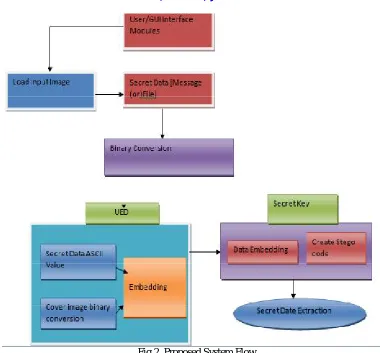
These are all the various methodology to embed the data to cover image .message embedding procedure reduces the deduction of message. Our system improves the solution space and also reduces the computational complexity. Explanation-
Fig 2. Proposed System Flow
1. Loading message and Image:
User can enter into login page by an authenticated username and password. The username and password should be valid then only we can enter into login padre. Then, the choosing of an image path Mechanism should be performed. The selection of image path is user specified. It depends upon the user who selects their image from any location. Then the selection of image did by the user for embedding purpose. the selected image then placed on a square like format. Then enter the secret message which we desire to embed on that cover image. Then the secret message and image had been embedded by using GUI.
2. Conversion Mechanism
Binary conversion carried out for both image and secret data. First for the image, The RGB range of an image has been taken and then corresponding binary value will be obtain. Next the embedded text has been taken and the word taken as individual character it will convert firstly as related ASCII code. Secondly for that ASCII code will convert as binary 8 bit code. Each and every time the 8 bit will get add. For the first character length of the word is 8 bit .For the next character the length is 16 bit like wise it goes on. The larger the cover message is (in data content terms—number of bits) relative to the hidden message, the easier it is to hide. Image Conversion of red, green and the blue as well we can get one letter of ASCII text for every three pixels.
For example: a 24-bit bitmap will have 8 bits representing each of the three color values (red, green, and blue) at each pixel. The difference between 11111111 and 11111110 in the value for blue intensity is likely to be undetectable by the human eye. If we consider just the blue there will be 28 different values of blue.
3. Better value transformation:
means 3 bits will append or else if 11 will be the ending of RGB bit then add 4 bits. All these Mechanism should be done at the end of the image’s RGB binary converted bits. The Optimal transfer matrix for illustrating the modification of cover values in reversible data hiding. Then, an iterative procedure is proposed to calculate the optimal value transfer matrix, which will be used to realize reversible data hiding with good performance. Matrix Embedding by Matrix Extending method and produces a stego object with least distortion under the tree based parity check model.
4. Embedding Mechanism:
The original matrix embedding, when the number of random columns (K) increases, the solution space of is exponentially expanded, and thus we have more chances to find a solution with smaller Hamming weight. That is why the embedding efficiency can be improved when increases, but the computational complexity of searching for this solution exponentially grows. In this section, we propose a novel method, by which we can also exponentially expand the solution space, but only cost linearly increasing time to search the solution space. The key idea of the proposed method is to append some referential columns to the matrix.
5. Verification and validation: Color Filtering:
The Stego image gives information about the gradient intensity of red, green, and blue (RGB) wavelength regions in the digital image. Sheinberg illumination to highlight different textures on the is a very accurate color filter used to selectively pass light of a small range of colors while reflecting other colors.
Weight Estimation:
Estimation of the infarction by using distortion weighted imaging (DWI) and quantitative measures of distortion. It’s a procedure to estimate the distortion tensor from a sequence of distortion-images. To check whether the image has been created by adding different types od distortion of original mage.
6. Extraction of secret message:
The embedding and extraction, a location finding method determines a sequence of locations that point to elements in the cover object. The embedding algorithm modifies the elements in these locations to hide message and the Reversible steganalytic algorithm can recover the message by inspecting the sequence of locations. The steganalytic algorithm using reversible texture synthesis Mechanism is used to extract the source texture from original image .this also extracts the secret message.
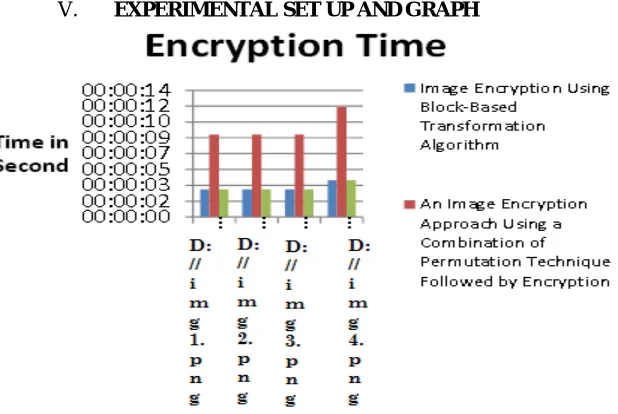
V. EXPERIMENTAL SET UP AND GRAPH
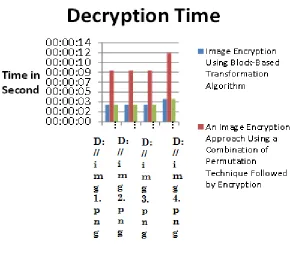
Fig 4.Decryption time for Reverse Texture
V. APPLICATION
1. Stenography can be used anytime you want to hide the data.
2. Terrorists can also use steganography to keep their communications secret and to coordinate attacks.
3. All of this sounds fairly nefarious, and in fact the obvious uses of steganographic are for things like espionage. 4. But there are a number of peaceful applications.
5. The simplest and oldest are used in map making, where cartographers sometimes add a tiny fictional street to
their maps, allowing them to prosecute copycats.
6. A similar trick is to add fictional names to mailing lists as a check against unauthorized resellers.
VI. CONCLUSION
From the thought of every single above point we reason that the ideal move instrument proposed in this work is autonomous from the era of accessible spread qualities. Our calculation can deliver outwardly conceivable stego picture regardless of the possibility that the mystery messages comprising of bit "0" or "1" have an uneven appearance of probabilities. The exhibited calculation is secure and hearty against a RS steganalytic assault. At the end of the day, the ideal exchange system gives another guideline of quality adjustment and can be utilized on different spread qualities. In the event that a more astute expectation strategy is abused to make the estimation mistakes more like zero, a superior execution can be accomplished, however the calculation many-sided quality because of the forecast will be higher.
REFERENCES
[1] W. Kuo-Chen andW.Chung-Ming, “Steganography Using Reversible Texture Synthesis,” IEEE Transactions on Image Mechanisming, pp. 1-10, 2014.
[2] Y. Guo, G. Zhao, Z. Zhou, and M. Pietikäinen, “Video texture synthesis with multi-frame LBP-TOP and diffeomorphic growth model,” IEEE Trans. Image Mechanism., vol. 22, no. 10, pp. 3879-3891, 2013.
[3] L.-Y. Wei and M. Levoy, “Fast texture synthesis using tree-structured vector quantization,” in Proc. of the 27th Annual Conference on Computer Graphics and Interactive Techniques, 2000, pp. 479-488.
[4] A. A. Efros and T. K. Leung, “Texture synthesis by non-parametric sampling,” in Proc. of the Seventh IEEE International Conference on Computer Vision, 1999, pp. 1033-1038.
[5] Shan-Chun Liu and Wen-Hsiang “Line-Based Cubism-Like Image—A New Type of Art Image and its Application to Lossless Data Hiding “IEEE Transaction on Information forensics and security vol. 7, No. 5, October 2012
[6] YimoGuo, Guoying Zhao, Senior, Ziheng Zhou “Video Texture Synthesis with Multi-frame LBP-TOP and Diffeomorphic Growth Model ” IEEE Transaction on image Mechanisming, vol. 22, No. 10, October 2013
[7] Xiaolong Li, Bin Li, Bin Yang, and TieyongZeng “General Framework to Histogram-Shifting-Based Reversible Data Hiding” IEEE Transaction on Information forensics and security VOL. 22, No 6, June 2013
[8] Hirofumi Otori and Shigeru Kuriyama “Texture Synthesis for Mobile Data Communications” IEEE Computer graphics and application. [9] Ioan-CatalinDragoi, Member, ,DinuColtuc, Senior Member, “Local-Prediction-Based Difference Expansion Reversible Watermarking” IEEE Transaction on Information forensics vol. 23, no. 4, April 2014
[10] L. Liang, C. Liu, Y.-Q.Xu, B. Guo, and H.-Y.Shum, “Real-time texture synthesis by patch-based sampling,” ACM Trans. Graph., vol. 20, no. 3, pp. 127-150, 2001.
[11] A. A. Efros and W. T. Freeman, “Image quilting for texture synthesis and transfer,” in Proc. of the 28th Annual Conference on Computer Graphics and Interactive Techniques, 2001, pp. 341-346.
[12] Z. Ni, Y.-Q. Shi, N. Ansari, and W. Su, “Reversible data hiding,” IEEE Trans. Circuits Syst. Video Technol., vol. 16, no. 3, pp. 354-362, 2006. [13] X. Li, B. Li, B. Yang, and T. Zeng, “General framework to histogram-shifting-based reversible data hiding,” IEEE Trans. Image Process., vol. 22, no. 6, pp. 2181-2191, 2013.
[14] J. L. Rodgers and W. A. Nicewander, “Thirteen ways to look at the correlation coefficient,” The American Statistician, vol. 42, no. 1, pp. 59-66, 1988.
[15] M. Kede, Z. Weiming, Z. Xianfeng, Y. Nenghai, and L. Fenghua, “Reversible Data Hiding in Encrypted Images by Reserving Room Before Encryption,” IEEE Trans. Information forensics and security., vol. 8, no. 3, pp. 553-562, 2013.