Privacy-Preserving Auditing Scheme
⋆Mehmet Sabır Kiraz, ˙Isa Sertkaya, Osmanbey Uzunkol
Mathematical and Computational Sciences T ¨UB˙ITAK B˙ILGEM, Turkey
{mehmet.kiraz, isa.sertkaya, osmanbey.uzunkol}@tubitak.gov.tr
Abstract. One of the most important benefits of public cloud storage is outsourcing of management and maintenance with easy accessibility and retrievability over the internet. However, outsourcing data on the cloud brings new challenges such as integrity verification and privacy of data. More concretely, once the users outsource their data on the cloud they have no longer physical control over the data and this leads to the integrity protection issue. Hence, it is crucial to guarantee proof of data storage and integrity of the outsourced data. Several pairing-based au-diting solutions have been proposed utilizing the Boneh-Lynn-Shacham (BLS) short signatures. They basically provide a desirable and efficient property of non-repudiation protocols. In this work, we propose the first ID-based privacy-preserving public auditing scheme with message recov-erable signatures. Because of message recovrecov-erable auditing scheme, the message itself is implicitly included during the verification step that was not possible in previously proposed auditing schemes. Furthermore, we point out that the algorithm suites of existing schemes is either insecure or very inefficient due to the choice of the underlying bilinear map and its baseline parameter selections. We show that our scheme is more ef-ficient than the recently proposed auditing schemes based on BLS like short signatures.
Keywords: Data storage, public auditability, privacy preserving, mes-sage recoverable signatures, bilinear maps
1
Introduction
Cloud service providers lead to rapidly increasing data storage in the cloud servers. They give opportunities to edit and share the data on the fly, while enabling the users to work with arbitrarily large amount of data without down-loading into their local machines. Such an elasticity enables users also to perform expensive computation like big data analysis or search on the cloud. Even if the cloud service providers build powerful, reliable and maintainable infrastructures internal and external breach may still happen (e.g., [3,4,14,19,22]). In particular,
cloud storage solutions demand new data security and privacy policies [23, 24]. For example, the cloud provider may behave unfaithful by means of modify-ing and deletmodify-ing the data because the control over the remotely stored data is limited [5, 27, 32, 33, 36, 37, 39].
Cloud Storage Users
Trusted Party Auditor
Dat aA
uditi ngD
eleg atio
n
Pu b lic
Au d iting
Secure Communication
Data Flow
Fig. 1.Public Auditing Model
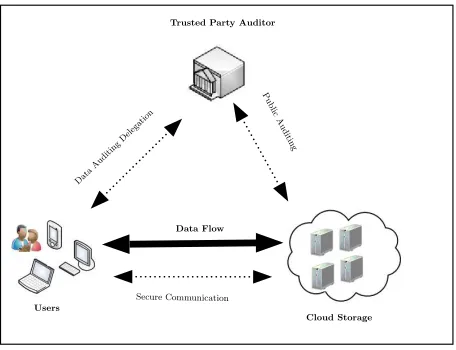
Public auditing is an assurance of the integrity for outsourced data. To over-come this challenge, the trivial solution is to download the whole outsourced data locally, and to check its integrity. However, such a solution is rapidly in-feasible for big data. Trusted party auditor is introduced in order to eliminate the online involvement of users from auditing, to perform verification, and to minimize computational burdens (which can be important to scale the cloud computing) [2, 36]. Henceforth, all the existing auditing schemes in the cloud include three entities: 1) the data owner who outsources her data, 2) the cloud service provider with large amount of storage space and computation power and 3) a honest-but-curious third party auditor that is only responsible for auditing tasks on behalf of the users. Note that the auditor is assumed to be a state-less machine for usability concerns. An illustration of a typical public auditing scheme can be seen in Figure 1.
the cloud storage on behalf of users. Upon receiving the challenges the cloud storage prepares a proof using the challenge, the data and the corresponding signatures. Finally, the trusted party auditor verifies the proof. There are various attacks to be considered in this scenario. On the one hand, a malicious server may apply replace attacks (server may arbitrarily behave, and disobey the challenge and use another valid data block), replay attacks (server generates proofs without querying the actual data), or forgery attacks (server may forge the signatures). On the other, since the auditor is honest-but-curious it can internally try to gather extra information about the data. Therefore, the existence of honest-but-curious trusted party auditor for integrity checking of remotely stored data on the cloud requires additional privacy enhancing solutions. However, conventional cryptographic primitives alone (like symmetric encryption or hash functions) do not suffice to ensure data integrity and privacy on the cloud because these primitives lack certain level of malleability.
Related work.
For a comprehensive survey and taxonomy on remote data auditing we refer to [28, 39]. As stated in [28], data auditing approaches can be grouped into three different models; provable data possession-based (PDP) [5, 15], proof of retrievability-based (POR) [21, 26], and proof of ownership-based (POW) [25]. Studies on remotely stored data auditing problem dates back to Atenieseet al.’s paper in which RSA-based homomorphic tags in PDP model for static data storage scenario is first proposed [5]. Later, they proposed an enhanced PDP model for limited dynamical data storage scenario [6].
Based on [39], it is possible to group auditing methods regarding the utilized methods: Message Authentication Code based [26], RSA-based homomorphic [20,40], the Boneh-Lynn-Shacham (BLS) signatures based homomorphic [9] and algebraic signatures based [11, 41]. Moreover, approaches may also differ for the underlying scenarios; the stored data is assumed to be static [5], dynamic [6,35], shared or version controlled [30].
Based on Wang et al.’s proposals [32–34], in [37] Worku et al. proposed a more efficient auditing protocol based on a variant of the Boneh-Lynn-Shacham (BLS) signature [9]. But later, in [12, 38], the authors give certain linear attacks to the verification phase of Worku et al.’s auditing protocol. We would like to highlight that these attack scenarios are arguable since the proof of data possession by the cloud includes indirectly the valid data and corresponding signatures. Still, these attacks point out security flaws with respect to replace and replay attacks. In particular, an adversary interacts both with the cloud server and with the auditor, and can subsequently manipulate proof generation and verification steps.
An ID-based certificateless scheme is proposed in [31]. However, their param-eter selection in the setup phase uses ordinary elliptic curves in Type 1 bilinear map setting [13]. In the next section, we explain that usage of ordinary elliptic curves in Type 1 setting is very inefficient.
To the best of our knowledge, all the existing auditing schemes try to verify the data integrity with corresponding signatures in case of a dispute. However, if a proof verification step fails, these schemes are not capable of message recovery. This is the starting point of this work. In order to overcome this problem, we propose an efficient privacy-preserving public auditing scheme based on message recoverable signatures. Hence, whenever the proof verification fails, the valid signature itself will be sufficient to recover the original message. The proposed auditing protocol will be utilizing a modified version of Tso et al.’s ID-based message recoverable signature scheme [29]. Tsoet al.’s scheme has a deficiency due to recent quasi-polynomial discrete logarithm attacks [1, 7, 18]. In order to make Tso et al.’s scheme realizable and resistant, we modify their scheme by utilizing a Type 3 bilinear map and without changing its security margins. This approach has the efficiency advantage (due to smaller group sizes) when compared to the existing auditing schemes utilizing a variant of the Boneh-Lynn-Shacham (BLS) short signatures. We prove the security of our protocol by considering each cases, i.e. malicious users, malicious cloud servers and honest-but-curious auditor. We finally compare the complexity of our protocol with the existing auditing schemes.
Roadmap. The rest of the paper is organized as follows: In Section 2, we
give the necessary preliminaries about bilinear maps and our notation. In Section 3, we define the system and the security model. Next, in Section 4, we present our proposed scheme and provide security analysis in Section 5, respectively. We further show the practicality of our schemes in Section 6. Finally, Section 7 concludes the paper.
2
Preliminaries
2.1 Bilinear Maps and DLP Security
Auditing schemes are mostly realized using certain malleability property of the underlying signature primitives. Bilinear maps are one of the good candidate for enabling this property. Efficient construction of bilinear maps uses Weil, Tate or optimal pairings of abelian varieties (e.g. elliptic curves) having reasonably small embedding degrees [13]. Abelian varieties of dimension≤2 (elliptic curves or jacobians of hyperelliptic curves of genus 2 [13]), are the main mathemat-ical objects. Although bilinear maps are used as a black box in our scheme, we revisit preliminaries of the pairing types and pairing-friendly elliptic curves. These choices effect not only the security but also the complexity of the proposed scheme. Unless otherwise stated, we follow the lines of [8, Chapter IX] for the properties of pairings.
Let (G1,+) and (G2,+) be two additive cyclic groups of orderqwithG1=<
Q >andG2=< P >, (G3,·) be a multiplicative cyclic group of orderq, where
q is a prime number and 0G1,0G2 and 1G3 are the identity elements of the
clear from the context we write 0 for the identity elements of G1, G2 and 1 for G3. A bilinear map is a map e: G1×G2 → G3 satisfying the following properties:
– Bilinearity:For allP1, Q1∈G1, P1′, Q′1∈G2,eis a group homomorphism in each component, i.e.
1. e(P1+Q1, P1′) =e(P1, P1′)·e(Q1, P1′), 2. e(P1, P1′+Q′1) =e(P1, P1′)·e(P1, Q′1).
– Non-degeneracy:eis non-degenerate in each component, i.e.
1. For allP∈G1,P 6= 0, there is an elementQ∈G2such thate(P, Q)6= 1, 2. For allQ∈G2,Q6= 0, there is an elementP∈G1such thate(P, Q)6= 1.
– Computability: There exists an algorithm which computes the bilinear
mapeefficiently.
Bilinear maps can be realized by finding a suitable pairing-friendly elliptic curve
E(or more generally an abelian variety) over a finite fieldFl. Then, appropriate
subgroups G1 and G2 are constructed. The group G3 is a subgroup of Flk,
where kis the embedding degree ofE [16]. We revisit the types of realizations of bilinear maps due to its security and efficiency for our auditing scheme. There are essentially 3 types of bilinear maps [17, pp. 3115]:
– Type 1:(G1=G2)G1 is generally determined by a supersingular elliptic curve which is typically defined over a finite field of characteristic 2 and 3.
– Type 2:(G1 6=G2 and there is an efficiently computable homomorphism
φ:G2→G1) In this case,G1 andG2can be realized by using any elliptic curve with small embedding degree. The disadvantage of Type 2 pairings is that there exists no random sampling algorithm fromG2yielding to a secure hash function which maps arbitrary elements toG2, [17, pp. 3119].
– Type 3: (G1 6= G2 and there exists no efficiently computable
homomor-phism φ:G2 → G1) Like in Type 2 pairings,G1 and G2 are determined by constructing an elliptic curve with small embedding degree. Note that a general method transforming protocols from Type 2 to Type 3 is given in [10, Section 5].
Type 3 pairings are the most efficient realization of bilinear maps due to their efficiency (less group operations, more efficient membership testing and bandwidth) [10, pp. 1313]. Furthermore, the protocols based on Type 1 pairings are mostly insecure due to recent quasi-polynomial algorithms on solving discrete logarithms in finite fields and their implications to the weakness of discrete logarithms of supersingular elliptic curves [1, 7, 18]. Additionally, if one uses supersingular elliptic curves over large prime fields, the protocol will be very inefficient since we have the embedding degree k = 2. Type 3 bilinear maps realize more efficient protocols since it is possible to have embedding degree larger than 2 (e.g. typically for Barreto-Naehrig (BN) curves with k = 12 are chosen for optimal efficiency [16]). In this case, the same level of security can be assured with much smaller key sizes.
our proposed scheme [29]. We note that the security assumptions and the proof of security remain unchanged (because no specific property of Type 1 bilinear maps is used in the security proof). The only difference will be the replacement of the precomputed valueµ :=e(P, P) with µ:=e(Q, P) to adapt the scheme into a Type 3 setting.
2.2 Notations
We fix a Type 3 pairinge: G1×G2→G3for the rest of the paper. We mainly follow Tsoet al.’s notation as follow [29]:
– G1 =< Q >, G2 =< P > of prime order q. Let |q| = ℓ1+ℓ2 be the bit length ofq.
– µ: the value ofe(Q, P).
– akb : a concatenation of two bit stringsaand b.
– ⊕: XOR computation in the binary system.
– [x]10 : the decimal notation ofx∈ {0,1}∗.
– [x]2 : the binary notation ofx∈N.
– ℓ2|β|: the firstℓ2bits of β from the left hand side.
– |β|ℓ1 : the firstℓ1bits of β from the right hand side.
– H:{0,1}∗→Z∗
q: a cryptographic one-way hash function.
– H1:{0,1}∗→ {0,1}ℓ1+ℓ2: a cryptographic one-way hash function.
– F1:{0,1}ℓ1 → {0,1}ℓ2: a cryptographic one-way hash function.
– F2:{0,1}ℓ2 → {0,1}ℓ1: a cryptographic one-way hash function.
3
Security Model
In the public auditing scheme there are three different entities as follows:
– A cloud server (S) is a data storage owner to provide data storage services for its users to create, store, update and request for retrievability.Sis assumed to have a large storage space and large computation resources.
– A user (C) is a client who has large amount of data to be stored in the cloud. Furthermore,Cis assumed to delegate the checkability property to a third party whether her data is indeed stored in the cloud correctly.
– A trusted party auditor (TPA) is assumed to be stateless (memoryless) which has expertise and capabilities to check the cloud storage reliability and valid-ity.TPAhas always an interaction withSto check the integrity and validity of users’ data.
In the proposed security model,Cand Sare assumed to be malicious which may arbitrarily deviate from the protocol whereasTPAis assumed to be honest-but-curious (semi-honest) to asses the reliability of S on behalf of the users whenever needed. Hence,SandTPAare deployed by different organizations and are assumed not to collude each other.
Setup:
On input a security parameterκ∈N, the algorithm - outputs a random numbers∈Z∗
qas Key Generator Center (KGC)’s private key
- setsPpub=sP as KGC’s public key.
System parameters: params ={G1,G2,G3, e, q, Q, P, Ppub, µ, H, H1, F1, F2, ℓ1, ℓ2}
KeyGen(1k):
KGC computesC’s private keySIDC= (H(IDC) +s)
−1Q, whereID
C∈ {0,1}∗andPIDC= (H(IDC) +s)P
Cnow generates a random signing key pair (ssk, spk)
Cforms her secret keysk:= (SIDC, ssk) andpk:= (PIDC, spk) as his public parameters.
SigGen(sk, F):
For file naming,C
- chooses a random elementname∈RZqfor the fileF= (m1,· · ·, mn)
- computes the file tag ast=name||Sigssk(name) with a signature on the elementname.
By picking random elementri
1∈RZ∗q, for each blockmi∈ {0,1}ℓ1,Cgenerates a signatureσias follows:
- for simplicity denotewi:=H(i||name),
- computesµri
1andR
i:=ri1Q
- computesαi=H1(IDC, µr
i
1)∈ {0,1}ℓ1+ℓ2 ,
- computesβi=F1(mi)k(F2(F1(mi))⊕mi) andr2i= [αi⊕βi]10,
- computesUi= (ri1+wi+ri2)SIDC.
The signatureσionmiis (r2, Ui i).Cthen sends{φ={σi}1≤i≤n, ψ={Ri}1≤i≤n, t}toS.
Signature Verification and Message Recovery: Upon receiving the signatures fromC,S:
- computes ˜αi=H1(IDC, e(Ui, PIDC)µ
−(ri
2+wi)) and ˜β
i= [ri2]2⊕α˜i,
- recovers the message ˜mi=|β˜i|ℓ1⊕F2(ℓ2|β˜i|),
- outputs 1 and acceptsσias a valid signature of the message ˜mi(=mi) if and only ifℓ2|β˜i|=F1( ˜mi).
- extracts eachmifor 1≤i≤nand stores (F={mi}1≤i≤n, φ={σi}1≤i≤n, ψ={Ri}1≤i≤n, t).
Proof of the Signature and Message Recovery:
e(Ui, PIDC)·µ
−(ri
2+wi)=e((ri
1+wi+ri2)·SIDC, PIDC)·e(Q, P)
−(ri
2+wi)
=e(SIDC, PIDC)
(ri
1+wi+ri2)·e(Q, P)−(r2i+wi)
=e((H(IDi) +s)−1Q,(H(IDi) +s)P)(r i
1+wi+r
i
2)·e(Q, P)−(r
i
2+wi)
=e(Q, P)(ri
1+wi+r
i
2)·e(Q, P)−(r
i
2+wi)
=e(Q, P)ri
1
=µri
1.
Message Recovery:
Ifσiis valid, thenH1(IDC, µri) =αiandF1(mi)k(F2(F1(mi))⊕mi) =βi= [ri2]2⊕αi. Hence,
|βi|ℓ1⊕F2(ℓ2|βi|) = (F2(F1(mi))⊕mi)⊕F2(F1(mi)) =mi.
– Public verifiability: It allowsTPA to verify the correctness of cloud data without retrieving the entire data or without having online connections with the cloud users.
– Storage correctness:It ensures that a server can pass TPA’s verification
only if it indeed keeps user’s data.
– Privacy-preserving: It assures that no information about data is leaked
toTPAduring the auditing process.
4
Our Proposed Public Auditing Scheme
A privacy-preserving public verifiable auditing scheme consists of basically four algorithms KeyGen, SigGen, GenProof and VerifyProof. KeyGen and SigGen
are performed by the Client Cto generate public/private keys, signatures and related information.
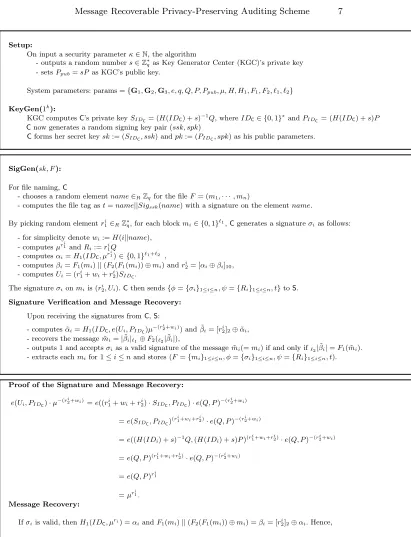
We assume thatCpartitions the fileF into nblocksm1, m2, . . . , mn, where each blockmi ∈ {0,1}ℓ1 for processing the data. The proposed scheme is illus-trated in Figure 2.
WheneverTPAstarts the auditing protocol, the tagtfor the fileFis retrieved and validated by usingspk, and the process is ended if the test fails. Next,TPA randomly choosesx1, x2∈RZ∗q, constructs a challengechal={{sj, vsj}1≤j≤c, P1= x1·P, H(x1||x2)}, where{sj}1≤j≤cis a random subset withSc:={s1,· · ·, sc} ⊆
{1,· · ·, n} and {vsj}1≤j≤c are random mask values for sj ∈ Sc. TPA
subse-quently sendschalto S.
GenProof(F, φ, ψ, chal) After receiving the challengechal={{sj, vsj}1≤j≤c, P1= x1·P, H(x1||x2)},S picks firstly a random maskλ∈RZq, then computes
Φ:=λ·
c
X
j=1
vsj ·Usj andΨ :=λ·
c
X
j=1
vsj ·(Rsj+r
sj
2 ·Q),
and finally sends (Φ, e(Ψ, P1), e(Q, λ·P)) toTPA.
VerifyProof(chal, Φ, e(Ψ, P1), e(Q, λ·P)) TPA checks
e(Φ, x1x2PIDC) ?
=e(Ψ, P1)x2·e(Q, λP)x1x2 Pc
j=1vsjwsj .
5
Security Analysis
5.1 Termination and Correctness
Theorem 1. The algorithm of the above described public verifiable auditing
Proof. First of all, note that
e(SIDC, PIDC) =e((H(IDC) +s)−1·Q,(H(IDC) +s)·P)
=e(Q, P)(H(IDC)+s)−1·(H(IDC)+s)
=µ .
Then, the result follows by using bilinear property ofe:
e(Φ, x1x2PIDC) =e(Φ, PIDC)x1x2
=e λ c X j=1
vsj(r
sj
1 +wsj +r
sj
2 )·SIDC, PIDC
x1x2
=e(SIDC, PIDC)λx1x2 Pc
j=1vsj(r
sj
1 +wsj+r
sj
2 )
=e(Q, P)λx1x2
Pc j=1vsj(r
sj
1 +wsj+r
sj
2 )
=e(Q, P)λx1x2
Pc j=1vsj(r
sj
1 +r
sj
2 )+λx1x2
Pc
j=1vsjwsj
=e(Q, P)λx1x2
Pc
j=1vsj(r1sj+r
sj
2 )·µλx1x2
Pc j=1vsjwsj
=e λ c X j=1
vsj r
sj
1 ·Q+r sj
2 ·Q
, x1·P
x2
·
e(Q, λ·P)x1x2Pcj=1vsjwsj
=e(Ψ, P1)x2·e(Q, λ·P)x1x2 Pc
j=1vsjwsj .
⊓ ⊔
5.2 Security Against Cloud Provider
Theorem 2. TPA passes the verification of the auditing successfully only if S
possesses truly the specified data.
Proof. In this case, the cloud server is treated as an adversary and the TPA is treated as a challenger controlling the random oracle. If there is a non-negligible probability in the adversary’s success, we can construct a simulator that can solve the computational Diffie-Hellman problem.
Let (Φ, e(Ψ, P1), e(Q, λ·P)) be the output of an honestS. Then, it satisfies
e(Φ, x1x2·PIDC) =e(Ψ, P1)x2·e(Q, λ·P)x1x2 Pc
j=1vsjwsj.
Given for the samex1, x2 andλ, let (Φ′, e(Ψ′, P1), e(Q, λ·P)) be the adversary’s response satisfying
e(Φ′, x
1x2·PIDC) =e(Ψ′, P1)x2e(Q, λ·P)x1x2 Pc
Dividing both equations, we obtain the equality
e(Φ−Φ′, x
1x2·PIDC) =e(Ψ−Ψ′, P1)x2 More concretely, we have
e λ c X j=1
vsj r
sj
1 +r sj
2 −r′1 sj
−r′
2 sj
·Q, x1·P
x2 =e λ c X j=1
vsj r
sj
2 −r′2 sj
·Q, x1·P
x2
By letting∆rsj
1 :=r
sj
1 −r′1
sj and∆
r2sj :=r
sj
2 −r′2
sj, we get
e λ c X j=1
vsj
∆rsj
1 +∆r
sj
2
·Q, x1·P
x2 =e λ c X j=1
vsj
∆rsj
2
·Q, x1·P
x2
,
and dividing right hand side to the left hand side, we obtain the following:
e λ c X j=1
vsj
∆rsj
1
·Q, x1x2·P
= 1 .
In order to obtain this equality we must haveλPc
j=1vsj∆rsj1 ≡0 modq. This
only holds if
∆rsj
1 ≡0 modq .
The probability of this event is 1/qwhich is negligible, thereforersj
1 =r′1
sj for allsj.
If the adversaries success probability in this case is non-negligible, we can con-struct a simulator that can solve the discrete logarithm problem as follows:
Usj −U
′
sj =(r
sj
1 +wsj +r
sj
2 )·SIDC
−(r′sj
1 +wsj+r
′sj
2 )·SIDC =(rsj
2 −r′ sj
2 )·SIDC .
Hence, the simulator can compute
SIDC = (r sj
2 −r
′sj
2 )−1·(Usj −U
′
sj).
Table 1.Complexity of the Proposed Protocol
FMult FExp ECSMult BCompBandwidth betweenTPAandS TPA c+ 3 2 2 1 logn+ 3(ℓ1+ℓ2)
S c 1 3c+ 2 1 3(ℓ1+ℓ2)
Table 2.Comparison with Previous Results (Considering onlyTPA)
FMult FExp ECSMult BCompMessage Recoverable Wanget al.[32] 1 0 c+ 3 2 ✗
Workuet al.[37] 0 0 c+ 1 2 ✗
Ours c+ 3 2 2 1 X
Theorem 3. A maliciousS cannot perform replay and replace attacks. In
par-ticular,S cannot generate proofs without querying or computing the actual data or cannot modify the data and its signatures.
Proof. The only reason for integratingP1=x1·PandH(x1||x2) into the equation by TPA is to prevent replay attack of S. For instance, when x2 = 1, S can manipulate the exponents simply by using the bilinear properties of the pairing function e. More concretely, if x1 andx2 were excluded in our scheme,S could easily manipulate theΦ, Ψ values accordingly and could pass successfully since S knows whatTPA will compute at the verification phase. That is, one could modify the data by adding any random element to the exponents on both sides of the equality which passes the validation step ofTPAsince it would not affect the equality. Hence, randomizing the exponent with the valuex2enables to prevent
replay attacks. ⊓⊔
5.3 Security Against TPA
Theorem 4. An honest-but-curiousTPA cannot obtain any information about
the message blocks F ={m1, . . . , mt}.
Proof. TPA sends a challenge set and obtains a valid response of the proof (Φ, e(Ψ, P1), e(P, λ·P)). The challenges are completely random and are inde-pendent of the message blocks. Moreover, each signature block is multiplied with a random elementλwhich randomizesΦ, Ψ andP. ⊓⊔
6
Complexity Analysis
constant rounds therefore will be omitted. Note that the complexity between the client C and the serverS is pretty standard, i.e., authentication and gen-eration/verification of signatures are used. Both BLS like short signatures and message recoverable signatures are used to minimize the communication cost betweenCandS. Although our modified message recoverable signature scheme for auditing purposes seems to add extra complexity overhead toS, our Type 3 version of Tso et al.’s [29] protocol tolerates the additional complexity. In this way, message recoverable signatures with Type 3 protocols considerably hinder possible disadvantages of communication overhead due to more efficient choice of underlying group structures. Since auditing is the main concern of this work and due to space constraints, we omit the further details about complexity between CandS.
In Table 1, we demonstrate both computation and communication overhead of our auditing protocol (for bothSandTPA) by counting basic group operations including field multiplication (FMult), field exponentiation (FExp), elliptic curve scalar multiplication (ECSMult), and bilinear computation (BComp).
In Table 2, we compare our auditing protocol with the recently proposed auditing schemes using BLS like structures of Wang et al. and Worku et al.
[32, 37]. The number of operations has been calculated for only TPA because in real-life scenariosTPA is assumed to be a stateless machine and has rather low computational power with respect to S. Therefore, it is essential to reduce the computational overhead for TPA. Table 2 shows that the computational complexity of TPA in our scheme is significantly better. More concretely, we only need 2 ECMults and only 1 BComps whereas others need elliptic curve scalar multiplications increasing linearly inc and 2 bilinear pairings.
6.1 Further Discussion: Reducing Number of Group Elements
For the communication overhead betweenCandSone can observe the following. In our scheme, the user sends the group elements
{φ={σi}1≤i≤n, ψ={Ri}1≤i≤n, t}
to S. Since we have groups of orderq, 3n(ℓ1+ℓ2) bits are required to be trans-mitted for a single run of the message recoverable signature scheme. This can be reduced to transmission of 2n(ℓ1+ℓ2) bits of information, hence gaining a linear factor on the block size of a message. The reason comes from the following simple observation:
Instead of working with a groupG1of prime orderq, at the beginning one can simply choose a groupG1 having orderN =p1p2, wherep1 andp2are different prime numbers with bit lengths ℓ∗
1, ℓ∗∗1 respectively such that ℓ1 = ℓ∗1+ℓ∗∗1 . Furthermore, by Chinese Remainder Theorem we have the property that
G1∼=H1×H2,
the message blocksmi, the user sends the blocks ˜mi=mi||Ri by restricting the elementsmi∈H1andRi∈H2, respectively. We note that we need to have the property that the DLP has to be intractable in bothH1andH2, since otherwise Pohling-Hellman reduction technique solves DLP also in G1 [13].
In order to construct a groupG1 with composite order, we need to generate pairing friendly abelian varieties using complex multiplication techniques [16]. Due to our efficiency concerns, we need to construct elliptic curves having composite orders and reasonably small embedding degree k such as k = 1 or
k = 2 [16]. Hence, this idea would be impractical due to underlying key sizes. We note that it would be interesting to find an efficient way of reducing the communication complexity to 2n(ℓ1+ℓ2) by using Type 3 bilinear maps with prime or nearly prime order.
7
Conclusion
In this study, we proposed the first privacy-preserving public auditing scheme using ID-based message recoverable signatures. In all existing schemes, the server has to protect the messages together with their corresponding signatures. Our scheme is robust, in the sense that the messages will be still recoverable unless the signatures are damaged. We prove the security of our scheme against forgery, replay and replace attacks in the random oracle model. We give the efficiency and the complexity comparisons of our scheme with the previously proposed auditing schemes and show that our scheme is significantly more efficient than the most efficient auditing schemes based on BLS like short signatures. In par-ticular, the complexity of the stateless third party auditor has been considerably improved. Unlike previous schemes, we chose a variant of Type 3 version of mes-sage recoverable signature scheme to achieve a desired security level with small key sizes and to optimize the efficiency.
Acknowledgments. Kiraz’s research is supported by a grant from Ministry of
Development of Turkey provided to the Cloud Computing and Big Data Research Lab Project. Uzunkol’s research is supported by the project (114C027) funded by EU FP7-The Marie Curie Action and T ¨UB˙ITAK (2236-CO-FUNDED Brain Circulation Scheme). Uzunkol’s work is also partly supported by a joint research project funded by Bundesministerium f¨ur Bildung und Forschung (BMBF), Ger-many (01DL12038) and T ¨UB˙ITAK, Turkey (TBAG-112T011).
References
1. Adj, G., Menezes, A., Oliveira, T., Rodr´ıguez-Henr´ıquez, F.: Weak-ness of F36·509 for discrete logarithm cryptography. In: Pairing-Based
Cryptography - Pairing 2013 - 6th International Conference, Beijing, China, November 22-24, 2013, Revised Selected Papers. pp. 20–44 (2013),
2. Alliance, C.S.: Security guidance for critical areas of focus in cloud computing (2009),http://www.cloudsecurityalliance.org
3. Amazon.com: Amazon s3 availability event: July 20, 2008 (2008),
http://status.aws.amazon.com/s3-20080720.html
4. Arrington, M.: Gmail disaster: Reports of mass email deletions (2006),
http://www.techcrunch.com/2006/12/28/gmail-disasterreports-of-mass-email-deletionsTech Crunch Web Article
5. Ateniese, G., Burns, R., Curtmola, R., Herring, J., Kissner, L., Peterson, Z., Song, D.: Provable data possession at untrusted stores. Cryptology ePrint Archive, Re-port 2007/202 (2007),http://eprint.iacr.org/2007/202
6. Ateniese, G., Pietro, R.D., Mancini, L.V., Tsudik, G.: Scalable and efficient provable data possession. Cryptology ePrint Archive, Report 2008/114 (2008),
http://eprint.iacr.org/2008/114
7. Barbulescu, R., Gaudry, P., Joux, A., Thom´e, E.: A quasi-polynomial algorithm for discrete logarithm in finite fields of small characteristic. CoRR abs/1306.4244 (2013)
8. Blake, I., Seroussi, G., Smart, N., Cassels, J.W.S.: Advances in Elliptic Curve Cryptography (London Mathematical Society Lecture Note Series). Cambridge University Press, New York, NY, USA (2005)
9. Boneh, D., Lynn, B., Shacham, H.: Short signatures from the weil pairing. In: Boyd, C. (ed.) Advances in Cryptology, ASIACRYPT 2001, Lecture Notes in Computer Science, vol. 2248, pp. 514–532. Springer Berlin Heidelberg (2001),
http://dx.doi.org/10.1007/3-540-45682-1_30
10. Chatterjee, S., Menezes, A.: On cryptographic protocols employing asymmetric pairings - the role of ψ revisited. Discrete Applied Mathematics 159(13), 1311– 1322 (2011),http://dx.doi.org/10.1016/j.dam.2011.04.021
11. Chen, L.: Using algebraic signatures to check data possession in cloud storage. Future Generation Computer Systems 29(7), 1709 – 1715 (2013)
12. Chen, Y., Chou, J.S.: Crypto-analyses on ”secure and efficient privacy-preserving public auditing scheme for cloud storage”. Cryptology ePrint Archive, Report 2014/723 (2014),http://eprint.iacr.org/2014/723
13. Cohen, H., Frey, G., Avanzi, R., Doche, C., Lange, T., Nguyen, K., Vercauteren, F.: Handbook of elliptic and hyperelliptic curve cryptography. Chapman & Hall, Boca Raton, FL, 1st edn. (2006)
14. Ferdowsi, A.: Dropbox blog. yesterday’s
authen-tication bug (2011 (Accessed 15 April 2015)),
http://blog.dropbox.com/index.php/yesterdays-authentication-bug
15. Filho, D.L.G., Barreto, P.S.L.M.: Demonstrating data possession and uncheat-able data transfer. Cryptology ePrint Archive, Report 2006/150 (2006),
http://eprint.iacr.org/2006/150
16. Freeman, D., Scott, M., Teske, E.: A taxonomy of pairing-friendly elliptic curves. Journal of Cryptology 23(2), 224–280 (2010)
17. Galbraith, S.D., Paterson, K.G., Smart, N.P.: Pairings for
cryp-tographers. Discrete Appl. Math. 156(16), 3113–3121 (Sep 2008),
http://dx.doi.org/10.1016/j.dam.2007.12.010
18. Granger, R., Kleinjung, T., Zumbr¨agel, J.: Breaking ’128-bit secure’ supersingular binary curves - (or how to solve discrete logarithms in F24·1223 and F212·367). In:
19. Group, T.T.W.: The notorious nine: Cloud computing top threats in 2013 (2013 (Accessed 15 April 2015)),https://downloads.cloudsecurityalliance.org
20. Hao, Z., Zhong, S., Yu, N.: A privacy-preserving remote data integrity checking protocol with data dynamics and public verifiability. Knowledge and Data Engi-neering, IEEE Transactions on 23(9), 1432–1437 (Sept 2011)
21. Juels, A., Kaliski, Jr., B.S.: Pors: Proofs of retrievability for large files. In: Proceedings of the 14th ACM Conference on Computer and Communica-tions Security. pp. 584–597. CCS ’07, ACM, New York, NY, USA (2007),
http://doi.acm.org/10.1145/1315245.1315317
22. Kincaid, J.: Mediamax/the linkup closes its doors (2008),
http://www.techcrunch.com/2008/07/10/mediamaxthelinkup-closes-its-doorsTech Crunch Web Article
23. Liu, B., Chen, Y.: Auditing for data integrity and reliability in cloud storage. In: Khan, S.U., Zomaya, A.Y. (eds.) Handbook on Data Centers, pp. 535–559. Springer New York (2015), http://dx.doi.org/10.1007/978-1-4939-2092-1_17
24. Liu, C., Ranjan, R., Zhang, X., Yang, C., Chen, J.: A big picture of integrity verification of big data in cloud computing. In: Khan, S.U., Zomaya, A.Y. (eds.) Handbook on Data Centers, pp. 631–645. Springer New York (2015),
http://dx.doi.org/10.1007/978-1-4939-2092-1_21
25. Mandagere, N., Zhou, P., Smith, M.A., Uttamchandani, S.: Demystifying data deduplication. In: Proceedings of the ACM/IFIP/USENIX Middleware ’08 Con-ference Companion. pp. 12–17. Companion ’08, ACM, New York, NY, USA (2008),
http://doi.acm.org/10.1145/1462735.1462739
26. Shacham, H., Waters, B.: Compact proofs of retrievability. In: Pieprzyk, J. (ed.) Advances in Cryptology - ASIACRYPT 2008, Lecture Notes in Com-puter Science, vol. 5350, pp. 90–107. Springer Berlin Heidelberg (2008),
http://dx.doi.org/10.1007/978-3-540-89255-7_7
27. Shah, M.A., Swaminathan, R., Baker, M.: Privacy-preserving audit and extrac-tion of digital contents. Cryptology ePrint Archive, Report 2008/186 (2008),
http://eprint.iacr.org/
28. Sookhak, M., Talebian, H., Ahmed, E., Gani, A., Khan, M.K.: A review on remote data auditing in single cloud server: Taxonomy and open issues. Journal of Network and Computer Applications 43(0), 121 – 141 (2014)
29. Tso, R., Gu, C., Okamoto, T., Okamoto, E.: Efficient id-based digital signatures with message recovery. In: Cryptology and Network Security, Lecture Notes in Computer Science, vol. 4856, pp. 47–59. Springer Berlin Heidelberg (2007) 30. Wang, B., Li, B., Li, H.: Oruta: privacy-preserving public auditing for shared data
in the cloud. Cloud Computing, IEEE Transactions on 2(1), 43–56 (Jan 2014) 31. Wang, B., Li, B., Li, H., Li, F.: Certificateless public auditing for data integrity in
the cloud. In: Communications and Network Security (CNS), 2013 IEEE Confer-ence on. pp. 136–144 (Oct 2013)
32. Wang, C., Chow, S., Wang, Q., Ren, K., Lou, W.: Privacy-preserving public au-diting for secure cloud storage. Computers, IEEE Transactions on 62(2), 362–375 (Feb 2013)
33. Wang, C., Ren, K., Lou, W., Li, J.: Toward publicly auditable secure cloud data storage services. Network, IEEE 24(4), 19–24 (July 2010)
35. Wang, Q., Wang, C., Li, J., Ren, K., Lou, W.: Enabling public verifiability and data dynamics for storage security. Cryptology ePrint Archive, Report 2009/281 (2009),http://eprint.iacr.org/2009/281
36. Wang, Q., Wang, C., Ren, K., Lou, W., Li, J.: Enabling public auditability and data dynamics for storage security in cloud computing. Parallel and Distributed Systems, IEEE Transactions on 22(5), 847–859 (May 2011)
37. Worku, S.G., Xu, C., Zhao, J., He, X.: Secure and efficient privacy-preserving public auditing scheme for cloud storage. Computers and Electrical Engineering 40(5), 1703 – 1713 (2014)
38. Xu, C., Zhang, Y., Yu, Y., Zhang, X., Wen, J.: An efficient provable secure public auditing scheme for cloud storage. KSII Transactions on Internet and Information Systems 8(11), 4226 – 4241 (2014)
39. Yang, K., Jia, X.: Data storage auditing service in cloud computing: chal-lenges, methods and opportunities. World Wide Web 15(4), 409–428 (2012),
http://dx.doi.org/10.1007/s11280-011-0138-0
40. Yu, Y., Au, M., Mu, Y., Tang, S., Ren, J., Susilo, W., Dong, L.: En-hanced privacy of a remote data integrity-checking protocol for secure cloud storage. International Journal of Information Security pp. 1–12 (2014),
http://dx.doi.org/10.1007/s10207-014-0263-8