Vol. 4, Issue 9, September 2015
A Study On Power System Automation
Ankita Pai1, Tejas Kopte2
U.G. Student, Dept. of Electrical Engineering, Sardar Patel College of Engineering, Mumbai, India1
U.G. Student, Dept. of Electrical Engineering, Sardar Patel College of Engineering, Mumbai, India2
ABSTRACT: Power providers continuously face problems to reduce costs and improve productivity. Therefore steps are taken to make smarter devices that can collect and communicate information. Automation is defined as the usage of machines thus eliminating human efforts to finish a task. It helps in improving overall system productivity and the time needed to do a task is reduced. Power system Automation can be defined as managing, protecting and controlling an electrical power system. Real time information is obtained from systems having local and remote control applications with advanced power system protection. This paper deals with the architecture of Power system automation and its usage in the industry along with its future scope and technologies.
KEYWORDS: Automation, SCADA, IED, Substation Automation, Distribution Automation
I.INTRODUCTION
Automation is doing jobs without the help of skill and labor of man. It uses the automatic methods in labs, homes, factories, research centers. It assists in doing tasks beyond man’s capabilities. Automation goes back earlier than transmission and Distribution.
Electric Utilities constantly face the problems of providing power at competitive prices. Due to accidents, lightning and natural incidents power failures occur resulting in interruption of power supply. Therefore power systems should be monitored and controlled effectively to take timely actions and ensure uninterrupted supply of power.
Power system automation is defined as the automatically collecting information and taking decision with the help of Instrumentation and Control devices. These devices monitor, protect and control the power system. It includes processes involved in generation and distribution of power. Power system Automation depends on data communications, local intelligence along with supervisory monitoring and control.
In earlier times plant processes were manually supervised .This needed the operator/supervisor to be at the plant all the time which was not possible. Automation has solved this problem and can be mechanical, economical, computerized or a combination.
Vol. 4, Issue 9, September 2015
II.TYPES OF POWER SYSTEM AUTOMATION
A. Substation Automation
At substations functions such as automatic reclosing, capacitor switching and reclosing are performed. Earlier these functions used to be performed with the help of devices such as relays, switches, lights and transducers. Currently Intelligent Electronic Devices [IED] consisting of programmable logic controllers and communication ports which send data and carry out control commands like meters, specialized sensor and relays. Inside the substation the expensive cables are replaced by local area networks to send data and execute control commands. Many techniques are available to send data outside the substation like telephone lines, dial up phone lines, cellular telemetry and fiber optic networks. This results in transmitting information at lesser cost per bit. PLC and other techniques enable to obtain more information about power system variables and equipment’s. Information is obtained regarding location of fault and its analysis.
B. Distribution Automation
Distribution Automation systems are defined as those which allow to coordinate, analyse and operate components from further locations.
Features of Distribution Automation include:-
Improved public image
Better information
Increased System Efficiency
Consumer Satisfaction Reduced Expenses
Goals of Distribution Automation:- Less Costs
Improve service
Improve reliability of Service Improve Government Relations Automation also includes:
Energy Management systems:VAR, voltage and generation control and monitoring, load flow studies.Fault analysis and equipment maintenance
III.STRUCTURE
Power system Automation consists of the following components:- A. Data acquisition
B. Supervision
C. Electrical Protection D. Control:-
Control involves local and remote control. Local control is the steps that the controller can take such as synchronizing check and switching sequences. There is little risk of human error involved. Remote control, controls the substation via SCADA master.. Advantage offered is of faster operation. Examples include switching of circuit breaker in case of fault and request certain information via system. The operator has an overall view of the system enabling speedier decision making. Production losses are also reduced.
Vol. 4, Issue 9, September 2015
Measurement:- Measurement involves electrical measurements such as power factor, current, voltage and harmonics. Analog measurements and disturbance recordings for fault analysis. This information about the station is obtained from the control room or central database.
This prevents the operator/engineer from going to the station to obtain information thus assisting in worker safety and work is reduced. The information obtained can help in network studies, preventing faults and disturbances which cause large amount of losses.
Monitoring:- Sequence of events , status and condition monitoring. This can help in locating the fault and take preventive measures
Data Communication:- Without data communication , power system automation cannot function. This can help to locate the fault and take preventive measures.
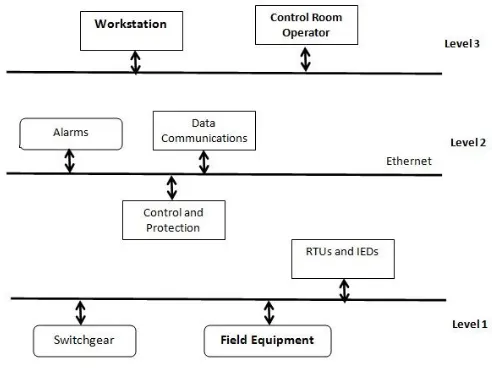
Fig2. Functional structure of Power System Automation
IV.SYSTEM REQUIREMENTS
An automation scheme shall have the following features
Controlling and monitoring the system equipment from a central point Interface to SCADA system
Management of Energy
Control and monitoring of electrical equipment in a bay locally System data base management
V.POWER SYSTEM AUTOMATION ARCHITECTURE
Three divisions make up the structure of power automation system
1) Object Division- object division of power system automation consists of RTU’s, IED’S and relays. The current and potential transformers, transducers provide the analog inputs or digital inputs from IED’S, auxiliary contacts. They perform arithmetic and logical operations and provide outputs to SCADA master or back to switchgear.
The component level consists of bay level (IED,RTU) and process level (information from current and potential transformer)
Vol. 4, Issue 9, September 2015
3) SCADA Master: - It performs the function of control of the entire automation system. It accepts data, takes decision regarding the data stores it and then sends commands to other remote devices. The SCADA master is made up of a PCand software package or a workstation. The installation maybe one master in control of several substations or the SCADA stations might form a LAN or WAN with the master controlling the sub-stationon.
Fig 3. Architecture of Power system automation
VI. SYSTEM COMPONENTS
1) I&C devices built using microprocessors are referred as intelligence electronic devices. Example of IED is a numerical relay. They are found in the substation and processes can be run into IED and communication handled through communication port on the computer.
2) Bay module (Remote Terminal Unit) it is an IED installed at remote locations. It collects data (analog, digital and status) and transmits it in suitable form to SCADA master.
3) Human Machine Interface includes a computer such as desktop computer or laptop with the necessary software installed in case of permanently installed HMI. A communication bus links the various devices.
4) A link to SCADA system- It may be provided by interface unit, or part of HMI computer or IED. The link is used to communicate outside the substation,
A. Power system Integration
Power system Integration is defined as the act of transmitting data to and from the instrumentation and control devices and remote users. Substation integration is combining data from the IED to substation such that there is a single contact point for all data. IED’s perform automation and integration in some cases. They perform data acquisition and IED control. The server plays the role of a client or master by collecting data and transmitting data to other devices as a slave in the communication industry. The data concentrator amasses data from various other devices. It transmits data between Intelligence electronic devices that are not directly connected. In this way through one data transfer data is transmitted. The archive client/server archives data obtained from devices and this archived data is retrieved in case of need.
VII.THREATS IN POWER SYSTEM AUTOMATION
Vol. 4, Issue 9, September 2015
Communication links again suffer from same problems faced by a computer such an interception of password and data. Information can be intercepted by unauthorized people. Similarly SCADA software suffers from attacks like intercepting, interruption and modification. The data must be encrypted to protect it from competition.
A. Counter Measures
The following measures are undertaken to eliminate threats.
Equipment location- Since the equipment is located in remote locations they must be mounted or housed.
Remote access- Password protection, encryption must be done for access to IED, RTU and relays.
Human element: No unauthorized person must access the system without authentication or smart card access.
VIII. ADVANTAGES AND DISADVANTAGES OF AUTOMATION
A. Advantages
1) Better quality of service and reduction in labor required
2) Reduced operating costs
3) Flexible payment options and less outage minutes
4) Improved access to information for customers and to take decisions
5) Portable and less maintenance costs
B. Disadvantages
1) Absence of trained personnel
2) Large initial capital investments
3) Troubled Alarms
C. Primary Applications
1) Telemetry: - It measures the amount of energy which is consumed. Data which is gathered daily from the bays is sent to the energy provider’s server. The data is coded and sent through GPS, GSM making ut available at remote locations.
2) Tele protection: - Digital connection between two or three different facilities is ensured so that certain protection facilities can be carried out which are dependent on data from more than one substation.
3)Equipment Supervision;- This performs equipment maintenance functions such as direct voltage batteries and transformers .Performance improvement and wear and tear is prevented by change of settings.
IX. FUTURE SCOPE AND CONCLUSION
Vol. 4, Issue 9, September 2015
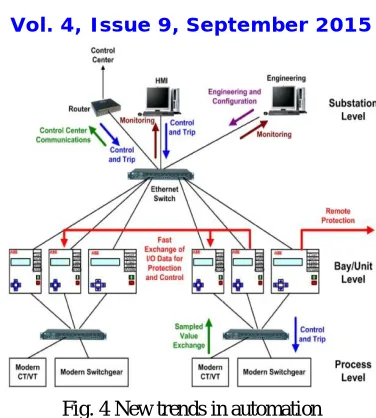
Fig.4 New trends in automation
Fig. 4 New trends in automation
In future the control systems will supervise the systems, rather than controlling it. The system will incorporate the latest technologies and use multiple communication channels. The operator interface will become the human computer interface allowing collaboration between interested parties enabling them to participate in optimization and operation of plant. This development is already going forward.
Automation systems are now network enabled and becoming communication channels and real time information is provided to those which give input to the decision making process. Wireless stations can get information about field devices and allow technicians to make configuration analysis.
In the future computers will be at the power plant but the operator will be somewhere else. Data will be available through portals to the outside world with the aim to optimize process and operation costs are reduced. Thus using this technology and hardware reliability of future automation systems will be improved.
REFERENCES
[1] James Northcote – Green and Robert G. Vision, “Control and Automation of Electrical Power Distribution Systems” [2] Edward Chikuni “Concise Higher Electrical Engineering”, Juta Academic Publishers, 2008
[3] Cobus Strauss, “Practical Electrical Network Automation and Communication System” [4] Alstom Grid, “Network Protection and Automation Guide”, Edition May 2011
[5]“Automation Solution Guide, Schneider Electric Industrial Automation”, 1st edition, volume 6, IDC Engineering Pocket Guide
[6] Vadiati M., Ghorbani MA, Ebrahimi, , “Future Trends of Substation Automation System by applying IEC 61850”, M. Universities Power Engineering Conference 2008, UPEC 2008, 43rd International
[7] Wikipedia the free encyclopedia
[8] Programmable logic controllers from Siemens — for tailor-made performance: http://www.automation.siemens.com/mcms/programmable-logiccontroller/en/pages/default.aspx