Electronic Thesis and Dissertation Repository
12-12-2013 12:00 AM
Flexible Partially Linear Single Index Regression Models for
Flexible Partially Linear Single Index Regression Models for
Multivariate Survival Data
Multivariate Survival Data
Na Lei
The University of Western Ontario
Supervisor Wenqing He
The University of Western Ontario
Graduate Program in Statistics and Actuarial Sciences
A thesis submitted in partial fulfillment of the requirements for the degree in Doctor of Philosophy
© Na Lei 2013
Follow this and additional works at: https://ir.lib.uwo.ca/etd
Part of the Biostatistics Commons, Multivariate Analysis Commons, and the Survival Analysis
Commons
Recommended Citation Recommended Citation
Lei, Na, "Flexible Partially Linear Single Index Regression Models for Multivariate Survival Data" (2013). Electronic Thesis and Dissertation Repository. 1802.
https://ir.lib.uwo.ca/etd/1802
This Dissertation/Thesis is brought to you for free and open access by Scholarship@Western. It has been accepted for inclusion in Electronic Thesis and Dissertation Repository by an authorized administrator of
FLEXIBLE PARTIALLY LINEAR SINGLE INDEX REGRESSION
MODELS FOR MULTIVARIATE SURVIVAL DATA
(Thesis format: Monograph)
by
Na Lei
Graduate Program in Statistical and Actuarial Sciences
A thesis submitted in partial fulfillment
of the requirements for the degree of
Doctor of Philosophy
The School of Graduate and Postdoctoral Studies
The University of Western Ontario
London, Ontario, Canada
c
Survival regression models usually assume that covariate effects have a linear form.
In many circumstances, however, the assumption of linearity may be violated. The
present work addresses this limitation by adding nonlinear covariate effects to survival
models. Nonlinear covariates are handled using a single index structure, which allows
high-dimensional nonlinear effects to be reduced to a scalar term. The nonlinear single
index approach is applied to modeling of survival data with multivariate responses, in
three popular models: the proportional hazards (PH) model, the proportional odds
(PO) model, and the generalized transformation model. Another extension of the
PH and PO model is the handling of the baseline function. Instead of modeling it in
a parametric way, which is fairly restrictive, or leaving it unspecified, which makes
it impossible to calculate the survival and hazard functions, a weakly parametric
approach is used here. As a result, the full likelihood can be applied for inference.
The new developments are realized by adding a number of weakly parametric
elements to the standard parametric regression models. The marginal baseline
haz-ard functions are modeled using piecewise constants. Marginal survival functions are
combined in using copula models, such as the Clayton model, to incorporate
associa-tion among the multivariate responses. The nonlinear covariate effect is brought into
the model through a smooth function with the single-index structure as the input.
The smooth function is modeled using a spline.
The performance of the PH, PO, and transformation models with the proposed
extensions is evaluated through extensive simulation studies. The PH and PO
mod-els are also applied to a real-world data set. The results suggest that the proposed
methods can capture the nonlinear covariate effects well, and that there is benefit to
modeling the association between the correlated responses. Individual-level survival
or hazard function estimates also provide information of interest to researchers. The
proposed transformation model in particular is very promising. Some discussion of
how this model may be further developed is provided.
Keywords: Proportional hazard model, proportional odds model, linear transfor-mation model, spline function, partially linear single index model, Clayton model.
All material presented in this thesis was completed under the supervision of Dr.
Wen-qing He. Dr. He provided valuable insight for the ideas behind the material. The
majority of the work associated with implementing this research was done by myself.
Dedicated to the memory of Lanying Ma and Lawrence Wolters
I would like to express sincere gratitude to my supervisor, Dr. Wenqing He, for his
guidance and support throughout my study at UWO. Especially during the time of
conducting this thesis, he gave me very valuable suggestions and showed me the way
of scientific thinking. It was truly a pleasure to be his student and learn from him.
I also want to thank him for his constant support and understanding in my difficult
times. Without him, this thesis would not have been completed.
My appreciation goes to Dr. Xuewen Lu, Dr. Bruce Jones, Dr. Mark Reesor and
Dr. Xingfu Zou for being the members of my thesis committee. I appreciate them for
taking the time to review my thesis and for giving me very insightful comments and
advice.
I would like to extend my gratitude to the rest of the faculty and staff members
in the Department of Statistical and Actuarial Sciences at the University of Western
Ontario for their academic support throughout my study as a PhD student. They
enriched my statistics knowledge and broadened my views when I was taking courses
and working on projects with them. Special thanks go to Jennifer, Jane and Lisa, for
their kind help whenever I need it in my study and life.
I also want to thank my fellow graduate students. It is my pleasure to know you
in those years at UWO. Thank you for your help and companionship.
Deep gratitude goes to my family. To my Mum, for your selfless love toward me
until the end of your life; my Dad, for always being there whenever I need you; my
husband Mark, for your constant support and love; and my daughter Maria, for the
happiness you bring to my life.
Contents
Abstract ii
Co-Authorship Statement iv
Acknowledgements vi
List of Figures ix
List of Tables x
1 Introduction 1
1.1 Motivation and Problem Description . . . 2
1.1.1 Colon Cancer Data . . . 2
1.1.2 Busselton Health Study Data . . . 3
1.1.3 Problem Description . . . 3
1.2 Literature Review . . . 6
1.2.1 Modeling Association in Multivariate Survival Data . . . 6
1.2.2 Univariate Regression Models for Survival Data . . . 9
1.2.3 Extensions on Regression Models . . . 14
1.3 Overview of the Thesis . . . 17
2 Flexible Partially Linear Single Index Proportional Hazard Re-gression Model for Multivariate Survival Data 18 2.1 Introduction . . . 18
2.2 The Proposed Model . . . 20
2.2.1 Piecewise Constant Approach for Baseline Function . . . 22
2.2.2 Spline Function Approximation . . . 23
2.2.3 The Likelihood . . . 28
2.2.4 Parameter Estimates . . . 30
2.3 Simulation Studies . . . 33
2.3.1 Evaluate the Performance of the Proposed Model . . . 35
2.3.2 Compare the Proposed Model with PH Linear Model . . . 36
2.3.3 Assess the Proposed Model Under Various Scenarios . . . 39
2.4 Real data analysis . . . 40
2.4.1 Introduction . . . 40
2.4.2 Analysis . . . 43
3 Flexible Partially Linear Single Index Proportional Odds Regres-sion Model for Multivariate Survival Data 49
3.1 Introduction . . . 49
3.2 The Proposed Model . . . 51
3.2.1 Piecewise Constant Baseline Hazard Function and Spline Func-tions . . . 52
3.2.2 The Likelihood Function . . . 53
3.2.3 Parameter Estimates . . . 55
3.3 Simulation Studies . . . 57
3.3.1 Evaluate the Performance of the Proposed Model . . . 59
3.3.2 Compare the Proposed Model with PO Linear Model . . . 61
3.3.3 Assess the Proposed Model Under Various Scenarios . . . 62
3.4 Real Data Analysis . . . 64
3.4.1 Introduction . . . 64
3.4.2 Analysis . . . 64
3.5 Conclusion . . . 68
4 Flexible Partially Linear Single Index Generalized Transformation Regression Model for Multivariate Survival Data 72 4.1 Introduction . . . 72
4.2 The Proposed Model . . . 75
4.2.1 The Likelihood Function . . . 76
4.2.2 Parameter Estimates . . . 80
4.3 Simulation Studies . . . 82
4.3.1 Evaluate the Performance of the Proposed Model . . . 84
4.3.2 Compare the Proposed Model with Transformation Linear Model 86 4.3.3 Assessment of the Proposed Model Under Various Scenarios . 88 4.3.4 Assessment of the Proposed Method with Various r Values . . 91
4.3.5 Assessment of Model on the Generated Data from the Nonlinear PH and PO model . . . 91
4.4 Conclusion . . . 95
5 Discussion and Future Work 96 5.1 Discussion . . . 96
5.2 Future Work . . . 98
Bibliography 100
VITA 104
List of Figures
2.1 Spline functions . . . 26 2.2 Cumulative baseline hazard function Λ01 and nonlinear smooth
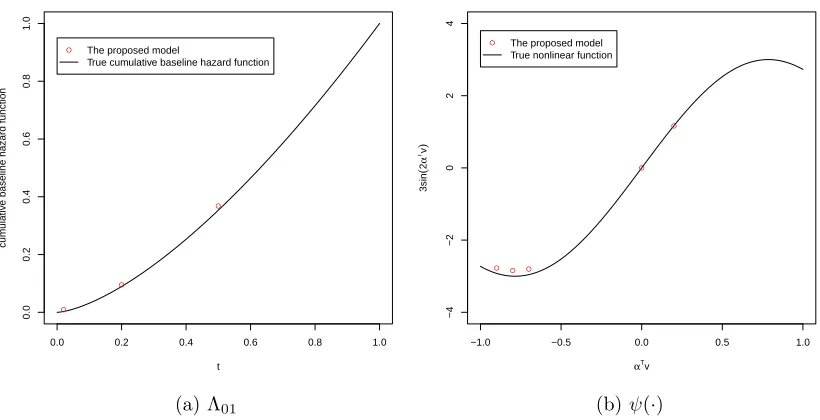
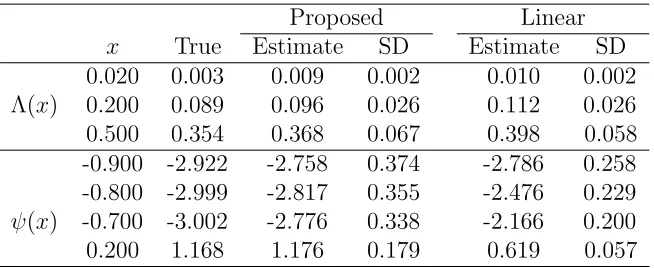
func-tion ψ(∙) with their estimates at the chosen points. . . 37 2.3 Compare the proposed model and the PH linear model on cumulative
baseline hazard function Λ01 and nonlinear smooth function ψ(∙). . . 39
2.4 Compare the cumulative baseline hazard function Λ0 with N-A
esti-mator for female and male. . . 45 2.5 Compare the cumulative hazard function Λ considering covariate
ef-fects with N-A estimator of Λ0 for female and male. . . 45
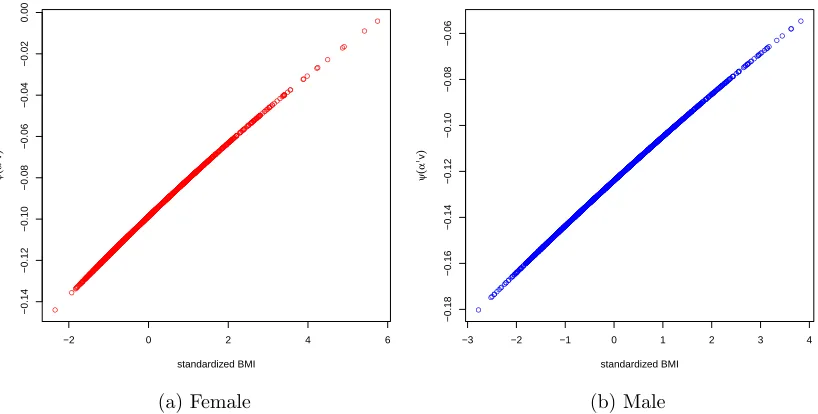
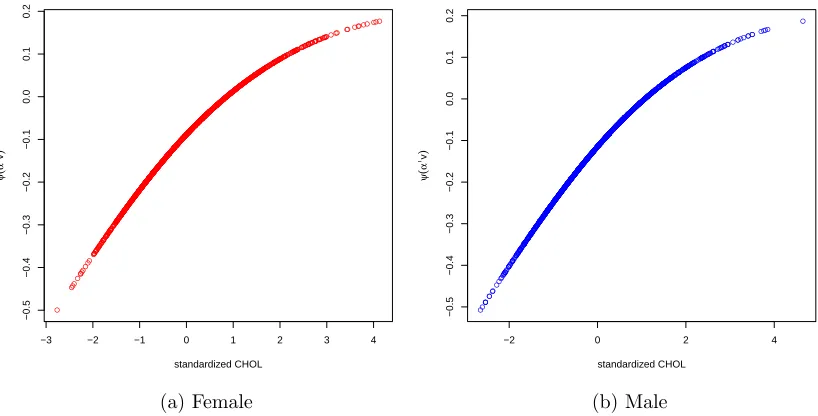
2.6 Nonlinear function ψ(∙) for females . . . 46 2.7 Nonlinear function ψ(∙) as the covariate age changes . . . 47 2.8 Nonlinear function ψ(∙) as the covariate body mass index changes . . 47 2.9 Nonlinear function ψ(∙) as the covariate cholesterol level changes . . . 48 3.1 Cumulative baseline hazard function Λ01 and nonlinear smooth
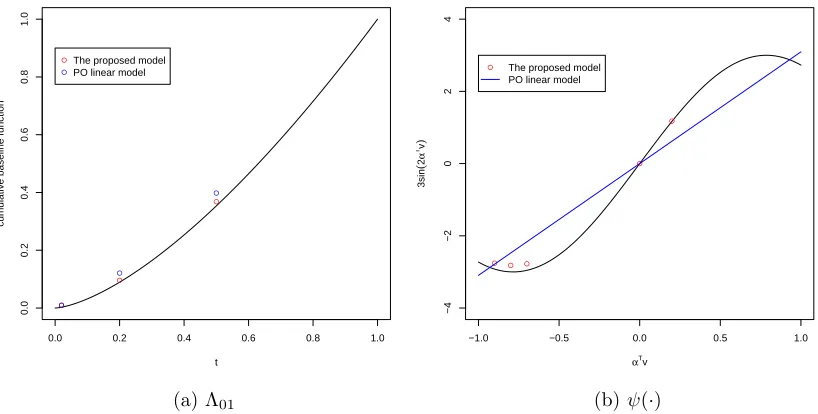
func-tion ψ(∙) with the estimates at the chosen points. . . 60 3.2 Compare the proposed model and PO linear model on cumulative
base-line hazard function Λ01 and nonlinear smooth function ψ(∙). . . 63
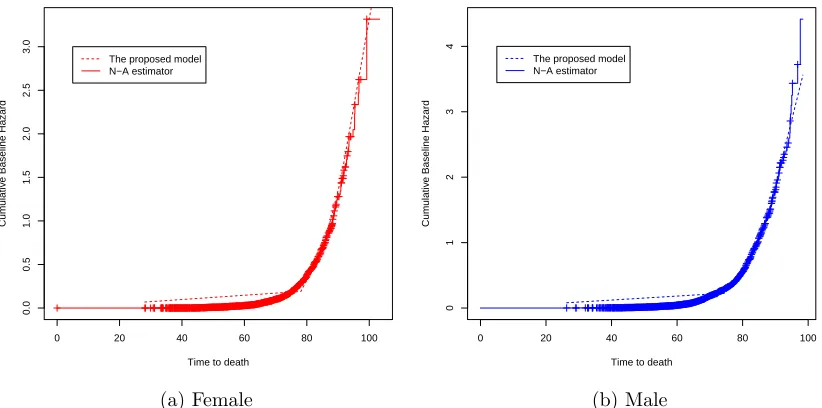
3.3 Compare the cumulative baseline hazard function Λ0 of the proposed
model with N-A estimator for female and male . . . 67 3.4 Compare the cumulative hazard function Λ considering covariate
ef-fects with N-A estimator of Λ0 for female and male. . . 67
3.5 Nonlinear function ψ(∙) for female . . . 69 3.6 Nonlinear function ψ(∙) as the covariate age changes . . . 69 3.7 Nonlinear function ψ(∙) as the covariate body mass index changes . . 70 3.8 Nonlinear function ψ(∙) as the covariate cholesterol level changes . . . 70 4.1 Nonlinear smooth function ψ(∙). . . 86 4.2 Compare the proposed transformation model and the transformation
linear model on the nonlinear smooth function ψ(∙). . . 89 4.3 The log likelihood profile of r . . . 92
1.1 Example data set . . . 4
2.1 The estimates for the covariate coefficients before and after transfor-mation . . . 35 2.2 The estimates for Λ01(∙) and ψ(∙) of one variate based on 200 runs . . 36
2.3 The estimates comparison of two models for the covariate coefficients α, β and φ based on 200 runs . . . 38 2.4 The estimates comparison of two models for Λ01(∙) and ψ(∙) based on
200 runs . . . 38 2.5 Simulation result for Weibull with shape parameter p= 0.5 of 200 runs 41 2.6 Simulation result for Weibull with shape parameter p= 1.5 of 200 runs 42 2.7 The estimates for the covariate coefficients α, β and φ of the data
analysis . . . 44
3.1 The estimates for the covariate coefficients before and after transfor-mation . . . 59 3.2 The estimates for Λ01(∙) and ψ(∙) of one variate based on 200 runs . . 60
3.3 The estimates comparison of two models for the covariate coefficients α, β and φ based on 200 runs . . . 62 3.4 The estimates comparison of two models for Λ01(∙) and ψ(∙) based on
200 runs . . . 62 3.5 Simulation result for Weibull with shape parameter p= 1.5 of 200 runs 65 3.6 The estimates for the covariate coefficients α, β and φ of the data
analysis . . . 66
4.1 The estimates for the covariate coefficients before and after transfor-mation (r= 1) . . . 85 4.2 The estimates for the covariate coefficients before and after
transfor-mation (r= 2) . . . 85 4.3 The estimates for ψ(∙) of one variate based on 200 runs (r = 1) . . . . 86 4.4 The estimates for ψ(∙) of one variate based on 200 runs (r = 2) . . . . 86 4.5 The estimates comparison of two models for α, β, φ and r based on
200 runs (r= 1) . . . 88 4.6 The estimates comparison of two models for α, β, φ and r based on
200 runs (r= 2) . . . 88 4.7 The estimates comparison of two models for ψ(∙) based on 200 runs
4.8 The estimates comparison of two models for ψ(∙) based on 200 runs (r= 2) . . . 89 4.9 Simulation result for different settings of censoring rate, sample size,
association parameter φ . . . 90 4.10 Simulation result for different r . . . 92 4.11 Simulation result for assessing the proposed transformation model on
the generated data from nonlinear PH or PO model . . . 94
Introduction
Multivariate survival data arise frequently in health and medical studies. Examples
include epidemiological cohort studies, in which members from the same family can
have the same disease, and the ages at disease occurrence are collected; and clinical
trials, in which multiple event times are recorded for each individual. A common
characteristic of these data is that the survival times are correlated and it is not
appropriate to model them as independent events. To extract the scientifically
use-ful information from such data, it is appropriate to use multivariate, rather than
univariate, survival analysis techniques. On many occasions, the collected survival
times arise together with some other health related information, such as the gender,
age, smoking status etc., which are called covariates. One important motivation of
multivariate survival analysis is to investigate the covariate effects on the survival
times.
A variety of survival regression models have been developed over time to study
the covariate effects. A large body of literature exists for univariate survival data,
while the amount of work on the multivariate case is relatively smaller. The existing
multivariate regression models often assume linear relationships when exploring
co-variate effects. But the linearity assumption may be violated in many circumstances.
Chapter 1 2
We work to loosen this assumption and apply weakly parametric methods in
mul-tivariate regression models to explore nonlinear covariate relationships and to allow
more flexibility to the modeling.
In Section 1.1, real data examples are introduced to motivate the problems of
interest considered in this thesis. In Section 1.2, background literature and related
work are reviewed.
1.1
Motivation and Problem Description
Approaches used with multiple survival data vary according to different settings. If
the survival times are observed in some specified order, it is referred to as the longi-tudinal or sequential setting. If the multiple survival times have no prior ordering, it is called the parallel setting. In this thesis, we focus on the parallel setting. In the following two sections, examples of sequential data and parallel data are
intro-duced. In Section 1.1.3, the problems of interest, that will be studied in this thesis,
are summarized.
1.1.1
Colon Cancer Data
Moertel et al. (1990) conducted a clinical trial on patients with Duke’s stage C
colon cancer, a cancer stage at which disease recurrence is common after treatment.
The trial evaluated the efficacy of two treatments (a particular drug therapy and a
placebo). Two times were measured for each patient: time to cancer recurrence and
time from cancer recurrence to death. Because the two times are ordered—recurrence
must occur before death—this is an example of sequential data. Also, association can
be expected between the two responses, since each pair of times is measured on the
1.1.2
Busselton Health Study Data
The Busselton Health Study (Knuiman et al., 1994) was a repeated cross-sectional
survey that was conducted in the Busselton community in West Australia. From
1966 to 1981 a survey was conducted on adults in the community every three years.
Various health-related information was collected, such as demographic variables,
gen-eral health and lifestyle variables, health history variables, and physical, biochemical,
haematological and immunological measurements.
This data set includes the health information from 2306 couples who are adults
over 18 years old. The survival experience of the individuals, with survival time
defined as age at death, is considered here. This is an example of parallel multivariate
survival data, as the survival times of the husband and wife are likely to be associated
(because of their similar lifestyles), and there is no prior ordering associated with the
times. The censoring rate for female is 80%, and 67% for male. Excluding the censored
data, the average survival times for female and male are 75.2 and 74.2 respectively.
The data set has over ten health-related covariates, such as age at the beginning of
survey (AGE), body mass index (BMI), total cholesterol (CHOL), alcohol
consump-tion level (DRINKING), smoking status (SMOKE), and history of coronary heart
disease (CHD). A very brief look at a portion of the data set is found in Table 1.1.
The survival time is variable SURVTIME, and the censoring is recorded using the
death indicator DTHCENS.
1.1.3
Problem Description
Parallel multivariate survival data can be roughly classified into two groups. The
data can arise from different individuals. For example in the Busselton Health Study
data, the survival times of two members of a married couple tend to be associated, as
one family likely shares a similar diet and lifestyle. Alternatively, correlated data may
Chapter 1 4
Table 1.1: Example data set
No. PAIR SEX SURVTIME DTHCENS AGE BMI CHOL SMOKE ...
1 1 F 76.3 1 50.4 24.61 6.32 1 ...
2 1 M 80.4 0 52.3 27.37 6.13 1 ...
3 2 F 65.4 0 40.3 26.39 5.13 0 ...
4 2 M 65.6 0 40.5 29.54 5.79 1 ...
5 3 F 79.9 1 56.5 39.66 6.92 0 ...
6 3 M 78.5 1 66.8 23.63 7.11 1 ...
... ...
have different event timesTi1, . . . , Tik corresponding to different diseases. These times
can be associated, as they are influenced by the person’s health characteristics. Both
groups of data can be viewed as the same type of multivariate data. The subjects
that are correlated with each other, such as the people from the same family and
the diseases from the same individual, can be viewed as one cluster. Both types of parallel data can be dealt with using similar statistical approaches.
In most studies, survival data are collected along with some covariates.
Re-searchers are interested in finding the effects of the covariates on the survival time.
Another statistical question of interest is how to include the association of the data
in the modeling. In addition, being able to calculate the estimated survival function
or hazard function, after including the covariate effect in the model, is often required
in research. Regression models can be applied to solve these problems.
Many researchers have worked with various regression models for univariate
sur-vival data. Two regression models have drawn a lot of attention. One is the
pro-portional hazards (PH) model, and the other is the propro-portional odds (PO) model.
LettingT be the survival time and x= (x1, . . . , xp)T be the covariate, a PH model is
written as:
λ(t|x) =λ0(t)exp(βTx),
of unknown parameters, and λ0(t) is the baseline hazard function when x=0 (Cox,
1972). PH models assume the covariates have a linear effect on the log hazards ratio.
This assumption is mainly for mathematical convenience, and it may be violated in
many situations. Such a linear structure also appears in the PO model. PO models
assume that the covariates have a linear effect on the log survival odds ratio:
S(t|x)
1−S(t|x) = exp{β
T
x} S0(t) 1−S0(t)
,
whereS(t|x) is the survival function given the effects of covariate x,βis the covariate coefficient with dimension p×1, and S0 is the baseline survival function when x=0
(Bennett, 1983).
Various ways have been explored to loosen the linearity assumption. One approach
is to assume the covariate effect can be described by a flexible smooth function, rather
than a rigid log linear relation. To fit the smooth function, nonparametric methods
can be applied. In the application of the nonparametric methods there is one problem
that often occurs: the so-called curse of dimensionality. This term describes the phenomenon where the volume of the covariate space becomes too large to sample
thoroughly with any practical number of observations. In this case, the accuracy of
the estimation is often poor. To solve such a problem, a single index model may be
used to reduce the dimensions of the covariates. Hardle et al. (1993) generalize the
linear covariate effect βT
x intoψ(βT
x), where ψ is an unknown univariate function. This is called a single-index model. The single-index model uses the structure βT
x as the input of a smooth function, to reduce the high-dimensional variable x into a scalar, and the curse of dimensionality problem can be avoided.
In this thesis, the above ideas are applied to the modeling of multivariate survival
data. Three survival regression models are proposed and explored: the PH model, the
Chapter 1 6
covariate effects are added in the model by a smooth single index function, to loosen
the linearity assumption while reducing the high dimensions of the nonlinear covariate.
Spline functions are used to construct the nonlinear smooth function. Piecewise
constants are applied to model the baseline hazard function.
1.2
Literature Review
This section reviews regression methods for modeling multivariate survival data.
First, methods for incorporating the association among multivariate survival
re-sponses are introduced. Then a literature review on survival regression models is
given. Extensions on regression models, such as nonparametric approaches, are
sum-marized at the end.
1.2.1
Modeling Association in Multivariate Survival Data
One important question in multivariate survival data modeling is how to incorporate
the association. The common approaches may be distinguished as: marginal models,
frailty models and copula models.
The marginal model approach makes inferences about the marginal distributions
while treating the dependence among the subjects within one cluster as unspecified.
Indeed, it takes into account the dependence only while looking at the variance
esti-mates of the parameters. Therefore, parameters can be estimated from the marginal
model using the likelihood by assuming independence among all subjects, which is
the product of all the marginal likelihoods over all subjects. This likelihood is called
the Independence Working Model (IWM) (Huster et al., 1989).
There are two main issues arising from the IWM. One problem is the consistency
of the parameter estimates. It can be demonstrated that under certain conditions
consistent estimate in spite of the fact that observations are correlated. The other
one is for the appropriate variance estimators of parameters. The variance-covariance
structure of the data needs to be taken into account to arrive at good estimators for
the variances of the estimated parameters.
Cox proportional hazards model have been considered in the marginal model
ap-proach by many researchers. Wei, Lin, and Weissfeld (1989) and Lee, Wei, and Amato
(1992) have done such related work. The former allows the baseline hazard functions
to be different among the marginal models while the latter assumes a common
base-line hazard function. Lin (1994) summarizes and continues the work of both of the
previous two methods, and develops simple estimating equations which yield
con-sistent and asymptotically normally distributed estimators. The work also includes
robust variance-covariance estimators to account for the intra-class correlation. In
recent years, nonparametric methods have been explored in the marginal model. Yu
and Lin (2008) use kernel estimating equations to estimate nonparametric covariate
effects. They show the nonparametric kernel estimator is consistent for any arbitrary
working correlation matrix and its asymptotic variance is minimized by assuming
working independence.
The second approach to multivariate modeling is frailty models. Frailty models
are random effect models, which account for heterogeneity caused by unmeasured
covariates. The term frailty is introduced by Vaupel et al. (1979) in univariate survival
models and the model is substantially promoted by its application to multivariate
survival data by Clayton (1978) in a study of chronic disease incidence in families.
Hougaard (2000) provides broad discussions on this topic. Following the definition
from Lawless (2003), the common approach in frailty models is to define a random
Chapter 1 8
covariatexi, the survival timesTi1, . . . ,Tikare independent, with the survival function
Sij(tj) = Pr(Tij ≥tj|xi,αi) j = 1, . . . , k;
and (2) the αi are independent and identically distributed across all subjects i =
1, . . . , n. Assuming αi has distribution function G(αi;φ), the joint survival function
for Ti1, . . . , Tik is
S(t1, . . . , tk|xi) =
Z "Yk
j=1
Pr(Tij ≥tj|xi,αi) #
dG(αi;φ),
where φ measures the dependence within the cluster. A common choice of the dis-tribution of αi is the gamma distribution. More general choices for this distribution
are discussed by Hougaard (2000).
Another approach to multivariate modeling is copula models. For simplicity, the
bivariate case is used as an example. A copula function is defined as a bivariate
function C: [0,1]2 →[0,1], which satisfies the following three properties (Shemyakin
and Youn, 2006):
1. C(u,0) = C(0, u) = 0 for any u∈[0,1]. 2. C(u,1) = C(1, u) =u for any u∈[0,1]. 3. For all 0 ≤u1 ≤u2 ≤1 and 0 ≤v1 ≤v2 ≤1,
C([u1, v1]×[u2, v2]) =C(u2, v2)−C(u1, v2)−C(u2, v1) +C(u1, v1)≥0.
Therefore, when the arguments of the copula function are univariate survival functions
S1(t1) = P(T1 > t1) and S2(t2) = P(T2 > t2), the copula function C(S1, S2) is a
bivariate survival function S(t1, t2) = P(T1 > t1, T2 > t2), with marginal survival
Development of the joint survival function can be done through the specification
of a parametric copula function C(u, v;φ) and the specification of the marginal distri-butions. Parameter φdetermines the association structure of the data. The marginal survival functions S1(t1) and S2(t2) can have parametric or semiparametric forms.
One such family of copula models is introduced by Clayton (1978). It has the
form
S(t1, t2) =
h
S1(t1)−φ
−1
+S2(t2)−φ
−1
−1i−φ. (1.1) whereφ ∈(0,∞). The larger the value of φis, the smaller the association among the data is. When φ =∞, the two survival times are independent. The range of φ can be extended to -1 to accommodate some negative association (Lawless, 2003).
Note that for copula models the parameter φ only controls the association but does not enter into the marginal distributions, while in frailty models φ not only controls the association, but also affects the marginal distributions. A frailty model
is more appropriate for designed studies where different treatments or covariate factor
levels are assigned to individuals within a cluster.
1.2.2
Univariate Regression Models for Survival Data
The widely used survival regression models are the proportional hazards (PH) model,
the accelerated failure time (AFT) model, and the proportional odds (PO) model.
In recent years, the linear transformation model has also drawn many researchers’
attention. We will discuss each of these models in turn.
Cox (1972) proposes the Cox proportional hazards function with the following
form:
λ(t|x) =λ0(t)exp(βTx), (1.2)
where λ0(t) is the baseline hazard function, x = (x1, x2, . . . , xp)T is the vector of
Chapter 1 10
vector of regression coefficients. The model makes no assumptions on the baseline
hazard function λ0(t), but assumes a parametric form for the effect of the predictors
on the hazard. Therefore, it is referred to as a semi-parametric model. To make
inference, the partial likelihood approach (Cox, 1975) can be applied. The beauty of
this model is that the vagueness of the baseline hazard function creates no problem
for estimation.
Note that covariates act multiplicatively on the hazard function in the Cox PH
model. One assumption of the Cox model is that the hazard of the event in one
group is proportional to the hazard in any other. To apply this model properly the
proportionality assumption needs to be satisfied.
The PH model can be generalized to have the form
λ(t|x) =λ0(t)r(ψ(x)),
where r(∙) is a positive function, and ψ(x) is usually assumed to be of linear regres-sion form ψ(x) = βT
x. Conventionally, r(∙) = exp(∙) can be applied to satisfy the positivity constraint. When λ0(t) is unspecified, it is referred to as the Cox model.
When λ0(t) is assumed to follow a specific distribution, it is called a parametric PH
model. More generally, λ0(t) can be specified as a piecewise constants or a spline
function (He and Lawless, 2003), in which case the full likelihood approach can be
applied.
Another popular model for survival data is the Accelerated Failure Time (AFT)
model. The AFT model usually can be written as a log-linear model for failure time
T according to:
logT =μ+α1x1+α2x2+∙ ∙ ∙+αpxp+σ.
the survival function of :
S(t) = P(T ≥t) = P (logT ≥logt)
= P (μ+α1x1+α2x2+∙ ∙ ∙+αpxp +σ≥logt)
= P
≥ logt−μ−α
Tx
σ
= S
logt−μ−αTx
σ
Another way of expressing the AFT model is
S(t|x) =S0(η(x)t),
whereS0(∙) is the baseline survival function, andη(∙) is an “acceleration factor” which
depends on the covariates x= (x1, x2, . . . , xp)T through the formula:
η(x) = exp(α1x1 +α2x2 +∙ ∙ ∙+αpxp).
In this model the effect of a covariate is to stretch or shrink the survival curve along
the time axis by a constant relative amount η(x).
In AFT models, it is often necessary to specify the distribution of failure time.
The common distributions used for this purpose are Weibull, Log-normal, Log-logistic,
and Gamma. Some other approaches have also been discussed by researchers. Wei
(1992) reviews some estimation methods applied to the AFT model. For example,
an estimation procedure based on rank test statistics, and an approach using least
squares principle proposed by Buckley and James (1979) are discussed. Recently, Jin,
Lin, Wei, and Ying (2003) and Jin, Lin, and Ying (2006) develop approximations to
Chapter 1 12
Resampling procedures are applied for the estimation of the limiting covariance
ma-trix.
A third popular approach for survival data modeling is the Proportional Odds
(PO) model, which is introduced by Bennett (1983). This model uses the survival
odds ratio as a measure of relative risk in the regression model. It can be expressed
as:
S(t|x)
1−S(t|x) = exp(β
T
x) S0(t) 1−S0(t)
, (1.3)
where x = (x1, x2, . . . , xp)T is the vector of explanatory variables for an individual,
β = (β1, β2, . . . , βp)T is the vector of regression coefficients, and S0(t), the baseline
survival function, is the survival function for an individual whose explanatory
vari-ables all take the value zero.
One important property of PO model is that the hazards ratio converges from the
value exp(−βT
x) at time t = 0, to unity at t = ∞. It can be shown that (Collett, 2003)
λ(t|x)
λ0(t)
= [1 + (exp(βT
x)−1)S0(t)]−1.
Therefore, when t = 0, S0(t) = 1, and λλ(t0|x(t)) = exp(−βTx); when t =∞, S0(t) = 0,
and λλ(t|x)
0(t) = 1. As a contrast, in the PH model, the hazards ratio remains constant
att. Recall that for the PH model,
λ(t|x)
λ0(t)
= exp(βT
x),
but this assumption can be unreasonable in certain circumstances. For example,
initial effects such as differences in the stage of disease or in treatment can disappear
with time. In this case, the property of PO model that the hazards ratio converges
to 1 as t increases to ∞makes more sense.
Bennett (1983) describes how the PO model can be fitted using maximum
properties of the PO model. Many researchers have discussed various approaches for
making inferences on PO model. Cheng et al. (1995) propose a modified V statistic for parameter estimation. Murphy et al. (1997) show the profile likelihood approach
of Bennett (1983) results in an asymptotically efficient regression estimator. Yang and
Prentice (1999) introduce some weighted empirical odds functions. Several classes of
regression estimators such as the psedo-maximum likelihood estimator, martingale
residual-based estimators, and minimum distance estimators are derived.
The final model considered here is the linear transformation model. Let T be the survival time andxbe the covariate with dimension p×1. The linear transformation model assumes that
H(T) = −βT
x+, (1.4)
where H is an increasing transformation function, is a random variable with a known distribution, and β is the covariate coefficient with dimension p×1. The proportional hazards model and the proportional odds model are special cases of (1.4)
withfollowing the extreme-value distribution and the standard logistic distribution, respectively.
An alternative way to show that the PH and PO models are the special cases of
the transformation model is though the hazard function of . If we let the hazard function of have the form
λ() = exp() 1 +rexp(),
then r= 0 corresponds to a PH model, and r= 1 corresponds to a PO model. More discussion related to this topic is given in Section 4.1.
Some inference procedures for this model have been proposed by various
re-searchers. Cheng et al. (1995) study a class of generalised estimating equations to
examine the covariate effects with censored observations. This method is further
Chapter 1 14
assumption in their approach is that the censoring variable is independent of the
covariates, which makes it possible to use the Kaplan-Meier method to estimate the
survival function. Chen et al. (2002) relax this assumption and propose an estimating
equation approach to make inference. Zeng and Lin (2006) study nonparametric
max-imum likelihood estimation in a class of semiparametric transformation models which
considers time dependent covariates. More recently, Lu and Zhang (2010) propose
a partially linear transformation model by incorporating nonlinear covariate effects,
and studied a martingale-based estimating equation approach to make inference.
1.2.3
Extensions on Regression Models
A lot of work has been done on extensions of regression models. As mentioned
pre-viously, one of the traditional assumptions of regression models is that the covariates
have a linear effect on the log hazards ratio, log survival odds ratio, or other quantity
of interest. However, this linearity assumption is mainly for mathematical
conve-nience, and might not be valid in many circumstances. A smooth function ψ(∙) has been proposed to generalize the linearity assumption βT
x. In the exploration of the smooth function, nonparametric or the weakly parametric methods have drawn much
attention. Tibshirani and Hastie (1987) use the linear regression method on a defined
local neighborhood of each x. This local likelihood estimation approach is applied to find the optimal estimator of the local regression coefficients. Note that this local
linear regression model can also be replaced by some other smooth function. Fan,
Gijbels, and King (1997) discuss the estimation of the nonparametric covaritate effect
in the PH model when the baseline function is parametric and nonparametric. When
the baseline function and the covariate effect are both unspecified, nonuniform kernel
methods are applied to fit the covariate effect and the inference is based on a local
version of partial likelihood. Spline functions have also been considered by some
nonparametric covariate effect in PH models. An automatic procedure involving the
maximum likelihood method, stepwise addition, stepwise deletion and BIC is used to
select the final model.
A considerable amount of work has been done to address the curse of
dimensional-ity problem under the univariate data modeling framework when the covariates have
high dimension. One approach is to use additive models. Hastie and Tibshirani (1990)
propose to use a sum of smooth functions over the components of covariates. That
is, instead of using the linear model Ppj=1xijβj, they suggest using an additive term Pp
j=1fj(xij), where xi1, . . . , xip are covariate values for the ith individual. The fj(∙)
are unspecified smooth functions that are estimated using scatter plot smoothers.
The other approach that has drawn a lot of attention is the single index model.
Har-dle et al. (1993) generalize the linear covariate effect βT
x intoψ(βT
x), where x is a
p×1 vector of covariates, β is a p×1 vector of parameters, and ψ is an unknown univariate function. This single index model reduces the p×1 vector of covariates x from higher dimensions to a scalar βT
x, and then treats the smooth function ψ(∙) as a univariate function of βT
x. Note the scale of βT
x in ψ(βT
x) may be determined arbitrarily, soβ may be replaced by the unit vector α=βkβk−1, wherek ∙ kdenotes
the Euclidean metric. Then we can estimate both ψ(∙) and α in the model.
Because of the useful characteristic of the single index model that it can reduce the
the high dimension of covariates to a scalar, it has drawn a lot of attention from many
researchers. Carroll, Fan, Gijbels, and Wand (1997) apply it to the generalized linear
model and introduces a more general model which is called “Generalized Partially
Linear Single Index Model (GPLSIM)”. In this model a response Y is to be predicted by covariates (X,V), where X (of length p) is to enter the model linearly and V (of length q) is to enter it nonlinearly. GPLSIM has the following form:
g{μ(x,v)}=βT
x+ψ(αT
Chapter 1 16
whereμ(x,v) = E(Y),g is the link function, ψ is an unknown smooth function, and αand β are coefficients of dimensions q and p. The single index structure ψ(αTv) is
added to extend the linear termβT
xwhich the generalized linear model normally has, and makes it more flexible to describe a nonlinear relationship between the covariate
(x,v) and g{μ(x,v)}. Kernel methods are used to explore the shape of the smooth function ψ nonparametrically.
In recent years, structures similar to GPLSIM have been applied in some
sur-vival models. For example, Lu, Chen, Singh, and Song (2006) introduce the partially
linear single index structure under the proportional hazards regression model
frame-work, and define a “Partially Linear Single-Index Survival Model (PLSISM)”. More
information about this model can be seen in Section 2.1.
The above work mainly focuses on the extensions of regression models for
univari-ate survival data. There is still limited work for regression modeling of multivariunivari-ate
survival data, however, especially on the exploration of nonparametric methods
ap-plied in regression models. He and Lawless (2003) use piecewise constant or spline
functions to fit the baseline hazard function in either marginal or conditional
propor-tional hazards models. The copula model is proposed to incorporate the association
among the multivariate survival data. As the baseline hazard function has a specified
form through the parametric approach, full likelihood can be applied to make
infer-ence. Yu and Lin (2008) study multivariate survival data through the marginal model
approach. They propose the marginal proportional hazards function and use kernel
methods in the regression model. They show that the nonparametric kernel estimator
is consistent for any arbitrary working correlation matrix and its asymptotic variance
is minimized by assuming working independence. These works have given inspiring
1.3
Overview of the Thesis
The focus of this thesis is on multivariate survival data regression modeling.
Cop-ula functions are proposed to include the association among the multivariate
sur-vival data, with covariate effects incorporated through the marginal model. For the
marginal distributions, three types of regression models are discussed: (i) the
pro-portional hazards function, (ii) the propro-portional odds model, (iii) the generalized
transformation model. Traditionally, these models assume the covariates have linear
effects in the regression part of the model. We relax the linearity assumption and
allow both the linear and the nonlinear relationships in the model. A smooth
func-tion is used to explore the nonlinear relafunc-tionship. The single index model is added to
reduce the dimensions of the nonlinear covariates into a scalar. Weakly parametric
methods are applied to explore the smooth function. In the marginal hazard
func-tion, piecewise constants are used to estimate the baseline hazard function. Based
on the above setup of the model, the full likelihood function can be applied to make
inference.
The remaining chapters of the thesis are organized as follows. In Chapter 2 the
partially linear single index proportional hazards regression model for multivariate
survival data is investigated. The proposed model is assessed by simulation studies.
The model is applied to the real data example, Busselton Health Study, for
illustra-tion. In Chapter 3 the partially linear single index proportional odds regression model
is explored. Simulation studies and real data analysis are also provided. Chapter 4
examines the partially linear single index generalized transformation model. As the
PH model and the PO model are two special cases of the generalized transformation
model, the third proposed model is a generalization of the first two. Simulation
stud-ies are provided. Some conclusions are discussed at the end of Chapter 4. Discussions
Chapter 2
Flexible Partially Linear Single
Index Proportional Hazard
Regression Model for Multivariate
Survival Data
2.1
Introduction
The proportional hazards model (1.2) has been a very popular survival model since
it was proposed by Cox (1972). One of the assumptions of the PH model is that the
covariatexhas a linear effect on the log hazards ratio. This assumption is mainly for mathematical convenience, however, may not hold in many situations. Many methods
have been proposed to add a smooth function ψ(∙) to relax the linearity assumption, letting the covariate effect be written as βT
x+ψ(v). In this expression x is a vector of covariates that enter the model linearly, and v is a vector of covariates that enter in a nonlinear fashion. This is called a partially linear model.
drawn much attention. However, if vis high-dimensional covariate vector, the curse of dimensionality problem (described in Section 1.1.3) makes it hard to achieve accurate
estimation for covariate effect ψ(v) using nonparametric methods.
One approach to solve this issue is through the use of single index models (Hardle
et al., 1993). In this approach, a new parameter vector α is introduced, and the inner product αTv is taken to reduce the covariate effects to a scalar, to summarize
covariates first. The smooth function ψ(∙) is then taken to be a function of this scalar argument. This particular type of partially linear model, with the covariate effect
taking the form βT
x+ψ(αTv), is known as a partially linear single index model.
Partially linear single index models have been explored in the literature. For
example, Lu, Chen, Singh, and Song (2006) propose the Partially Linear Single-Index
Survival Model (PLSISM). The hazard function has the form:
λ(t|x,v) = λ0(t)exp{βTx+ψ(αTv)}, with kαk= 1,
where λ0(t) is the baseline hazard function, ψ(∙) is the unknown smooth function, x
is the linear covariate with dimension p, v is the nonlinear covariate with dimension
q, and β and αare their corresponding coefficients. The authors use kernel methods to model the smooth function. The profile quasi-likelihood approach is applied to
make inference. Sun, Kopciuk, and Lu (2008) also apply a similar partially single
index structure in proportional hazards regression. They use spline functions to
approximate the smooth function. In their model, the baseline hazard function is not
specified, and the partial likelihood approach is applied for inference.
The above work has been done under the univariate response framework. We
propose to apply the partially linear single index structure in the marginal hazard
function for multivariate data. As has been introduced in Section 1.2.1, a copula
Chapter 2 20
data. Without loss of generality, a special case of multivariate data–bivariate data–is
considered here. Specifically, the Clayton model (Clayton, 1978) is employed to link
the marginal survival functions for illustration.
To make inference, two parts of the model still need to be specified. One is the
baseline hazard function, and the other one is the smooth function in the single
index structure. The objective we consider here is to model these functions without
making overly strong parametric assumptions, while also choosing a form that is
flexible enough. To do this, two weakly parametric approaches, piecewise constants
(He and Lawless, 2003) and spline functions, are proposed to model the baseline
hazard functions and the smooth function respectively. This model structure has
finite number of parameters, and therefore the full likelihood method can be invoked
for inference.
The details of the proposed model framework is introduced in Section 2.2.
Simu-lation studies are conducted in Section 2.3, to assess the performance of the proposed
method, to compare the proposed model to the model where the nonlinear covariate
effect is ignored, and to evaluate the impact of other factors on the estimation
un-der various scenarios. The Busselton health study is used as an illustrative example.
Some conclusions about the proposed model are summarized at the end.
2.2
The Proposed Model
Assume the survival data sample has m clusters. Let Tij and Cij be the failure and
censoring times of the jth observation in the ith cluster (j = 1, . . . , k, i= 1, . . . , m). The observed data (yij,xij,vij, δij) are realizations of the variables (Yij,Xij,Vij,Δij),
where Yij = min(Tij, Cij) is the observed time, and Δij =I(Tij ≤ Cij) is the
censor-ing indicator. The covariates are Xij andVij, which are assumed to have linear and
correlated, while the observations from different clusters are assumed to be
indepen-dent. For illustration purpose, we assume k = 2, to limit the survival distribution to be bivariate. The proposed marginal PH function is written as:
λj(tj|xj,vj) =λ0j(tj)exp{βTxj +ψ(αTvj)}, j = 1, 2,
where β is the linear covariate coefficient with dimension p and α is the nonlinear covariate coefficient with dimension q,ψ(∙) is a smooth function, and ψ(αTv
j) is the
single index model.
To incorporate the association in the model, a copula model is used for multivariate
modeling (see Section 1.2.1). More specifically, the Clayton model (Clayton, 1978) is
used, and the joint survival function is given by (1.1).
Let f(t1, t2) denote the joint density function. The likelihood contributed from
the ith cluster is,
Li = f(ti1, ti2)δi1δi2
"
−∂S(ti1, ti2)
∂ti1
#δi1(1−δi2)
×
"
−∂S(ti1, ti2)
∂ti2
#(1−δi1)δi2
S(ti1, ti2)(1−δi1)(1−δi2), (2.1)
which is also shown in Lawless (2003).
To make inference from the model, we need to write this likelihood explicitly as
a function of the parameters. To do this, the estimation approaches for the baseline
hazard functions λ0j(tj) and the smooth function ψ(∙) need to be specified. We
propose to use piecewise constant approach (He and Lawless, 2003) to approximate
the baseline hazard functions, and to use a spline function approach to approximate
Chapter 2 22
2.2.1
Piecewise Constant Approach for Baseline Function
In modelling the baseline hazard function λ0j(tj), we follow He and Lawless (2003),
to have a piecewise constant function approximation. Compared with the parametric
PH model, which assumes that the baseline hazard function has a known parametric
form, this method relaxes the parametric assumption of λ0j(tj) to allow flexibility in
its shape.
Assume that the marginal baseline hazard functions λ0j(tj), j = 1,2,have
piece-wise constant forms as follows:
λ01(t1) =ρk, wheret1 ∈Ak= (ak−1, ak], k= 1, . . . , r,
and
λ02(t2) =τl, where y2 ∈Bl= (bl−1, bl], l= 1, . . . , s,
where 0 = a0 < a1 < . . . < ar = ∞ and 0 = b0 < b1 < . . . < bs = ∞ are
pre-chosen sequences of constants, which are also called cut points. ρ= (ρ1, . . . , ρr)T and
τ = (τ1, . . . , τs)T are unknown positive constants to be estimated. Ak and Bl are the
intervals defined by the sequence of cut points. Therefore, the corresponding marginal
cumulative hazard functions are the integration over the piecewise constants, which
can be written as:
Λ01(t1) =
r X
k=1
ρkuk(t1)
Λ02(t2) =
s X
l=1
τlwl(t2),
where uk(t1) = max(0,min(ak, t1)−ak−1) are the length of the intersection of the
interval (0, t1) with the interval Ak, and wl(t2) = max(0,min(bl, t2)−bl−1) are the
How to choose the cut points is an important question. Normally they are chosen
based on prior assumptions about the marginal distributions of the survival time. If
we know the hazard function slope changes at some points, these points can be set as
the cut points. If such changes can not be detected clearly, one can start from a small
number of cut points, say 2 or 3, and increase the number to observe their effect.
Normally it is desirable to keep roughly the same number of failures within each
interval. For data with a high censoring rate, one useful way to choose the cut points
is based on the Kaplan-Meier survival probability without considering the covariate
effects. That is, use the cut points that give roughly the same survival probability
in each interval. In our simulation study and real data analysis, since the censoring
rate can be high, we use the strategy based on survival probability. We choose to use
four intervals (r = s = 4) to approximate the baseline hazard function, which can give reasonably good estimation (Lawless and Zhan, 1998), and keep the number of
parameters in the model to a manageable level.
2.2.2
Spline Function Approximation
Spline methods are used to estimate the smooth functionψ(∙). M-spline functions and I-spline functions (Ramsay, 1988) are proposed to approximate ψ(∙), because of their convenient characteristics. By definition, M-spline basis functions are nonnegative
functions. I-spline basis functions are defined as the integration of the corresponding
M-spline basis functions, and have the property of being monotone increasing. In the
proposed model we would like to model the smooth function ψ(∙) and its derivative
ψ0(∙). Therefore, it is very natural to use M-spline functions to approximate the derivative ψ0(∙), and use I-spline functions to approximate the smooth function ψ(∙). Note that while the I-spline basis functions are monotone, the I-spline itself will not
be monotone unless the coefficients are restricted to be positive. In the proposed
Chapter 2 24
flexible shape.
A spline function is a series of polynomials joined smoothly at some break points.
Given an interval [L, U] and the breakpoints η ={η0, . . . , ηk}, where L=η0 <∙ ∙ ∙<
ηk = U, there is one corresponding polynomial function Pj of order m or degree
m-1 on each subinterval [ηj, ηj+1) called a basis spline function. The spline function is
defined asf(x) =Pkj=1cjPj(x), wherecj is the corresponding coefficient for each basis
spline function. At the boundaries of the intervals, a certain degree of smoothness
is required. The smoothness is defined by the equality of the derivatives of Pj. A
popular choice is to let the derivatives be continuous up to order two at the break
points, as our human eyes are capable to detect the discontinuity no higher than the
second order.
The M-spline and I-spline functions are both defined based on a sequence of
“knots”. Once the breakpoints for the interval [L, U] are given, η = {η0, . . . , ηk},
the sequence of knots c={c1, . . . , ck+2m−1}are constructed as
c1 =. . .=cm =η0, ck+m =. . .=ck+2m−1 =ηk,
and
cm+j =ηj, j = 1,2, . . . , k−1.
Let Mi(x|1, c) be the ith M-spline basis function of order m with knot sequence c.
These basis functions are defined recursively:
Mi(x|1, c) =
1
ci+1−ci if ci ≤x < ci+1,
and for m >1, :
Mi(x|m, t) =
m[(x−ci)Mi(x|m−1, c) + (ci+m−x)Mi+1(x|m−1, c)]
(m−1)(ci+m−ci)
.
One main characteristic of M-spline function is that the basis spline functions
are positive within the interval (ci, ci+m) and zero otherwise. In total there are k+
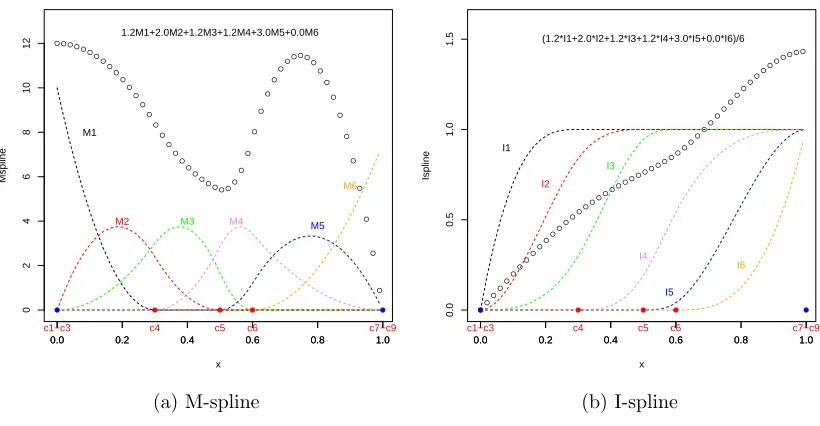
m−1 of them for spline function of order m. Figure (2.1a) gives one example of a group of cubic M-spline basis function on the interval of (0,1), and the breakpoints
(0.3,0.5,0.6). The basis spline functions are M1, M2, . . . , and M6. The function
f(x) = 1.2M1+ 2.0M2+ 1.2M3+ 1.2M4+ 3.0M5+ 0.0M6, is represented by the top
dotted line.
I-spline functions are defined based on the M-spline functions. The basis functions
are the integration of the corresponding M-spline basis functions:
Ii(x|m, c) = Z x
L
Mi(u|m, c)du.
The definition can be expressed in the following form:
Ii(x|m, c) =
0 i > j,
Pj
n=i(cn+m+1−cn)Mn(x|m+ 1, c)/(m+ 1), j−m+ 1≤i≤j,
1 i < j−m+ 1.
Figure (2.1b) shows the spline function corresponding to Figure (2.1a). The
I-spline basis functions I1, . . . , I6 are shown as dashed lines. They are the integrations
of the corresponding M-spline basis functions M1, . . . , M6. The I-spline function
g(x) = (1.2I1+ 2.0I2+ 1.2I3+ 1.2I4 + 3.0I5 + 0.0I6)/6, is represented by the dotted
line.
Chapter 2 26
● ● ● ●● ●●
● ●
● ●
● ●
● ●
● ●
● ●
● ●
● ●
●● ● ●● ●
● ●
● ●
● ●●
● ● ● ●
● ●
● ●
● ●
● ●
●
●
0.0 0.2 0.4 0.6 0.8 1.0
0
2
4
6
8
10
12
x
Mspline
0.0 0.2 0.4 0.6 0.8 1.0
● ● ● ● ●
M1
M2 M3 M4 M5 M6
1.2M1+2.0M2+1.2M3+1.2M4+3.0M5+0.0M6
c1−c3 c4 c5 c6 c7−c9
(a) M-spline
●● ●●
● ●●
●● ●●
●● ●●
●● ●●
●● ●●●
●●●● ●●
●● ●●
●● ●●
●● ●●
●● ●●
● ●● ●
0.0 0.2 0.4 0.6 0.8 1.0
0.0
0.5
1.0
1.5
x
Ispline
0.0 0.2 0.4 0.6 0.8 1.0
● ● ● ● ●
I1
I2
I3
I4
I5
I6
(1.2*I1+2.0*I2+1.2*I3+1.2*I4+3.0*I5+0.0*I6)/6
c1−c3 c4 c5 c6 c7−c9
(b) I-spline
Figure 2.1: Spline functions
Mj,j = 1, . . . , d, be the M-spline basis functions, and M(u) = (M1(u), . . . , Md(u))T.
Then ψ0(αTv) can be written as:
ψ0(αTv) = d X
j=1
γjMj(αTv) =γTM(αTv),
where γj is the coefficient for the jth basis function.
By definition, I-spline functions can be used to fit ψ(∙), as the basis function is the integration of the corresponding M-spline basis function. Note that ψ(0) is constrained to be 0. This is because in the regression model βTx+ψ(αTv), we want
the intercept to be 0, which implies βTx = 0 for x = 0 and ψ(0) = 0. Using this constraint, ψ(αTv) can be modeled by RαTv
ψ(αT
v) =
Z αTv
0
ψ0(x)dx
=
Z αTv
0
d X
j=1
γjMj(x)dx
=
d X
j=1
γj
Z αTv
0
Mj(x)dx
=
d X
j=1
γj
Z αTv
L
Mj(x)dx− d X
j=1
γj Z 0
L
Mj(x)dx
=
d X
j=1
γj[Ij(αTv)−Ij(0)]
= γT[I(αTv)
−I(0)]
Note there are another two constraints in the marginal PH model, and both are
related to parameter identifiability. One constraint is, for ψ(αTv) we needkαk= 1.
If the norm of α is not specified, the sets of solutions for α are not unique, and the solutions for γ are also not unique. But only with this one constraint, we are still not able to find the unique solution for γ and α. The other constraint is to let one particular component of α(for example, its last element) be positive. This is because
ψ∗(−α) = ψ(α), therefore for ψ∗, −α is the solution, and for ψ, α is the solution. That is, both (α,γ) and (−α,−γ) are solutions for the smooth function. With these two additional constraints, it is possible to find unique solutions for γ and α.
Regarding the strategy of choosing the number of breakpoints, we follow the
advice given by Lawless and Zhan (1998), who suggest to use 4-10 intervals. In the
simulation study and the real data analysis, in order to satisfy the goal of having
good model performance and not too long of a simulation time, 4 intervals (i.e.,3
breakpoints) are chosen in spline functions. Each interval contains roughly the same
Chapter 2 28
2.2.3
The Likelihood
Now that the baseline hazard function λ0j(tj) and the smooth function ψ(∙) have
been fully specified, the likelihood as given in equation (2.1) can be worked out.
Using the relationship between the survival function and the hazard function, the
marginal survival functions can be written as shown below. Note that in the following
expressions we write Sij(tij) rather than Sij(tij|xij,vij) for notational simplicity. In
the remainder of the thesis we will use these two notations for the survival function
interchangeably.
Si1(ti1) = exp
h
−Λ01(ti1)exp{βTxi1+ψ(αTvi1)}
i
, Si2(ti2) = exp
h
−Λ02(ti2)exp{βTxi2+ψ(αTvi2)}
i
,
where Λ01(ti1) =Prk=1ρkuk(ti1), Λ02(ti2) = Prl=sτlwl(ti2), and
ψ(αT
vi1) = γT[I(αTvi1)−I(0)],
ψ(αTv
i2) = γT[I(αTvi2)−I(0)].
Note, in the proposed model, the linear covariate coefficients and the nonlinear
co-variate coefficients are assumed to be same for the two members of the same cluster
(that is, coefficients β, α, and γ are the same for j = 1 and j = 2). The reason for this is to control the list of the parameters to a manageable level and to avoid long
run times in simulations. The natural extension is to assume the linear and nonlinear
covariate coefficients are different for the two variates. This extension poses no
diffi-culties if computation time is not a concern, as estimation and inference procedures
are unaffected.
given in Formula 1.1. The log likelihood is written as:
l =
n X
i=1
logLi
=
n X
i=1
(
δi1δi2logf(ti1, ti2)
+δi1(1−δi2)log
h
−∂S(ti1, ti2)
∂ti1
i
+(1−δi1)δi2log
h
−∂S(ti1, ti2)
∂ti2
i
+(1−δi1)(1−δi2)logS(ti1, ti2)
)
(2.2)
The entries of the log likelihood function −∂S(ti1,ti2)
∂ti1 ,
−∂S(ti1,ti2)
∂ti2 , and f(ti1, ti2) are
given as follows:
−∂S(ti1, ti2)
∂ti1
= −
∂hSi1(ti1)−φ
−1
+Si2(ti2)−φ
−1
−1i−φ
∂ti1
= −hSi1(ti1)−φ
−1
+Si2(ti2)−φ
−1
−1i−φ−1hSi1(ti1)−φ
−1i
×exp{βT
xi1+ψ(αTvi1)}
∂[−Λ01(ti1)]
∂ti1
−∂S(ti1, ti2)
∂ti2
= −
∂hSi1(ti1)−φ
−1
+Si2(ti2)−φ
−1
−1i−φ
∂ti2
= −hSi1(ti1)−φ
−1
+Si2(ti2)−φ
−1
−1i−φ−1hSi2(ti2)−φ
−1i
×exp{βTx
i2+ψ(αTvi2)}
∂[−Λ02(ti2)]
Chapter 2 30
f(ti1, ti2) =
∂S(ti1, ti2)
∂ti1∂ti2
= hSi1(ti1)−φ
−1ih
Si2(ti2)−φ
−1i
exp{βTx
i1 +ψ(αTvi1)}
×exp{βT
xi2+ψ(αTvi2)}
∂[−Λ01(ti1)]
∂ti1
×∂[−Λ02(ti2)]
∂ti2
h
Si1(ti1)−φ
−1
+Si2(ti2)−φ
−1
−1i−φ−2(1 +φ−1)
2.2.4
Parameter Estimates
The likelihood function involves the following parameters:
θ = (φ,ρT,τT,αT,βT
,γT)T,
where φ is the association parameter; ρ and τ are the parameters for the piecewise constants, and ρ = (ρ1, . . . , ρr)T, τ = (τ1, . . . , τs)T; α are the nonlinear covariate
parameters with α= (α1, . . . , αq)T; β are the linear covariate parameters with β =
(β1, . . . , βp)T; and γ are the parameters for spline functions with γ = (γ1, . . . , γd)T.
Recall, some of the parameters have constraints required by the model, which are
summarized as follows:
ρ1, . . . , ρr >0,
τ1, . . . , τs >0,
φ >0,
kαk= 1, and αq >0,
ψ(0) = 0.
The question now is how to find the maximum likelihood estimates of the
param-eters, which actually becomes an optimization problem. The constraints will bring
the process of optimizing the solutions. To avoid such problem, we introduce some
new parameters which are transformed from the original parameters. Through the
transformation, the new parameters will have no constraints.
For positive parameters ρk, τl, and φ, a log transformation is applied. New
pa-rameters ξk,ζl and % are introduced as given below:
ξk = logρk, k = 1, . . . , r.
ζl= logτl, l = 1, . . . , s,
%= logφ.
For α, the transformation takes two steps. First we use the trigonometric trans-formation on αfor the constraint kαk= 1, and make sure the last component of α is positive. Parameter ω is introduced with ω= (ω1, . . . , ωq−1)T. That is:
α1 = sinω1sinω2∙ ∙ ∙sinωq−2sinωq−1
α2 = sinω1sinω2∙ ∙ ∙sinωq−2cosωq−1
. . . (2.3)
αq−1 = sinω1cosω2
αq = cosω1
where ω1, . . . , ωq−1 ∈[−π2,π2] and ω1 ∈[−π2,π2] can satisfy αq >0.
Chapter 2 32
new parameter ϕ is introduced, where ϕ = (ϕ1, . . . , ϕq−1)T:
ϕ1 = log
π
2 +ω1
π
2 −ω1
⇒ω1 =
eϕ1 −1
eϕ1 + 1
π
2
ϕ2 = log
π
2 +ω2
π
2 −ω2
⇒ω2 =
eϕ2 −1
eϕ2 + 1
π
2 (2.4)
. . . ϕq−1 = log
π
2 +ωq−1
π
2 −ωq−1
⇒ωq−1 =
eϕq−1 −1
eϕq−1 + 1
π
2
Through the two steps of transformation the relationship between α and ϕ are as follows:
α1 = sin
heϕ1 −1
eϕ1 + 1
π
2 i
sinhe
ϕ2 −1
eϕ2 + 1
π
2 i
∙ ∙ ∙sinhe
ϕq−1 −1
eϕq−1 + 1
π
2 i
α2 = sin
heϕ1 −1
eϕ1 + 1
π
2 i
sinhe
ϕ2 −1
eϕ2 + 1
π
2 i
∙ ∙ ∙coshe
ϕq−1 −1
eϕq−1 + 1
π
2 i
. . . αq = cos
heϕ1 −1
eϕ1 + 1
π
2 i
As a summary, the new parameters to estimate without constraints are:
θ∗ = (%,ξT
,ζT
,ϕT
,βT
,γT
)T
,
whereξ = (ξ1, . . . , ξr)T, andζ = (ζ1, . . . , ζs)T,ϕ= (ϕ1, . . . , ϕq−1)T,β = (β1, . . . , βp)T,
and γ = (γ1, . . . , γd)T. For these unconstrained parameters, a standard optimization
algorithm such as Newton-Raphson method can be applied to find the maximum
likelihood estimators.
For the purpose of making inference, the variance estimate of the maximum
likeli-hood estimator ˆθ∗can be obtained from the inverse of the observed information matrix
2003)
c
var(ˆθ∗) = " n
X
i=1
∂logLi
∂θ∗
∙∂logLi
∂θ∗
0#−1 θ∗
=θˆ∗
. (2.5)
In the simulation study and real data analysis, we use this formula to obtain the
variance estimate of ˆθ∗.
Once the variance estimate for ˆθ∗, var(ˆc θ∗), is found, the delta method can be applied to calculate the variance estimate for ˆθ. If we call the map G: θ∗ →θ, that is θ = G(θ∗), by the delta method, ˆθ is asymptotically normal with an estimated asymptotic variance-covariance matrix:
var(ˆθ) = var(G(ˆθ∗))
= G0(ˆθ∗)var(ˆθ∗)G0(ˆθ∗)T
, (2.6)
where G0 denotes the derivative of G with respect to ˆθ∗. Based on the relationship between θ and θ∗, G0 can be worked out analytically. In the above formula, we substitute var(ˆc θ∗) for var(ˆθ∗), and then the estimate of var(ˆθ) can be obtained.
2.3
Simulation Studies
In this section, the performance of the proposed model is assessed through three
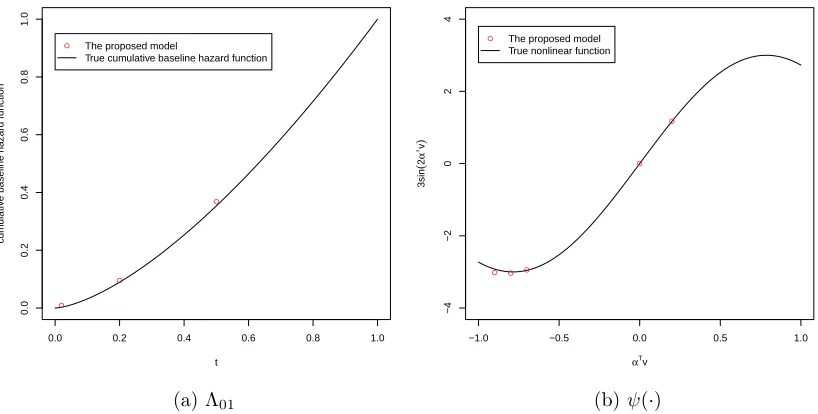
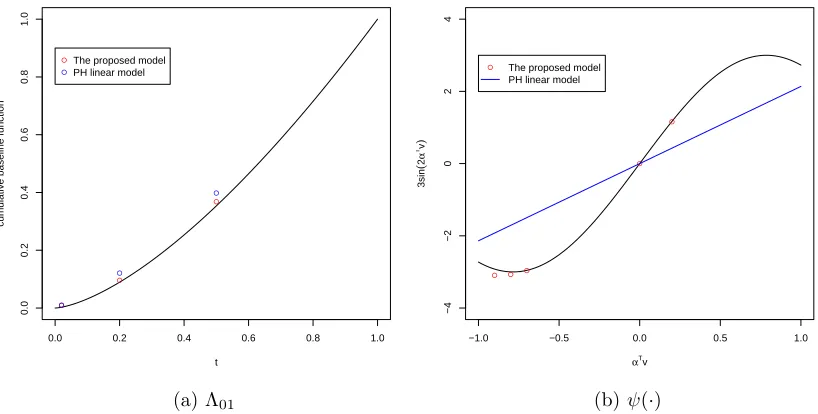
sim-ulation studies. The first simsim-ulation study gives the estimates of the parameters of
interest, such as the linear covariate parameter β, the nonlinear covariate parameter α and the association parameter φ. The estimate of the cumulative baseline hazard function Λ0(∙) and the nonlinear function ψ(∙) are also given. The second simulation
study compares the proposed model with what is referred to as the PH linear model here. The PH linear model is the one that has the same structure as the proposed
model except that the covariates are all assumed to have linear effects on the log