Performance Analysis of Gaussian Minimum Shift
Keying (GMSK) With Error Control Codes in
Wireless Sensor Networks
M. Sheik Dawood1 ,C.Jenifer2 ,R.Abdul sikkandhar3 and G.Athisha4
1,2,3
Deapertment of ECE,Sethu Institute of Technology, Pulloor ,4
Depaertment of ECE, PSNA Colleges of Engg. and Technology, Dindigul
Abstract-Energy efficient transmission mechanism is a significant issue in Wireless Sensor Network to prolong its lifetime. Energy efficiency and lifetime awareness fetching important design concerns in clustered WSN.The challenging choice of selecting modulation and coding in different channel condition is focused on this work. Furthermore, the performance of modulation and error control codes is analyzed with distance between nodes taken as a constraint. The sensor event transmission mechanism is analyzed with GMSK system with Golay, RS (Reed-Solomon) and convolutional codes. The performance of transmission approach are evaluated by calculating the energy required to transmit a bit under AWGN (Additive White Gaussian Noise) and Rayleigh channel.It also examine the adaptability of GMSK technique for WSN. Our focus is on enhancing the lifetime of each cluster of WSN using proper selection of the modulation and coding schemes for different sensors.
Keywords: Sensor network; GMSK, Lifetime;Modulation;Energy Efficiency;Error control codes
1. INTRODUCTION
A WSN Consists of several sensor nodes, which are distributed in an environment and use batteries as an energy resource.[1] These sensor nodes could be deployed at home, military, science and industry applications. Battery power is one of the major constraints in WSN.In order to get better lifetime, an energy efficient transmission approach should be adapted at the transceiver of sensor node. On the communication part of sensor node, the choice of selecting modulation and coding method played an imperative responsibility to get better energy efficiency.[2,3] Several researchers examined PSK, FSK, QPSK, QAM AND MSK modulation schemes with different combination of error control codes to improve the lifetime of sensor nodes.[5,6,10].In this work,we study the performance of GMSK system with Golay, Convolutional and RS codes under both AWGN and Rayleigh channel.
2. EXISTING WORK
The previous works take note carefully on improving the lifetime of sensor node by reducing energy consumption at the transceiver level with different energy models. A variety of combinations of modulation and coding is examined based on their performance in dissimilar channel condition.The section 2.1 &2.2 give details of modulation and coding techniques and its performance in wireless sensor networks
2.1.Performance of Various Modulation Techniques Together with and Excepting Coding
Maryam Soltan et al. (2008) present consideration on improvement of life time of hierarchical WSN using energy optimization methods at the physical layer. It furthermore analyzed the energy in the network being distributed more uniformly by proper selection of the modulation schemes for different sensors.[1],[10].Performance analysis of BPSK,MSK,QPSK,QAM,GMSK is done with AWGN channel conditions for two tired Wireless Sensor Network.[6]sheik dawood et al.(2012)
Sudhir Babu et al. (2011) evaluated the performance of transmission modes by calculating the probability of BER versus the Signal Noise Ratio (SNR) for different modulations like 16QAM, 64QAM, 16DPSK and 64DPSK under the three wireless channel models (AWGN, Rayleigh and Rician). The result concluded that 16-QAM is performing better than 64-QAM. [9].Gopinath Balakrishnan et al. (2007) focused on the performance analysis of different error control codes based of their BER performance and power consumption over Gaussian channel.The work reveals that binary-BCH codes with VLSI realization are preeminent choise for Wireless Sensor Networks. [2]
The performance of a mixture of grouping modulation schemes along with error control codes studied to identify the suitable energy efficient information communication method in a clustered WSN.The modulation schemes take into account for this work together with 16-PSK, 16-PAM, 16-QAM and 16-FSK in company with convolutional, Golay and RS codes under both AWGN and Rayleigh fading channels. The simulation and mathematical outcome shows that 16FSK with Golay codes in AWGN and 16QAM with Golay codes in Rayleigh channel is further energy efficient than other combination of modulation and coding techniques.[3]
Kun Yang et al. (2012) examined an adaptive modulation and coding procedure such as BPSK, QPSK, 16QAM, 64QAM and convolutional coding for all-participate amplify-and-forwards relay network systems. At this point, authors considered the source nodes chosen the appropriate modulation and coding scheme based on the information from the feedback channels. [7]Sami H. O. Salih et al. (2011) analzed the use of an Adaptive Modulation and Coding (AMC) using wireless technologies for giving better throughputs while satisfying distances as constraint. It also revealed AMC features of the wirless access technologies and focused on the physical layer design with BPSK, QPSK, 16QAM, 64QAM and RS codes. [11] 2.2.Performance of GMSK System in Wireless Systems
GMSK system is examined by several researchers and adapted in GSM,LTE,Code Division Multiple Access (CDMA) and MIMO wireless systems. GMSK modulation system is examined by LiDuan MA et al.
(2005), which uses RS codes both in AWGN channels and Rayleigh fading channels at different code rates. The work reveals that GMSK with RS code under the AWGN channel is more efficient than a Rayleigh channel. [12] Sattar B. Sadkhan et al. (2011) investigated the mobile communication system using GSM standard with GMSK modulation scheme. The performance of GMSK is studied with the effect of the Raleigh fading channel. [14] Manish Rai et al. (2012) presented an analytical framework for DS-CDMA network with a two branch diversity schemes for a Rayleigh fading channel also analyzed GMSK modulation technique which clearly showed an improvement over QPSK modulation. [13]
3. PROPOSED WORK
GMSK is a demonstrated technique for many wireless networks such as GSM,MIMO and CDMA system. Here we are trying out study the performnce of GMSK with error control code for WSN at different channel condition.
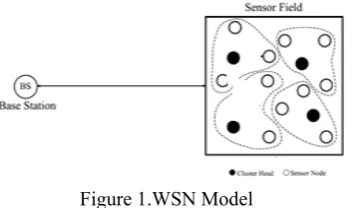
Figure 1.WSN Model
The network model WSN considered in this work is adapted from[8] for it suitability to improve the energy efficiency of sensor node.The sensor network have sensor nodes in Spreaded manner in sensor field. The operational situation is shown in Figure 1, here the sensor field is a square area of side at a distance of only fixed base station. The sensor nodes are afforded with limitations on battery power, processing power and memory. The nodes in a cluster carry out the cluster head job or sensing functions. Every cluster
multi-hop routing. The nodes to be used for sensing events are decided and controlled by the base station.[8]
3.1.Energy Efficient Clustering Architecture for Performance Analysis of Modulation and Coding
Different from the sensor nodes, the base station is not with the restricted resources. Thus the communication from the base station to the sensor nodes can be performed straightforwardly. The base station has information about the position of every node in the network that is situated within the sensor field. Sensors form a cluster around each cluster head (CH) node as shown in Figure 1. The CH node directly collects data from sensors in its assigned cluster and forwards the data towards the base station. Within a cluster, sensors communicate with the CH node through different pairs of FDMA/TDMA channels. Within a cluster, sensors communicate with the CH node through different pairs of TDMA channels. The network lifetime depends on the lifetime of each cluster. In this study, we try to analyze the selection of modulation and coding for energy efficient transmission of data from sensor node to CH or base station. Assume that CH nodes have access to larger energy source than the sensor nodes, so we focus on the energy consumption of the sensors due to data transmission to CH nodes. To increase a cluster’s lifetime, the energy consumption in each sensor should be reduced. Energy dissipation due to data transmission is a large percentage of the overall energy consumption within the sensors.
Sensor nodes are deployed Based on the QoS Enhanced base Station Controlled Dynamic Clustering Protocol (QBCDCP), by applying this clustering mechanism in hierarchical WSN the sensor node position controlled by the base station. The distance based approach is useful to select the appropriate transmission strategies for improving the lifetime of selected WSN.[8]
3.2.Performance Analysis of GMSK
One common modulation and coding scheme is considered for all nodes leads to wastage of transmission energy,to overcome this issue distance based diverse modulation techniques adapted with error control codes. This paper analyzes the performance of GMSK with Golay, Convolutional and RS codes under both AWGN and Rayleigh channel to improve the energy efficiency and lifetime for a constant bit error rate.
3.2.1. Radio Model for Sensor Node
In order to transmit n bits at a distance of r, the radio transmitter will consume the following amount of energy
eTx (n, r) = Etc (n) +E amp (n, r) ---(1)
where Etc(n) is the energy that the radio circuitry needs to expend in order to process n bits, and Eamp(n,r) is the energy needed by the radio amplifier circuit to send n bits at r meters. The formula can further refine by different researchers [1,10,3] for calculating transmit energy per bit.
3.2.2.Calculation of Transmitting Energy
Equation (1) redefined for calculating the transmission energy in log distance path loss model is shown in Equation (2). The required energy per transmitted bit in the ith sensor node may be written as:
e i = K . E . 4πd ,
λω
β ,
… … … . . 2
Where, kTx is a constant coefficient,. Eb is the desired energy per bit of the receiver in order to suit a preferred BER requirement. de(i),i and βe(i),i denote the distance and the path loss exponent respectively. βe(i),i vary on the environment and is typically between 2 and 5, whereas λw denotes the signal wavelength.For any modulation scheme, the BER can be described as a function of Eb/No which is the ratio of the energy per bit to the noise power spectral density. For a given Eb/No, there can be a large difference between the required BER of different modulation schemes and vice versa.
An energy efficient modulation scheme for WSNs is chosen by the aid of BER Vs Eb/No plot using MATLAB. In this paper, BER is taken as 10-1 and the corresponding Eb value is found from the graph of BER Vs Eb/No (dB). Figure 3 & 4 shows a BER curve for AWGN & Rayleigh channel.The correnponding Eb value of selected modulation is applied in Equation (2) to calculate the transmission energy.
Figure 3. BER curve for GMSK under AWGN channel
Figure 4. BER curve for GMSK under Rayleigh channel
3.2.3.Calculation of Network Lifetime
Network lifetime as the time span from the sensor deployment to the first loss of coverage. Define the network lifetime as the time span from the deployment to the instant when the network is considered non-functional. [15,16]According to definition of lifetime, the formula derived for calculating the average network lifetime is shown in Equation 3
= Ε Ε …… ………. (3)
Where, S is the total number of sensors, E0 is the initial energy, Ew is the expected wasted energy,Er is the expected reporting energy consumed by all sensors.
4. SIMULATION STUDY
In this study, 500 sensors placed using a two-dimensional uniform distribution in a 100x100 m2 field. The sensors are distributed into five clusters with CH nodes placed in the center of each cluster. The packet size is set to 128 bytes.The initial battery energy level of each sensor is 100J. The path loss exponent is set to 3. By using the Equation (3), the network lifetime is calculated for different modulation schemes with error control codes. Figure 5, 6, 7&8 shows the lifetime (days) at BER=10-1 for different modulations along with Golay, Convolutional and RS codes at different distances d=5m, 10m, 40m & 60m under AWGN and Rayleigh channel. It is clear that the value of Eb/No (dB) is same for Golay codes under AWGN and Rayleigh channel. The result shows that GMSK with Golay codes in both AWGN & Rayleigh channel is more energy efficient than other combination of coding techniques. It is also observed that AWGN channel is more efficient than a Rayleigh channel.
0 1 2 3 4 5 6 7 8
10-7 10-6 10-5 10-4 10-3 10-2 10-1 100
Eb/No
B
it
E
rr
or
P
robabi
lit
y
BER vs. Eb/No for GMSK under AWGN
gmsk+Golay gmsk+RS gmsk+conv
0 1 2 3 4 5 6 7 8 9 10
10-3 10-2 10-1 100
Eb/No
B
it
E
rro
r P
ro
b
a
b
ili
ty
BER vs. Eb/No for GMSK under Rayleigh
Table 1. Lifetime (days) at BER=10-1 for GMSK with different codes under AWGN & Rayleigh channel at distance d=5 & 10m
Type of Modulations Type of Codes Eb/No(dB)
d=5m d=10m
eTx (J) Life time
(Days) eTx (J)
Life Time (Days)
GMSK+ AWGN
Convolutional 2.4 0.59 169 4.75 21
Golay 1 0.25 399 1.98 50
RS 8 1.98 50 15.8 6
GMSK+ Rayleigh
Convolutional 2.5 0.62 161 4.95 20
Golay 1 .25 399 1.98 50
RS 10 2.48 40 19.8 5
Table 2. Lifetime (days) at BER=10-1 for GMSK with different codes under AWGN & Rayleigh channel at distance d=40 &60m
Type of Modulations Type of Codes Eb/No (dB)
d=40m d=60m
eTx (KJ) Life time
(Days) eTx (KJ)
Life time (Days)
GMSK+ AWGN
Convolutional 2.4 0.30 333 1.03 97
Golay 1 0.13 768 0.43 232
RS 8 1.01 99 3.42 29
GMSK+ Rayleigh
Convolutional 2.5 0.32 312 1.07 93
Golay 1 0.13 768 0.43 232
RS 10 1.27 79 4.28 23
Figure 5. Lifetime for GMSK at distance d=5m under AWGN & Rayleigh channel
Figure 6. Lifetime for GMSK at distance d=10m under
Figure 7- Lifetime for GMSK at distance d=40m under AWGN & Rayleigh channel
Figure 8- Lifetime for GMSK at distance d=60m under 0
50 100 150 200 250 300 350 400 450
Lifetime
AWGN
Raleigh
0 10 20 30 40 50 60
Lifetime
AWGN
Raleigh
0 100 200 300 400 500 600 700 800 900
Lifetime
AWGN
Raleigh
0 50 100 150 200 250
Lifetime
AWGN
5. CONCLUSION AND FUTURE WORK
In this work the performance analysis of GMSK modulation with error control codes is studied under AWGN & Rayleigh channels to improve the energy efficiency and lifetime of a WSN. The result shows that GMSK with Golay codes in AWGN & Rayleigh channel is more energy efficient than other combination of coding techniques. It is also shown that the performance of GMSK in AWGN channel is further competent than a Rayleigh channel environment. The future work is to determine the strategies to further improvement in sensor node lifetime by Analyzing the GMSK system with variable bit error rate at different channel conditions.
REFERENCES
1. Maryam Soltan, Inkwon Hwang and Massoud Pedram, “Modulation-Aware Energy Balancing in Hierarchical Wireless Sensor Networks” in proceedings of 3rd International Symposium on wireless Pervasive Computing, 2008.
2. Gopinath Balakrishnan, M. Yang, Y. Jiang, and Y. Kim
,“Performance analysis of error control codes for wireless sensor networks,” in Proc. Int. Conf. Information Technology (ITNG’07), pp. 876–879,2007.
3. M. Sheik Dawood, G. Athisha, Performance Analysis Of Modulation And Coding To Maximize The Lifetime Of Wireless Sensor Network, International Review On Computers And Software (IRECOS), Vol. 8 N. 10, October 2013.
4. M. Sheik Dawood, R. Aiswaryalakshmi, G. Athisha, Performance Analysis Of MSK Modulation And Coding In Energy Efficient Sensor Network Protocol, Journal Of Theoretical And Applied Information Technology, Vol. 56. No. 1. October 2013.
5. M. Sheik Dawood, R. Aiswaryalakshmi, R Abdul Sikkandhar, G. Athisha,” A Review on Energy Efficient Modulation and Coding Techniques for Clustered Wireless Sensor Networks”, International Journal of Advanced Research in Computer Engineering & Technology (IJARCET), Vol.2 No.2,2013.
6. M. Sheik Dawood, Sajin Salim, S. Sadasivam and G. Athisha .“ Energy Efficient Modulation Techniques for Fault Tolerant Two-Tiered Wireless Sensor Networks” Journal of Asian Scientific Research, Vol.2.No.3, pp.124-131,2012
7. Kun Yang and Lingyang Song , “Adaptive Modulation and Coding for Two-Way Amplify-and-Forward Relay Networks, ” IEEE International Conference on Communications in China: CTS,2012. 8. Sheik Dawood. M., S. Sadasivam and G. Athisha,”Energy Efficient
Wireless Sensor Networks based on QoS Enhanced base station controlled Dynamic Clustering Protocol”, International Journal of Computer Applications, Vol.13, No.4, pp.0975 – 8887,2011 9. Sudhir Babu and Dr. K.V Sambasiva Rao , “Evaluation of BER for
AWGN, Rayleigh and Rician Fading Channels under Various Modulation Schemes” International Journal of Computer Applications, Vol.26 .No.9, pp.0975 – 8887,2011.
10. Maryam Soltan, Inkwon Hwang, and Massoud Pedram “
Heterogeneous Modulation for Trading-off Energy Balancing with Bandwidth Efficiency in Hierarchical Sensor Networks, ” Proceedings of the 2008 International Symposium on a World of Wireless, Mobile and Multimedia Networks.2008
11. Sami H. O. Salih and Mamoun M. A. Suliman , “Implementation of Adaptive Modulation and Coding Technique” International Journal of Scientific & Engineering Research Volume Vol.2 .No.5,2011. 12. Liduan MA and David Asano , “Performance of GMSK and
Reed-Solomon Code Combinations”, IEICE Transactions on Fundamentals of Electronics, Communications and Computer Sciences, Vol.E88-A No.10 pp. 2863-2868,2005.
13. Manish Rai and Amit Nigam), “Analysis of Performance
Improvement Using GMSK Modulation Techniques in Wireless DS-CDMA Communication Systems”, International Journal of Engineering Science and Technology (IJEST), Vol. 4, No.05, 2012. 14. Sattar B. Sadkhan, Nidaa A. Abbas and M. Hutahit , “Wireless
communication system based on GMSK modulation scheme” Atti Della “Fondazione Giorgio Ronchi”, Anno LXVI, N. 2, 2011 15. Yunxia Chen and Qing Zhao ,“On the Lifetime of Wireless Sensor
Networks, ” IEEE Communications letters, Vol. 9.No.11, 2005. 16. Bhardwaj, M and Chandrakasan, A.P , “Bounding the Lifetime of