IOT based smart Irrigation system
S.KINNERA, B.ANUSHA
1M- Tech, Department of ECE, ASR College of Engineering
2Assistant Professor, Department of ECE, ASR College of Engineering
ABSTRACT: Automation of farm activities can transform agricultural domain from being manual and static to intelligent and dynamic leading to higher production with lesser human supervision. This paper proposes an automated irrigation system which monitors and maintains the desired soil moisture content via automatic watering. Aurduino platform is used to implement the control unit. The setup uses soil moisture sensors which measure the exact moisture level in soil. This value enables the system to use appropriate quantity of water which avoids over/under irrigation. IOT is used to keep the farmers updated about the status of sprinklers. Information from the sensors is regularly updated on a webpage through which a farmer can check whether the water sprinklers are ON/OFF at any given time. Also, the sensor readings are transmitted to a Thing speak channel to generate graphs for analysis.
Keywords
Automation, Microcontroller, Arduino, IOT.
Introduction:
Internet of Things (IoT) describes a network of physical objects that connect to each other through the internet. Objects or ‘things’ can transfer information wirelessly without requiring human interaction. A ‘thing’ can be any object that can be assigned an IP address and provided with the ability to transfer data over a network. A Thing, in the Internet of Things, can be a person with a heart monitor implant, a farm animal with a biochip transponder, an automobile that has built-in sensors to alert the driver when tire pressure is low -- or any other natural or man-made object that can be assigned an IP address and provided with the ability to transfer data over a network. These devices collect useful data with the help of various existing technologies and then autonomously flow the data between other devices. Current market examples include smart thermostat systems and washer/dryers that utilize Wi-Fi for remote monitoring. Internet of Things or IoT is an architecture that comprises specialized hardware boards, Software systems, web IJSER International Journal of Scientific & Engineering Research Volume 8, Issue 5, May-2017 45 ISSN 2229-5518 IJSER © May-2017 http://www.ijser.org APIs, protocols which together creates a seamless environment which allows smart embedded devices to be connected to internet such that sensory data can be accessed and control system can be triggered over internet. Also devices could be connected to internet using various means like WiFi, Ethernet and so on. Furthermore devices may not need to be connected to internet independently.
Proposed method:
TRANSDUCERS:
A transducer is a device which measures a physical quantity and converts it into a signal which can be read by an observer or by an instrument. Monitoring and controlling of a greenhouse environment involves sensing the changes occurring inside it which can influence the rate of growth in plants. The parameters which are of importance are the temperature inside the greenhouse which affect the photosynthetic and transpiration processes are humidity, moisture content in the soil, the illumination etc. Since all these parameters are interlinked, a closed loop (feedback) control system is employed in monitoring it. The sensors used in this system are:
1. Soil Moisture Sensor
2. Light Sensor (LDR)
3. Humidity Sensor
4. Temperature Sensor
SOIL MOISTURE SENSOR
Features of the Soil moisture sensor:
1. The circuit designed uses a 5V supply, fixed resistance of 100Ω, variable resistance of 10ΚΩ, two copper leads as the sensor probes, 2N222N transistor.
3. The conductivity of soil depends upon the amount of moisture present in it. It increases with increase in the water content of the soil.
4. The voltage output is taken at the transmitter which is connected to a variable resistance. This variable resistance is used to adjust the sensitivity of the sensor.
LIGHT SENSOR
Light Dependent Resistor (LDR) also known as photoconductor or photocell, is a device which has a resistance which varies according to the amount of light falling on its surface. Since LDR is extremely sensitive in visible light range, it is well suited for the proposed application.
Light Dependent Resistor
HUMIDITY SENSOR
The humidity sensor HIH4000, manufactured by Honeywell is used for sensing the humidity. It delivers instrumentation quality RH (Relative Humidity) sensing performance in a low cost, solder able SIP (Single In-line Package). Relative humidity is a measure, in percentage, of the vapour in the air compared to the total amount of vapour that could be held in the air at a given temperature.
HIH-4000-001 Humidity Sensor
TEMPERATURE SENSOR
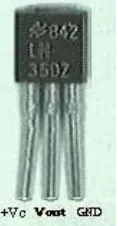
proportional to the temperature (in oC). The temperature can be measured more accurately with it than using a thermistor. The sensor circuitry is sealed and not subject to oxidation, etc.
Fig. 4.6 LM35 temperature sensor
IOT:
The Internet of things (IoT) is the network of physical devices, vehicles, home appliances and other tems embedded with electronics, software, sensors, actuators, and connectivity which enables these objects to connect and exchange data. Each thing is uniquely identifiable through its embedded computing system but is able to inter-operate within the existing Internet infrastructure.
The figure of online capable devices increased 31% from 2016 to 8.4 billion in 2017. Experts estimate that the IoT will consist of about 30 billion objects by 2020. It is also estimated that the global market value of IoT will reach $7.1 trillion by 2020.
The IoT allows objects to be sensed or controlled remotely across existing network infrastructure, creating opportunities for more direct integration of the physical world into computer-based systems, and resulting in improved efficiency, accuracy and economic benefit in addition to reduced human intervention. When IoT is augmented with sensors and actuators, the technology becomes an instance of the more general class of cyber-physical systems, which also encompasses technologies such as smart grids, virtual power plants, smart homes, intelligent transportation and smart cities.
"Things", in the IoT sense, can refer to a wide variety of devices such as heart monitoring implants, biochip transponders on farm animals, cameras streaming live feeds of wild animals in coastal waters, automobiles with built-in sensors, DNA analysis devices for environmental/food/pathogen monitoring, or field operation devices that assist firefighters in search and rescue operations. Legal scholars suggest regarding "things" as an "inextricable mixture of hardware, software, data and service".
Proposed method:
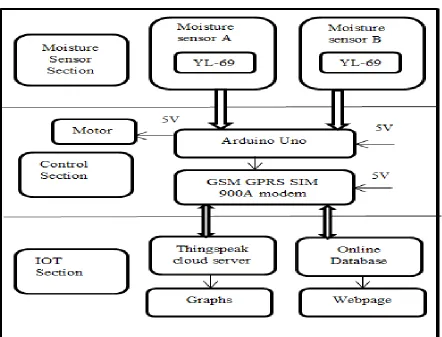
The system is a combination of hardware and software components. The hardware part consists of embedded system and software is the webpage designed using PHP. The webpage is hosted online and consists of a database in which readings from sensors are inserted using the hardware.
Figure 1: Overall Engineering Design
Moisture Sensing Section
Two YL-69 soil moisture sensors along with LM393 comparator modules were placed in different soil conditions for analysis. The sensor YL-69 is made up of two electrodes. It reads the moisture content around it. A current is passed across the electrodes through the soil and the resistance to the current in the soil determines the soil moisture. If the soil has more water resistance will be low and thus more current will pass through.
analog input pin of Arduino can read analog signals being sent from the sensor and return binary integers from 0 to 1023. Greater amount of output implies lesser moisture content.
Control Section
Information from the sensors is transmitted to the arduino board. The arduino board consists of microcontroller ATMEGA328P which is responsible for controlling the switching on/off of the motor on which water sprinklers can be attached. Sensor values from arduino are transmitted to the GSM-GPRS SIM900A modem. A sim with 3G data pack is inserted into this modem which provides IOT features to the system. Values are further transmitted IOT section through the modem.
The GSM modem is a highly flexible plug and play quad bandSIM900A GSM modem for direct and easy integration to RS232 applications. It Supports features like Voice, SMS, Data/Fax, GPRS and integrated TCP/IP stack. The tx and rx pins from arduino are connected to the rx and tx of GSM modem respectively.
IOT Section
This section comprises of a webpage which displays the current water sprinkler status i.e. on or off and a button which redirects the user to a thing speak page which graphically depicts the sensor values.
METHODOLOGY
Water sprinkler control was achieved by setting a threshold value at which irrigation should begin. When the sensors detect moisture content before the threshold, the sprinklers are switched on till the soil is completely moist. Figure 5 shows the flow chart of the system.
Results:
Conclusion:
A system to monitor moisture levels in the soil was designed and the project provided an opportunity to study the existing systems, along with their features and drawbacks. The proposed system can be used to switch on/off the water sprinkler according to soil moisture levels thereby automating the process of irrigation which is one of the most time consuming activities in farming. Agriculture is one of the most water-consuming activities. The system uses information from soil moisture sensors to irrigate soil which helps to prevent over irrigation or under irrigation of soil thereby avoiding crop damage. The farm owner can monitor the process online through a website. Through this project it can be concluded that there can be considerable development in farming with the use of IOT and automation. Thus, the system is a potential solution to the problems faced in the existing manual and cumbersome process of irrigation by enabling efficient utilization of water resources.
REFERENCES:
[1] Dr. Narayan G. Hegde, “Water Scarcity and Security in India”, BAIF Development ReseachFoundation, Pune.
[2]Marvin T. Batte, “Changing computer use in agriculture: evidence from Ohio”, Computers and Electronics in Agriculture, Elsevier science publishers, vol. 47, 1–13, 2005
[4] Jin Shen, Song Jingling, Han Qiuyan and Yang Yan, “A Remote Measurement and Control System for Greenhouse Based on GSM-SMS”, Electronic Measurement andInstruments, 2007. ICEMI '07. 8th International Conference
[5] Indu Gautam and S.R.N Reddy, “Innovative GSM based Remote Controlled Embedded System for Irrigation”, International Journal of Computer Applications Vol. 47 – No.13, June 2012
[6] R.Suresh, S.Gopinath, K.Govindaraju, T.Devika, N.SuthanthiraVanitha, “GSM based Automated IrrigationControl using Raingun Irrigation System”, InternationalJournal of Advanced Research in Computer and Communication Engineering Vol. 3, Issue 2, February 2014.
[7] Karan Kansara, Vishal Zaveri, Shreyans Shah, Sandip Delwadkar, and Kaushal Jani “Sensor based Automated Irrigation System with IOT: A Technical Review”,(IJCSIT) International Journal of Computer Science and Information Technologies, Vol. 6 (6) , 2015, 5331-5333 [8] Sumeet. S. Bedekar, Monoj. A. Mechkul, and Sonali. R. Deshpande “IoT based Automated Irrigation System”, IJSRD - International Journal for Scientific Research& Development| Vol. 3, Issue 04, 2015 | ISSN (online): 2321-0613
[9] K.S.S. Prasad, Nitesh Kumar, Nitish Kumar Sinha and Palash Kumar Saha “Water-Saving Irrigation System Based on Automatic Control by Using GSM Technology”, Middle-East Journal of Scientific Research 12 (12): 1824-1827, 2012ISSN 1990-9233 c IDOSI Publications, 2012DOI: 10.5829/idosi.mejsr.2012.12.12.1258
[10] Remote Sensing and Control of an Irrigation System Using a Distributed Wireless Sensor Network by Yunseop (James) Kim, Member, IEEE, Robert G. Evans, and William M. Iversen, IEEE Transaction on Instrumentation and Measurement, VOL.57
[11] Thingspeak: https:// thingspeak.com/
[12] Alexandros Kaloxylos, Robert Eigenmann, Frederick Teye, Zoi Politopoulou, Sjaak Wolfert, Claudia Shrank, Markus Dillinger, Ioanna Lampropoulou, Eleni Antoniou, Liisa Pesonen, Huether Nicole, Floerchinger International Journal of Computer Applications (0975 –