61 |
P a g e
APPLICATION FOR HAND REHABILITATION
USING LEAP MOTION SENSOR BASED ON A
GAMIFICATION APPROACH
Adrian Karashanov
1, Agata Manolova
2, Nikolay Neshov
31,2,3
Faculty of Telecommunications, Technical University of Sofia, (Bulgaria)
ABSTRACT
In recent years, many researchers and companies are seeking to provide more natural, human-oriented means of interacting with computers. A particularly important direction of that trend is hand gesture recognition. These systems have received great attention in the recent few years because of their countless applications such as gaming, robotics, education, physical therapy etc. In this paperwe present an application for rehabilitation developed for upper limb motor disabled users using the Leap Motion controller based on a gamification approach. The basic idea of this application is to help develop the muscle tonus and increase precision in gestures using the opportunities that the new technologies offer by making the rehabilitation process fun and engaging.
Keywords
:
Gesture Recognition, Human-Computer Interface, Leap Motion Controller,
Rehabilitation, Unity 3D Game Engine
I INTRODUCTION
Human computer interaction (HCI) [1] refers to the relation between the human and the computer and since the machine is insignificant without suitable utilize by the human [2] the current technologies try to provide more natural, human-oriented means of interaction. There are two main characteristics should be deemed when designing a HCI system as mentioned in [1]: functionality and usability. System functionality referred to the set of functions or services that the system equips to the users [1], while system usability referred to the level and scope that the system can operate and perform specific user purposes efficiently. The system that attains a suitable balance between these concepts can offer to the user an engaging and useful experience.
62 |
P a g e
constantly use our hands to interact with objects: move them, modify them, and transform them. In the same unconscious way, we gesticulate while speaking to communicate ideas („stop‟, „come closer‟, „no‟, etc.). Hand movements are thus a mean of non-verbal communication, ranging from simple actions (pointing at objects for example) to more complex ones (such as expressing feelings or communicating with others). A gesture can be defined as a physical movement of the hands, arms, face and body with the intent to convey information or meaning [3, 4].Gestures are vital for many of the new technologies. Particularly, Virtual Reality systems are notable for having a high interaction with the user based on real-time responsive actions. In rehabilitation, these systems are offered as modern strategies where a patient performs a set of therapy activities recognized as integration tasks through games or simulations [5]. If a therapy is focused on upper limbs, a set of specialized gestures are necessary for the total recovery of patients. The interpretation of human gestures is a well-known computational problem in Computer Vision field. For the developed application to be useful the GUI (Graphics User Interface) used must be friendly and simple to perform particular movements required by a software application. Based on that, the hardware to capture the gestures has a relation with the GUI as well as the established set of body movement which represent a gesture [6].
Nowadays, there are studies dedicated to achieve gesture recognition algorithms for health purpose to improve the quality of certain tasks. A remarkable example is shown in the Physical Rehabilitation field where the low-cost hardware and algorithms accomplish outstanding results in therapy over patients with mobility issues [7]. However, the gesture recognition and the effective calibration between the hardware and the software application is still a challenge to be solved.
In this paper, we describe a solution to capture and recognize the movement of upper limbs using the Leap Motion controller based on the gamification approach with application in the physical rehabilitation therapy. Thus, we define a automaton for gesture action for helping users with upper limb problems increase muscle tonus and precision in fun and engaging ways. This paper is organized as follows: Section 2 presents a briefly overview in gesture recognition on rehabilitation systems. Next, Section 3 describes our approach proposed in recognition using low cost hardware, specifically the Leap Motion. In Section 4, we show the developed application. Finally, Section 5 presents conclusions and future work.
II. GESTURE RECOGNITION IN REHABILITATION SYSTEMS
63 |
P a g e
includes a magnetic tracker which can detect gross gestures from the upper limbs. Another example is shown by the system IREX (Interactive Rehabilitation and Exercise System) [9] which includes a wide range of interactive games focused in gross motor movement for the arms. All these systems are efficient showing good results. Nevertheless, their acquisitions are expensive due to the employed hardware. Therefore, the requirement of low-cost options is necessary. Thus, the hardware provided by the video game consoles emerged as an excellent option because they are designed to obtain the 3D position of game players in real time. Thereby, researches focused on the Microsoft Kinect, Nintendo Wii, PlayStation Move, Leap Motion, Myo armband and others are outstanding examples. Recently, Cameirao et al. [10] developed a Kinect-based tool for the rehabilitation of motor deficits of upper extremities (Rehabilitation Gaming System - RGS) after a brain lesion due to stroke. In addition, researches like those made by Hayes et al. [11] and Lange et al. [12], show platforms of video games for rehabilitation using the Kinect as a rehabilitation tool.There are two types of devices for recognizing gestures available on the market that enable independent developments of the third-party developers [13]:
• Motion sensing systems - bracelets, rings, bracelets under elbow, gloves and pointers;
The primary advantage that motion sensing gesture recognition devices have over computer vision systems is a larger library of possible gestures enabled by the precision sensor array. This may include things such as “air handwriting” recognition and the subtle nuances of sign languages. Furthermore, the gesturing itself may be less conspicuous because it can be done with smaller movements made closer to the body thus calling less attention to the user.
The disadvantage is that motion sensing devices are separate pieces of hardware that must be toted along with the user. They have the additional burdens of needing their own power sources and having to establish and maintain a radio connection to the human-compuer interface (HCI). Today‟s devices are mostly made by third parties and compatibility may be limited to select HCI.
• Computer Vision Systems
They consist of two or more camera sensors and one or more infrared laser or LED light projectors. The cameras track infrared light which is outside of the visible spectrum and work in stereo to aid depth perception through parallax as human eyes do. The angle of the camera lenses defines the width of the sensor system‟s field of view which gets wider as it gets farther from the lenses; however the viewing range is limited by the output of the light source.
Computer vision based systems have several advantages. Unlike motion sensing peripherals, the depth sensing time of flight components can be integrated directly into the HCI. This means that there is only one device to carry, one battery to charge and no pairing necessary between devices. Also the gesture recognition software is integrated into the operating system of the HMD which should make for smoother, more efficient user experience because there is no interoperability overhead.
64 |
P a g e
For this study a comparison between several sensors from the two different types was done.The Myo Armband is a device in the form of a bracelet below the elbow, developed by Canadian company Thalmic Labs [14]. Myo is placed on the widest part of the guide (dominant) hand. A key point is that the bracelet should always be in direct contact with skin. It can be worn under clothes, but not on them. Myo uses sensors that measure muscle activity in the hand. They work on the principle of electromyography (EMG) - recording the electrical potential of muscle cells when they are electrically or neurologically activated.
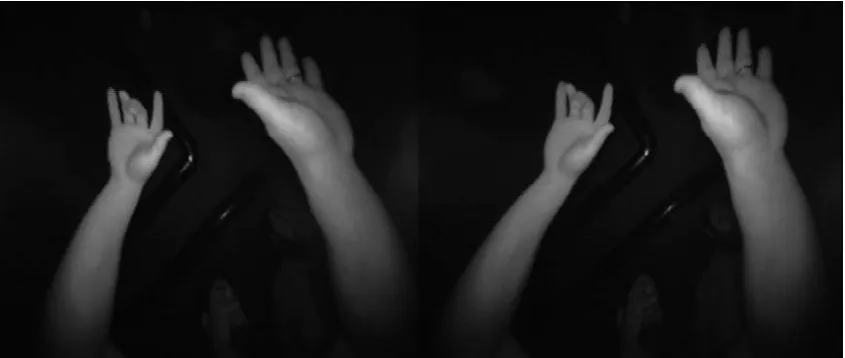
Leap Motion (LM) controller is a device from the second type. The controller is a computer hardware sensor device developed by the American company Leap Motion, Inc. [15]. It can detect in real time the movement of the hands and pointers. It is used as an input peripheral device, similar to the computer mouse, but there is no need for physical contact. The mechanics of Leap Motion controller are relatively simple [15]. The basic units of LM controller are two VGA monochrome cameras, three infrared LEDs (light-emitting diode) and a USB controller. The cameras and light emitting diodes serve for monitoring the infrared light with wavelength λ = 850 nm (outside the visible spectrum to the human eye). Thanks to the wide-angle lens the unit has a large space of interaction, it is approximately 0.23m³ (8 ft3) of the shape of inverted pyramid obtained by the intersection of the visual fields of the two cameras. The data is converted to gray scale stereo image divided into left and right camera (Fig. 1).
Fig. 1 The image that comes from the cameras LM controller
The purpose of this paper is the creation of application for rehabilitation of patients with upper limb motor problems based on the gamification approach. For this we needed a device which must be able to identify human fingers and palms with high enough precision to allow precision work in a virtual environment. In addition, it must be able to operate at close distances. This will allow to be used by patients in a seated or lying position. Not the last we needed to consider the economic factors - the price needed to be accessible, so there will be an opportunity for wider applications in practice.
65 |
P a g e
is almost imperceptible. Leap motion controller has an advantage in physical size also. This means easier transportation and positioning. It would be advantageous, from the viewpoint of the medical application because it would facilitate the implementation of therapy in different locations with different patients. Efforts to transfer of LM controller are negligible.Other advantages of the LM have the opportunity to work with all operating systems. What Myo armband is lacking is precision. The ability to sign an electronic document to paint a picture or even perform remote medical operation put Leap Motion forward. The application for the rehabilitation of hand requires careful and precise actions and coordination to be able to properly monitor the treatment of the patient and to take account of a significant improvement if such occur. The physical dimensions of both devices are comparable and according to this criterion no device has an advantage. From a financial perspective LM has the advantage of about two times lower price. On to the physical characteristics, it can be said that LM has a very slight advantage since it does not require synchronization gesture. This allows for easy use of people of different ages and different physiological characteristics.
This results as Leap Motion controller being a logical choice for the searched device. The application based on the gamification approach in a virtual reality environment will strive to achieve the effects of conventional physiotherapy and real improvements in the condition of patients with upper limb motor problems.
III. APPLICATION DEVELOPPMENT USING UNITY 3D GAME ENGINE
The application, developed for the purpose of this work has a main menu and sub-menus, which unite groups of exercises. Each group will bring together a number of exercises that are very close to each other or variations of the same exercise. The exercises will be organized in levels.
The levels are selected to be of four types:
- “Labyrinth” in which the patient moves a ball to the exit. Each successive level is of a more complicated labyrinth.
- “Pyramid”, in which the patient hand must put the missing pieces in the correct slots and sort them. On each level the missing pieces are more and more complicated.
- “Trash can” in which patient must collect and carry small objects with his hand to the trash. Bins are equal in number to the number of levels (eg. The third level has three bins). Each hand is responsible for filling only one basket.
- “Drawing” in which patient with his fingertips or with a pen (or similar object) uses a pre-drawn template to follow. Each successive level requires more complex coordination and more precise work.
Different levels can be added and the time of execution of each task can be followed to measure the outcome of therapy. As a function of the application is added option for selection of random level.
66 |
P a g e
The fig.2 illustrates the main menu of the program, which provides three options the user to enter a submenu for selecting an exercise to call selected by the system randomly exercise or quit the application.Fig. 2 Menu with sub-menus – exercise, random, exit (on the left), sub-menu Exercise – with
“Labyrinth”, “Pyramids”, “Trash can”, “Draw”, Random, Credits, Exit (on the right)
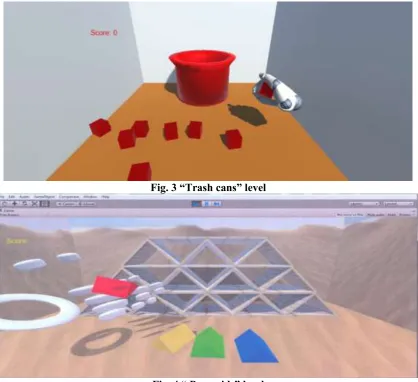
On the next figures (3, 4 and 5) are illustrated the different game options.
Fig. 3 “Trash cans” level
67 |
P a g e
Fig.5 “Labyrinth” level
The purpose of the level "Trash can" is the operated by a player from Leap Motion controller hand to collect all the "junk" and put it in the trash. The user needs to grab the object, transport it to the trash and release it over the target for successful completion he gets a point.
The level "Pyramids" (fig. 4) is more complicated to implement than previous as it requires precise movements on the horizontal axis, and the targets are smaller. As LM track equally well both hands, this demonstration is performed with the left hand. The purpose of this level is to gather blocks and put them on the shelves, it is important to note that the block must be properly oriented in space; otherwise it will not enter the desired location.
The most complex level, which requires the highest precision by the user is "Labyrinth" (fig. 5). Here, in addition to deal with coordination and precise move of the ball through the maze, the player himself has to deal with figuring out the right path. The aim of the game is to get the ball to the opposite diagonal, where the exit is located. The time of task completion is measured, allowing monitoring the improvement of skills in guidance and keeping the ball. Due to the high level of precision in tracking the movements of the player‟s hand muscle tonus of the patient who uses it can be measured. In this, as in the previous game levels we use minimum skeletal model for the arms and fingers, because it provides a good view of the actions of the player. But on the other hand has a lower contact surface, which hinders the action of the patient.
IV. CONCLUSION
68 |
P a g e
For future work, adding new levels will offer greater adaptability and flexibility in the platform to embrace a wider range of motion detection applications and adding a measurement of muscle tonus will increase the usefulness. Also, it would be possible to add more precision and versatility with technologies as Oculus Rift.ACKNOWLEDGEMENTS
This work was supported by contract DFNI I02/1 for research project: ”Intelligent man-machine interface for assistive medical systems in improving the independent living of motor disabled users“ of the Bulgarian Research Fund of the Ministry of Education and Science.
REFERENCES
[1] G. R. S. Murthy, R. S. Jadon. (2009). “A Review of Vision Based Hand Gestures Recognition,” International
Journal of Information Technology and Knowledge Management, vol. 2(2), pp. 405- 410.
[2] P. Garg, N. Aggarwal and S. Sofat. (2009). “Vision Based Hand Gesture Recognition,” World Academy of
Science, Engineering and Technology, Vol. 49, pp. 972-977.
[3] Fakhreddine Karray, Milad Alemzadeh, Jamil Abou Saleh, Mo Nours Arab, (2008) .“Human- Computer
Interaction: Overview on State of the Art”, Intern. Journal on Smart Sensing and Intelligent Systems, Vol. 1. [4] S. S. Rautaray, A. Agrawal, “Vision based Hand Gesture Recognition for Human Computer Interaction: A
Survey”, ARTIFICIAL INTELLIGENCE REVIEW 43(1) · JANUARY 2012
[5] Mitra S, Acharya T, Gesture recognition: a survey. IEEE Trans Syst. Man Cybern. (SMC) Part C Appl. Rev
37(3):311–324, 2007
[6] J. Ojeda, F. Moreno, E. Ramırez, and O. Rodrıguez, “Gesture-gross recognition of upper limbs to physical
rehabilitation,” in Proceedings of the International Congress of Numerical Methods in Engineering and Applied Sciences (CIMENICS)), 2014, pp. PI 7–12
[7] A. L. S. Kawamoto and F. S. C. da Silva, “Using low-cost technologies in the development of
people-monitoring applications,” in Proceedings of the 2013 XV Symposium on Virtual and Augmented Reality, ser. SVR ‟13. IEEE Computer Society, pp. 204–207.
[8] Bienetec, BioTrak. Retrieved from http://www.biotraksuite.com, 2013.
[9] GestureTek Inc., IREX. Retrieved from http://bit.ly/i0KA16, 2013.
[10] Cameir˜ao, M., Berm´udez, S., Duarte, E., & Verschure, P., Virtual reality basedrehabilitation speeds up
functional recovery of the upper extremities after stroke: A ran-domized controlled pilot study in the acute phase of stroke using the Rehabilitation GamingSystem. Restorative Neurology and Neuroscience, vol. 29, pp. 287-298, 2011.
[11] Hayes, A., Dukes, P., & Hodges, L., A Virtual Environment for Post-Stroke Motor Rehabilitation ,
Clemson University. Retrieved from http://bit.ly/GQ72lt, 2011.
[12] Lange, B., Skip, R., & Chang, C-Y., Markerless Full Body Tracking: Depth-SensingTechnology within
69 |
P a g e
[13] R. Padzensky, “Gesture Control”, 18 April 2015, - online report (http://augmera.com/?p=546)[14] www.myo.com