Semantic Annotation Aggregation with Conditional Crowdsourcing
Models and Word Embeddings
Paul Felt
IBM Watson∗ [email protected]
Eric K. Ringger
Facebook∗ [email protected]
Kevin Seppi
Brigham Young University [email protected]
Abstract
In modern text annotation projects, crowdsourced annotations are often aggregated using item response models or by majority vote. Recently, item response models enhanced with genera-tive data models have been shown to yield substantial benefits over those with conditional or no data models. However, suitable generative data models do not exist for many tasks, such as semantic labeling tasks. When no generative data model exists, we demonstrate that similar ben-efits may be derived by conditionally modeling documents that have been previously embedded in a semantic space using recent work in vector space models. We use this approach to show state-of-the-art results on a variety of semantic annotation aggregation tasks.
1 Introduction
Text annotation is a crucial part of natural language processing (NLP), enabling content analysis (Krip-pendorff, 2012) and providing training data for supervised and semi-supervised machine learning algo-rithms in NLP. Modern text annotation is often crowdsourced, meaning that the work is divided up and assigned to internet workers on micro-task marketplaces such as Amazon’s Mechanical Turk1or
Crowd-Flower.2 Although crowdsourced annotations tend to be error-prone, high quality labels may be obtained
by aggregating multiple redundant low-quality annotations (Surowiecki, 2005). For many tasks, aggre-gated crowdsourced judgments have been shown to be more reliable than expert judgments (Snow et al., 2008; Cao et al., 2010; Jurgens, 2013).
Traditionally annotations were aggregated via majority vote. More sophisticated approaches jointly model annotator reliability and document labels. These models can down-weight the annotations of workers who often disagree with others and up-weight the annotations of workers who often agree with others. However, when annotation error is high or few annotations are available it can be difficult for these models to know which annotators to trust. Jin and Ghahramani (2002), Raykar et al. (2010), Liu et al. (2012), and Yan et al. (2014) show that crowdsourcing annotation models can be enhanced by conditioning the model on the document data (e.g., word content), improving the model by identifying annotators whose judgments tend to agree with word patterns found in the documents being annotated.
Recent work has shown that generative data models allow crowdsourcing models to converge to useful estimates even when few annotations are available, whereas by the time a conditional model has enough information (in the form of annotations) to be useful, the problem is often largely solved by majority vote (Felt et al., 2015b). However, although generative data modeling has been shown to be effective in categorizing text according to its topic, realistic generative data models are not always available. In this paper, we use advances in text representation to demonstrate that data-conditional annotation models can This work is licensed under a Creative Commons Attribution 4.0 International License. License details: http:// creativecommons.org/licenses/by/4.0/
∗This work was completed while the first and second authors were at Brigham Young University.
1http://mturk.com 2http://crowdflower.com
θ
γjc b(θ)
b(γ)
yd
adj
d= 1. . . D
c= 1. . . C j= 1. . . J j= 1. . . J
(a)ITEMRESPas a plate diagram.
γjc φc
b(γ) Σ
µ
yd
xd adj
d∈1. . . D
c∈1. . . C j∈1. . . J j∈1. . . J
c∈1. . . C
(b)LOGRESPas a plate diagram.
θ
γjc
φc
b(θ)
b(φ) b(γ)
yd
xd adj
d= 1. . . D
c= 1. . . C j= 1. . . J j= 1. . . J
c= 1. . . C
(c)MOMRESPas a plate diagram.
θd
γjc φt
ηc b(θ)
b(φ)
b(γ) µ Σ
yd zdn
wdn adj
d= 1. . . D n=
1. . . Nd c= 1. . . C j= 1. . . J
c= 1. . . C
j= 1. . . J t= 1. . . T
[image:2.595.99.503.59.354.2](d)CSLDAas a plate diagram.
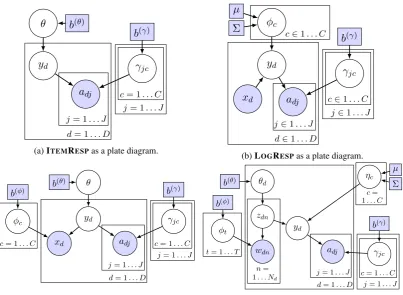
Figure 1: Round nodes are variables with distributions. Rectangular nodes are values without distribu-tions. Shaded nodes are observed.D, J, C,andTare the number of documents, annotators, classes, and topics, respectively.Ndis the number of words in documentd.
achieve gains similar to those of data-generative annotation models, including for tasks where generative data models are currently unavailable, such as paired text similarity and compatibility.
In Section 2 we briefly review annotation models with generative and conditional data components and also discuss representing words and documents via embeddings in a semantic vector space. In Section 3 we show that data-conditional annotation models succeed on a variety of text datasets and classification tasks. In Section 4 we conduct error analysis on an anomalous dataset, and in Sections 5 and 6 we list additional related work and summarize our conclusions.
2 Background
Most crowdsourcing models extend the item-response model of Dawid and Skene (1979). The Bayesian version of this model, referred to here as ITEMRESP, is illustrated by Figure 1a and defines the joint dis-tributionp(y, a, θ, γ), whereais the annotation andyis an unobserved document label. In the generative story for this model, a confusion matrixγj is drawn for each human annotatorj. Each rowγjc of the confusion matrixγj is drawn fromDir(b(jcγ)), and encodes a probability distribution over label classes
that annotatorjis apt to choose when presented with a document whose true label isc. A general prior over label classesθis drawn fromDirichlet(b(θ)), then for each documentdan unobserved document labelydis drawn from categorical distributionCat(θ). Finally, annotations are generated as annotatorj
corrupts the true labelydaccording to the multinomial distributionMult(γjyd).
2.1 Data-aware annotation models
Notice that the ITEMRESPmodel entirely ignores document datax(e.g., words). ITEMRESPextensions model the dataxand related feature parametersφeither conditionallyp(y, a, γ, φ|x)or else generatively
Conditional crowdsourcing models make few assumptions about the data and can use the same general log-linear structure as maximum entropy classifiers, which have enjoyed success in a large number of classification problems. Figure 1b shows a Bayesian formulation of a conditional crowdsourcing model
p(y, a, γ, φ|x). For each class k,φk is drawn from a multivariate Gaussian distribution Gauss(0,Σ).
Then for each document,ydis drawn from a log-linear distributionp(yd|φ, x) ∝eφTydx. For this reason
we refer to this model as LOGRESP. LOGRESPis representative of a popular class of conditional crowd-sourcing models (Jin and Ghahramani, 2002; Raykar et al., 2010; Liu et al., 2012; Yan et al., 2014). In previous work we found that LOGRESPoften provides only incremental gains over majority vote (Felt et al., 2015b). This partly because itsφestimates, like other conditional models, tend to converge rela-tively slowly withO(N)labeled examples (Ng and Jordan, 2001). By the time LOGRESP’sφestimates become useful, there are often enough annotations available that majority vote is sufficient.
Generative data-aware crowdsourcing models have complementary strengths. Although they make strong assumptions about the data that they model, their parameters can converge quickly with only
O(logn)labeled examples (Ng and Jordan, 2001). This means that when data does not violate a gen-erative model’s assumptions too badly, the gengen-erative model can offer dramatic improvements over ma-jority vote, especially when few annotations are available. Figures 1c and 1d depict two such generative models. In Figure 1c, each document ddraws its dataxdfrom a class-conditional multinomial word
distributionMult(φyd). We call this model MOMRESPbecause it models data as a mixture of
multino-mials. MOMRESPrepresents a common class of generative crowdsourcing models (Bragg et al., 2013; Lam and Stork, 2005; Simpson and Roberts, 2015). Figure 1d shows CSLDA, a more sophisticated generative crowdsourcing model based on supervised topic modeling (Felt et al., 2015a).
For inference in the ITEMRESP, LOGRESPand MOMRESPcrowdsourcing models, we use existing variational inference (Felt et al., 2015b). Note that variational inference for ITEMRESPis easily derived as a special case of MOMRESP inference where terms involving the data are dropped. Inference for CSLDA is stochastic expectation maximization.
2.2 Word and Document Representations
Documents have historically been represented in NLP algorithms by large, sparse word count vectors
xd =P|nx=1d| 1(xdn)where1(xdn)is a one-hot vector having length equal to the size of the vocabulary.
However, word-count document representations have a number of drawbacks. They define a space that is often so high-dimensional and sparse that inter-document distances and other vector computations have little meaning. In word-count representations, features that strongly relate to one another (e.g., the words “horse” and “equine”) are represented as entirely orthogonal dimensions, exploding the number of parameters needed by downstream learning algorithms.
Recently, methods have been developed to represent words as locations in low-dimensional vector spaces where distance and direction encode semantic and syntactic meaning (Mikolov et al., 2013a; Pen-nington et al., 2014). These embedding vectors have been shown to improve a variety of language tasks including named entity recognition, phrase chunking (Turian et al., 2010), relation extraction (Nguyen and Grishman, 2014), and part of speech induction (Lin et al., 2015). The hypothesis investigated by the current work is that semantic, vector-based text representations can help conditional annotation aggrega-tion models achieve some of the same early performance advantage seen in their generative counterparts, as well as help them operate on datasets that make semantic distinctions. This hypothesis is plausiblea
prioribecause using data embeddings is akin to using semi-supervision to enable faster learning. The
reason for this is that data embeddings are traditionally induced in an unsupervised manner on extremely large corpora before being applied to a downstream supervised task. In addition, operating on dense, low-dimensional vector data reduces the number of model parameters which can also reduce the number of instances required to learn effectively.
Dataset Size Unique Annotators
Annotations
per Instance Classes AverageDoc size Gold Labels Timestamps
Sentiment 1,000 83 5 2 12.8 1,000 No
Weather 1,000 102 20 5 13.6 724 Yes
Compatibility 17,977 411 10 2 2×1 15,157 No
Paraphrase 4,000 119 5 2 2×11.2 838 Yes
Table 1: Dataset statistics. Evaluation metrics are calculated only over the subset of each dataset for which gold labels are available. The timestamps column indicates whether or not it is known exactly when each annotation was generated. When available, timestamps determine the order of annotation in reported learning curves.
word2vec algorithm introduced by Mikolov et al. (2013a) to convert words to vectors for the purposes of this paper, understanding that other text embedding methods may be swapped in for additional improve-ments as they are developed. Word2vec operates on individual words. When sentences or docuimprove-ments must be vectorized, we do so by averaging the vectors of each word in the sentence or document without any word filtering or selection. While we briefly experimented with gensim’sdoc2vecimplementation of Le and Mikolov (2014), we noticed little benefit for the twitter data explored in this paper, possibly because of the short, focused nature of tweets.
3 Experiments
In order to test the hypothesis that vector space document representations can improve conditional crowd-sourcing model performance on semantic classification tasks, we plot and visually compare learning curves charting the accuracy of the labels inferred by various crowdsourcing models. All of the algo-rithms from Section 2 are trained on sparse one-hot vector representations of text; and an additional variant of LOGRESP is reported which is trained on low dimensional semantic vector representations (LOGRESP+w2v). Learning curves advance as annotations from multiple annotators are incrementally added to the set of annotations available to each model. When annotation timestamps are available, an-notations are added in the empirical order in which they were created. When unavailable, anan-notations are added in randomized breadth-first order so that each document gets one annotation before any document receives a second. Accuracy is computed over the subset of gold labels having at least one annota-tion. This process illustrates model behavior both when few annotations per document are available (in the early stages of learning curves) and when many annotations per document are available (in the late stages of the learning curves).
For our word embedding model, we use the word2vec algorithm, implemented by the gensim docu-ment processing library ( ˇReh˚uˇrek and Sojka, 2010) to train word embeddings on a June 2015 snapshot of the English Wikipedia pages and articles dump (approximately 2.1 billion words). The word2vec algorithm requires a number of parameters, which we report here for replicability. We train embeddings using a context window of 10 words, discarding words that occur fewer than 5 times. For training, we use hierarchical sampling with a skip-gram model and no negative sampling. Embeddings of size 300 are learned. All of these settings are rather standard for a large corpus like Wikipedia.
3.1 Datasets
WEATHER
0.6 0.7 0.8 0.9 1.0
0 5 10 15 20
Number of annotations x 1,000
Accur
acy
algorithm
LogResp+w2v
LogResp
csLDA
MomResp
ItemResp
Majority
(a) TheWeatherDataset
TWITTER_SENT
0.60 0.65 0.70 0.75 0.80
0 1 2 3 4 5
Number of annotations x 1,000
Accur
acy
algorithm LogResp+w2v
LogResp
csLDA
MomResp
ItemResp
Majority
[image:5.595.104.486.62.190.2](b) TheSentimentDataset
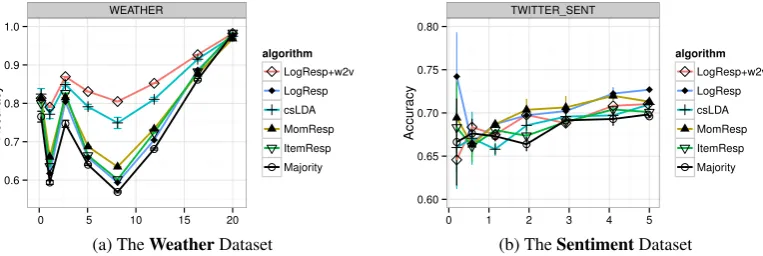
Figure 2: Inferred label accuracy (y axis) learning curves of various crowdsourcing models. The x axis is the number of annotations×1,000.
inexpert workers are, in aggregate, trustworthy. The purpose of automatic aggregation models such as those decribed in Section 2 is to arrive at the same judgment with a few annotations that a simpler scheme like majority vote would have arrived at given many annotations. Therefore, a crowd-constructed gold standard is appropriate for evaluation of such models.
Paraphrase. During an exploratory annotation phase, Xu et al. (2014) paid Amazon Mechanical Turk workers to annotate 4,000 tweet pairs with binary judgments indicating whether or not the tweet pair communicates the same information.3 For example, the tweets “Star Wars Return of the Jedi is on”
and “My favorite Star Wars movie is on” communicate mostly the same information and are labeled as paraphrases of one another, while the tweet “and of course because I drink and like Star Wars I know nothing about football” communicates different information, and is labeled as not a paraphrase of the other two tweets. Each tweet pair received 5 binary annotations. Gold standard labels were constructed for a subset of 838 tweet pairs by experts who rated each pair on a scale from 0-5. Following the original authors, expert ratings of 0-2 are labeledno paraphrase, and 4-5 are labeledparaphrase. Ratings of 3 are ignored for evaluation purposes.
Compatibility. Kruszewski and Baroni (2015) paid CrowdFlower workers to rate word pairs according to their semantic compatibility, meaning that the two words can be used to refer to the same real-world entity.3For example, the words “artist” and “teacher” are compatible with one another, whereas “bread”
and “rattlesnake” are not. Each word pair was rated by 10 different annotators on a 7-point scale. Fol-lowing the original authors, the gold standard is constructed by labeling items with a mean rating less than 1.6 as incompatible, and those with a mean rating greater than 3.7 as compatible. Ratings between 1.7 and 3.7 are ignored for evaluation purposes.
Sentiment. Mozafari et al. (2014) paid Mechanical Turk workers to annotate tweets with binary sen-timent labels: Positive and Negative, and manually created gold standard labels using trusted (non-crowdsourced) labelers.4
Weather. CrowdFlower has made a number of annotated datasets freely available.5 In their “Weather
sentiment” dataset, 20 annotators were paid to annotate weather-related tweets with sentiment labels:
Negative,Neutral,Positive,Unrelated to weather, andI can’t tell. A gold standard was constructed by
running a separate evaluation task called “Weather sentiment evaluated” in which 10 additional annota-tors were paid to annotate the majority vote label from the previous task as correct or incorrect. We form a gold standard from those labels that are judged to be correct by at least 9/10 annotators.
Our focus in this paper is on challenging sentiment classification tasks which tend to have few classes. In preliminary experiments we observed that even on topical classification datasets such as 20 News-groups or the LDC-labeled Enron emails, LOGRESP is perceptibly improved by running on vector space features, although CSLDA remains dominant. Note that in the experiments described below, the
WeatherandParaphraseannotations are applied in the order indicated in the dataset, however, the
ac-3Not publicly available at the time of writing.
COMPATIBILITY
0.94 0.96 0.98 1.00
0 50 100 150
Number of annotations x 1,000
Accur
acy
algorithm
LogResp+w2v
ItemResp
Majority
(a) TheCompatibilityDataset
TWITTER_PARA
0.75 0.80 0.85 0.90 0.95
0 5 10 15 20 Number of annotations x 1,000
Accur
acy
algorithm
LogResp+w2v ItemResp Majority
[image:6.595.104.488.61.190.2](b) TheParaphraseDataset
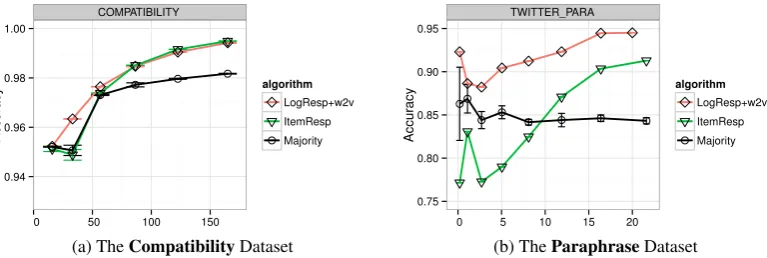
Figure 3: Inferred label accuracy (y axis) learning curves of vector space crowdsourcing models on tasks with paired-comparison data for which generative crowsdsourcing models are unsuitable. The x axis is the number of annotations×1,000.
tual order ofSentimentandCompatibilityannotations is not provided in the data set so they are applied in random order.
3.2 Comparison with generative methods
Two datasets, Weatherand Sentiment, are traditional text classification tasks with instances consist-ing of one label per text document. We use these datasets to compare the performance of LOGRESP trained on vector space text features (LOGRESP+w2v) to the performance of alternatives using sparse word-count features, including LOGRESPas well as the generative models MOMRESPandCSLDA. The majority vote and ITEMRESP algorithms serve as baselines. In Figure 2a we see that on theWeather dataset, LOGRESP with embeddings (LOGRESP+w2v) performs far better than traditional LOGRESP, and even outperforms the previous state-of-the-art for this dataset, CSLDA. Although all algorithms eventually reach a high level of performance on the Weatherdataset, we prefer algorithms like LOG -RESP+w2v that reach high levels of accuracy using as few annotations as possible, potentially reducing annotation cost. The accuracy of all of the models is unstable until a reasonable number of annotations is obtained, 5,000 to 10,000 in this case. Models which make little or no use of the words themselves (espe-cially Majority vote and ITEMRESP) are particularly susceptible to variability in the initial annotations. Data-sensitive models likeCSLDA and LOGRESP+w2v are far less susceptible to these swings.
In Figure 2b we see that no algorithm improves much over majority vote on the Sentimentdataset. Also, the baseline accuracy levels at the end of the curves are extremely low for a binary classification task with 5 annotations per instance, meaning that annotator accuracy is unusually low. We include this dataset as a reminder that the “no free lunch” theorem applies to crowdsourcing models the same as to any other class of models. In Section 4 we explore in more detail what makes the Sentimentdataset particularly difficult for crowdsourcing models.
3.3 When generative methods are unavailable
The datasetsCompatibilityandParaphraseboth involve data pairs being compared for semantic con-tent (see Section 3.1 for examples of these tasks).Compatibilitycompares the semantic compatibility of word pairs whileParaphrasecompares the semantic similarity of tweets pairs. Generative crowdsourc-ing models such as MOMRESPandCSLDA do not natively accommodate such paired data since the data does not comport with these models’ generative stories. To make them do so would require restructur-ing the models and their inference procedures. On the other hand, it is straightforward to combine the semantic vector representations of two documentsv1andv2. We do so by forming a new feature vector
vnew=hcos(v1, v2),
L1(v1−v2), L2(v1−v2),
P C50(v1), P C50(v2),
Alternative Gold Standard Neg Pos None Hard Gold
Standard
Neg 35 6 5 1
Pos 9 29 11 3
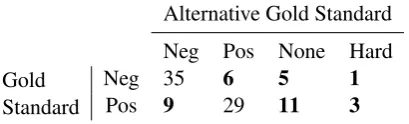
Table 2: Disagreement between the original gold standard (rows) and an alternative gold standard (columns) on 100 arbitrarily selected tweets. The alternative gold standard employs a more flexible label set. Neg=Negative, Pos=Positive, None=No sentiment, Hard=Can’t decide. Bold values reflect various kinds of disagreement between the labelings.
[image:7.595.197.402.66.128.2]where cos(·) is cosine distance, L1(·) and L2(·) are the first two p-norms, and P Cn(v) is a vector consisting of the top-ncomponents ofv, found via PCA on the set of embedded documents.
Figure 3a shows that LOGRESP with semantic embeddings outperforms majority vote and ITEM -RESPbaselines on the wordCompatibilitydataset when there are fewer than 3 annotations per instance. Later in the learning curve, when annotations become sufficiently abundant (up to 20 per instance), the data appears to no longer be helpful. Fortunately, incorporating data information using LOGRESPwith semantic embeddings appears to never actually hurt compared with using just ITEMRESP.
On the other hand, Figure 3b shows that on the Paraphrasedataset, LOGRESP with semantic em-beddings dramatically outperforms the baselines along the entire learning curve. This is partly because, unlike theCompatibilitytask,Paraphraseaccuracy is low enough to permit the improved vector data representation to benefit LOGRESP.
3.4 Summary of experiments
Overall, with the exception of the somewhat anomalousSentimentdataset, which we examine in more detail in Section 4, running LOGRESP on semantically embedded data is always an improvement over LOGRESPrunning on traditional document representations. The gains in Figures 3a and 3b strongly con-firm the hypothesis that semantic embeddings can allow crowdsourcing models to see some of the same efficiency gains for challenging semantic labeling tasks as previously observed using generative data-aware crowdsourcing models on more straight-forward topical labeling tasks. Not only that, but the fact that semantic embeddings lend themselves to sensible vector-space operations allows data-aware crowd-sourcing models to be applied to complex tasks like labeling paired text similarity and compatibility, which was not previously possible.
4 Sentiment dataset error analysis
An analysis of the Sentiment dataset (results in Figure 2b) helps explain why algorithms behave so differently on it than on the other datasets. Kilgarriff (1998) identifies three sources of annotation noise: inherent data ambiguity, poor task definition, and annotator error. The crowdsourcing models used here account only for annotator error. However, theSentimentdataset task definition dictates that each tweet be labeled with a binary sentiment label, forcing annotators to make arbitrary decisions when tweets encode little or ambiguous sentiment. For example, the tweet “EBTM.com is BACK?!” is genuinely ambiguous, and the tweet “@comeagainjen if you dont, neither do i” contains little explicit sentiment. Kilgarriff (1998) suggests that an important step towards addressing data ambiguity is ensuring that tasks are defined so that annotators have the ability to explicitly identify ambiguous instances.
To assess the impact of inherent data ambiguity and task definition on the Sentiment dataset, we arbitrarily chose 100 instances with gold labels and compared them with an alternative gold standard labeled according to a more flexible annotation scheme. The latter labels were generated by a pair of graduate students working in tandem. We added a No sentimentlabel to address problems with task definition and a Can’t decidelabel to capture inherent data ambiguity. Table 2 shows the confusion matrix between the two gold standard sets. A large percentage (16%) of tweets were assigned toNo
Although this analysis does not make this dataset any less interesting (indeed, the problems associated with modeling and correcting the effects of task misspecification are highly interesting), it does warn us that it is less representative than the others of annotation projects where effort is made up-front to iteratively refine an annotation specification before paying for large number of annotations.
5 Additional Related Work
A sizable body of research is currently underway to improve vector word representations. Although most commonly word embeddings are trained in an unsupervised manner, they may be tuned to maximize performance on a particular target task (Le and Mikolov, 2014). They may also be supervised by multiple tasks simultaneously (Collobert et al., 2011). Others fit one embedding per word sense rather than per lexical type, improving model fit (Neelakantan et al., 2014). Srikumar and Manning (2014) embed not only word types, but also label types, modeling the fact that some labels are more similar than others.
Another line of work explores ways of embedding larger spans of text. Although words tend to com-pose surprisingly well simply via linear combination, many phrases are more than the sum of their parts (e.g., collocations like “White House”). These can be dealt with by using heuristics to identify and combine token phrases (Mikolov et al., 2013b). Other approaches incorporate composition functions as first-class constituents of the objective function itself. Mitchell and Lapata (2010) motivate a general composition framework and compare a number of simple instantiations, including additive, multiplica-tive, and tensor product combination. Socher et al. (2012) assign vectors representing semantic content and matrices representing semantic transformations to every node in a parse tree. Fyshe et al. (2015) focus on learning phrasal representations whose dimensions are easily interpretable by humans, similar to successful models whose topics are easy for humans to recognize and name because they align with a topic distinction knowna priorito the human.
In this work we focus on using instance data to improve probabilistic crowdsourcing models. Passon-neau and Carpenter (2014) argue that probabilistic crowdsourcing models are generally more effective and reliable than traditional chance-adjusted agreement heuristics such as Krippendorff’s alpha for as-sessing corpus quality (Krippendorff, 2012). Other previous work in crowdsourcing ignores the data being annotated, focusing instead on modeling other aspects of the annotation process, such as item difficulty and noise (Whitehill et al., 2009; Welinder et al., 2010). Hovy et al. (2013) model the non-linear nature of human reliability by adding binary variables to each annotator indicating whether they are a spammer or not. These extensions are orthogonal to the issue explored by this paper and could be incorporated into any of the models used here.
6 Conclusions and Future Work
Previous work indicates that generative crowdsourcing models enjoy significant learning advantages when aggregating topic-based document labels. Unfortunately, some text classification tasks make dis-tinctions for which no good generative text models currently exist, such as labeling the similarity or compatibility of paired words and sentences. We have demonstrated that vector space text embeddings can be used to gain similar advantages using conditional models and for an even broader class of data. Using this approach, we have shown state-of-the-art annotation aggregation for several semantic anno-tation aggregation tasks. Future work includes experimenting with deep learning methods of jointly learning embeddings and hidden labels, rather than pipelining the two tasks.
Acknowledgments
References
Jonathan Bragg, Mausam, and Daniel S. Weld. 2013. Crowdsourcing multi-label classification for taxonomy creation. InProc. Conference on Human Computation and Crowdsourcing (HCOMP).
Jing Cao, S Lynne Stokes, and Song Zhang. 2010. A Bayesian approach to ranking and rater evaluation an application to grant reviews. Journal of Educational and Behavioral Statistics, 35(2):194–214.
Ronan Collobert, Jason Weston, L´eon Bottou, Michael Karlen, Koray Kavukcuoglu, and Pavel Kuksa. 2011. Natural language processing (almost) from scratch.The Journal of Machine Learning Research, 12:2493–2537. Rajarshi Das, Manzil Zaheer, and Chris Dyer. 2015. Gaussian lda for topic models with word embeddings. In
Proceedings of the 53rd Annual Meeting of the Association for Computational Linguistics and the 7th Interna-tional Joint Conference on Natural Language Processing (Volume 1: Long Papers), pages 795–804, Beijing, China, July. Association for Computational Linguistics.
Alexander P. Dawid and Allan M. Skene. 1979. Maximum likelihood estimation of observer error-rates using the EM algorithm. Applied Statistics, pages 20–28.
Paul Felt, Eric K. Ringger, Jordan Boyd-Graber, and Kevin Seppi. 2015a. Making the most of crowdsourced document annotations: Confused supervised LDA. InProc. Conference on Computational Natural Language Learning (CoNLL).
Paul Felt, Eric K. Ringger, Kevin Seppi, and Robbie A. Haertel. 2015b. Early gains matter: A case for preferring generative over discriminative crowdsourcing models. InProc. Conference of the North American Chapter of the Association for Computational Linguistics: Human Language Technologies (NAACL-HLT).
Alona Fyshe, Leila Wehbe, Partha P. Talukdar, Brian Murphy, and Tom M. Mitchell. 2015. A compositional and interpretable semantic space. In Proc. Conference of the North American Chapter of the Association for Computational Linguistics: Human Language Technologies (NAACL-HLT).
Bo Han, Paul Cook, and Timothy Baldwin. 2012. Automatically constructing a normalisation dictionary for microblogs. InProc. Conference on Empirical Methods in Natural Language Processing (EMNLP).
Dirk Hovy, Taylor Berg-Kirkpatrick, Ashish Vaswani, and Eduard H. Hovy. 2013. Learning whom to trust with MACE. InProc. Conference of the North American Chapter of the Association for Computational Linguistics: Human Language Technologies (NAACL-HLT).
Rong Jin and Zoubin Ghahramani. 2002. Learning with multiple labels. InProc. Advances in Neural Information Processing Systems (NIPS).
David Jurgens. 2013. Embracing ambiguity: A comparison of annotation methodologies for crowdsourcing word sense labels. InProc. Conference of the North American Chapter of the Association for Computational Linguistics: Human Language Technologies (NAACL-HLT).
Adam Kilgarriff. 1998. Gold standard datasets for evaluating word sense disambiguation programs. Computer Speech & Language, 12(4):453–472.
Klaus Krippendorff. 2012.Content Analysis: An Introduction to its Methodology. Sage.
Germ´an Kruszewski and Marco Baroni. 2015. So similar and yet incompatible: Toward the automated identifica-tion of semantically compatible words. InProc. Conference of the North American Chapter of the Association for Computational Linguistics: Human Language Technologies (NAACL-HLT).
Chuck P. Lam and David G. Stork. 2005. Toward optimal labeling strategy under multiple unreliable labelers. In
Proc. AAAI Spring Symposium: Knowledge Collection from Volunteer Contributors.
Quoc V. Le and Tomas Mikolov. 2014. Distributed representations of sentences and documents. InProc. Interna-tional Conference on Machine Learning (ICML).
Chu-Cheng Lin, Waleed Ammar, Chris Dyer, and Lori Levin. 2015. Unsupervised POS induction with word em-beddings. InProc. Conference of the North American Chapter of the Association for Computational Linguistics: Human Language Technologies (NAACL-HLT).
Tomas Mikolov, Kai Chen, Greg Corrado, and Jeffrey Dean. 2013a. Efficient estimation of word representations in vector space. InProc. Workshops at International Conference on Learning Representations (ICLR).
Tomas Mikolov, Ilya Sutskever, Kai Chen, Greg S. Corrado, and Jeff Dean. 2013b. Distributed representations of words and phrases and their compositionality. InAdvances in Neural Information Processing Systems (NIPS). Jeff Mitchell and Mirella Lapata. 2010. Composition in distributional models of semantics. Cognitive Science,
34(8):1388–1429.
Barzan Mozafari, Purna Sarkar, Michael Franklin, Michael Jordan, and Samuel Madden. 2014. Scaling up crowd-sourcing to very large datasets: a case for active learning. InProc. Very Large Databases (VLDB) Conference. Arvind Neelakantan, Jeevan Shankar, Alexandre Passos, and Andrew McCallum. 2014. Efficient non-parametric
estimation of multiple embeddings per word in vector space. In Proc. Conference on Empirical Methods in Natural Language Processing (EMNLP).
Andrew Y. Ng and Michael I. Jordan. 2001. On discriminative vs. generative classifiers: A comparison of logistic regression and Naive Bayes. InProc. Advances in Neural Information Processing Systems (NIPS).
Thien Huu Nguyen and Ralph Grishman. 2014. Employing word representations and regularization for domain adaptation of relation extraction. In Proc. Annual Meeting of the Association for Computational Linguistics (ACL).
Rebecca J. Passonneau and Bob Carpenter. 2014. The benefits of a model of annotation. Transactions of the Association for Computational Linguistics, 2:311–326.
Jeffrey Pennington, Richard Socher, and Christopher D. Manning. 2014. Glove: Global vectors for word repre-sentation. InProc. Empiricial Methods in Natural Language Processing (EMNLP 2014).
Vikas C. Raykar, Shipeng Yu, Linda H. Zhao, Gerardo Hermosillo Valadez, Charles Florin, Luca Bogoni, and Linda Moy. 2010. Learning from crowds. The Journal of Machine Learning Research, 11:1297–1322. Radim ˇReh˚uˇrek and Petr Sojka. 2010. Software framework for topic modelling with large corpora. InProc. LREC
Workshop on New Challenges for NLP Frameworks.
Edwin Simpson and Stephen Roberts. 2015. Bayesian methods for intelligent task assignment in crowdsourcing systems. InDecision Making: Uncertainty, Imperfection, Deliberation and Scalability, pages 1–32. Springer. Rion Snow, Brendan O’Connor, Daniel Jurafsky, and Andrew Y. Ng. 2008. Cheap and fast—but is it good?:
Evaluating non-expert annotations for natural language tasks. InProc. Conference on Empirical Methods in Natural Language Processing (EMNLP).
Richard Socher, Brody Huval, Christopher D. Manning, and Andrew Y. Ng. 2012. Semantic compositional-ity through recursive matrix-vector spaces. InProc. Conference on Empirical Methods in Natural Language Processing (EMNLP).
Vivek Srikumar and Christopher D. Manning. 2014. Learning distributed representations for structured output prediction. InAdvances in Neural Information Processing Systems 27, pages 3266–3274.
James Surowiecki. 2005.The Wisdom of Crowds. Random House LLC.
Joseph Turian, Lev Ratinov, and Yoshua Bengio. 2010. Word representations: a simple and general method for semi-supervised learning. InProc. Annual Meeting of the Association for Computational Linguistics (ACL). Peter Welinder, Steve Branson, Pietro Perona, and Serge J. Belongie. 2010. The multidimensional wisdom of
crowds. InProc. Advances in Neural Information Processing Systems (NIPS).
Jacob Whitehill, Ting-fan Wu, Jacob Bergsma, Javier R Movellan, and Paul L. Ruvolo. 2009. Whose vote should count more: Optimal integration of labels from labelers of unknown expertise. InProc. Advances in Neural Information Processing Systems (NIPS).
Wei Xu, Alan Ritter, Chris Callison-Burch, William B. Dolan, and Yangfeng Ji. 2014. Extracting lexically divergent paraphrases from Twitter. Transactions of the Association for Computational Linguistics, 2:435–448. Yan Yan, R´omer Rosales, Glenn Fung, Ramanathan Subramanian, and Jennifer Dy. 2014. Learning from multiple