IJEDR1602154
International Journal of Engineering Development and Research (www.ijedr.org)873
PEAK TO AVERAGE POWER RATIO and BIT
ERROR RATE reduction in MIMO-OFDM system
using LOW DENSITY PARITY CHECK CODES
over Rayleigh fading channel
1Punit Upmanyu, 2Saurabh Gaur 1PG Student, 2Associate Professor
Electronics and Communication Department
Mahakal Institute of Technology, Ujjain (Madhya Pradesh), India.
________________________________________________________________________________________________________
Abstract -With the evolution of the wireless system in the demand for high-speed data have been increasing day by day, making it impossible to be achieved by the data transmission system in the conventional series, the quality of service and the other the need for additional spectrum in a limited spectrum scenario. To overcome this new system for data transmission problem in parallel has been proposed, which is known as the OFDM system. Performance of the OFDM system can be further improved by using multiple antennas in an arrangement called a MIMO system. MIMO-OFDM system is currently recognized as one of the most competitive technologies for 4G wireless mobile systems .The main disadvantage of MIMO-OFDM system is high peak average power ratio (PAPR) for a large number of subcarriers, resulting in many restrictions for practical applications. Coding is among the many PAPR reduction schemes have been proposed to overcome this problem. In this BER and PAPR of MIMO-OFDM system is calculated and the PAPR using the low density parity check codes is reduced.
Keywords-Orthogonal frequency division multiplexing (OFDM), MIMO, Peak-to-average power ratio (PAPR), Low density parity check (LDPC), and Complementary Cumulative Distribution Function (CCDF).
________________________________________________________________________________________________________
I.INTRODUCTION
Orthogonal frequency-division multiplexing is the mostly used multicarrier transmission technique in wireless communication standards, which presents high spectral efficiency, immune to the multipath path delay spread tolerance[1], low inter-symbol interference), immune towards frequency selective fading and high power efficiency.
Orthogonal Frequency division Multiplexing method with Multiple Input Multiple Output (MIMO) systems has been an area of interesting and challenging research in the field of broadband wireless communication. Multiple input multiple output (MIMO) system using multiple transmit antenna and receive antennas are widely recognized as the vital breakthrough that will allow future wireless systems to get more data rates with limited bandwidth and power resources. The multiple antennas have been used to increase diversity to combat channel fading system [2]. Hence, A MIMO system can give two types of gains: spatial multiplexing or capacity gain and diversity gain. The advantages of Orthogonal Frequency division Multiplexing make it a good scheme for high-speed transmission links. One major difficulty is Orthogonal Frequency division Multiplexing (OFDM’s) high Peak to Average Power Ratio. When N signals are combining with the same phase; produce a peak power that is N times the average power. Higher peaks cause saturation in the power amplifiers method; leading to inter modulation products among the subcarrier and disturbing out of band energy. It becomes worth while reducing Peak to Average Power Ratio towards this end there are many proposals such as clipping, coding and peak windowing method. Reduction of PAPR comes at a price of performance degradation; mainly in terms of rate and BER (Bit Error Ratio). This paper finds to use the LDPC codes as powerful coding techniques for IEEE 802.11 x OFDM standards which are combined with PAPR scheme. LDPC codes can be out a better solution first to overcome the disadvantage of OFDM technique and second to keep a robustness regarding the BER performances.
A. MIMO system
IJEDR1602154
International Journal of Engineering Development and Research (www.ijedr.org)874
h(t) = [
h0,0(t) ⋯ h0,L−1(t)
⋮ ⋱ ⋮
hM−1,0(t) ⋯ hM−1,L−1(t) ](1)
Wherehm,l (t) represents the impulse response of the channel between the transmit (Tx) antenna m and the receive (Rx)
antenna l.
Fig: 1. MIMO system
From the above general model, two cases exist: (a) case M = 1, resulting in a single input/multiple output (SIMO) channel, and (b) case L = 1, resulting in a multiple input/single output (MISO) channel. In the case of SIMO, conventional receiver diversity techniques such as MRC can be realized, which can improve power efficiency, especially if the channels between the Tx and the Rx antennas are independently faded paths (e.g. Rayleigh distributed), where the multi-path diversity order is identical to the number of receiver antennas.
With diversity techniques, a frequency- or time-selective channel tends to become an AWGN channel. This improves the power efficiency. However, there are two ways to increase the spectral efficiency. The first one, which is the trivial way, is to increase the symbol alphabet size and the second one is to transmit different symbols in parallel in space by using the MIMO properties. The capacity of MIMO channels for an uncoded system in flat fading channels with perfect channel knowledge at the receiver is calculated by Foschini as
C = log2[det (IL+ Es/N0
M h(t)h
∗T(t))](2)
B. Orthogonal frequency-division multiplexing (OFDM) System
A communication system with multi-carrier modulation transmits [4]Nc complex-valued source symbols 1 Sn, n = 0, . .
. ,Nc − 1, in parallel on to Nc sub-carriers bandwidth. The source symbols may, for instance, obtain after source and channel
coding, interleaving, and symbol mapping. The source symbol duration Td of the serial data symbols results after serial-to-parallel
conversion in the OFDM symbol duration
Tx= NcTd
The principle of OFDM is to modulate the Nc sub-streams on sub-carriers with a spacing of
Fs= 1/Ts
In order to achieve orthogonality between the signals on the Ncsub-carriers, presuming a rectangular pulse shaping [5].
The Nc parallel modulated source symbols Sn, n = 0, . . . ,Nc − 1, are referred to as an OFDM symbol. The complex envelope of an
OFDM symbol with rectangular pulse shaping has the form
Xn = (1
√N∑ Xlej2πN ni N−1
l=0 ) (3)
x(t) = 1 Nc
∑ Snej2πfnt, 0 ≤ t < Ts Nc−1
n=0
The Nc sub-carrier frequencies are located at
Fs= 1 Ts
IJEDR1602154
International Journal of Engineering Development and Research (www.ijedr.org)875
Fig: 2. Basic OFDM Block Diagram.In the above figure we can see the block diagram of the basis OFDM; now in the following subsection. The source coding entails the efficient representation of information sources [6]. Both discrete and continuous sources, the correlations between samples are exploited to produce an efficient representation of the information.
C. MIMO OFDM SYSTEM MODEL
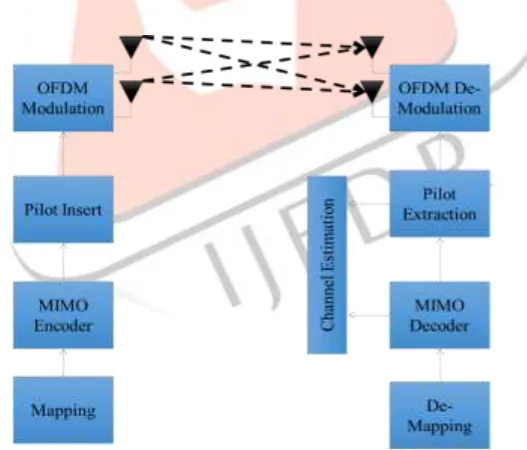
In high-speed wireless communication system, combining MIMO and OFDM technology, in Orthogonal Frequency division Multiplexing can be applied to transform frequency-selective MIMO channel into parallel flat MIMO channel, it is reducing the complexity of the receiver, through multipath fading environment[7] can also achieve high data rate robust transmission scheme. Therefore, MIMO-OFDM obtain diversity gain and coding gain by space-time coding, at the same time, the orthogonal frequency division multiplexing system can be realized with simple structure[8]. Therefore, MIMO-OFDM system has become a welcome proposal for fourth generation mobile communication technique. The basic structure of MIMO OFDM system model is shown in figure 3.
Fig: 3. OFDM-MIMO Block Diagram.
At the transmitting end, a number of transmission antennas are used. An input data bit stream is supplied into STC (space-time coding), then modulated by OFDM and finally fed to antennas for sending out. At the receiving end, incoming signals are fed into a signal detector and processed before recovery of the original signal is made.
D. PAPR REDUCTION SCHEMES
Theoretically, large peaks in OFDM system can be expressed as Peak-to-Average Power Ratio (PAPR), or referred to as PAPR (Peak-to-Average Power Ratio), in some literatures, also written as PAR. It is usually defined as:
PAPR = Ppeak
Paverage10log10
IJEDR1602154
International Journal of Engineering Development and Research (www.ijedr.org)876
Where Ppeak represents peak output power and Paverage means average output power. E [∙] denotes the expected value, xnrepresents the transmitted OFDM signals which are obtained by taking IFFT (Inverse Fast Fourier Transform) operation on modulated input symbols Xk, Mathematically, xn is expressed as:
xn= 1
√N∑ XkWN
nk N−1
k=0 (5)
PAPR depends on modulation schemes, oversampling factor and number of subcarriers. There are different kinds of PAPR reduction Schemes [9]. They are:
1. Distortion Schemes (Clipping and Filtering) 2. Scrambling Schemes
3. Coding Schemes
E.Low Density Parity Check codes (LDPC) Encoder
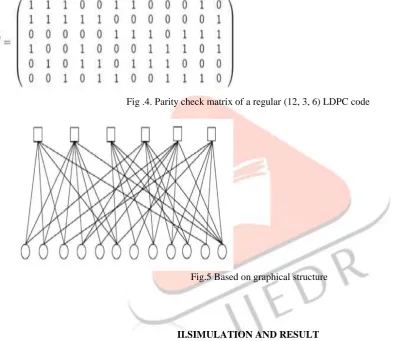
Low Density Parity Check (LDPC)codes are a class of linear block codes (LDPC). The name comes from the characteristics of their parity check matrix which contains only a few 1‟s in comparison to the amount of 0‟s. the basically there are two different possibilities to represent Low Density Parity Check [10]. They can be described via matrices (or) graphical representation. In following parity check matrix with dimension mn for a (12, 3, 6) code. Wr for number of 1‟s in each row (row
weight) and wc for the columns (column weight). LDPC codes are classified into two groups, regular LDPC codes and irregular
LDPC codes. In the regular LDPC codes have a uniform column and row weight, and irregular LDPC codes have a non-uniform column and row weight. For a matrix to be called low-density the two conditions wc<< n &wr<< m must be satisfied. Number of
ones in the parity check matrix H = wc · n = wr ·m. where m≥ (n − k) =) R = k/n ≥ 1 − (wc/wr), and thus wc<wr . A systematic linear block code Cb(nout, k) is specified by generator matrix which is in a form
Represented by shorter form
The systematic form of the parity check matrix H of the code Cbis given by
The design of LDPC code starts from the construction of parity check matrix H, from which parity check matrix is obtained from the formulation of generator matrix G. An LDPC code is denoted by CLDPC(nout, k ,s, t) where nout and k are input and output bits
with s number of 1’sin each column and t no of s in each row. These codes are of two types:-
1. Regular LDPC codes:
sub-IJEDR1602154
International Journal of Engineering Development and Research (www.ijedr.org)877
series wc. N, every with one of every column. The primary of those sub matrices contains one "s in down order. The opposite sub matrices square measure simply permutations of columns sub-matrix.one 1st example shown in Figure. 42. Irregular LDPC codes:
For checking code Low density Parity irregular degrees of every set of nodes they're chosen consistent with some distribution. Within the construction of irregular LDPC code, the primary step involves the choice of a profile that describes the specified range of columns in every weight and also the desired weight of every row range. The second step includes a way of construction, i.e., the algorithmic rule to place edges between vertices so as to satisfy the constraints. The edges placed subject "completely random" to the restrictions of the profile. It’s shown in fig.5
Fig .4. Parity check matrix of a regular (12, 3, 6) LDPC code
Fig.5 Based on graphical structure
II.SIMULATION AND RESULT
The software has been developed to simulate the orthogonal frequency-division multiplexing (OFDM) and MIMOtransmission and Peak-to-Average Power Ratio (PAPR) reductiontechnique is evaluated on same test bench. In the following parameter are taken during simulation.
Table. 1. Simulation Parameter
S.N. Parameter Specification value
1. FFT size 64
2. MIMO system analyzed 2 x 3,2 x 4
3. Modulation technique QAM-64
4. SNR range 0-30 db
5. Maximum no of symbols loaded 5*104
6. Channel Model Rayleigh
7. Channel coding LDPC codes
IJEDR1602154
International Journal of Engineering Development and Research (www.ijedr.org)878
In MIMO-OFDM system the Peak-to-Average Power Ratio (PAPR) results of every symbol for with and without LDPC are shown in Figure.Fig.6. AnMIMO-OFDM symbol (in k), with and without LDPC containing 64 subcarriers using QAM modulation Table.2. PAPR improvement in MIMO-OFDM using LDPC
SN. TECHNIQUE PAPR(DB)
1. Mimo-Ofdm without Ldpc
12.3228
2. Mimo-Ofdm with Ldpc
10.8737
The CCDF vs. PAPR is shown in the fig.. From the figure it is clear that the only 17% symbol having PAPR higher the 10 db with LDPC where as in without LDPC 30% symbol having more than 10 db value of PAPR.
Fig.7. PAPR reduction using QAM-64 in MIMO-OFDM system
0 0.5 1 1.5 2 2.5 3 3.5 4 4.5 5
x 104
7 8 9 10 11 12 13
symbole number
P
A
P
R
(
d
B
)
Without LDPC with LDPC
8 9 10 11 12 13 14
0.05 0.1 0.15 0.2 0.25 0.3 0.35 0.4 0.45
PAPR
CCDF
IJEDR1602154
International Journal of Engineering Development and Research (www.ijedr.org)879
Fig.8: BER v/s SNR for 2x2 MIMO-OFDM using QAM modulation in Rayleigh fading channel
Table.3. BER improvement MIMO-OFDM using LDPC
S.N. SNR(dB) BER BER without Ldpc with Ldpc
1. 0 0.3705 0.3662
2. 3 0.3322 0.3308
3. 6 0.2936 0.2915
4. 9 0.2565 0.246
5. 12 0.2139 0.1976
6. 15 0.1664 0.1447
7. 18 0.1127 0.09247
8. 21 0.06338 0.04806
9. 24 0.02379 0.0156
Fig.9: BER v/s SNR for 2x3 MIMO-OFDM using QAM modulation in Rayleigh fading channel Table.4. BER improvement MIMO-OFDM using LDPC
S.N. SNR(dB) BER BER without Ldpc with Ldpc
1. 0 0.3662 0.344
2. 3 0.3364 0.3052
3. 6 0.2938 0.2638
0 5 10 15 20 25 30
10-4 10-3 10-2 10-1 100
SNR
B
E
R
Without LDPC with LDPC
0 5 10 15 20 25 30
10-5 10-4 10-3 10-2 10-1 100
SNR
BER
IJEDR1602154
International Journal of Engineering Development and Research (www.ijedr.org)880
4. 9 0.2552 0.2175
5. 12 0.214 0.1671
6. 15 0.1655 0.1173
7. 18 0.1121 0.06771
8. 21 0.06286 0.02767
9. 24 0.02276 0.007161
Fig 10: BER v/s SNR for 2x4 MIMO-OFDM using QAM modulation in Rayleigh fading channel Table.5. BER improvement MIMO-OFDM using LDPC
S.N. SNR(dB) BER BER without Ldpc with Ldpc
1. 0 0.3758 0.3206
2. 3 0.3305 0.2855
3. 6 0.2938 0.2426
4. 9 0.2546 0.1992
5. 12 0.2135 0.1487
6. 15 0.164 0.09456
7. 18 0.1126 0.04672
8. 21 0.06101 0.01603
9. 24 0.02359 0.003205
The curves show that in MIMO-OFDM system as we increase the number of Transmitters and Receivers the BER keeps on decreasing and the proposed system provide better BER performance as compared to the other antenna configurations used.
III.CONCLUSION
The BER evolution of 2x2, 2x3, 2x4 MIMO-OFDM system for 64-QAM modulation technique using Rayleigh Fading channel was presented. BER performance of MIMO-OFDM system using Low Density Parity Check codes is found better as compare to conventional MIMO-OFDM system. As a number of receiving antenna increases BER performance of the system also improves. LDPC coding also reduces the Peak to Average Power Ratio value of MIMO-OFDM system. Simulation results showed that PAPR of conventional MIMO-OFDM system is 12.3228 db, while using LDPC code it decreases up to 10.8737
db.
IV.REFERENCES
[1] Alan J. Coulson., “Bit Error Rate Performance of OFDM in Narrowband Interference with Excision Filtering,” IEEE Transaction on Wireless Communications, vol. 5, no. 9,pp.2484-2492, Sept 2006.
0 5 10 15 20 25 30
10-5 10-4 10-3 10-2 10-1 100
SNR
BER
IJEDR1602154
International Journal of Engineering Development and Research (www.ijedr.org)881
[2] Paulraj, A.J., Gore, D.A., Nabar, R.U., Balckei,H (2004),An overview of MIMO communication,-a key to gigabitwireless, proceedings of the IEEE international conference on communication, v.92,p. 198 218,Feb.
[3] GamalMabrouk Abdel, “Performance Improvement of MIMO-OFDM Wireless Systems using PAPR Reduction Techniques”, International Journal of Computer Applications, Volume 53– No.18, September 2012.
[4] R. Saltzberg, “Performance of an efficient parallel data transmission system,” IEEE Transactions on Communication. Technology, vol. 15, pp.805-813 Dec
[5] SrinuPyla, “PAPR reduction in OFDM systems using PTS and various modulation schemes”, 978-1-4673-2818-0/13/$31.00 ©2013 IEEE.
[6] K Srinivasarao, “PEAK-to-average power reduction in mimoofdm systems using sub-optimal algorithm”, International Journal of Distributed and Parallel Systems (IJDPS) Vol.3, No.3, May 2012.
[7] Hasegawa, T.; Shimizu, M., “Multipath interference reduction property by using multipath interference correlative timing throughout for DS-CDMA systems,” The 57th IEEE Semiannual Vehicular Technology Conference, 2003. VTC 2003-Spring., vol.4, no., pp.2827-2831 vol.4, 2003
[8] NishaAchra, GarimaMathur, “Performance Analysis of MIMO OFDM System for Different Modulation Schemes under Various Fading Channels”, International Journal of Advanced Research in Computer and Communication Engineering Vol. 2, Issue 5, May 2013.
[9] Y. Rahmatallah and S. Mohan, “Peak-to-Average Power Ratio Reduction in OFDM System: A Survey and Taxonomy”, IEEE Communication Surveys and Tutorials, vol. 15, no. 5, (2013), pp. 1567-1592