A Power Efficient CMOS PLC Receiver
Design-Dual Use of Power Lines for Design for
Testability
Roshni Pankajakshan. C
1, Dr. David Solomon George
2PG Scholar [VLSI & ES], Dept. of ECE, Government Engineering College, Idukki, Kerala, India1
Associate Professor, Dept. of ECE, Government Engineering College, Idukki, Kerala, India2
ABSTRACT:The PLC is one in which the power pins and the power distribution networks of ICs are used for data communication as well as power delivery. PLC is used in order to reduce the number of input pins that an IC needs to couple the test data signals to each and every node. Hence to extract the test data signals from this power lines, so many receivers are in need at each and every nodes of the ICs or at places where we have to apply the test. For this purpose, PLC receivers are already designed. But all of them consume very high power. So, in this paper a power efficient CMOS PLC receiver for the same purpose in 180 nm CMOS technology under a supply voltage of 1.8 V is designed with the help of Cadence tool. To achieve this much extreme low power, so many CMOS low power technics are successfully employed like the stacking method, resistor less approach etc. It is found that the power consumption of this new CMOS PLC receiver is only 1.228mW, which is too less than even half power of the presently existing design. Also the receiver is good in keeping the required level of noise immunity and could reduce the area consumption, since the circuit do not have any resistive elements.
KEYWORDS: Power Line Communication (PLC), power efficient CMOS PLC receiver, power consumption, stacking method.
I. INTRODUCTION
Today’s VLSI technology is advancing in such a way that the designers can incorporate a large number of functions inside a chip. Microprocessors are one of the best examples for this. Day by day the size of ICs reduces and the operations it can perform are increasing. So many challenges still exist such as, the need of proper provision for the thermally generated heat removal, the number of the input output pins that an IC needs, proper power supply injection etc., due to which there exists limits on incorporating functions inside ICs. Also routing inside the IC too has a major role in it. There should also be the provisions in ICs like sensors to detect what is happening inside each and every point and if anything happens wrongly, the normal state have to be recovered. Even though the increase in system complexity is an advantage in the sense that the size of ICs can be reduced, with that there should be new inventions for proper data passage inside the same. The power line communication aspect presented in this paper is one of such methods.
otherwise if each unit of receiver consumes such huge power, the overall power consumption of the entire chip will increase by a large value, which is hard to afford.
In this paper, such a power efficient CMOS PLC receiver is designed in 180nm CMOS technology under the supply voltage of 1.8 V. The methods that are incorporated to achieve the power reduction are very simple to understand and realize.
II. PREVIOUS WORKS
In PLC area, previous works are already conducted to reduce the ICs smaller by incorporating the PLC to reduce the pin count, area and hence the cost of the chip. So many such works at the base levels are already carried out in this area. Works are conducted in ICs to measure the data propagation loss from the main power supply to the internal nodes and also, communication technologies are put forward such as the Ultra Wide Band (UWB) and Direct Sequence Code Division Multiple Access (DS CDMA) for successful test data passage inside ICs with reduced noise level.
Since our work concentrates on the design of the PLC receiver let’s have a brief literature review on the same.
At first, a data recovery block was designed which can extract the test data signals from the power line modulated with impulses in which Ultra Wide Band communication technology was adopted [8]. The sensing scheme inside the recovery block was designed in such a way that it maintains very small Power Supply Rejection Ratio(PSRR) and it is found that the data recovery block was able to extract the data with about the amplitude of 90mV and with the period of 300pS. The design was implemented in TSMC .18µm CMOS technology which had a power consumption of 2.8mW.
Later, a work on the power distribution networks of microprocessors are carried out by using the UWB communication technology for test data transmission by superimposing UWB impulses on the power lines [7]. Based on the resultant characteristics of the PDNs, a data recovery block design was proposed and the work was implemented in TSMC .18µm CMOS technology under a supply voltage of 1.8 V with a pulse repetition rate of 200MHz and the resultant power consumption was at about 4.42mW.
A robust receiver for PLC was proposed in ICs which employs the differential Schmitt trigger as the third stage of the receiver for better noise immunity and also to tolerate supply voltage variations and drops [6]. Thus the aim was on the robustness and the design was proposed in .18µm CMOS technology under a supply voltage of 1.8 V. The measurement results showed that the receiver can tolerate up to 22.2% of the supply voltage drop under the signal-to-noise ratio (SNR) of 16.3 dB. The power consumption was 2.4mW.
A PLC receiver was designed in .18µm CMOS technology under a supply voltage of 1.8 V, which can be applicable to fault diagnosis, scan design, system debugging like low data rate communications [1]. The receiver was designed with three building blocks, the level shifter, signal extractor, and the logic restorer. The main aim of this work was not the high data rate communication, but the robust operation under variations of supply voltage and droops. Amplitude Shift Keying (ASK) approach was put forward for the superimposition of the test data signals with the power lines. Adopting binary ASK has the advantage of less circuit complexity, simple and easy implementation and hence lower cost and area. But the main problem was on the ability to withstand the noise level that is present in the test data which couples through the power lines. To overcome the same, differential concepts are intelligently employed in the receiver which could achieve high level of noise rejection. Differential Schmitt trigger was the key building block in this design, since it was the major contributor for the noise immunity. The measurement results showed that the receiver can tolerate a voltage drop of up to .423 V, which has a power dissipation of 3.26mW and a core area of 74.9 µm × 72.2 µm.
inside the same IC for other operations. So power efficient design has its own importance in present VLSI design with increased complexity especially in microprocessor like ICs. This paper presents the design of such a power efficient CMOS PLC receiver in 180 nm CMOS technology under the supply voltage of 1.8V with the help of Cadence Virtuoso tool.
III. PROPOSED POWER EFFICIENT CMOS PLC RECEIVER
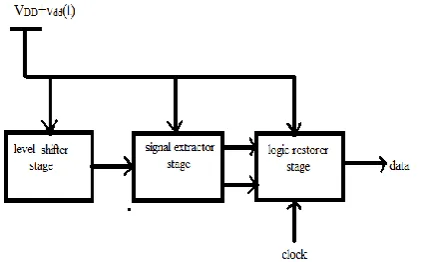
The power efficient CMOS PLC receiver designed in this paper under a supply voltage of 1.8 V in 180 nm CMOS technology using Cadence tool consists of three major building blocks, they are the level shifter, the signal extractor and the logic restorer. The block diagram of the proposed receiver is shown in fig. 1. The test data is represented by Vdd(t) and the main power signal by VDD. So VDD + Vdd(t) represents the test data superimposed on the power lines.
The input signal is the power line signal in which the test data is superimposed and it is supplied to each of the building blocks. The clock signal of amplitude 0-1.8V is supplied to the logic restorer. The output of the level shifter is the input of the signal extractor and the output of it, which is a differential signal and is applied to the logic restorer. The detailed operation and design concepts of each of the building blocks are described hereafter.
Fig. 1 Block Diagram of Proposed Power Efficient CMOS PLC Receiver
1. Level Shifter
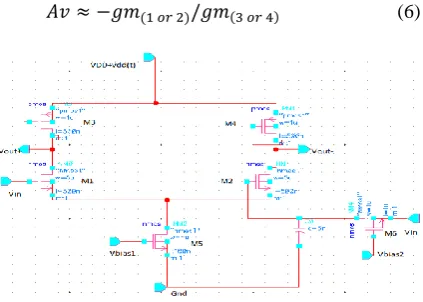
The level shifter is the first stage in the proposed PLC receiver which is nothing but a common source amplifier having diode connected load and is shown in fig. 2. The purpose of this level shifter is to lower the DC level of the signal at the output so that, it will be easy for the subsequent blocks to process the data. Also since the test data signals are superimposed on the power lines, this stage should have the ability to sense the variations that are present in the power lines and for that, it’s sensitivity to the input signal is purposefully lowered and the same to power signal is increased by lowering the characteristic called the Power Supply Rejection Ratio (PSRR) [3]-[5]. It can be expressed as in equation (1)
(1)
Where is the small signal voltage gain of the circuit and is the small signal voltage gain from the power input to circuit’s output. The small signal voltage gain can be expressed in terms of as
(2)
The small signal voltage gain from the supply voltage can be expressed as
Fig. 2 Level Shifter Substituting (2) and (3) in (1) gives
(4)
PSRR can be again represented in terms of device dimensions and overdrive voltage as
PSRR ( ) ( )
( ) ( )
(5)
Since we need a level shifter having a low PSRR, the equation (5) can be treated in two different ways. In order to reduce the PSRR, either we can reduce the device dimension of transistor M1 and can increase the same of M2. Also the overdrive voltage of M1 should be lowered and that of M2 should be made high compared to M1. These two concerns should be kept in mind while designing the level shifter stage for a smaller PSRR.
2. Signal Extractor
The signal extractor in the proposed power efficient design is a differential amplifier having diode connected loads and is shown in Fig 3. The output of the level shifter is simultaneously fed to two input terminals of the differential amplifier, out of which a low pass filter is connected to one of the terminals. The low pass filter is used in this design to extract the DC value from the level shifter output. Since the differential amplifier has a property of rejecting the common mode signal, which is the DC signal in our design, is thus successfully eliminated. Also the differential amplifier amplifies the signal to achieve the required level of gain. The use of the same has another advantage that it reduces the noise levels that are already present in the signals. The signal extractor of the proposed design is shown in figure 3.
The voltage gain of the differential amplifier with PMOS diode connected loads is expressed as in (6)
( ) ( ) (6)
Where
( ) ( ) (7)
Expressing Av in terms of device dimensions, we have
√ ( )( )
( )( ) (8)
From equation (8), it is clear that for proper amplification, the device dimensions of the transistors can be adjusted. The signal extractor converts the single ended output of the level shifter to a differential signal. Also for the previous design of PLC receiver, the loads were resistive for the signal extractor and the same contributed to a larger extent to the power consumption of the entire circuit. In the proposed design, the resistive loads were replaced with diode connected transistors and the result of it was a further reduction in the power consumption of the receiver.
3. Logic Restorer
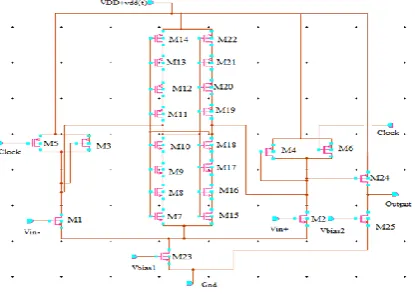
The logic restorer is the block which contributes to a great part in the noise immunity of the entire system. It is a differential Schmitt trigger with tunable hysteresis [2] property. The main advantage of using a differential Schmitt trigger is that, it is excellent in handling the situations of extreme noise and disturbances. The differential Schmitt trigger employed in the design is shown in figure 4.
The key components that contribute to the hysteresis are the symmetrical loads and the cross coupled inverter pair. Stacking method is incorporated in the cross coupled inverter pair to reduce the power consumption considerably. Each transistor in the normal cross coupled inverter pair is replaced by four transistors each having a width of W/4 and due to which the leakage power reduces by a greater extent. By adjusting the currents through the symmetrical loads, the regenerative feedback mechanism of the cross coupled inverter pair can be adjusted to control the hysteresis property. Symmetrical loads are selected to achieve the linearity. According to the application of the data signals, the clock signals switches and thus the currents to the differential amplifier also changes. It simply adjusts the gap between the low and high threshold voltages and thus improves the noise immunity of the receiver.
Fig. 4 Differential Schmitt Trigger
IV. MEASUREMENT RESULTS
1. Level Shifter
The level shifter that is the common source amplifier with diode connected load is simulated with the proper bias voltage at the gates of the transistor M2.The timing response obtained is shown below in fig. 5
Fig. 5 Level Shifter Transient Response
The supply voltage is 1.8 V with the superposition of the data signal. The top waveform is the input signal superimposed on the supply voltage, in which the voltage level of 1.89 V represents logic 1 and 1.8 V represents logic 0. The bottom waveform shows the output signal of the level shifter. The output signal obtained is the level shifted version of the test data signal which is superimposed on the power lines.
The layout of the level shifter is created with the help of cadence tool and is shown in fig. 6
Fig. 6 Level Shifter Layout
2. Signal Extractor
The signal extractor is a differential amplifier having diode connected loads .The output of the level shifter is supplied directly to one of the differential amplifier input and the other input is fed from the output of the filter attached to the second input terminal. The filter extracts the DC value from the signal to reject the common mode signals that is the DC levels in the input. The transient response of the signal extractor is shown below in fig 7.
Fig. 7 Signal Extractor Transient Response
level that was incorporated at the output of the differential amplifier in the previous design is somewhat reduced in this new design and is clear from the transient responses.
The layout of the signal extractor is created with the help of cadence tool and is shown in fig. 8
Fig. 8 Signal Extractor Layout 3. Logic Restorer
Logic restorer is a differential Schmitt trigger having the stacked model for the cross coupled inverter pair. The outputs of the differential amplifier are supplied to the inputs of the logic restorer. Clock signals of value 0-1.8 are fed and proper biasing signals are applied and finally simulated the entire circuit. The simulation results of the logic restorer are shown in fig. 9
Fig. 9 Logic Restorer Transient Response
The data signal superimposed on the supply voltage of 1.8 V and the restoration of the logic values are shown in order.
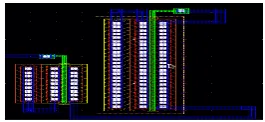
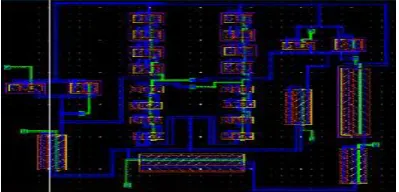
The layout of the logic restorer is created with the help of cadence tool and is shown in fig. 10
Fig. 10 Logic Restorer Layout
4. Power Efficient PLC Receiver
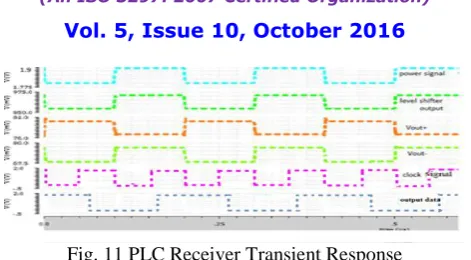
The three sub blocks of the PLC receiver are combined together after the verification of the individual blocks. The overall transient response is shown below in fig 11 .The power line superimposed data signal output of level shifter, signal extractor outputs, the clock signal and the final output of the PLC receiver are shown in order.
Fig. 11 PLC Receiver Transient Response
The work was mainly concentrated on a power efficient design, since power is one of the most important criterions in the VLSI design. The total power consumption of the PLC receiver is calculated with the help of the cadence tool and it is found to be about 1.228mWs, which is very small compared to the power consumption of previously implemented PLC receivers. Since these PLC receivers are required in large amounts in each ICs, the achievement here is of great importance because, the power consumption of the entire IC can be reduced by a large amount. The power could be reduced in this paper by too less than half of the existing design.
V. CONCLUSION
A power efficient CMOS PLC receiver which can be incorporated in microprocessor like ICs to extract the test data signals from the power lines which are used for the low data rate communications such as scan design, system debugging, fault diagnosis etc. is designed and simulated in this work in CMOS 180 nm technology under the supply voltage of 1.8v. Also the layouts of each section are created with the help of the cadence tool.
The receiver mainly consists of three building blocks out of which the level shifter, the first block is responsible for shifting the data signal DC level to somewhat half of the supply level. The PSRR of the same is lowered to a smaller extend to make the output signal sensitive to the supply voltage. The signal extractor which is a differential amplifier having diode connected loads along with a low pass filter in which a biased NMOS transistor and a capacitor are the main components is used to eliminate the DC value from the signal to mitigate the supply voltage variations and droops. The third block which is responsible for the noise immunity of the entire receiver is a differential Schmitt trigger and in which to contribute to the power reduction, stacking method is put forward in the cross coupled inverter section. The proposed work is a resistor less approach which has its own significance in the power reduction and also the low power CMOS technique called the stacking method could also contributed to achieve the aim. This new work could reduce the power consumption to less than half of the presently existing CMOS PLC receiver [1] and is found to be 1.228mWs. Due to the same, the total power consumption of the entire IC in which these receivers play the role can also be reduced. Also the area is also reduced in this proposed work.
At the time of the implementation and testing of the designed PLC receiver in the real IC environment, a little more noise level is expected, since the power lines in which the test data is to be superimposed were noisy but still it performs well at its best to reproduce the test data signals from the power lines.
REFERENCES
[1] Jebreel M. Salem and Dong Sam Ha, “dual use of power lines for design for testability-A CMOS receiver design,” IEEE Trans. Very Large Scale Integr. (VLSI), 2015
[2] F. Yuan,“Differential CMOS Schmitt trigger with tunable hysteresis,” Analog Integ. Circuits Signal Process. vol. 62, no. 2, pp. 245–248, Feb. 2010.
[3] B. Razavi, Design of Analog CMOS Integrated Circuits. New York, NY, USA: McGraw-Hill, 2001.
[4] P. R. Gray, P. J. Hurst, S. H. Lewis, and R. G. Meyer, Analysis and Design of Analog Integrated Circuits, 5th ed. New York, NY, USA: Wiley, 2009.
[5] P. E. Allen and D. R. Holberg, CMOS Analog Circuit Design, 3rd ed. London, U.K.: Oxford Univ. Press, 2002.
[6] J. Salem and D.S. Ha, “A robust receiver for power line communications in integrated circuits,” in Proc. IEEE 55th Int. Midwest Symp. Circuits Syst. (MWSCAS), Aug. 2012, pp. 254–257.
[7] V. Chawla, R. Thirugnanam, D. S. Ha, and T. M. Mak, “Design of a data recovery block for communications over power distribution networks of microprocessors,” in Proc. 4th IEEE Int. Conf. Circuits Syst. Commun., May 2008, pp. 708–712.