Sublanguage Corpus Analysis Toolkit: A tool for assessing the
representativeness and sublanguage characteristics of corpora
Irina P. Temnikova
♥, William A. Baumgartner Jr.
♠†, Negacy D. Hailu
♠‡, Ivelina Nikolova
♣5,
Tony McEnery
♦, Adam Kilgarriff
♦, Galia Angelova
♣⊕, and K. Bretonnel Cohen
♠]♥Qatar Computing Research Institute, Doha, Qatar
♠Computational Bioscience Program, Univ. of Colorado School of Medicine, USA ♣IICT, Bulgarian Academy of Sciences, Sofia, Bulgaria
♦Department of Linguistics and English Language, Lancaster University, Lancaster, UK ♦Lexical Computing Ltd., Brighton, UK
♥[email protected],†[email protected],‡[email protected],5[email protected], ♦[email protected],♦[email protected],⊕[email protected],][email protected]
Abstract
Sublanguages are varieties of language that form “subsets” of the general language, typically exhibiting particular types of lexical, semantic, and other restrictions and deviance. SubCAT, the Sublanguage Corpus Analysis Toolkit, assesses the representativeness and closure properties of corpora to analyze the extent to which they are either sublanguages, or representative samples of the general language. The current version of SubCAT contains scripts and applications for assessing lexical closure, morphological closure, sentence type closure, over-represented words, and syntactic deviance. Its operation is illustrated with three case studies concerning scientific journal articles, patents, and clinical records. Materials from two language families are analyzed—English (Ger-manic), and Bulgarian (Slavic). The software is available atsublanguage.sourceforge.netunder a liberal Open Source license.
Keywords:sublanguage recognition, sublanguage characterisation, corpus linguistics
1.
Introduction
A fundamental early stage in working with a corpus is to analyze its properties. Such an analysis commonly includes steps such as checking to see if its contents fit Zipf’s law and detecting over-represented words. These analyses can be done quite easily with simple scripts. However, there are other types of analyses that are useful but that cannot currently be accomplished without a specialized software package. This paper describes the Sublanguage Corpus Analysis Toolkit (SubCAT), the first set of tools and simple format specifications for assessing the representativeness of a corpus and whether or not it is a fit to the sublanguage model.
We illustrate three use cases for SubCAT, and show that it can be applied to a wide variety of genres and to multiple languages with a variety of character encodings. The cor-pus of interest need only be converted to a very simple input format.
1.1.
Corpora and Representativeness
Representativeness is an important, but infrequently de-fined, notion in corpus linguistics. We will define repre-sentativeness as the extent to which a corpus or other lan-guage sample reflects the lanlan-guage from which it is sam-pled. As such, representativeness is a continuum, rang-ing from large balanced samples such as the British Na-tional Corpus (BNC) to highly specialized corpora such as health care records or weather reports. Recently, McEnery and Hardie have defined it as follows: “A representative corpus is one that is sampled in such a way that it con-tains all the types of text, in the correct proportions, that are needed to make the contents of the corpus an accurate reflection of the whole of the language or variety that it samples. See alsobalance.” The latter term is then defined
as: “A property of a corpus (or, more properly, of a cor-pus sampling frame). A corcor-pus is said to be balancedif the relative sizes of each of its subsections have been cho-sen with the aim of adequately reprecho-senting the range of language that exists in the population of texts being sam-pled” (McEnery and Hardie, 2012). Thus, there is a rela-tionship between balance and representativeness—in par-ticular, balance might lead to representativeness. However, they remain separate—as a reviewer pointed out, the British National Corpus is balanced, but might no longer be con-sidered representative of the current language.
Closureis the tendency toward finiteness in a genre or sam-ple of language. It is exemplified, for instance, by limited vocabularies in a specialized domain. If unrestricted nat-ural language tends toward the infinite, then we see the opposite in language samples from restricted domains. A body of work inspired by sublanguage theory and begun by McEnery and Wilson (McEnery and Wilson, 2001) has fo-cused on studying the closure properties of language. How-ever, no publicly available tools for language closure have been released yet. The clearest conclusion from this line of research is that corpora constructed from restricted domains exhibit closure, or a tendency towards finiteness; the corol-lary, which so far has not been utilized in corpus analysis, is that representative corpora do not show closure. This in-sight is put to practical use in SubCAT.
1.2.
Sublanguages
• Sentence type analysis
• Over-represented words
Lexical closure analysis: The lexical closure analysis al-gorithm detects the way that vocabulary size changes as in-creasingly large amounts of the corpus are observed. As tokens are observed sequentially, the number of types that those tokens represent is counted. The number of types ob-served is output at every 1,000 tokens. General language samples will tend to show continued growth in the number of types as long as new tokens are observed – a lack of clo-sure. Sublanguages will show a tapering off in the growth of the number of types after some number of tokens have been observed—in other words, closure.
Type/POS closure analysis:The type/POS closure analy-sis algorithm detects the way that the set of part of speech tags for word types changes as increasingly large amounts of the corpus are observed. As tokens are observed sequen-tially, the number of types that those tokens represent is counted. The number of types observed is output at ev-ery 1,000 tokens. Representative samples show increasing number of type/POS sets as more tokens are observed. In sublanguages, word types are coerced into more parts of speech, and closure is observed after some number of to-kens have been observed.
Sentence type closure analysis:The sentence type closure algorithm detects the way that the size of the set of sentence types observed changes as increasingly large amounts of the corpus are observed. A sentence type is defined as a se-quence of part of speech tags. We note that this is arguably not a syntactic description of a sentence at all. However, it is both theoretically neutral and extremely sensitive to differences in sentences. Additionally, this representation has been found to yield results similar to experiments us-ing more lus-inguistically motivated representations, as will be seen below.
Over-represented words analysis: This analysis finds words that are over-represented in the corpus under anal-ysis as compared to some reference corpus. Note that it does not find the most frequent words – it finds words that occur more often than would be expected. The ba-sic principle is to calculate the ratio of frequencies in the corpus under analysis to frequencies in the background or reference corpus (Kilgarriff, 2012). Rather than simple smoothing, an adjustable parameter in the range from 1 to infinity can be set to bias the analysis towards finding over-represented content words or over-represented func-tion words (also conceivable as over-represented rare words versus over-represented common words).
Additionally, format conversion scripts are included for a variety of corpora, currently including the British National Corpus, the Bulgarian National Reference Corpus, the GE-NIA corpus, and the CRAFT corpus.
3.
Results
SubCAT has been applied and evaluated in three different scenarios. Here we discuss the three scenarios, give an example of each of the three closure measures described above, and describe the portability and availability of the software.
3.1.
Scientific journal articles
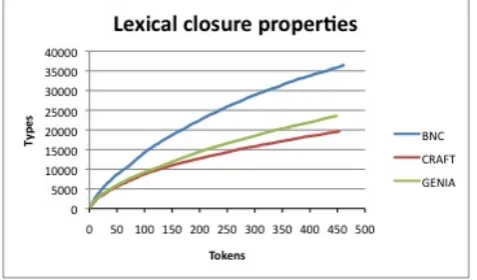
In (Temnikova and Cohen, 2013), SubCAT was used to as-sess the fit of two corpora of scientific journal articles from the molecular biology domain to the sublanguage model. Using the British National Corpus as a reference corpus, SubCAT showed that both molecular biology corpora were good fits to the sublanguage model, while in contrast, the British National Corpus has the characteristics of a repre-sentative corpus. Figure 1 shows the lexical closure char-acteristics of the three corpora. It reveals that both of the molecular biology corpora show lexical closure – growth in the number of lexical types is much slower than in the British National Corpus and asymptotes after about 50,000 lexical tokens have been examined – while the British Na-tional Corpus shows no tendency towards lexical closure.
Figure 1: Lexical closure properties, comparing the British National Corpus and two corpora of the molecular biology domain, CRAFT and GENIA. Tick-marks on thexaxis in-dicate increments of 50,000 tokens.
3.2.
Patents
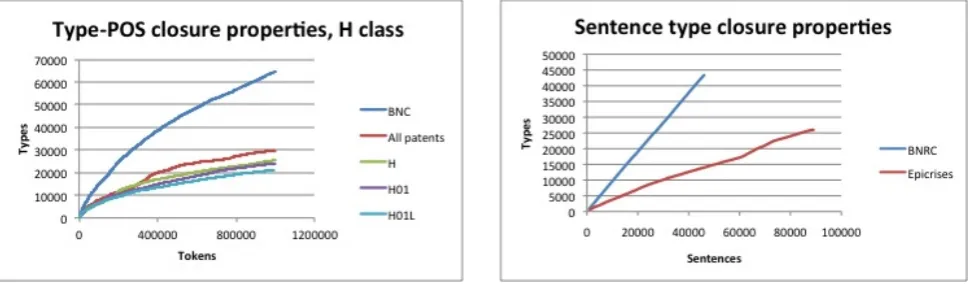
In (Temnikova et al., 2013a), SubCAT was used to assess the fit of a variety of collections of patents to the sublan-guage model. Patents are hierarchically classified, with lower classifications in the hierarchy corresponding to more granularly divided domains. (Temnikova et al., 2013a) tested the hypothesis that fit to the sublanguage model in-creases the further in the hierarchy one descends. Figure 2 shows the type-POS closure properties of the patents and the British National Corpus. The British National Cor-pus shows no tendency towards closure at all. Patents at all levels of the hierarchy show clear tendencies towards closure, with greater tendency towards closure the farther down the hierarchy one descends: the patents fit the sublan-guage model, and the fit increases as one descends the hier-archy; in contrast, the British National Corpus again shows the characteristics of a representative corpus. SubCAT was also used to measure average sentence length (Temnikova et al., 2013a).
3.3.
Bulgarian patient records
Word type Lemma
q hour q hour
/ / / /
leqenie treatment diabetna diabetic, f. sg.
diabet diabetes leqenie treatment
; ; diabet diabetes
x repetition, e.g. of dosage zaharen sugar, m. sg. adj.
mg mg klinika clinic
diabetna diabetic, f. sg. mg mg
tip type polinevropati polyneuropathy
polinevropati polyneuropathy anamneza anamnesis
Table 2: Word types and lemmata that are over-represented in the epicrises. Note that these are not the most frequent word types/lemmata, but rather the ones that occur more frequently than would be expected as compared to the reference corpus.
Figure 2: Type-POS closure properties of patents. All patentsis a sample from the full collection of patents,His a class within all patents,H01is a sub-class of the H class, andHO1Lis a sub-class of the H01 sub-class. Tick-marks on thexaxis indicate increments of 400,000 tokens.
showed similar closure properties in a restricted domain. Documents from patient health records from an endocrinol-ogy hospital were compared to the Bulgarian National Ref-erence Corpus. It was found that the Bulgarian clinical records showed the closure properties of a sublanguage for all three metrics. In fact, this was the only study ever to demonstrate closure for sentence types; previous stud-ies had shown lexical closure and type-POS closure, but even the experiments on a controlled language in McEnery and Wilson had not shown sentence type closure. Figure 3 shows the sentence type closure properties of the Bulgar-ian patient records and the BulgarBulgar-ian National Reference Corpus. The Bulgarian National Reference Corpus, in con-trast with the patient records, shows almost a 1:1 sentence type to sentence token ratio—there is no tendency towards closure whatsoever.
In addition, in (Temnikova et al., 2013b), SubCAT was used to findover-represented wordsin Bulgarian patient records and also to record the number of verbless sentences. The results showed that clinically relevant words were ex-tractable by this methodology and that Bulgarian patient records are characterized by 66% of verbless sentences. Table 2 shows the word types and lemmata that are
over-Figure 3: Sentence type closure properties in Bulgarian. BNRC is the Bulgarian National Reference Corpus. Epi-crisesis the collection of Bulgarian patient records. Tick-marks on thexaxis indicate increments of 20,000 tokens.
represented in Bulgarian epicrises.
3.4.
Availability and portability of software
The SubCAT toolkit, as well as example files in the required formats and several corpus format conversion scripts, is available at sublanguage.sourceforge.net. The software has been tested on Mac OSX, Windows, and a va-riety of Linux operating systems.
4.
Discussion and Future work
We have presented the first toolkit which allows automatic recognition of whether a corpus is written in a sublanguage or whether it is a sample of the representative language. Future extensions of SubCAT will include a sublanguage characterization module, which will provide a picture of a variety of basic characteristics of the sublanguage under in-vestigation.
5.
Acknowledgments
of the paper. Jin-Dong Kim helped us interpret the re-sults of the experiment on scientific journal articles. The AComIn project (EC FP7 grant 316087) supported Galia Angelova, Irina Temnikova, and Ivelina Nikolova’s work. Irina Temnikova’s work was additionally supported by the Qatar Computing Research Institute1.
6.
References
Finin, T. W. (1986). Constraining the interpretation of nominal compounds in a limited context. In Grishman, R. and Kittredge, R., editors,Analyzing language in re-stricted domains: sublanguage description and process-ing, pages 85–102. Lawrence Erlbaum Associates. Grishman, R. and Kittredge, R. (1986). Analyzing
lan-guage in restricted domains: sublanlan-guage description and processing. Lawrence Erlbaum Associates.
Grishman, R. (2001). Adaptive information extraction and sublanguage analysis. InProc. of IJCAI 2001.
Hirschman, L. and Sager, N. (1982). Automatic informa-tion formatting of a medical sublanguage. In Kittredge, R. and Lehrberger, J., editors, Sublanguage: studies of language in restricted semantic domains, pages 27–80. Walter de Gruyter.
Kilgarriff, A. (2001). Comparing corpora. International Journal of Corpus Linguistics, 6:1–37.
Kilgarriff, A. (2012). Getting to know your corpus. In Text, speech and dialogue.
Kittredge, R. I. (2003). Sublanguages and controlled lan-guages. In Mitkov, R., editor,The Oxford Handbook of Computational Linguistics, pages 430–447. Oxford Uni-versity Press.
Lippincott, T., S´eaghdha, D. ´O., and Korhonen, A. a. (2011). Exploring subdomain variation in biomedical language.BMC bioinformatics, 12(1):212.
McDonald, D. D. (2000). Natural language generation. In Dale, R., Moisl, H., and Somers, H., editors,Handbood of Natural Language Processing, pages 147–179. Marcel Dekker.
McEnery, T. and Hardie, A. (2012). Corpus Linguistics. Cambridge University Press.
McEnery, T. and Wilson, A. (2001). Corpus Linguistics. Edinburgh University Press, 2nd edition.
Mihaila, C., Batista-Navarro, R. T., and Ananiadou, S. (2012). Analysing entity type variation across biomed-ical subdomains. In Third workshop on building and evaluating resources for biomedical text mining, pages 1–7.
Moll´a, D. and Vicedo, J. L. (2007). Question answering in restricted domains: An overview.Computational Lin-guistics, 33(1):41–61.
Sekine, S. (1994). A new direction for sublanguage nlp. In Proceedings of the international conference on new methods in natural language processing, pages 123–129. Somers, H. (2000). Machine translation. In Dale, R., Moisl, H., and Somers, H., editors,Handbook of Natural Language Processing, pages 329–346. Marcel Dekker.
1
http://www.qcri.org.qa
Temnikova, I. P. and Cohen, K. B. (2013). Recognizing sublanguages in scientific journal articles through clo-sure properties. InProceedings of BioNLP 2013. Temnikova, I. P., Hailu, N. D., Angelova, G., and Cohen,
K. B. (2013a). Measuring closure properties of patent sublanguages. InRecent Advances in Natural Language Processing, pages 659–666.