Instructor's Guide for
Introduction to the Team Software Process
By
Watts S. Humphrey
With Support Tool by
James W. Over
Site Contents
1. TSPi Support Tool
2. TSPi Support Tool Instructions
3. Instructor's Guide
4. The TSPi Forms
Copyright 2000 Addison Wesley Longman, Inc. All rights reserved
Contents
Chapter 1
Introduction
1.1 Teaching a TSPi Course 1.2 What the TSPi Is
1.3 Team Selection and Leadership
1.4 Using TSPi in an Industrial Environment 1.5 Where Not to Use TSPi
1.6 The Contents of This Guide
Chapter 2
General Suggestions
2.1 Explaining Processes 2.2 Processes as Tools
2.3 The Benefits of Varied Experiences 2.4 Class Schedule and Pace
2.5 Keeping It Small 2.6 Tool Support
Chapter 3
Specific Course Suggestions 3.1 Student Preparation 3.2 Instructor Preparation 3.3 The Weekly Schedule 3.4 Facilities Required
Chapter 4
Course Overview
4.1 Course Objectives
4.2 The Principal Lessons of the Course 4.3 Learning From History
4.4 Team Selection 4.5 The PSP Refresher 4.6 Team Communication 4.7 Course Grading Chapter 5 Team Selection
5.1 Selecting Team Leaders 5.2 Assigning Students to Teams
5.3 The Team-leader Meeting 5.4 Team Size 5.5 Role Assignments Chapter 6 A PSP Refresher 6.1 Quality Metrics 6.2 Tracking Time
6.3 Defects, Code Reviews, and Checklists 6.4 Program Size
6.5 Task and Schedule Planning 6.6 Estimating Project Completion
Chapter 7
The Weekly Team-leader Meeting 7.1 Why Have a Weekly Meeting? 7.2 Why Review Team Data?
7.3 Conducting the Team-leader Meeting 7.4 The First Weekly Meeting
Chapter 8
The Process Phases 8.1 Launching Teams
8.2 The Development Strategy 8.3 Team Planning
8.4 The Requirements Process 8.5 Designing with Teams 8.6 Implementation
8.7 Test
8.8 The Postmortem 8.9 The Final Report
Chapter 9
Checking Forms and Data 9.1 The Forms to Check 9.2 The WEEK Form
9.3 The Configuration Change Request: CCR 9.4 The Configuration Status Report: CSR 9.5 The Inspection Report: INS
9.6 The Defect Recording Log: LOGD 9.7 The Time Recording Log: LOGT
9.8 The Test Log: LOGTEST
9.9 The Schedule Planning Template: SCHEDULE 9.10 The Strategy Recording Form: STRAT
9.11 The Program Plan Summary: SUMP 9.12 The Quality Plan: SUMQ
9.13 The Size Summary: SUMS
9.14 The Task Planning Template: TASK
Chapter 10
Later Development Phases 10.1 Launch Issues 10.2 Strategy Issues 10.3 Planning Issues 10.4 Requirements Issues 10.5 Design Issues 10.6 Implementation Issues 10.7 Test Issues 10.8 Postmortem Issues Chapter 11
Grading Team Courses 11.1 Teamwork 11.2 Measurement
11.3 Overall Effectiveness
Chapter 12
Handling People Problems 12.1 The Shrinking Violet 12.2 The Drone
12.3 The Hard Head
12.4 Removing a Team Member 12.5 Losing a Team Member
12.6 Losing Multiple Team Members 12.7 Team-leader Problems
Chapter 13
The Rewards of Teaching Teams Appendix A
PSP Familiarization Exercises
Exercise 1: Tracking Time
TSPi Time Recording Log: Form LOGT
TSPi Time Recording Log Instructions: Form LOGT
Exercise 2: Defects, Code Reviews, and Checklists
The TSPi Defect Types - Standard DEFECT
TSPi Defect Recording Log: Form LOGD
TSPi Defect Recording Log Instructions: Form LOGD
Code Review Script
Code Review Checklist: Pascal
Pascal Source Program
Exercise 3: Program Size
Pascal Source Program
Exercise 4: Task and Schedule Planning
TSPi Example Task Planning Template: Form TASK
TSPi Task Planning Template Instructions: Form TASK
TSPi Schedule Planning Template: Form SCHEDULE
TSPi Schedule Planning Template Instructions: Form SCHEDULE
Exercise 5: Estimating Project Completion
TSPi Schedule Planning Template: Form SCHEDULE
TSPi Schedule Planning Template Instructions: Form SCHEDULE
Appendix B
PSP Familiarization Exercise Answers Exercise 1 Answer: Tracking Time
Exercise 2 Answer: Defects, Code Reviews, and Checklists
Exercise 2 Answer: TSPi Defect Recording Log: Form LOGD
Exercise 3 Answer: Program Size
Exercise 4 Answer: Task and Schedule Planning
TSPi Schedule Planning Template: Form SCHEDULE
Exercise 5 Answer: Estimating Project Completion
TSPi Example Task Planning Template: Form TASK
TSPi Schedule Planning Template: Form SCHEDULE References
List of Forms
Instructions for Using the TSPi Support Tool
Copyright 2000 Addison Wesley Longman, Inc. All rights reserved
Chapter 1
Introduction
This guide is designed to help instructors when they teach the team course defined in the text
Introduction to the Team Software Process. This guide is for use with the text Introduction to the Team
Software Process,1 by Watts S. Humphrey, (Reading, MA: Addison Wesley, 2000). It describes some issues and answers questions instructors will have as they guide student teams in developing small to moderate-sized software products. This chapter covers the following topics:
The purpose of this guide
.
Teaching a TSPi (Introductory Team Software Process) course
.
What the TSPi is.
Team selection and leadership
.
Using TSPi in an industrial environment
.
When not to use TSPi.
The contents of this guide
.
Even though much of the material in this guide concerns classroom situations, many of the topics relate to industrial work, and almost all the software and project-related comments apply equally to both educational and industrial environments. Industrial groups, however, should be aware of the limited nature of the TSPi process. Sections 1.4 and 1.5 of this chapter discuss various aspects of using TSPi. Before they take a TSPi course, engineers must be trained in the Personal Software Process (PSP)SM.
Also, each team should have four to six engineers, the projects must be small, and the schedules should be short. This guide does not repeat the material given in Introduction to the Team Software Process. It assumes that you have read that book and are familiar with its contents.
1 This guide is for use with the text Introduction to the Team Software Process, by Watts S. Humphrey (Reading, MA:
Addison Wesley, 2000).
SM Personal Software Process and PSP are service marks of Carnegie Mellon University.
Introduction 1.1 ->
Contents List of Forms Tool Instructions
Copyright 2000 Addison Wesley Longman, Inc. All rights reserved
1.1. Teaching a TSPi Course
The TSPi course objective is to teach engineers how to conduct a team software project. It shows them how to work on a team and how to follow a disciplined process. Although producing a working program is an important course objective, the program produced by the team is a means to an end. It provides the team¹s focus and is concrete evidence that the team completed the project. The principal goal, however, is to ensure that the teams properly use the TSPi process. To get the students to use the process, you must emphasize the importance of following every step, gathering all the data, and completing all the required forms. If the students do not follow the process, their grades must suffer, and you should tell them this in advance. Also emphasize that you will periodically look at their work to ensure that they are following the process.
Software development is a complex process, and if they do not faithfully follow the TSPi while they do their work, they will be unable to fake it after the fact.
Make sure that the students know the course priorities: process fidelity, cooperative and
supportive teamwork, and the product. If they do not follow the process and gather and report all the process data, they will not get a good grade, regardless of the quality of the product they produce. After they complete the course, students should believe that the process helps and that it helps them the most when they are under schedule pressure.
<- Introduction 1.1 1.2 ->
Contents List of Forms Tool Instructions
Copyright 2000 Addison Wesley Longman, Inc. All rights reserved
TSPi Forms
TSPi forms
Configuration Change Request (CCR)
Configuration Status Report (CSR)
Student Information Sheet (INFO)
Inspection Report (INS)
Issue Tracking Log (ITL)
Defect Recording Log (LOGD)
Time Recording Form (LOGT)
Test (LOGTEST)
Team and Peer Evaluation (PEER)
Process Improvement Proposal (PIP)
Schedule Planning Template (SCHEDULE)
Strategy Form (STRAT)
Defects Injected Summary Form (SUMDI)
Defects Removed Summary Form (SUMDI)
Plan Summary (SUMP)
Quality Plan (SUMQ)
Size Summary (SUMDI)
Time Summary Form (SUMT)
Task Summary Form (SUMTASK)
Task Planning Template (SUMTASK)
Weekly Status Report (WEEK)
Contents Instructions for Using the TSPi Support Tool List of Forms
Copyright 2000 Addison Wesley Longman, Inc. All rights reserved
Instructions for Using the TSPi Support Tool
Overiew
Project Planning
Tracking the Project Schedule
Tracking the Project Quality Plan
User Interface Features
User Interface Contraints
TSPi.xIs worksheets
The LOGT Worksheet
The LOGD Worksheet
The TASK Worksheet
The SCHEDULE Worksheet
The SUMP Worksheet
The SUMQ Worksheet
The SUMS Worksheet
Contents Instructions for Using the TSPi Support Tool List of Forms
Copyright 2000 Addison Wesley Longman, Inc. All rights reserved
1.2. What the TSPi Is
The TSPi process provides all the forms, scripts, and standards needed for a small software team project. It also provides a procedure for launching a project, the steps for conducting a project, and a tool for gathering, analyzing, and reporting the data for this project. TSPi shows engineers how to establish goals, assign team roles, and devise a development strategy. It also walks teams through making development and quality plans. TSPi teams make detailed schedules, track their progress, and assess their status against these schedules. In addition, TSPi guides them through requirements analysis, product design, implementation, test planning, and testing. It provides an explicit process for performing team inspections, establishing and using a configuration
management system, and conducting a project postmortem assessment.
The TSPi requires that students have previously been trained in the PSP. The PSP and TSPi constitute a fundamental change from traditional software development. PSP changes the
engineering culture from one that concentrates on coding and testing to a planned and measured process that produces quality products on predictable schedules. The TSPi then shows engineers how to use the PSP methods while planning and doing development work. PSP and TSP go together. Without one, the other will not be effective.
<- 1.1 1.2 1.3 ->
Contents List of Forms Tool Instructions
Copyright 2000 Addison Wesley Longman, Inc. All rights reserved
1.3. Team Selection and Leadership
Often, in a course, you will have limited say about who participates and who does not. However, you can decide which students are on which teams and who will have which roles on these teams. These are important issues, for the ability of team members to work together is the most
important single factor in determining team success. Thus, if you do not know the students personally, you should get help from someone who does know them.
Start by selecting those students you think will make the best leaders; then decide which engineers to put with each of these leaders. In doing so, try to form balanced and compatible teams. Often, in fact, the students themselves can help in deciding how to compose the teams. In this process, the most important step is to select motivated and capable team leaders. This topic is described in more detail in Chapter 5.
<- 1.2 1.3 1.4 ->
Contents List of Forms Tool Instructions
Copyright 2000 Addison Wesley Longman, Inc. All rights reserved
1.4. Using TSPi in an Industrial Environment
The TSPi is a scaled-down version of the Team Software Process (TSP)SM developed by the Software Engineering Institute (SEI). This introductory version is designed to teach teamwork principles in a graduate or upper-level undergraduate university course. It was designed for use in a supportive environment with a restricted team size and a relatively short-duration project. Most important, the instructors who guide this work must monitor and support each team.
The material in the TSPi text should help working software teams, but if the project conditions are not relatively close to the environment planned for TSPi, the process will need to be tailored. The areas likely to most need attention are the team roles, the launch process, and team
management.
The most important limitation of the TSPi is that it does not address management issues. The principal problem with using TSPi in industry is that the managers want to plan the engineers' work and assign their tasks. With TSP and TSPi, the engineers do these things and the managers concentrate on coaching and supporting the teams. Without a major intervention, managers do not generally know how to support TSPi teams. Under these conditions, the process often does not work.
The SEI has developed an industrial-grade TSP for larger projects and bigger teams. This
industrial-grade TSP shows engineers how to apply the PSP in an industrial environment, and it addresses the changes needed in management culture. For further information on the TSP, contact the SEI.2
SM Team Software Process and TSP are service marks of Carnegie Mellon University. 2 Information on the SEI, the PSP, and the TSP can be obtained at www.sei.cmu.edu.
<- 1.3 1.4 1.5 ->
Contents List of Forms Tool Instructions
Copyright 2000 Addison Wesley Longman, Inc. All rights reserved
1.5. Where Not to Use TSPi
When engineers have not been PSP-trained, neither the TSP nor the TSPi process will work. In industry, we have found that when software engineers have not been PSP-trained, they do not generally understand why or how to plan a project or how to gather and use the process data. Because much of the TSPi process deals with project planning, data gathering, and data analysis, untrained engineers are often lost. Similarly, when students have not been PSP-trained, they will have so much new material to learn that they are not likely to complete their projects.
We once attempted to introduce TSP to an industrial team that was not PSP-trained. The results were totally unsatisfactory, and we learned to never introduce the TSP to a team that is not properly prepared. This is also true for TSPi. Changing the current software culture is extremely difficult, and if the engineers and their managers have not been PSP-trained, any attempt to guide them through the TSP or TSPi, will almost certainly fail.
<- 1.4 1.5 1.6 ->
Contents List of Forms Tool Instructions
Copyright 2000 Addison Wesley Longman, Inc. All rights reserved
1.6. The Contents of This Guide
This guide starts with a chapter on general suggestions (Chapter 2) followed by chapters on advanced preparation, a course overview, and team selection. Chapters 6 and 7 cover the PSP refresher and the weekly team-leader meeting. Chapter 8 covers many of the issues teams will likely face as they use the process, and it gives suggestions for how to handle these issues. Chapter 9 discusses the TSPi forms, and Chapters 10, 11, and 12 deal with subsequent
development cycles, team coaching, and team grading. The last chapter comments on the rewards of teaching a team course, and Appendixes A and B provide exercises designed to familiarize engineers with the PSP.
<- 1.5 1.5 Chapter 2 ->
Contents List of Forms Tool Instructions
Copyright 2000 Addison Wesley Longman, Inc. All rights reserved
Chapter 2
General Suggestions
This chapter provides general guidance on the TSPi process. It contains the following parts:
Explaining processes
.
Processes as tools.
The benefits of varied experiences
.
Class schedule and pace: one, two, or three development cycles
.
Keeping it small.
Tool support
.
<- 1.6 Chapter 2 2.1 ->
Contents List of Forms Tool Instructions
Copyright 2000 Addison Wesley Longman, Inc. All rights reserved
2.1. Explaining Processes
When you use a process such as TSPi, it is important to distinguish between a process and a text. A process guides you in doing a task that you know how to do. It is not intended to teach you how to do something you don't understand. A process is thus more like a shopping list than a textbook. It doesn't contain anything you didn't already know, but when you don't follow it you are likely to forget something important.
The reason it is important to understand the nature of processes is that a process is useful only if people follow it. However, people do not follow a process if it is large and wordy or contains material that seems unnecessary or repetitive. Thus students using TSPi for the first time need guidance on using the process. Although the TSPi is explained in detail in the text Introduction to
the Team Software Process, many students do not read textbooks. Others may not fully grasp the
material.
It is not surprising that students have trouble understanding the TSPi. Even though the material is straightforward, many first-time readers simply do not grasp the concepts. TSPi is a major
departure from the way they have previously developed software, and most inexperienced teams need considerable support at first. Therefore, you must plan to spend time with each team each week, particularly during the first development cycle.
The teams need guidance on how to follow the process, and they need coaching to ensure that they record and use their data. When faculty insist that the process be followed, teams generally do so, at least with adequate coaching. When teams follow the process, their results are almost universally good.
If teams do not follow the process, they do not learn the lessons the course is designed to teach. They generally fall behind schedule, panic, and revert to banging out code. Under these
conditions, the teams are not efficient, the work takes longer, and the products are of poor quality. Most important, the students do not learn that the fastest and most efficient way to develop
quality software is to follow a defined, high-quality process.
<- Chapter 2 2.1 2.2 ->
Contents List of Forms Tool Instructions
Copyright 2000 Addison Wesley Longman, Inc. All rights reserved
2.2. Processes as Tools
The process is a tool, and teams should adjust the process if they find parts that do not work for them. Make sure that the students understand that the process is not a straightjacket and that they can change it if they need to. They must, however, record their data and fill out the process forms. Before they change the process, however, they must make sure that the process is the problem. Do not let the students skip the reviews and inspections, stop recording their data, or omit completing the forms.
Be pragmatic about the process and make sure that the work students are required to do really contributes to their results. Students should think of the process as a tool that helps them do better work and not as a bureaucratic set of unnecessary tasks.
<- 2.1 2.2 2.3 ->
Contents List of Forms Tool Instructions
Copyright 2000 Addison Wesley Longman, Inc. All rights reserved
2.3. The Benefits of Varied Experiences
There is a trade-off in teaching this course. It is designed to maximize student learning, and a broader range of experiences will increase its educational value. However, changes in the process temporarily reduce productivity, add to learning time, and cause inefficiency. Therefore, students generally resist process changes when they are given a choice.
For example, in a second or third development cycle, if you give teams the choice of keeping the same roles or switching to new ones they invariably keep the same roles. Students who have been forced to change roles, however, generally think it was a good idea. The usual exception,
however, is for the team leader. If teams want to keep the same leader, permit them to do so. Even then, if there is a good alternative candidate who would like the leadership role, urge the team to consider a change.
<- 2.2 2.3 2.4 ->
Contents List of Forms Tool Instructions
Copyright 2000 Addison Wesley Longman, Inc. All rights reserved
2.4. Class Schedule and Pace
The TSPi process is designed for one, two, or three development cycles. Depending on the other topics in the course, there should be ample time for one and possibly two cycles in almost any semester or quarter system. With three cycles, however, a full semester is required and there is no time for any other material. Depending on the students' familiarity with the PSP, you may not even have time for three development cycles.
Students often complain that the first TSPi cycle is too leisurely and that the second cycle is too rushed. This is by design. The TSPi is designed to push the students. It teaches them the process in the first cycle, and then, in the second cycle, they use the process when under schedule
pressure. Thus, even though students learn about the process in the first cycle, they do not have the conviction to use it in practice. After the second cycle, students both understand the process and have tried to use it when rushing to meet a tight schedule. Unfortunately, under these
conditions, many teams fail to follow the process. Although they know many things they should have done differently, they need a third cycle to fully internalize the lessons they learned in the first two.
Software development is not a relaxed occupation, and engineers rarely have a leisurely time. Thus, without pressure, students do not get a realistic experience. If you follow the defined course strategy, the students will see the need to adapt the size of the job to the time they expect to have available. They will also see that a defined, high-quality process is the fastest and best way to do the job, even under pressure. Because the process they will use in practice is the one they fall back on when in a hurry, they need to learn this important lesson.
<- 2.3 2.4 2.5 ->
Contents List of Forms Tool Instructions
Copyright 2000 Addison Wesley Longman, Inc. All rights reserved
2.5. Keeping It Small
In spite of the advice in the textbook, the most common mistake teams make is trying to do too much. Even faculty report that the biggest single mistake they made was picking too big a
problem. So keep the projects small. You do not want a trivial problem, but unless you have built the product before and have data on how big it will likely be, the chances are that it will take more code than you think. When the job is too large, the students either fail to produce a working product or they spend an excessive amount of time in test. This is unnecessary and unfair because students can learn the important lessons of this course even while developing small products.
<- 2.4 2.5 2.6 ->
Contents List of Forms Tool Instructions
Copyright 2000 Addison Wesley Longman, Inc. All rights reserved
2.6. Tool Support
Software development is a sophisticated and complex process, and a well-run TSPi project will amass a substantial amount of data. Without an orderly process, recording and using these data are not easy. Sometimes the data are lost in volumes of material, and, more often, the data are simply not recorded. The TSPi tool was developed to help students manage their process data. After students enter their time, size, and defect data, the TSPi tool automatically completes all the required forms and makes all the necessary calculations.
Although the TSPi is relatively simple, it is difficult to use without tool support. Without support, students would have to do a substantial amount of manual data collection and complete a large number of forms. A tool helps to ensure process fidelity, but it also has the disadvantage that students do not gain a full understanding of all the forms, data, and calculations. You can
minimize this potential problem by designing the course for three complete development cycles. You must also require that the students use their data to thoughtfully analyze and report on their work.
<- 2.5 2.6 Chapter 3 ->
Contents List of Forms Tool Instructions
Copyright 2000 Addison Wesley Longman, Inc. All rights reserved
Chapter 3
Specific Course Suggestions
This chapter describes specific suggestions for conducting a TSPi course. The topics covered are as follows.
Student preparation
.
Instructor preparation.
The weekly schedule.
Facilities required.
<- 2.6 Chapter 3 3.1 ->
Contents List of Forms Tool Instructions
Copyright 2000 Addison Wesley Longman, Inc. All rights reserved
3.1. Student Preparation
The basic prerequisites for the TSPi course are explained in the textbook Introduction to the
Team Software Process. The principal requirement is that the students have completed a PSP
course, either with the textbook A Discipline for Software Engineering or the textbook
Introduction to the Personal Software Process. The students must also be competent programmers and have a copy of Introduction to the Team Software Process.
In addition, it would be most helpful if the students had courses on software design and software requirements. Additional useful courses include testing, configuration management, and team inspections.
If the students have not satisfactorily completed a PSP course or are not competent programmers, you should not let them into the TSPi course. They would likely have a great deal of trouble with the material. This would be unfair both to these students and to the other members of their teams. Before the students start using the TSPi process, they should read textbook Chapters 1, 2, and 3 and Appendix A. They should also read the two-page scripts on each team role in Appendix E. Finally, have them read the chapter or chapters in Part III (Chapters 11 through 15) on the roles that most interest them.
During the course, the students must also read about one chapter a week during the first
development cycle. These chapters are specified in the DEV script in Chapter 1 of the textbook as well as in Appendix D. Then, in cycles 2 and 3, the students should read those chapters in Part III (Chapters 11 through 15) that they have not previously read. Also explain that the material in Part IV (Chapters 16, 17, and 18) deals with teamwork problems and methods. These topics are
frequent sources of trouble, and most engineers find it helpful to have read these chapters early in the course. I suggest that you assign this reading before the teams start the second development cycle or earlier.
<- Chapter 3 3.1 3.2 ->
Contents List of Forms Tool Instructions
Copyright 2000 Addison Wesley Longman, Inc. All rights reserved
3.2. Instructor Preparation
If you are a qualified software engineering or computer science instructor and are a competent programmer, you should have no trouble teaching a TSPi course. This assumes, of course, that you are adequately prepared. The suggested instructor preparation for this course is that you have either taught or taken a PSP course, using either the PSP textbook A Discipline for Software
Engineering or the introductory textbook Introduction to the Personal Software Process.
Alternatively, you could have attended a qualified faculty workshop on teaching the PSP and TSP. In addition, you must have read the textbook Introduction to the Team Software Process as well as this Instructor's Guide. You should also be familiar with the TSPi tool used by this text. It is described in the TSPi tool instructions which are available in the supplements for the TSPi text. These supplements are described on the last page of the text.
Experience with software development, either in industry or with project team courses, would also be most helpful. In addition, you should be familiar with software process principles,
understand how processes are used in software organizations, and recognize the need for process discipline. In particular, you must be willing to monitor the quality of the processes the students use. This means that you must regularly examine their process data, analyze their work, and periodically emphasize the importance of quality. You must also examine the products the students produce, but this is of secondary importance compared with the need for maintaining process discipline.
<- 3.1 3.2 3.3 ->
Contents List of Forms Tool Instructions
Copyright 2000 Addison Wesley Longman, Inc. All rights reserved
3.3. The Weekly Schedule
The biggest problem most students and instructors have with the TSPi course is the need to manage their time. The teams must meet for weekly meetings, strategy development, product planning, and
inspections. They generally have trouble finding this time. You also must hold a weekly meeting with the team leaders, help the teams when they have problems, and review the teams' TSPi materials and data. Many of these needs can be efficiently covered if you schedule a two- to three-hour closed laboratory session every week.
The principal factor governing the success of your course is the amount of time and effort you can devote to guiding and assessing the students' work. As a rule, you should expect to spend a minimum of about an hour per week per student on this work. For very small classes, the time would probably be two or more hours per week per student. If the course has more than about 10 to 15 students, however, you will likely need a teaching assistant.
In addition, as described in Chapters 7 and 9, the quality of the teams' work largely depends on the care and regularity with which you review their data. Because few faculty have the time to do all the reviews suggested in Chapter 9, you must establish priorities. Chapter 9 discusses this subject in some detail. I suggest you consider the following general priorities for reviewing team data.
Make sure that the teams are recording all the required data. You can generally 1.
check this by looking at the team and engineer TASK, SCHEDULE, SUMP, and SUMQ forms. 2.
When in doubt, also ask to see the engineers' LOGT and LOGD forms. 3.
To anticipate problems and provide timely help, track the teams' progress 4.
using the team and engineer WEEK forms. 5.
Try to examine each form the first time it is called for, as shown in 6.
Tables 7.1 and 9.1. 7.
When forms are incorrect, require that they be corrected and reviewed with you 8.
again. If they are still incorrect, do it again until they are right. 9.
This discipline can initially take a fair amount of time. When the students start properly reporting their data and completing their forms, however, the time demands of the course will be much less.
<- 3.2 3.3 3.4 ->
Contents List of Forms Tool Instructions
Copyright 2000 Addison Wesley Longman, Inc. All rights reserved
3.4. Faculties Required
The key facility needed for a TSPi course is a laboratory environment where each student can have a personal workstation. These workstations must be equipped with the development
environment the teams will use and an e-mail capability for intrateam communication any time of the day or night. To use the TSPi tool, the teams also need to run Microsoft Windows or
Windows NT systems as well as Excel.
The teams will also need space to work together, hold team meetings, and meet with the instructor. Teamwork requires that the team members learn to work together. To do this, they must be able to interact frequently as a team. Unless the teams have convenient facilities for doing this, they are unlikely to have a satisfactory team experience.
<- 3.3 3.4 Chapter 4 ->
Contents List of Forms Tool Instructions
Copyright 2000 Addison Wesley Longman, Inc. All rights reserved
Chapter 4
Course Overview
This chapter describes a suggested initial lecture to explain what the TSPi course is about and to tell students what is expected of them. The chapter also describes the principal lessons the students should take from the course. The topics covered in this chapter are as follows.
Course objectives
.
The principal lessons of the course
.
Learning from history.
Team selection
.
The PSP refresher.
Team communication.
Course grading.
Before you discuss the TSPi process in detail, it would be a good idea to use the DEV script to give a brief overview. This overview should include the cyclic development strategy and the phases within each cycle. Also, describe the product the teams will develop and explain where they can find more
information about it. If you plan to use one of the sample need statements in Appendix A of the textbook, tell the students which one and describe where to find it.
<- 3.4 Chapter 4 4.1 ->
Contents List of Forms Tool Instructions
Copyright 2000 Addison Wesley Longman, Inc. All rights reserved
4.1. Course Objectives
The three principal objectives of this course are to expose students to the problems of developing software-intensive products, to guide teams through a team development process, and to
demonstrate the benefits of using a defined and measured process. Although the process the students will use is an extension of the PSP, they will apply PSP methods to a larger product, and they will track and report on their work every week.
<- Chapter 4 4.1 4.2 ->
Contents List of Forms Tool Instructions
Copyright 2000 Addison Wesley Longman, Inc. All rights reserved
4.2. The Principal Lessons of the Course
When students follow the TSPi process, they start off thinking that data gathering is a burden. Assuming that you require them to consistently record and report all their data, data gathering soon becomes automatic. Until you get the students to this point, however, they fight the process and have trouble learning from it.
The second lesson, which many software teams must learn for themselves, is that without a disciplined process, the development and testing of even small programs can take a very long time. In fact, industrial software groups often take several weeks to test programs of the size the students will develop in this course. Because this course allows only one week for testing in the first cycle and half a week each for the second and third cycles, the teams must use a high-quality process. If they do not, they either will not produce a working product or will have to work many late nights and weekends.
The third lesson is that, with a disciplined process, the teams will finish their projects on time, the products will work, and they will take little system test time. Finally, the students will find that disciplined teamwork is predictable, rewarding, and fun.
<- 4.1 4.2 4.3 ->
Contents List of Forms Tool Instructions
Copyright 2000 Addison Wesley Longman, Inc. All rights reserved
4.3. Learning from History
The principal advance of the Industrial Age was the introduction of scientific and engineering methods. Technological progress was limited, however, until the early scientists began to learn from the experiences of others. As long as artisans and craftsmen could learn only by themselves or from their immediate associates, technological progress was limited. If every engineer had been forced to invent calculus, create statistics, or devise Khirchhoff's laws, we wouldn't have automobiles, computers, or jet airplanes.
Urge your students to learn from what others have painfully learned. The TSPi builds on nearly 50 years of software development experience. When engineers don't capitalize on this wealth of historical knowledge, they spend years painfully learning what others have already discovered. What is more, they will spend this time only to learn that following a disciplined process is the fastest and best way to develop quality software. Although a lifetime of learning can be
rewarding, it is a tragedy to waste it learning what is already well known.
The story of one industrial software developer is illustrative. He needed to produce a small program in one week. Although he had learned the PSP, he was not convinced that all the discipline was worthwhile. He therefore decided to forget about the PSP, ignore planning, skip design and reviews, and start writing code. He wrote the program in a couple of days, and
compiling took only a few hours. Then he started testing. He worked late every night and most of one weekend and, after two weeks, was finally finished. He later told his manager, "Never again!" He realized that he would have found almost every test defect in a careful code review. In this course, the students do not have time for two weeks of system testing.
<- 4.2 4.3 4.4 ->
Contents List of Forms Tool Instructions
Copyright 2000 Addison Wesley Longman, Inc. All rights reserved
4.4. Team Selection
The TSPi process used in this course is designed for five-person teams. You will make the team assignments and, barring unforeseen problems, these teams will stay together for the entire semester. Also, the TSPi teams have defined team-member roles, and you will assign these roles for the first development cycle. To properly make these assignments, however, you need
information from the students. The INFO form, designed for this purpose, contains a wealth of useful information. One of your first actions should be to hand out copies of the INFO form and ask the students to complete and return them to you as soon as possible. Point out that if they have any team or role preferences, they should indicate them on this form.
Also suggest that before they complete the INFO form, they should read the two-page
descriptions of each role in Appendix E of the text. They will also find more information on the roles in Part III of the TSPi textbook. Team selection is discussed in more detail in Chapter 5 of this guide.
<- 4.3 4.4 4.5 ->
Contents List of Forms Tool Instructions
Copyright 2000 Addison Wesley Longman, Inc. All rights reserved
4.5. The PSP Refresher
If you plan to give a PSP refresher lecture or two, explain what you plan to cover and why. This topic is covered in more detail in Chapter 6 of this guide.
<- 4.4 4.5 4.6 ->
Contents List of Forms Tool Instructions
Copyright 2000 Addison Wesley Longman, Inc. All rights reserved
4.6. Team Communication
Describe how the TSPi maintains communication among teams and between the instructor and the teams. This is done through a weekly meeting of every team and the meeting you hold with all of the team leaders every week. The purpose of the team-leader meeting is to monitor each team's use of the TSPi and to provide help and guidance. Also describe the reporting process and explain that each team will report its data to you every week. The team-leader meeting is
described in Chapter 7.
<- 4.5 4.6 4.7 ->
Contents List of Forms Tool Instructions
Copyright 2000 Addison Wesley Longman, Inc. All rights reserved
4.7. Course Grading
The students will be most interested in the criteria you will use to determine their grades. Their principal concern will be whether they will be graded as individuals or all members of a team will get identical grades. Explain the PEER form and discuss how you will handle grading. For a further discussion of these points, see Chapter 11 in this guide and Chapter 3 in the TSPi textbook.
<- 4.6 4.7 Chapter 5 ->
Contents List of Forms Tool Instructions
Copyright 2000 Addison Wesley Longman, Inc. All rights reserved
Chapter 5
Team Selection
This chapter discusses team selection for a TSPi course. The selection of teams for industrial software projects is an entirely different subject and is not discussed in this guide. This is one of the areas in which TSPi differs the most from the industrial-grade TSP. The topics covered in this chapter are as follows.
Selecting team leaders
.
Assigning students to teams.
The team-leader meeting.
Team size.
Role assignments
.
<- 4.7 Chapter 5 5.1 ->
Contents List of Forms Tool Instructions
Copyright 2000 Addison Wesley Longman, Inc. All rights reserved
5.1. Selecting Team Leaders
Selecting good team leaders is important. The leader makes the team, and teams with effective leaders have an enormous advantage. Conversely, if the leader has personal problems or is
unwilling or unable to establish and maintain discipline, the team is likely to fail. The strategy for selecting student teams is to first select the students you think will make the best leaders and then select the members for these leaders' teams. Next, before announcing the team assignments to the class, hold a team-leader meeting to discuss the selections.
In selecting the team leaders, start by reviewing the INFO forms and looking at the students' transcripts. If you don't know all the students well, ask other faculty for advice and then interview the candidates before making the final choices. You need to understand peoples' characters to judge whether they will be effective leaders. On the other hand, there is considerable evidence that many people can be effective leaders, at least when they need to be.
The principal criteria for effective leaders are that they are objective and motivated and can deal openly with their teams. They must not get hung up on authority problems or have an outsized ego. Effective leaders must be tough when necessary as well as empathic and patient as the situation requires. The key is to select leaders who will think about the team and its needs rather than about themselves and their needs.
Leadership is particularly important when a team has multiple stars. Highly competent engineers are often creative and self-confident. When a team has several such stars, they often compete. The leader's job is to focus the team on the principal objective and to build a cooperative rather than a competitive environment. The leader's objective is to fully utilize all the team members' skills and abilities.
Above all, avoid leaders who seek power or have something personal to prove. Effective leaders build loyalty, they engender trust, and they are enthusiastic. Like the best coaches, they strive to get the best from their people. They don't make touchdowns or hit home runs, and they don't seek publicity or praise. Instead, they want these tokens of success for their teams.
<- Chapter 5 5.1 5.2 ->
Contents List of Forms Tool Instructions
Copyright 2000 Addison Wesley Longman, Inc. All rights reserved
5.2. Assigning Students to Teams
The students' INFO forms will contain much of what you need to know about the students' capabilities and interests. Try to honor their preferences. If someone does not want to be on the same team with another student, try to oblige. Similarly, when students wish to work together, arrange it if you can.
Try to balance the students' capabilities. Give each team a mix of skills and backgrounds. Distribute those students who have industrial experience, and do the same for any graduate students or seniors who have had the full PSP course. Mix the men and the women, age with inexperience, and strive for a cultural, racial, and ethnic balance. Although you should not put antagonistic people together, recognize that team diversity generally increases a team's creativity and resilience.
In picking teams, try to ensure that all the students know a common programming language and urge them to use a language they all know. The students have a great deal to learn in this course without also struggling to learn a new programming language. For each team, try to pick students who have compatible schedules so that they can meet and work together.
Transfer students can be a problem for two reasons: you do not know them, and they may not be adequately prepared. You may also have to accept some transfer students who have not had PSP training, even though this is not recommended. Make sure to put such students on different teams, and give them extra help with the PSP and TSPi. Because it is unfair to put students into courses for which they are ill prepared, discuss the issues with them and make sure that they understand and are prepared to handle the problems.
<- 5-1 5.2 5.3 ->
Contents List of Forms Tool Instructions
Copyright 2000 Addison Wesley Longman, Inc. All rights reserved
5.3. The Team-leader Meeting
After you have picked the teams, meet with the team leaders before announcing the team assignments. In this meeting, discuss the students you have assigned to each team. You might even have a free-agent trading session, giving the team leaders an opportunity to swap team members. Although they will probably not trade anyone, the opportunity to do so will involve them in the team selection process and could prevent some serious problems.
<- 5-2 5.3 5.4 ->
Contents List of Forms Tool Instructions
Copyright 2000 Addison Wesley Longman, Inc. All rights reserved
5.4. Team Size
Five students per team is optimum. With four or fewer members, there can be problems if a student must leave. It is always traumatic when a team loses a member, but with a small team a single loss can cause especially serious problems. On the other hand, the more students there are on a team, the harder it is to balance schedules and to run a consensus-based decision-making process. It is best to stick to five-student teams if possible.
In general, class size will not be an even multiple of five. Under these conditions, make a few six-engineer teams instead of more four-engineer groups. For example, with 36 students, I suggest six teams of five and one of six instead of four teams of four students and four teams of five.
<- 5-3 5.4 5.5 ->
Contents List of Forms Tool Instructions
Copyright 2000 Addison Wesley Longman, Inc. All rights reserved
5.5. Role Assignments
Based on the information in the students' INFO forms, you should be able to make team
assignments that give most students the roles they request. For larger or smaller teams, however, you must make some role adjustments. When assigning roles for four-student teams, distribute the support manager role among the team members. For six-student teams, split the
quality/process manager role into a quality manager and a process manager.
When teams are larger than six, the role adjustments are more significant. You can, for example, establish roles for each process step, such as a requirements manager, design manager, and so on. These roles then maintain the focus on their areas of responsibility throughout the process. A test manager, for example, ensures that the team considers testing issues, even during the
requirements phase.
Another approach is to establish backup responsibilities; students act as alternates to the member who has the primary role responsibility. It is then important, however, to ensure that the students with shared roles really share the work. One approach is to have them divide the activities and responsibilities shown in the scripts for that role. They give you a copy and put a copy in the team's project notebook. Because the role workload is heaviest for the team leader, the planning manager, and the quality/process manager, assign backups for these roles first.
<- 5.4 5.5 Chapter 6 ->
Contents List of Forms Tool Instructions
Copyright 2000 Addison Wesley Longman, Inc. All rights reserved
Chapter 6
The PSP Refresher
This chapter describes the suggested contents of some brief refresher lectures to give at the beginning of the course. These lectures are particularly important when a number of the students have not recently used the PSP. The topics in this chapter review subjects covered in the textbook Introduction to the Personal Software Process. The review topics and the chapters in this introductory PSP text that cover them are as follows.
When a refresher is needed
.
Metrics review (Chapter 19).
Tracking time (Chapter 3).
Defects, code reviews, and checklists (Chapters 12, 13, and 14)
.
Program size (Chapter 6).
Task and schedule planning (Chapter 9)
.
Estimating project completion (Chapter 9).
After a review of the first two topics, the recommended approach is to have the students complete an exercise and then to review their results in class. These exercises are about the PSP and are based on the process described in Introduction to the Personal Software Process. Because the TSPi process used in this course is more sophisticated, emphasize that the students must read the textbook for this course
(Introduction to the Team Software Process) and familiarize themselves with the TSPi tool that supports it. All the exercises are described in the exercise packages given in Appendix A of this guide. The
exercise answers are given in Appendix B.
If many students took their PSP courses more than a semester earlier or if they have not used the PSP in one or more recent courses, start the course with one or two refresher lectures. It is also a good idea to have the students do the exercises described in this chapter and even write a simple program using the PSP.
<- 5.5 Chapter 6 6.1 ->
Contents List of Forms Tool Instructions
Copyright 2000 Addison Wesley Longman, Inc. All rights reserved
6.1. Quality Metrics
The basic measures in the PSP and TSPi are time, size, and defects. If the students gather data on these measures for every process phase, every product element, and each team member, they can calculate all the measures they will need for this course. Although the PSP courses cover the measures used by the TSPi, it would be a good idea to review some of the principal measures students will be using. I recommend discussing KLOC, defects/KLOC, yield, A/FR and LOC/hour. All these are described in the PSP texts as well as in the TSPi textbook.
<- Chapter 6 6.1 6.2 ->
Contents List of Forms Tool Instructions
Copyright 2000 Addison Wesley Longman, Inc. All rights reserved
6.2. Tracking Time
This lecture is based on the material in Chapter 3 of Introduction to the Personal Software Process. If any students are confused or want a further review of this material, suggest that they read this chapter. To track time, students need the following:
A defined process or plan to follow ●
A time tracking log or tool for recording the time ●
Some way to tell time ●
Work to do while tracking their time ●
After reviewing the basic concepts of time tracking, hand out the Exercise 1 package in Appendix A of this guide and have the students complete the time log (LOGT) entries for paragraphs 2 and 3 of the exercise scenario. A completed LOGT form with the correct entries is given in Appendix B of this guide under Exercise 1 Answer.
Have the students take a few minutes to complete the LOGT entries and then go over the correct answers with the class. If anyone got an incorrect answer, make sure that he or she understands the reason for the error before you proceed.
<- 6.1 6.2 6.3 ->
Contents List of Forms Tool Instructions
Copyright 2000 Addison Wesley Longman, Inc. All rights reserved
6.3. Defects, Code Reviews, and Checklists
The material in this refresher lecture comes from Chapters 12, 13, and 14 in the textbook Introduction to
the Personal Software Process. If any students are confused or want a further review of this material,
suggest that they read these chapters. In this lecture, briefly discuss the following topics with the class. Defects and quality
●
Major and minor defects ●
Defect types ●
The defect recording log ●
Code reviews ●
The code-review checklist ●
Using a code-review checklist ●
A LOGD form and the LOGD instructions ●
The defect-type standard ●
A code-review script ●
A code-review checklist (language-dependent) ●
A small sample program with seeded defects (language-dependent) ●
After this discussion, give the students the Exercise 2 package in Appendix A of this guide and have them complete it. This package contains the source code for a small program, which they will review. While the students are doing the code review, they should record their defects on a LOGD form. Also have them use the code review checklist and the defect-type standard. Copies of all these materials are in the Exercise 2 package.
If the students know the Pascal programming language, you can use the exercise package in this guide. If they do not, you will have to prepare exercise materials in a language the students know. For a new exercise, you will need to provide the following materials.
For this new exercise package, you can use items 1, 2, and 3 from the Exercise 2 package but need to replace items 4 and 5 using a language the students know. You also need to prepare a LOGD form and a program listing with the seeded defects identified. You should test the program to make sure it works.
After the students have completed the exercise, hand out a copy of the correct answer and go over it with the class. Have each student calculate the yield he or she achieved in the review. Note that this simple program has several seeded defects, and anyone who makes a reasonable effort should find at least 50% of them. A competent review would find 70% or more, and a 90% or higher yield would be excellent. Also emphasize the importance of doing careful reviews. Point out how much time the students will waste in test if they do not find most of the defects in the reviews and that their work will be much more efficient and predictable when they do. Emphasize that in the TSPi projects, the class schedule does not provide enough time for them to find all or even most of their defects in compile and test. Thus, if they do not do competent reviews, they will likely have to work several late nights in the final week of each development cycle. The answers to the Pascal version of Exercise 2 are given in Appendix B of this guide under Exercise 2 Answer.
<- 6.2 6.3 6.4 ->
Contents List of Forms Tool Instructions
Copyright 2000 Addison Wesley Longman, Inc. All rights reserved
6.4. Program Size
The principles of size measurement ●
How LOC are counted in the PS ●
After giving students a few examples, have them count the program in the Exercise 3 package in Appendix A of this guide. This program is also shown in Appendix B of this guide with each LOC numbered. Again, after the students complete the exercise, distribute the correct answer and ask whether everyone got the correct answer and whether there are any questions.
The material in this review segment is based on Chapter 6 of Introduction to the Personal
Software Process. If any students are confused or want a further review of this material, suggest
that they read this chapter. In this lecture, you should review
<- 6.3 6.4 6.5 ->
Contents List of Forms Tool Instructions
Copyright 2000 Addison Wesley Longman, Inc. All rights reserved
6.5. Task and Schedule Planning
The material in this lecture is based on Chapter 9 of Introduction to the Personal Software Process. If any students are confused or want a further review of this material, suggest that they read this chapter. Because the introductory PSP course does not require that students use earned value to track their projects, many will not know how to do it. It is therefore important that you take enough time to completely cover the material in this and the next section. I suggest you cover the following topics.
How and why earned value is used ●
The task plan ●
The schedule plan ●
Calculating planned value ●
Next, hand out the Exercise 4 package and have the students complete it. In this exercise, the students complete a task plan with task hours along with a schedule plan with weekly hours. They also make the planned-value calculations. Then they must show the planned value for each TASK on the task template and the planned value for each week on the SCHEDULE template. To complete this exercise, the
students need a hand calculator or a computer with spreadsheet capability.
After the students have completed the exercise, hand out the exercise answer and go over the correct answers. If anyone got an incorrect answer, make sure he or she understands the reason for the error before you proceed. The correct answer for this exercise is given in Appendix B of this guide.
<- 6.4 6.5 6.6 ->
Contents List of Forms Tool Instructions
Copyright 2000 Addison Wesley Longman, Inc. All rights reserved
6.6. Estimating Project Completion
The material in this section is taken from Section 9.6 in Introduction to the Personal Software Process. If any students are confused or want a further review of this material, suggest that they read this section. The topics I suggest you cover are
Calculating earned value ●
Estimating project completion ●
After the lecture, give the students copies of the Exercise 5 package and ask them to determine the earned value achieved to date. Also, have them estimate the week when the project will be completed. After they have completed the exercise, review the correct results and check that all the students either got the correct answer or understand where they made a mistake. The correct results are given in Appendix B of this guide.
<- 6.5 6.6 Chapter 7 ->
Contents List of Forms Tool Instructions
Copyright 2000 Addison Wesley Longman, Inc. All rights reserved
Chapter 7
The Weekly Team-leader Meeting
This chapter covers the weekly team-leader meeting. By holding this meeting with the team leaders every week, you will be able to monitor team status, assess the teams' work, and identify problems. The topics in this chapter are as follows.
Why have a weekly team-leader meeting?
.
Why review team data?.
Conducting the team-leader meeting
.
The first weekly meeting.
<- 6.6 Chapter 7 7.1 ->
Contents List of Forms Tool Instructions
Copyright 2000 Addison Wesley Longman, Inc. All rights reserved
7.1. Why Have a Weekly Meeting?
The objective of the weekly team-leader meeting is to have the team leaders help you manage the course. Unless this is a very small class or you have several teaching assistants, you will not have time to review all the work of every engineer on every team. You need the help of the team
leaders to ensure that all the members of every team follow the TSPi. Ask the team leaders to alert you when anyone is having problems and rely on their judgment in handling problems.
Explain to the team leaders that their job is to help you run this course. Although this puts them in the position of representing the team to you and you to the team, that is the nature of leadership. To be effective leaders, they must be able to handle such dual roles.
The team leaders must prepare for the weekly meetings with you. When they are prepared, the team status reviews should be quick and efficient. Then you can spend the bulk of the time discussing the teams' issues and problems. If the team leaders are not prepared, the meeting will take a great deal longer and will not be very productive. So insist that the team leaders be
prepared. It will save a lot of time.
During these meetings, look at the team and individual data and assure yourself that the teams are following the process. Use Chapter 9 in this guide to decide which forms to examine and what questions to ask. Then tell the team leaders what you plan to cover next week. This means, of course, that you must also prepare for the team-leader meeting. After you have reviewed the data, discuss any teamwork problems or any other topics that the team leaders wish to raise.
Team courses provide a marvelous perspective on teamwork principles and issues. Strive to keep the meetings relaxed and open, and encourage the team leaders to participate in all the
discussions. Ask for their comments and suggestions, and seek to learn from everyone's experience. This approach will make the meetings more productive and will provide the team leaders with a richer learning experience. It should also be more fun.
<- Chapter 7 7.1 7.2 ->
Contents List of Forms Tool Instructions
Copyright 2000 Addison Wesley Longman, Inc. All rights reserved
7.2. Why Review Team Data?
The principal reason to review the team's data is to ensure that all the students are following the process and that they are not having any serious problems. If the students suspect that no one is looking at their data, they will stop recording the data. Emphasize that to get a good grade in the course, they must gather and report all the required TSPi data.
As noted in Chapter 3, you will probably not have time to do all the reviews suggested in Chapter 9. If you start the team-leader reviews properly, however, you can have them do much of the work. Again, the guidelines suggested in Chapter 3 are as follows.
Make sure the teams are recording all the required data. You can generally check this by looking at the team and engineer TASK, SCHEDULE, SUMP, and SUMQ forms. When in doubt, also ask to see the engineers' LOGT and LOGD forms.
1.
To anticipate problems and provide timely help, track the teams' progress using the team and engineer WEEK forms.
2.
Try to examine each form the first time it is called for, as shown in Tables 7.1 and 9.1. 3.
When forms are incorrect, require that they be corrected and reviewed with you again. If they are still incorrect, do it again until they are right.
4.
Although recording and reporting data takes effort, the students should have learned how to do this in the PSP course. They should also know why the data are needed and how the data can help them to track and manage their work. If the students are using the TSPi tool, it will handle much of the work of gathering and reporting the data. If, for some reason, they are not using this tool, they need some automated support or else the volume of data will quickly become unmanageable. Some teams have developed a simple spreadsheet tool in only a few hours and found it to be very helpful.
<- 7.1 7.2 7.3 ->
Contents List of Forms Tool Instructions
Copyright 2000 Addison Wesley Longman, Inc. All rights reserved
7.3. Conducting the Team-leader Meeting
In addition to the team's and every engineer's WEEK forms, have each team leader bring an updated copy of the team's project notebook to the weekly meeting. Also ask them to bring copies of the team's time logs, at least for the first few weeks. Based on your plans for the meeting, they should also bring copies of the other materials you requested.
Meeting Roles
At the opening of each meeting, agree on who will be the meeting recorder. Someone can volunteer to do this every week, or the team leaders can choose to rotate the responsibility. The TSPi calls for every meeting to have a recorder and a timekeeper. You will presumably handle the timekeeper role, and the recorder's job is to note the key meeting results and produce a brief meeting report. This report should summarize only the action items and key decisions.
The Meeting Agenda
For the weekly team-leader meeting, I suggest the following standard agenda. Meeting roles
●
The meeting agenda ●
Outstanding items from the previous meeting ●
Team-leader status reports ●
Special issues or problems ●
Topics for the next weekly meeting ●
Outstanding action items ●
If the weekly meeting has a standard agenda, the team leaders will find it easier to prepare. They should know in advance that you will review the outstanding action items from the prior meeting, what data you wish to review, and which special issues or problems you plan to discuss. If you or any of the team
leaders wishes to include additional agenda items, you should do so at the beginning of the meeting.
Outstanding Items from the Previous Meeting
Before the team leaders review their reports, review the outstanding items that you plan to cover. The team leaders should then cover their follow-up items during their team reports. Check each outstanding item, however, to ensure that none are forgotten.
Team Leader Status Reports
Each team leader should provide you copies of the forms specified for that week's review. The forms to review each week are shown by the E and T marks in Table 7.1. The E refers to the individual engineer or student data, and the T refers to the team data. The data to review for each form are discussed in Chapter 9.
The first week a form is called for, examine the data closely to ensure that the teams are completing the forms properly. If any are incorrect, have the team leaders get them corrected and, in the next meeting, review the corrected forms as well as the updated versions for the next week. After the team leaders understand what is wanted, their teams will start submitting correct data. When they do, you can stop reviewing those forms. You should, however, ask the team leaders every week whether they have examined all the team's forms and can attest that every engineer is properly recording and reporting all his or her data. You should also make an occasional spot check to ensure that they are continuing to do so. When teams do not record and track their data, it is generally because the team leader did not check. Make sure they know that they must check the data every week.
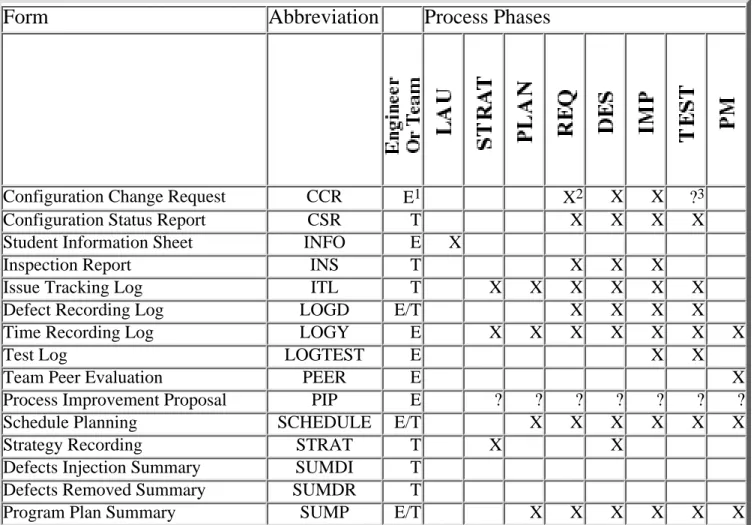
Table 7.1. Phases when TSPi Forms Should Be Completed
Form Abbreviation Process Phases
Configuration Change Request CCR E1 X2 X X ?3
Configuration Status Report CSR T X X X X
Student Information Sheet INFO E X
Inspection Report INS T X X X
Issue Tracking Log ITL T X X X X X X
Defect Recording Log LOGD E/T X X X X
Time Recording Log LOGY E X X X X X X X
Test Log LOGTEST E X X
Team Peer Evaluation PEER E X
Process Improvement Proposal PIP E ? ? ? ? ? ? ?
Schedule Planning SCHEDULE E/T X X X X X X
Strategy Recording STRAT T X X
Defects Injection Summary SUMDI T
Defects Removed Summary SUMDR T
Program Plan Summary SUMP E/T X X X X X X
Quality Plan SUMQ E/T X X X X X X
Size Summary SUMS E/T X X X X X X
Time Summary SUMT T
Task Summary SUMTASK E
Task Planning TASK E/T X X X X X X
Weekly Status WEEK E/T X X X X X X
Note 1: E means the form is completed with data for a single engineer, T means the form has data for the team, and E/T means the form is used for both engineer and team data.
Note 2: The X means that these forms should be completed in that phase and be available in the team's project notebook the next week.
Note 3: The ? means that these forms may or may not be completed in these phases.
Special Issues or Problems
If the team leaders have any special issues or concerns, they should cover them during their reports. If many team leaders have the same issue, however, you may wish to hold a more general discussion of the issue after all the team-leader reports.
Topics for the Next Weekly Meetin
At this point, use Table 7.1 to identify the forms you wish to review in the next weekly meeting. Also, tell the team leaders what you intend to ask about on each form so that they can be prepared. The key is for the team leaders to know that you will look at the team's data and that you will ask detailed questions about the data. If they are prepared, the reviews will take very little time. The items to review for each form are described in more detail in Chapter 9.
Summary of Action Items
At the close of the meeting, summarize the action items from the meeting. Do not rehash the issues; just summarize what the action item is, who will handle it, and when. Then have the meeting recorder note these items for the meeting report. Add any other significant items and provide copies of the report to all the attendees. The report should be brief and cover only the outstanding items, important decisions, and any key facts or data. Also, if there are more than a few action items, consider using the ITL form and an ITL tracking system to track them.
<- 7.2 7.3 7.4 ->
Contents List of Forms Tool Instructions
Copyright 2000 Addison Wesley Longman, Inc. All rights reserved
7.4. The First Weekly Meeting
You will hold the first team-leader meeting during team selection. Then, depending on the time taken by the PSP revie