Comparative Analysis of HAProxy& Nginx in Round Robin
Algorithm to Deal with Multiple Web Request
Raka Yusuf*, Rizza Syah Pasha Ulin Nuha**
*(Mercubuana University, Faculty of Computer Science, South Meruya St 1 No. 1 Kembangan, 11650, Indonesia) ** (Mercubuana University, Faculty of Computer Science, South Meruya St 1 No. 1 Kembangan, 11650, Indonesia)
---
************************
---Abstract:
Web based service providers like Google, have a large number of transactions every day. By using one web server, certainlyall ofthe transactions cannot be handled by it alone because of the excess user demand. Therefore we need a technology for distribution system and load balancing to minimize system failure. Load balancing server accepts request from each user then distributes to each of the back-end server. The purpose of this study is to verify software-based load balancing that runs on virtualization technology docker can run with its full capacity by distributing the load to each back-end server.
Keywords — Load Balancing, HAproxy, Nginx, Virtualization, Docker
---
************************
---I. INTRODUCTION
With the rapid development in the world of technology and increase number in users, one server node can be accessed by many users simultaneously. The result of these conditions increases the load on the server node, because one server node cannot handle a large number of users request which can causeasystem failure.Therefore a solution is needed to handle simultaneous users request using cluster technology on the web server. With the existence of a web server cluster, user requests are divided based on the load on the server node located on the back-end cluster. The use of servers with distributed systems requires a method to provide load evenly on each server. Various studies have been conducted to regulate the division of workload on clustering servers in order to optimize system performance by applying load balancing methods. The application of load balancing technology in dividing the load on the server plays an important role in a system that has a heavy load on a daily basis, so that it can increase scalability on distributed systems. Other than
requiringload balancing in a cluster system to divide the load, the load balancing also plays an important role in optimizing resource utilization, maximizing throughput, reducing latency and ensuring system failure tolerance.
II.RELATEDRESEARCH
The main use of working with load balancing is to divide the load on each request to the back-end server according algorithm used.Factors that influence the load balancing performance are the resources used in each back-end server such as CPU, RAM and the load of each user request.
Apache Performance Tuning, 2013 states performance of web server is mostly dependent to the memory. The higher the memory, the throughput will be goodon the web server and on the contrary the lower the memory, the overall throughput will be poor on the web server [1].
Research conducted by Sameer Tamrakar, Anand Singh andManoj Shakya, 2015, used exponential smoothing forecasting algorithm in HAProxy load balancer. The web server application used in this research is using apache and for the testingis using
apache jmeter. The results obtained from this test is memory plays an important role in determining engine performance, 2 nodes have 60% memory utilization and 1 node has 70% memory utilization [1].
Research conducted by Dongsheng Zhang, 2018, used software load balancer namely Nginx by applying multidimensional load balancing algorithm to distribute loads to 3 back-end web servers. The result obtained from the test ismultidimensional load balancing algorithm is 9 times faster when compared to default load balancing from nginx [2].
Research conducted by Sukarno and Nur Laila, 2018, used round robin algorithm in HAProxy. 3 nodes on web server and 1 database server run under Virtual Machine. Docker device hub then use to connect each node onthe web server. The resultsfrom the test that has been carried out using a round robin algorithm isHAProxy can divide the load into each server node alternately. Also, HAProxy can reduce overhead, service response time and decrease back end server resources [3].
Research conducted by EkoWidianto, 2018, used the least connection, round-robin and source algorithm are tested on HAProxy using 3 nodes of web server. The scenario used in this test sends high amount of transaction to HAProxy for each algorithm. The result is maximum load of each algorithm is 65connections per second. Source algorithm has poor throughput meanwhile least connection has the best throughput. Total number of connections that fail in source algorithm has the highest valued, round-robin and least connection algorithm can handle the load properly [4].
In this journal the writer will do the test using round-robin algorithm with different load balancer software such asHAProxy and Nginx. The difference in this journal with the previous literature is by using 2 software load balancers along with 3 web server nodes will be installed and configured above the docker virtualization.The expected output is 2 load balancer software can run optimally above docker virtualization by comparing response time, CPU and memory utilizationfor each load balancer software.
III. COMPARATIVEIMPLEMENTATION
A. Docker
Docker is an open source software under the Apache Version 2.0 license that can be used for free. It is avirtualization software that functions as a container that can hold a complete software along with its supporting components needed by the application. In virtualization technology in the machine level (Virtual Machine), Guest OS is generally needed where each server requires its own resources. Unlike Docker, applications that run on Docker virtualization use the same kernel so it canminimize the use of excessive resources such as CPU, memory, hard drive and network adapter.
B. HAProxy
HAProxy is a popular open source software used to handle TCP / HTTP request that can run on Operating Systems such asLinux, Solaris and freebsd. The cronjob which runs every few minutes is responsible for reading back-end information and updating configuration so that various request are transferred to member clusters if one of the nodes in the cluster fails. Generally this software is used to improve performance and reliability on servers by distributing workload to several servers (web, application and database).
C. Nginx
Nginx is an open source software that is generally used as a database server.Nginx can also act as a load balancer by distributing loads to the back-end server.
D. Apache Benchmark
Apache Benchmark (ab) is a tool commonly used to test the performance of HTTP servers for Linux devices. Ab’s way of working is to overrun with a large request towards the URL and retrieve data in the form of HTTP server performance results.
E. Scenario Testing
In this scenario test, installation and configuration will be performed in Docker as virtualization software and runs with the following hardware specifications:
Model Type Processor Memory OS
Dell Inspirion
7447 Core I7 8Gb
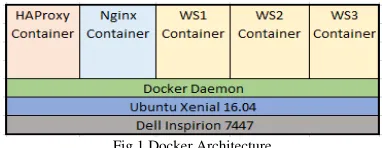
The reason behind using minimalist hardware in this testing is because in addition to doing a comparison of two load balancer software, the writer will also prove the docker resistance level if it runs on laptop hardware. The system architecture that will be used in this test can be seen in fig 1.
Fig 1 Docker Architecture
In this test, the writer will install and configure a web server running on the docker with a simple HTTP configuration. The parameters that will be used to compare2 load balancer software include CPU utilization, memory utilization, response time and the user success level that can be handled in the load balancer.
The test scenario in this journal can be seen in the below table:
Simulation LB
Software
Web
Server User Consistency
Scenario 1
HAProxy
Container 3container 9000 10
Nginx
Container 3container 9000 10
Scenario 2
HAProxy
Container 3container 18000 10
Nginx
Container 3container 18000 10
IV. COMPARISONRESULT
The results of testing with the first scenario, HAProxy and Nginx can distribute the load to each back-end server. In fig 2 by testing 9000 users, response time in Nginx has increased by 2ms with user request of 1100, meanwhile HAProxy has increased response time by 2ms with 4500 user requests.
Fig 2 Response Time Scenario 1
Average utilization CPU and memory in HAProxy for scenario 1 can be seen in fig 3. Average CPU in the amount of 42% meanwhile memory utilization in the amount of 36%.
Fig 3HAProxy Utilization Scenario 1
Average utilization CPU and memory in Nginx for scenario 1 can be seen in fig 4. Average CPU in the amount of 46% meanwhile memory utilization in the amount of 36%.
Fig 4 Nginx Utilization Scenario 1
were no failed transaction. Each user with 10 consistency level transaction in HAProxy can beprovided1.645ms response time, can be seen in fig 5.
Fig 5 HAProxy AB Scenario 1
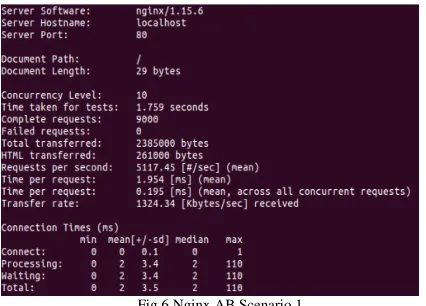
The results of testing using apache benchmark with a simulation of 9000 users on Nginx, there were no failed transaction. Each user with 10 consistency level transaction in Nginx can be provided 1.954ms response time, can be seen in fig 6.
Fig 6 Nginx AB Scenario 1
The results of testing with the second scenario, HAProxy and Nginx can distribute the load to each back-end server. In fig7 by testing 18000 users, response time in Nginx has increased by 2ms with user request of 2200, meanwhile HAProxy has increased response time by 2ms with 8400 user requests.
Fig 7 Reponse Time Scenario 2
Average utilization CPU and memory in HAProxy for scenario 2 can be seen in fig 8. Average CPU in the amount of 77% meanwhile memory utilization in the amount of 36%.
Fig 8 HAProxy Utilization Scenario 2
Average utilization cpu and memory in Nginx for scenario 2 can be seen in fig 9. Average cpu in the amount of 66% meanwhile memory utilization in the amount of 32%.
Fig 9 Nginx Utilization Scenario 2
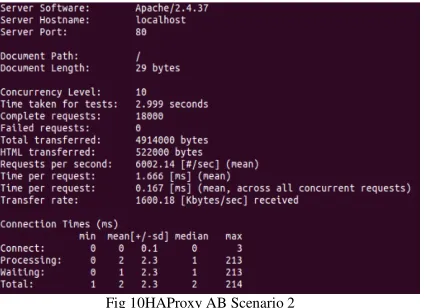
Fig 10HAProxy AB Scenario 2
The results of testing using apache benchmark with a simulation of 18000 users on Nginx, there were no failed transaction. Each user with 10 consistency level transaction in Nginx can be provided 1.873ms response time, can be seen in fig 11.
Fig 11 Nginx AB Scenario 2
V.CONCLUSION
From the results of testing conducted by the writer, for testing with a load of 9.000 users HAProxy has good results compared to Nginx. The average CPU obtained in scenario 1 is 42% and the response time obtained around 1.645ms for each user with 10 consistency level.
The second scenario test results conducted by the writer, for testing with a load of 18.000 users HAProxy gave good results compared to Nginx with response time 1.666ms for each user with 10 consistency level. But average cpu on HAProxy has increased to 77%.
There are no significant memory usage in each scenario, it provide around 36% memory
utilization.It means docker virtualization can handle properly using laptop device. In the future research based on this journal, can be developed using docker virtualization with kubernetes orchestrator and can use a different tool for benchmarking HTTP request to perform utilization in each back-end server.
Scenario 1 User Response
Time
Avg CPU
Avg Memory
Nginx 9000 1.954ms 46% 36%
HAProxy 9000 1.645ms 42% 36%
Scenario 1 User Response
Time
Avg CPU
Avg Memory
Nginx 18000 1.873ms 66% 32%
HAProxy 18000 1.666ms 77% 36%
REFERENCES
[1] M. Shakya and A. Singh, “Load Balancing for High Traffic Web Server in Cloud,” no. December, 2015.
[2] D. Zhang, “Resilience Enhancement of Container-based Cloud Load Balancing,” pp. 0–5, 2018.
[3] N. L. Meilani, “Design and Implementation of Load Balancing Technology on Linux-Based Servers,” 2018.
[4] A. B. Prasetijo, E. D. Widianto, and E. T. Hidayatullah, “Performance comparisons of web server load balancing algorithms on HAProxy and Heartbeat,” Proc. - 2016 3rd Int. Conf. Inf. Technol. Comput. Electr. Eng. ICITACEE 2016, no. January 2016, pp. 393–396, 2017.
[5] M. Mesbahi and A. Masoud Rahmani, “Load Balancing in Cloud Computing: A State of the Art Survey,” Int. J. Mod. Educ. Comput. Sci., vol. 8, no. 3, pp. 64–78, 2016.
[6] P. Patel, “Ananta : Cloud Scale Load Balancing Windows Azure - Some Stats,” pp. 207–218.
[7] A. Ashraf, B. Byholm, and I. Porres, “Prediction-based VM provisioning and admission control for multi-tier web applications,” J. Cloud Comput., vol. 5, no. 1, 2016.
[8] R. Trivedi, M. Karamta, P. Scientist, and H. Upadhyay, “An Autonomous Approach for High Availability and Fault Tolerance using Effective Monitoring in Cloud Data,” vol. 7, no. 02, pp. 53–57, 2018.
[9] J. E. C. De La Cruz and I. C. A. R. Goyzueta, “Design of a high availability system with HAProxy and domain name service for web services,” in Proceedings of the 2017 IEEE 24th International Congress on Electronics, Electrical Engineering and Computing, INTERCON 2017, 2017.
[10] J. Sahni and D. P. Vidyarthi, “Heterogeneity-aware adaptive auto-scaling heuristic for improved QoS and resource usage in cloud environments,” Computing, vol. 99, no. 4, pp. 351–381, 2017.
[11] S. Saeid and T. Ali Yahiya, “Load Balancing Evaluation Tools for a Private Cloud: A Comparative Study,” ARO-The Sci. J. Koya Univ., vol. 6, no. 2, pp. 13–19, 2018.