Intuitionistic Fuzzy Multi–Objective
Structural Optimization using Non-linear
Membership Functions
Samir Dey
Department of Mathematics, Asansol Engineering College Vivekananda Sarani, Asansol-713305, West Bengal, India.
Abstract
In this paper, we develop an intuitionistic fuzzy optimization approach using non-linear membership and non-membership function for optimizing multi objective structural model. In this optimum design formulation, the objective functions are the weight of the truss and the deflection of loaded joint; the design variables are the cross-sections of the truss members; the constraints are the stresses in members. A classical truss optimization example is given to demonstrate the efficiency of the Intuitionistic fuzzy optimization approach with non-linear membership function. A three-bar planar truss subjected to a single load condition is considered as a test problem. Numerical example is given to illustrate our approach.
Keywords - Structural Design, Intuitionistic fuzzy optimization, Non-linear membership and non-membership function.
I. INTRODUCTION
In the context of structural design the uncertainty is connected with lack of accurate data of design factors. This problem has been solving by use of fuzzy mathematical algorithm for dealing with this class of problems. However the problem may be an optimization problem where one or more constraints are simultaneously satisfied subject to the minimization of the weight function. Again sometimes it does not hold good in real world problems where multiple and conflicting objectives frequently exist. The accomplishment of this task is due to the methodology known as multi-objective structural optimization (MOSO). The MOSO is gaining importance especially in the last decade due to the increasing technological demand of structural optimization.
Bellman[14] and Zadeh [11] incorporate the fuzzy set theory to the decision making problem. The fuzzy set theory also found application in Structural design. Several researchers like Huang et.al [6], Wang et al. [16], Rao [13] ,Yeh et al. [18], Xu [17], Shih et.al [4], Dey et. al [5] ,have distinctive contribution to fuzzy set theory as well as fuzzy optimization.
Atanassov[3,8-10] introduced Intuitionistic fuzzy set (IFS) which is one of the generalizations of fuzzy set theory characterized by a membership function, a non-membership function and a hesitancy function. In fuzzy sets the degree of acceptance is only considered but IFS is characterized by a membership function and a non-membership function so that the sum of both values is less than one. The concept of membership and non-membership was first considered by Angelov[1] in optimization problem and gave intuitionistic fuzzy approach to solve this. Luo.et al. [19] applied the inclusion degree of intuitionistic fuzzy set to multi criteria decision making problem. Pramanik et al.[12] solved a vector optimization problem using an intuitionistic fuzzy goal programming. A transportation model was solved by Jana et al.[7] using multi-objective intuitionistic fuzzy linear programming. Dey et al. [15] use Intuitionistic fuzzy optimization technique to optimize non-linear single objective two bar truss structural model.
In this paper, a well-known three bar truss design model is considered as a Structural design model. The results are compared numerically with both in fuzzyoptimization technique and intuitionistic fuzzy optimization techniquefor non-linear membership function. From our numerical result, it is clear that intuitionistic fuzzy optimization provides better results than fuzzy optimization.
The motivation of the present study is to give computational algorithm for solving multi-objective nonlinearprogramming problem by Intuitionistic fuzzy optimization approach and the impact of various type of membership functions in computation of Intuitionistic fuzzy optimization and thus made comparative study of linear and nonlinear membership.
optimization Problem by fuzzy and intuitionistic fuzzy optimization technique. In section VI, we discuss about numerical solution of structural model of three bar truss and compared results by Intuitionistic Fuzzy Non-linear programming (IFNLP) technique and by fuzzy non-linear programming (FNLP) technique. Finally we draw conclusions from the results in section VII.
II. MULTI-OBJECTIVESTRUCTURAL
MODEL
In the design problem of the structure i.e lightest weight of the structure and minimum deflection of the loaded joint that satisfies all stress constraints in members of the structure .In truss structure system,the basic parameters (including allowable stress etc.) are known and the optimization’s target is that identify the optimal bar truss cross-section area so that the structure is of the smallest total weight with minimum nodes displacement in a given load conditions .
The multi-objective structural model can be expressed as
Minimize WT A (1)
Minimize A
subject to A
min max
A A A
Where 1, 2,...,
T n
A A A A are the design variables for the cross section, n is the group number of design
variables for the cross section
bar ,
1
n i i i i
WT A A L
is the total weight of thestructure ,
A is the deflection of the loaded joint ,where L Ai, iand iare the bar length ,crosssection area and density of the ith group bars respectively.
A is the stress constraint and
is allowable stress of the group bars under various conditions, Aminand Amax are the lower and upper bounds of cross section area A respectively.III. MATHEMATICALPRELIMINARIES
A. Fuzzy Set
The entire Let X denotes a universal set. Then the fuzzy subset Ain Xis a subset of order
pairs
,
:
A
A x x xX where
: 0,1
A X
is called the membership function
which assigns a real number A
x in the interval
0,1 to each elementxX .A
is non fuzzy and
A x
is identical to the characteristic function of crisp set. It is clear that the range of membership function is a subset of non-negative real numbers.
B.
Level set or
Cut of a Fuzzy SetThe level set of a fuzzy set Aof X is a crisp set A which contains all the elements of X that have membership values greater than or
equal to i.eA
x:A
x ,xX,
0,1
.C. Intuitionistic Fuzzy Set
Let X
x x1, 2,...,xn
be a finite universalset. An intuitionistic fuzzy set (IFS) set Ai in the sense of Attanassove [14] is given by equation
, i , i
i
i
A A
A X x x x X where the
function
:
0,1i i A x X
; xi X Ai
xi
0,1 and
:
0,1i i A x X
;
x
i
X
Ai
x
i
0,1
. define the degree of membership and degree of non-membership of an element xiX to the seti
A X ,such that they satisfy the condition
0Ai xi Ai xi 1 , xiX . For each
IFS Ai in X the amount
1
i i i
i i
i
A x A x A x
is called the
degree of uncertainty (or hesitation) associated with the membership of elements
x
i
X
inA
iwe call it intuitionistic fuzzy index of Ai with respect of an element.D.
,
Level Intervals or
,
cutsA set of
,
cut, generated by an IFSi
A where
,
0,1 are fixed number such that 1 is defined as
,
, , /
, , , 0,1
i i
i i
i A A
A A
x x x x X
A
x x
.We
define
,
level or
,
cut ,denoted by ,i
A ,as the crisp set of elements x which belong to
i
A at least to the degree and which belong to
i
A at most to the degree .
IV. MATHEMATICALANALYSIS
A. Fuzzy Non-linear Programming (FNLP)
Technique to Solve Multi-objective non-linear Programming Problem Document
A multi-objective non-linear programming (MONLP) Problem may be taken in the following form
1 , 2 ,...,
T p
Minimize f x f x f x (2)
Subject to gj
x bj; j1, 2,...,m0
Following Zimmermann [4] ,we have presented a solution algorithm to solve the MONLP Problem by fuzzy optimization technique.
Step-1: Solve the MONLP (2) as a single objective non-linear programming problem pth by taking one of the objective at a time and ignoring the others .These solutions areknown as ideal solutions. Let
i
x be the respective optimal solution for the
th
i different objectives with same constraints and
evaluate each objective values for all these ithoptimal solutions.
Step-2:From the result of step -1 determine the corresponding values for every objective for each derived solutions.With the values of all objectives at each ideal solutions ,pay-off matrix can be formulated as follows
1 2
* 1 * 1 * 1
1 1 2
* 2 * 2 * 2
2
1 2
* * *
1 2
...
...
...
... ... ... ...
...
p
p
p
p p p p
p
f x f x f x
f x f x f x
x
f x f x f x
x
x f x f x f x
Here x x1, 2,...,xp are the ideal solution of the objectives f1
x ,f2 x ,...,fp
x respectively.Step-3:From the result of step-2,now we find lower bound (minimum) Li and upper bound (maximum)
i
U by using the following rule
max , min
i i p i i p
U f x L f x where
1 i p.It is obvious Li fi*
xi , 1 i p. Step-4:Using aspiration level of each objective, the MONLP (2)maybe written as followsFind xso as to satisfy (3)
1, 2,...,
i i
f x L i p
; 1, 2,...,j j
g x b j m
0
x
Here objective function of (2) are consider as fuzzy constraints. This type of fuzzy constraint can be quantified by eliciting a corresponding membership function i
fi
x
,i1, 2,...,p
1
1 0
ACC
i i
ACC ACC
i i
ACC
i i
f x L
w
U L w
ACC ACC
i i w i i i
ACC
i i
if f x L
e e
f x if L f x U
e
if f x U
Under the concept of mean operator, the feasible solution set is defined by intersection of the fuzzy objective set .The feasible set is then characterized by its membership D
x which is
min
1
1
, 2
2
,...,
D x f x f x p fp x
(4) The decision solution can be obtained by solving the problem of maximizeD
x subject to the givenconstraints i.e
0 i
Maximize Minimize x
x i
(5)
,j j
such that g x b
0, 1, 2,..., , 1, 2,...,
x j m i p
Now if suppose Minimizei
x be the overallsatisfactory level of compromise, then we obtain the following equivalent model
Maximize (6)
, 1, 2,...,i
such that x i p
, 1, 2,...,j j
g x b j m
0, 0,1
x
Step-5: Solve (7) to get optimal solution.
B. An Intuitionistic Fuzzy Approach for Solving
Multi-Objective Non-Linear Programming
Problem with linear membership and Non-linear Non-membeship Function
Following Zimmermann [20] and Angelov [2],we have presented a solution algorithm to solve MONLP (2) by Intuitionistic fuzzy optimization (IFO). Here Step 1 and Step 2 are same as shown in (IV.A)
Step-3:From the result of step 2 now we find lower bound (minimum) LiACC and upper bound
(maximum) UiACC by using following rule
max , min
ACC p ACC p
i i i i
U f x L f x where
1 i p.But in IFO The degree of non-membership (rejection) and the degree of membership (acceptance) are considered so that the sum of both value is less than one. To define the non-membership of NLP problem let UiRej and LRei j be the upper bound and lower bound of objective function fi
xwhere LiACCLiRej UiRej UiACC.
For objective function of minimization problem ,the upper bound for non-membership function (rejection) is always equals to that the upper bound of membership function (acceptance).One can take lower bound for non-membership function as followsLRei j LAcci iwhere
0i UiAccLAcci based on the decision maker
choice.
so as to satisfy fi
x i LAcci with tolerance
Acc Acc Acc
i i i
P U L for the degree of acceptance
for i=1,2,…,p.
i Reji i
f x U with tolerance
Acc Acc Acc
i i i
P U L for degree of rejection for
1, 2,...,
i p.Define the membership (acceptance) and non-membership (rejection) functions of above uncertain objectives as follows. For the
, 1, 2,...,
th
i i p objectives functions the linear membership function i
fi
x
and linearnon-membership i
fi
x
is defined as follows
11 0
Acc
i i
Acc Acc
i i
Acc
i i
f x L w
U L w
Acc Acc
i i w i i i
Acc i i
if f x L
e e
f x if L f x U
e
if f U
Re2 Re
Re Re
Re Re
Re 0
1
j
i i
j
i i j j
i i j j i i i
i i
j
i i
if f x L
f x L
f x if L f x U
U L
if f x U
Step-4:Now an Intuitionistic fuzzy optimization for above problem with membership and non-membership function can be written as
i i
Maximizef x
i
(7)
i i
Minimizef x
i
1i i i i
subject to f x f x
i f xi
i
f xi
;
i f xi
0;
0;j
g x
0 x
1, 2,..., ; 1, 2,...,
i p j m
Find an equivalent crisp model by using membership and non-membership functions of objectives by IF as follows
1, 2,.., p
1, 2,..., p
Max Min Min Max
1i i i i
subject to f x f x
(8)
i f xi
i
f xi
;
i f xi
0;
0;j
g x
0 x
1, 2,..., ; 1, 2,...,
i p j m
If we consider
1, 2,..., p
; Minimize
1, 2,..., p
Maximize accordingly the Angelov
[15], the above can be written as
Maximize
(9)
;i i
subject to f x
0;j
g x
0, 1
x
0,1 ,
0,1 ; i 1, 2,...,p
1, 2,...,
j m
which on substitution of
1, 2,...,i fi x and i fi x for i p
becomes
( )
Maximize (10) subject to
ln 1
;Acc Acc
w w Acc
i i
i i
U L
f x e e L
w
Re Re
Re;
j j j
i i i i
f x U L L
0;j
g x
1;
0,1 ,
0,1
1, 2,..., ; 1, 2,...,
i p j m
Step-5:Solve the above crisp model (11) by using appropriate mathematical programming algorithm to get optimal solution of objective function.
Step-6:Stop.
V. SOLUTIONOFMULTI-OBJECTIVE
STRUCTURALOPTIMIZATIONPROBLEM
BYFUZZYANDINTUITIONISTICFUZZY
OPTIMIZATIONTECHNIQUE
To solve the MOSOP (1) step 1 of IV is used. After that according to step 2 pay-off matrix is formulated
* 1 1
1
2 2 * 2
WT A A
WT A A
A
A WT A A
In next step following step 2 we calculate the bound of the objective 1 , 1
Acc Acc
U L and U1Rej,L1Rejfor weight
function WT A
,suchthat 1
1Acc Acc
L WT A U and Re2
2Rej j
L WT A U
and 2 , 2
Acc Acc
U L ;U2Rej,LRe2 jfor deflection
A ,suchthat 2
2Acc Acc
L WT A U andLRe2 j
A U2Rejwith the condition
Re ;
Acc j
i i
U U LRei j LiAcci for i1, 2 so as
According to IFO technique considering membership and non-membership function for MOSOP (1)
1 1 0 Acc WT Acc Acc WT WT Acc WTWT A L
w
U L w
Acc Acc
WT WT
WT A w
Acc WT
if WT A L
e e
WT A if L WT A U
e
if WT A U
Re 2 Re Re Re Re Re Re 0 1 j WT jWT j j
WT WT
WT A j j
WT WT
j WT
if WT A L WT A L
WT A if L WT A U
U L
if WT A U
And
1 1 0 Acc Acc Acc Acc A L wU L w
Acc Acc
A w
Acc
if A L
e e
A if L A U
e
if A U
Re 2 Re Re Re Re Re Re 0 1 j j j jA j j
j
if A L
A L
A if L A U
U L
if A U
crisp non-linear programming problem is formulated as follows
, , WT WTMax Min WT A A
Min Max WT A A
(11)
subject to
1;WT WT A WT WT A
A
A
1;
;WT WT A WT WT A
A
A
;
0,
0;WT WT A WT WT A
A
0,
A
0;
A ;A 0
According to Angelov [2] the above problem can be written as
Maximize
(12)
subject to
;WT WT A
WT
WT A
;
A
;
A
;
A , 1;
0, 0,1 , 0,1
A
Solve the above crisp model (13) by an appropriate mathematical programming algorithm to get optimal
solution and hence objective function i.e structural weight and deflection of loaded joint will get the Pareto optimal solution.
VI. NUMERICALILLUSTRATION A well-known three bar planer truss is considered is to minimize weight WT A A
1, 2
of thestructure and minimize the deflection
A A1, 2
at a loading point of a statistically loaded three bar planer truss subject to stress constraints on each of the truss membersFig.1. Design of Three Bar Planer Truss
The multi-objective optimization problem can be stated as follows
1, 2
2 2 1 2
Minimize WT A A L A A (13)
1 2 1 2 , 2 PL Minimize A AE A A
1 2
1 1 2 2 1
1 1 2
2
, ;
2 2
T
P A A
subject to A A
A A A
2 1 2 2
1 2 , ; 2 T P A A A A
2
3 1 2 2 3
1 1 2
, ;
2 2
C
PA A A
A A A
min max
1, 2
i i i
A A A i
where P applied load ; material
density ; L length ; E Young’s
modulus ; A1 Cross section of 1 and bar-3; A2 Cross section of bar-2;
is deflection of loaded joint. 1Tand2Tare maximum allowabletensile stress for bar 1 and bar 2 respectively, 3
C
is maximum allowable compressive stress for bar 3. Solution: According to step 2 pay-off matrix is formulated as follows
1 2
1 2
1
2
, ,
2.638958 14.64102
19.14214 1.656854
WT A A A A
Here
1 1
19.14214, 2.638958 ;
WT WT WT WT
U U L L
Such that 01
19.14214 2.638958
;2 2
14.64102, 1.656854 ;
U U L L
such that 02
14.64102 1.656854
.Here truth, indeterminacy, and falsity membership function for objective functions are
1 2
, 1 2
WT A A A A are defined as follows
1 2
1 2
, 2.638958
16.503182
1 2 1 2
1 2
1 , 2.638958
, 2.638958 , 19.14214
1
0 , 19.14214
WT A A w
w
WT w
if WT A A
e e
WT A A if WT A A
e
if WT A A
1 2 1
2
1 2 1
1 2 1 1 2
1
1 2
0 , 2.638958
, (2.638958 )
, 2.638958 , 19.14214
16.503182
1 , 19.14214
WT
if WT A A
WT A A
WT A A if WT A A
if WT A A
1 2
1 2
, 3.638958
11.002062
1 2 1 2
1 2
1 , 3.638958
, 3.638958 , 14.64102
1
0 , 14.64102
A A w
w
w
if A A
e e
A A if A A
e
if A A
1 2 2
2
1 2 2
1 2 2 1 2
2
1 2
0 , 3.638958
, (3.638958 )
, 3.638958 , 14.64102
11.002062
1 , 14.64102
if A A
A A
A A if A A
if A A
Now using IFO technique with membership and non-membership functions we get
Maximize (14)
1 2
16.503182
2 2 ln w 1 w 2.638958;
subject to
A A e e
w
2 1
20 11.002062
ln 1 3.638958;
2
w w
e e
w
A A
1 2 1 1
(2 2AA) 16.503182 2.638958 ;
2
2
2 1
20
11.002062 3.638958 ;
2A A
2 1 2
1 1 2
20 2
20;
2 2
A A
A A A
1 2
2020; 2
A A
2 2
1 1 2
20
15;
2 2
A
A A A
0,1 ,
0,1 ;
1 2
2; 0.1 , 5;
w A A
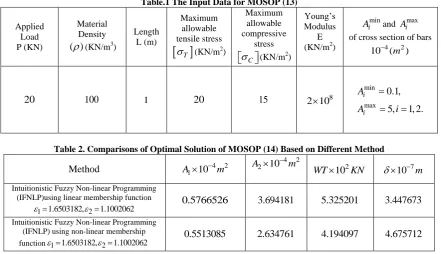
The Pareto optimal solution of MOSOP (14) using fuzzy and Intuitionistic fuzzy multi objective non-linear programming technique is given in table 2. Here we get best solution for different tolerance
1
and
2 for non linear membership and non-membership function of IFO method. From Table-2 it shows that Non-linear IFO gives better result.Table.1 The Input Data for MOSOP (13)
Applied Load P (KN)
Material Density ( ) (KN/m3)
Length L (m)
Maximum allowable tensile stress
T (KN/m2 )
Maximum allowable compressive
stress
C
(KN/m2)
Young’s Modulus
E (KN/m2)
min
i
A and Aimax
of cross section of bars 4 2
10 (m )
20 100 1 20 15 8
2 10
min
max 0.1,
5, 1, 2.
i
i
A
A i
Table 2. Comparisons of Optimal Solution of MOSOP (14) Based on Different Method
Method A1 10 4m2
A2 10 4m2
2
10
WT KN 107m
Intuitionistic Fuzzy Non-linear Programming (IFNLP)using linear membership function
1 1.6503182, 2 1.1002062
0.5766526 3.694181 5.325201 3.447673
Intuitionistic Fuzzy Non-linear Programming (IFNLP) using non-linear membership function 1 1.6503182,21.1002062
VII. CONCLUSIONS
In view of comparing the intuitionistic fuzzy optimization with fuzzy optimization method for membership and non-membership we also obtained the solution of the undertaken numerical problem by fuzzy optimization method given by Zimmermann and intuitionistic fuzzy optimization method given by Angelov. The main objective of this work is to illustrate the impact of nonlinear membership and non-membership of IFO technique in utilization of nonlinear structural problem . Here we have considered a non-linear three bar truss design problem .In this problem, we find out optimum weight of the structure in presence of optimum deflection of loaded joint. The comparison of results obtained for the undertaken problem clearly show the difference between the linear and non-linearintuitionistic fuzzy optimization in perspective of structural design. The results of this study may lead to the development of effective non linear IFO i.e (NLIFO) technique solving other nonlinear model in different field.
ACKNOWLEDGMENT
Authors would like to thank referees for their helpful comments.
REFERENCES
[1] P.P.Angelov, Intuitionistic fuzzy optimization. Notes on Intutionistic Fuzzy Sets 1 (2), 123–129, 1995.
[2] P.P.Angelov,Optimization in intuitionistic fuzzy environment. Fuzzy Sets and Systems 86, 299–306, 1997.. [3] K.Attanassov and P.Das,“Interval valued intuitionistic fuzzy
sets” Fuzzy set and systems,31,343-349,(1989).
[4] C.J.Shih. and C.J.Chang., Mixed-discrete nonlinear fuzzy optimization for multi-objective engineering design. AIAA-94-1598-CP, pp. 2240-2246, 1994.
[5] S.Dey and T.K.Roy, “Optimized solution of two bar truss design using intuitionistic fuzzy optimization technique” ,
International Journal of Information Engineering and Electronic Business,2014(3), 45-51,2014.
[6] H.Z.Huang, P.Wang, M.J.Zuo, W.Wu and C.Liu, “A fuzzy set based solution method for multi-objective optimal design problem of mechanical and structural systems using functional-link net, Neural Comput & Applic (2006) 15: 239–244.
[7] B.Jana and T.K. Roy, Multi-objective intuitionistic fuzzy linear programming and its application in transportation model. Notes on Intuitionistic Fuzzy Sets, 13 (1), 34–51, 2007.
[8] K.Atanassov, “Intuitionistic fuzzy sets,” Fuzzy sets and Systems, 20,87-96, 1986.
[9] K.Atanassov, “Idea for intuitionistic fuzzy sets equation, in equation and optimization,” Notes on Intuitionistic Fuzzy Sets, 1, 17-24, 1995.
[10] K.Atanassov, “Two theorems for Intuitionistic fuzzy sets,” Fuzzy Sets and Systems, 110,267-269, 2000.
[11] L.A.Zadeh, Fuzzy set, Information and Control, vol.8, no.3, pp.338-353, 1965.
[12] S.Pramanik and T.K.Roy, An intuitionistic fuzzy goal programming approach to vector optimization problem. Notes on Intutionistic Fuzzy Sets 11 (1), 1–14,2004. [13] S.S.Rao, “ Description and optimum Design of Fuzzy
Mathematical Systems”, Journal of Mechanisms, Transmissions, and Automation in Design, Vol.109,pp.126-132,1987.
[14] R.E.Bellman and L.A.Zadeh, Decision-making in a fuzzy environment, Management Science, 17(4), B141-B164, 1970.
[15] S.Dey and T.K.Roy, Multi-objective structural optimization using fuzzy and intuitionistic fuzzy otimization technique, I.J. Intelligent systems and applications ,05,57-65,2015. [16] G.Y.Wang and W.Q.Wang,“ Fuzzy optimum design of
structure.” Engineering Optimization, 8,291-300,1985. [17] C.Xu,“Fuzzy optimization of structures by the two-phase
method”,Computer and Structure, 31(4),575–580,1989. [18] Y.C.Yeh and D.S.Hsu, “Structural optimization with fuzzy
parameters”.Computer and Structure, 37(6), 917–24, (1990). [19] Y.Luo and C.Yu, “ An fuzzy optimization method for multi criteria decision making problem based on the inclution degrees of intuitionistic fuzzy set,” Journal of Information and Computing Science, 3(2),146-152,2008.