R E S E A R C H
Open Access
Array-based comparative genomic hybridization
for genomic-wide screening of DNA copy number
alterations in aggressive bone tumors
Masahiko Kanamori
1,2*, Akimi Sano
2, Taketoshi Yasuda
2, Takeshi Hori
2and Kayo Suzuki
2Abstract
Background:The genetic pathways of aggressive changes of bone tumors are still poorly understood. It is very important to analyze DNA copy number alterations (DCNAs), to identify the molecular events in the step of progression to the aggressive change of bone tissue.
Methods:Genome-wide array-based comparative genomic hybridization (array CGH) was used to investigate DCNAs of 14 samples from 13 aggressive bone tumors, such as giant cell tumors (GCTs) and osteosarcoma (OS), etc.
Results:Primary aggressive bone tumors had copy number gains of 17.8±12.7% in the genome, and losses of 17.3 ±11.4% in 287 target clones (threshold for each DCNA:≦085, 1.15≦). Genetic unstable cases, which were defined by the total DCNAs aberration≧30%, were identified in 9 of 13 patients (3 of 7 GCTs and all malignant tumors). High-level amplification ofTGFβ2,CCND3,WI-6509,SHGC-5557,TCL1A,CREBBP,HIC1,THRA,AFM217YD10,LAMA3,RUNX1and
D22S543, were commonly observed in aggressive bone tumors. On the other hand,NRAS,D2S447,RAF1,ROBO1,MYB,
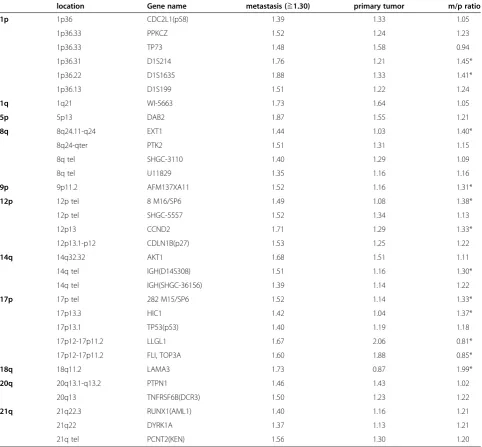
MOS,FGFR2,HRAS,D13S319,D13S327,D18S552,YES1andDCC, were commonly low. We compared genetic instability between a primary OS and its metastatic site in Case #13. Metastatic lesion showed increased 9 DCNAs of remarkable change (m/p ratio≧1.3 folds), compared to a primary lesion.D1S214, D1S1635, EXT1, AFM137XA11, 8 M16/SP6, CCND2, IGH, 282 M15/SP6, HIC1andLAMA3,were overexpressed. We gave attention toHIC1(17p13.3), which was common high amplification in this series.
Conclusion:Our results may provide several entry points for the identification of candidate genes associated with aggressive change of bone tumors. Especially, the locus 17p11-13 includingHIC1close top53was common high amplification in this series and review of the literature.
Keywords:Osteosarcoma, Giant cell tumor, Bone tumors, Microarray, Comparative genomic hybridization
Background
The development and progression of aggressive bone tumor is a multi-step process. The acquisition of chromo-somal abnormalities in tumor cells and a series of genetic alterations occurring over the life-time of the tumor are one of the central events in malignant transformation or aggressive change. Multiple studies have identified the prevalence and clinical significance of a various genetic markers in primary bone tumors [1,2]. However, the ge-netic pathways of aggressive changes of bone tumors are
still poorly understood. It is very important to analyze DNA copy number alterations (DCNAs), to identify the molecular events in the step of progression to the aggres-sive change of bone tissue.
Metaphase comparative genomic hybridization (meta-phase CGH) enabled us to detect DCNAs on whole chro-mosomes [3,4]. But the resolution of metaphase CGH is approximately 2 Mb for amplifications and 10−20 Mb for deletions. Advances in mapping resolution using array-based CGH (array CGH), have greatly improved resolving power in comparison to metaphase CGH, and provide more details regarding both the complexity and exact location of genomic rearrangements leading to DCNAs [5,6]. Thereafter, array CGH technologies for identifying * Correspondence:[email protected]
1Department of Human Science, University of Toyama, 2630 Sugitani,
Toyama city, Toyama 930-0194, Japan
2Department of Orthopaedic Surgery, University of Toyama, 2630 Sugitani,
Toyama city, Toyama 930-0194, Japan
target molecules developed to permit for the identification of genes involved in tumors [3,4].
In this study, we investigated DCNAs of human aggressive bone tumors using the technique of array CGH. The quantitative measurement of DCNAs across the genome may facilitate oncogene identification, and might also be used for tumor classification.
Materials and methods
Tumor tissue specimens and DNA extraction
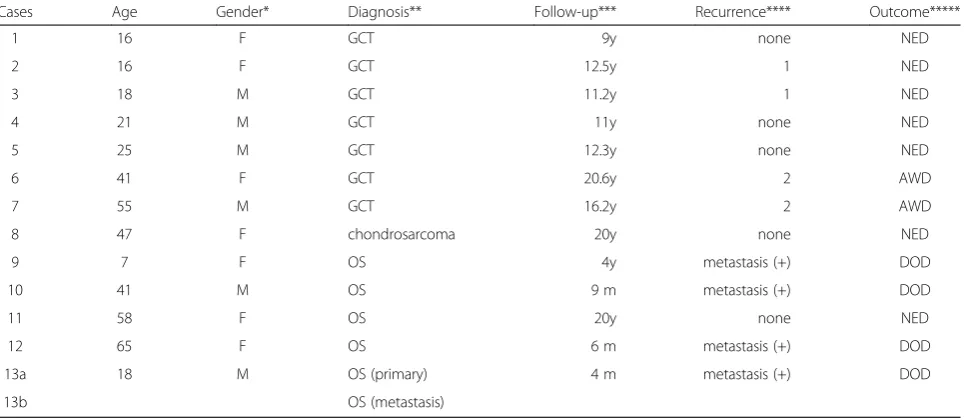
Fourteen bone tumor samples were collected from 13 patients with aggressive bone tumors and frozen until use. Samples from 7 giant cell tumors (GCTs), 5 osteo-sarcoma (OS) and 1 chondroosteo-sarcoma, were obtained from the surgical- or biopsied specimens at the Univer-sity Hospital of Toyama (Table 1). Patients consisted of 6 men and 7 women with an average age of 32.9 years old (range, 7–65 years). No cases had been received the chemotherapy before the sampling. This study protocol was approved by the Institutional Review Board for Human Use at the University Hospital of Toyama.
Tumor specimens were stored frozen at −80°C until use. Genomic DNA was isolated from the tumor accor-ding to standard procedures using proteinase K diges-tion and phenol-chloroform extracdiges-tion [7].
Hybridization and analysis of array CGH
Hybridization and analysis of array CGH were performed according to the manufacture’s protocols (Vysis-Abbott Japan Inc., Tokyo, JAPAN). The array CGH consisted of 287 clones containing important tumor suppressor and
oncogene loci. Each tumor DNA sample was labeled and hybridized to microarrays for CGH. One hundred nano-gram of tumor DNA was labeled by random priming with fluorolink cy3-dUTP (Perkin-Elmer Life Sciences, Inc., Boston, MA, USA), and normal reference DNA was labeled in the same fashion with cy5-dUTP. Then, the tumor and control DNAs were mixed with Cot-1 DNA (Vysis-Abbott Japan Inc), precipitated, and re-suspended in microarray hybridization buffer containing 50% forma-mide. The hybridization solution was heated to 80°C for 10 min to denature the DNA, and then was incubated for 1 h at 37°C. Hybridization was performed for 72 h in a moist chamber, followed by post-hybridization wash in 50% formamide/2xSSC at 45°C. Slides were mounted in phos-phate buffer containing 4', 6-diamidino- 2-phenylindole (array DAPI solution). Fluorescence intensity images were obtained from the hybridized microarray slides using GenoSensor Reader System equipped with Array 300 Soft-ware (Vysis-Abbott Japan Inc.) according to the manufac-ture’s instructions. The total intensity and the intensity ratio of the two dyes for each spot were automatically cal-culated [7,8].
Evaluation of array CGH
The diagnostic cut-off level representing gains and losses of DCNAs was set to 1.15 (upper threshold) and 0.85 (lower threshold), respectively [7,8]. The p value is the probability that the data value for an individual set of target spots is part of the normal distribution. All ratios were filtered bypvalues, and only those samples withp
Table 1 Clinicopathologic data on the samples in genomic array analysis
Cases Age Gender* Diagnosis** Follow-up*** Recurrence**** Outcome*****
1 16 F GCT 9y none NED
2 16 F GCT 12.5y 1 NED
3 18 M GCT 11.2y 1 NED
4 21 M GCT 11y none NED
5 25 M GCT 12.3y none NED
6 41 F GCT 20.6y 2 AWD
7 55 M GCT 16.2y 2 AWD
8 47 F chondrosarcoma 20y none NED
9 7 F OS 4y metastasis (+) DOD
10 41 M OS 9 m metastasis (+) DOD
11 58 F OS 20y none NED
12 65 F OS 6 m metastasis (+) DOD
13a 18 M OS (primary) 4 m metastasis (+) DOD
13b OS (metastasis)
*Gender; F: female, M: male.
**Diagnosis; GCT: giant cell tumor, OS: osteosarcoma. ***Follow-up; m: month, y: year.
values of 0.01 or less were displayed in the GenoSensor Reader System.
We defined the three grades by the genomic imbalances from the data of array CGH; genetically stable group (genetic aberration <5%), intermediate group (5%≦genetic aberration <30%), genetically unstable group (genetic aber-ration≧30%).
Statistical analysis
The results are expressed as the mean ± SD. We used independent sample t-test for continuous variables and chi square test for categorical variables in comparison. A p value less than 0.05 was considered significant. All statistics were calculated using StatMate III software (Atoms Co., Tokyo, Japan).
Results
Overall array CGH results in aggressive bone tumors
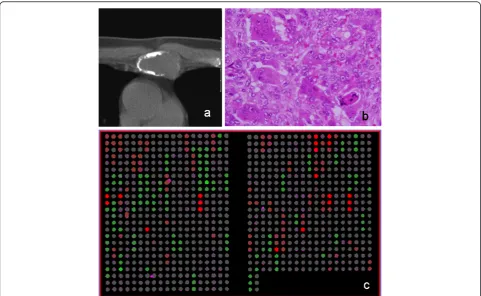
Figure 1 shows a representative case, and a microarray slide which was hybridized by array CGH technique. DCNAs of primary tumors showed 17.8±12.7% in gains, and 17.3±11.4% in losses of target 287 clones. The ave-rage of the proportion of total genetic instability reached the 38.6±22.8%. Genetic unstable cases which were defined by the total DCNAs aberration (≧30%) were
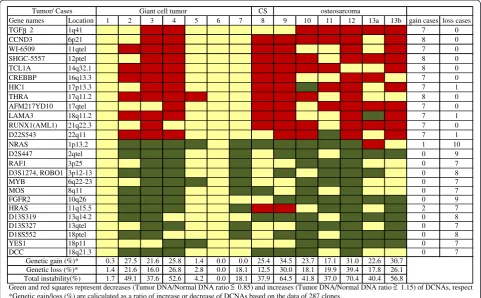
identified in 9 of 13 patients (3 of 7 GCTs and all malig-nant tumors). All maligmalig-nant cases were genetically clas-sified into the unstable group. We picked up major gene names, which showed many gain cases or loss cases. An overall array CGH results and gene names of common genetic instability are listed in Figure 2.
High-level amplification of TGFβ2 (1q41), CCND3 (6p21), WI-6509 (11qtel), SHGC-5557 (12ptel), TCL1A (14q32.1), CREBBP (16q13.3), HIC1 (17p13.3), THRA (17q11.2), AFM217YD10 (17qtel), LAMA3 (18q11.2),
RUNX1 (21q22.3) andD22S543(22q11), was commonly
observed in aggressive bone tumors. On the other hand, NRAS(1p13.2),D2S447(2qtel),ROBO1(3p12-13),RAF1 (3p25), MYB (6q22-23), MOS (8q11), FGFR2 (10q26), HRAS (11q11.5), D13S319 (13q14.2), D13S327 (13qtel), YES1 (18p11), D18S552 (18ptel) and DCC (18q21.3) were commonly low (Figure 2).
Clinical relevance in GCT
GCT is an aggressive bone tumor, but not malignant. Seven GCT series were divided into three groups: 3 cases were genetically unstable group, and 3 cases were stable group (Figure 3). One case (Case #7) belongs to the intermediate group. Histologically, however, we could not find the difference in each GCT case. The
mean clinical follow-up time of these GCT cases was 11.8 years. Tumor recurrence was observed in all cases of genetically unstable group. On the other hand, the re-currence rate of stable group was low (33.3%). However, there was no significance between two groups
(chi-square test; p= 0.083), because the sample size was small.
As many GCTs have some telomeric associations, we have given an attention to these areas. In analyzed 73 clones of telomeric area, losses of D2S447 (2qtel), and
CS
Gene names Location 1 2 3 4 5 6 7 8 9 10 11 12 13a 13b gain cases loss cases
TGFβ2 1q41 7 0
CCND3 6p21 8 0
WI-6509 11qtel 7 0
SHGC-5557 12ptel 8 0
TCL1A 14q32.1 8 0
CREBBP 16q13.3 7 0
HIC1 17p13.3 7 1
THRA 17q11.2 8 0
AFM217YD10 17qtel 7 0
LAMA3 18q11.2 7 1
RUNX1(AML1) 21q22.3 7 0
D22S543 22q11 7 1
NRAS 1p13.2 1 10
D2S447 2qtel 0 9
RAF1 3p25 0 7
D3S1274, ROBO1 3p12-13 0 8
MYB 6q22-23 0 7
MOS 8q11 0 7
FGFR2 10q26 0 9
HRAS 11q15.5 2 7
D13S319 13q14.2 0 8
D13S327 13qtel 0 7
D18S552 18ptel 0 8
YES1 18p11 0 7
DCC 18q21.3 0 7
0.3 27.5 21.6 25.8 1.4 0.0 0.0 25.4 34.5 23.7 17.1 31.0 22.6 30.7 1.4 21.6 16.0 26.8 2.8 0.0 18.1 12.5 30.0 18.1 19.9 39.4 17.8 26.1 1.7 49.1 37.6 52.6 4.2 0.0 18.1 37.9 64.5 41.8 37.0 70.4 40.4 56.8
Green and red squares represent decreases (Tumor DNA/Normal DNA ratio 0.85) and increases (Tumor DNA/Normal DNA ratio 1.15) of DCNAs, respecti *Genetic gain/loss (%) are caliculated as a ratio of increase or decrease of DCNAs based on the data of 287 clones.
CS: chondrosarcoma, Case #13a: primary tumor, #13b: metastatic tumor Total instability(%)
Genetic loss (%)* Genetic gain (%)*
Tumor/ Cases Giant cell tumor osteosarcoma
Figure 2Summary of DCNAs data detected by array CGH.
gain of WI-6509 (11qtel) and D19S238E (19qtel) were mainly observed.
Primary vs. Metastatic OS
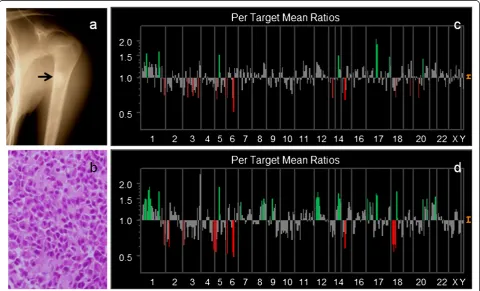
We compared the genetic instability of both primary OS and a metastatic lymph node in Case #13. Briefly, 18-year-old man presented with the left shoulder mass. Radiographs revealed an osteosclerotic lesion of the pro-ximal humerus (Figure 4a). A chest radiogram and CT scans showed multiple lung metastases. A small nodule was palpable in the axillary region. We biopsied bone tumor and removed a local swelling lymph node. Histo-logic examination of the both samples showed osteoblastic OS (Figure 4b). Chromosomal analysis by G-band showed 77–82 chromosomes with various complicated transloca-tion from the primary tumor.
In this case, array CGH resulted in 22.6% gain of DCNAs and 17.8% loss of primary tumor (genetic total in-stability; 40.4%). Chromosomal instabilities of primary tumor detected by array CGH, are figured out (Figure 4c). However, a metastatic lymph node showed the gain of 30.7%, and the loss of 26.1% of DCNAs (genetic total in-stability; 56.8%). Genetic aberrations of a metastatic lesion were clearly increased (Figure 4d). We picked up detected
DCNAs presenting with remarkable significant gains (≧1.30) or losses (≦0.85) in a metastatic sample compared to a primary sample (m/p ratio), and listed in Table 2. Thirty-one DCNAs of 287 clones were gained. Of these, 12 DCNAs also showed high level amplification in the pri-mary site.
It is important to assess the change of DCNAs between a metastatic tumor and a primary tumor. Nine DCNAs (m/p ratio≧1.30 folds) showed remarkable enhancement, compared to a primary lesion;D1S1635(1p36.22),D1S214 (1p36.31), EXT1 (8q24.11-q24), AFM137XA11 (9p11.2),
CCND2 (12p13), 8M16SP6 (12ptel), IGH (14qtel), HIC1
(17p13.3) and LAMA3 (18q11.2), 282 M15/SP6 (17ptel). On the other hand, loss of DCNAs (≦0.85) in a metastatic sample, was only LLGL1 (m/p ratio = 0.81) and FLI
(TOP3A) (m/p ratio = 0.85). Both of these genes are
encoded on the location of 17p11.2-17p12. These DCNAs showing remarkable enhancement or decreasing, may pro-vide several entry points for the identification of candidate genes associated with metastatic ability.
Discussion
Our present analysis indicated to 25 genes showing gen-etic instability, as target genes of aggressive bone tumors
(Figure 2). Especially, the loss of NRAS was mainly observed in 10 cases (76.9%) of 13. NRAS mutations have detected prostate cancers before [9]. However, there has been no report about the relationship between bone tumors andNRAS.
The incidence of aggressive changes of bone tissue is low. Similar to other solid tumors, malignant changes are characterized by high propensity for me-tastasis. Metaphase CGH studies have identified fre-quent gains and amplifications at 1p21-32, 1q21-24, 5p13, 6p12, 8q23-24, 8cen-q13, 17p11.2-13, 19q, and Xp21, and frequent losses at 6q16, 10p12-pter, and 10q22-q26 in OS [2,10-13]. Recent studies have also reported that amplification at 17p11.2-ptel has been
found in approximately 13-29% of high-grade OS [11,14,15].
In our data, the most remarkable change in metastatic tumor was occurred at increases (≧1.30) of D1S1635 (1p36.22), D1S214 (1p36.31), EXT1 (8q24.11-q24),
AFM137XA11 (9p11.2), CCND2 (12p13), 8 M16/SP6
(12ptel),IGH(D14S308),HIC1(17p13.3),282 M15/SP16 (17ptel), and LAMA3 (18q11.2). DCNAs of p53 (17p13.1) have also increased scarcely (1.19 → 1.40), which have been suggested as an OS-related gene. As Chen, et al. [16] suggested, HIC1 (hypermethylated in cancer-1 located at 17p13.3) was frequent with p53 mutations in human OS. Their results indicated the importance of genes altered only through epigenetic
Table 2 Genetic instability between primary and metastatic tumor at Case #13
location Gene name metastasis (≧1.30) primary tumor m/p ratio
1p 1p36 CDC2L1(p58) 1.39 1.33 1.05
1p36.33 PPKCZ 1.52 1.24 1.23
1p36.33 TP73 1.48 1.58 0.94
1p36.31 D1S214 1.76 1.21 1.45*
1p36.22 D1S1635 1.88 1.33 1.41*
1p36.13 D1S199 1.51 1.22 1.24
1q 1q21 WI-5663 1.73 1.64 1.05
5p 5p13 DAB2 1.87 1.55 1.21
8q 8q24.11-q24 EXT1 1.44 1.03 1.40*
8q24-qter PTK2 1.51 1.31 1.15
8q tel SHGC-3110 1.40 1.29 1.09
8q tel U11829 1.35 1.16 1.16
9p 9p11.2 AFM137XA11 1.52 1.16 1.31*
12p 12p tel 8 M16/SP6 1.49 1.08 1.38*
12p tel SHGC-5557 1.52 1.34 1.13
12p13 CCND2 1.71 1.29 1.33*
12p13.1-p12 CDLN1B(p27) 1.53 1.25 1.22
14q 14q32.32 AKT1 1.68 1.51 1.11
14q tel IGH(D14S308) 1.51 1.16 1.30*
14q tel IGH(SHGC-36156) 1.39 1.14 1.22
17p 17p tel 282 M15/SP6 1.52 1.14 1.33*
17p13.3 HIC1 1.42 1.04 1.37*
17p13.1 TP53(p53) 1.40 1.19 1.18
17p12-17p11.2 LLGL1 1.67 2.06 0.81*
17p12-17p11.2 FLI, TOP3A 1.60 1.88 0.85*
18q 18q11.2 LAMA3 1.73 0.87 1.99*
20q 20q13.1-q13.2 PTPN1 1.46 1.43 1.02
20q13 TNFRSF6B(DCR3) 1.50 1.23 1.22
21q 21q22.3 RUNX1(AML1) 1.40 1.16 1.21
21q22 DYRK1A 1.37 1.13 1.21
21q tel PCNT2(KEN) 1.56 1.30 1.20
mechanisms in cancer progression in conjunction with genetically modified tumor suppressor genes. In our study,HIC1was also higher in the metastatic lesion than the primary site (m/p ratio =1.37 in Table 2). Therefore, we gave attention to the locus of 17p13 includingHIC1 as a target gene.
Recent studies have reported that overexpression of 17p11-p12 have been linked p53 degradation [10,16-20]. In Case #13, the gain of LLGL1, FLI (TOP3A)at 17p11-p12 have also detected. However, these two DCNAs were decreased in a metastatic sample, compared with primary tumor, which might be important in the step of metastasis. These findings support that target genes close to p53 (17p13.1), may contribute to OS tumorige-nesis [17,18].
Thus, the present pilot study suggests that array CGH could powerful means to detect genetic instability and gene aberrations that are reflected to the progression and outcome of primary aggressive bone tumors. HIC1 is increased at the both step of aggressive change and metastatic process. HIC1 might play a role of bone tumor progression and metastasis. We should pay atten-tion the locus of 17p11-13 including HIC1, LLGL1, FLI
(TOP3A), as well as p53. Further detailed studies are
necessary to clarify genetic pathways of the aggressive bone tumors.
Conclusion
Our results may provide several entry points for the iden-tification of candidate genes associated with aggressive change of bone tumors. Especially, the locus 17p11-13 in-cluding HIC1 close to p53 was common high amplifica-tion in this series and review of the literature.
Competing interests
The authors declare that they have no competing interests.
Authors’contributions
MK participated in the data collection, performed the statistical analysis and drafted the manuscript.
AS, TY and TH made substantial contributions to the analysis and interpretation of data. KS helped to draft the manuscript. All authors read and approved the final manuscript.
Acknowledgements
This study was supported by grants from the he National Science Council of Japan (NSC 88-2314-B-075-096). The authors would like to thank Prof. Tomoatsu Kimura and Dr. Shigeharu Nogami, Department of Orthopaedics, University of Toyama, who provided clinical advices.
Received: 2 May 2012 Accepted: 25 June 2012 Published: 30 November 2012
References
1. Boehm AK, Neff JR, Squire JA, Bayani J, Nelson M, Bridge JA:Cytogenetic findings in 36 osteosarcoma specimens and a review of the literature.
Pediatr Pathol Mol Med2000,19:359–376.
2. Sandberg AA, Bridge JA:Updates on the cytogenetics and molecular genetics of bone and soft tissue tumors: osteosarcoma and related tumors.Cancer Genet Cytogenet2003,145:1–30. 35–46.
3. Kallioniemi A, Kallioniemi OP, Sudar D, Rutovitz D, Gray JW, Waldman F, Pinkel D:Comparative genomic hybridization for molecular cytogenetic analysis of solid tumors.Science1992,258:818–821.
4. Pinkel D, Segraves R, Sudar D, Clark S, Poole I, Kowel D, Collins C, Kuo W-L, Chen C, Zhai Y, Dairkee SH, Ljung B, Gray JW, Albertson DG:High resolution analysis of DNA copy number variation using comparative genomic hybridization to microarrays.Nat Genet1998,20:207–211. 5. Pollack JR, Perou CM, Alizadeh AA, Eisen MB, Pergamenschikov A, Williams
CF, Jeffrey SS, Bostein D, Brown PO:Genome-wide analysis of DNA copy-number changes using cDNA microarrays.Nat Genet1999,23:41–46. 6. Hashimoto K, Mori N, Tamesa T, Okada T, Kawauchi S, Oga T, Furuya T,
Tangoku A, Oka M, Sasaki K:Analysis of DNA copy number aberrations in hepatitis C virus-associated hepatocellular carcinomas by conventional CGH and array CGH.Mod Pathol2004,17:617–622.
7. Kanamori M:Cytogenetics of dedifferentiated chondrosarcoma.Toyama Med J2007,18:34–38.
8. Yasuda T, Kanamori M, Nogami S, Hori T, Oya T, Suzuki K, Kimura T: Establishment of a new human osteosarcoma cell line, UTOS-1: cytogenetic characterization by array comparative genomic hybridization.J Exp Clin Cancer Res2009,28:26–33.
9. Eskandarpour M, Hashemi J, Ringborg U, Platz A, Hansson J:Frequency of UV-inducible NRAS mutations in melanomas of patients with germline CDKN2A mutations.J Natl Cancer Inst2003,95:790–798.
10. Overholtzer M, Rao PH, Favis R, Lu X-Y, Elowitz MB, Barany F, Ladanyi M, Gorlick R, Levine AJ:The presence of p53 mutations in human osteosarcomas correlates with high levels of genomic instability.Proc Natl Acad Sci USA2003,100:11547–11552.
11. Tarkkanen M, Karhu R, Kallioniemi A, Elomaa I, Kivioja AH, Nevalainen J, Böhling T, Karaharju E, Hyytinen E, Knuutila S, Kallioniemi O-P:Gains and losses of DNA sequences in osteosarcomas by comparative genomic hybridization.Cancer Res1995,55:1334–1338.
12. Ozaki T, Schaefer K-L, Wai D, Buerger H, Flege S, Lindner N, Kevric M, Diallo R, Bankfalvi A, Brinkschmidt C, Juergens H, Winkelmann W, Dockhorn-Dworniczak B, Bielack SS, Poremba C:Genetic imbalances revealed by comparative genomic hybridization in osteosarcomas.Int J Cancer2002, 102:355–365.
13. Ozaki T, Neumann T, Wai D, Schäfer K-L, van Valen F, Lindner N, Scheel C, Böcker W, Winkelmann W, Dockhorn-Dworniczak B, Horst J, Poremba C: Chromosomal alterations in osteosarcoma cell lines revealed by comparative genomic hybridization and multicolor karyotyping.Cancer Genetics Cytogenet2003,140:145–152.
14. Stock C, Kager L, Fink FM, Gadner H, Ambros PF:Chromosomal regions involved in the pathogenesis of osteosarcomas.Genes Chrom Cancer
2000,28:329–336.
15. Zielenska M, Bayani J, Pandita A, Toledo S, Marrano P, Andrade J, Petrilli A, Thorner P, Sorenson P, Squire JA:Comparative genomic hybridization analysis identifies gains of 1p35 approximately p36 and chromosome 19 in osteosarcoma.Cancer Genet Cytogenet2001,130:14–21.
16. Chen W, Cooper TK, Zahnow CA, Overholtzer M, Zhao Z, Ladanyi M, Karp JE, Gokgoz N, Wunder JS, Andrulis I, Levine AJ, Mankowski JL, Baylin SB: Epigenetic and genetic loss of Hic1 function accentuates the role of p53 in tumorigenesis.Cancer Cell2004,6:387–398.
17. van Dartel M, Cornelissen PWA, Redeker S, Tarkkanen M, Knuutila S, Hogendoorn PCW, Wsterveld A, Gomes I, Bras J, Hulsebos TJM: Amplification of 17p11.2-p12, including PMP22, TOP3A and MAPK7 in high-grade osteosarcoma.Cancer Genet Cytogenet2002,139:91–96. 18. van Dartel M, Redeker S, Bras J, Kool M, Hulsebos TJM:Overexpression
through amplification of genes in chromosome region 17p11.2-p12 in high-grade osteosarcoma.Cancer Genet Cytogenet2004,152:8–14. 19. van Dartel M, Hulsebos TJM:Amplification and overexpression of genes in
17p11.2-p12 in osteosarcoma.Cancer Genet Cytogenet2004,153:77–80. 20. Henriksen J, Aagesen TH, Maelandsmo GM, Lothe RA, Myklebost O, Forus A:
Amplification and overexpression of COPS3 in osteosarcomas potentially target TP53 for proteasome-mediated degradation.Oncogene2003, 22:5358–5361.
doi:10.1186/1756-9966-31-100