Tanaffos (2008) 7(3), 53-58
©2008 NRITLD, National Research Institute of Tuberculosis and Lung Disease, Iran
Efficacy of Different Methods in Decreasing the Students’
Tendency towards Smoking
Mohammad Ali Emam Hadi 1, Maryam Jalilvand 2, Mina Hadian 2, Gholamreza Heydari 3
1 Department of Legal Medicine, NRITLD, Shahid Beheshti University, M.C, 2 Tohid Counselling and Psychological Services, Ministry of
Education and Training, 3 Tobacco Prevention and Control Research Center, NRITLD, Shahid Beheshti University, M.C, TEHRAN-IRAN.
ABSTRACT
Background: Smoking is the first cause of preventable morbidity and mortality in the world. This study aimed to compare
different methods in reducing the students’ tendency towards smoking.
Materials and Methods: This semi-experimental study comprised all 7th grade students studying in middle schools
throughout Iran in the year 2005-2006. Students were divided into 4 groups: three study groups (social skills training,
increasing knowledge and poster presentation) and 1 control group. Sampling method used was multi-phase cluster.
The country was geographically divided into 5 districts (north, south, east, west and central) and the provinces were selected
randomly. A questionnaire was used to collect the data. These questionnaires were designed to evaluate the attitude and
knowledge of students with regard to smoking and complications.
Results: A total of 2911 students with the mean age of 13 years were studied out of which 7.4% were smokers.
There were significant differences between the study groups and the control group regarding the attitude and knowledge
about the hazards of smoking and abuse of illicit substances. In other words, among the study groups, social skills training,
building knowledge and poster presentation had the best results, respectively.
Conclusion: In evaluating the preventive methods, social skills training group had the most negative attitude and the highest
level of knowledge concerning the disadvantages and hazards of smoking and use of illegal substances. The greatest
decrease in smoking was also observed in this group. Social skills training can be an effective preventive measure to control
smoking by emphasizing self-respect, problem-solving skills and self restraint. (Tanaffos 2008; 7(3): 53-58)
Key words: Training, Prevention, Social Skills, Attitude, Smoking tendency
INTRODUCTION
Smoking is the first cause of preventable morbidity and mortality in the world. It is known as the most
Correspondence to: Emam Hadi MA
Address: NRITLD, Shaheed Bahonar Ave, Darabad, TEHRAN 19569, P.O:19575/154, IRAN
Email address: [email protected] Received: 15 November 2007 Accepted: 21 June 2008
morbidity and mortality is shifting towards developing countries (4).
The most susceptible time for initiating tobacco use is during adolescence and early adulthood, between the ages 15 and 24(5). According to the Global Youth Tobacco Survey report; globally, 9.5% of adolescents currently use cigarettes (6), with nearly 25% of them trying their first cigarette before the age of 10 and 19.1% susceptible towards initiating smoking during the next year (7).
Some studies indicate that smoking is often associated with other forms of high-risk behaviors such as the early initiation of sexual intercourse, alcohol abuse and drug use (5).
Considering the fact that the majority of Iran’s population is youth, implementation of smoking control programs with special emphasis on preventing initiation among adolescents is a matter of importance. According to the first round of the GYTS in 2003, 2% of Iranian students (13-15 years) smoked cigarettes. This amount has increased to 3% in the second round of GYTS in 2007 (7).
We assessed different methods to know which of them is more effective in decreasing the tendency of students towards smoking.
MATERIALS AND METHODS
This was a Semi-Experimental study to evaluate the effect of preventive programs on changing the attitude and increasing the knowledge of students. Students were divided into 4 groups: 3 study groups (social skills training, increasing knowledge and poster presentation) and 1 control group. The study population comprised all 7th grade students studying in middle schools throughout the country in the year 2005-2006. Sampling was done via multi-stage cluster. The country was geographically divided into 5 districts (north, south, east, west and central). From districts, one province and from the south and west districts, 2 provinces were chosen randomly. Thus, Mazandaran, Khorasan, Tehran, Azerbaijan,
Kurdistan, Kerman and Fars provinces were selected from the north, east, central, west and south areas respectively.
The capital of each province was selected out of which 8 schools (4 girl’s schools and 4 boy’s schools) were chosen.
In each school, 2 classrooms with a mean number of 30 students were selected. Out of the selected 4 girl’s or boy’s schools, 3 study groups (1-Social skills training 2-Increasing the knowledge and 3- poster presentation) and 1 control group with no training were selected. All 4 groups filled out questionnaires. Then, the 1st and 2nd groups participated in a 6-session curriculum each lasting for 45 minutes (one session a week and a total of 1.5 months). During this time period, some posters related to the subjects were hung on the walls of the group 3 schools so that students could see them easily. Two months after completion of the course, all 4 groups filled out the questionnaires for the 2nd time.
Social skills training program was based on Hawkins et al. studies and the social cognitive theory and the social influence increased competence.
This program aims to teach some necessary skills to students to efficiently and effectively confront the social effects of smoking and in general, increases the students’ ability to fight. It also promotes the mental health, primarily prevents the social damages of addiction and substance abuse, builds the knowledge, changes the attitude and behavior and eventually develops the ability for compatibility and compliance with the changing conditions of life through education and training personal and social skills.
complications and smoking status of them and their family members. The reliability of knowledge and attitude questionnaires were estimated to be 0.87 and 0.89 respectively. Descriptive statistical methods were used to analyze the data. To evaluate the correlations and differences, chi-square test, ANOVA and MANOVA were used with SPSS version 12 software.
RESULTS
A total of 2911 students with the mean age of 13 years were studied out of which 49.5% were males and 50.5% were females; 23% were in the age range of 11-12 years, 75% were in the age range of 13-14 years and 2% were 15 years or older.
Thirty-one percent of students’ family members were smokers out of which, in 27% of cases the father was smoker, in 1.8% the brother, in 0.5% the mother, in 0.3% the sister and in the remaining, more than 1 family member were smokers. Almost 7.4% of students (4.8% boys and 2.7% girls) were smokers. The difference between the two sexes was statistically significant (p=0.000). Also, there was a significant correlation between smoking by parents and cigarette smoking by their children (p=0.000). Most of the smoker students initiated their smoking at the age of 11 (Table 1).
The mean age of smoking initiation was 11.7 years. The prevalence of smoking was higher among Tehran and Mazandaran students. Smoking prevalence in Tehran was twice the total prevalence rate of the country.
The started reason for smoking was curiosity (5%), sadness (1.4%), offering by others (1.23%) and leisure (0.7%) (Table 2). Students acquired the cigarette mostly from others (4%) or buying it personally (3%). Boys bought cigarettes personally significantly more than girls (p=0.007). Students mostly smoked at a friend’s house or at school (3%). Results demonstrated that boys mostly smoked at a friend’s house or at school while girls mostly smoked at home (p=0.001). After our intervention, there was a significant difference between the study groups and the control group in terms of knowledge regarding smoking hazards and attitude towards smoking (p=0.000). In other words, social skills training showed the best result followed by knowledge increasing and poster presentation.
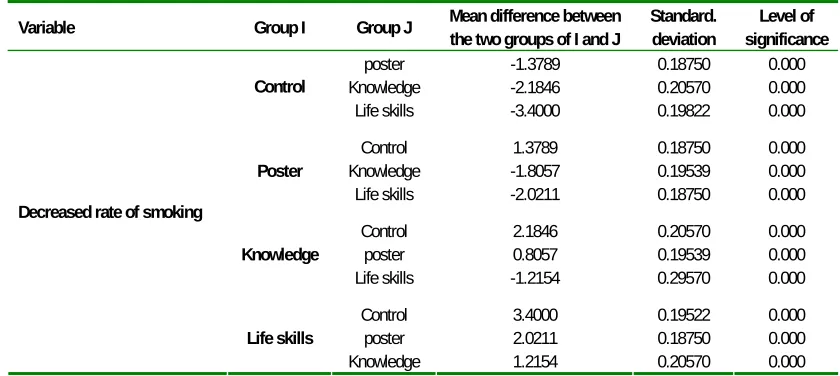
This was also true regarding decreasing or quitting smoking and the difference between the study groups and the control group was statistically significant in this regard (p=0.000, Table 3). Social skills training had the highest effect on quitting smoking followed by knowledge building and poster presentation.
Table 1. Age of smoking initiation
Age of experience (years)
10 11 12 13 14 15 Total
Boy N(%) 3(1.4%) 92(42.4%) 7(3.2%) 13(6%) 23(10.6%) 1(0.5%) 139(64.1%)
Girl N(%) 1(0.5%) 51(23.5%) 9(4.1%) 7(3.2%) 10(4.6%) - 78(35.9%)
Total 4(1.8%) 143(65.9%) 16(7.4%) 20(9.2%) 33(15.2%) 1(0.5%) 217(100%)
Table 2. The started reason for smoking
Curiosity Leisure Sadness Offering Others Total
Boy N(%) 79 (36.4%) 10(4.6%) 7(3.2%) 35(16.1%) 8(3.7%) 139(64.1%)
Girl N(%) 50(23%) 4(1.8%) 8(3.7%) 12(5.5%) 4(1.8%) 78(35.9%)
Table 3. Scheffe Test data summary (mean difference of control group scores and study groups scores).
Variable Group I Group J Mean difference between
the two groups of I and J
Standard. deviation
Level of significance
poster -1.3789 0.18750 0.000
Knowledge -2.1846 0.20570 0.000
Control
Life skills -3.4000 0.19822 0.000
Control 1.3789 0.18750 0.000
Knowledge -1.8057 0.19539 0.000
Poster
Life skills -2.0211 0.18750 0.000
Control 2.1846 0.20570 0.000
poster 0.8057 0.19539 0.000
Knowledge
Life skills -1.2154 0.29570 0.000
Control 3.4000 0.19522 0.000
poster 2.0211 0.18750 0.000
Decreased rate of smoking
Life skills
Knowledge 1.2154 0.20570 0.000
DISCUSSION
The prevalence of smoking was 2.6% among girls and 4.8% among boys and 7.4% in general. A significant correlation was seen between gender and the rate of smoking.
A national survey of U.S showed that 18% of 8th graders, 26% of 10th grade students and 23% of 12th grade students were daily smokers (8).
The difference between the results of our study and GYTS is probably caused by the different methods of smoking status evaluation. In our study all student who had the experience of smoking in the last 30 days were considered as smokers but in GYTS, the student who smoked daily were considered as smoker.
Out of 7.4% smoker students, almost half reported the age of smoking initiation to be less than age 12 with a mean of 11.3 years. Studies indicate that the age of smoking initiation has decreased (9) and some researchers reported that more than 95% of smokers have stared smoking before the age of 19(10).
In addition, this is why WHO in its 1999 report has emphasized that “if we could yield the tobacco use to zero in the 2nd decade of life, the overall rate
in the society will decrease to less than 10% of the present rate”. (11).
In this study, the main reason for smoking was curiosity followed by sadness and offering by the others. Students mostly acquired the cigarettes through others and smoked them usually at a friend’s house.
This fact is in accord with other studies which show that juveniles usually imitate their peers in terms of law breaking behaviors such as smoking or substance abuse (12).
Evidence shows that attitudes affect the behavior (13, 14). As it was shown in our study; there is a correlation between initiation of smoking and attitudes towards it (15,16).
Some experimental studies have confirmed the effect of attitude on substance use. For example, a study on 2646 students in 7th-grade of high school indicated that their current and anticipated smoking in the upcoming year was significantly correlated with their positive attitude towards smoking (17).
had the greatest impact on changing the attitude. Building a broader knowledge on health hazards of smoking was also effective in changing the attitude. However, in terms of knowledge, no difference was detected between the two methods of skill training and knowledge increasing. Our study results are in accord with previous studies. (18-21).
In terms of increasing knowledge changing attitude and decreasing the rate of smoking, life skills training method was the best as it has been shown by other studies. (19)
Building knowledge was the same as life skills training in increasing the knowledge but it was less effective in changing the attitude and decreasing the rate of smoking.
Poster was the least effective method in decreasing the students’ tendency towards smoking.
REFERENCES
1. Centers for Disease Control and Prevention.
Smoking-attributable mortality and years of potential life lost-United
State, 1990. Morbidity and Mortality Weekly Report 1993;
42(33):645-8.
2. Centers for Disease Control and Prevention. Cigarette
Smoking- Related Mortality. Tobacco Information and
prevention Source Fact Sheet, July 1996. (http://www.cdc.
gov/tobacco/research_data/health_consequences/mortali.htm)
3. The Health Consequences of Smoking: A Report of the
Surgeon General. U.S. Department of Health and Human
Services, Centers for Disease Control and Prevention,
National Center for Chronic disease Prevention and Health
Promotion, Office on Smoking and Health, Washington,
DC,2004.(http://www.cdc.gov/tobacco/sgr/sgr-2004/Factsheets/2.htm)
4. WHO, Report on the global tobacco epidemic, Feb2008.
http://www.who.int/tobacco/ mpower/en/index.html
5. Baumrind D. Familial antecedents of adolescent drug use: a
developmental perspective. NIDA Res Monogr 1985; 56:
13-44.
6. Global Youth Tobacco Survey Collaborating Group.
Differences in world wide tobacco use by gender: finding
from the Global Youth Tobacco Survey. J Sch Health 2003;
73:207-15.
7. Trends in tobacco use among school students in the Eastern
Mediterranean Region 2007. http://www.emro.who.int/tfi/
pdf/tobacco%20-among-school-students.pdf
8. Johnston LD, Malley PM, Bachman JG. National survey
results on drug use from the monitoring the future study,
1975-2002, Vol. I: Secondary school students. Washington,
D. C. U. S. Department of Health and Human Services. 1995,
46-54
9. Monshi Gh, Samouie R, Valiani M. The effect of social skills
training on preventing adolescent addiction in Isfahan.
Abstract book of the 1st congress on scientific evaluation of
law-breakers and preventive solutions. Khorasgan Islamic
Azad University. 2005. p 109-93.
10. Global Youth Tobacco Survey Collaborating Group.
Differences in Worldwide Tobacco Use by Gender: Findings
from the Global Youth Tobacco Survey. Journal of School
Health 2003; 73(6): 207-15.
11.World Health Organization. A thorough review of global
consumption, smoking rates, tobacco industry and national
tobacco control action by country up to 1995-96. Mainly
valuable as a reference book. Tobacco or health. A global
status report. Geneva: WHO. 1999. 31; 62-9.
12.Bandura A. Self-efficacy: toward a unifying theory of
behavioral change. Psychol Rev 1977; 84 (2): 191- 215.
13.Botvin GJ, Griffin KW, Diaz T, Miller N & Ifill – Williams.
M. Smoking initiation and escalation in early adolescent
girls: One – Year follow – up of a school - based prevention
intervention for minority youth. Journal of the American
Medical Women's Association 2004; 54: 139-43.
14.Karimzadeh S. Efficacy of "disseminator of health" project in
Kerman middle-school students in 2002-2003. An
unpublished research. Kerman education and training
organization-Deputy of physical education, 2003. p 127-32
15.Oetting ER, Beauvais F. Peer cluster theory, Socialization
characteristics. and adolescent drug use : A path analysis .
16.Eisen M, Zellman GL, Murray DM. Evaluating the
Lions-Quest "Skills for Adolescence" drug education program.
Second-year behavior outcomes. Addict Behav 2003; 28 (5):
883- 97.
17.Barkin SL, Smith KS, DuRant RH. Social skills and attitudes
associated with substance use behaviors among young
adolescents. J Adolesc Health 2002; 30 (6): 448- 54.
18.Botvin GJ, Griffin KW, Paul E, Macaulay AP. Preventing
tobacco and alcohol use among elementary school students
through Life Skills Training. Journal of Child & Adolescent
Substance Abuse 2003; 65-71.
19.Botvin GJ, Schinke SP, Epstein JA, 7 Diaz, T. Effectiveness
of culturally- focused and generic skills training approaches
to alcohol and drug abuse prevention among minority youths.
Psychology of Addictive Behaviors 2002; 8:116-27.
20.Botvin GJ, Baker E, Botvin EM, Filazzola AD, Millman R B.
Prevention of alcohol misuse through the development
of personal and social competence: A pilot study.
Journal of Studies on Alcohol 2000; 45: 550-2.
21.Botvin GJ, Baker E, Dusenbur L, Tortu S, Botvin EM.
Preventing adolescent drug abuse through a multimodal
cognitive-behavioral approach: Results of a three-year study.
Journal of Consulting and Clinical Psychology 2006; 58: