Relationship between Career and Competency: Verification of Theoretical Model
Validity
Virginija Chreptaviciene, Jovita Starkute
Kaunas University of Technology
K. Donelaicio st. 73, LT-44029, Kaunas, Lithuania
e-mail: [email protected], [email protected]
http://dx.doi.org/10.5755/j01.ee.23.2.1539
In a constantly changing environment, a new approach to an organization as a performance system where employee’ss are becoming the most important factor determining the efficiency of organizational performance is developing. However, the ability to attract and retain competent specialists is often a challenge for the organization since it has to recognize the range of factors that motivate each employee’s and serve as incentives for activity. One of such incentives is the possibilities to make a successful career as each person wants to ‘grow in an organization’ literally. Structural changes in the organization, i.e. transition from pyramidal structure through team organization structure to learning organization, which, according to Salopek (2004), Giesecke and McNeil (2004), has the characteristics of experimentation and future vision, have direct impact on employee’s’s career development: the possibilities for vertical career are reduced, it is difficult to anticipate workforce flow in an organization, employee’ss’ individual career do not anchor them in one organization, which increases the importance of competency and the insights into the future career possibilities.
In order to preserve unique skills and competencies, each organization must foresee the possibilities for employee’s’s career. If career is considered to be the process of personal development, authority, power influence, status, prestige, growth, climbing the ladder of hierarchy, qualification and promotion, the significance of career planning in the organization becomes obvious. Successful career planning in the organization, according to Lovelock and Wright (2002), helps to satisfy employee’ss’ needs for training and professional growth; to use employee’ss’ competencies efficiently; to increase employee’ss’ self-reliance; to form an internal reserve of professional growth. Moreover, career planning helps to combine the aims of the organization and an employee’s, to meet the latter’s interests and in such a way to retain competent specialists in an organization. Knowing their perspectives in the organization, employee’ss will try to act more efficiently, i.e. to use their competency and experience while striving for organizational goals. Yet when aiming at the effective usage of every employee’s’s competency in a particular activity, one should know not only the structure of the activity but also its levels and levels of competency respectively (Dreyfus, Dreifus, 1986, Reich (1993), Bowden & Monton (1997, 2003), Juceviciene, Liepaite (2000), Vernhout (2005). Chreptaviciene (2009), Chreptaviciene, Starkute, 2010), on the basis of which career should be planned and developed in the organization.
Scientific literature analysis revealed that the impact of competency level on career as well as its relation to career planning has not been studied yet. Consequently, it allows proposing adequate perspectives to employee’s’s career planning in the organization on the basis of his/her competency levels.
Having analyzed scientific literature, the authors of the article prepared a theoretical-hypothetical model of career planning based on the impact of competency level (Chreptaviciene & Starkute, 2010). The Model of Cohesions between Career and Competence. Inzinerine Ekonomika-Engineering Economics, 21(5), 537-549. In the model, employee’s’s competency level is equated to four stages of career. The employee’s progresses in professional career consistently passing through all the stages, where he/she faces activities and challenges of respective complexity. The employee’s’s ability to perform a certain task/activity (his/her level of competency) is assessed in each stage. Levels of competency distinguished by Bowden and Marton, (1997, 2003) as well as by Juceviciene and Lepaite (2000) correlate with four professional career stages identified by Dalton and Thompson (1986), which emphasize the relationship between an individual’s age and his/her position, show how employee’ss move from one stage to another. The movement determines changes in activity, in complexity of performed functions, and simultaneously the need for respective level of competency. Therefore, when conditions change and new activities appear; they require the acting person to apply the possessed competency to the conditions of the new activity or to be able to evaluate personal experience critically and engage in further development. The growth in the level of competency ensures the possibilities for professional career. The career based on the identification of competency levels shows that it is not enough to have only a certain competency; the level of competency and its recognition is important as well.
- 164 -
procedure and results. While applying the methods of written and oral survey, all employee’ss of one organization (managers and subordinates) were surveyed (N=30). The empirical research revealed that career planning in the organization depends on employee’s’s level of competency. Improved professional skills and increased level of competency has influence and is the main factor and guideline for employee’s’s career planning in the organization. The research findings confirmed the theoretical-hypothetical career model and theoretical conclusions maintaining that career planning in the organization on the basis of employee’s’s competency level is purposeful and relevant.
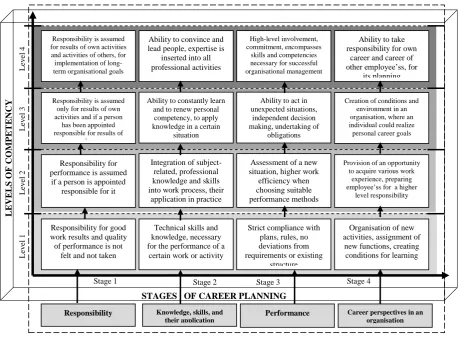
On the grounds of obtained research results, the article presents a practical model of relationship between career planning and employee’s’s competency (see Figure 5), which basically does not differ from the theoretical-hypothetical model (Chreptaviciene, Starkute, 2010); the practical model is more adapted to the characteristics of the organization being studied.
Keywords: career planning, competency, levels of competency, career planning model.
Introduction
Employee’s’s career planning has recently become one of the important strategic objectives of organizations. If career is considered to be the process of personal development, authority, power influence, status, prestige, growth, climbing the ladder of hierarchy, qualification and promotion (Danilevicius, 2008), the significance of career planning in the organization becomes obvious. A successful career planning in the organization, according to Lovelock and Wright (2002), helps to satisfy employee’ss’ needs for training and professional growth; to use employee’ss’ abilities efficiently; to increase employee’ss’ self-reliance; to form an internal reserve of professional growth.
The research in the field reveals the benefit of employee’s’s career planning to the organization, which ensures employee’ss’ loyalty, attraction of potential employee’ss, employee’ss’ satisfaction, motivation and efficiency at work. Career planning in the organization must be associated with employee’s’s competency and its development as performance is not static; on the other hand, a more complex activity requires higher level competency. The organizations that form talents out of internal resources of the organization accumulate a specific competency created and used only in the organization, which may guarantee competitive advantage.
When striving for career in a particular activity, employee’ss realize new roles, assume new obligations and responsibilities, and seek for autonomy. They need mental ability and integration of competencies in the particular activity. Person’s autonomy in the context of activity may be determined by mastered skills and competency of the highest level. Staff autonomy in terms of management is perceived as empowerment associated with process and its outcomes, which affect employee’s’s improvement, increase in efficiency and competency development. It generates positive results on individual and organizational level: there is an increase in job satisfaction, high level motivation and commitment to an organization.
With reference to research experience in the West and in Lithuania, the dilemma of career planning in the organization (Kucinskiene, 2003; Baruch, 2004; Paston, McMahon, 2006; Valackiene, 2003, 2005; Garniene, 2006; Ciutiene, 2006; Petkeviciute, 2003, 2007; Barnett & Bradley, 2007; Hennequin, 2007; Chreptaviciene & Starkute, 2010 et al.) is defined as problematic and perspective. After the conceptual vision of career has changed, the assessment of the relationship between career and competency is relevant both for science and for
managerial practice. Possibilities for employee’s’s career in the organization, career planning, competence development more and more frequently become the object of public discussion. Scientific problem of the research is reflected by the following questions: Does employee’s’s
career depend on their competency? Is career in the organization planned on the basis of employee’ss’ competency? Does the level of employee’s’s competency have impact on career planning in the organization? Do autonomy and responsibility for performance outcomes show high level of competency? Having analyzed scientific literature while searching for answers to the questions, the authors of the article prepared the theoretical model of relationship between career and competency (Chreptaviciene & Starkute, 2010). On the grounds of the assumption proposed in the article, that the higher the level of competency is, the greater career possibilities are, this research is an attempt to measure the validity of the theoretical-hypothetical model.
The aim of the article is to determine whether the developed theoretical career model is possible to use as methodological basis in the context of modern Lithuanian organization.
Methodological Grounding
The aim of the research is to validate the theoretical career model on the basis of empirical study findings. Case study is chosen for this research, i.e. there is one single object in the research – the company that manages shopping malls. The choice was determined by the following two reasons: first, the subject has successfully realized employee’s’s career planning; second, case study is the only way to verify a theoretical model (Andrikiene & Anuziene, 2006; Zydziunaite, 2008).
For the implementation of quantitative research, two non-standardized genuine questionnaires were prepared, one for managers and another for subordinates. Each of them contains 33 questions, compiled on the basis of the characteristics indicated in the theoretical career model. Every block of questions includes statements (265 in total), and the respondents could choose the answers that corresponded to their opinion or indicate their answer as
data processing SPSS 10.0 for Windows. Descriptive statistics was applied. The calculation of correlation coefficients as well as their analysis was carried out. The calculation of correlation coefficients was applied in order to determine the interrelation and interdependence of diagnostic variables while searching for and confirming statistical relations among the statements presented, i.e. the Pearson’s correlation coefficient was calculated. All statistical solutions that did not satisfy the condition p<=0.05 were treated as invalid in the research. In other words, the margin of error of no more than 5% was set in the research (Merkys, 1995; Bitinas, 1998).
The research sample is target, theoretical population. 30 people (91 per cent of all employee’ss) working in a shopping mall management company were surveyed. 6 of them were managers and 24 were employee’ss.
Analysis of Research Findings
Because of the limitations of the article, only the research findings that reveal the relationships between organizational career planning and employee’s’s competency are discussed. The article presents certain
statements in percentage and statistically reliable relations, which reveal the aim of the research, among them.
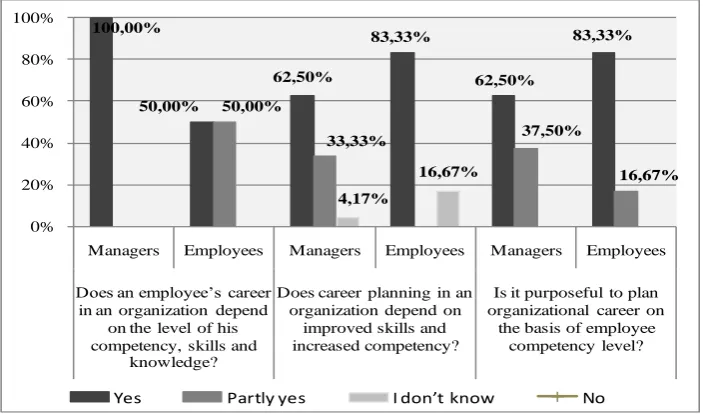
During the research, it was important to ascertain whether employee’s’s career in the organization depends on their competency level; whether the increase in competency level has any influence on employee’s’s professional career; whether it is purposeful to plan a career on the grounds of employee’s’s competency level. Responses to the questions demonstrated different opinions of managers and employee’ss. It is seen that all employee’ss (100 %) indicated that employee’s’s career in the organization depends on their level of competency, whereas only half (50 %) of managers indicated depends
and 50 per cent of them indicated partly depends.
Responses to the question “Do improved skills and
increased competency have impact on employee’s’s career planning in the organization?” were conditionally different. More than a half (62.50 %) of employee’ss and the majority (83.30 %) of managers responded Yes and only a third (33.33%) of employee’ss indicated Partly yes. The responses of participants in percentage are shown in Figure 1.
100,00%
50,00%
62,50%
83,33%
62,50%
83,33%
50,00%
33,33% 37,50%
16,67%
4,17%
16,67%
0% 20% 40% 60% 80% 100%
Managers Employees Managers Employees Managers Employees
Does an employee’s career in an organization depend
on the level of his competency, skills and
knowledge?
Does career planning in an organization depend on
improved skills and increased competency?
Is it purposeful to plan organizational career on
the basis of employee competency level?
Yes Partly yes I don’t know No
Figure 1. Career planning according to employee’ss’ competency level
The data corresponds with the responses to another question: “Is it purposeful to plan career on the basis of employee’s’s level of competency?” The conclusion that competency level is extremely important in planning employee’s’s career in the organization may possibly be drawn. The results of empirical research confirmed that organizational career planning on the basis of employee’s’s competency level is purposeful and significant.
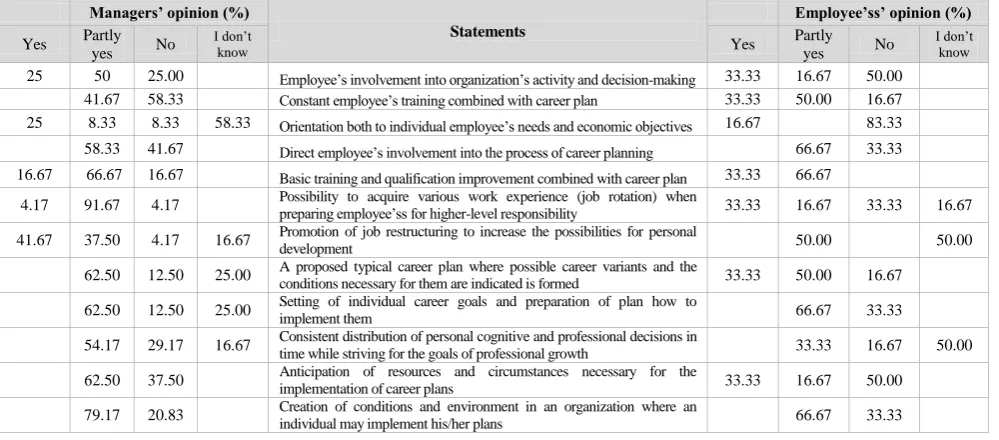
When carrying out the research, it was important to confirm theoretical attitudes, to ascertain the principles of career planning in the organization, and to find out what is taken into consideration in the process. Research results (when analyzing them and presenting in the form of answers Yes and Partly yes) revealed that career in the organization is planned on the basis of possibility to acquire various work experience (job rotation) (91.67 %), creation of conditions and environment where the
- 166 - The results of empirical research revealed that according to the managers, employee’s’s career plan in the organization is combined with trainings and qualification improvement (100 %), constant training of employee’ss (83.33 %), a typical career plan is formed where possible career variants and conditions they require are indicated (83.33 %), conditions and environment for the individuals to pursue their plans are created, individual career plans are developed and the ways to implement them are proposed, employee’ss are involved into direct process of career planning (66.67 % each). However, in managers’ opinion, the organization is not oriented towards individual needs of employee’ss and towards economic organizational goals (83.33 %), it does not involve
employee’ss into decision-making process sufficiently (50 %), it does not foresee necessary resources and circumstances to pursue career in the organization (see Table 1). It is possible to state that both employee’ss and managers distinguish the same principles of career planning in the organization. There is a constant employee’s training and qualification improvement undergoing in the organization while planning career and striving to increase the level of employee’s competency; a typical career plan indicating possible career variants after the employee’s improvement and the conditions needed for that are developed; however, there is no concern with individual needs of employee’ss and the anticipation of required resources and conditions.
Table 1
The principles of career planning in an organization
In order to confirm the relationship between career planning in the organization and employee’s competencies, to find statistical relations among statements presented to respondents, correlation coefficients were calculated. The results of correlation analysis show that strong statistical relations were revealed between constant training of employee’ss and four scales. The possibility to improve, expanding specific knowledge and competency development correlates with change in the nature of work (r=0.913, p<0.000), undertaking of greater obligations (r=0.816, p<0.000), individual work activity, experience and its application (r=0.816, p<0.000), employee’s involvement into the process of organizational career planning (r=0,805, p<0,000) (see Figure 2).
It is possible to state that employee’s improvement (i.e. further development of specific knowledge and competencies) influences the change in the nature of work, undertaking of greater obligations, individual work experience and its application to specific situations at work, and employee’s involvement into the process of organizational career planning. Moreover, the relationships between the improvement of specific knowledge, competency development and the process of career planning are revealed. When planning employee’ss’ career, the organization is also planning the development of employee’s
competency; the increased level of competency in turn leads to assumption of greater responsibilities and obligations. Basic training and qualification improvement in combination with career plan correlates with the possibility for job rotation in order to improve knowledge in various departments of the organization (r=1.000, p<0.000), the possibility to express skills and improve qualification (r=0.722, p<0.000), the increase in the level of responsibility (r=1.000, p<0.000), and assuming greater obligations (r=1.000, p<0.000) (see Figure 2).
Strong correlations were found between employee’s involvement into organizational career planning and increase in the level of responsibility (r=0.822, p<0.000), undertaking of greater obligations (r=0.822, p<0.000), the possibility to constantly improve competency (r=0.809, p<0.000) as well as becoming acquainted with information about career possibilities in the organization (r=0.7809, p<0.000) (see Figure 2). It may be proposed that employee’s involvement into organizational process of career planning is related to the increase in the level of responsibility, undertaking of greater obligations, a constant possibility for competency improvement and introduction to career possibilities in the organization.
Correlation was revealed between discussion with the organization about the means to pursue career and four
Managers’ opinion (%)
Statements
Employee’ss’ opinion (%)
Yes Partly yes No
I don’t
know Yes
Partly yes No
I don’t know
25 50 25.00 Employee’s involvement into organization’s activity and decision-making 33.33 16.67 50.00 41.67 58.33 Constant employee’s training combined with career plan 33.33 50.00 16.67 25 8.33 8.33 58.33 Orientation both to individual employee’s needs and economic objectives 16.67 83.33 58.33 41.67 Direct employee’s involvement into the process of career planning 66.67 33.33 16.67 66.67 16.67 Basic training and qualification improvement combined with career plan 33.33 66.67
4.17 91.67 4.17 Possibility to acquire various work experience (job rotation) when preparing employee’ss for higher-level responsibility 33.33 16.67 33.33 16.67
41.67 37.50 4.17 16.67 Promotion of job restructuring to increase the possibilities for personal
development 50.00 50.00
62.50 12.50 25.00 A proposed typical career plan where possible career variants and the
conditions necessary for them are indicated is formed 33.33 50.00 16.67 62.50 12.50 25.00 Setting of individual career goals and preparation of plan how to implement them 66.67 33.33
54.17 29.17 16.67 Consistent distribution of personal cognitive and professional decisions in
time while striving for the goals of professional growth 33.33 16.67 50.00 62.50 37.50 Anticipation of resources and circumstances necessary for the
implementation of career plans 33.33 16.67 50.00 79.17 20.83 Creation of conditions and environment in an organization where an
scales. Discussion about the means to pursue career with the organization correlates with such statements as increase in the level of responsibility (r=0.552, p<0.000), planning of self-education, individual learning (r=0.731, p<0.000), with the statement that career planning depends on improved skills, increased competency (r=0.647, p<0.000),
organizational commitment (strong belief in organization values) (r=0.552, p<0.000) (see Figure 2). It is possible to claim that discussion about the means to pursue career is related to the increase in the level of employee’s responsibility, planning of self-education and individual learning, as well as to organizational commitment.
The correlations revealed the relationship between responsibility level, undertaking of obligations, competency improvement and pursuing career in the organization. Consequently, career planning in the organization depends on improved skills, increased competency, high level of responsibility and undertaking of obligations.
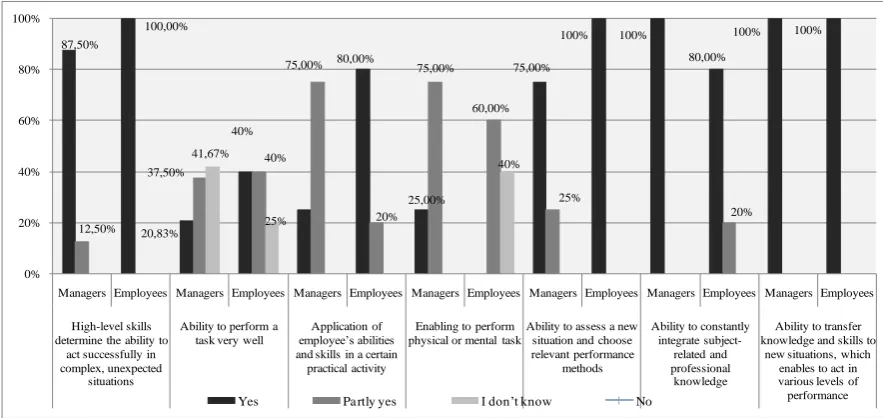
The research aimed to ascertain if high level of employee’s competence have impact on career planning. Respondents’ answers are shown in Figure 3.
The results of managers’ responses revealed that the ability to transfer knowledge and skills to new situations simultaneously enabling the performance in various levels of activity (100 %), the ability to assess a new situation and to choose suitable performance methods (100 %), and the ability to act successfully in unexpected situations (100 %) have influence on career planning. High level of competency in career planning is indicated by the ability to constantly integrate subject-related and professional knowledge (80 %) as well as by application of skills and abilities to a certain practical activity (80 %). A rather high level of competence is indicated by enabling to perform a physical or mental task (60 %) and the ability to perform a task well (40 %). According to employee’ss, the ability to constantly integrate subject-related and professional knowledge (100 %), the ability to transfer knowledge and skills to new situations at the same time enabling the performance on various levels of activity (100 %), the ability to act successfully in complex situations (87.50 %), application of abilities and skills in a certain activity (80
%), and the ability to assess new situation and to choose relevant performance methods (75 %) show that high level of competency has influence in career planning. Enabling the employee’s to perform the physical or mental task (75 %) has influence on partly high level of competency in career planning. When interpreting the obtained results, it is possible to state that in employee’ss and managers’ opinion, the ability to transfer knowledge and skills to new situations at the same time enabling the performance on various levels of activity, the ability to assess the new situation and to choose relevant performance methods, the ability to act successfully in unexpected situations, and application of skills and abilities in certain activity have great influence in career planning.
r = 0.522
Increase in the level of responsibility
Constant possibility to improve competency
Setting of individual career goals and preparation of plan for their
implementation
Undertaking greater obligations Employee’s involvement into
organizational career planning
Possibility to improve, develop competencies
Discussion about the means to pursue career with the organization
Career planning depends on improved skills and increased competency
Organizational committment Training and qualification
improvement combined with career plan
Job rotation: possibility to improve knowledge in other departments
r = 0.909 r = 1.000
r = 1.000 r = 0.900
r = 0.926
r = 0.900
r = 0.822 r = 0.805
r = 0.647 r = 0.522
r = 0.816
r = 0.926 r = 0.900
r = 0.816
r = 0.809
r = 0.822
- 168 - 87,50%
100,00%
20,83%
40%
25%
80,00%
25,00%
75,00%
100% 100%
80,00%
100% 100%
12,50%
37,50%
40% 75,00%
20% 75,00%
60,00%
25%
20% 41,67%
40%
0% 20% 40% 60% 80% 100%
Managers Employees Managers Employees Managers Employees Managers Employees Managers Employees Managers Employees Managers Employees
High-level skills determine the ability to
act successfully in complex, unexpected
situations
Ability to perform a task very well
Application of employee’s abilities and skills in a certain
practical activity
Enabling to perform physical or mental task
Ability to assess a new situation and choose relevant performance
methods
Ability to constantly integrate
subject-related and professional knowledge
Ability to transfer knowledge and skills to
new situations, which enables to act in various levels of performance
Yes Pa rtly yes I don’t know No
Figure 3. The impact of employee’s competency level on career planning.
Employee’s’s competency level depends not only on performed functions, achievements, improvement of work process, constantly developed skills and competencies, sharing of new knowledge and experience with peers in the organization, but also on the commitments to organization, the level of responsibility, the degree of assumed responsibility.The highest level of competence is indicated by the employee’s’s degree of responsibility and ability to assume responsibility. It was important to ascertain in the research respondents’ opinion whether assuming responsibility shows high level of competency. When interpreting the obtained results, it is possible to state that 95.83 per cent of employee’ss and 83.33 per cent of managers think that assuming responsibility shows high level of competency; 16.67 per cent of managers and 4.17 per cent of employee’ss indicated that it partly shows high level of competency. Therefore, according to respondents, assuming responsibility for the outcomes of own performance indicates high level of competency.
It was important to find out whether the respondents assume responsibility for the outcomes of their
performance. The answers to the questions (see Figure 4) showed that managers (100 %) feel accountable not only for the results of their work but also for the results of other employee’ss’ performance and they always assume responsibility for the results of work they perform. 83.33 per cent of managers stated that the manager is responsible for performance outcomes, whereas 83.33 per cent of managers indicated that they assume responsibility only partly, i.e. for the results of their work. 66.67 per cent of them stated that they assume responsibility for good performance only when they are appointed responsible for it. According to employee’ss, they feel responsible not only for their work results but also for those of their peers (100 %), they always assume responsibility for the outcomes of the work they perform (79.17 %). The employee’ss’ responses revealed that the manager is responsible for performance outcomes (83.33 %), a part of employee’ss (79.17 %) only assume responsibility for good performance and when they are responsible for it (see Figure 4).
79,17%
100%
4,17%
25,00%
83,33% 100% 100%
16,67%
79,17%
66,67%
45,83%
29,17%
83,33%
4,17%
16,67%
33,33%
29,17%
16,67%
41,67%
16,67%
0% 20% 40% 60% 80% 100%
Managers Employees Managers Employees Managers Employees Managers Employees Managers Employees
I always assume responsibility for performance outcomes
I assume responsibility for good performance
only when I am responsible for it
Manager is responsible for performance
outcomes
I assume responsibility for the outcomes of my
performance
I feel responsible for the outcomes of both my performance and that of
other employees
Yes Pa rtly yes No I don’t know
The conclusion may be drawn that managers feel responsible not only for the outcomes of their performance but also for those of their subordinates and they always assume responsibility for them. Employee’ss also feel responsible for both their and their peers’ performance outcomes, yet they would like the manager to assume responsibility as well.
Responsibility is perceived as a duty to organization, relationship with others and feeling of personal commitment when striving for set goals. On the highest level of competency, the degree of responsibility is the highest; therefore, when planning career, the highest level of competency may be measured by the ability to assume responsibility. Strong statistical relations were revealed between the increase in the level of responsibility and five statements. Increase in the level of responsibility correlates with constant possibility to improve competency (r=0.900, p<0.000), identification of the complex of organizational means for career planning (r=0.816, p<0.000), setting of individual career goals and preparation of plan how to attain them (r=0.926, p<0.000), undertaking greater obligations (r=1.000, p<0.000), individual work experience and its application (r=0.900, p<0.000) (see Figure 2). Empirical research results showed that the increase in the degree of responsibility is related to constant improvement of competency, the complex of organizational means for career planning, setting of individual career goals and preparation of plan how to attain them, to undertaking greater obligations, individual work experience and its application. Consequently, the increase in the level of responsibility in the organization is determined by constant competency improvement, planning of career means and goals, development of implementation strategy, undertaking greater obligations, and application of personal experience.
The research aimed at ascertaining What is the benefit for organization to plan employee’s career? Research findings are reflected in Table 2. According to employee’ss, organizational career planning is a possibility to manage employee’s career rationally (100 %), increase employee’s loyalty (70.83 %), assume responsibility for implementation of long-term organizational goals (66.76 %), enable employee’ss to participate in decision-making (50 %). The benefit of career planning for the organization is partly revealed through enabling employee’ss to make decisions independently (75 %), increasing employee’ss’ interest in the quality of performance (70.83 %), enabling more effective performance of tasks (70.83 %).
According to managers, the benefit of career planning to the organization becomes clear when employee’ss are provided with the possibility to manage their career rationally (100 %), when employee’ss are able participate in decision-making (100 %), when tasks may be performed more effectively (83.33 %), when employee’ss are partly able to make decisions independently (83.33 %), when the loyalty of employee’ss is increased (66.67 %), when employee’ss are provided with the possibility to assume responsibility for the implementation of long-term goals (66.67 %). In managers’ opinion, when there is career planning in the organization, employee’s turnover decreases (66.67 %) and the possibilities for employee’ss to perform quality work increases (50 %) (see Table 2). Therefore, when the organization is planning career, employee’ss’ responsibility for performance outcomes and long-term organizational goals is increasing, work is performed more effectively, employee’s loyalty to organization is increasing, employee’ss are capable to adapt to changes introduced in the organization more easily; moreover, they show more initiative in decision-making and take independent decisions faster and more easily.
Table 2
The benefit of career planning for the organization
Opinion of managers (%)
Statements Opinion of employee’ss (%)
Yes Partly yes No Yes Partly yes No
66.67 33.33 Increases employee’s loyalty 70.83 29.17
50 50 Employee’ss adapt more easily to changes being implemented in an
organization 45.83 45.83 8.33
66.67 33.33 Responsibility is assumed for the implementation of long-term
organizational goals 66.67 33.33
83.33 16.67 Enables employee’ss to perform tasks more effectively 29.17 70.83
100 Enables employee’ss to participate in decision-making 50 25 25 66.67 33.33 Employee’s turnover decreases 45.83 45.83 8.33
50 50 Increases possibilities for employee’ss to perform their work better 4.17 70.83 25 100 A possibility to plan and manage employee’s career rationally 100
16.67 83.33 Enables employee’ss to make decisions independently 75 25
Significant statistical relations were revealed between undertaking greater obligations and the six scales. Undertaking greater obligations correlates with the change in job position and the nature of work (r=0.745, p<0.000), constant possibility of competency improvement (r=0.900, p<0.000), identification of the complex of organizational means for career planning (r=0.816, p<0.000), setting of individual career goals and preparation of the plan how to attain them (r=0.926, p<0.000), possibility to improve, further development of specific knowledge and
- 170 - means, creation of individual’s career plan, and setting of goals. It is possible to make an assumption that undertaking greater obligations depends on the change in job positions and the nature of work, possibilities for constant competency improvement, possibility for professional growth, further development of specific knowledge and competencies, employee’s involvement into the process of organizational career planning, the complex of organizational means for career planning, setting of individual career goals and preparation of plan how to reach them. So relationships between constant competency improvement, development of specific knowledge and competencies in the organization and the process of career planning in the organization, which is based on employee’s involvement into the planning process, and preparation of means for its implementation are revealed. The results of correlation analysis allowed to highlight the relationships between employee’s competency and career planning in the organization (see Figure 2).
It appeared that career planning in the organization depended on improved skills, increased competency, high level of responsibility and undertaking of obligations. High
level of employee’s responsibility and undertaking greater responsibilities are determined by employee’s involvement into the process of organizational career planning, introduction of career opportunities in the organization, planning of career means and goals, development of implementation strategy and constant development of competency. Undertaking greater obligations depends on the change in the nature of work and in job positions, on the possibilities for constant competency improvement, development of competencies, employee’s involvement into the process of organizational career planning, identification of the complex of organizational means for career planning, setting of individual career goals and on the preparation of plan how to attain them. When planning employee’s career and involving them into the planning process, the organization also plans the development of employee’s competencies and improvement of knowledge, since increased level of competency determines the higher organizational commitment, high level of responsibility and assuming responsibility for performance outcomes, greater employee’s involvement into organizational activities. Research results and statement results of correlation analysis are presented in Figure 5.
The obtained research results confirm the theoretical approach that career in the organization depends on the level of employee’s competency, skills, and knowledge. Improved skills and increased competency level influence career planning in the organization; the level of competency is one of the most important marks in
organizational career planning. Career planning is influenced by the following phenomena: ability to transfer knowledge and skills to new situations, ability to act on various levels of activities at the same time, ability to assess a new situation, to choose relevant performance methods according to the situation, ability to act
Figure 5. Practical model of relationships between career planning and employee’s competency.
Responsibility for good work results and quality of performance is not
felt and not taken
Technical skills and knowledge, necessary for the performance of a
certain work or activity
Strict compliance with plans, rules, no deviations from requirements or existing
structure
Organisation of new activities, assignment of
new functions, creating conditions for learning Responsibility for
performance is assumed if a person is appointed
responsible for it
Integration of subject-related, professional knowledge and skills into work process, their
application in practice
Assessment of a new situation, higher work efficiency when choosing suitable performance methods
Provision of an opportunity to acquire various work
experience, preparing employee’ss for a higher
level responsibility Responsibility is assumed
only for results of own activities and if a person
has been appointed responsible for results of
others Responsibility is assumed for results of own activities and activities of others, for implementation of long-term organisational goals
Ability to convince and lead people, expertise is
inserted into all professional activities
Creation of conditions and environment in an organisation, where an individual could realize personal career goals
Ability to act in unexpected situations,
independent decision making, undertaking of
obligations Ability to constantly learn
and to renew personal competency, to apply knowledge in a certain
situation
Ability to take responsibility for own
career and career of other employee’ss, for
its planning
High-level involvement, commitment, encompasses
skills and competencies necessary for successful organisational management
Responsibility Knowledge, skills, and their application
Performance Career perspectives in an organisation LEVE LS O F CO MP ETEN CY Le v el 1 Le v el 2 Le v el 3 Le v el 4
STAGES OF CAREER PLANNING
successfully in unexpected situations, and application of abilities and skills in certain activities (see Figure 5).The abilities, which are important in each stage of career, are as follows: to assess a new situation, to choose relevant performance methods, to act successfully in unexpected situations, to assume responsibility for own performance and its outcomes, even when working in a team. According to the respondents, assuming responsibility for the outcomes of own performance shows high level of competency.
The results of empirical research revealed that when planning career in the organization, employee’ss’ responsibility for performance outcomes and long-term organizational goals increase, work is performed more effectively, employee’s loyalty to the organization increases, and employee’ss adapt to the changes implemented in the organization more easily.
Based on the received results of empirical research and on the theoretical model of relationship between competency and career, practical model of relationship between career planning and competency is presented (see Figure 5). The model has been validated on the grounds of the relations between employee’s competency and career planning in the organization that were revealed in the research: highlighted aspects of recognizing the level of employee’s competency, the principles of career planning and skills, abilities and competencies, necessary for career planning; factors that influence employee’s career; the respondents’ opinion about parameters of abilities and skills that show high level of employee’s competency; factors that motivate to develop personal competency; influence of high-level employee’s competency on career planning, and the principles, stages and requirements of career planning in the organization; the respondents’ attitude that employee’s career planning based on the level of competency is purposeful, and that career planning also depends on improved skills and the increased level of competency.
The practical model of relationship between career planning and competency is presented, assessing the respondents’ opinion through the prerogatives of application and use of knowledge and skills, of responsibility, active involvement into activities and career perspectives.
Levels of competency presented in the vertical axis of Figure 5 correlate with career stages identified in the horizontal axis.
Relationships between the levels of competency and career stages were assessed within the limits of the chosen competencies and within the framework of certain abilities. The competencies and abilities that ensure them enable the individual to solve tasks that appear in his/her career path and to meet the requirements of the contemporary work world. Yet the expression and level of competencies are not the same in different career stages; therefore, only certain abilities that define competencies were analyzed in order to prove relationship between career and competency. The first level of competencies expresses knowledge and competency (which is expressed by certain behavior according to directions given by specialists for the required job position) of certain job or activity. When the nature of certain activity changes, this competency has
few applications. The second level of competencies expresses the competencies necessary when working in social interaction with other people. This level of competency is revealed when the employee’s develops certain examples of application, diversifies traditional processes or activities, perceiving new possibilities and improving the work process. The third level of competencies encompasses the discovery of new methods, changing the productivity and practice of personal work, the development of teaching and learning possibilities and competencies necessary for successful management of the organization. This level of competencies determines inner personal attitudes and abilities to concentrate on successful performance. The professional level of competency is inserted into all professional activities, it encompasses the analysis of problems and technical areas, assuming responsibility, and sharing the acquired experience. Skills that are more related to the ability to act single-mindedly both personally and engaging others to pursue goals are expressed in the highest level of competencies. This level of competencies is especially important for top managers; it is also important for middle-level managers, yet not so important for the lower level managerial positions. Employee’s competency is expressed in each career stage: the level of preparation to perform his/her work and skills.
When identifying the level of employee’s competency, it appeared that the activity level of operational performance of work, improvement of work contents, change of work conditions were characteristic of employee’ss. In the managerial level, the highest level of competency is also well-defined, and it manifests itself by assuming responsibility, searching for new contexts and transfer of knowledge and skills to new performance situation in working environment. When carrying out the research, it was demonstrated what level of competency was necessary in each career stage, and what abilities and skills identified higher level of competencies.
Conclusions
1. Empirical research has revealed that career depends on the level of employee’s competency, skills, and knowledge in the organization. Improved abilities and increased level of competency influence career planning in the organization, and the level of competency is one of the most important aspects and marks for career planning in the organization.
2. Career planning in the organization encompasses assessment of professional competency, assessment of acquired experience, identification of requirements of the work place, recognition of employee’s needs and interests, and development of employee’s qualification necessary for the performance of a certain task.
- 172 - 4. When identifying the level of employee’s competency, it emerged that activity level of operational performance of work, improvement of work contents, and change of work conditions was characteristic of employee’ss. A holistic activity level becomes more pronounced, which is also characteristic of managers, and is manifested by assuming responsibility, searching for new contexts, and transferring knowledge and skills into new performance situation in working environment.
5. In career planning, the ability to transfer knowledge and skills to new situations and at the same time to act on various levels of activity, the ability to assess a new situation and to choose relevant performance methods, the ability to act successfully in unexpected situations, application of abilities and skills to certain activity, and the ability to assume responsibility for own performance and its outcomes even when working in team or when nobody requests to assume the responsibility are important in career planning. According to the respondents, assuming responsibility for the outcomes of own performance shows the highest level of competency.
6. The model of relationship between career planning and competency (see Figure 5) is presented on the grounds of respondents’ relations between competency and career planning in the organization revealed in the course of the research after the aspects of recognizing the level of employee’s competency, the principles and stages of career planning, as well as abilities, skills and competencies necessary for career planning had been identified. The model was developed after various aspects that prevail in the organization had been analyzed and identified (factors that determine employee’s career; the respondents’ opinion on parameters of abilities and skills that show high level of
employee’s competency; factors that motivate to improve personal competency) and the influence of high level of employee’s competency on career planning and the principles, stages and requirements of career planning in the organization had been highlighted.
7.
Strong statistical relations became apparent among many attributes (see Figure 2). Career planning in the organization depends on improved skills, increased competency, the level of responsibility, and undertaking of obligations. High level of employee’s responsibility and undertaking of obligations are determined by employee’s involvement into the process of organizational career planning, introduction of career possibilities to employee’ss in the organization, planning of career means and goals and creation of the implementation strategy, and constant development of competency. Undertaking greater obligations depends on the nature of work and change in job positions, possibilities for constant competency improvement, competency development, employee’s involvement into the process of organizational career planning, identification of the complex of organizational means for career planning, setting of individual career goals and preparation of plan how to attain them. When planning employee’s career and involving them into the planning process, the organization also plans the development of employee’s competency and improvement of knowledge, because the increased level of competency determines higher organizational commitment, high level of responsibility and assuming responsibility for performance outcomes, as well as stronger employee’s involvement into organizational performance.References
Barnett, B. R., Bradley, L. (2007). The impact of organisational support for career development on career satisfaction.
Career Development International, 12(7), 617-636. http://dx.doi.org/10.1108/13620430710834396
Baruch, Y. (2004). Transforming careers: from linear to multidirectional career paths. Career Development International. 9(1), 58-73. http://dx.doi.org/10.1108/13620430410518147
Bowden, J. A., & Marton, F. (2003). The University of Learning: Beyond Quality and Competence. RoutledgeFalmer: London.
Cascio, W. F. (2006). Managing Human Resources: Productivity, Quality of Work Life, Profits. McGraw-Hill/Irwin. Chreptaviciene, V., & Starkute, J. (2010). The Model of Cohesions between Career and Competence. Inzinerine
Ekonomika-Engineering Economics, 21(5), 537-549.
Ciutiene, R. (2006). Darbuotoju ir organizacijos interesu derinimas formuojant karjera. Daktaro disertacija. Danilevicius, E. (2008). Karjeros pletros modeliavimas. Tiltai, 3, 45-155.
Garniene, D. (2006). Bendrojo lavinimo mokyklos ugdymo karjerai modelis: parametrai ir realizavimo principai. Daktaro disertacija.
Hennequin, E. (2007). What „career success“ means to blue-collar workers. Career Develompment International, 12(6), 565-581. http://dx.doi.org/10.1108/13620430710822029
Kardelis, K. (2002). Moksliniu tyrimu metodologija ir metodai. Kaunas: Judex.
Kucinskiene, R. (2003). Ugdymo karjerai metodologija. Klaipeda: Klaipedos universiteto leidykla.
Lovelock Ch.,& Wright, L. (2002). Principles of service marketing and managment, 2nd ed. Uppe Saddle River: Prentice Hall.
Patton, W., & McMahon, M. (2006). Career development and systems theory: Connecting theory and practice. Rotterdam: Sense Publishers.
Petkeviciute, N. (2006). Karjeros valdymas: asmenine/individualioji perspektyva. Kaunas: VDU leidykla.
Valackiene, A. (2003). Profesine karjera sąlygojantys veiksniai: subjektyvus vertinimas. Profesinis rengimas. 7, 110-126. Valackiene, A. (2005). Profesines karjeros procesas: teoriniai aspektai. Ekonomika ir vadyba: aktualijos ir perspektyvos.
5, 382-388.
Virginija Chreptavičienė, Jovita Starkutė
Karjeros ir kompetencijos ryšys: teorinio modelio validumo patikrinimas
Santrauka
Straipsnyje pristatomi empirinio tyrimo, kuriuo patikrinamas karjeros planavimo ir darbuotojų kompetencijos ryšio teorinio modelio (žr. Chreptavičienė, V., Starkutė, J., 2010. The Model of Cohesions between Career and Competence. Engineering Economics. Nr. 21(5), 537-549) validumas, rezultatai.
Organizacijų struktūriniai pokyčiai, kai judama nuo piramidinės struktūros link komandinės ir iki besimokančios organizacijos, kuriai, pasak Salopek (2004), Giesecke, McNeil (2004), būdingas eksperimentavimas ir ateities vizija, tiesiogiai turi įtaką darbuotojų karjeros plėtrai: mažėja vertikalios karjeros galimybės, didėja kompetencijos svarba, darbuotojų judėjimas organizacijoje sunkiai prognozuojamas, jų individuali karjera neįtvirtinama vienoje organizacijoje. Siekdama išsaugoti žmogiškąjį potencialą, kuris būtinas organizacijos veiklos strategijai įgyvendinti, kryptingai paversti jį tikru konkurenciniu pranašumu, organizacija privalo turėti aiškią žmogiškųjų išteklių valdymo strategiją, kuri būtų orientuota į personalo karjeros valdymą, nes tai geriausiai užtikrina pusiausvyrą tarp organizacijos ir kiekvieno darbuotojo poreikių ir lūkesčių. Karjerą suprantant kaip žmogaus profesinio tobulėjimo, jo autoriteto, valdžios įtakos, statuso, prestižo ir atlyginimo didėjimo, kilimo hierarchijos pakopomis procesą, akcentuotina karjeros planavimo organizacijoje svarba, nes tai padeda: patenkinti darbuotojų ugdymo ir profesinio augimo poreikius; efektyviai panaudoti darbuotojų galimybes; skatinti didesnį darbuotojų pasitikėjimą savo jėgomis; suformuoti vidinį profesinio tobulėjimo rezervą. Atlikti tyrimai pagrindžia personalo karjeros planavimo naudą organizacijai, užsitikrinant darbuotojų lojalumą, potencialių darbuotojų pritraukimą, darbuotojų pasitenkinimą, motyvavimą, veiklos produktyvumą. Karjeros planavimas organizacijoje turi būti siejamas su darbuotojų kompetencija ir jos tobulinimu, nes veikla nestruktūruota ir nėra statiška. Darbuotojai, siekdami karjeros konkrečioje veikloje, realizuoja naujus vaidmenis, prisiima naujus įsipareigojimus ir atsakomybę, siekia autonomiškumo. Asmens autonomiją veikloje gali lemti įvaldyti aukščiausio lygmens gebėjimai bei turima kompetencija. Tačiau planuojant karjerą ir vertinant kintantį veiklos pobūdį, organizacijai neužtenka žinoti, kad darbuotojai turi specifinę kompetenciją, svarbus jo turimos kompetencijos lygmuo bei jo nustatymas. Tyrimo, pristatomo šiame straipsnyje, mokslinį problematiškumą lemia ta aplinkybė, jog karjeros planavimo organizacijoje ir darbuotojų kompetencijų ryšiai nebuvo tyrinėti. Aktualu rasti mokslinį atsakymą į konkrečius klausimus: 1) Ar darbuotojų karjera priklauso nuo jo kompetencijos lygio? Ar karjera organizacijoje planuojama remiantis darbuotojų kompetencijos lygiu? Ar darbuotojo kompetencijos lygmuo turi įtaką karjeros planavimui organizacijoje? Ar atsakomybės prisiėmimas už veiklos rezultatus parodo aukštą kompetencijos lygį? Atsakymų į šiuos klausimus paieška iškėlė šio tyrimo tikslą – patikrinti karjeros ir kompetencijos ryšio teorinio modelio validumą.
Empiriniam tyrimui pasirinkta atvejo tyrimo strategija, t. y. tyrimą sudaro vienas atskiras objektas – Prekybos centrų valdymo įmonė. Tokį pasirinkimą sąlygojo 2 priežastys: 1) subjektas sėkmingai realizuoja darbuotojų karjeros planavimą; 2) atvejo tyrimas yra vienintelis būdas verifikuoti teorinį modelį (Andrikienė, Anužienė (2006), Žydžiūnaitė (2008). Pagrindžiant teorinį-hipotetinį karjeros planavimo modelį, straipsnyje pateikiama karjeros planavimo organizacijoje ir darbuotojų kompetencijos ryšių tyrimo metodologija, tyrimo procedūra ir rezultatai. Taikant apklausos raštu bei žodžiu tyrimo metodus, buvo apklausti visi vienos organizacijos vadovai ir darbuotojai (N=30).
Atliekant tyrimą, kompetencijos lygio ir karjeros ryšys buvo vertinamas remiantis pasirinktomis kompetencijomis. Kiekviename karjeros etape įvertinama darbuotojo kompetencija: pasirengimo atlikti tam tikrą veiklą bei gebėjimų lygmuo. Tyrimo rezultatai parodė, jog pirmajame karjeros etape pasireiškia konkrečios veiklos kompetencija, išreiškiama tam tikra elgsena, atsižvelgiant į reikalingos darbo vietos reikalavimus. Antrasis karjeros etapas koreliuoja su antruoju kompetencijos lygiu, kuris grindžiamas ne tik meistriškai išmokta elgsena, bet ir tam tikru žinojimu, kuris interpretuojamas kaip veiklos principų supratimas, suvokiant naujas galimybes, įvairinant tradicines veiklas ir tobulinant darbo procesą. Aukštesniuose veiklos lygiuose, veiklai tampant sudėtingesnei, plėtojama kompetencija remiantis jau esama patirtimi ir žiniomis, kurių integruotas taikymas sukuria visiškai kitą veiklos kokybę, reikalaujančią integruoto ir holistinio lygmens kompetencijos. Trečiasis kompetencijų lygis apima naujų būdų atradimą, keičiant asmeninio darbo produktyvumą ir praktiką, mokymo ir mokymosi galimybių plėtrą. Tyrimo rezultatai atskleidė, jog darbuotojo karjera organizacijoje priklauso nuo patobulintų gebėjimų, padidėjusios kompetencijos lygio, atsakomybės lygio ir įsipareigojimų prisiėmimo. Atsakomybė yra suvokiama kaip pareiga organizacijai, ryšio buvimas su kitais ir asmeninių įsipareigojimų jausmas, siekiant užsibrėžtų tikslų. Aukščiausiame kompetencijos lygyje atsakomybės laipsnis yra pats didžiausias, todėl planuojant karjerą, aukščiausias kompetencijos lygmuo matuojamas gebėjimu prisiimti atsakomybę. Empiriniai tyrimo rezultatai parodė, jog didesnė atsakomybė susijusi su nuolatinės kompetencijos tobulinimu, karjeros priemonių komplekso planavimu, individualių karjeros tikslų nustatymu bei plano parengimu kaip juos pasiekti, didesnių įsipareigojimų priėmimu, individualios veiklos patirtimi bei jos pritaikymu. Taigi atsakomybės lygio didėjimą lemia nuolatinis kompetencijos tobulinimas, karjeros priemonių, tikslų planavimo ir įgyvendinimo strategijos kūrimas, didesnių įsipareigojimų prisiėmimas, individualios patirties pritaikymas. Aukščiausiu kompetencijų lygiu ir aukščiausiu karjeros etapu išreiškiami įgūdžiai, kurie susiję su gebėjimu kryptingai veikti tiek asmeniškai, tiek sutelkiant kitus asmenis tikslams siekti. Šis kompetencijų lygmuo itin svarbus aukščiausiojo lygmens vadovams, svarbus viduriniosios grandies vadovams, ne toks reikšmingas žemesniajam valdymo lygmeniui.
Identifikuojant darbuotojų kompetencijos lygį išryškėjo, jog darbuotojams būdingas darbo operacinio atlikimo, darbo turinio tobulinimo, darbo sąlygų keitimo veiklos lygis. Vadovų lygmeniu ryškus ir aukščiausias kompetencijos lygmuo, pasireiškiantis atsakomybės prisiėmimu, naujų kontekstų ieškojimu bei žinių, gebėjimų perkėlimu į naują veiklos situaciją darbo aplinkoje. Atliekant tyrimą buvo siekiama nustatyti, kokio lygio kompetencija reikalinga kiekviename karjeros etape, kokie gebėjimai ir įgūdžiai identifikuoja aukštesnį kompetencijos lygį.
Tyrimo rezultatai patvirtino teorinę nuostatą, jog organizacijoje karjera priklauso nuo darbuotojo kompetencijos lygio. Patobulinti gebėjimai bei didesnis kompetencijos lygmuo turi įtaką karjeros planavimui organizacijoje. Pastarasis lygmuo yra vienas svarbiausių orientyrų. Karjerai planuoti svarbūs darbuotojo gebėjimai perkelti žinias ir įgūdžius į naujas situacijas, kartu suteikiant galimybę veikti įvairiuose veiklos lygiuose, t.y. gebėjimas įvertinti naują situaciją, pasirinkti joje tinkamus veiklos metodus, gebėjimas sėkmingai veikti nenumatytose situacijose, gebėjimų, įgūdžių pritaikymas tam tikroje veikloje, gebėjimas įvertinti naują situaciją bei pasirinkti joje tinkamus veiklos metodus bei gebėjimas prisiimti atsakomybę už savo darbą ir jo rezultatus, net jei dirbama komandoje. Respondentų nuomone, atsakomybės prisiėmimas už savo veiklos rezultatus rodo aukštą kompetencijos lygį. Empirinio tyrimo rezultatai atskleidė, jog planuojant karjerą organizacijoje, didėja darbuotojų atsakomybė už veiklos rezultatus bei ilgalaikius organizacijos tikslus, efektyviau atliekamas darbas, didėja darbuotojų lojalumas organizacijai, darbuotojai lengviau prisitaiko prie organizacijoje diegiamų pokyčių.
Tyrimo rezultatai patvirtino teorinį karjeros ir kompetencijos ryšio modelį ir teorines išvadas, jog karjeros planavimas organizacijoje, remiantis darbuotojų kompetencijos lygiu, yra tikslingas.
Šis modelis gali būti naudojamas organizacijose, kaip vienas iš būdų realizuoti darbuotojų ir organizacijos interesus, planuojant ir tobulinant individualią darbuotojų karjerą bei karjerą organizacijoje.
Raktažodžiai: karjera, karjeros planavimas, kompetencija, kompetencijos lygiai, karjeros ir kompetencijos ryšio modelis.