1 PUNE [email protected] PUNE [email protected] PUNE [email protected] PUNE [email protected] ABSTRACT This paper shows that E-Toll booking can be completely managed using the ‘Internet of Things’ concept based on the RFID and QR/Barcode scanning technology using Raspberry Pi. In reference to survey of annual toll collection on toll plazas, conducted by government of Maharashtra in year 2010, we examine and report on the conditions of total time spent, for money transaction on toll plaza, by a particular vehicle and further evaluate total fuel wastage as well as human errors involvement, while doing so. Finally to provide an optimal solution, we consent with the idea of making toll plazas completely automated, with assistance of IoT technology. By using this system no separate lane required at Toll Plaza.
Keywords
IoT: Internet of Things, RFID: Radio Frequency Identification, Webcam, Stepper Motor, RFID Reader: EM18, Raspberry Pi: 3B Model, WordPress Software OpenCV
1.INTRODUCTION Transportation is the backbone of any country’s economy. Advancement in transportation systems has led to a lifestyle characterized by extraordinary freedom of movement, immense trade in manufactured goods and services, high employment levels and social mobility. In fact, the economic wealth of a nation has been closely tied to efficient methods of transportation. Due to increasing number of vehicles on the road, problems such as congestion, incident, air pollution and many others have become a major factor of concern. E-Toll Booking System aims to reduce the delay on toll roads by collecting tolls payment Electronically E-Toll Booking System determines whether the cars passing are enrolled in the program, alerts enforcers for those that are not, and users electronically debits the accounts of registered vehicle owners without requiring them to stop to pay cash. They can show the QR code or barcode or RFID Tag at Toll Plaza and it operates automatically E-toll booking has facilitated the concession to the private sector of the construction and operation of urban freeways [9]. Electronic toll collection becomes the primary option for payment, with payment by mail as a secondary option. Open road tolling (ORT) is a type of electronic toll collection without the use of toll booths. The major advantage to E-Toll is that users are able to drive through the toll plaza at highway speeds without having to stop to pay the toll. By this we don’t have to carry a handsome amount of cash with us relates to security as well. This system does not require any manual operation of toll
barriers and collection of toll amounts, it is completely automated toll collection system.
Fig.1: E-Toll Booking System
2.REVIEW OF LITERATURE William Vickrey the Nobel Economics prize winner, in 1959, was the first who proposed electronic toll system for Washington Metropolitan Area. Free flow tolling with fixed transponders undersides of vehicles and the readers were located under the highway surfaces (1960s and 1970s). Norway wide spread implementation of this transponder and reader technology. This system was first introduced in Bergen (1986). World’s first use of completely unaided full speed electronic toll system was introduced by Trondheim (1991). Norway has electronic fee collection EFC. Single, universal system was applied firstly by Portugal (1995). [5] In different places in the United States like California, Pennsylvania, Texas, Delaware and Florida, vehicles can pass through electronic toll collecting booths directly. For the same no of cars, operations in electronic toll booths take place faster as the users are preregistered. Toll collecting gates are usually broader than the original width of the road but this made it possible to fit them into smaller narrower roads. Although these limitations are present, if the time taken for operation at the toll plaza is reduced, then the speed of operation can be increased. The greater the speed of operation, less number of total lanes was required and as more number of lanes started getting automated, there was a reduction in the overall short term cost of the project. Also if the long term cost of the project is considered, larger number of vehicles started using electronic toll and vehicles using manual toll reduced. [5] According to reference, the initial technical realization of IoT was achieved by utilizing RFID (Radio Frequency Identification) technology, which was limited to identification, object tracking and extracting information of specific objects. However, the implemented IoT based system performs sensing,
International Journal of Research Publications
Volume-2, Issue-1,April 2018
Accepted and Published Manuscript
IOT BASED E-TOLL BOOKING SYSTEM
SAGAR INGLE, AKASH GAIKWAD, AKSHAY MHETRE, Prof.R.D.Komati
PII : SAGAR INGLE.100214201850
DOI: 100214201850
Web: http://ijrp.org/paper_detail/51
To appear in: International Journal of Research Publication (IJRP.ORG)
Received date: 24 Mar 2018
Accepted date: 25 Mar 2018
Published date: 23 April 2018
Please cite this article as: SAGAR INGLE, AKASH GAIKWAD,
AKSHAY MHETRE, Prof.R.D.Komati , IOT BASED E-TOLL
BOOKING SYSTEM , International Journal of Research Publication
(Volume: 2, Issue: 1), http://ijrp.org/paper_detail/51
This is a PDF file of an unedited manuscript that has been accepted for
publication. As a service to our customers we are providing this final
version of the manuscript.
IoT Based E-Toll Booking System
Sagar Ingle
Student
Dept.Of Electronics and Telecommunication Engineering MAEER’S MITCOE, PUNE
[email protected]
Akash Gaikwad
StudentDept.Of Electronics and Telecommunication Engineering MAEER’S MITCOE, PUNE [email protected]
Akshay Mhetre
StudentDept.Of Electronics and Telecommunication Engineering MAEER’S MITCOE, PUNE [email protected]
Prof.R.D.Komati
Professor
Dept.Of Electronics and Telecommunication Engineering MAEER’S MITCOE, PUNE [email protected]
ABSTRACT
This paper shows that E-Toll booking can be completely managed using the ‘Internet of Things’ concept based on the RFID and QR/Barcode scanning technology using Raspberry Pi. In reference to survey of annual toll collection on toll plazas, conducted by government of Maharashtra in year 2010, we examine and report on the conditions of total time spent, for money transaction on toll plaza, by a particular vehicle and further evaluate total fuel wastage as well as human errors involvement, while doing so. Finally to provide an optimal solution, we consent with the idea of making toll plazas completely automated, with assistance of IoT technology. By using this system no separate lane required at Toll Plaza.
Keywords
IoT: Internet of Things, RFID: Radio Frequency
Identification, Webcam, Stepper Motor, RFID Reader: EM18, Raspberry Pi: 3B Model, WordPress Software OpenCV
1.
INTRODUCTION
Transportation is the backbone of any country’s economy. Advancement in transportation systems has led to a lifestyle characterized by extraordinary freedom of movement, immense trade in manufactured goods and services, high employment levels and social mobility. In fact, the economic wealth of a nation has been closely tied to efficient methods of transportation. Due to increasing number of vehicles on the road, problems such as congestion, incident, air pollution and many others have become a major factor of concern. E-Toll Booking System aims to reduce the delay on toll roads by collecting tolls payment Electronically E-Toll Booking System determines whether the cars passing are enrolled in the program, alerts enforcers for those that are not, and users electronically debits the accounts of registered vehicle owners without requiring them to stop to pay cash. They can show the QR code or barcode or RFID Tag at Toll Plaza and it operates automatically E-toll booking has facilitated the concession to the private sector of the construction and operation of urban freeways [9].
Electronic toll collection becomes the primary option for payment, with payment by mail as a secondary option. Open road tolling (ORT) is a type of electronic toll collection without the use of toll booths. The major advantage to E-Toll is that users are able to drive through the toll plaza at highway speeds without having to stop to pay the toll. By this we don’t have to carry a handsome amount of cash with us relates to security as
barriers and collection of toll amounts, it is completely automated toll collection system.
Fig.1: E-Toll Booking System
2.
REVIEW OF LITERATURE
William Vickrey the Nobel Economics prize winner, in 1959, was the first who proposed electronic toll system for Washington Metropolitan Area. Free flow tolling with fixed transponders undersides of vehicles and the readers were located under the highway surfaces (1960s and 1970s). Norway wide spread implementation of this transponder and reader technology. This system was first introduced in Bergen (1986). World’s first use of completely unaided full speed electronic toll system was introduced by Trondheim (1991). Norway has electronic fee collection EFC. Single, universal system was applied firstly by Portugal (1995). [5]
In different places in the United States like California, Pennsylvania, Texas, Delaware and Florida, vehicles can pass through electronic toll collecting booths directly. For the same no of cars, operations in electronic toll booths take place faster as the users are preregistered. Toll collecting gates are usually broader than the original width of the road but this made it possible to fit them into smaller narrower roads. Although these limitations are present, if the time taken for operation at the toll plaza is reduced, then the speed of operation can be increased. The greater the speed of operation, less number of total lanes was required and as more number of lanes started getting automated, there was a reduction in the overall short term cost of the project. Also if the long term cost of the project is considered, larger number of vehicles started using electronic toll and vehicles using manual toll reduced. [5]
actuating, data gathering, storing, and processing by connecting physical or virtual devices to the Internet. [2]
According to reference, to facilitate vehicle monitoring, toll collection and faithful vehicle authentication on the highways and to have an efficient usage of communication link between RF Modems over a wireless channel, a module is proposed. There are two types of implementation modules the Vehicle Module (Active RFID Tag) and the Base Module. Raspberry pi contains user-specific information associated with vehicle, such as the owner’s information with his billing address, vehicle registration number. The base module allows the base module to check the activities of vehicles in range, including the vehicles in range, their status, and the detailed information about any registered vehicle.
According to reference, Open Road Tolling uses video evidence to identify vehicle usage of a toll facility without the use of toll booths for toll collection without having to stop or even slow down to pay the toll. The application, for Open Road Tolling, utilizes pattern recognition and image processing methods. The Number Plate Recognition (NPR) techniques consist of mainly two modules: histogram based number plate localization and number plate recognition using template matching, thus making it simple & faster. AVI technology uses Laser or Radio Frequency (RF) method. Laser systems uses barcode attached to the vehicle & read by vehicle scanner as the vehicle passes through the toll lane. [10]
3.
SYSTEM DESIGN
The system consist of user interface for registering on the web portal. On web portal user enters the RFID number during the booking of E-Toll if the user has availability of RFID Tag. User has multiple options for verification of his toll booking at Toll Plaza. The options are QR or Barcode or Manual Code and RFID Tag. The user puts radio frequency signals in a relatively short range for activation of tag. When this tag comes in electromagnetic zone it detects the activation signal from reader. Once the tag has been identified by the reader then the tag can read and write information to the reader. Then the tag transmitting information to the reader and then it is sent to Raspberry Pi. This data is then verified on the Raspberry Pi.In same way the QR code or Barcode data is verified. If user is identified, process goes to next level. The Raspberry pi then drives the motor to operate the toll gate. Display Unit is used to display the verified toll amount.
Entire operation is performed using the Raspberry Pi and WordPress web development software. IoT has been implemented for online application of the system. It has been connected to the cloud server and entire data of the transaction such as amount, vehicle type, QR or Barcode and RFID Tag number sent to user through email and to Raspberry pi through ftp account of cloud server. The data is received on raspberry at a same time when user register on web portal and books the toll. The user has multiple payment options for toll payment. When user came at toll plaza the raspberry pi uses the registered user data for verification at Toll plaza. As a result entire operation is recorded on the server and information can be accessed remotely. It is very easy to manage the all transactions and very easy to refund. Hence entire operation can be made devoid of human intervention.
Components of system block diagram:
i. Raspberry pi: The Raspberry Pi is a credit card-sized
single-board computer developed in the UK by the
Raspberry Pi Foundation with the intention of promoting the teaching of basic computer science in schools. It is the core of the whole system. The job of Raspberry pi in this system is processing large quantities of data and also it will keep detailed log of vehicles which are in the system. The Raspberry Pi is a good choice for a webserver that will not receive too much traffic and only uses around 5 Watts of power.
ii. RFID Reader: RFID Reader: In order for an RFID
system to function, it needs a reader, or scanning device, that is capable of reliably reading the tags and communicating the results to a database. A reader uses its own antenna to communicate with the tag. When a reader broadcasts radio waves, all tags designated to respond to that frequency and within range will respond. A reader also has the capability to communicate with the tag without a direct line of sight, depending on the radio frequency and the type of tag (active, passive, or semi passive) used. Readers can process multiple items at once, allowing for increased read processing times.
iii. Stepper Motor: A stepper motor or step motor or
stepping motor is a brushless DC electric motor that divides a full rotation into a number of equal steps.
iv. Wordpress software: WordPress is a free and
open-source content management system based on PHP and MySQL. To function, WordPress has to be installed on a web server, which would either be part of an Internet hosting service or a network host in its own right.
v. Webcam:In this project we have to use high image
capturing digital camera to get the clear images of QR/Barcode.
vi. OpenCV:OpenCV stands for Open Source Computer
Vision. Computer Vision is the transformation of data from a still camera or video camera into a new decision or a new representation. It attempts to provide vision to computer or machine [4].
Fig 2:User Registration and E –Toll Booking Portal
Fig 3: System Block Diagram
4.
DISCUSSION AND CONCLUSION
We aim to show that Toll collection can be completely managed by ‘Internet of Things’ technology with the help of RFID reader and QR or Barcode Scanner using OpenCV and Raspberry pi. We present a related literature and market survey to show need of such design. We now discuss the potential directions for improving the design presented in this paper.
High data rates: While the data rates of transmission and reception of data by Raspberry pi and RFID reader are sufficient for our target application scenarios, we believe that with better access to the hardware functionality of RFID sensors and QR/Barcode scanner,
one can achieve higher data rates.
Fig 4: E-Toll Order Details.
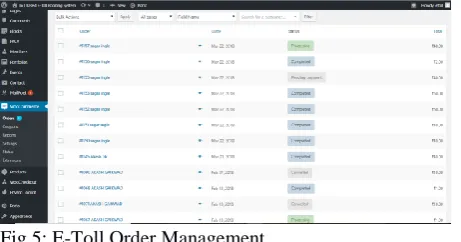
Fig 5: E-Toll Order Management
Fig 5 shows the users complete order details and order status.
5.
ACKNOWLEDGMENTS
We would like to express our special thanks of gratitude to our teacher Prof. R.D.Komati, who gave us the golden opportunity to do this wonderful project, which also helped us in doing a lot of Research and we came to knowabout so many new things. We thank Prof. R.D.Komati for her valuable guidance for the paper.
6.
REFERENCES
[1] Mr.V.B.Dharmadhikari and Abhijeet Suryatali, et al.
"Computer Vision Based Vehicle Detection for Toll Collection System Using Embedded Linux." 2015 International Conference on Circuit, Power and Computing Technologies
[2] W.-H. Lee, B.-S.Jeng, S.-S.Tseng, and C.-H.
Wang,Electronic toll collection based on vehicle-positioning system Techniques, in Proc. IEEE Int. Conf. Networking, Sensing, and Control, Taipei, Taiwan, R.O.C., Mar. 21–23, 2004, pp
[3] C.M. Roberts, “Radio Frequency Identification
(RFID),”Computers & Security, Elsevier, 2006. James J. Barbelllo. Handbook for parallel port design. Prompt Publications, 1999.
[4] Uke Nilesh J., and Ravindra C. Thool. "Moving Vehicle
Detection for Measuring Traffic Count Using
OpenCV."Journal of Automation and Control
Engineering Vol 1.4
(2013).
[5] Ganesh K. Andurkar, Vidya R. Ramteke,”Smart Highway
Electronic Toll Collection System”ISSN: 2320-9801 International Journal of Innovative Research in Computer and Communication Engineering, Vol. 3, Issue 5, May 2015.
[6] Kamalakannan, P., et al. "Automated toll collection with
Complex security system." Education Technology and Computer (ICETC), 2010 2nd International Conference on.Vol. 4. IEEE, 2010.
[7] KRaihan, Kawser Jahan, et al. "Raspberry Pi Image
Processing based Economical Automated Toll System." Global Journal of Researches in Engineering 13.13 (2013).
[8] P Wenter, Siemens AG, Germany, “AUTOMATIC FEE
COLLECTION ON GERMAN AUTOBAHNS - THE CHIPTICKET SYSTEM”, IEEE.
[9] Prof. Amruta Sankhe, Electronic Toll Collection
UsingBarcode Reader, International Journal of Advanced Research in Computer Science and Software
Engineering, 2015.
[10]Radia BELKEZIZ a, Zahi Jarir b, “A Survey on Internet
of Things Coordination”, IEEE 201
[11]Datasheet:Raspbery Pi 3B
[12]Datasheet EM 18 RFID Reader
[13]Datasheet:Stepper Motor
[14]Professional WordPress: Design and Development Book
by Brad Williams, David Damstra, and Hal Stern
[15]Learning OpenCV Book by Adrian Kaehler and Gary
Bradski