www.wjpr.net Vol 3, Issue 3, 2014. 4113
METHOD DEVELOPMENT AND VALIDATION FOR THE
SIMULTANEOUS ESTIMATION OF DUTASTERIDE AND
TAMSULOSIN HYDROCHLORIDE IN PHARMACEUTICAL DOSAGE
FORMS BY RP-HPLC
Jahnavi Bandla*, Gorja Ashok
Department of Pharmaceutical Analysis & QA, Faculty of Pharmacy, Gland Institute of
Pharmaceutical Sciences, Kothapet, Medak-502313, Andhra Pradesh, India.
ABSTRACT
A simple, rapid, accurate and precise method was developed and
validated for the simultaneous estimation of Dutasteride and
Tamsulosin hydrochloride in pharmaceutical dosage form. The method
was based on RP-HPLC. Chromatographic separation was performed
on Xterra-symmetry C18 (150mm x 4.6mm, 5µm particle size) column
using a mobile phase consisting of a mixture of Phosphate buffer (pH
2.5 with dilute orthophosphoric acid): Acetonitrile (20:80%v/v) in an
isocratic mode. The following system conditions were maintained
throughout development and validation i.e., flow rate 0.8mL/min,
column was maintained at room temperature and the detected by a
UV-wave length at 274nm. The Dutasteride and Tamsulosin hydrochloride
were well resolved on the stationary phase and the retention times were
2.0 and 5.0minutes respectively. The method was validated;
Dutasteride and Tamsulosin hydrochloride both were shown to be linear over a range of
25-75µg/mL. The limit of quantification was 18.1µg/mL for Dutasteride and 18.7µg/mL for
Tamsulosin hydrochloride and the limit of detection was 5.9µg/mL for Dutasteride and
6.2µg/mL for Tamsulosin hydrochloride. The Precision, Accuracy, Specificity, Ruggedness
and Robustness were determined to validate the method.
Keywords: Dutasteride, Tamsulosin hydrochloride, RP-HPLC, Method development, Validation and C18 Column.
Volume 3, Issue 3, 4113-4121. Research Article ISSN 2277 – 7105
Article Received on 17 February 2014,
Revised on 09 March 2014, Accepted on 27 March 2014,
*Correspondence for
Author
Jahnavi Bandla
Department of Pharmaceutical
Analysis & QA, Faculty of
Pharmacy, Gland Institute of
Pharmaceutical Sciences,
Kothapet, Medak-502313,
www.wjpr.net Vol 3, Issue 3, 2014. 4114 INTRODUCTION
Dutasteride (DU) (Fig. 1A) is chemically designated as (5α, 17β)-N-{2,5-bis(trifluoromethyl)
phenyl}-3-oxo-4-azaandrost-1-ene-17-carboxamide. It is a dual 5-α reductase inhibitor that
inhibits conversion of testosterone to dihydrotestosterone (DHT). It is used for benign
prostatic hyperplasia; it increases the risk of erectile dysfunctionand decreased sexual desire.
Tamsulosin hydrochloride (TA) (Fig. 1B) is chemically designated as
(-)-(R)-5-[2-[[2-(o-Ethoxyphenoxy) ethyl]amino]propyl]-2-methoxybenzenesulfonamide, monohydrochloride
[1-6]
. It is α1a-selective alpha blocker used in the symptomatic treatment of benign prostatic
hyperplasia (BPH). It is used in the treatment of difficult urination, a common symptom of
enlarged prostate.
According to the literature survey[7-15] it was found that few analytical methods on UV
Spectrophotometer, HPLC, HPTLC, LC-MS/MS and Chiral separations were reported for the
estimation of Dutasteride and Tamsulosin hydrochloride individually and in combination
with other drugs. Hence there is need to develop and validate an analytical method to
estimate drugs. The objective of the proposed method is to develop simple and accurate
method for the simultaneous estimation of Dutasteride and Tamsulosin hydrochloride in
pharmaceutical dosage form by RP-HPLC.
[image:2.595.73.494.427.586.2]
Figure 1: Chemical structures of Dutasteride (A) and Tamsulosin hydrochloride (B)
MATERIAL AND METHODS
Reagents and Chemicals: Dutasteride and Tamsulosin hydrochloride working standards were procured from Pharmatrain, Hyderabad. Combination tablets of Tamsulosin
hydrochloride 400µg and Dutasteride 500µg (DUODART®) were purchased from local
pharmacies. Purified water was obtained from Millipore system. Acetonitrile (HPLC grade)
www.wjpr.net Vol 3, Issue 3, 2014. 4115 Instrumental and analytical conditions: The HPLC analysis was performed using a Waters 2998 model equipped with an autosampler, UV-Vis detector and running on empower
software. Column used was Xterra-symmetry C18 (150mm × 4.6mm, 5µm particle size). UV
detection was performed at 274nm. The injection volume of sample was 20µL. An isocratic
mobile phase containing Acetonitrile and 0.05M potassium dihydrogen orthophosphate buffer
(80:20%v/v), at the pH 2.5 with O-phosphoric acid was carried out with the flow rate of
0.8mL/min. Column was maintained at room temperature.
EXPERIMENTAL
Mobile Phase Preparation
Mixture of Phosphate buffer, pH 2.5 and Acetonitrile in the ratio of 20:80(%v/v) respectively
was used.
Preparation of Standard Solution
Accurately weighed 50mg of Dutasteride working standard and 50mg of Tamsulosin
hydrochloride working standard was transferred into two separate 100mL volumetric flasks.
About 60mL of methanol was added and sonicated to dissolve. The volumes was made up
with methanol and mixed. 1.5mL of these solutions were diluted to 10mL with mobile phase
and mixed.
Preparation of Sample Solution
20 tablets were weighed accurately and the average weight was calculated.
Tablets were crushed to fine powder and equivalent to 50mg of Dutasteride sample was
weighed and transferred into 100mL volumetric flask. 60mL of methanol was added and
sonicated for 30min with intermediate shaking. Volume was made up with methanol. The
above solution was centrifuged for 10min at 8000rpm. 1.5mL of this solution was diluted to
10mL with mobile phase and mixed.
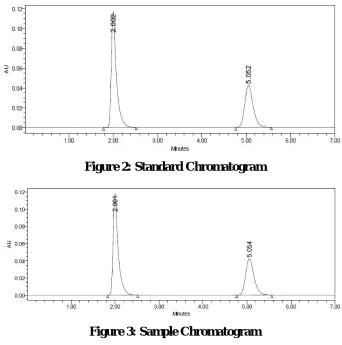
METHOD DEVELOPMENT
An Xterra-symmetry C18 (150mm × 4.6mm, 5µm particle size) as a stationary phase with a
mobile phase of Phosphate buffer, pH 2.5 and Acetonitrile (20:80) at a flow rate 0.8mL/min
and a detection wavelength of 274nm afforded the best separation of drugs. The standard
solution and sample solution prepared as above were injected into the 20µL loop and the
www.wjpr.net Vol 3, Issue 3, 2014. 4116 retention times of drugs, Dutasteride and Tamsulosin hydrochloride were found to be 2.0mins
and 5.0mins respectively. The amount of drugs present in sample was calculated.
[image:4.595.123.465.113.458.2]Figure 2: Standard Chromatogram
Figure 3: Sample Chromatogram
METHOD VALIDATION
The proposed method has been developed and validated for the determination of Dutasteride
and Tamsulosin hydrochloride in pharmaceutical dosage forms. According to International
Conference on Harmonization (ICH)[16,17] guidelines, validation of the method was carried
out by using accuracy, linearity, suitability, range, LOD, LOQ, precision, ruggedness and
robustness.
System suitability
A standard solution was prepared by using Dutasteride and Tamsulosin hydrochloride
working standards as per test method and was injected 5 times into the HPLC system. The
system suitability parameters were evaluated from the USP tailing and USP plate count
values obtained from standard chromatograms as shown in Table 1.
Specificity
www.wjpr.net Vol 3, Issue 3, 2014. 4117 and it was observed that there was no interference from placebo.
Linearity of test solution
A series of solutions are prepared from standard stock solution at concentration levels from
25-125µg/ml for Dutasteride and Tamsulosin hydrochloride.
Accuracy
Drug assay was performed in triplicate as per test method with equivalent amount of drugs
into each volumetric flask for each spike level to get the concentration of drugs equivalent to
50%, 100% and 150% of the labeled amount as the test method.
Precision
Repeatability: Repeatability of method was evaluated by calculating the %RSD of peak areas of six replicate injections for the standard concentration (100%) of drugs.
Ruggudness: The ruggedness was also evaluated by analyzing six samples of drugs by two analysts in the same laboratory using different HPLC systems.
Robustness
Standard solution was prepared as per the test method and analyzed using varied mobile
phase composition (±5% of actual organic phase composition) and flow rate (±0.1ml/min of
actual flow rate). System suitability parameters were evaluated.
Limit of Detection and Limit of Quantitation
The parameters LOD and LOQ were determined on the basis of standard deviation and slope
of the regression equation.
RESULTS AND DISCUSSION Selection of detection wavelength
From the overlain UV spectra, suitable wavelength considered for monitoring the drugs was
274nm as shown in “Fig. 4”.
A RP-HPLC method was developed by using an Xterra-symmetry C18 (150mm × 4.6mm,
5µm particle size) as a stationary phase with a mobile phase of Phosphate buffer, pH 2.5 and
Acetonitrile (20:80) at a flow rate 0.8mL/min and a detection wavelength of 274nm afforded
the best separation of drugs. The injection volume is 20µL and retention time for Dutasteride
www.wjpr.net Vol 3, Issue 3, 2014. 4118 according to ICH guidelines for various parameters like accuracy, precision, linearity,
specificity, ruggedness, robustness, LOD and LOQ. Linearity was obtained in the
concentration range of 25-125µg/mL for Dutasteride and Tamsulosin hydrochloride with
correlation coefficient (r) of 0.999. The %recovery was found to be 99.91% for Dutasteride
and 99.99% for Tamsulosin hydrochloride. The %RSD was found to be 0.42 for Dutasteride
and 0.45 for Tamsulosin hydrochloride.
Figure: 4 Overlain spectra of (a) Dutasteride and (b) Tamsulosin hydrochloride
Table: 1 Data for Optimize Chromatographic condition Name Retention time
(Min)
Area
(µV*sec) USP Plate Count USP Tailing Resolution
Dutasteride 2.006 921892 2712 1.8
11.0 Tamsulosin
hydrochloride 5.060 551768 3428 1.3
www.wjpr.net Vol 3, Issue 3, 2014. 4119 Figure: 6B Linearity plot of Tamsulosin hydrochloride
Table: 2 Result of different parameters
Parameters Dutasteride Tamsulosin
hydrochloride
Specificity Specific Specific
Linearity
Regression equation, y=mx+c y = 14853x – 127803 y = 8852.3x - 73823 Correlation coefficient (r) 0.9992 0.9992 Accuracy
(recovery) n=3
Level I (50%) 99.61% 100.08%
Level II (100%) 99.97% 100.13%
Level III (150%) 100.17% 99.76%
Precision (%RSD) n=6 0.42 0.45
Ruggedness (%RSD) n=6 0.46 0.31
Robustness (%RSD)
Variation in flow rate (±0.1) < 2 < 2 Variation in organic composition in
mobile phase (±5%) < 2 < 2
Limit of Detection (LOD) 5.9µg/mL 6.2µg/mL Limit of Quantitation (LOQ) 18.1µg/mL 18.7µg/mL System
Suitability
USP Plate Count 2712 3428
USP Tailing 1.8 1.3
CONCLUSION
A simple, precise, accurate, rapid, economical analytical method for simultaneous estimation
of Dutasteride and Tamsulosin hydrochloride has been developed by using RP-HPLC
method. The developed method was validated as per ICH guidelines. The proposed method
shows good agreement with all validation parameters. The optimized method is precise,
accurate, specific, rugged, and robust and a linear relation is observed between the
concentration and the result. The developed method can be used for the analysis of routine
www.wjpr.net Vol 3, Issue 3, 2014. 4120 ACKNOWLEDGEMENTS
The authors are thankful to Pharmatrain, Hyderabad, India for providing the gift samples.
REFERENCES
1. Tripathi K.D. Essentials of medical pharmacology. 6th edition, Jaypee brother medical
publisher: 2008.
2. Sweetman SC. Martindale, The Complete Drug Reference. 34th ed. London; The
pharmaceutical press: 2005, pp 1549.
3. Budavari S. The Merck Index. 13th ed. Whitehouse station, NJ; Merck & Co, Inc: 2001,
pp.3504.
4. Martindale. The Extra Pharmacopoeia. Council of Royal Pharmaceutical Society of Great
Britain. 29th edition: 1989.
5. Budavari S. The Merck Index. Merck and Co. Inc. White House Station, NJ, USA; 14th
edition: 1996.
6. Sethi PD. High Performance Liquid Chromatography-Quantitative analysis of
Pharmaceutical Formulations. 1st Ed., CBS Publishers & Distributors: New Delhi, India;
2001.
7. Sangita Agarval, Veeran Gowda. K, Amlan Kanti Sarkar, Debotri Ghosh, Uttam
Bhaumik, Tapas Kumar Chattaraj, Tapan Kumar Pal. Simultaneous determination of
Tamsulosin and Dutasteride in human plasma by LC–MS–MS. Chromatographia, 2008;
67 (11-12): pp. 893–903.
8. Bari S. B., Bakhshi A. R., Jain P.S., Surana S.J. Development and validation of
stability-indicating HPTLC determination of tamsulosin in bulk and pharmaceutical dosage form.
Chromatogr. Res. Int., 2011; 89326: pp. 6
9. Vishnu P. Choudhari, Asawaree A. Hable, Sagar S. Bolegaonkar, Sachin S. Suryawanshi,
Sacchidanand R. Gite, Bhanudas S. Kuchekar. Spectrophotometric simultaneous
determination of dutasteride and tamsulosin in combined tablet dosage form by ratio
derivative and dual wavelength method and its application to determine uniformity of
contents. Der Pharma Chemica, 2012; 4 (3): pp. 989–995.
10. Kamila M.M., Mondal N., Ghosh L.K. A validated spectrophotometric method for
determination of dutasteride in bulk drug and pharmaceutical formulations. Int. J. Pharm.
www.wjpr.net Vol 3, Issue 3, 2014. 4121 11. Maier V., Horakova J., Petr J., Tesarova E., Coufal P., Sevcik J. Chiral separation of
tamsulosin capillary electrophoresis. J. Pharm. Biomed. Anal., 2005; 15 (39): pp. 691–
696.
12. Pande V.V., Jadhav J.N., Chandorkar J.G. Simultaneous estimation of tamsulosin
hydrochloride and dutasteride in combined dosage form by UV spectroscopy method. J.
Pharm. Res., 2009; 2 (3): pp. 507–509.
13. Dipti B. Patel, Natubhai J. Patel. Validated RP-HPLC and TLC methods for simultaneous
estimation of tamsulosin hydrochloride and finasteride in combined dosage forms. Acta
Pharm., 2010; 60: pp. 197–205.
14. Dipti B. Patel, Natubhai J. Patel. Validated stability indicating HPTLC method for the
determination of dutasteride in pharmaceutical dosage forms. Chromatogr. Res. Int.,
2011; 278923: p. 5
15. Pekka Keski Rahkonen, Olavi Parssinen, Esa leppanen, Timo Mauriala, Marko lohtonen,
Seppo Auriola. Determination of tamsulosin in human aqueous humor and serum by
liquid chromatography – electrospray ionization tandem mass spectrometry. J.
Pharmaceut. Biomed. Anal., 2007; 43 (2): pp. 6006–6612.
16. ICH, Validation of Analytical Procedures: Text and methodology Q2 (R1): International
Conference on Harmonization, IFPMA, Geneva (2005).
17. United States Pharmacopoeia (USP), XXVI. Validation of compendial methods. United