FORMULATION DEVELOPMENT AND EVALUATION OF
SUSTAINED RELEASE TABLETS OF LORNOXICAM
Abhishek Pandey*1 and Sanket Singhal2
1
School of Studies in Pharmaceutical Sciences, Jiwaji University, Gwalior (M.P.).
2
A.R.A. College of Pharmacy, Dhule, Maharashtra.
ABSTRACT
Lornoxicam is a non-steroidal anti-inflammatory drug, Lornoxicam has
short half-life (3-5 hr.), makes the development of sustained-release
(SR) forms extremely advantageous, lornoxicam is weak acid having
pKa 5.1, it has pH dependent solubility, characterized by poor
solubility in low pH condition present in stomach, which consequently
leads to a delayed onset of its analgesic action. Formulation of
sustained release tablet is effective approach for non- steroidal
anti-inflammatory drug (lornoxicam) for maximum pain relief with prolong
drug concentration due to sustained release from tablet matrix.
Different formulations (F1- F8) were designed with HPMC (K4M and
K100), MCC, PVP k30, magnesium stearate and talc. Pre and post
compression parameters for all formulations were studied. Batch F8 selected as optimized
batch on the basis of dissolution profile.
KEYWORDS: Lornoxicam, Sustained release, Dissolution, HPMC.
INTRODUCTION
Oral route of drug administration is the most important method of administering drugs for
systemic effects. Nevertheless, it is probable that at least 90% of all drugs used to produce
systemic effects are administered by the oral route. When a new drug is discovered, one of
the first questions a pharmaceutical company asks is whether or not the drug can be
effectively administered for its intended effect by the oral route.
Tablet represents unit dosage forms in which one usual dose of drug has been accurately
Volume 6, Issue 4, 928-935. Research Article ISSN 2277– 7105
*Corresponding Author
Abhishek Pandey
School of Studies in
Pharmaceutical Sciences,
Jiwaji University, Gwalior
(M.P.).,
Article Received on 22 Jan. 2017,
Revised on 12 Feb. 2017, Accepted on 05 March 2017
above the stomach, especially when coated, provided that tablet disintegration is not
excessively rapid. Tablets are compressed of two or three tablets of granulation compressed
together. They have the appearance of a sandwich because the edges of each tablet are
exposed.[1] Extended Release systems were introduced three decades ago. Extended release,
extended action, prolonged release, controlled release, timed release, depot and repository
dosage forms are the terms used to identify drug delivery system that are designed to achieve
a prolonged therapeutic effect by continuously releasing medication over an extended period
of time after administration of a single dose. Expressions such as “prolonged action”, & “Sustained release” have also been used to describe extended release dosage form.[2-3]
Lornoxicam is a non-steroidal anti-inflammatory drug, Lornoxicam has short half-life (3-5
hr.), makes the development of sustained-release (SR) forms extremely advantageous, but
Lornoxicam is weak acid having pKa 5.1, it has pH dependent solubility, characterized by
poor solubility in low pH condition present in stomach, which consequently leads to a
delayed onset of its analgesic action. Formulation of sustained release tablet is effective
approach for non- steroidal anti-inflammatory drug for maximum pain relief. Extended
release dosages forms cover a wide range of prolong action preparation that provides
continuous release of their active ingredient for a specific period of time.[4] By prescribing
sustained release system, it is possible to achieve several therapeutic advantages like
Frequency of doses reduced. Patient compliance can be improved, and drug administration
can be made more convenient. The aim of the present research work was to develop sustained
release tablet of lornoxicam to maintain its prolong drug concentration due to sustained
release from tablet matrix.
MATERIAL AND METHODS
MATERIAL
Lornoxicam was obtained as gift sample from Ajanta Pharmaceuticlas Pvt Ltd. HPMC,
Microcrystalline cellulose, PVP k 30, Magnesium stearate, Talc were of Lobachem.
METHODS
Drug - excipients Interaction Study[5]
Preformulation testing is an investigation of physical and chemical properties of a drug
sealed. The sealed vials were kept at 40°C at 75% RH for 1 month relative humidity for 30
days in stability chamber.
Evaluation of physical properties[6] Angle of repose
The angle of repose was determined by the funnel method. The accurately weighed powder
was taken in a funnel. The height of the funnel was adjusted in such a way that the tip of the
funnel just touched the apex of the heap of the powder. The powder was allowed to flow
through the funnel freely onto the surface. The diameter of the powder cone was measured.
The bulk density and tapped density (TBD) of drug, polymers and excipients were
determined. 2 gm of powder was introduced into a 10 ml calibrated measuring cylinder. After
noting down the initial volume, the cylinder was allowed to fall under its own weight onto a
hard surface from the height of 2.5 cm at 2 seconds intervals.
Compressibility
The compressibility index of all ingredients were determined by following equations.
Formulation of tablet
The Sustained Release was achieved by means of a polymeric matrix for which the tablet is
formed. Sustained release tablet tends to swell and slowly erode rather than disintegrating.
Formulation and development of Lornoxicam Sustained release tablet involves following
steps.
Manufacturing of Lornoxicam Sustained Release Tablet[7-9] Sifting of active material.
Melting of hydrophobic polymers on hot water bath & heating of drug in tray dryer. Addition of active material to melt of polymer with continuous stirring.
Solidifying melted mixture at room temperature. Screening of solidified mass- granulation.
Table.1 Composition of Lornoxicam Sustained Release Tablet.
Composition Quantity in mg
Lornoxicam 12 12 12 12 12 12 12 12
MCC 157 152 162 167 172 182 167 172
HPMC K4M 90 90 85 60 60 50 40 40
PVP K30 5 10 15 15 15 15 15 15
Purified Water q.s q.s q.s q.s q.s q.s q.s q.s
HPMC K100M - - - 10 15 25 30 25
Talc 2 2 2 2 2 2 2 2
Mg.Sterate 4 4 4 4 4 4 4 4
Total 450 450 450 450 450 450 450 450
Evaluation of sustained release tablet[10-12] Weight variation test
According to the official test, 20 tablets were weighed individually and collectively. Average
weight per tablet was calculated from the collective weight. Then the weights of the
individual tablets were compared with the average weight to determine weight variation.
Friability and hardness
For each formulation, the hardness of 6 tablets was determined using the Monsanto hardness
tester. In The Roche friabilator the weight of tablets was noted initially (W1) and placed in a
friabilator for 4 min/ 100 rpm. The tablets were reweighed and noted as (W2). The difference
in the weight is noted and expressed as percentage.
Thickness
The thickness of the tablets was determined using a vernier caliper. 20 tablets from each
batch were used.
Drug content
Ten Tablets were weighed individually, crushed, and the drug was extracted in phosphate
buffer ph 7.4. The solution was filled through a 0.45 um Millipore filter and drug content was
determined by UV spectroscopy after a suitable dilution with reference to calibration curve.
In-vitro dissolution parameter (Table.2).
Dissolution medium pH 6.8 phosphate buffer Dissolution medium volume 1000ml
Apparatus USP Type-II,Paddle
RESULT AND DISCUSSION
Precompression parameter of sustained release tablet blend.
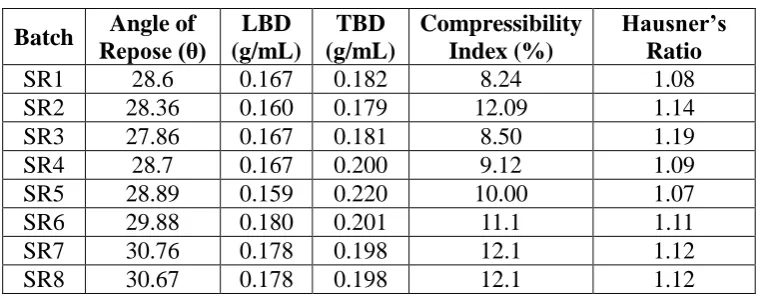
Precompression parameters like angle of repose, loose bulk density, tapped bulk density,
compressibility index, and hausner’s ratio of all batches of lornoxicam was represented in
[image:5.595.108.491.206.355.2]table 3.
Table: 3 Precompression parameters of sustained release tablet
Batch Angle of Repose (θ) LBD (g/mL) TBD (g/mL) Compressibility Index (%) Hausner’s Ratio
SR1 28.6 0.167 0.182 8.24 1.08
SR2 28.36 0.160 0.179 12.09 1.14
SR3 27.86 0.167 0.181 8.50 1.19
SR4 28.7 0.167 0.200 9.12 1.09
SR5 28.89 0.159 0.220 10.00 1.07
SR6 29.88 0.180 0.201 11.1 1.11
SR7 30.76 0.178 0.198 12.1 1.12
SR8 30.67 0.178 0.198 12.1 1.12
Evaluation of Sustained release tablets
Weight variation of tablet was found within limit (460 ± 5%). Friability of bi-tablet tablet
0.1% was found less than 1% except in batch F1 & F2 due to less binder. Hardness was found
9.0-9.5, in batch F1 & F2 hardness is less (5.0-6.5) and thickness variation was found less
than 5% variation. Content uniformity of lornoxicam in bi-tablet tablet was found between 92
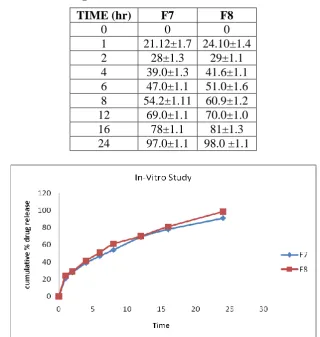
-99% respectively. Batch F7 and F8 were selected to obtained for dissolution study on the
basis of drug content uniformity among them batch F8 exhibited desired release profile.
(Table 4 and 5).
Table. 4 Properties of Sustained release tablet
Sr. NO Weight
Variation (mg) *
Thickness (mm) * Hardness (Kp) † Friability (%)† Drug Content Uniformity (%)
F1 460±1.3 7.0±0.03 5.0±0.60 1.12±1.1 92.0±1.1
F2 461±2.1 5.4±0.04 6.5±0.50 1.00±0.9 97.0±1.2
F3 459±1.3 6.1±0.09 9.12±1.20 0.1±0.12 95.0±1.1
F4 460±1.1 5.7±1.8 9.3±0.89 0.12±0.1 97.0±1.1
F5 462±1.1 6.0±1.1 9.5±0.55 0.13±0.2 96.0±1.3
F6 460±1 5.9±1.4 9.4±0.98 0.14±0.1 97.0±0.4
F7 460±2.7 6.0±1.8 9.3±1.20 0.12±0.3 99.0±1.0
Table: 5 Cumulative % Drug Release Lornoxicam from Bi-tablet Tablet
TIME (hr) F7 F8
0 0 0
1 21.12±1.7 24.10±1.4
2 28±1.3 29±1.1
4 39.0±1.3 41.6±1.1
6 47.0±1.1 51.0±1.6
8 54.2±1.11 60.9±1.2
12 69.0±1.1 70.0±1.0
16 78±1.1 81±1.3
24 97.0±1.1 98.0 ±1.1
Fig.1 In-vitro drug release study of sustained release tablet Batch F7 and F8
Drug release study
The zero-order rate describes the systems where the drug release rate is independent of its
concentration. Figure.2shows that cumulative amount of drug release vs. time for zero-order
[image:6.595.141.454.562.742.2]The first order Equation which describes the release from systems where the release rate is
concentration dependent, is illustrated by figure 3, shows the log cumulative percent drug
remaining vs. time.
Figure: 3 First order plot (cumulative amount drug release vs. time)
CONCLUSION
Sustained release tablet formulated by using HPMC as release retardant, two grades of
HPMC that are HPMC K4M and HPMC K100M selected, PVP-K30 Selected As Binder.
Batch F1 and F2 Increases the binder concentration to increase hardness and pass the
friability test. Various trial batches are taken to get sustained release profile for 24 hr by
addition of HPMC K4M and HPMC K100M extragranular to intragranular ratio. Batch F7
give maximum release 97.0% in 24 hr is selected as batch in formulation of sustained release
tablet. Batch F8 formulate as sustained release tablet which shows 24.10 % of drug release in
1 hr and 98. % drug release in 24 hr is selected as optimized batch of sustained release tablet
formulation.
ACKNOWLEDGEMENT
The authors acknowledge Ajanta Pharmaceuticlas Pvt. Ltd. to provide lornoxicam as gift
sample.
Conflict of interest
REFERENCES
1. Lachman L, Lieberman HA, Kanig JL. The Theory and Practice of Industrial Pharmacy.
3rd edition, Varghese publishing house, Bombay, 1991: 453: 317-20.
2. USP 30/NF25, Pharmacceutical Dosage Forms, 30 Edition, MAY, 2007; 1151.
3. Brahmankar DM, Jaiswal SB. Biopharmaceutics and Pharmacokinetics: A Treatise. 1st
edition, Vallabh Prakashan, Delhi, 1995; 215-220.
4. Collate J, Morenton C, Pharmaceutics: The Science and Practice of Pharmacy. 1st edition,
(Aulton M.E., Ed.) Churchill Livingstone, London, 1996; 315-20.
5. Lee TWY and Robinson J R. Controlled release drug delivery system. 47 In Gennaro AR.
(Ed.), Remington: The science and practice of pharmacy. 20th edition, Mack publishing
house, Easton, Pannsylvania, 2000; 903-914.
6. Vyas SP, Khar RK. Controlled drug delivery: concepts and advances. 1st edn. Delhi:
Vallabh Prakashan, 2002; 1-6.
Brahmankar DM, Jaiswal SB. Controlled release medications, Biopharmaceutics and
pharmacokinetics: A treatise. 1st edn, New Delhi: Vallabh prakashan, 1995; 336: 337.
Jain NK. Progress in controlled and novel drug delivery system. 1st edn. New Delhi:
CBS Publishers, 2002; 76-97.
7. Hui ho-wah "Design and fabrication of oral controlled release drug delivery systems",
Chapter 9, In Robinson JR and Lee VHL (Eds.) Controlled drug delivery; fundamentals
and applications. 2nd edition, Marcel Dekker Inc., New York, 1978; 29: 373.
8. Yassin EH, Mona HA. Design and In Vitro Evaluation of Novel Sustained-Release
Double Layer Tablets of Lornoxicam: Utility of Cyclodextrin and Xanthan Gum
Combination. AAPS Pharm Sci Tech, Dec, 2009; 10(4).
9. Yasin EH, Mona HA. Innovation of novel Sustained release compression-coated tablets
for lornoxicam: formulation and in vitro investigations, Drug Dev Ind Pharm., 2010; 36:
337-49.
10. Skjoodt NM, Davies NM. Clinical pharmacokinetics of Lornoxicam. A short half-life