S T U D Y P R O T O C O L
Open Access
Facilitating return to work through early
specialist health-based interventions
(FRESH): protocol for a feasibility
randomised controlled trial
Kathryn A Radford
1*, Julie Phillips
1, Trevor Jones
2, Ali Gibson
3, Chris Sutton
3, Caroline Watkins
3, Tracey Sach
4,
Lelia Duley
5, Marion Walker
1, Avril Drummond
6, Karen Hoffman
7, Rory O
’
Connor
8, Denise Forshaw
3and
David Shakespeare
9Abstract
Background:Over one million people sustain traumatic brain injury each year in the UK and more than 10 % of these are moderate or severe injuries, resulting in cognitive and psychological problems that affect the ability to work. Returning to work is a primary rehabilitation goal but fewer than half of traumatic brain injury survivors achieve this. Work is a recognised health service outcome, yet UK service provision varies widely and there is little robust evidence to inform rehabilitation practice. A single-centre cohort comparison suggested better work outcomes may be achieved through early occupational therapy targeted at job retention. This study aims to determine whether this intervention can be delivered in three new trauma centres and to conduct a feasibility, randomised controlled trial to determine whether its effects and cost effectiveness can be measured to inform a definitive trial.
Methods/design:Mixed methods study, including feasibility randomised controlled trial, embedded qualitative studies and feasibility economic evaluation will recruit 102 people with traumatic brain injury and their nominated carers from three English UK National Health Service (NHS) trauma centres. Participants will be randomised to receive either usual NHS rehabilitation or usual rehabilitation plus early specialist traumatic brain injury vocational rehabilitation delivered by an occupational therapist. The primary objective is to assess the feasibility of conducting a definitive trial; secondary objectives include measurement of protocol integrity (inclusion/exclusion criteria, intervention adherence, reasons for non-adherence) recruitment rate, the proportion of eligible patients recruited, reasons for non-recruitment, spectrum of TBI severity, proportion of and reasons for loss to follow-up, completeness of data collection, gains in face-to-faceVs postal data collection and the most appropriate methods of measuring primary outcomes (return to work, retention) to determine the sample size for a larger trial.
Discussion:To our knowledge, this is the first feasibility randomised controlled trial of a vocational rehabilitation health intervention specific to traumatic brain injury. The results will inform the design of a definitive trial.
Trial registration:The trial is registered ISRCTN Number 38581822.
Keywords:Occupational therapy, Return to work, Traumatic brain injury, Vocational rehabilitation, Feasibility, Randomised controlled trial
* Correspondence:[email protected]
1
Division of Rehabilitation and Ageing, School of Medicine, Medical School Queen’s Medical Centre, B-Floor, Nottingham NG7 2UH, UK
Full list of author information is available at the end of the article
Background
Approximately 1.4 million people in the UK sustain trau-matic brain injury (TBI) each year [1] and up to 150,000 incur moderate or severe injury [2] resulting in cognitive and psychological problems that interfere with daily living activities including work. The societal cost of TBI in terms of diagnostic tests, treatment, rehabilitation, lost time at work and dependency on benefits is estimated at 2.8 bil-lion Euros per year in Germany (price year unclear but survey conducted 2000/1) [3]. It is also a known cause of personal bankruptcy [4]. People who do not return to work are more likely to be depressed [5].
Returning to work is a primary rehabilitation goal yet reported success varies widely. Only around 41 % of TBI survivors who were working before their injury are in work at 1 and 2 years later [6]. The reasons for this are complex. Systematic reviews of factors predicting a re-turn to work following TBI are inconclusive [7–10]. Bio-medical factors such as injury severity or post injury physical or neuropsychological function alone do not fully explain work outcomes. Personal, environmental, social and organisational factors are also known to influ-ence outcome success in supporting people with long-term conditions to return to work [11]. Whilst study heterogeneity and known difficulty in following people with TBI up over time [12] explain some of the difference in reported TBI work outcomes, inadequate rehabilitation cannot be excluded as a cause. Keeping people with TBI in work is also problematic. Many TBI survivors return prematurely but leave once the impact of the brain injury on their job is realized [13].
What is vocational rehabilitation?
Vocational rehabilitation (VR) is defined as “whatever helps someone with a health problem to stay at, return to and remain in work” [14]. It involves helping people find work, helping those who are working but having difficulty and supporting career progression in spite of illness or disability. It is recognised as an important out-come of the UK National Health Service (NHS) health in-terventions [15], as a role for healthcare professionals [16] and recommended in clinical guidelines for TBI [17–19]. However, health services supporting people with TBI in returning to work are rare in the UK [20, 21]. For many people with TBI, NHS provision does not typically extend to VR. When it does, this is often towards the end of re-habilitation, after goals for independence in mobility and daily function have been achieved. People with milder head injuries and/or hidden disabilities, such as cognitive, hearing or visual impairment and those with milder TBI, are often discharged without follow-up.
There is a lack of evidence to support the effectiveness or cost effectiveness of VR for people with TBI. Whilst re-habilitation interventions for people with TBI have been
evaluated using randomised controlled trials and work outcomes reported [22, 23], these were military trials and the interventions not specific to vocational rehabilitation. In a systematic review of vocational rehabilitation models, Fadyl et al. [24] identified only one randomised controlled trial (n= 22) that included a mixed acquired brain injury sample and only seven people with a traumatic brain in-jury [25].
In a single-centre cohort comparison, an early TBI specialist vocational rehabilitation intervention (ESTVR) delivered by an occupational therapist (OT), supported by a TBI case manager was compared to usual NHS re-habilitation (whatever support was available locally) and found it to be more effective (27 % more people with moderate and severe TBI in work at 12 months) at return-ing people with TBI to work and keepreturn-ing them there 12 months after injury than usual care [26]. The mean per-patient difference in health and social care costs was only £75.00. This was because usual care participants re-ceived roughly the same amount of input but from GPs and other non-coordinated community services.
The primary focus of the ESTVR intervention was on preventing job loss by identifying people early after in-jury and focusing on timely returning to work with an existing employer (job retention). However, as ESTVR was an existing part of traumatic brain injury service provision in Nottingham and the intervention was delivered by a single therapist in one centre, uncertainty exists as to whether the successful outcomes were attributable to ESTVR and whether it can be delivered by therapists elsewhere.
Aim
The primary aims are to assess the feasibility of (i) deliv-ering early specialist traumatic brain injury vocational rehabilitation (ESTVR) in three NHS regional TBI refer-ral centres in a way that is acceptable to people with TBI, NHS staff and employers when compared to usual NHS rehabilitation and of (ii) conducting a randomised controlled trial comparing ESTVR in addition to the usual NHS rehabilitation with usual NHS rehabilitation alone. In addition, we aim to identify the primary outcome of importance of ESTVR to service providers, service users and employers. This will enable us to determine whether a definitive evaluation trial is feasible and, if so, how its design can be optimised.
Study objectives In addition, we will:
2) estimate the recruitment rate and the proportion of potentially eligible TBI patients recruited and identify reasons non-recruitment (missed, medical, logistic, others);
3) estimate the proportion of participants lost to follow-up and the reasons for loss to follow-up; 4) determine the spectrum of TBI severity among
recruits;
5) explore the views of TBI patients and staff on recruitment and the acceptability of randomisation; 6) determine the most appropriate method(s) of
measuring key outcomes (return to work, retention);
7) estimate parameters necessary to calculate sample size for a larger trial (e.g. rate of return to work at 12 months in control group);
8) explore the completeness of data collection for potential primary outcome(s) for a definitive trial; 9) explore potential gains in using face-to-face rather
than postal data collection; and
10) investigate how return to work is related to mood, wellbeing, function, work capacity, social
participation, quality of life and carer-strain.
In a series of embedded qualitative studies, we will explore retrospectively the following items:
1. What service interventions are most valued in practice by an employee with TBI?
2. What service interventions are most valued in practice by an employer?
3. Clinical NHS staff views of the acceptability and usefulness of the ESTVR training package, including the manual and mentoring system.
4. Service user, employer and NHS staff views on factors likely to affect the ESTVR implementation and clinical delivery in the NHS.
Methods/design
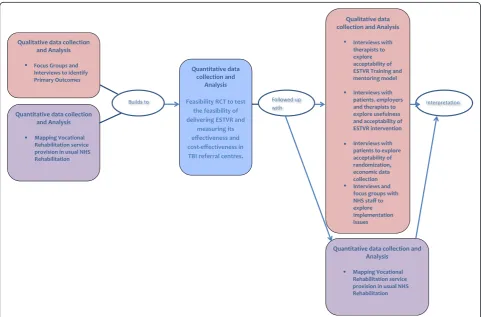
Mixed methods: Feasibility individually randomised parallel-group controlled trial with embedded qualitative evaluation and feasibility economic evaluation can be seen in Fig. 1.
Participants
Adults (aged 16 and above) living in the London, Pres-ton and Leeds health communities and admitted for
[image:3.595.57.539.389.706.2]48 h or more with new TBI and who were either in work (paid or unpaid) or in full-time education prior to their injury. Those not intending to return to work/study, un-able to consent for themselves or living more than 1 h (or reasonable) travelling distance from the recruiting centre will be excluded. Nominated carers of recruited patients will also be invited to take part. Carers who are not nominated by a TBI participant will be excluded. We will attempt to include people with a language barrier or in whom English is not their first language.
Identification and recruitment of trial participants
Potential participants will be identified by members of the existing clinical care team using existing TBI regis-ters. The initial approach will be from a member of the patient’s usual care team, who will provide information sheets and notify the research team. The research team (research assistant or research network nurse) will in-form potential participants of all aspects pertaining to participation in the study.
The University of Nottingham’s (sponsor) screening log will be used to monitor and identify recruitment against eligibility criteria and demonstrate that recruits are representative of the group as a whole. The propor-tion of refusals and reasons for refusal (where given) will be recorded. Every person with TBI admitted fitting the inclusion criteria during the trial recruitment period will be entered onto the screening log by the research assist-ant or research network nurse. Minimum data recorded will be age, gender, meeting eligibility criteria (Y/N), consented (date) or reason for non-consent.
Discharged patients will be sent a participant informa-tion sheet with covering letter from the consultant informing them about the project and stating that the researcher will contact them to ask if they are interested in taking part. If the patient expresses interest, then an appointment will be made for the researcher to visit, an-swer any questions and, if applicable, take informed writ-ten consent.
Consenting TBI participants will be asked to nominate a carer (spouse, partner, parent or person with whom they have most contact) during the baseline assessment visit. Carers will be sent a carer’s information sheet and covering letter from the consultant informing them about the project and stating that the researcher will contact them to ascertain their interest in taking part. Interested carers will be visited by a member of the research team to take written consent. Carers will only be recruited with consent from the TBI participant.
Completeness of carer recruitment will be verified by crosschecking TBI participants with nominated carers and the proportion of identified consenting carers recruited. This will be done by the research assistant employed in each centre.
The process for obtaining participant informed consent will be in accordance with Research Ethics Committee guidance and Good Clinical Practice. The investigator or their nominee and the participant shall both sign and date the informed consent form before the person can participate.
Baseline assessments will be completed prior to ran-domisation and within 8 weeks of TBI (this time frame was based on data from the original cohort comparison study where most recruitment occurred within 5 weeks of injury and because we were keen to ensure that par-ticipants received early intervention to prevent job loss). All baseline measures will be collected face-to-face by the research assistant or research nurse either in hospital or at the participant’s home if they have been discharged at the time of recruitment.
Randomisation
Patient participants will be randomised by the research as-sistant using stratified randomisation (strata based on centre) via a computer-generated random allocation se-quence created by Nottingham Clinical Trials Unit accessed via the web. The randomisation will be based on a computer-generated pseudo-random code using random permuted blocks of randomly varying size, created by Not-tingham CTU in accordance with their standard operating procedure and held on a secure server.
The participants will be un-blinded to the intervention group allocation. Other members of the research team (chief investigator, health economist, data coordinator and trial management team) including the research as-sistant responsible for collecting face-to-face follow-up outcome measures and data entry staff will be blinded to group allocation. Allocation will remain concealed until all interventions are assigned and recruitment, data col-lection, and analyses complete.
Each participant will be assigned a trial identity code, allocated at randomisation, which will be used on case report forms, other trial documents and the electronic database. The documents and database will also use their initials and date of birth.
Intervention and comparator
Early specialist traumatic brain injury vocational rehabilitation (ESTVR)
Participants (TBI patients) randomised to the interven-tion group will receive all usual NHS rehabilitainterven-tion in-terventions but, in addition, will receive ESTVR (as required) targeted at job retention.
single-centre cohort comparison study [27], and the results suggested a positive influence on 12-month work outcomes in those who received it. ESTVR is a case coordination model [24] based on best practice guidelines for vocational rehabilitation following ac-quired brain injury [19]. It is delivered by an occupa-tional therapist, supported by a health-based case manager both of whom have knowledge and skills in working with people with a TBI and in vocational re-habilitation. Most interventions are delivered in the community.
People with TBI are identified early (at point of in-jury) and the intervention aims to prevent job loss. The vocational rehabilitation intervention seeks to lessen the impact of TBI by assessing the patient’s role as a worker and finding acceptable strategies to overcome problems, e.g. assessing and addressing new disabilities which might impact directly on work activities. The intervention process follows three stages, assessment, intervention, monitoring and review. Detailed assess-ment of the person’s occupational status and vocational aspirations and functional capacity for work, is followed by intervention to prepare the TBI person for work by providing pre-work training and establishing structured routines with gradually increasing activity levels; oppor-tunity to practice work skills, e.g. computer use to in-crease concentration, cooking to practice multi-tasking. The occupational therapist liaises with employers/tu-tors and employment services to advise about the ef-fects of TBI and plan and monitor-graded work return, conduct worksite visits and job evaluations, identifies the need for workplace or job adaptations and serves as the link between health and employment services to ac-cess additional support. During monitoring and review, progress is reviewed and ongoing advice, support and feedback provided for TBI patient, family and employer (supervisor and work colleagues as appropriate) with ongoing liaison with employment services if needed. TBI case managers coordinate the overall TBI care package and provide support, education and advice to patients, family and others, e.g. NHS staff, social ser-vices, headway and solicitors, remaining in contact with patients and families whilst there are achievable re-habilitation goals.
The intervention is tailored to individual needs ac-cording to the following menu of components:
assessing people’s functional capacity for work;
detailed job evaluation and safety assessment;
liaison with employers regarding necessary accommodations (equipment and adaptations) and graduated return to work programmes;
individual work-related goal setting and problem-solving sessions;
partnership working with statutory and voluntary service providers such as disability employment and benefits advisors and headway;
negotiating voluntary work placements, and
providing information and advice to TBI patients, their families and employers and counselling.
A manualised training programme, developed in ad-vance of the trial and based on the original Nottingham Pilot [26, 27], will be delivered centrally to occupational therapists and case managers (a nominated member of the rehabilitation team who will be trained to adopt a vocational rehabilitation case manager role) in each of the three NHS centres. The training and intervention delivery will be supported by telephone and email men-toring. Intervention delivery will be quality monitored and fidelity checks implemented to assess adherence to the ESTVR model.
Control: usual NHS rehabilitation
Participants allocated to the control group will avail themselves of usual health and social care services as necessary.
We will attempt to measure and describe the current focus of usual care by including resource use questions in our outcome measurement. In addition, efforts to support people with TBI in a return to work in usual NHS rehabilitation (UC) will be gathered in qualitative interviews with usual care participants.
Concomitant therapy
There are no known issues with the intervention and concomitant treatments, therefore no concomitant treat-ments will be excluded. Information on participants’use of other community rehabilitation, social care and third-sector services will be recorded as part of the assessment of feasibility.
Follow-up
Follow-up assessments will be completed by a research assistant masked to treatment allocation in one centre and by postal questionnaire in two centres. Steps will be taken to minimise missing data by personal contact and text messaging to prompt returns. Every attempt will be made to locate participants for follow-up.
Outcome data will be entered by a data manager blind to treatment allocation at Lancashire Clinical Trials Unit. Electronic data will be backed up every 24 h to both local and remote media in encrypted format.
Assessment of objectives
The study adopts the National Institute for Health Re-search Health Technology Assessment (NIHR HTA) definition of a feasibility study [28]. The primary ob-jective will be to assess the integrity of the study proto-col to determine the feasibility of conducting a larger, appropriately powered trial. The assessment of feasibil-ity will be determined by measuring eligible numbers, the recruitment rate per centre, the spectrum of disease among recruits, reasons for non-recruitment, compliance with vocational rehabilitation in the intervention group and with usual care in controls and the completeness of follow-up of the primary endpoint. The study will also en-able us to determine whether participants can be rando-mised to the intervention and the likely effect on drop out of randomisation to the control group (i.e. whether pa-tients randomised to receive no vocational rehabilitation are more likely to withdraw).
The feasibility objectives will be measured as identified in Additional file 1.
Determination of acceptability in TBI patients, staff and employers will be measured by interviewing up to 30 trial participants, 10–20 employers and the therapists providing the intervention (n= 4) to seek their views on the interventions (ESTVR vs UC) and in-patients and staff only, their views on recruitment and the acceptabil-ity of randomisation. We will seek to understand what service interventions are most valued in practice by an employee with TBI and which by an employer. We an-ticipate that we will interview between 10 and 20 em-ployers (not all TBI participants will agree to employer contact), 15 NHS staff (5 from each centre), 4 ESTVR trained therapists and 30 trial participants (15 in each arm of the trial). It was felt that this would provide suffi-cient data to inform the feasibility objectives and identify issues and strategies to inform the design of the defini-tive trial.
The combination of the qualitative process data, plus the feasibility trial data will help to determine the integ-rity of the study protocol and allow us to estimate pa-rameters necessary to calculate the sample size for a larger trial (e.g. rate of return to work at 12 months in control group).
This feasibility trial will enable us to measure recruit-ment, retention, the viability of delivering the interven-tion and measurement of the effectiveness and cost effectiveness of ESTVR plus usual NHS rehabilitation vs usual NHS rehabilitation.
As the likely primary measure of effectiveness for the main trial is work status at 12 months defined as com-petitive employment (full- or part-time paid work in an ordinary work setting, paid at the market rate) [29], we will record as the success criteria for the intervention at 12 months post randomization, the proportion of per-sons returned to and retained in:
a) work in the same role with an existing employer; b) work in a different role with an existing employer; c) work with a different employer, i.e. new work, same
or a different role; and d) self-employed work.
This will be collected by postal questionnaire using a series of bespoke work focussed questions.
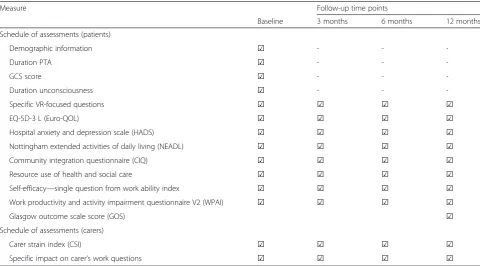
Secondary measures of effectiveness collected at 3-, 6-and 12-month post r6-andomisation include hospital anx-iety and depression scale [30], extended activities of daily living [31], community integration questionnaire [32], EuroQol EQ-5D-3 L [33], work productivity and activity impairment questionnaire [34], carer-strain index [35], self-efficacy question from the work ability index [36] and data on the use of health and social care resources, including GP, nurse, therapists, employment services and medication use. At 12 months, the Glasgow out-come scale score will be collected as a measure of TBI recovery. This will help determine the sensitivity of mea-sures/their value and any change related to the ESTVR intervention.
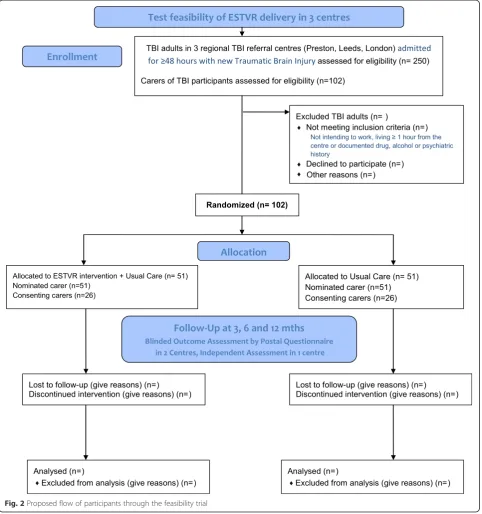
The schedule of assessments is shown in Table 1 The proposed flow of participants through the study is shown in Fig. 2.
Sample size justification
The sample size was based on an expectation to recruit ap-proximately one third of patients fitting the eligibility cri-teria, e.g. 100 participants from 300 patients approached over 12 months. This will enable us to estimate the recruit-ment rate to within +/−6 % (with 95 % confidence) and the attrition rate to within +/−7 % (with 95 % confidence) (as-suming attrition rate ≤15 %). The trial will recruit for 12 months. We anticipate that not all TBI participants will have or be willing to pass on carer details; however, we be-lieve that at least 30 % of carers identified by TBI partici-pants’can be recruited.
Data management
data may include but are not limited to, consent forms, baseline data forms and current occupational therapy treatment records, audio recordings and interview tran-scripts from the process evaluation studies. A case report form may also completely serve as its own source data. Data will be restricted to those personnel approved by the chief or local principal investigator and recorded on the Trial Delegation Log.
Analysis
Estimation of eligibility, consent and attrition rates etc. (both overall and by subgroups, e.g. site) will use descrip-tive statistics, supported by 95 % confidence intervals.
Effectiveness outcomes will be described at each time point and compared between groups using descriptive and inferential methods for categorical, continuous and/ or ordinal health outcome measures using an intention-to-treat approach, although imputation of missing out-come data will not be performed for the primary analysis; any inferential analysis of outcomes will use 95 % confidence intervals (nopvalues will be reported). Exploratory logistic regression will be used to provide estimates of intervention effectiveness, adjusted for base-line factors previously found to be related to work return (and therefore considered to be clinically important) at 12-month post-randomisation. Investigation of the dis-tribution of responses for health outcome measures and of patterns in work status over time will be performed to inform the design (primary outcome, follow-up
duration, analysis, sample size etc.) of a future trial. Key parameters (e.g. percentage in work at 12 months in control arm) will also be estimated (with confidence in-tervals) to inform the design of the potential future trial. Although imputation of missing data will not be per-formed, we will describe the nature and extent of missing data. Relationship between return to work, mood, well-being, function, work capacity, social participation, quality of life and carer strain will be explored in complete case respondents.
Data will be analysed using SPSS and Stata. A detailed statistical analysis plan will be written by the trial statis-tician, in consultation with the Study Steering Commit-tee and Trial Management Group, prior to un-blinding of the data.
Embedded qualitative and quantitative sub studies In a series of embedded qualitative and quantitative studies, we will explore the following:
[image:7.595.57.538.99.365.2]a) Factors that determine how much VR intervention is delivered. We will maintain detailed records of each session of the ESTVR intervention delivered by each OT using a proforma developed for use in the original cohort comparison and described elsewhere [22] and analyse the content retrospectively on a case-by-case basis to identify core components of the intervention for future trial design and replica-tion. Features of treatment in those with successful
Table 1Schedule of assessments for patients and carers
Measure Follow-up time points
Baseline 3 months 6 months 12 months
Schedule of assessments (patients)
Demographic information ☑ - -
-Duration PTA ☑ - -
-GCS score ☑ - -
-Duration unconsciousness ☑ - -
-Specific VR-focused questions ☑ ☑ ☑ ☑
EQ-5D-3 L (Euro-QOL) ☑ ☑ ☑ ☑
Hospital anxiety and depression scale (HADS) ☑ ☑ ☑ ☑
Nottingham extended activities of daily living (NEADL) ☑ ☑ ☑ ☑
Community integration questionnaire (CIQ) ☑ ☑ ☑ ☑
Resource use of health and social care ☑ ☑ ☑ ☑
Self-efficacy—single question from work ability index ☑ ☑ ☑ ☑
Work productivity and activity impairment questionnaire V2 (WPAI) ☑ ☑ ☑ ☑
Glasgow outcome scale score (GOS) ☑
Schedule of assessments (carers)
Carer strain index (CSI) ☑ ☑ ☑ ☑
and unsuccessful work outcomes will be identified and described using acontent of treatmentproforma [22]. Further detail about the intervention will be ascertained during participant interviews in 15 trial participants randomised to receive ESTVR. b) Practical issues relating to the deployment of the
intervention will be discussed at site monitoring visits using a topic guide to include practical issues related to the screening, recruitment and consent of
participants and deployment of the intervention in each group. The Nottingham therapist who
developed the original ESTVR intervention and who recruited participants with TBI in the original cohort comparison study [21] will visit the newly trained ESTVR therapists and recruitment staff in each centre every 3 months. She will discuss intervention cases, review case notes andcontent of treatmentproformas and monitor ESTVR fidelity
[image:8.595.58.541.90.605.2]by cross-referencing with data from the original study and 20 years’clinical experience in model delivery.
c) Issues relating to the training provided and required for NHS staff and participants to deploy the VR intervention. The ESTVR trained therapists views of the acceptability and usefulness of the ESTVR training, manual and mentoring will be explored in four occupational therapists trained to deliver the intervention. Their views on perceived changes in practice resulting from training and the anticipated and actual effects (including costs) of ESTVR implementation on supporting services will be ascertained. In addition, participants’, employers’and NHS staff views of the factors likely to affect the way ESTVR vocational rehabilitation can be
implemented and delivered clinically in the NHS will be explored in 15 NHS staff with a role in managing, commissioning or delivering TBI rehabilitation (five each per site) identified by local PIs and therapists involved in the ESTVR delivery, 15 TBI participants randomised to receive ESTVR and up to 10 of their employers. They will be contacted by letter and invited to participate.
d) Finally, to describe the content of usual care and ESTVR in the two groups and the extent to which ESTVR occurs in usual care (the routine
rehabilitation of people with TBI), we will use a questionnaire developed for a related mapping study [15] which allows components of the VR intervention delivered in any service to be mapped against agold standard(best practice recommendations for vocational rehabilitation for people with long-term neurological conditions) [13]. This will enable us to identify and describe compo-nents of VR service delivery in usual care and any differences between usual care and the ESTVR model in the proposed study. VR providers in health services in each centre will be identified using data from the original mapping study plus local know-ledge of PIs and therapists in each centre, to identify usual care providers. We will ask identified services to complete the questionnaire at the study outset and again at the end of the intervention period. This will capture data about the actual VR components offered by services in usual care at the study outset and allow us to describe whether usual care changed during the course of the study. As this is feasibility study, this descriptive data will allow us to charac-terise the variation in usual care across the three centres and pre-set criteria for planning a larger study. In addition, during participant interviews de-scribed above, the extent to which support similar to ESTVR is delivered in usual care will be explored
among participants interviewed from the UC group (n= 15).
e) To identify primary outcomes of VR that are important to service users, service providers and employers, we will conduct focus groups and interviews with people from each category. We will interview trial participants prior to randomisation to explore what outcome from vocational rehabilitation would important to them. We will also hold three focus groups, one with TBI survivors (n= 10) of mixed severity and time since injury identified in partnership with existing services; one with employers (n= 10) identified from local business networks and large employers, human resource departments, disability employment advisors, the chamber of commerce, the Federation of Small Businesses and the Employers Forum for people with disability; and one with TBI service providers in health (n= 10) (including doctors, nurses, and therapists). Focus groups will explore the notion of important outcomes for people with TBI following a health-based vocational rehabilitation intervention. The success criteria defined in the outcomes section of the trial plan, which are provisional and subject to change, will be presented to promote discussion about the best endpoint and nominal group technique [37] used to prioritise identified outcomes.
Using data iteratively from the qualitative interviews, focus groups and actual outcome data from our feasi-bility trial, we will identifyprimary outcomesof import-ance to explain the impact of health-based vocational rehabilitation interventions in terms of “what matters to people with TBI, what matters to TBI service pro-viders and what matters to employers of people with TBI”.
Interviews will be digitally recorded and field notes made to capture inaudible or other contextual informa-tion. All interviews will be fully transcribed and analysed using the framework approach. The findings will inform the design of the definitive trial, the delivery of the ESTVR and the challenges likely to be faced in sustaining its deliv-ery in the longer term.
Health economic evaluation
data will be assessed from a health (NHS) and social care (personal social service (PSS) system) perspective to determine the frequency and costs of all NHS, social services and medication provided and from a societal perspective to determine the frequency and cost of TBI on the carers work status, the employer and govern-ment employgovern-ment services, e.g. benefits and disability employment advisors.
A preliminary cost analysis will compare the overall and incremental costs for the intervention to standard prac-tice. This sub-study will identify the resource items likely to change as a result of the ESTVR intervention, explore the practicality of collecting necessary data, and find ap-propriate unit cost sources to value them. In particular, we will test using bespoke patient questionnaires to capture patient costs and the ease with which patients’self-report patient and carer costs. We will also attempt to capture the costs to employers of makingreasonable adjustment for TBI survivors returning to work. These may include pieces of equipment or modifications to the workplace, changes to the employee’s role and responsibilities that mean other input is needed, e.g. help from employees, additional breaks, greater flexibility in terms of hours and support or supervision. However, in this feasibility study, our starting point will be to record and describe these changes and attempt to quantify them using local (data from interviews with participants and employers where reasonable adjustment has been made) and published sources.
Should data be sufficient to proceed to analysis, the cost analysis will be combined with outcome measures to per-form preliminary cost-effectiveness (CEA) and cost-utility analyses (CUA). CEA and CUA produce ratio statistics in terms of cost per unit of outcome (the outcome being the percentage difference between groups of participants in work or education) and cost per quality adjusted life year (QALY), area under the curve analysis with EQ-5D-3 L values will be used to calculate QALYs. Point estimate in-cremental cost effectiveness ratios (ICERs) will be gener-ated where appropriate (e.g., where the new intervention is both more expensive and more effective or less costly and less effective. Uncertainty surrounding the economic results will be explored using cost-effectiveness acceptabil-ity curves (CEACs) [38].
Trial management and oversight
A study steering committee is in place composed of in-dependent representatives (3:1) from the medical, aca-demic and lay communities and representatives from the Trial Management Group. Ethical approval for this study is provided by the Northampton Research Ethics Com-mittee (13/EM/0353) and management approval has been obtained from the trial sites.
Safety monitoring and adverse events
As this is a feasibility trial, the side effects of the interven-tion are as yet unknown. We will identify these as part of this study to inform future trial design. Therefore, we propose to collect outcome data related to the interven-tion from participants and trial therapists including ac-cidental injury resulting from non-compliance with equipment or work place adaptations recommended by the FRESH occupational therapists, work accidents result-ing in injury requirresult-ing hospital admission, incidents of ag-gression (defined as excessive verbal agag-gression, physical aggression against objects, physical aggression against self and physical aggression against others) of the participant towards the researcher, staff or others (e.g. work col-leagues), attempted suicide. All adverse outcomes will be recorded and monitored until resolution, stabilisation, or until it has been shown that the study intervention is not a likely cause.
The CI and the sponsor shall be informed immediately of any serious adverse outcomes and the seriousness and causality will be reviewed by the chief investigator in conjunction with the medical practitioner chair of the date monitoring and ethics committee which is integral to the study steering committee.
Discussion
Work is important. It confers status and a sense of pur-pose and economic benefits at a personal, health and so-cietal level. Traumatic brain injury affects people in the prime of their working life. Those who are unable to re-turn to work face a lifetime on state benefits. The health and economic consequences of being out of work are se-vere and highlight the need for vocational rehabilitation to ensure those who have the capacity to work are afforded the opportunity to do so. This is now a policy imperative and an NHS outcome. However, despite widespread inves-tigation into efforts to support people with musculoskel-etal or pain-related conditions to return to or remain in work, little has been done in TBI. To our knowledge, this is the first feasibility RCT of an early health-based job re-tention intervention for people with TBI. If shown to be feasible, this study will provide the foundations for a fu-ture definitive trial to determine the effectiveness and cost effectiveness of early intervention to prevent job loss for people with TBI. The feasibility trial findings will be rele-vant to researchers and will assist service providers and commissioners in understanding the wider problem of implementing complex rehabilitation interventions in the English NHS.
will involve the use of social media, newsletters and patient and public involvement groups.
Trial status
The trial is currently recruiting. The trial is registered with ISRCTN Number 38581822.
Additional file
Additional file 1:The feasibility objectives and their measurement criteria.
Abbreviations
CEA:cost-effectiveness analysis; CEACs: cost-effectiveness acceptability curves; CTU: clinical trials unit; CUA: cost-utility analyses; EQ-5D-3 L: EuroQol 5D; ESTVR: early specialist TBI vocational rehabilitation; FRESH: facilitating return to work through early specialist health-based interventions; ICERS: incremental cost effectiveness ratios; ISRCTN: is a simple numeric system for the unique identification of randomised controlled trials worldwide; NHS: UK National Health Service; QALYs: quality adjusted life years; TBI: traumatic brain injury; UC: usual care; VR: vocational rehabilitation.
Competing interests
The authors declare that they have no competing interests.
Authors’contributions
KR, BB and JP conceived the study. KR drafted the manuscript. All authors contributed to the study design and read and approved the final manuscript.
Acknowledgements
We would like to thank members of the Study Steering Committee, who in addition to named authors include Dr Audrey Bowen, Professor Derick Wade, Professor Anne Chamberlain, Dr Nicola Brain, Mr Richard Morris, Dr Michael Dewey and Ms Angela Shone.
Study sponsor and funder
This study is sponsored by the University of Nottingham, Research and Graduate Services, Kings Meadow Campus, Lenton Lane, Nottingham, NG7 2NR, UK.
This project is funded by the NIHR HTA Programme (project number 11/66/ 02). The views and opinions expressed herein are those of the authors and do not necessarily reflect those of the HTA programme, NIHR, NHS or the Department of Health.
Author details
1Division of Rehabilitation and Ageing, School of Medicine, Medical School
Queen’s Medical Centre, B-Floor, Nottingham NG7 2UH, UK.2Nottingham, UK.3Lancashire Clinical Trials Unit, School of Health, University of Central Lancashire, Brook Building, Room 217, Preston PR1 2HE, UK.4Health Economics Group, Norwich Medical School, University of East Anglia, CD Annex 1.13, Norwich Research Park, Norwich NR4 7TJ, UK.5Nottingham Clinical Trials Unit, Nottingham Health Science Partners, C Floor, South Block, QMC, Nottingham NG7 2UH, UK.6School of Health Sciences, University of Nottingham Queen’s Medical Centre (QMC), A Floor, Nottingham NG7 2UH, UK.7Trauma Science, Royal London Hospital, Ward 12D, Whitechapel E1 1BB, London, UK.8Academic Department of Rehabilitation Medicine, Leeds Institute of Molecular Medicine, University of Leeds, Level D, Martin Wing, Leeds General Infirmary, Leeds LS1 3EX, UK.9Preston Neuro-Rehab Unit, Lancashire Teaching Hospitals NHS Trust, 32A Watling St, Preston, Lancashire PR2 8DY, UK.
Received: 19 December 2014 Accepted: 29 May 2015
References
1. National Institute for Health and Clinical Excellence (NICE), Head injury. 2014, NICE quality standard 74
2. Headway. Headway: the brain injury association.Available at http:// www.headway.org.uk/factsheets.aspx. Accessed 27 January 2011. 3. Rickels E, von Wild K, Wenzlaff P. Head injury in Germany: a
population-based prospective study on epidemiology, causes, treatment and outcome of all degrees of head-injury severity in two distinct areas. Brain Inj. 2010;24(12):1491–504.
4. Relyea-Chew A, Hollingworth W, Chan L, Comstock BA, Overstreet KA, Jarvik JG. Personal bankruptcy after traumatic brain or spinal cord injury: the role of medical debt. Arch Phys Med Rehabil. 2009;90(3):413–9.
5. Franulic A, Carbonell CG, Pinto P, Sepulveda I. Psychosocial adjustment and employment outcome 2, 5 and 10 years after TBI. Brain Inj. 2004;18(2):119–29.
6. Van Velzen JM, van Bennekom CA, Edelaar MJ, Sluiter JK, Frings-Dresen MH. How many people return to work after acquired brain injury?: a systematic review. Brain Inj. 2009;23(6):473–88.
7. Ownsworth T, McKenna K. Investigation of factors related to employment outcome following traumatic brain injury: a critical review and conceptual model. Disabil Rehabil. 2004;26(13):765–83.
8. Schonbrun S, Kampfe C. Variables relating to employment outcome in individuals with traumatic brain injury. J Appl Rehabil Counsel. 2004;35(3):14–21.
9. Willemse-van Son AH, Ribbers GM, Verhagen AP, Stam HJ. Prognostic factors of long-term functioning and productivity after traumatic brain injury: a systematic review of prospective cohort studies. Clin Rehabil. 2007;21(11):1024–37.
10. van Velzen JM, van Bennekom CA, Edelaar MJ, Sluiter JK, Frings-Dresen MH. Prognostic factors of return to work after acquired brain injury: a systematic review. Brain Inj. 2009;23(5):385–95.
11. Waddel G, Burton AK, Kendall NAS. Vocational rehabilitation: what works, for whom, and when? An independent review of the evidence on the effectiveness of vocational rehabilitation interventions. Department for Work and Pensions; 2013. ISBN 978-0-11-703861-5.
12. Langley J, Johnson S, Slatyer M, Skilbeck CE, Thomas M. Issues of loss to follow-up in a population study of traumatic brain injury (TBI) followed to 3 years post-trauma. Brain Inj. 2010;24(7–8):939–47.
13. Possl J, Jurgensmeyer S, Karlbauer F, Wenz C, Goldenberg G. Stability of employment after brain injury: a 7-year follow-up study. Brain Inj. 2001;15(1):15–27.
14. Waddell G, Burton A K, Kendal N A. Vocational rehabilitation. What works, for whom, and when? The Stationary Office; 2008
15. Department of Health. The NHS outcomes framework 2011/12. London; 2010. https://www.gov.uk/government/uploads/system/uploads/ attachment_data/file/213789/dh_123138.pdf Accessed 15 April 2013. 16. Black C, Frost, D Health at work—an independent review of sickness
absence. Available at https://www.gov.uk/government/uploads/system/uploads/ attachment_data/file/181060/health-at-work.pdf. Accessed 28 January 2012. 17. British Society of Rehabilitation Medicine. Rehabilitation following acquired
brain injury: national clinical guidelines. Royal College of Physicians: Clinical Effectiveness and Evaluation Unit; 2003.
18. British Society of Rehabilitation Medicine. Vocational assessment and rehabilitation for people with long-term neurological conditions: recommendations for best practice. London: British Society of Rehabilitation Medicine; 2010.
19. Tyerman A, Meehan MJ. Vocational assessment and rehabilitation after acquired brain injury: inter-agency guidelines. London: British Society of Rehabilitation Medicine/Royal College of Physicians; 2004.
20. Playford ED, Radford K, Burton C, Gibson A, Jellie B, Sweetland J, et al. Mapping vocational rehabilitation services for people with long term neurological conditions summary report. March: Department of Health; 2011. Available from http://www.ltnc.org.uk.
21. Deshpande P, Turner-Stokes L. Survey of vocational rehabilitation services available to people with acquired brain injury in the UK. In: Tyerman A, Meehan MJ, editors. Vocational assessment and rehabilitation after acquired brain injury: inter-agency guidelines. London: Royal College of Physicians; 2004. 22. Vanderploeg RD, Schwab K, Walker WC, Fraser JA, Sigford BJ, et al.
Rehabilitation of traumatic brain injury in active duty military personnel and veterans: defense and veterans brain injury center randomized controlled trial of two rehabilitation approaches. Arch Phys Med Rehabil. 2008;89(12):2227–38. 23. Salazar AM, Warden DL, Schwab K, Spector J, Braverman S, et al. Cognitive
24. Fadyl JK, McPherson KM. Approaches to vocational rehabilitation after traumatic brain injury: a review of the evidence. J Head Trauma Rehabil. 2009;24(3):195–212.
25. Trexler LE, Trexler LC, Malec JF, Klyce D, Parrott D. Prospective randomized controlled trial of resource facilitation on community participation and vocational outcome following brain injury. J Head Trauma Rehabil. 2010;25(6):440–6.
26. Radford KA, Phillips J, Drummond A, Sach T, Walker M, Tyerman A, et al. Return to work after traumatic brain injury: cohort comparison and economic evaluation. Brain Inj. 2013;27(5):507–20.
27. Phillips J, Drummond A, Radford K, Tyerman A. Return to work after traumatic brain injury: recording, measuring and describing occupational therapy intervention. Br J Occup Ther. 2010;73(9):422–30.
28. National Institute for Health Research. Feasibility and Pilot Studies. Definition agreed by the EME, PHR, HTA and RfPB programmes. http://www.nihr.ac.uk/ CCF/RfPB/FAQs/Feasibility_and_pilot_studies.pdf. Accessed 27.4.15 29. CrowtherR, Marshall M, Bond G, Huxley P. Vocational rehabilitation for
people with severe mental illness. Cochrane Database of Systematic Reviews 2004, Issue 2 [doi:10.1002/14651858.CD003080]
30. Zigmond AS, Snaith RP. The hospital anxiety and depression scale. Acta Psychiatr Scand. 1983;67(6):361–70. Epub 1983/06/01.
31. Nouri F, Lincoln N. An extended activities of daily living scale for stroke patients. Clin Rehabil. 1987;1(4):301–5.
32. Willer B, Rosenthal M, Kreutzer JS, Gordon WA, Rempel R. Assessment of community integration following rehabilitation for traumatic brain injury. J Head Trauma Rehabil. 1993;8(2):1–116.
33. Brooks R. EuroQol: the current state of play. Health Policy. 1996;37:53–72. 34. Reilly MC, Zbrozek AS, Dukes EM. The validity and reproducibility of a work
productivity and activity impairment instrument. Pharmacoeconomics. 1993;4(5):353–65.
35. Robinson B. Validation of a caregiver strain index. J Gerontol. 1983;38:344–8. 36. Ilmarinen J, Tuomi K. Work ability index for aging workers. In: Ilmarinen J,
editor. Ageing and work. Helsinki Finnish Institute of Occupational Health, 1993, 142–151
37. Horton JN. Nominal group technique. Anaesthesia. 1980;35:811–4. 38. Briggs AH, Gray AM. Handling uncertainty when performing economic
evaluation of healthcare interventions. Health Technol Assess. 1999;3(2):1–134.
Submit your next manuscript to BioMed Central and take full advantage of:
• Convenient online submission
• Thorough peer review
• No space constraints or color figure charges
• Immediate publication on acceptance
• Inclusion in PubMed, CAS, Scopus and Google Scholar
• Research which is freely available for redistribution