A Study of Aging Treatment on the Mg-10Li-0.5Zn Alloy
P. C. Wang
1, H. C. Lin
1;*, K. M. Lin
2, M. T. Yeh
3and C. Y. Lin
41Department of Materials Science and Engineering, National Taiwan University, Taipei, Taiwan, R. O. China 2Department of Materials Science and Engineering, Feng Chia University, Taichung, Taiwan, R. O. China 3
Amli Co. Ltd., Taipei, Taiwan, R. O. China
4Department of Environmental Engineering and Science, Feng Chia University, Taichung, Taiwan, R. O. China
In this study, an aging treatment was performed to investigate the microstructures and mechanical properties of Mg-10Li-0.5Zn (LZ101)
alloy. Experimental results show that the LZ101 Mg-Li alloy exhibits a dual-phase microstructure of(HCP) and(BCC) phases, and has a
good ductility. The 723 K solid-solution treated LZ101 Mg-Li alloy exhibits a singlestructure and producesprecipitates after natural and
artificial aging. The solid-solution treated specimen has lower mechanical strength and higher elongation than the as-extruded one. The aged specimens exhibit a typical behaviour of precipitation hardening. The maximum tensile strength can reach 188 MPa, 180 MPa and 173 MPa,
corresponding to the natural aging of 345.6 ks, 423 K aging of 21.6 ks and 523 K aging of 10.8 ks. [doi:10.2320/matertrans.M2009133]
(Received April 10, 2009; Accepted June 4, 2009; Published August 12, 2009)
Keywords: magnesium-lithium alloy, aging treatment, precipitation hardening, mechanical property
1. Introduction
Magnesium alloys are considered as potential candidates for numerous applications, especially in transportation vehicles or lightweight enclosures for 3C (computer, com-munication and consumer electronic) products owing to their excellent properties, such as low density, high specific strength, high damping capacity and high recycle ability.1–3) Products from Mg alloys are mainly manufactured by die-casting because of their poor formability. However, the high ratio of defective products in die-casting of Mg alloys will reduce their manufacturing efficiency. Therefore, the devel-opment of new Mg alloys with high formability of rolling, pressing and forging is an important issue to improve the manufacturing ability of thin plates of Mg alloys.
It is known that the Mg-Li alloys with Li content of
511mass% will exhibit a dual-phase structure ofand phases. The single-phase structure exists if Li content is greater than 11 mass%. These Mg-Li alloys have excellent formability, as well as extra-low density.4–6)But, these alloys exhibit low mechanical strength and are not very useful in engineering applications. Hence, it is an important matter to improve the mechanical property of Mg-Li alloys. Recently, some articles have studied the mechanical properties of Mg-Li alloys, including the effects of cold working, addition of alloying elements and precipitation hardening.7–10)Hsuet al. have also investigated the natural aging of Mg-Li-Al-Zn alloy.11) However, to the author’s knowledge, there is no paper reporting about the precipitation behaviour of Mg-10Li-0.5Zn (LZ101) alloy. Hence, the LZ101 Mg-Li alloy is prepared in the present study, and its crystal structure, mechanical properties and precipitation behaviour are sys-tematically investigated.
2. Experimental Procedures
Melting of LZ101 Mg-Li alloy was processed in a high frequency electric induction furnace equipped with vacuum
capability and inert argon gas was employed. The cast alloy was analyzed with ICP-AES (Induction Coupled Plasma Atomic Emission Spectrometry) apparatus, and its chemical compositions are shown in Table 1. Cast rods with a diameter of 200 mm were extruded to be plates with a thickness of 10 mm at a billet preheating temperature of 493 K. The specimens for various testing were carefully cut from these extruded plates. Specimens for solid-solution and aging treatment were sealed in evacuated quartz tubes, solid-solution treated at 723 K for 7.2 ks, quenched in water, and then aged at room temperature, 423 K and 523 K for
0604:8ks,028:8ks and021:6ks, respectively. Optical microscope (OM) and scanning electron micro-scope (SEM) were employed for microstructure observation. X-ray diffraction (XRD) was utilized for the identification of crystal structures. TEM observations were conducted with a JEOL 100CX II electron microscope operating at 100 kV. Specimen hardness was measured by a MicroVickers tester with a load of 50 g for 15 seconds. For each specimen, the average hardness value was calculated from at least ten test readings. The mechanical properties, involving the tensile strength and elongation, were examined with a tensile tester. Three tensile tests for each specimen were carried out, and their results exhibited no obvious difference.
3. Results and Discussion
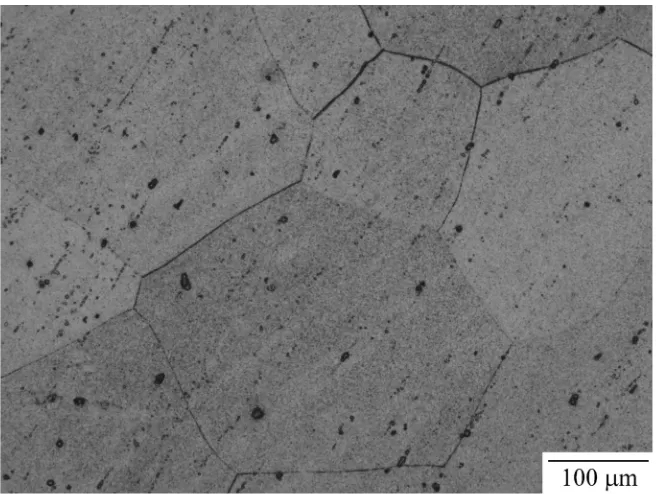
Figure 1 shows the OM microstructure of the as-extruded LZ101 alloy. It exhibits a dual-phase microstructure ofand phases. As shown in Fig. 1, the particles of phase are quite diverse in their shapes and sizes. The extruded specimens were solid-solution treated at 723 K for 7.2 ks and then quenched in water. As shown in Fig. 2, the
solid-Table 1 The ICP-AES measured chemical compositions of LZ101 alloys
used in this study (mass%).
Alloy Li Zn Mn Si Mg
LZ101 9.94 0.46 0.26 0.04 balance
*Corresponding author, E-mail: [email protected]
Materials Transactions, Vol. 50, No. 9 (2009) pp. 2259 to 2263
[image:1.595.304.550.335.363.2]solution treated specimen exhibits a single phase with typical equi-axial grains.
To better understand the precipitation behaviours of this LZ101 alloy, the aging temperatures are set to room temperature, 423 K and 523 K in this study. Their corre-sponding aging times are 0604:8ks, 028:8ks and
021:6ks, respectively. Figures 3(a)–(h) show the XRD patterns of various as-treated LZ101 specimens. The XRD spectra in Fig. 3(a) exhibit that bothandphases coexist for the as-extruded specimen. In Fig. 3(b), only XRD spectra ofphase can be observed. These results are consistent with those shown in Figs. 1 and 2. In Figs. 3(c)–(h), the XRD
spectra of bothandphases can be observed for various aging conditions. These results indicate that the solid-solution treated LZ101 alloy will produceprecipitate after aging at room temperature, 423 K or 523 K. Meanwhile, the XRD intensities of phase, such as the (101) and (002)
peaks, are found to increase with increasing aging time, no matter the aging temperatures. This feature is reasonable because more quantity ofprecipitate has been produced for a longer aging time. According to Mg-Li-Zn ternary phase diagram,12)the solubility of Zn element in both Mg and Li matrix exceeds 0.5 mass%. Hence, no precipitates related to Zn will occur within the LZ101 alloy in this study. Actually,
Fig. 1 OM microstructures of as-extruded LZ101 alloy.
[image:2.595.134.462.72.316.2] [image:2.595.134.463.357.604.2]the main purpose of adding 0.5 mass% Zn into Mg-10Li matrix is to enhance its corrosion resistance, although these Zn atoms may also have the effect of solid-solution strengthening.
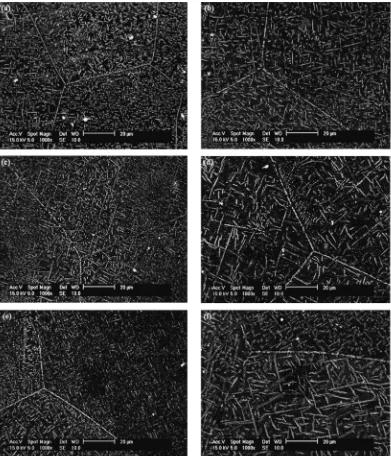
Figures 4(a)–(b), (c)–(d) and (e)–(f) show the SEM microstructures ofprecipitates after aging at room temper-ature, 423 K and 523 K, respectively, for the solution-treated LZ101 alloy. As shown in Figs. 4(a), (c) and (e), a lot of fine particles ofphase have precipitated within thematrix in the early aging periods at various aging temperatures. The particle sizes ofprecipitates have obviously grown up with increasing aging time, as shown in Figs. 4(b), (d) and (f). As compared to the particle sizes of precipitates in Figs. 4(a)–(f), it can be clearly seen that the precipitation rate ofphase is rapider at higher aging temperatures. It is worthy of mention that the precipitates in Figs. 4(a)–(f) exhibit a needle-shape, which grows in specific
crystallo-20 30 40 50 60 70 80 90
(101)
(002)
(100)
(g) (h)
(f) (e) (d) (c)
(b) (a)
523K-10.8ks
S.T. 523K-3.6ks 423K-21.6ks 423K-7.2ks RT-345.6ks
RT-86.4ks
as-extruded Mg-Li ( BCC β phase)
Mg (HCP α phase)
Intensity (Arb.unit)
2θ
(110)
Fig. 3 XRD patterns of various as-treated LZ101 specimens.
Fig. 4 SEM microstructures of various aged LZ101 specimens. (a) room temperature, 86.4 ks, (b) room temperature, 345.6 ks, (c) 423 K,
10.8 ks, (d) 423 K, 21.6 ks, (e) 523 K, 3.6 ks, (f) 523 K, 10.8 ks.
[image:3.595.62.275.70.259.2] [image:3.595.103.494.301.758.2]graphic directions or planes of thematrix, and are similar to Widmansta¨tten structures. Kim et al.13) demonstrated that the existence of Widmansta¨tten-type phase in the matrix would strengthen the squeeze-cast Mg-Li-Al alloy. Therefore, the precipitation hardening of phase for the LZ101 alloy in this study is expected and will be discussed later.
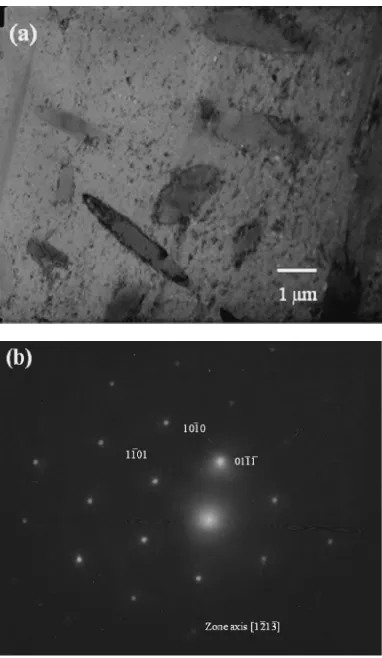
The TEM bright-field image and selected area diffraction pattern (SADP) ofprecipitates for the LZ101 alloy aged at room temperature for 345.6 ks are shown in Figs. 5(a) and (b), respectively. The longitudinal length of needle-shape precipitate is about 3mm. The lattice parameter a and c/a ratio are calculated to be 0.32 nm and 1.616, respectively. Furthermore, the planar=inter-phase boundaries with an irrational crystallographic orientation have been reported by crystallographic analysis.14)
Figure 6 shows the specimen hardness versus aging time for the solution-treated LZ101 alloy aged at room temper-ature, 423 K and 523 K. As shown in Fig. 6, the solution-treated LZ101 alloy can clearly exhibit the precipitation hardening at various aging temperatures. In Fig. 6, one can also find that the specimens aged at room temperature can have higher peak hardness, although it has a longer aging time of 345.6 ks. This phenomenon is reasonable because the growth rate of precipitates is quite slow at room temper-ature. On the contrary, the 423 K and 523 K aged specimens can reach the peak hardness after aging of 21.6 ks and 10.8 ks, respectively, due to the rapid growth ofprecipitates.
Figure 7 shows the mechanical properties of the as-treated LZ101 specimens. As Fig. 7 showa, the solid-solution treated specimen exhibits lower mechanical strength and higher elongation than the as-extruded one. Besides, the mechanical strength increases significantly after aging at room temper-ature, 423 K and 523 K, though the elongation decreases. These results exhibit the typical behaviour of precipitation hardening. The maximum tensile strength can reach 188 MPa, 180 MPa and 173 MPa, corresponding to the room-temperature aging of 345.6 ks, 423 K aging of 21.6 ks and 523 K aging of 10.8 ks. Based on these results, it is understood that the (HCP) precipitates can increase effectively the mechanical strength of LZ101 alloy. Besides, these aged specimens can still exhibit excellent ductility due to the ductile matrix of (BCC) phase. Hence, the elongations at break for these peak-aged specimens are still higher than 40%.
4. Conclusions
(1) The as-extruded LZ101 alloy exhibits a dual-phase microstructure of and phases. The 723 K solid-solution treated specimen has a single phase with equi-axial grains. The aging treatment at room
temper-Fig. 5 TEM observation of the LZ101 alloy aged at room temperature for
96 hours. (a) bright-field image, (b) SADP ofprecipitate.
1 10 100 1000
40 42 44 46 48 50 52 54 S.T. room-temperature 423K 523K Hv
Aging time (t/ks)
Fig. 6 The specimen hardness versus aging time for the LZ101 alloy aged
at various conditions.
0 20 40 60 80 100 120 140 160 180 200 220 28.8 25.2 21.6 432 345.6 259.2 172.8 86.4 Elongation [%]
Aging time (t/ks)
UTS, σ /MPa 0 10 20 30 40 50 60 70 80 as-extruded Temsile strength Elongation S.T. 18 14.4 10.8 7.2 3.6 14.4 7.2 518.4 523K-aged 423K-aged RT-aged
Fig. 7 Plots of tensile strength and elongation for various as-treated LZ101
[image:4.595.73.264.70.399.2] [image:4.595.327.528.73.218.2] [image:4.595.314.539.277.443.2]ature, 423 K and 523 K for the solution-treated LZ101 alloy will produce the precipitates within the matrix. The precipitate exhibits a needle-shape, and has lattice parameter a of 0.32 nm and c/a ratio of 1.616.
(2) The solid-solution treated LZ101 specimen has lower mechanical strength and higher elongation than the as-extruded one. The aged specimens have a large quantity of fine precipitate and exhibit a typical behaviour of precipitation hardening. The maximum tensile strength can reach 188 MPa, 180 MPa and 173 MPa, corresponding to the room-temperature aging of 345.6 ks, 423 K aging of 21.6 ks and 523 K aging of 10.8 ks. These age-hardened specimens can still exhibit excellent ductility due to the ductile matrix of phase.
Acknowledgement
The authors are pleased to acknowledge the financial support of this research by Feng Chia University, Taiwan, under Grant No. FCU-08G27201.
REFERENCES
1) A. Lasraoui and J. J. Jonas: Metall. Trans.22A(1991) 1545–1558.
2) Y. Kojima: Mater. Sci. Forum350(2000) 3–18.
3) S. Nemoto:Handbook of Advanced Magnesium Technology, (Kallos
Publishing Co., Tokyo, 2000) p. 2.
4) H. Haferkamp, R. Boehm, U. Holzkamp, C. Jaschik, V. Kaese and
M. Niemeyer: Mater. Trans.42(2001) 1160–1166.
5) P. Metenier and G. Gonzalez-Doncel: Mater. Sci. Eng. A125(1990)
195–202.
6) K. Matuzawa, T. Koshihara and Y. Kojima: J. Jpn. Inst. Light Met.39
(1989) 45–51.
7) J. Y. Wang, W. P. Hong, P. C. Hsu, C. C. Hsu and S. Lee: Mater. Sci.
Forum419–422(2003) 165–170.
8) A. Yamamoto, T. Ashida, Y. Kouta, K. B. Kim, S. Fukumoto and
H. Tsubakino: Mater. Trans.44(2003) 619–624.
9) C. H. Chiu, H. Y. Wu, J. Y. Wang and S. Lee: J. Alloy. Compd.460
(2008) 246–252.
10) H. Takuda, S. Kikuchi, T. Tsukada, K. Kubota and N. Hatta: J. Mater.
Sci.37(2002) 51–57.
11) C. C. Hsu, J. Y. Wang and S. Lee: Mater. Trans.49(2008) 2728–2731.
12) P. Villars, A. Prince and H. Okamoto:Handbook of ternary alloy phase
diagrams, ASM International9(1995) 12223–12229.
13) Y. W. Kim, D. H. Kim, H. I. Lee and C. P. Hong: Scr. Mater.38(1998)
923–929.
14) M. V. Kral, B. C. Muddle and J. F. Nie: Mater. Sci. Eng. A460–461
(2007) 227–232.