Scaling Context Space
James R. Curran and Marc Moens
Institute for Communicating and Collaborative Systems University of Edinburgh
2 Buccleuch Place, Edinburgh EH8 9LW United Kingdom
jamesc,marc @cogsci.ed.ac.uk
Abstract
Context is used in many NLP systems as an indicator of a term’s syntactic and se-mantic function. The accuracy of the sys-tem is dependent on the quality and quan-tity of contextual information available to describe each term. However, the quan-tity variable is no longer fixed by lim-ited corpus resources. Given fixed train-ing time and computational resources, it makes sense for systems to invest time in extracting high quality contextual in-formation from a fixed corpus. However, with an effectively limitless quantity of text available, extraction rate and repre-sentation size need to be considered. We use thesaurus extraction with a range of context extracting tools to demonstrate the interaction between context quantity, time and size on a corpus of 300 million words.
1 Introduction
Context plays an important role in many natural lan-guage tasks. For example, the accuracy of part of speech taggers or word sense disambiguation sys-tems depends on the quality and quantity of con-textual information these systems can extract from the training data. When predicting the sense of a word, for instance, the immediately preceding word is likely to be more important than the tenth previ-ous word; similar observations can be made about POS taggers or chunkers. A crucial part of train-ing these systems lies in extracttrain-ing from the data high-quality contextual information, in the sense of
defining contexts that are both accurate and corre-lated with the information (the POS tags, the word senses, the chunks) the system is trying to extract.
The quality of contextual information is often de-termined by the size of the training corpus: with less data available, extracting context information for any given phenomenon becomes less reliable. However, corpus size is no longer a limiting fac-tor: whereas up to now people have typically worked with corpora of around one million words, it has be-come feasible to build much larger document collec-tions; for example, Banko and Brill (2001) report on experiments with a one billion word corpus.
When using a much larger corpus and scaling the context space, there are, however, other trade-offs to take into consideration: the size of the corpus may make it unfeasible to train some systems because of efficiency issues or hardware costs; it may also result in an unmanageable expansion of the extracted con-text information, reducing the performance of the systems that have to make use of this information.
This paper reports on experiments that try to es-tablish some of the trade-offs between corpus size, processing time, hardware costs and the perfor-mance of the resulting systems. We report on ex-periments with a large corpus (around 300 mil-lion words). We trained a thesaurus extraction sys-tem with a range of context-extracting front-ends to demonstrate the interaction between context quality, extraction time and representation size.
2 Automatic Thesaurus Extraction
Thesauri have traditionally been used in informa-tion retrieval tasks to expand words in queries with synonymous terms (e.g. Ruge, (1997)). More
cently, semantic resources have also been used in collocation discovery (Pearce, 2001), smoothing and model estimation (Brown et al., 1992; Clark and Weir, 2001) and text classification (Baker and Mc-Callum, 1998). Unfortunately, thesauri are very ex-pensive and time-consuming to produce manually, and tend to suffer from problems of bias, inconsis-tency, and lack of coverage. In addition, thesaurus compilers cannot keep up with constantly evolving language use and cannot afford to build new thesauri for the many subdomains that information extraction and retrieval systems are being developed for. There is a clear need for methods to extract thesauri auto-matically or tools that assist in the manual creation and updating of these semantic resources.
Most existing work on thesaurus extraction and word clustering is based on the general observation that related terms will appear in similar contexts. The differences tend to lie in the way “context” is defined and in the way similarity is calculated. Most systems extract co-occurrence and syntactic infor-mation from the words surrounding the target term, which is then converted into a vector-space repre-sentation of the contexts that each target term ap-pears in (Brown et al., 1992; Pereira et al., 1993; Ruge, 1997; Lin, 1998b). Other systems take the whole document as the context and consider term co-occurrence at the document level (Crouch, 1988; Sanderson and Croft, 1999). Once these contexts have been defined, these systems then use clustering or nearest neighbour methods to find similar terms.
Finally, some systems extract synonyms directly without extracting and comparing contextual rep-resentations for each term. Instead, these systems recognise terms within certain linguistic patterns (e.g. X, Y and other Zs) which associate synonyms and hyponyms (Hearst, 1992; Caraballo, 1999).
Thesaurus extraction is a good task to use to ex-periment with scaling context spaces. The vector-space model with nearest neighbour searching is simple, so we needn’t worry about interactions be-tween the contexts we select and a learning algo-rithm (such as independence of the features). But also, thesaurus extraction is a task where success has been limited when using small corpora (Grefen-stette, 1994); corpora of the order of 300 million words have already been shown to be more success-ful at this task (Lin, 1998b).
3 Experiments
Vector-space thesaurus extraction can be separated into two independent processes. The first step ex-tracts the contexts from raw text and compiles them into a vector-space statistical description of the con-texts each potential thesaurus term appears in.
We define a context relation as a tuple (w,r,w0) where w is a thesaurus term, occurring in relation type r, with another word w0 in the sentence. The
type can be grammatical or the position ofw0 in a
context window: the relation (dog, direct-obj, walk)indicates that the termdog, was the direct
ob-ject of the verbwalk. Often we treat the tuple(r,w0) as a single unit and refer to it as anattribute of w. The context extraction systems used for these exper-iments are described in the following section.
The second step in thesaurus extraction performs clustering or nearest-neighbour analysis to deter-mine which terms are similar based on their context vectors. Our second component is similar to Grefen-stette’s SEXTANT system, which performs nearest-neighbour calculations for each pair of potential the-saurus terms. For nearest-neighbour measurements we must define a function to judge the similarity be-tween two context vectors (e.g. the cosine measure) and a function to combine the raw instance frequen-cies for each context relation into weighted vector components.
SEXTANT uses a generalisation of the Jaccard measure to measure similarity. The Jaccard measure is the cardinality ratio of the intersection and union of attribute sets (atts(wn)is the attribute set forwn):
|atts(wm)∩atts(wn)|
|atts(wm)∪atts(wn)| (1) The generalised Jaccard measure allows each rela-tion to have a significance weight (based on word, attribute and relation frequencies) associated with it:
P
a∈atts(wm)∪atts(wn)min(wgt(wm,a),wgt(wn,a))
P
a∈atts(wm)∪atts(wn)max(wgt(wm,a),wgt(wn,a)) (2)
Grefenstette originally used the weighting function:
wgt(wi,aj)= log2(f(wi
,aj)+1)
log2(n(aj)+1) (3)
where f(wi,aj)is the frequency of the relation and
n(aj)is the number of different wordsaj appears in
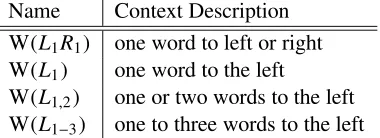
Name Context Description W(L1R1) one word to left or right
W(L1) one word to the left
W(L1,2) one or two words to the left
[image:3.612.323.533.71.116.2]W(L1−3) one to three words to the left
Table 1: Window extractors
However, we have found that using the t-test be-tween the joint and independent distributions of a word and its attribute:
wgt(wi,aj)= p(wi
,aj)−p(wi)p(aj)
p
p(wi)p(aj) (4)
gives superior performance (Curran and Moens, 2002) and is therefore used for our experiments.
4 Context Extractors
We have experimented with a number of different systems for extracting the contexts for each word. These systems show a wide range in complexity of method and implementation, and hence develop-ment effort and execution time.
The simplest method we implemented extracts the occurrence counts of words within a particular win-dow surrounding the thesaurus term. These winwin-dow extractors are very easy to implement and run very quickly. The window geometries used in this experi-ment are listed in Table 1. Extractors marked with an asterisk, for example W(L1R1∗), do not distinguish
(within the relation type) between different positions of the wordw0in the window.
At a greater level of complexity we have two shal-low NLP systems which provide extra syntactic in-formation in the extracted contexts. The first sys-tem is based on the syntactic relation extractor from SEXTANT with a differentPOS tagger and chunker. The SEXTANT-based extractor we developed uses a very simple Na¨ıve Bayes POS tagger and chunker. This is very simple to implement and is extremely fast since it optimises the tag selection locally at the current word rather than performing beam or Viterbi search over the entire sentence. After the raw text has beenPOStagged and chunked, the SEXTANT re-lation extraction algorithm is run over the text. This consists of five passes over each sentence that asso-ciate each noun with the modifiers and verbs from the syntactic contexts that it appears in.
Corpus Sentences Words
British National Corpus 6.2M 114M Reuters Corpus Vol 1 8.7M 193M
Table 2: Training Corpora Statistics
The second shallow parsing extractor we used was the CASS parser (Abney, 1996), which uses cas-caded finite state transducers to produce a limited depth parse of POS tagged text. We used the out-put of the Na¨ıve Bayes POS tagger output as input to the CASS. The context relations used were ex-tracted directly by thetuplesprogram (usinge8
demo grammar) included in the CASS distribution. The FST parsing algorithm is very efficient and so CASSalso ran very quickly. The times reported be-low include the Na¨ıve BayesPOS tagging time.
The final, most sophisticated extractor used was the MINIPARparser (Lin, 1998a), which is a broad-coverage principle-based parser. The context rela-tions used were extracted directly from the full parse tree. Although fast for a full parser, MINIPAR was no match for the simpler extractors.
For this experiment we needed a large quantity of text which we could group into a range of corpus sizes. We combined theBNCand Reuters corpus to produce a 300 million word corpus. The respective sizes of each are shown in Table 2. The sentences were randomly shuffled together to produce a sin-gle homogeneous corpus. This corpus was split into two 150M word corpora over which the main experi-mental results are averaged. We then created smaller corpora of size 1
2down to641th of each 150M corpus.
The next section describes the method of evaluating each thesaurus created by the combination of a given context extraction system and corpus size.
5 Evaluation
For the purposes of evaluation, we selected 70 single word noun terms for thesaurus extraction. To avoid sample bias, the words were randomly selected from Wordnet such that they covered a range of values for the following word properties:
occurrence frequency based on frequency counts
from the Penn Treebank,BNCand Reuters;
number of senses based on the number of Wordnet
[image:3.612.92.282.73.142.2]generality/specificity based on depth of the term in the Wordnet hierarchy;
abstractness/concreteness based on even
distribu-tion across all Wordnet subtrees.
Table 3 shows some of the selected terms with fre-quency and synonym set data. For each term we extracted a thesaurus entry with 200 potential syn-onyms and their weighted Jaccard scores.
The most difficult aspect of thesaurus extraction is evaluating the quality of the result. The sim-plest method of evaluation is direct comparison of the extracted thesaurus with a manually created gold standard (Grefenstette, 1994). However on smaller corpora direct matching alone is often too coarse-grained and thesaurus coverage is a problem.
Our experiments use a combination of three the-sauri available in electronic form: The Macquarie Thesaurus (Bernard, 1990), Roget’s Thesaurus (Ro-get, 1911), and the Moby Thesaurus (Ward, 1996). Each thesaurus is structured differently: Roget’s and Macquarie are topic ordered and the Moby thesaurus is head term ordered. Roget’s is quite dated and has low coverage, and contains a deep hierarchy (depth up to seven) with terms grouped in 8696 small syn-onym sets at the leaves of the hierarchy. The Mac-quarie consists of 812 large topics (often in antonym related pairs), each of which is separated into 21174 small synonym sets. Roget’s and the Macquarie provide sense distinctions by placing terms in mul-tiple synonym sets. The Moby thesaurus consists of 30259 head terms and large synonym lists which conflate all the head term senses. The extracted the-saurus does not distinguish between different head senses. Therefore, we convert the Roget’s and Mac-quarie thesaurus into head term ordered format by combining each small sense set that the head term appears in.
We create a gold standard thesaurus containing the union of the synonym lists from each thesaurus, giving a total of 23207 synonyms for the 70 terms. With these gold standard resources in place, it is possible to use precision and recall measures to cal-culate the performance of the thesaurus extraction systems. To help overcome the problems of coarse-grained direct comparisons we use three different types of measure to evaluate thesaurus quality:
1. Direct Match (DIRECT)
2. Precision of thentop ranked synonyms (P(n)) 3. Inverse Rank (INVR)
A match is an extracted synonym that appears in the corresponding gold standard synonym list. The direct match score is the number of such matches for each term. Precision of the topnis the percentage of matches in the topnextracted synonyms. In these experiments, we calculate this forn=1, 5, and10. The inverse rank score is the sum of the inverse rank of each match. For example, if matching synonyms appear in the extracted synonym list at ranks 3, 5 and 28, then the inverse rank score is 1
3 + 15 + 281 =
0.569. The maximum inverse rank score is 5.878 for a synonym list of 200 terms. Inverse rank is a good measure of subtle differences in ranked results. Each measure is averaged over the extracted synonym lists for all 70 thesaurus terms.
6 Results
Since MINIPARperforms morphological analysis on the context relations we have added an existing mor-phological analyser (Minnen et al., 2000) to the other extractors. Table 4 shows the improvement gained by morphological analysis of the attributes and relations for the SEXTANT150M corpus.
The improvement in results is quite significant, as is the reduction in the representation space and num-ber of unique context relations. The reduction in the number of terms is a result of coalescing the plu-ral nouns with their corresponding singular nouns, which also reduces data sparseness problems. The remainder of the results use morphological analysis of both the words and attributes.
Word PTBRank PTB# BNC# Reuters # Macquarie # WordNet # Min / Max WordNet subtree roots
company 38 4076 52779 456580 8 9 3 / 6 entity, group, state
interest 138 919 37454 146043 12 12 3 / 8 abs., act, group, poss., state
problem 418 622 56361 63333 4 3 3 / 7 abs., psych., state
change 681 406 35641 55081 8 10 2 / 12 abs., act, entity, event, phenom.
house 896 223 47801 45651 10 12 3 / 6 act, entity, group
idea 1227 134 32754 13527 10 5 3 / 7 entity, psych.
opinion 1947 78 9122 16320 4 6 4 / 8 abs., act, psych.
radio 2278 59 9046 20913 2 3 6 / 8 entity
star 5130 29 8301 6586 11 7 4 / 8 abs., entity
knowledge 5197 19 14580 2813 3 1 1 / 1 psych.
pants 13264 5 429 282 3 2 6 / 9 entity
[image:5.612.84.532.71.204.2]tightness 30817 1 119 2020 5 3 4 / 5 abs., state
Table 3: Examples of the 70 thesaurus evaluation terms with distribution information
Morph. Analysis Space Unique Terms DIRECT P(1) P(5) P(10) INVR
None 345Mb 14.70M 298k 20.33 32.5 % 36.9 % 33.6 % 1.37
Attributes 302Mb 13.17M 298k 20.65 32.0 % 37.6 % 32.5 % 1.36
[image:5.612.118.495.235.283.2]Both 274Mb 12.08M 269k 23.74 64.5 % 47.0 % 39.0 % 1.86
Table 4: Effect of morphological analysis on SEXTANTthesaurus quality
than SEXTANT, and partly because it extracts ex-tra multi-word terms. Amongst the simpler meth-ods, W(L1R1) and W(L1,2) give reasonable results.
The larger windows with low correlation between the thesaurus term and context, extract a massive context representation but the results are about 10% worse than the syntactic extractors.
Overall the precision and recall are relatively poor. Poor recall is partly due to the gold stan-dard containing some plurals and multi-word terms which account for about 25% of the synonyms. These have been retained because the MINIPARand CASS systems are capable of identifying (at least some) multi-word terms.
Given a fixed time period (of more than the four days MINIPAR takes) and a fixed 150M corpus we would probably still choose to use MINIPAR unless the representation was too big for our learning algo-rithm, since the thesaurus quality is slightly better.
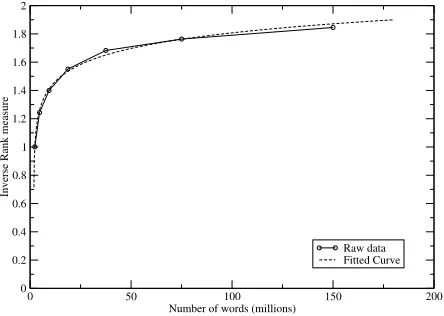
Table 6 shows what happens to thesaurus quality as we decrease the size of the corpus to 641th of its original size (2.3M words) for SEXTANT. Halving the corpus results in a significant reduction for most of the measures. All five evaluation measures show the same log-linear dependence on the size of the corpus. Figure 1 shows the same trend for Inverse Rank evaluation of the MINIPAR thesaurus with a log-linear fitting the data points.
We can use the same curve fitting to estimate
the-0 50 100 150 200
Number of words (millions) 0
0.2 0.4 0.6 0.8 1 1.2 1.4 1.6 1.8 2
Inverse Rank measure
Raw data Fitted Curve
Figure 1: MINIPAR INVR scores versus corpus size
saurus quality on larger corpora for three of the best extractors: SEXTANT, MINIPARand W(L1R1).
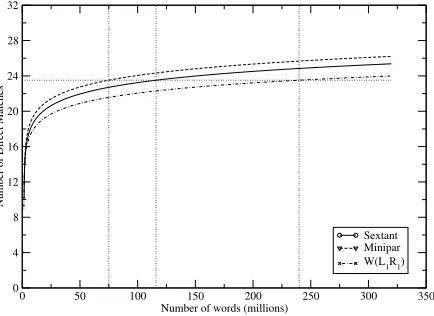
Fig-ure 2 does this with the direct match evaluation. The estimate indicates that MINIPAR will continue to be the best performer on direct matching. We then plot the direct match scores for the 300M word corpus to see how accurate our predictions are. The SEX-TANT system performs almost exactly as predicted and the other two slightly under-perform their pre-dicted scores, thus the fitting is accurate enough to make reasonable predictions.
[image:5.612.316.538.322.480.2]System Space Relations Unique Terms DIRECT P(1) P(5) P(10) INVR Time MINIPAR 399Mb 142.27M 16.62M 914k 24.55 61.5 % 46.5 % 40.5 % 1.85 4438.9m SEXTANT 274Mb 53.07M 12.08M 269k 23.75 64.5 % 47.0 % 39.0 % 1.85 159.0m
CASS 186Mb 50.63M 9.09M 204k 20.20 48.5 % 38.5 % 32.5 % 1.51 173.7m
W(L1) 117Mb 105.62M 7.04M 406k 20.60 51.5 % 40.0 % 32.5 % 1.56 6.8m
W(L1,2) 336Mb 206.02M 18.04M 440k 21.30 58.5 % 44.5 % 36.5 % 1.71 7.2m
W(L1,2∗) 258Mb 206.02M 15.34M 440k 20.75 55.0 % 41.5 % 35.5 % 1.64 6.8m
[image:6.612.96.517.71.185.2]W(L1−3) 570Mb 301.10M 30.62M 444k 20.50 60.0 % 43.5 % 37.0 % 1.69 8.2m W(L1−3∗) 388Mb 301.10M 22.86M 444k 19.85 48.5 % 39.5 % 33.5 % 1.53 8.2m W(L1R1) 262Mb 211.24M 14.07M 435k 22.40 62.0 % 44.5 % 37.0 % 1.76 7.2m W(L1R1∗) 211Mb 211.24M 12.56M 435k 20.90 54.5 % 42.5 % 34.5 % 1.64 7.2m
Table 5: Average thesaurus quality results for different extraction systems
Corpus Space Relations Unique Terms DIRECT P(1) P(5) P(10) INVR 150.0M 274Mb 53.07M 12.08M 268.94k 23.75 64.5 % 47.0 % 39.0 % 1.85
75.0M 166Mb 26.54M 7.38M 181.73k 22.60 58.0 % 43.5 % 36.0 % 1.73
37.5M 98Mb 13.27M 4.36M 120.48k 21.75 54.0 % 41.0 % 34.5 % 1.62
18.8M 56Mb 6.63M 2.54M 82.33k 20.45 47.0 % 36.5 % 31.0 % 1.46
9.4M 32Mb 3.32M 1.44M 55.55k 18.50 40.0 % 32.5 % 27.5 % 1.29
4.7M 18Mb 1.66M 0.82M 37.95k 16.65 34.0 % 29.5 % 23.5 % 1.13
[image:6.612.109.505.221.306.2]2.3M 10Mb 0.83M 0.46M 25.97k 14.60 27.5 % 25.0 % 19.5 % 0.93
Table 6: Average SEXTANTthesaurus quality results for different corpus sizes
0 50 100 150 200 250 300 350 Number of words (millions)
0 4 8 12 16 20 24 28 32
Number of Direct Matches
Sextant Minipar W(L1R1)
Figure 2: Direct matches versus corpus size
resources at an arbitrary point, e.g. the point where MINIPAR can process 75M words, we get a best direct match score of 23.5. However, we can get the same resultant accuracy by using SEXTANT on a corpus of 116M words or W(L1R1) on a corpus
of 240M words. From Figure 5, extracting contexts from corpora of these sizes would take MINIPAR37 hours, SEXTANT2 hours and W(L1R1) 12 minutes.
Interpolation on Figure 3 predicts that the extraction would result in 10M unique relations from MINI-PAR and SEXTANT and 19M from W(L1R1).
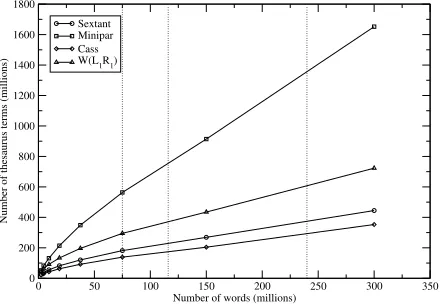
Fig-ure 4 indicates that extraction would result in 550k
0 50 100 150 200 250 300 350 Number of words (millions)
0 4 8 12 16 20 24 28 32
Number of unique relations (millions)
Sextant Minipar Cass W(L1R1) W(L1R1*) W(L1,2)
Figure 3: Representation size versus corpus size
MINIPAR terms, 200k SEXTANT terms and 600k W(L1R1) terms.
Given these values and the fact that the time com-plexity of most thesaurus extraction algorithms is at least linear in the number of unique relations and squared in the number of thesaurus terms, it seems SEXTANTmay represent the best solution.
[image:6.612.78.295.351.509.2] [image:6.612.313.538.352.509.2]System Space Relations Unique Terms DIRECT P(1) P(5) P(10) INVR SEXTANT300M 431Mb 80.33M 20.41M 445k 25.30 61.0 % 47.0 % 39.0 % 1.87 SEXTANT150M 274Mb 53.07M 12.08M 269k 23.75 64.5 % 47.0 % 39.0 % 1.85 SEXTANT FIXED 244Mb 61.17M 10.74M 265k 24.35 65.0 % 46.5 % 38.5 % 1.86 SEXTANT LEXICON 410Mb 78.69M 18.09M 264k 25.25 62.0 % 47.0 % 40.0 % 1.87 SEXTANT>1 149Mb 67.97M 6.63M 171k 24.20 66.0 % 45.0 % 38.0 % 1.85
[image:7.612.76.296.191.343.2]SEXTANT>2 88Mb 62.57M 3.93M 109k 23.20 66.0 % 46.0 % 36.0 % 1.82
Table 7: Thesaurus quality with relation filtering
0 50 100 150 200 250 300 350 Number of words (millions)
0 200 400 600 800 1000 1200 1400 1600 1800
Number of thesaurus terms (millions)
Sextant Minipar Cass W(L1R1)
Figure 4: Thesaurus terms versus corpus size
full 300M word corpus, but have size limits based on the 150M word corpus. TheFIXEDfilter does not allow any object/attribute pairs to be added that were not extracted from the 150M word corpus. The LEX-ICON filter does not allow any objects to be added that were not extracted from the 150M word cor-pus. The>1and >2filters prune relations with a frequency of less than or equal to one or two. The FIXEDandLEXICONfilters show that counting over larger corpora does produce marginally better re-sults. The >1 and >2 filters show that the many relations that occur infrequently do not contribute significantly to the vector comparisons and hence don’t impact on the final results, even though they dramatically increase the representation size.
7 Conclusion
It is a phenomenon common to manyNLPtasks that the quality or accuracy of a system increases log-linearly with the size of the corpus. Banko and Brill, (2001) also found this trend for the task of confu-sion set disambiguation on corpora of up to one bil-lion words. They demonstrated behaviour of differ-ent learning algorithms with very simple contexts on
extremely large corpora. We have demonstrated the behaviour of a simple learning algorithm on much more complicated contextual information on very large corpora.
Our experiments suggest that the existing method-ology of evaluating systems on small corpora with-out reference to the execution time and representa-tion size ignores important aspects of the evaluarepresenta-tion ofNLPtools.
These experiments show that efficiently imple-menting and optimising theNLPtools used for con-text extraction is of crucial importance since the in-creased corpus sizes make execution speed an im-portant evaluation factor when deciding between different learning algorithms for different tasks and corpora. These results also motivate further re-search into improving the asymptotic complexity of the learning algorithms used in NLP systems. In the new paradigm, it could well be that far simpler but scalable learning algorithms significantly out-perform existing systems.
Finally, the mass availability of online text re-sources should be taken on board. It is important that language engineers and computational linguists continue to try and find new unsupervised or (as Banko and Brill suggest) semi-supervised methods for tasks which currently rely on annotated data. It is also important to consider how information ex-tracted by systems such as thesaurus extraction sys-tems can be incorporated into tasks which use pre-dominantly supervised techniques, e.g. in the form of class information for smoothing.
to investigate how this thesaurus information can be used to improve the accuracy or generality of other NLPtasks.
Acknowledgements
We would like to thank Miles Osborne, Stephen Clark, Tara Murphy, and the anonymous reviewers for their comments on drafts of this paper. This re-search is supported by a Commonwealth scholarship and a Sydney University Travelling scholarship.
References
Steve Abney. 1996. Partial parsing via finite-state cas-cades. Journal of Natural Language Engineering, 2(4):337–344, December.
L. Douglas Baker and Andrew McCallum. 1998. Distri-butional clustering of words for text classification. In
Proceedings of the 21st annual international ACM SI-GIR conference on Research and Development in In-formation Retrieval, pages 96–103, Melbourne, Aus-tralia, 24–28 August.
Michele Banko and Eric Brill. 2001. Scaling to very very large corpora for natural language disambigua-tion. InProceedings of the 39th annual meeting of the Association for Computational Linguistics, pages 26– 33, Toulouse, France, 9–11 July.
John R. L. Bernard, editor. 1990. The Macquarie Ency-clopedic Thesaurus. The Macquarie Library, Sydney, Australia.
Peter F. Brown, Vincent J. Della Pietra, Peter V. deSouza, Jennifer C. Lai, and Robert L. Mercer. 1992. Class-based n-gram models of natural language. Computa-tional Linguistics, 18(4):467–479, December.
Sharon A. Caraballo. 1999. Automatic construction of a hypernym-labeled noun hierarchy from text. In Pro-ceedings of the 37th annual meeting of the Association for Computational Linguistics, pages 120–126, Col-lege Park, MD USA, 20–26 June.
Stephen Clark and David Weir. 2001. Class-based prob-ability estimation using a semantic hierarchy. In Pro-ceedings of the Second Meeting of the North American Chapter of the Association for Computational Linguis-tics, pages 95–102, Pittsburgh, PA USA, 2–7 June.
Carolyn J. Crouch. 1988. Construction of a dynamic the-saurus and its use for associated information retrieval. In Proceedings of the eleventh international confer-ence on Research and Development in Information Re-trieval, pages 309–320, Grenoble, France, 13–15 June.
James R. Curran and Marc Moens. 2002. Improve-ments in automatic thesaurus extraction. In ACL-SIGLEX Workshop on Unsupervised Lexical Acquisi-tion, Philadelphia, PA USA.(to appear).
Gregory Grefenstette. 1994. Explorations in Automatic Thesaurus Discovery. Kluwer Academic Publishers, Boston, USA.
Marti A. Hearst. 1992. Automatic acquisition of hy-ponyms from large text corpora. InProceedings of the 14th international conference on Computational Lin-guistics, pages 539–545, Nantes, France, 23–28 July.
Dekang Lin. 1998a. Dependency-based evaluation of MINIPAR. InWorkshop on the Evaluation of Parsing Systems, Proceedings of the First International Con-ference on Language Resources and Evaluation, pages 234–241, Granada, Spain, 28–30 May.
Dekang Lin. 1998b. An information-theoretic definition of similarity. InProceedings of the Fifteen Interna-tional Conference on Machine Learning, pages 296– 304, Madison, WI USA, 24–27 July.
Guido Minnen, John Carroll, and Darren Pearce. 2000. Robust applied morphological generation. InIn Pro-ceedings of the First International Natural Language Generation Conference, pages 201–208, Mitzpe Ra-mon, Israel, 12–16 June.
Darren Pearce. 2001. Synonymy in collocation extrac-tion. In Workshop on WordNet and Other Lexical Resources: Applications, Extensions and Customiza-tions, (NAACL 2001), pages 41–46, Pittsburgh, PA USA, 2–7 June.
Fernando Pereira, Naftali Tishby, and Lillian Lee. 1993. Distributional clustering of English words. In Pro-ceedings of the 31st annual meeting of the Associ-ation for ComputAssoci-ational Linguistics, pages 183–190, Columbus, Ohio USA, 22–26 June.
Peter Roget. 1911. Thesaurus of English words and phrases. Longmans, Green and Co., London, UK.
Gerda Ruge. 1997. Automatic detection of thesaurus re-lations for information retrieval applications. In Foundations of Computer Science: Potential Theory -Cognition, Lecture Notes in Computer Science, vol-ume LNCS 1337, pages 499–506. Springer Verlag, Berlin, Germany.
Mark Sanderson and Bruce Croft. 1999. Deriving con-cept hierarchies from text. In Proceedings of the 22nd annual international ACM SIGIR conference on Research and Development in Information Retrieval, pages 206–213, Berkeley, CA USA, 15–19 August.