Proceedings of NAACL-HLT 2016, pages 45–52,
Individual Differences in Strategic Deception
Scott Appling and Erica Briscoe Georgia Tech Research Institute Georgia Institute of Technology
Atlanta, GA, United States
[email protected] [email protected]
Abstract
While text-based deception in computer me-diated communication has been studied, e.g., Zhou (2005) and Duran et al. (2010), there has been less focus on the differentiation of strate-gies for deception, especially those which may manifest in modern communication, such as found in social media. In this paper, we extend our previous work on the evaluation of linguis-tic indicators to strategic deception (Appling et al., 2015), by evaluating the relationship be-tween personality and deceptive strategy use and the utilization of linguistic features for in-ferring both (personality and deception). We find that even with a relatively small corpus, there is evidence that personality is related to particular deception strategies, though in short social media communications, these personal-ity traits are difficult to infer using standard linguistic measures (e.g., LIWC). We also de-scribe the corpus we collected from an exper-iment in which subjects engaged in deception through a social media platform.
1 Introduction
The ubiquitous nature of social media has signifi-cantly magnified the communicative ability of indi-viduals and groups and changed the way many in-dividuals receive information (Lenhart et al., 2010). Consequently, this increased access has enlarged the influence opportunity space, where deception is a commonly utilized influence method (Buller et al., 1994). A theme of our research is focused on the evaluation of how findings from previously stud-ied communication methods, e.g., Burgoon et al.
(1996), differ as a result of both changing communi-cation styles and the affordances provided by mod-ern communication platforms (i.e., social media).
Research into “tells” that indicate when a person is lying have been a subject of interest for many years, e.g. (Ekman and Friesen, 1969), and has re-sulted in a substantial list of potential cues (DePaulo et al., 2003). These cues to deception are usually described as those that occur significantly more or less frequently when a communicator expresses an untruth as compared to the truth. These indicators may differ according to the point of view of the re-ceiver and sender (Anderson et al., 1999) and have been identified in widespread communications, such as the 2016 United States election coverage (Scott, 2016). While our previous work evaluated the de-tection of deceptive statements and deception strate-gies using linguistic cues (Briscoe et al., 2014; Ap-pling et al., 2015), here we describe our evaluation of how individual differences, specifically as rep-resented through different personalities, may affect strategic deception and be inferred from an experi-mentally collected corpus.
2 Eliciting Deception Strategies
Past work has characterized multiple deception strategies (Rubin, 2010; Turner et al., 1975; Bur-goon et al., 1996), roughly organized into the four main types described below.
• Falsification- e.g. lies, contradictions, or “dis-tortions”
• Exaggeration- e.g. more or modified informa-tion via superlatives
• Omission- e.g. secrets (missing information), half-truths (less or modified information), or ‘concealment”
• Misleading- e.g. topic changes, irrelevant in-formation, equivocation, or ‘diversionary re-sponses”
To evaluate the use of the previously described set of strategies, we conducted human subject experi-mentation to simulate an online social network vironment where participants were tasked with en-gaging in a conversation involving a decision mak-ing task where they were encouraged to employ de-ception. We also administered a personality inven-tory to assess each participant’s standing on the di-mensions contained within the Five Factor Model (FFM) of personality (McCrae and Costa Jr, 1999): openness, conscientiousness, extroversion, agree-ableness, neuroticism. Then we extracted lingus-tic features that were found to be statislingus-tically sig-nificant predictors of related personality traits. We then report on an analysis on the use of linguistic features for predicting deception strategies based on individual-trait level psychological constructs (per-sonality).
The rest of the paper is organized as follows. First we describe the experimental setup and the collected data. Next, we discuss the deception strategies cor-pus that was created. We then discuss the results of two analyses: one related to predicting deception strategy on personality trait scores and a second on using psycholinguistic features to predict personal-ity. We conclude with a discussion of the implica-tions of the results and future direcimplica-tions
3 Deception Experiment
To study deception strategies in social media, we de-signed and ran an in-lab experiment where individ-uals were asked to use a social media platform for a group decision making task. The task allowed us to control the scenario as well as topics of discussion within the conversations.
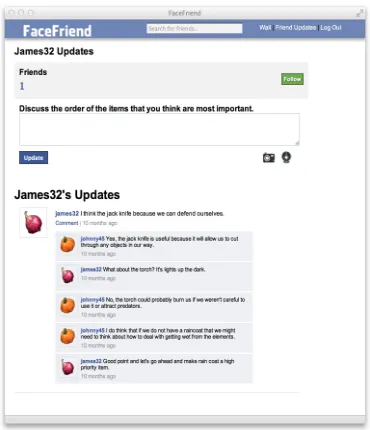
[image:2.612.334.519.71.286.2]Seventy-five subjects recruited from the student body at Georgia Tech participated in the experiment. Each subject was seated at a computer station and asked to use a mock online social media site (Face-Friend, see Figure 1). The mock site was intended
Figure 1: Example screenshot of theFaceFriendweb-based interface used in the experiment. The interface was designed to mimic commonly used social media platforms.
to resemble a popular social networking site. Partic-ipants completed three pre-experiment surveys, in-cluding a personality test and a survey regarding their social media and email usage, so as to en-sure consistency among familiarity with social me-dia. The procedure and results reported below are from one of a three part experiment, the other two parts of which are not reported here (as they cen-tered on the perception of deception and credibility, see Briscoe et al. (2014) and Briscoe et al. (2013) for details of the other parts of the study. Subjects were paid for their participation.
included an Axe, which the expert noted could be used to chop wood. Lastly, participants were os-tensibly informed that the other conversation par-ticipant would be unaware of any potential decep-tion. The participant’s conversational partner was a confederate member of the research team, sitting in another room. During the conversation, to min-imize variation in the confederate’s response lan-guage, the confederates communicated using a list of statements conceived beforehand as suitable de-cision making conversation responses (e.g., “What about the canvas?”). After discussing the items for 12 minutes, the interaction was concluded, and sub-jects were asked to log out of FaceFriend.
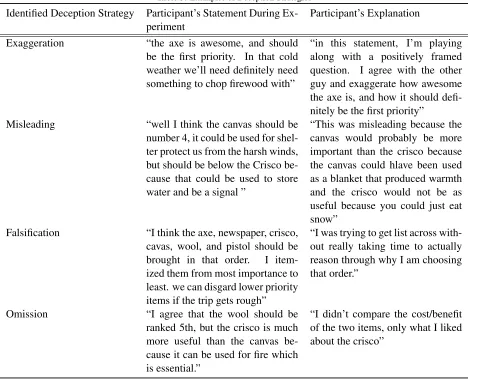
After the end of the conversation, participants were shown the list of statements they made during the task in a browser windows and asked to identify which ones were deceptive using a check box. Upon indicating a particular statement was deceptive, par-ticipants were prompted to categorize their strategy for that particular message. The possible strategies to select were the same types described in Section 2. Multiple strategies were allowed to be designated. An additional category, “Other”, was available that allowed free response space for any strategies that the subject felt did not fit into one of the four pro-vided categories. Table 3 displays example decep-tive statements, as identified by subjects, in each cat-egory.
4 Deception Corpus
The deception corpus contains all statements made by participants during the deception experiment de-scribed earlier. These include truthful and deceptive statements. For each statement we provide a boolean indicator as to whether or not the participant anno-tated that statement as enacting one or more of the deception strategies described in Section 2. 1
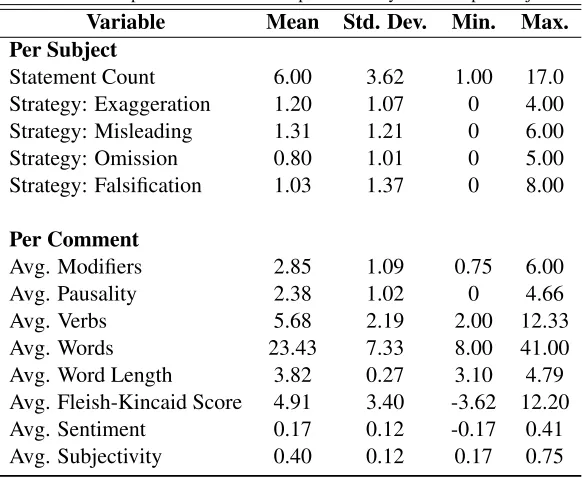
Table 4 lists the frequencies of each identified strategy in the corpus as indicated by the subjects. Statements which subjects identified as containing multiple strategies are not included. On average, the misleading strategy was the most likely strategy to be employed by participants and the omission strat-egy the least likely. Table 1 lists summary statistics about the statements in the corpus. Sentiment and
1The collected corpus is available by emailing the authors.
subjectivity scores were calculated for each state-ment, using the method described by De Smedt and Daelemans (2012). Table 2 provides the descriptive statistics of the distribution of personality variables across our subject pool, as well as relevant demo-graphic information.
5 Analysis
5.1 Linguistic Cues and Deception Strategies
After excluding statements falling below a mini-mum one word threshold2, 393 statements
(includ-ing truthful statements) were used in a one-way mul-tivariate analysis of variance to determine the ef-fect of deception strategy on linguistic cue levels. The 8 linguistics cues studied are listed in Table 1. A statistically significant difference was found be-tween the different deception strategies and truthful statements on the combined linguistic cues depen-dent variablesF(32,1406.654) = 1.93, p <0.001; Wilks’ Λ = 0.852; partial η2 = 0.039, though
no specific differences were found between specific strategies. Follow-up univariate ANOVAs showed a statistically significant difference between the use of deception strategies and no strategy using a Bon-ferroni adjusted α level of 0.025. Tukey post-hoc tests showed: there were less average verb cues for truthful statements compared to exaggerations (p <0.001) and compared to misleading statements (p < 0.019) (M = 4.695;SD = 0.274;M = 6.657;SD = 0.419;M = 6.222, SD = 0.413, respectively); lower mean word count for truth-ful statements compared to exaggeration statements (p < 0.019;M=20.024; SD=0.899; M=25.086; SD=1.376, respectively); and lower mean Fleish-Kincaid score cues for truthful statements compared to exaggeration statements (p < 0.005; M = 3.228;SD = 0.438;M = 5.993;SD = 0.670, re-spectively).
2Exclusion of one-word statements was based on the fact
Table 1:Deception Conversation Corpus Summary Statistics per Subject
Variable Mean Std. Dev. Min. Max. Per Subject
Statement Count 6.00 3.62 1.00 17.0
Strategy: Exaggeration 1.20 1.07 0 4.00 Strategy: Misleading 1.31 1.21 0 6.00
Strategy: Omission 0.80 1.01 0 5.00
Strategy: Falsification 1.03 1.37 0 8.00
Per Comment
Avg. Modifiers 2.85 1.09 0.75 6.00
Avg. Pausality 2.38 1.02 0 4.66
Avg. Verbs 5.68 2.19 2.00 12.33
Avg. Words 23.43 7.33 8.00 41.00
Avg. Word Length 3.82 0.27 3.10 4.79 Avg. Fleish-Kincaid Score 4.91 3.40 -3.62 12.20
Avg. Sentiment 0.17 0.12 -0.17 0.41
Avg. Subjectivity 0.40 0.12 0.17 0.75 Note:Sentiment scores range between -1 (extremely negative) and 1 (extremely positive); Subjectivity scores range between 0 (completely objective) and 1 (completely subjective).
Table 2:Participant Demographic and Personality Statistics Variable Mean Stdev. Min. Max.
Age 22.5 4.8 18 45
Openness 25.1 4.8 15 35
Conscientiousness 35.9 6.4 18 49
Extroversion 29.8 6.2 17 42
Agreeableness 28.7 3.0 21 35
Neuroticism 19.6 6.3 8 34
Gender Female 35 Male 40
5.2 Predicting Deception Strategies using Personality
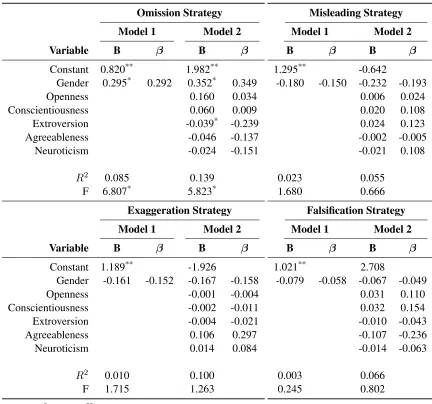
Hierarchical multiple regression analyses were con-ducted using each deception strategy as the depen-dent variable with each FFM personality trait as a predictor including gender as a blocking variable. See Table 5 for details on each regression model. From the analysis, we find that only extroversion
was a predictive trait, found to influence the omis-siondeception strategy during deceptive communi-cations, R2 = .139, F(2,72) = 5.823, p < .01.
The direction of the relationship suggests that less extroverted individuals are more likely to use an
omission strategy.
5.3 Predicting Personality using Psycholinguistic Lexical Features
Given that there was a relationship found between
extroversionand theomission strategy, we are then motivated leverage other work centered on automat-ically deriving personality from text, in order to de-rive indicators for extra version. To create our in-dicators, we utilize previously identified psycholin-guistic features from (Mairesse et al., 2007) related to predicting extroversion from text. A hierarchi-cal multiple regression analysis was conducted us-ing theomissiondeception strategy as the dependent variable with the following LIWC features (found to be indicative of extroversion by Mairesse (2007): 1st Person Plural, 1st Person Singular, Articles, Body, Family, Filler, Inclusion, Negations, Positive Emotion, Social Processes, Tentativeness, Total Pro-nouns.
The ANOVA omnibus F-test proved insignificant,
[image:4.612.74.302.392.519.2]Table 3:Examples of Deception Strategies
Identified Deception Strategy Participant’s Statement During
Ex-periment Participant’s Explanation
Exaggeration “the axe is awesome, and should be the first priority. In that cold weather we’ll need definitely need something to chop firewood with”
“in this statement, I’m playing along with a positively framed question. I agree with the other guy and exaggerate how awesome the axe is, and how it should defi-nitely be the first priority”
Misleading “well I think the canvas should be number 4, it could be used for shel-ter protect us from the harsh winds, but should be below the Crisco be-cause that could be used to store water and be a signal ”
“This was misleading because the canvas would probably be more important than the crisco because the canvas could hlave been used as a blanket that produced warmth and the crisco would not be as useful because you could just eat snow”
Falsification “I think the axe, newspaper, crisco, cavas, wool, and pistol should be brought in that order. I item-ized them from most importance to least. we can disgard lower priority items if the trip gets rough”
“I was trying to get list across with-out really taking time to actually reason through why I am choosing that order.”
Omission “I agree that the wool should be ranked 5th, but the crisco is much more useful than the canvas be-cause it can be used for fire which is essential.”
[image:5.612.72.555.81.461.2]“I didn’t compare the cost/benefit of the two items, only what I liked about the crisco”
Table 4:Frequency of Deception Strategies
Exaggeration Misleading Omission Falsification
Count 67 69 41 45
6 Discussion
The goal of the work was to evaluate how personal-ity (as a means of characterizing individuals) can be used to predict the types of deception strategies that those individuals might use in short, social media-based conversations. The secondary goal was to de-termine if, given a limited social media corpus, those personality characteristics found related to strategic deception could be derived based on linguistic fea-tures. While we did find a relationship between per-sonality and deception strategies, where less
extro-verted individuals are more likely to use anomission
strategy, we did not find evidence that the extrover-sion trait can be accurately derived from this same text using only the extroversion indicators identified by Mairesse et al. (2007). The difficulty in inferring traits from content-derived psycholinguistic features has been identified in other investigations (Adali and Golbeck, 2012; Schwartz et al., 2013); however, the use of additional features, both linguistic, e.g. (Ap-pling et al., 2013)) and non-, e.g. (Adali and Gol-beck, 2012), can improve trait prediction.
decep-Table 5:Hierarchical Multiple Regression Predicting Strategy from Gender and Personality
Omission Strategy Model 1 Model 2
Variable B β B β
Constant 0.820** 1.982**
Gender 0.295* 0.292 0.352* 0.349
Openness 0.160 0.034
Conscientiousness 0.060 0.009
Extroversion -0.039* -0.239
Agreeableness -0.046 -0.137
Neuroticism -0.024 -0.151
R2 0.085 0.139
F 6.807* 5.823*
Exaggeration Strategy Model 1 Model 2
Variable B β B β
Constant 1.189** -1.926
Gender -0.161 -0.152 -0.167 -0.158
Openness -0.001 -0.004
Conscientiousness -0.002 -0.011
Extroversion -0.004 -0.021
Agreeableness 0.106 0.297
Neuroticism 0.014 0.084
R2 0.010 0.100
F 1.715 1.263
Note:*p < .05,**p < .001
Misleading Strategy Model 1 Model 2
B β B β
1.295** -0.642
-0.180 -0.150 -0.232 -0.193 0.006 0.024 0.020 0.108 0.024 0.123 -0.002 -0.005 -0.021 0.108
0.023 0.055
1.680 0.666
Falsification Strategy Model 1 Model 2
B β B β
1.021** 2.708
-0.079 -0.058 -0.067 -0.049 0.031 0.110 0.032 0.154 -0.010 -0.043 -0.107 -0.236 -0.014 -0.063
0.003 0.066
0.245 0.802
tion strategies (Appling et al., 2015) based solely on linguistic features. There, we found that some features were more discriminative for some strate-gies. For example, the most predictive feature for discriminating falsification was in the LIWC nega-tion category (e.g., using ‘no’, ‘not’, ‘never’), which we found unsurprising given that these statements are often disagreements in response to the state-ments made by the other participant. Those features, however, were not found to be significantly associ-ated with any particular strategy in the current study. Also, in that study, the omission strategy was the most difficult to discriminate, using a train random
forest classifier (Breiman, 2001). This result was not surprising given that, by definition, the omission of information does not provide linguistic content from which to derive features. Interestingly, and perhaps unfortunately, it is this same strategy that we find most related to personality dimensions, i.e., extro-version, in the current study.
[image:6.612.70.502.106.510.2]from combined social media status updates, whereas Mairesse et al. (2007) captured on average 766.4 words per subject. Other works, e.g. Nie et al. (2014), give no indication concerning the amount of text being used per individual. These questions are especially relevant given that social media commu-nications are likely highly variable, exhibiting fluc-tuations arising from a variety of factors, such as mood (Bradley and Mogg, 1994).
7 Future Work and Conclusion
Given the likely influence of modern communica-tion platforms on human communicacommunica-tion styles, uti-lizing linguistic-based indicators for deception is a difficult and evolving challenge. One, likely fruit-ful, method of addressing this challenge is to lever-age work that has been done on characterizing in-dividuals as a means of using that characterization for predictive tasks; however, given the brevity and informality of social media communications, much more work must be done to create methods for uti-lizing this kind of text. Related to the use of lexical psycholinguistic features, we see opportunity with recent work in vectorized word representations to develop semantic features based on lexical qualities that weight observations smoothly. Future work will continue to evaluate the efficacy of using informal text-based characterizations as means of predicting communication strategies.
Acknowledgments
This material is based upon work supported in part by the Defense Advanced Research Projects Agency (DARPA) under Contract No. W911NF-12-1-0043.
References
Sibel Adali and Jennifer Golbeck. 2012. Predicting personality with social behavior. In Proceedings of the 2012 International Conference on Advances in So-cial Networks Analysis and Mining (ASONAM 2012), pages 302–309. IEEE Computer Society.
D Eric Anderson, Bella M DePaulo, Matthew E Ans-field, Jennifer J Tickle, and Emily Green. 1999. Be-liefs about cues to deception: Mindless stereotypes or untapped wisdom? Journal of Nonverbal Behavior, 23(1):67–89.
D Scott Appling, Erica J Briscoe, Heather Hayes, and Rudolph L Mappus. 2013. Towards automated per-sonality identification using speech acts. In Seventh International AAAI Conference on Weblogs and Social Media.
Darren Scott Appling, Erica J Briscoe, and Clayton J Hutto. 2015. Discriminative models for predicting deception strategies. InProceedings of the 24th Inter-national Conference on World Wide Web Companion, pages 947–952. International World Wide Web Con-ferences Steering Committee.
Brendan P Bradley and Karin Mogg. 1994. Mood and personality in recall of positive and negative informa-tion. Behaviour research and therapy, 32(1):137–141. Leo Breiman. 2001. Random forests.Machine learning,
45(1):5–32.
Erica J Briscoe, D Scott Appling, Rudolph L Mappus IV, and Heather Hayes. 2013. Determining credibil-ity from social network structure. InProceedings of the 2013 IEEE/ACM International Conference on Ad-vances in Social Networks Analysis and Mining, pages 1418–1424. ACM.
Erica J Briscoe, D Scott Appling, and Heather Hayes. 2014. Cues to deception in social media communica-tions. InSystem Sciences (HICSS), 2014 47th Hawaii International Conference on, pages 1435–1443. IEEE. David B Buller, Judee K Burgoon, JA Daly, and JM Wie-mann. 1994. Deception: Strategic and nonstrategic communication. Strategic interpersonal communica-tion, pages 191–223.
Judee K Burgoon, David B Buller, Laura K Guerrero, Walid A Afifi, and Clyde M Feldman. 1996. Inter-personal deception: Xii. information management di-mensions underlying deceptive and truthful messages.
Communications Monographs, 63(1):50–69.
Tom De Smedt and Walter Daelemans. 2012. Pattern for python. The Journal of Machine Learning Research, 13(1):2063–2067.
Bella M DePaulo, James J Lindsay, Brian E Mal-one, Laura Muhlenbruck, Kelly Charlton, and Harris Cooper. 2003. Cues to deception. Psychological bul-letin, 129(1):74.
Nicholas D Duran, Charles Hall, Philip M McCarthy, and Danielle S McNamara. 2010. The linguistic corre-lates of conversational deception: Comparing natural language processing technologies.Applied Psycholin-guistics, 31(03):439–462.
Patrick M Eady and James Clayton Lafferty. 1969. The subarctic survival situation. Experimental Learning Methods.
Jennifer Golbeck, Cristina Robles, and Karen Turner. 2011. Predicting personality with social media. In
CHI ’11 Extended Abstracts on Human Factors in Computing Systems, CHI EA ’11, pages 253–262, New York, NY, USA. ACM.
Amanda Lenhart, Kristen Purcell, Aaron Smith, and Kathryn Zickuhr. 2010. Social media & mobile in-ternet use among teens and young adults. millennials.
Pew Internet & American Life Project.
Franc¸ois Mairesse, Marilyn A Walker, Matthias R Mehl, and Roger K Moore. 2007. Using linguistic cues for the automatic recognition of personality in conver-sation and text. Journal of artificial intelligence re-search, pages 457–500.
Robert R McCrae and Paul T Costa Jr. 1999. A five-factor theory of personality. Handbook of personality: Theory and research, 2:139–153.
Dong Nie, Zengda Guan, Bibo Hao, Shuotian Bai, and Tingshao Zhu. 2014. Predicting personality on so-cial media with semi-supervised learning. In Proceed-ings of the 2014 IEEE/WIC/ACM Conference on Web Intelligence and Intelligent Agent Technologies, pages 158–165, Washington, DC, USA. IEEE Computer So-ciety.
Victoria L Rubin. 2010. On deception and deception de-tection: Content analysis of computer-mediated stated beliefs. Proceedings of the American Society for In-formation Science and Technology, 47(1):1–10. H Andrew Schwartz, Johannes C Eichstaedt, Margaret L
Kern, Lukasz Dziurzynski, Stephanie M Ramones, Megha Agrawal, Achal Shah, Michal Kosinski, David Stillwell, Martin EP Seligman, et al. 2013. Per-sonality, gender, and age in the language of social media: The open-vocabulary approach. PloS one, 8(9):e73791.
Leslie Scott. 2016. Across new jersey, bands of local is-lamophobes crusade to drive islam underground, Mar. Ronny E Turner, Charles Edgley, and Glen Olmstead. 1975. Information control in conversations: Honesty is not always the best policy. Kansas Journal of Soci-ology.