The CoNLL-2015 Shared Task on Shallow Discourse Parsing
Nianwen Xue∗Hwee Tou Ng†Sameer Pradhan‡Rashmi Prasad3Christopher Bryant†Attapol T. Rutherford∗
∗Brandeis University
xuen,[email protected]
†National University of Singapore
nght,[email protected]
‡Boulder Language Technologies
[email protected] 3University of Wisconsin-Milwaukee
Abstract
The CoNLL-2015 Shared Task is on Shal-low Discourse Parsing, a task focusing on identifying individual discourse relations that are present in a natural language text. A discourse relation can be expressed ex-plicitly or imex-plicitly, and takes two argu-ments realized as sentences, clauses, or in some rare cases, phrases. Sixteen teams from three continents participated in this task. For the first time in the history of the CoNLL shared tasks, participating teams, instead of running their systems on the test set and submitting the output, were asked to deploy their systems on a remote virtual machine and use a web-based evaluation platform to run their systems on the test set. This meant they were unable to ac-tually see the data set, thus preserving its integrity and ensuring its replicability. In this paper, we present the task definition, the training and test sets, and the evalua-tion protocol and metric used during this shared task. We also summarize the dif-ferent approaches adopted by the partic-ipating teams, and present the evaluation results. The evaluation data sets and the scorer will serve as a benchmark for future research on shallow discourse parsing. 1 Introduction
The shared task for the Nineteenth Conference on Computational Natural Language Learning (CoNLL-2015) is on Shallow Discourse Parsing (SDP). In the course of the sixteen CoNLL shared
tasks organized over the past two decades, pro-gressing gradually to tackle phenomena at the word and phrase level phenomena and then the sentence and extra-sentential level, it was only very recently that discourse level processing has been addressed, with coreference resolution (Prad-han et al., 2011; Prad(Prad-han et al., 2012). The 2015 shared task takes the community a step further in that direction, with the potential to impact scores of richer language applications (Webber et al., 2012).
Given an English newswire text as input, the goal of the shared task is to detect and categorize discourse relations between discourse segments in the text. Just as there are different grammati-cal formalisms and representation frameworks in syntactic parsing, there are also different concep-tions of the discourse structure of a text, and data sets annotated following these different the-oretical frameworks (Stede, 2012; Webber et al., 2012; Prasad and Bunt, 2015). For example, the RST-DT Corpus (Carlson et al., 2003) is based on the Rhetorical Structure Theory of Mann and Thompson (1988) and produces a complete tree-structured RST analysis of a text, whereas the Penn Discourse TreeBank (PDTB) (Prasad et al., 2008; Prasad et al., 2014) provides a shallow rep-resentation of discourse structure, in that each dis-course relation is annotated independently of other discourse relations, leaving room for a high-level analysis that may attempt to connect them. For the CoNLL-2015 shared task, we chose to use the PDTB, as it is currently the largest data set anno-tated with discourse relations.1
1http://www.seas.upenn.edu/˜pdtb
The necessary conditions are also in place for such a task. The release of the RST-DT and PDTB has attracted a significant amount of research on discourse parsing (Pitler et al., 2008; Duverle and Prendinger, 2009; Lin et al., 2009; Pitler et al., 2009; Subba and Di Eugenio, 2009; Zhou et al., 2010; Feng and Hirst, 2012; Ghosh et al., 2012; Park and Cardie, 2012; Wang et al., 2012; Bi-ran and McKeown, 2013; Lan et al., 2013; Feng and Hirst, 2014; Ji and Eisenstein, 2014; Li and Nenkova, 2014; Li et al., 2014; Lin et al., 2014; Rutherford and Xue, 2014), and the momentum is building. Almost all of these recent attempts at discourse parsing use machine learning tech-niques, which is consistent with the theme of the CoNLL conference. The resurgence of deep learn-ing techniques opens the door for innovative ap-proaches to this problem. A shared task on shal-low discourse parsing provides an ideal platform for the community to gain crucial insights on the relative strengths and weaknesses of “standard” feature-based learning techniques and “deep” rep-resentation learning techniques.
The rest of this overview paper is structured as follows. In Section 2, we provide a concise def-inition of the shared task. We describe how the training and test data are prepared in Section 3. In Section 4, we present the evaluation protocol, met-ric and scorer. The different approaches that par-ticipants took in the shared task are summarized in Section 5. In Section 6, we present the ranking of participating systems and analyze the evaluation results. We present our conclusions in Section 7.
2 Task Definition
The goal of the shared task on shallow discourse parsing is to detect and categorize individual dis-course relations. Specifically, given a newswire article as input, a participating system is asked to return a set of discourse relations contained in the text. A discourse relation, as defined in the PDTB, from which the training data for the shared task is drawn, is a relation taking two abstract ob-jects (events, states, facts, or propositions) as argu-ments. Discourse relations may be expressed with explicit connectives likebecause,however,but, or implicitly inferred between abstract object units. In the current version of the PDTB, non-explicit relations are inferred only between adjacent units. Each discourse relation is labeled with a sense se-lected from a sense hierarchy, and its arguments
are generally in the form of sentences, clauses, or in some rare cases, noun phrases. To detect a dis-course relation, a participating system needs to:
1. Identify the text span of an explicit discourse connective, if present;
2. Identify the spans of text that serve as the two arguments for each relation;
3. Label the arguments as (Arg1orArg2) to in-dicate the order of the arguments;
4. Predict the sense of the discourse relation (e.g., “Cause”, “Condition”, “Contrast”).
3 Data
3.1 Training and Development
The training data for the CoNLL-2015 Shared Task was adapted from the Penn Discourse Tree-Bank 2.0. (PDTB-2.0.) (Prasad et al., 2008; Prasad et al., 2014), annotated over the one mil-lion word Wall Street Journal (WSJ) corpus that has also been annotated with syntactic structures (the Penn TreeBank) (Marcus et al., 1993) and propositions (the Proposition Bank) (Palmer et al., 2005). The PDTB annotates discourse relations that hold between eventualities and propositions mentioned in text. Following a lexically grounded approach to annotation, the PDTB annotates rela-tions realized explicitly by discourse connectives drawn from syntactically well-defined classes, as well as implicit relations between adjacent sen-tences when no explicit connective exists to relate the two. A limited but well-defined set of implicit relations are also annotated within sentences. Ar-guments of relations are annotated in each case, following theminimality principlefor selecting all and only the material needed to interpret the rela-tion. For explicit connectives, Arg2, which is de-fined as the argument with which the connective is syntactically associated, is in the same sentence as the connective (though not necessarily string ad-jacent), but Arg1, defined simply as the other ar-gument, is unconstrained in terms of its distance from the connective and can be found anywhere in the text (Exs. 1-3). (All the following PDTB ex-amples shown highlight Arg1 (in italics), Arg2 (in boldface), expressions realizing the relation (un-derlined), sense (in parentheses), and the WSJ file number for the text with the example (in square brackets)).
talks begin. (Temporal.Asynchronous.Precedence) [wsj 2338]
(2) But that ghost wouldn’t settle for words,he wanted money and people – lots. SoMr. Carter formed three new Army divisions and gave them to a new bureaucracy in Tampa called the Rapid Deployment Force. (Contingency.Cause.Result) [wsj 2112]
(3) Big buyers like Procter & Gamble saythere are other spots on the globe, and in India, where the seed could be grown. “It’s not a crop that can’t be doubled or tripled,” says Mr. Krishnamurthy. Butno one has made a serious effort to trans-plant the crop. (Comparison.Concession.Contra-expectation) [wsj 0515]
Between adjacent sentences unrelated by any explicit connective, four scenarios hold: (a) the sentences may be related by a discourse relation that has no lexical realization, in which case a con-nective (called anImplicitconnective) is inserted to express the inferred relation (Ex. 4), (b) the sen-tences may be related by a discourse relation that is realized by some alternative non-connective ex-pression (calledAltLex), in which case these alter-native lexicalizations are annotated as the carriers of the relation (Ex. 5), (c) the sentences may be related not by a discourse relation realizable by a connective or AltLex, but by an entity-based co-herence relation, in which case the presence of such a relation is labeled EntRel(Ex 6), and (d) the sentences may not be related at all, in which case they are labeledNoRel. Relations annotated in these four scenarios are collectively referred to asNon-Explicitrelations in this paper.
(4) The Arabs had merely oil. Implicit=while These farmers may have a grip on the world’s very heart. (Comparison.Contrast) [wsj 0515]
(5) Now, GM appears to be stepping up the pace of its factory consolidation to get in shape for the 1990s. One reason is mounting competition from new Japanese car plants in the U.S.that are pouring out more than one million vehicles a year at costs lower than GM can match. (Contin-gency.Cause.Reason) [wsj 2338]
(6) Pierre Vinken, 61 years old, will join the board as a nonexecutive director Nov. 29. EntRelMr. Vinken is chairman of Elsevier N.V., the Dutch publish-ing group. [wsj 0001]
In addition to the argument structure of rela-tions, the PDTB provides sense annotation for each discourse relation, capturing the polysemy of connectives. Senses are organized in a three-level hierarchy, with 4 top-level semanticclasses. For each class, a second level oftypesis defined, and there are 16 such types. There is a third level of subtype which provides further refinement to the
second level types. In the PDTB annotation, an-notators are allowed back off to a higher level in the sense hierarchy if they are not certain about a lower level sense. That is, if they cannot dis-tinguish between the subtypes under a type sense, they can just annotate the type level sense, and if there is further uncertainty in choosing among the types under a class sense, they can just annotate the class level sense. Most of the discourse rela-tion instances in the PDTB are annotated with at least a type level sense, but there are also a small number annotated with only a class level sense.
The PDTB also provides annotations of attribu-tion over all discourse relaattribu-tions and each of their arguments, as well as of text spans considered as supplementary to arguments of relations. How-ever, both of these annotation types are excluded from the shared task.
PDTB-2.0. contains annotations of 40,600 dis-course relations, distributed into the following five types: 18,459 Explicit relations, 16,053 Implicit relations, 624 AltLex relations, 5,210 EntRel rela-tions, and 254 NoRel relations. We provide Sec-tions 2–21 of the PDTB 2.0 release as the training set, and Section 22 as the development set.
3.2 Test Data
We provide two test sets for the shared task: Sec-tion 23 of the PDTB, and a blind test set we pre-pared especially for the shared task. The official ranking of the systems is based on their perfor-mance on the blind test set. In this section, we provide a detailed description of how the blind test set was prepared.
3.2.1 Data Selection and Post-processing For the blind test data, 30,158 words of untok-enized English newswire texts were selected from a dump of English Wikinews2, accessed 22nd October 2014, and annotated in accordance with PDTB 2.0 guidelines.
The raw Wikinews data was pre-processed as follows:
• News articles were extracted from the Wikinews XML dump3 using the publicly available WikiExtractor.py script.4
2https://en.wikinews.org/
3https://dumps.wikimedia.org/enwikinews/20141119/
enwikinews-20141119-pages-articles.xml.bz2
4http://medialab.di.unipi.it/wiki/Wikipedia_
• Additional processing was done to remove any remaining XML information and pro-duce a raw text version of each article (in-cluding its title).
• All paragraphs were double spaced to ease paragraph boundary identification.
• Each article was named according to its unique Wikinews ID such that it is accessible online at http://en.wikinews.org/ wiki?curid=ID.
Initially, 30k words of text were selected from this processed data at random. However, it soon became apparent that some texts were too short for PDTB-style annotation or otherwise still con-tained remnant XML errors. Another issue was that since Wikinews texts are written by members of the public, rather than professionally trained journalists, some articles were considered as not up to the same standards of spelling and grammar as the WSJ texts in the PDTB.
For these reasons, despite making the decision to allow the correction of extremely minor errors (such as obvious typos and occasional article or preposition errors), just under half of the orig-inal 30k word random selection was ultimately deemed unsuitable for annotation. Consequently, the remaining texts were selected manually from Wikinews, with a slight preference for longer arti-cles with many multi-sentence paragraphs that are more consistent with WSJ-style texts.
3.2.2 Annotations
Annotation of the blind test set was carried out by two of the shared task organizers, one of whom (fifth author) was the main annotator (MA) while the other (fourth author), a lead developer of the PDTB, acted as the reviewing annotator (RA), re-viewing each relation annotated by the MA and recording agreement or disagreement. Annotation involved marking the relation type (Explicit, Im-plicit, AltLex, EntRel, NoRel), relation realiza-tion (explicit connective, implicit connective, Al-tLex expression), arguments (Arg1 and Arg2), and sense of a discourse relation, using the PDTB an-notation tool.5 Unlike the PDTB guidelines, we did not allow back-off to the top class level dur-ing annotation. Every relation was annotated with a sense chosen from at least the second type level.
5
https://www.seas.upenn.edu/˜pdtb/tools.shtml# annotator
Also different from the PDTB, attribution spans or attribution features were not annotated.
Before commencing official annotation, MA was trained in PDTB-2.0. style annotation by RA. A review of the guidelines was followed by double blind annotation (by MA and RA) of a small num-ber of WSJ texts not previously annotated in the PDTB, and differences were then compared and discussed. MA then also underwent self-training by first annotating some WSJ texts that were al-ready annotated in the PDTB, and then comparing these annotations, to further strengthen knowledge of the guidelines.
After the training period, the entire blind test data was annotated by MA over a period of a few weeks, and then reviewed by RA. Disagreements during the review were manually recorded using a formal scheme addressing all aspects of the an-notation, including relation type, explicit connec-tive identification, senses, and each of the argu-ments. This was done to verify the integrity of the blind test data and keep a record of any confu-sion or difficulty encountered during annotation. Manual entry of disagreements was done within the tool interface, through its commenting feature. A recorded comment in the tool is unique to a re-lation token and is recorded in a stand-off style. Disagreements were later resolved by consensus between MA and RA.
3.2.3 Inter-annotator Agreement
The record of disagreements was utilized to com-pute inter-annotator agreement between MA and RA. The overall agreement was 76.5%, which represents the percentage of relations on which there was complete agreement. Agreement on ex-plicit connective identification was 96.0%, repre-senting the percentage of explicit connectives that both MA and RA identified as discourse connec-tives. We note here that if a connective was identi-fied in the blind test data, but was not annotated in the PDTB despite its occurrence in the WSJ (e.g.,“after which time”, “despite”), we did not consider it a potential connective and hence did not include it in the agreement calculation. When the textual context allowed it, such expressions were instead marked as AltLex.
together, as well as for Explicit and Non-Explicit relation types separately. Sense disagreement was computed using the CoNLL sense classification scheme (see Section 3.3), even though the anno-tation was done using the full PDTB sense clas-sification scheme (see Table 2). The agreement percentages are shown in Table 1. When multi-ple senses were provided for a relation, a ment on any of the senses was counted as disagree-ment for the relation; disagreedisagree-ment on more than one of the senses was counted only once. Absence of a second sense by one annotator when the other did provide one was also counted as disagreement. As the table shows, agreement on senses was reasonably high overall (85.5%), with agreement for Explicit relations expectedly higher (91.0%) than for Non-Explicit relations (80.9%). Over-all agreement on arguments was also high, but in contrast to the senses, agreement was generally higher for the Non-Explicit than for Explicit re-lations. Agreement on the Arg1 of Explicit rela-tions (89.6%) is, not surprisingly, lower than for Arg2 (98.7%), because the Arg1 of Explicit rela-tions can be non-adjacent to the connective’s sen-tence or clause, and thus, harder to identify. For the Non-Explicit relations, in contrast, but again to be expected, because of the argument adjacency constraint for such relations, agreement on Arg1 (95.0%) and Arg2 (96.4%) shows minimal differ-ence. Table 1 also provides the percentage of re-lations with agreement on both Arg1 and Arg2, showing this to be higher for Non-Explicit rela-tions (92.4%) than for Explicit relarela-tions (88.7%).
Compared to the agreement reported for the PDTB (Prasad et al., 2008; Miltsakaki et al., 2004), the results obtained here (See Table 1) are slightly better. PDTB agreement on Arg1 and Arg2 of Explicit relations is reported to be 86.3% and 94.1%, respectively, whereas overall agreement on arguments of Non-Explicit relations is 85.1%. For the senses, although the CoNLL senses do not exactly align with the PDTB senses, a rough correspondence can be assumed between the CoNLL classification as a whole and the type and subtype levels of the PDTB classification, for which PDTB reports 84% and 80%, respectively.
3.3 Adapting the PDTB Annotation for the shared task
The discourse relations annotated in the PDTB have many different elements, and it is
impracti-cal to predict all of them in the context of a shared task where participants have a relatively short time frame in which to complete the task. As a result, we had to make a number of exclusions and sim-plifications, which we describe below.
The core elements of a discourse relation are the two abstract objects as its arguments. In addition to this, some discourse relations include supple-mentary information that is relevant but not neces-sary (as per the minimality principle) to the inter-pretation of a discourse relation. Supplementary information is associated with arguments, and op-tionally marked with the labels “Sup1”, for rial supplementary to Arg1, and “Sup2”, for mate-rial supplementary to Arg2. An example of a Sup1 annotation is shown in (7). In the shared task, sup-plementary information is excluded from evalua-tion when computing argument spans.
(7) (Sup1 Average maturity was as short as 29 days at the start of this year), when short-term interest rates were moving steadily up-ward. Implicit=for example The average seven-day compound yield of the funds reached 9.62% in late April. (Expansion.Instantiation) [wsj 0982]
Also excluded from evaluation, to make the shared task manageable, are attribution relations annotated in PDTB. An example of an explicit at-tribution is “he says” in (8), marked over Arg1.
(8) When Mr. Green won a $240,000 verdict in a land condemnation case against the state in June 1983 , he says Judge O’Kicki unexpect-edly awarded him an additional$100,000 (Tempo-ral.Synchrony) [wsj 0267]
Arg1 agr Arg2 agr Arg1+Arg2 agr Sense agr Explicit 89.6% 98.7% 88.7% 91.0% Non-Explicit 95.0% 96.4% 92.4% 80.9% Total 92.5% 97.4% 90.7% 85.5%
Table 1: Inter-annotator agreement on blind test data annotation in various conditions.
CoNLL senses PDTB senses
Temporal.Synchronous same
Temporal.Asynchronous.Precedence same Temporal.Asynchronous.Succession same
∗Contingency.Cause.Reason Contingency.Cause.Reason + Contingency.Pragmatic cause Contingency.Cause.Result same
∗Contingency.Condition Contingency.Condition + Contingency.Pragmatic condition + Subtypes of Contingency.Condition + Subtypes of
Contingency.Pragmatic Condition
∗Comparison.Contrast Comparison.Contrast + Comparison.Pragmatic contrast + Subtypes of Comparison.Contrast
∗Comparison.Concession Comparison.Concession + Comparison.Pragmatic concession + Subtypes of Comparison.Concession
∗Expansion.Conjunction Expansion.Conjunction + Expansion.List Expansion.Instantiation same
∗Expansion.Restatement Expansion.Restatement + Subtypes of Expansion.Restatement
∗Expansion.Alternative Expansion.Alternative.Conjunctive + Expansion.Alternative.Disjunctive Expansion.Alternative.Chosen
alternative same
Expansion.Exception same
EntRel same
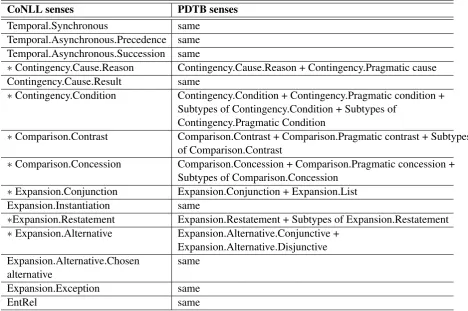
Table 2: Flat list of 15 sense categories used in CoNLL-2015, with correspondences to PDTB senses. Senses that involve a change from the PDTB senses are marked∗.
For example, “Contingency.Pragmatic cause” is merged into “Contingency.Cause.Reason”, and “Contingency.Pragmatic condition” is merged into “Contingency.Condition”. Second, the distinction between “Expansion.Conjunction” and “Expansion.List” is not clear in the PDTB and in fact, they seem very similar for the most part, so the latter is merged into the former. Third, while “Expansion.Alternative.Conjunctive” and “Expansion.Alternative.Disjunctive” are merged into “Expansion.Alternative”, a third subtype of “Expansion.Alternative”, “Expan-sion.Alternative.Chosen Alternative” is kept as a separate category as its meaning involves more than presentation of alternatives. Finally, while “EntRel” relations are not treated as discourse relations in the PDTB, we have included this cat-egory as a sense for sense classification since they
Relation Sense WSJ-Train WSJ-Dev WSJ-Test
Explicit Overall 14722 680 923
Expansion.Conjunction 4323 185 242
Comparison.Contrast 2956 160 271
Contingency.Condition 1148 50 63
Temporal.Synchrony 1133 68 71
Comparison.Concession 1080 12 27
Contingency.Cause.Reason 943 38 74
Temporal.Asynchronous.Succession 842 51 64
Temporal.Asynchronous.Precedence 770 49 36
Contingency.Cause.Result 487 19 38
Comparison 347 20 1
Expansion.Instantiation 236 9 21
Expansion.Alternative 195 6 5
Expansion.Restatement 121 6 7
Expansion.Alternative.Chosen-alternative 96 6 3
Expansion 24 0 0
Expansion.Exception 13 0 0
Temporal 4 1 0
Temporal.Asynchronous 3 0 0
Contingency 1 0 0
Implicit Overall 13156 522 769
Expansion.Conjunction 3227 120 141
Expansion.Restatement 2486 101 190
Contingency.Cause.Reason 2059 73 113
Comparison.Contrast 1614 82 127
Contingency.Cause.Result 1372 49 89
Expansion.Instantiation 1132 47 69
Temporal.Asynchronous.Precedence 418 25 7
Comparison.Concession 193 5 5
Temporal.Synchrony 153 8 5
Comparison 145 1 0
Expansion.Alternative.Chosen-alternative 142 2 15
Temporal.Asynchronous.Succession 125 3 5
Expansion 73 6 3
Expansion.Alternative 11 0 0
Contingency.Condition 2 0 0
Temporal 1 0 0
Expansion.Exception 1 0 0
Contingency.Cause 1 0 0
Contingency 1 0 0
EntRel Overall 4133 215 217
EntRel 4133 215 217
AltLex Overall 524 19 19
Contingency.Cause.Result 147 4 8
Expansion.Conjunction 94 3 8
Contingency.Cause.Reason 76 5 8
Expansion.Restatement 57 0 1
Temporal.Asynchronous.Precedence 42 2 2
Expansion.Instantiation 33 1 1
Comparison.Contrast 32 2 1
Temporal.Asynchronous.Succession 18 0 0
Temporal.Synchrony 16 1 0
Comparison.Concession 4 0 1
Expansion 2 0 0
Contingency.Condition 2 0 0
Expansion.Exception 1 0 0
Expansion.Restatement 0 1 0
[image:7.595.117.477.69.686.2]Expansion.Alternative 0 0 0
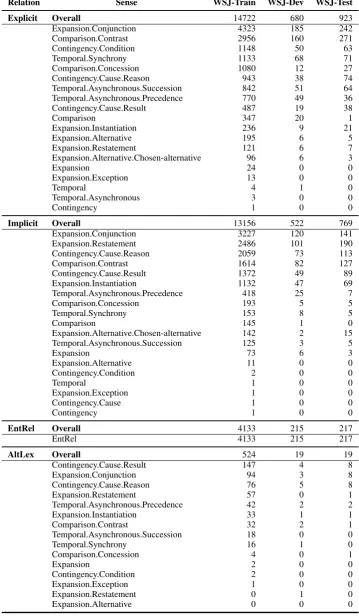
Table 3 shows the distribution of the senses across the four discourse relations within the WSJ PDTB data6. We are intentionally withholding the sense distribution across the blind test set in case there is a repeat of the SDP shared task using the same test set.
4 Evaluation
4.1 Closed and open tracks
In keeping with the CoNLL shared task tradition, participating systems were evaluated in two tracks, a closed track and an open track. A participat-ing system in the closed track could only use the provided PDTB training set but was allowed to process the data using any publicly available (i.e., non-proprietary) natural language processing tools such as syntactic parsers and semantic role label-ers. In contrast, in the open track, a participating system could not only use any publicly available NLP tools to process the data, but also any pub-licly available (i.e., non-proprietary) data for train-ing. A participating team could choose to partici-pate in the closed track or the open track, or both.
The motivation for having two tracks in CoNLL shared tasks was to isolate the contribution of al-gorithms and resources to a particular task. In the closed track, the resources are held constant so that the advantages of different algorithms and models can be more meaningfully compared. In the open track, the focus of the evaluation is on the overall performance and the use of all possible means to improve the performance of a task. This distinc-tion was easier to maintain for early CoNLL tasks such as noun phrase chunking and named entity recognition, where competitive performance could be achieved without having to use resources other than the provided training set. However, this is no longer true for a high-level task like discourse parsing where external resources such as Brown clusters have proved to be useful (Rutherford and Xue, 2014). In addition, to be competitive in the discourse parsing task, one also has to process the data with syntactic and possibly semantic parsers, which may also be trained on data that is outside the training set. As a compromise, therefore, we allowed participants to use the following linguistic resources in the closed track, other than the
train-6There is a small number of instances in the PDTB
train-ing set that are only annotated with the class level sense. We did not take them out of the training set for the sake of com-pleteness.
ing set:
• Brown clusters
• VerbNet
• Sentiment lexicon
• Word embeddings (word2vec)
To make the task more manageable for partic-ipants, we provided them with training and test data with the following layers of automatic lin-guistic annotation processed with state-of-the-art NLP tools:
• Phrase structure parses (predicted using the Berkeley parser (Petrov and Klein, 2007))
• Dependency parses (converted from phrase structure parses using the Stanford converter (Manning et al., 2014))
As it turned out, all of the teams this year chose to participate in the closed track.
4.2 Evaluation Platform: TIRA
We use a new web service called TIRA as the plat-form for system evaluation (Gollub et al., 2012; Potthast et al., 2014). Traditionally, participating teams were asked to manually run their system on the blind test set without the gold standard labels, and submit the output for evaluation. This year, however, we shifted this evaluation paradigm, ask-ing participants to deploy their systems on a re-mote virtual machine, and to use the TIRA web platform (tira.io) to run their systems on the test sets without actually seeing the test sets. The or-ganizers would then inspect the evaluation results, and verify that participating systems yielded ac-ceptable output.
are archived and available for distribution upon re-quest to the organizers and upon the permission of the participating team, who holds the copyrights to the software. Replicability also helps speed up the research and development in discourse pars-ing. Anyone wanting to extend or apply any of the approaches proposed by a shared task partic-ipant does not have to re-implement the model from scratch. They can request a clone of the vir-tual machine where the participating system is de-ployed, and then implement their extension based off the original source code. Any extension ef-fort also benefits from the precise evaluation of the progress and improvement since the system is based off the exact same implementation.
4.3 Evaluation metrics and scorer
A shallow discourse parser is evaluated based on the end-to-endF1score on a per-discourse relation
basis. The input to the system consists of docu-ments with gold-standard word tokens along with their automatic parses. We do not pre-identify the discourse connectives or any other elements of the discourse annotation. The shallow discourse parser must output a list of discourse relations that consist of the argument spans and their labels, ex-plicit discourse connectives where applicable, and the senses. TheF1score is computed based on the
number of predicted relations that match a gold standard relation exactly. A relation is correctly predicted if (a) the discourse connective is cor-rectly detected (for Explicit discourse relations), (b) the sense of the discourse connective is cor-rectly predicted, and (c) the text spans of its two ar-guments are correctly predicted (Arg1 and Arg2).
Although the submissions are ranked based on the relation F1 score, the scorer also provides
component-wise evaluation with error propaga-tion. The scorer computes the precision, recall, andF1for the following7:
• Explicit discourse connective identification.
• Arg1 identification.
• Arg2 identification.
• Arg1 and Arg2 identification.
• Sense classification with error propagation from discourse connective and argument identification.
For purposes of evaluation, an explicit discourse connective predicted by the parser is considered
7Available at:http://www.github.com/attapol/conll15st
correct if and only if the predicted raw connective includes the gold raw connective head, while al-lowing for the tokens of the predicted connective to be a subset of the tokens in the gold raw connec-tive. We provide a function that maps discourse connectives to their corresponding heads. The no-tion of discourse connective head is not the same as its syntactic head. Rather, it is thought of as the part of the connective conveying its core meaning. For example, the head of the discourse connective “At least not when” is “when”, and the head of “five minutes before” is “before”. The non-head part of the connective serves to semantically re-strict the interpretation of the connective.
Although Implicit discourse relations are anno-tated with an implicit connective inserted between adjacent sentences, participants are not required to provide the inserted connective. They only need to output the sense of the discourse relation. Sim-ilarly, for AltLex relations, which are also anno-tated between adjacent sentences, participants are not required to output the text span of the AltLex expression, but only the sense. The EntRel rela-tion is included as a sense in the shared task, and here, systems are required to correctly label the EntRel relation between adjacent sentence pairs.
An argument is considered correctly identified if and only if it matches the corresponding gold standard argument span exactly, and is also cor-rectly labeled (Arg1 or Arg2). Systems are not given any credit for partial match on argument spans.
Sense classification evaluation is less straight-forward, since senses are sometimes annotated partially or annotated with two senses. To be con-sidered correct, the predicted sense for a relation must match one of the two senses if there is more than one sense. If the gold standard is partially annotated, the sense must match with the partially annotated sense.
Additionally, the scorer provides a breakdown of the discourse parser performance for Explicit and Non-Explicit discourse relations.
5 Approaches
identify-System learning methods resources used extra resources
ECNU Naive Bayes, maxent Brown clusters, MPQA
subjectivity lexicon no
Trento CRF++, AdaBoost Brown clusters,
dependency/phrase structure parses
no
Soochow Maxent in Open NLP VerbNet, MPQA subjectivity lexicon, Brown clusters no JAIST CRF++, LibSVM (SMO) syntactic parses, Brown
clusters no
UIUC Liblinear Brown clusters, MPQA
lexicon no
Concordia C4.5 (Weka) ClearTK, syntactic parse no
∗UT Dallas - -
-NTT Rule-based argument
extraction and SVM based sense classification
Brown clusters, dependency
trees no
AU KBC CRF++ for both arguments
and sense, and rules MPQA, VerbNet, Brownclusters no
CAS OpenNLP maxent phrase structure trees no
Dublin 1 RNN (Theano) for argument
extraction, Maxent for others syntactic features, skip-gramword embeddings no
Dublin 2 LibSVM, Theano, word2vec Brown clusters no
Goethe University Frankfurt
SVM, rule-based Brown clusters, word
embeddings no
IIT Naive Bayes, Maxent syntactic parses, Boxer no
SJTU Maxent no external resource used no
∗PKU - -
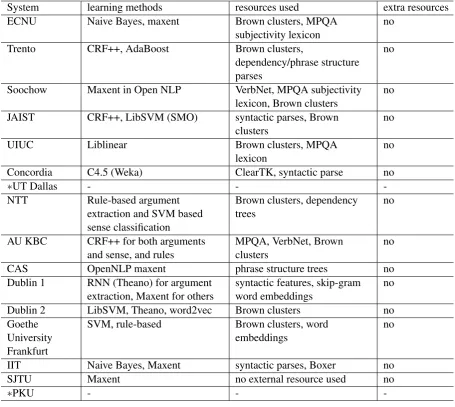
-Table 4: Approaches of participating systems. Teams that have not submitted a system description paper are marked with∗.
ing discourse connectives and extracting their ar-guments, for determining the presence or absence of discourse relations in a particular context, and for predicting the senses of the discourse rela-tions. Most participating systems cast discourse connective identification and argument extraction as token-level sequence labeling tasks, while a few systems use rule-based approaches to extract the arguments. Sense determination is cast as a straightforward multi-category classification task. Most systems use machine learning techniques to determine the senses, but there are also systems that, due to lack of time, adopt a simple base-line approach that detects the most frequent sense based on the training data.
In terms of learning techniques, all participat-ing systems except the two systems submitted by the Dublin team use standard “shallow” learning
[image:10.595.71.527.62.469.2]learning technique to good effect within a short time window. In this shared task, only the Dublin University team attempted to use neural networks as a learning approach in their system compo-nents. In their first submission (Dublin I), Recur-rent Neural Networks (RNN) are used for token level sequence labeling in the argument extraction task. In their second submission, paragraph em-beddings are used in a neural network model to determine the senses of discourse relations.
The discussion of learning techniques cannot be entirely separated from the use of features and the linguistic resources that are used to extract them. Standard “shallow” architectures typically make use of discrete features while neural networks gen-erally use continuous real-valued features such as word and paragraph embeddings. For discourse connective and argument extraction, token level features extracted from a fixed window centered on the target word token are generally used, and so are features extracted from syntactic parses. Dis-tributional representations such as Brown clusters have generally been used to determine the senses (Chiarcos and Schenk, 2015; Devi et al., 2015; Kong et al., 2015; Song et al., 2015; Stepanov et al., 2015; Wang and Lan, 2015; Wang et al., 2015; Yoshida et al., 2015), although one team also used them in the sequence labeling task for argument extraction (Nguyen et al., 2015). Addi-tional resources used by some systems for sense determination include word embeddings (Chiar-cos and Schenk, 2015; Wang et al., 2015), Verb-Net classes (Devi et al., 2015; Kong et al., 2015), and the MPQA polarity lexicon (Devi et al., 2015; Kong et al., 2015; Wang and Lan, 2015). Table 4 provides a summary of the different approaches.
6 Results
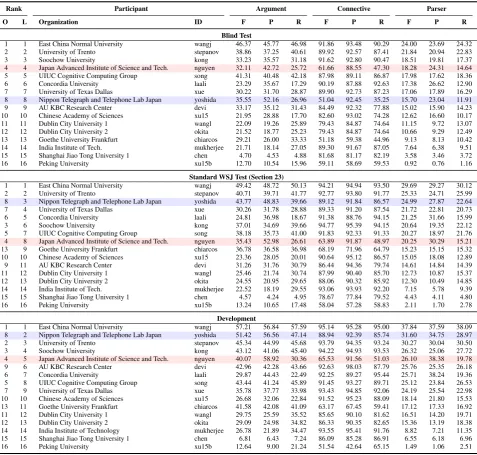
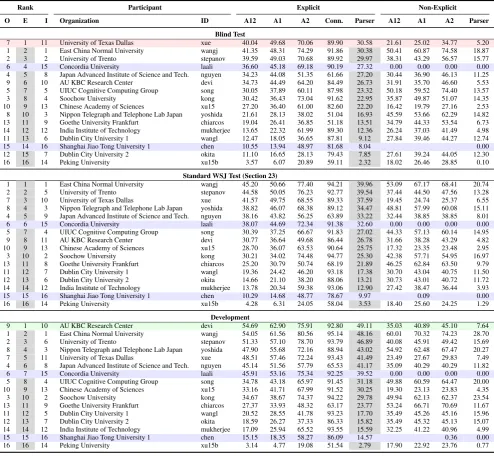
Table 5 shows the performance of all participat-ing systems across the three test evaluation sets: i) (Official) Blind test set; ii) Standard WSJ test set; iii) Standard WSJ development set. The official rankings are based on the blind test set annotated specifically for this shared task. The top-ranked system is the submission by East China Normal University (Wang and Lan, 2015). As discussed in Section 4, the evaluation metric is very strict, and is based on exact match for the extraction of ar-gument spans. For the detection of discourse con-nectives, only the head of a discourse connective has to be correctly detected. Errors in the
begin-ning of the pipeline will propagate to the end, and other than word tokenization, all input to the par-ticipating systems is automatically generated, so the overall accuracy reflects results in realistic sit-uations. The scores are very low, with the top sys-tem achieving an overall parsing score of 24.00% (F1) on the blind test set and 29.69% (F1) on the Wall Street Journal (WSJ) test set. For compar-ison purposes, the National University of Singa-pore team re-implemented the state-of-the-art end-to-end parser described in (Lin et al., 2014), and this system achieves an F1 of 19.98% on the WSJ test set. This shows that a fair amount of progress has been made against the Lin et al baseline.
The rankings are generally consistent across the two test sets, with the largest change in ranking from the NTT team and the Goethe University team. This is perhaps not a coincidence: both teams used rule-based approaches to extract argu-ments. The rules worked well on the WSJ test set which draws from the same source as the devel-opment set, but might not adapt well to the blind test set, which is drawn from a different source. Machine-learning based approaches generally can better adapt to new data sets.
Due to the short time frame participants had to complete an end-to-end task, teams chose to focus on either argument extraction components or the sense classification components, or in the case of sense classification, either focus on the classification of senses for Explicit relations or senses for Non-Explicit relations. A detailed breakdown of the performance for Explicit ver-sus Non-Explicit discourse relations is presented in Table 6. In general, parser performance for Explicit discourse relations is much higher than that of Non-Explicit discourse relations. The dif-ficulty for Non-Explicit discourse relations mostly stems from Non-Explicit sense classification. This is evidenced by the fact that even for systems that achieve higher argument extraction accuracy for Non-Explicit discourse relations than Explicit dis-course relations, the overall parser accuracy is still lower for Non-Explicit relations. The lower ac-curacy in sense classification thus drags down the overall parser accuracy for Non-Explicit discourse relations.
7 Conclusions
dis-Rank Participant Argument Connective Parser
O L Organization ID F P R F P R F P R
Blind Test
1 1 East China Normal University wangj 46.37 45.77 46.98 91.86 93.48 90.29 24.00 23.69 24.32 2 2 University of Trento stepanov 38.86 37.25 40.61 89.92 92.57 87.41 21.84 20.94 22.83 3 3 Soochow University kong 33.23 35.57 31.18 91.62 92.80 90.47 18.51 19.81 17.37 4 4 Japan Advanced Institute of Science and Tech. nguyen 32.11 42.72 25.72 61.66 88.55 47.30 18.28 24.31 14.64 5 5 UIUC Cognitive Computing Group song 41.31 40.48 42.18 87.98 89.11 86.87 17.98 17.62 18.36 6 6 Concordia University laali 23.29 35.67 17.29 90.19 87.88 92.63 17.38 26.62 12.90 7 7 University of Texas Dallas xue 30.22 31.70 28.87 89.90 92.73 87.23 17.06 17.89 16.29 8 8 Nippon Telegraph and Telephone Lab Japan yoshida 35.55 52.16 26.96 51.04 92.45 35.25 15.70 23.04 11.91 9 9 AU KBC Research Center devi 33.17 35.12 31.43 84.49 92.32 77.88 15.02 15.90 14.23 10 10 Chinese Academy of Sciences xu15 21.95 28.88 17.70 82.60 93.02 74.28 12.62 16.60 10.17 11 11 Dublin City University 1 wangl 22.09 19.26 25.89 79.43 84.87 74.64 11.15 9.72 13.07 12 12 Dublin City University 2 okita 21.52 18.77 25.23 79.43 84.87 74.64 10.66 9.29 12.49 13 13 Goethe University Frankfurt chiarcos 29.21 26.00 33.33 51.18 59.38 44.96 9.13 8.13 10.42 14 14 India Institute of Tech. mukherjee 21.71 18.14 27.05 89.30 91.67 87.05 7.64 6.38 9.51 15 15 Shanghai Jiao Tong University 1 chen 4.70 4.53 4.88 81.68 81.17 82.19 3.58 3.46 3.72 16 16 Peking University xu15b 12.70 10.54 15.96 59.11 58.69 59.53 0.92 0.76 1.16
Standard WSJ Test (Section 23)
1 1 East China Normal University wangj 49.42 48.72 50.13 94.21 94.94 93.50 29.69 29.27 30.12 2 2 University of Trento stepanov 40.71 39.71 41.77 92.77 93.80 91.77 25.33 24.71 25.99 8 3 Nippon Telegraph and Telephone Lab Japan yoshida 43.77 48.83 39.66 89.12 91.84 86.57 24.99 27.87 22.64 7 4 University of Texas Dallas xue 30.26 31.78 28.88 89.33 91.20 87.54 21.72 22.81 20.73 6 5 Concordia University laali 24.81 36.98 18.67 91.38 88.76 94.15 21.25 31.66 15.99 3 6 Soochow University kong 37.01 34.69 39.66 94.77 95.39 94.15 20.64 19.35 22.12 5 7 UIUC Cognitive Computing Group song 38.18 35.73 41.00 91.83 92.33 91.33 20.27 18.97 21.76 4 8 Japan Advanced Institute of Science and Tech. nguyen 35.43 52.98 26.61 63.89 91.87 48.97 20.25 30.29 15.21 13 9 Goethe University Frankfurt chiarcos 36.78 36.58 36.98 68.19 71.96 64.79 15.23 15.15 15.32 10 10 Chinese Academy of Sciences xu15 23.36 28.05 20.01 90.64 95.12 86.57 15.05 18.08 12.89 9 11 AU KBC Research Center devi 31.26 31.76 30.79 86.44 94.36 79.74 14.61 14.84 14.39 11 12 Dublin City University 1 wangl 25.46 21.74 30.74 87.99 90.40 85.70 12.73 10.87 15.37 12 13 Dublin City University 2 okita 24.55 20.95 29.65 88.06 90.32 85.92 12.30 10.49 14.85 14 14 India Institute of Tech. mukherjee 22.52 18.19 29.55 93.06 93.93 92.20 7.15 5.78 9.39 15 15 Shanghai Jiao Tong University 1 chen 4.57 4.24 4.95 78.67 77.84 79.52 4.43 4.11 4.80 16 16 Peking University xu15b 13.24 10.65 17.48 58.04 57.28 58.83 2.11 1.70 2.78
Development
[image:12.595.77.555.139.594.2]1 1 East China Normal University wangj 57.21 56.84 57.59 95.14 95.28 95.00 37.84 37.59 38.09 8 2 Nippon Telegraph and Telephone Lab Japan yoshida 51.42 56.56 47.14 88.94 92.39 85.74 31.60 34.75 28.97 2 3 University of Trento stepanov 45.34 44.99 45.68 93.79 94.35 93.24 30.27 30.04 30.50 3 4 Soochow University kong 43.12 41.06 45.40 94.22 94.93 93.53 26.32 25.06 27.72 4 5 Japan Advanced Institute of Science and Tech. nguyen 40.07 58.92 30.36 65.53 91.56 51.03 26.10 38.38 19.78 9 6 AU KBC Research Center devi 42.96 42.28 43.66 92.63 98.03 87.79 25.76 25.35 26.18 6 7 Concordia University laali 29.87 44.43 22.49 92.25 89.27 95.44 25.71 38.24 19.36 5 8 UIUC Cognitive Computing Group song 43.44 41.24 45.89 91.45 93.27 89.71 25.12 23.84 26.53 7 9 University of Texas Dallas xue 35.78 37.77 33.98 93.43 94.85 92.06 24.19 25.54 22.98 10 10 Chinese Academy of Sciences xu15 26.68 32.06 22.84 91.52 95.23 88.09 18.14 21.80 15.53 13 11 Goethe University Frankfurt chiarcos 41.58 42.08 41.09 63.17 67.45 59.41 17.12 17.33 16.92 11 12 Dublin City University 1 wangl 29.75 25.59 35.52 85.65 90.10 81.62 16.51 14.20 19.71 12 13 Dublin City University 2 okita 29.09 24.98 34.82 86.33 90.35 82.65 15.36 13.19 18.38 14 14 India Institute of Technology mukherjee 26.78 21.89 34.47 93.55 95.41 91.76 8.82 7.21 11.35 15 15 Shanghai Jiao Tong University 1 chen 6.81 6.43 7.24 86.09 85.28 86.91 6.55 6.18 6.96 16 16 Peking University xu15b 12.64 9.00 21.24 51.54 42.64 65.15 1.49 1.06 2.51
Rank Participant Explicit Non-Explicit
O E I Organization ID A12 A1 A2 Conn. Parser A12 A1 A2 Parser
Blind Test
7 1 11 University of Texas Dallas xue 40.04 49.68 70.06 89.90 30.58 21.61 25.02 34.77 5.20 1 2 1 East China Normal University wangj 41.35 48.31 74.29 91.86 30.38 50.41 60.87 74.58 18.87 2 3 2 University of Trento stepanov 39.59 49.03 70.68 89.92 29.97 38.31 43.29 56.57 15.77 6 4 15 Concordia University laali 36.60 45.18 69.18 90.19 27.32 0.00 0.00 0.00 0.00 4 5 8 Japan Advanced Institute of Science and Tech. nguyen 34.23 44.08 51.35 61.66 27.20 30.44 36.90 46.13 11.25 9 6 10 AU KBC Research Center devi 34.73 44.49 64.20 84.49 26.73 31.91 35.70 46.60 5.53 5 7 5 UIUC Cognitive Computing Group song 30.05 37.89 60.11 87.98 23.32 50.18 59.52 74.40 13.57 3 8 4 Soochow University kong 30.42 36.43 73.04 91.62 22.95 35.87 49.87 51.07 14.35 10 9 13 Chinese Academy of Sciences xu15 27.20 36.40 61.00 82.60 22.20 16.42 19.79 27.16 2.53 8 10 3 Nippon Telegraph and Telephone Lab Japan yoshida 21.61 28.13 38.02 51.04 16.93 45.59 53.66 62.29 14.82 13 11 9 Goethe University Frankfurt chiarcos 19.04 26.41 36.85 51.18 13.51 34.79 44.33 53.54 6.73 14 12 12 India Institute of Technology mukherjee 13.65 22.32 61.99 89.30 12.36 26.24 37.03 41.49 4.98 11 13 6 Dublin City University 1 wangl 12.47 18.05 36.65 87.81 9.12 27.84 39.46 44.27 12.74 15 14 16 Shanghai Jiao Tong University 1 chen 10.55 13.94 48.97 81.68 8.04 0.00 12 15 7 Dublin City University 2 okita 11.10 16.65 28.13 79.43 7.85 27.61 39.24 44.05 12.30 16 16 14 Peking University xu15b 3.57 6.07 20.89 59.11 2.32 18.02 26.46 28.85 0.10
Standard WSJ Test (Section 23)
1 1 1 East China Normal University wangj 45.20 50.66 77.40 94.21 39.96 53.09 67.17 68.41 20.74 2 2 5 University of Trento stepanov 44.58 50.05 76.23 92.77 39.54 37.44 44.50 47.56 13.28 7 3 10 University of Texas Dallas xue 41.57 49.75 68.55 89.33 37.59 19.45 24.74 25.37 6.55 8 4 3 Nippon Telegraph and Telephone Lab Japan yoshida 38.82 46.07 68.38 89.12 34.47 48.81 57.99 60.08 15.11 4 5 9 Japan Advanced Institute of Science and Tech. nguyen 38.16 43.82 56.25 63.89 33.22 32.44 38.85 38.85 8.01 6 6 15 Concordia University laali 38.07 44.69 72.34 91.38 32.60 0.00 0.00 0.00 0.00 5 7 4 UIUC Cognitive Computing Group song 30.39 37.25 66.67 91.83 27.02 44.33 57.13 60.14 14.95 9 8 11 AU KBC Research Center devi 30.77 36.64 49.68 86.44 26.78 31.66 38.28 43.29 4.82 10 9 13 Chinese Academy of Sciences xu15 28.70 36.07 63.53 90.64 25.75 17.32 23.35 23.48 2.95 3 10 2 Soochow University kong 30.21 34.02 74.48 94.77 25.30 42.38 57.71 54.95 16.97 13 11 8 Goethe University Frankfurt chiarcos 25.20 30.79 50.74 68.19 21.89 46.25 62.84 63.50 9.79 11 12 7 Dublin City University 1 wangl 19.36 24.42 46.20 93.18 17.38 30.70 43.04 40.75 11.50 12 13 6 Dublin City University 2 okita 14.66 21.10 38.20 88.06 13.21 30.73 43.01 40.72 11.72 14 14 12 India Institute of Technology mukherjee 13.78 20.34 59.38 93.06 12.90 27.42 38.47 36.44 3.93 15 15 16 Shanghai Jiao Tong University 1 chen 10.29 14.68 48.77 78.67 9.97 0.09 0.00 16 16 14 Peking University xu15b 4.28 6.31 24.05 58.04 3.53 18.40 25.60 24.25 1.29
Development
[image:13.595.75.570.121.577.2]9 1 10 AU KBC Research Center devi 54.69 62.90 75.91 92.80 49.11 35.03 40.89 45.10 7.64 1 2 1 East China Normal University wangj 54.05 61.56 80.56 95.14 48.16 60.01 70.32 74.23 28.70 2 3 6 University of Trento stepanov 51.33 57.10 78.70 93.79 46.89 40.08 45.91 49.42 15.69 8 4 3 Nippon Telegraph and Telephone Lab Japan yoshida 47.90 55.68 72.16 88.94 43.02 54.92 62.48 67.47 20.27 7 5 11 University of Texas Dallas xue 48.51 57.46 72.24 93.43 41.49 23.49 27.67 29.83 7.49 4 6 8 Japan Advanced Institute of Science and Tech. nguyen 45.14 51.56 57.79 65.53 41.17 35.09 40.29 40.29 11.82 6 7 15 Concordia University laali 45.91 53.16 75.34 92.25 39.52 0.00 0.00 0.00 0.00 5 8 4 UIUC Cognitive Computing Group song 34.78 43.18 65.97 91.45 31.18 49.88 60.59 64.47 20.00 10 9 13 Chinese Academy of Sciences xu15 33.16 41.71 67.99 91.52 30.25 19.30 23.13 23.83 4.35 3 10 2 Soochow University kong 34.67 38.67 74.37 94.22 29.78 49.94 62.13 62.37 23.54 13 11 9 Goethe University Frankfurt chiarcos 27.37 33.93 48.32 63.17 23.77 53.24 66.71 70.69 11.67 11 12 5 Dublin City University 1 wangl 20.52 28.55 41.78 93.23 17.70 35.49 45.26 45.16 15.96 12 13 7 Dublin City University 2 okita 18.59 26.27 37.33 86.33 15.82 35.49 45.32 45.13 15.07 14 14 12 India Institute of Technology mukherjee 17.09 25.94 65.52 93.55 15.59 32.25 41.22 40.96 4.99 15 15 16 Shanghai Jiao Tong University 1 chen 15.15 18.35 58.27 86.09 14.57 0.36 0.00 16 16 14 Peking University xu15b 3.14 4.77 19.08 51.54 2.79 17.90 22.92 23.76 0.77
course parsing. The shared task required the de-velopment of an end-to-end system, and the best system achieved an F1 score of 24.0% on the blind test set, reflecting the serious error propagation problem in such a system. The shared task ex-posed the most challenging aspect of shallow dis-course parsing as a research problem, helping fu-ture research better calibrate their efforts. The evaluation data sets and the scorer we prepared for the shared task will be a useful benchmark for fu-ture research on shallow discourse parsing.
Acknowledgments
We would like to thank the Penn Discourse Tree-Bank team, in particular Aravind Joshi and Bonnie Webber, for allowing us to use the PDTB corpus for the shared task. Thanks also go the LDC (Lin-guistic Data Consortium), who helped distribute the training and development data to participat-ing teams. We are also very grateful to the TIRA team, who provided their evaluation platform, and especially to Martin Potthast for his technical as-sistance in using the TIRA platform and countless hours of troubleshooting.
This work was partially supported by the National Science Foundation via Grant Nos. 0910532 and IIS-1421067 and by the Singapore Ministry of Education Academic Research Fund Tier 2 grant MOE2013-T2-1-150.
References
Or Biran and Kathleen McKeown. 2013. Aggregated word pair features for implicit discourse relation dis-ambiguation. In Proceedings of the 51st Annual Meeting of the Association for Computational Lin-guistics.
Lynn Carlson, Daniel Marcu, and Mary Ellen Okurowski. 2003. Building a discourse-tagged cor-pus in the framework of Rhetorical Structure Theory. InCurrent Directions in Discourse and Dialogue.
Christian Chiarcos and Niko Schenk. 2015. A min-imalist approach to shallow discourse parsing and implicit relation recognition. InProceedings of the Nineteenth Conference on Computational Natural Language Learning: Shared Task.
Sobha Lalitha Devi, Sindhuja Gopalan, Lakshmi S, Pattabhi RK Rao, Vijay Sundar Ram R., and Malarkodi C.S. 2015. A hybrid discourse relation parser in CoNLL 2015. InProceedings of the Nine-teenth Conference on Computational Natural Lan-guage Learning: Shared Task.
David A Duverle and Helmut Prendinger. 2009. A novel discourse parser based on support vector ma-chine classification. In Proceedings of the Joint Conference of the 47th Annual Meeting of the Asso-ciation of Computational Lingustics and the 4th In-ternational Joint Conference on Natural Language Processing of the AFNLP.
Vanessa Wei Feng and Graeme Hirst. 2012. Text-level discourse parsing with rich linguistic features. In
Proceedings of the 50th Annual Meeting of the As-sociation for Computational Linguistics.
Vanessa Wei Feng and Graeme Hirst. 2014. A linear-time bottom-up discourse parser with constraints and post-editing. In Proceedings of the 52nd An-nual Meeting of the Association for Computational Linguistics.
Sucheta Ghosh, Giuseppe Riccardi, and Richard Jo-hansson. 2012. Global features for shallow dis-course parsing. InProceedings of the 13th Annual Meeting of the Special Interest Group on Discourse and Dialogue.
Tim Gollub, Benno Stein, and Steven Burrows. 2012. Ousting Ivory Tower Research: Towards a Web Framework for Providing Experiments as a Service. In Bill Hersh, Jamie Callan, Yoelle Maarek, and Mark Sanderson, editors, 35th International ACM Conference on Research and Development in In-formation Retrieval (SIGIR 12), pages 1125–1126. ACM, August.
Yangfeng Ji and Jacob Eisenstein. 2014. Represen-tation learning for text-level discourse parsing. In
Proceedings of the 52nd Annual Meeting of the As-sociation for Computational Linguistics.
Fang Kong, Sheng Li, and Guodong Zhou. 2015. The SoNLP-DP system in the CoNLL-2015 shared task. In Proceedings of the Nineteenth Conference on Computational Natural Language Learning: Shared Task.
Man Lan, Yu Xu, and Zhengyu Niu. 2013. Leveraging synthetic discourse data via multi-task learning for implicit discourse relation recognition. In Proceed-ings of the 51st Annual Meeting of the Association for Computational Linguistics.
Junyi Jessy Li and Ani Nenkova. 2014. Addressing class imbalance for improved recognition of implicit discourse relations. InProceedings of the 15th An-nual Meeting of the Special Interest Group on Dis-course and Dialogue.
Sujian Li, Liang Wang, Ziqiang Cao, and Wenjie Li. 2014. Text-level discourse dependency parsing. In
Proceedings of the 52nd Annual Meeting of the As-sociation for Computational Linguistics.
Ziheng Lin, Hwee Tou Ng, and Min-Yen Kan. 2014. A PDTB-styled end-to-end discourse parser. Natural Language Engineering, 20(2):151–184.
William C Mann and Sandra A Thompson. 1988. Rhetorical Structure Theory: Toward a functional theory of text organization. Text, 8(3):243–281.
Christopher D. Manning, Mihai Surdeanu, John Bauer, Jenny Finkel, Steven J. Bethard, and David Mc-Closky. 2014. The Stanford CoreNLP natural lan-guage processing toolkit. In Proceedings of the 52nd Annual Meeting of the Association for Com-putational Linguistics.
Mitchell P. Marcus, Beatrice Santorini, and Mary Ann Marcinkiewicz. 1993. Building a large annotated corpus of English: The Penn Treebank. Computa-tional Linguistics, 19(2):313–330.
Eleni Miltsakaki, Rashmi Prasad, Aravind Joshi, and Bonnie Webber. 2004. Annotating discourse con-nectives and their arguments. In Proceedings of the Human Language Technology/North American Chapter of the Association for Computational Lin-guistics Workshop on Frontiers in Corpus Annota-tion.
Truong Son Nguyen, Bao Quoc Ho, and Le Minh Nguyen. 2015. JAIST: A two-phase machine learn-ing approach for identifylearn-ing discourse relations in newswire texts. In Proceedings of the Nineteenth Conference on Computational Natural Language Learning: Shared Task.
Martha Palmer, Daniel Gildea, and Paul Kingsbury. 2005. The Proposition Bank: An annotated cor-pus of semantic roles. Computational Linguistics, 31(1):71–106.
Joonsuk Park and Claire Cardie. 2012. Improving im-plicit discourse relation recognition through feature set optimization. InProceedings of the 13th Annual Meeting of the Special Interest Group on Discourse and Dialogue.
Slav Petrov and Dan Klein. 2007. Improved infer-encing for unlexicalized parsing. InProceedings of the Human Language Technology/North American Chapter of the Association for Computational Lin-guistics.
Emily Pitler, Mridhula Raghupathy, Hena Mehta, Ani Nenkova, Alan Lee, and Aravind K Joshi. 2008. Easily identifiable discourse relations. Technical re-port, University of Pennsylvania.
Emily Pitler, Annie Louis, and Ani Nenkova. 2009. Automatic sense prediction for implicit discourse re-lations in text. InProceedings of the Joint Confer-ence of the 47th Annual Meeting of the ACL and the 4th International Joint Conference on Natural Lan-guage Processing of the AFNLP.
Martin Potthast, Tim Gollub, Francisco Rangel, Paolo Rosso, Efstathios Stamatatos, and Benno Stein. 2014. Improving the Reproducibility of PAN’s Shared Tasks: Plagiarism Detection, Author Iden-tification, and Author Profiling. In Evangelos Kanoulas, Mihai Lupu, Paul Clough, Mark Sander-son, Mark Hall, Allan Hanbury, and Elaine Toms, editors, Information Access Evaluation meets Mul-tilinguality, Multimodality, and Visualization. 5th International Conference of the CLEF Initiative (CLEF 14), pages 268–299, Berlin Heidelberg New York, September. Springer.
Sameer Pradhan, Lance Ramshaw, Mitchell Marcus, Martha Palmer, Ralph Weischedel, and Nianwen Xue. 2011. CoNLL-2011 shared task: Modeling unrestricted coreference in OntoNotes. In Proceed-ings of the Fifteenth Conference on Computation Natural Language Learining: Shared Task.
Sameer Pradhan, Alessandro Moschitti, Nianwen Xue, Olga Uryupina, and Yuchen Zhang. 2012. CoNLL-2012 Shared Task: Modeling multilingual unre-stricted coreference in OntoNotes. InProceedings of the Sixteenth Conference on Computation Natu-ral Language Learining: Shared Task.
Rashmi Prasad and Harry Bunt. 2015. Semantic rela-tions in discourse: The current state of ISO 24617-8. InProceedings of the 11th Joint ACL-ISO Workshop on Interoperable Semantic Annotation.
Rashmi Prasad, Nikhil Dinesh, Alan Lee, Eleni Milt-sakaki, Livio Robaldo, Aravind Joshi, and Bonnie Webber. 2008. The Penn Discourse Treebank 2.0. InProceedings of the 6th International Conference on Language Resources and Evaluation.
Rashmi Prasad, Bonnie Webber, and Aravind Joshi. 2014. Reflections on the Penn Discourse Treebank, comparable corpora, and complementary annota-tion. Computational Linguistics, 40(4):921–950. Attapol Rutherford and Nianwen Xue. 2014.
Dis-covering implicit discourse relations through Brown cluster pair representation and coreference patterns. InProceedings of the 14th Conference of the Euro-pean Chapter of the Association for Computational Linguistics.
Yangqiu Song, Haoruo Peng, Parisa Kordjamshidi, Mark Sammons, and Dan Roth. 2015. Improving a pipeline architecture for shallow discourse pars-ing. InProceedings of the Nineteenth Conference on Computational Natural Language Learning: Shared Task.
Manfred Stede. 2012. Discourse Processing. Morgan & Claypool Publishers.
Rajen Subba and Barbara Di Eugenio. 2009. An effec-tive discourse parser that uses rich linguistic infor-mation. InProceedings of Human Language Tech-nologies: The 2009 Annual Conference of the North American Chapter of the Association for Computa-tional Linguistics.
Jianxiang Wang and Man Lan. 2015. A refined end-to-end discourse parser. InProceedings of the Nine-teenth Conference on Computational Natural Lan-guage Learning: Shared Task.
Xun Wang, Sujian Li, Jiwei Li, and Wenjie Li. 2012. Implicit discourse relation recognition by select-ing typical trainselect-ing examples. In Proceedings of the 24th International Conference on Computational Linguistics.
Longyue Wang, Chris Hokamp, Tsuyoshi Okita, Xi-aojun Zhang, and Qun Liu. 2015. The DCU dis-course parser for connective, argument identification and explicit sense classification. InProceedings of the Nineteenth Conference on Computational Natu-ral Language Learning: Shared Task.
Bonnie Webber, Markus Egg, and Valia Kordoni. 2012. Discourse structure and language technology.
Natural Language Engineering, 18(4):437–490. Yasuhisa Yoshida, Katsuhiko Hayashi, Tsutomu
Hi-rao, and Masaaki Nagata. 2015. Hybrid approach to PDTB-styled discourse parsing for CoNLL-2015. In Proceedings of the Nineteenth Conference on Computational Natural Language Learning: Shared Task.