Proceedings of the CoNLL 2018 Shared Task: Multilingual Parsing from Raw Text to Universal Dependencies, pages 1–21 Brussels, Belgium, October 31 – November 1, 2018. c2018 Association for Computational Linguistics
1
CoNLL 2018 Shared Task: Multilingual Parsing
from Raw Text to Universal Dependencies
Daniel Zeman1, Jan Hajiˇc1, Martin Popel1, Martin Potthast2, Milan Straka1, Filip Ginter3, Joakim Nivre4, and Slav Petrov5
1Charles University, Faculty of Mathematics and Physics
2Universit¨at Leipzig,3University of Turku
4Uppsala University,5Google AI Language
{zeman|hajic|popel|straka}@ufal.mff.cuni.cz, [email protected], [email protected],
[email protected], [email protected]
Abstract
Every year, the Conference on Com-putational Natural Language Learning (CoNLL) features a shared task, in which participants train and test their learning systems on the same data sets. In 2018, one of two tasks was devoted to learn-ing dependency parsers for a large num-ber of languages, in a real-world setting without any gold-standard annotation on the input. All test sets followed the uni-fied annotation scheme of Universal
De-pendencies (Nivre et al., 2016). This
shared task constitutes a 2nd edition—the first one took place in 2017 (Zeman et al.,
2017); the main metric from 2017 was
kept, allowing for easy comparison, and two new main metrics were introduced. New datasets added to the Universal De-pendencies collection between mid-2017 and the spring of 2018 contributed to the increased difficulty of the task this year. In this overview paper, we define the task and the updated evaluation methodology, describe data preparation, report and ana-lyze the main results, and provide a brief categorization of the different approaches of the participating systems.
1 Introduction
The 2017 CoNLL shared task on universal depen-dency parsing (Zeman et al., 2017) picked up the thread from the influential shared tasks in 2006
and 2007 (Buchholz and Marsi,2006;Nivre et al.,
2007) and evolved it in two ways: (1) the
pars-ing process started from raw text rather than gold standard tokenization and part-of-speech tagging, and (2) the syntactic representations were consis-tent across languages thanks to the Universal
De-pendencies framework (Nivre et al., 2016). The
2018 CoNLL shared task on universal dependency parsing starts from the same premises but adds a focus on morphological analysis as well as data from new languages.
Like last year, participating systems minimally had to find labeled syntactic dependencies be-tween words, i.e., a syntactic head for each word, and a label classifying the type of the dependency relation. In addition, this year’s task featured new metrics that also scored a system’s capacity to pre-dict a morphological analysis of each word, in-cluding a part-of-speech tag, morphological fea-tures, and a lemma. Regardless of metric, the as-sumption was that the input should be raw text, with no gold-standard word or sentence segmen-tation, and no gold-standard morphological anno-tation. However, for teams who wanted to con-centrate on one or more subtasks, segmentation and morphology predicted by the baseline UDPipe system (Straka et al., 2016) was made available just like last year.
There are eight new languages this year: Afrikaans, Armenian, Breton, Faroese, Naija, Old
French, Serbian, and Thai; see Section2for more
2 Data
In general, we wanted the participating systems to be able to use any data that is available free of charge for research and educational purposes (so that follow-up research is not obstructed). We de-liberately did not place upper bounds on data sizes (in contrast to e.g.Nivre et al.(2007)), despite the fact that processing large amounts of data may be difficult for some teams. Our primary objective was to determine the capability of current parsers provided with large amounts of freely available data.
In practice, the task was formally closed, i.e., we listed the approved data resources so that all participants were aware of their options. How-ever, the selection was rather broad, ranging from Wikipedia dumps over the OPUS parallel corpora (Tiedemann, 2012) to morphological transducers. Some of the resources were proposed by the par-ticipating teams.
We provided dependency-annotated training and test data, and also large quantities of crawled raw texts. Other language resources are available from third-party servers and we only referred to the respective download sites.
2.1 Training Data: UD 2.2
Training and development data came from the Universal Dependencies (UD) 2.2 collection (Nivre et al.,2018). This year, the official UD re-lease immediately followed the test phase of the shared task. The training and development data were available to the participating teams as a pre-release; these treebanks were then released exactly in the state in which they appeared in the task.1 The participants were instructed to only use the UD data from the package released for the shared task. In theory, they could locate the (yet unre-leased) test data in the development repositories on GitHub, but they were trusted that they would not attempt to do so.
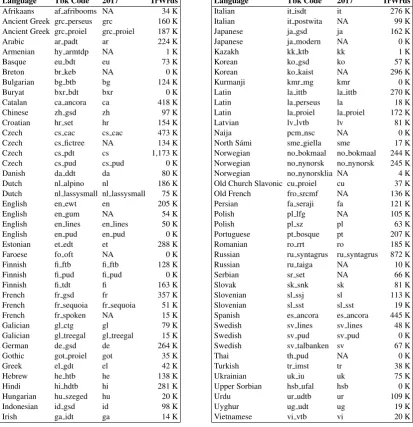
82 UD treebanks in 57 languages were included in the shared task;2 however, nine of the smaller treebanks consisted solely of test data, with no data at all or just a few sentences available for training. 16 languages had two or more treebanks
1UD 2.2 also contains other treebanks that were not in-cluded in the task for various reasons, and that may have been further developed even during the duration of the task.
2Compare with the 81 treebanks and 49 languages in the 2017 task.
from different sources, often also from different domains.3 See Table1for an overview.
61 treebanks contain designated development
data. Participants were asked not to use it
for training proper but only for evaluation, de-velopment, tuning hyperparameters, doing error analysis etc. Seven treebanks have reasonably-sized training data but no development data; only two of them, Irish and North S´ami, are the sole treebanks of their respective languages. For those treebanks cross-validation had to be used during development, but the entire dataset could be used for training once
hyperparame-ters were determined. Five treebanks consist
of extra test sets: they have no training or de-velopment data of their own, but large train-ing data exist in other treebanks of the same languages (Czech-PUD, English-PUD, Finnish-PUD, Japanese-Modern and Swedish-Finnish-PUD,
re-spectively). The remaining nine treebanks are
low-resource languages. Their “training data” was either a tiny sample of a few dozen sentences (Ar-menian, Buryat, Kazakh, Kurmanji, Upper Sor-bian), or there was no training data at all (Breton, Faroese, Naija, Thai). Unlike in the 2017 task, these languages were not “surprise languages”, that is, the participants knew well in advance what languages to expect. The last two languages are particularly difficult: Naija is a pidgin spoken in Nigeria; while it can be expected to bear some similarity to English, its spelling is significantly different from standard English, and no resources were available to learn it. Even harder was Thai with a writing system that does not separate words by spaces; the Facebook word vectors were prob-ably the only resource among the approved addi-tional data where participants could learn
some-thing about words in Thai (Rosa and Mareˇcek,
2018;Smith et al., 2018). It was also possible to exploit the fact that there is a 1-1 sentence map-ping between the Thai test set and the other four PUD test sets.4
Participants received the training and develop-ment data with gold-standard tokenization, sen-tence segmentation, POS tags and dependency
re-3We distinguish treebanks of the same language by their short names or acronyms. Hence, the two treebanks of An-cient Greek are identified as Perseus and PROIEL, the three treebanks of Latin are ITTB, Perseus and PROIEL, etc.
Language Tbk Code 2017 TrWrds
Afrikaans af afribooms NA 34 K Ancient Greek grc perseus grc 160 K Ancient Greek grc proiel grc proiel 187 K
Arabic ar padt ar 224 K
Armenian hy armtdp NA 1 K
Basque eu bdt eu 73 K
Breton br keb NA 0 K
Bulgarian bg btb bg 124 K
Buryat bxr bdt bxr 0 K
Catalan ca ancora ca 418 K
Chinese zh gsd zh 97 K
Croatian hr set hr 154 K
Czech cs cac cs cac 473 K
Czech cs fictree NA 134 K
Czech cs pdt cs 1,173 K
Czech cs pud cs pud 0 K
Danish da ddt da 80 K
Dutch nl alpino nl 186 K
Dutch nl lassysmall nl lassysmall 75 K
English en ewt en 205 K
English en gum NA 54 K
English en lines en lines 50 K
English en pud en pud 0 K
Estonian et edt et 288 K
Faroese fo oft NA 0 K
Finnish fi ftb fi ftb 128 K
Finnish fi pud fi pud 0 K
Finnish fi tdt fi 163 K
French fr gsd fr 357 K
French fr sequoia fr sequoia 51 K
French fr spoken NA 15 K
Galician gl ctg gl 79 K
Galician gl treegal gl treegal 15 K
German de gsd de 264 K
Gothic got proiel got 35 K
Greek el gdt el 42 K
Hebrew he htb he 138 K
Hindi hi hdtb hi 281 K
Hungarian hu szeged hu 20 K
Indonesian id gsd id 98 K
Irish ga idt ga 14 K
Language Tbk Code 2017 TrWrds
Italian it isdt it 276 K
Italian it postwita NA 99 K
Japanese ja gsd ja 162 K
Japanese ja modern NA 0 K
Kazakh kk ktb kk 1 K
Korean ko gsd ko 57 K
Korean ko kaist NA 296 K
Kurmanji kmr mg kmr 0 K
Latin la ittb la ittb 270 K
Latin la perseus la 18 K
Latin la proiel la proiel 172 K
Latvian lv lvtb lv 81 K
Naija pcm nsc NA 0 K
North S´ami sme giella sme 17 K
Norwegian no bokmaal no bokmaal 244 K Norwegian no nynorsk no nynorsk 245 K
Norwegian no nynorsklia NA 4 K
Old Church Slavonic cu proiel cu 37 K
Old French fro srcmf NA 136 K
Persian fa seraji fa 121 K
Polish pl lfg NA 105 K
Polish pl sz pl 63 K
Portuguese pt bosque pt 207 K
Romanian ro rrt ro 185 K
Russian ru syntagrus ru syntagrus 872 K
Russian ru taiga NA 10 K
Serbian sr set NA 66 K
Slovak sk snk sk 81 K
Slovenian sl ssj sl 113 K
Slovenian sl sst sl sst 19 K
Spanish es ancora es ancora 445 K
Swedish sv lines sv lines 48 K
Swedish sv pud sv pud 0 K
Swedish sv talbanken sv 67 K
Thai th pud NA 0 K
Turkish tr imst tr 38 K
Ukrainian uk iu uk 75 K
Upper Sorbian hsb ufal hsb 0 K
Urdu ur udtb ur 109 K
Uyghur ug udt ug 19 K
[image:3.595.93.507.67.495.2]Vietnamese vi vtb vi 20 K
Table 1: Overview of the 82 test treebanks. TbkCode= Treebank identifier, consisting of the ISO 639
language code followed by a treebank-specific code. 2017 = Code of the corresponding treebank in
the 2017 task if applicable (“NA” otherwise). TrWrds= Size of training data, rounded to the nearest
thousand words.
lations; and for most languages also lemmas and morphological features.
Cross-domain and cross-language training was allowed and encouraged. Participants were free to train models on any combination of the training treebanks and apply it to any test set.
2.2 Supporting Data
To enable the induction of custom embeddings and the use of semi-supervised methods in general, the participants were provided with supporting re-sources primarily consisting of large text corpora for many languages in the task, as well as embed-dings pre-trained on these corpora. In total, 5.9 M
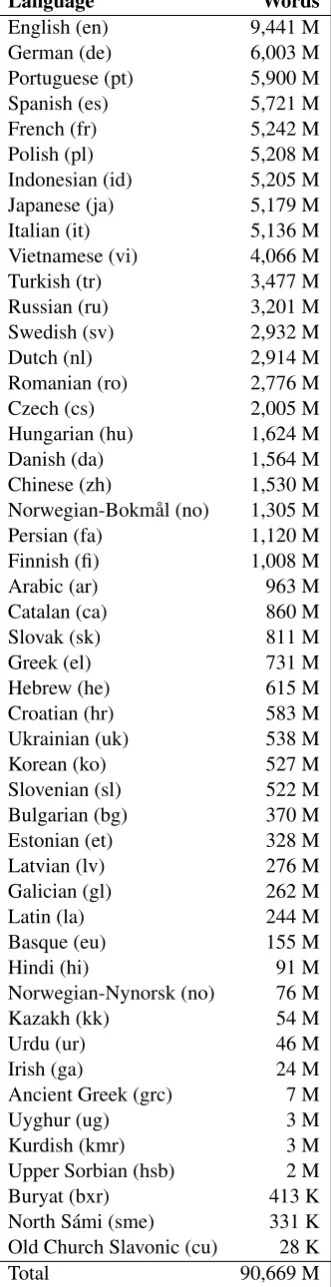
sentences and 90 G words in 45 languages are available in CoNLL-U format (Ginter et al.,2017); the per-language sizes of the corpus are listed in Table2.
SeeZeman et al.(2017) for more details on how the raw texts and embeddings were processed. Note that the resource was originally prepared for the 2017 task and it was not extended to include the eight new languages; however, some of the new languages are covered by the word vectors
provided by Facebook (Bojanowski et al., 2016)
Language Words
English (en) 9,441 M German (de) 6,003 M Portuguese (pt) 5,900 M Spanish (es) 5,721 M French (fr) 5,242 M Polish (pl) 5,208 M Indonesian (id) 5,205 M Japanese (ja) 5,179 M Italian (it) 5,136 M Vietnamese (vi) 4,066 M Turkish (tr) 3,477 M Russian (ru) 3,201 M Swedish (sv) 2,932 M Dutch (nl) 2,914 M Romanian (ro) 2,776 M Czech (cs) 2,005 M Hungarian (hu) 1,624 M Danish (da) 1,564 M Chinese (zh) 1,530 M Norwegian-Bokm˚al (no) 1,305 M Persian (fa) 1,120 M Finnish (fi) 1,008 M Arabic (ar) 963 M Catalan (ca) 860 M Slovak (sk) 811 M
Greek (el) 731 M
Hebrew (he) 615 M Croatian (hr) 583 M Ukrainian (uk) 538 M Korean (ko) 527 M Slovenian (sl) 522 M Bulgarian (bg) 370 M Estonian (et) 328 M Latvian (lv) 276 M Galician (gl) 262 M
Latin (la) 244 M
Basque (eu) 155 M
Hindi (hi) 91 M
Norwegian-Nynorsk (no) 76 M
Kazakh (kk) 54 M
Urdu (ur) 46 M
Irish (ga) 24 M
Ancient Greek (grc) 7 M
Uyghur (ug) 3 M
Kurdish (kmr) 3 M Upper Sorbian (hsb) 2 M Buryat (bxr) 413 K North S´ami (sme) 331 K Old Church Slavonic (cu) 28 K
[image:4.595.99.265.69.714.2]Total 90,669 M
Table 2: Supporting data overview: Number of words (M = million; K = thousand) for each lan-guage.
2.3 Test Data: UD 2.2
Each of the 82 treebanks mentioned in Section2.1
has a test set. Test sets from two different tree-banks of one language were evaluated separately as if they were different languages. Every test set contains at least 10,000 words (including punctu-ation marks). UD 2.2 treebanks that were smaller than 10,000 words were excluded from the shared task. There was no upper limit on the test data; the largest treebank had a test set comprising 170K words. The test sets were officially released as a part of UD 2.2 immediately after the shared task.5
3 Evaluation Metrics
There are three main evaluation scores, dubbed
LAS,MLASandBLEX.All three metrics reflect word segmentation and relations between content words. LAS is identical to the main metric of the 2017 task, allowing for easy comparison; the other two metrics include part-of-speech tags,
morpho-logical features and lemmas. Participants who
wanted to decrease task complexity could concen-trate on improvements in just one metric; however, all systems were evaluated with all three metrics, and participants were strongly encouraged to out-put all relevant annotation, even if they just copy values predicted by the baseline model.
When parsers are applied to raw text, the metric must be adjusted to the possibility that the num-ber of nodes in gold-standard annotation and in the system output vary. Therefore, the evaluation starts with aligning system nodes and gold nodes. A dependency relation cannot be counted as cor-rect if one of the nodes could not be aligned to a
gold node. See Section3.4 and onward for more
details on alignment.
The evaluation software is a Python script that computes the three main metrics and a number of additional statistics. It is freely available for down-load from the shared task website.6
3.1 LAS: Labeled Attachment Score
The standard evaluation metric of dependency parsing is thelabeled attachment score(LAS), i.e., the percentage of nodes with correctly assigned reference to the parent node, including the label (type) of the relation. For scoring purposes, only
5
Content nsubj, obj, iobj, csubj, ccomp, xcomp, obl, vocative, expl, dislocated, advcl, advmod, discourse, nmod, appos, nummod, acl, amod, conj, fixed, flat, compound, list, parataxis, orphan, goeswith, reparandum, root, dep
Function aux, cop, mark, det, clf, case, cc
[image:5.595.73.527.62.148.2]Ignored punct
Table 3: Universal dependency relations considered as pertaining to content words and function words, respectively, in MLAS. Content word relations are evaluated directly; words attached via functional relations are treated as features of their parent nodes.
Features PronType, NumType, Poss, Reflex, Foreign, Abbr, Gender,
Animacy, Number, Case, Definite, Degree, VerbForm, Mood, Tense, Aspect, Voice, Evident, Polarity, Person, Polite
Table 4: Universal features whose values are evaluated in MLAS. Any other features are ignored.
universal dependency labels were taken into ac-count, which means that language-specific
sub-types such as expl:pv(pronoun of a
pronomi-nal verb), a subtype of the universal relationexpl
(expletive), were truncated to expl both in the
gold standard and in the system output before comparing them.
In the end-to-end evaluation of our task, LAS is re-defined as the harmonic mean(F1)of precision P and recallR, where
P = #correctRelations
#systemNodes (1)
R= #correctRelations
#goldNodes (2)
LAS = 2P R
P +R (3)
Note that attachment of all nodes including punc-tuation is evaluated. LAS is computed separately for each of the 82 test files and a macro-average of all these scores is used to rank the systems.
3.2 MLAS: Morphology-Aware Labeled Attachment Score
MLAS aims at cross-linguistic comparability of the scores. It is an extension of CLAS (Nivre and
Fang, 2017), which was tested experimentally in
the 2017 task. CLAS focuses on dependencies be-tween content words and disregards attachment of function words; in MLAS, function words are not ignored, but they are treated as features of content words. In addition, part-of-speech tags and mor-phological features are evaluated, too.
The idea behind MLAS is that function words often correspond to morphological features in
other languages. Furthermore, languages with
many function words (e.g., English) have longer sentences than morphologically rich languages (e.g., Finnish), hence a single error in Finnish costs the parser significantly more than an error in English according to LAS.
The core part is identical to LAS (Section3.1): for aligned system and gold nodes, their respec-tive parent nodes are considered; if the system parent is not aligned with the gold parent, or if the universal relation label differs, the word is not counted as correctly attached. Unlike LAS, cer-tain types of relations (Table3) are not evaluated directly. Words attached via such relations (in ei-ther system or gold data) are not counted as inde-pendent words. Instead, they are treated as fea-tures of the content words they belong to. There-fore, a system-produced word counts as correct if it is aligned and attached correctly, its universal POS tag and selected morphological features (Ta-ble 4) are correct, all its function words are at-tached correctly, and their POS tags and features are also correct. Punctuation nodes are neither content nor function words; their attachment is ig-nored in MLAS.
3.3 BLEX: Bilexical Dependency Score
annota-tion that are important for language understand-ing: dependencies and lexemes. The inclusion of this metric should motivate the competing teams to model lemmas, the last important piece of an-notation that is not captured by the other metrics. A system that scores high in all three metrics will thus be a general-purpose language-analysis tool that tackles segmentation, morphology and sur-face syntax.
Computation of BLEX is analogous to LAS and MLAS. Precision and recall of correct attachments is calculated, attachment of function words and
punctuation is ignored (Table3). An attachment
is correct if the parent and child nodes are aligned to the corresponding nodes in gold standard, if the universal dependency label is correct, and if the lemma of the child node is correct.
A few UD treebanks lack lemmatization (or, as in Uyghur, have lemmas only for some words and not for others). A system may still be able to predict the lemmas if it learns them in other tree-banks. Such system should not be penalized just because no gold standard is available; therefore, if the gold lemma is a single underscore character (“ ”), any system-produced lemma is considered correct.
3.4 Token Alignment
UD defines two levels of token/word segmenta-tion. The lower level corresponds to what is usu-ally understood as tokenization. However, unlike some popular tokenization schemes, it does not include any normalization of the non-whitespace characters. We can safely assume that any two tok-enizations of a text differ only in whitespace while the remaining characters are identical. There is thus a 1-1 mapping between gold and system non-whitespace characters, and two tokens are aligned if all their characters match.
3.5 Syntactic Word Alignment
The higher segmentation level is based on the
no-tion of syntactic word. Some languages contain
multi-word tokens (MWT) that are regarded as contractions of multiple syntactic words. For
ex-ample, the German tokenzum is a contraction of
the prepositionzu“to” and the articledem“the”. Syntactic words constitute independent nodes in dependency trees. As shown by the example, it is not required that the MWT is a pure concate-nation of the participating words; the simple to-ken alignment thus does not work when MWTs
are involved. Fortunately, the CoNLL-U file for-mat used in UD clearly marks all MWTs so we can detect them both in system output and in gold data. Whenever one or more MWTs have overlap-ping spans of surface character offsets, the longest common subsequence algorithm is used to align syntactic words within these spans.
3.6 Sentence Segmentation
Words are aligned and dependencies are evaluated in the entire file without considering sentence seg-mentation. Still, the accuracy of sentence bound-aries has an indirect impact on attachment scores: any missing or extra sentence boundary necessar-ily makes one or more dependency relations incor-rect.
3.7 Invalid Output
If a system fails to produce one of the 82 files or if the file is not valid CoNLL-U format, the score of that file (counting towards the system’s macro-average) is zero.
Formal validity is defined more leniently than for UD-released treebanks. For example, a non-existent dependency type does not render the whole file invalid, it only costs the system one in-correct relation. However, cycles and multi-root sentences are disallowed. A file is also invalid if there are character mismatches that could make the token-alignment algorithm fail.
3.8 Extrinsic Parser Evaluation
The metrics described above are allintrinsic mea-sures: they evaluate the grammatical analysis task per se, with the hope that better scores corre-spond to output that is more useful for downstream NLP applications. Nevertheless, such correlations are not automatically granted. We thus seek to
complement our task with anextrinsicevaluation,
where the output of parsing systems is exploited by applications like biological event extraction, opinion analysis and negation scope resolution.
This optional track involves English only. It is organized in collaboration with the EPE initia-tive;7for details seeFares et al.(2018).
4 TIRA: The System Submission Platform
Similarly to our 2017 task and to some other re-cent CoNLL shared tasks, we employed the
based evaluation platform TIRA (Potthast et al.,
2014),8which implements theevaluation as a ser-vice paradigm (Hanbury et al., 2015). Instead of processing test data on their own hardware and submitting the outputs, participants submit
work-ing software. Naturally, software submissions
bring about additional overhead for both organiz-ers and participants, whereas the goal of an evalua-tion platform like TIRA is to reduce this overhead to a bearable level.
4.1 Blind Evaluation
Traditionally, evaluations in shared tasks are half-blind (the test data are shared with participants while the ground truth is withheld). TIRA en-ables fully blind evaluation, where the software is locked in a datalock together with the test data, its output is recorded but all communication channels to the outside are closed or tightly moderated. The participants do not even see the input to their soft-ware. This feature of TIRA was not too impor-tant in the present task, as UD data is not secret, and the participants were simply trusted that they would not exploit any knowledge of the test data they might have access to.
However, closing down all communication channels also has its downsides, since participants cannot check their running software; before the system run completes, even the task moderator does not see whether the system is really pro-ducing output and not just sitting in an endless loop. In order to alleviate this extra burden, we made two modifications compared to the previ-ous year: 1. Participants were explicitly advised to invoke shorter runs that process only a subset of the test files. The organizers would then stitch the partial runs into one set of results. 2. Partici-pants were able to see their scores on the test set rounded to the nearest multiple of 5%. This way they could spot anomalies possibly caused by ill-selected models. The exact scores remained hid-den because we did not want the participants to fine-tune their systems against the test data.
4.2 Replicability
It is desirable that published experiments can be re-run yielding the same results, and that the al-gorithms can be tested on alternative test data in the future. Ensuring both requires that a to-be-evaluated software is preserved in working
con-8http://www.tira.io/
dition for as long as possible. TIRA supplies
participants with a virtual machine, offering a range of commonly used operating systems. Once deployed and tested, the virtual machines are archived to preserve the software within.
In addition, some participants agreed to share their code so that we decided to collect the respec-tive projects in an open source repository hosted on GitHub.9
5 Baseline System
We prepared a set of baseline models using UD-Pipe 1.2 (Straka and Strakov´a,2017).
The baseline models were released together with the UD 2.2 training data. For each of the 73 treebanks with non-empty training data we trained one UDPipe model, utilizing training data for training and development data for hyperparam-eter tuning. If a treebank had no development data, we cut 10% of the training sentences and consid-ered it as development data for the purpose of tun-ing hyperparameters of the baseline model (em-ploying only the remainder of the original training data for the actual training in that case).
In addition to the treebank-specific models, we also trained a “mixed model” on samples from all treebanks. Specifically, we utilized the first 200 training sentences of each treebank (or less in case of small treebanks) as training data, and at most 20 sentences from each treebank’s development set as development data.
The baseline models, together with all informa-tion needed to replicate them (hyperparameters, the modified train-dev split where applicable, and pre-computed word embeddings for the parser) are
available fromhttp://hdl.handle.net/11234/
1-2859.
Additionally, the released archive also contains the training and development data with predicted
morphology. Morphology in development data
was predicted using the baseline models, morphol-ogy in training data via “jack-knifing” (split the training set into 10 parts, train a model on 9 parts, use it to predict morphology in the tenth part, re-peat for all 10 target parts). The same hyperparam-eters were used as those used to train the baseline model on the entire training set.
The UDPipe baseline models are able to recon-struct nearly all annotation from CoNLL-U files – they can generate segmentation, tokenization,
Treebank without Substitution training data model
Breton KEB mixed model
Czech PUD Czech PDT
English PUD English EWT
Faroese OFT mixed model
Finnish PUD Finnish TDT
Japanese Modern Japanese GSD
Naija NSC mixed model
Swedish PUD Swedish Talbanken
[image:8.595.308.526.60.438.2]Thai PUD mixed model
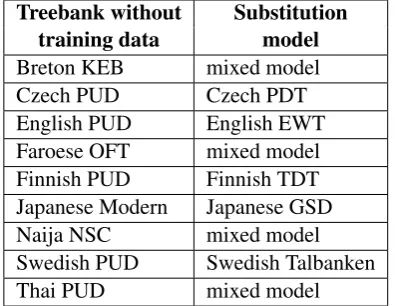
Table 5: Substitution models of the baseline sys-tems for treebanks without training data.
multi-word token splitting, morphological annota-tion (lemmas, UPOS, XPOS and FEATS) and de-pendency trees. Participants were free to use any part of the model in their systems – for all test sets, we provided UDPipe processed variants in addi-tion to raw text inputs.
Baseline UDPipe Shared Task System The shared task baseline system employs the UDPipe 1.2 baseline models. For the nine treebanks with-out their own training data, a substitution model according to Table5was used.
6 Results
6.1 Official Parsing Results
Table 6 gives the main ranking of participating
systems by the LAS F1score macro-averaged over
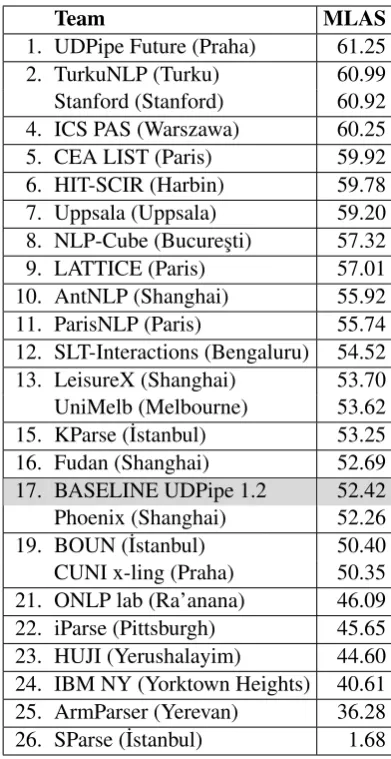
all 82 test files. The table also shows the perfor-mance of the baseline UDPipe system; 17 of the 25 systems managed to outperform it. The base-line is comparatively weaker than in the 2017 task (only 12 out of 32 systems beat the baseline there). The ranking of the baseline system by MLAS is similar (Table7) but in BLEX, the baseline jumps to rank 13 (Table8). Besides the simple explana-tion that UDPipe 1.2 is good at lemmatizaexplana-tion, we could also hypothesize that some teams put less effort in building lemmatization models (see also the last column in Table10).
Each ranking has a different winning system, al-though the other two winners are typically closely following. The same 8–10 systems occupy best positions in all three tables, though with variable mutual ranking. Some teams seem to have delib-erately neglected some of the evaluated attributes: Uppsala is rank 7 in LAS and MLAS, but 24 in
Team LAS
1. HIT-SCIR (Che et al.) 75.84
2. TurkuNLP (Kanerva et al.) 73.28
3. UDPipe Future (Straka) 73.11
LATTICE (Lim et al.) 73.02
ICS PAS (Rybak and Wr´oblewska) 73.02
6. CEA LIST (Duthoo and Mesnard) 72.56
7. Uppsala (Smith et al.) 72.37
Stanford (Qi et al.) 72.29
9. AntNLP (Ji et al.) 70.90
NLP-Cube (Boros, et al.) 70.82
11. ParisNLP (Jawahar et al.) 70.64
12. SLT-Interactions (Bhat et al.) 69.98
13. IBM NY (Wan et al.) 69.11
14. UniMelb (Nguyen and Verspoor) 68.66
15. LeisureX (Li et al.) 68.31
16. KParse (Kırnap et al.) 66.58
17. Fudan (Chen et al.) 66.34
18. BASELINE UDPipe 1.2 65.80
19. Phoenix (Wu et al.) 65.61
20. CUNI x-ling (Rosa and Mareˇcek) 64.87
21. BOUN (Ozates¸ et al.¨ ) 63.54
22. ONLP lab (Seker et al.) 58.35
23. iParse (no paper) 55.83
24. HUJI (Hershcovich et al.) 53.69
25. ArmParser (Arakelyan et al.) 47.02
26. SParse (Onder et al.¨ ) 1.95
Table 6: Ranking of the participating systems by
the labeled attachment F1-score (LAS),
macro-averaged over 82 test sets. Pairs of systems with significantly (p < 0.05) different LAS are sepa-rated by a line. Citations refer to the correspond-ing system-description papers in this volume.
BLEX; IBM NY is rank 13 in LAS but 24 in MLAS and 23 in BLEX.
While the LAS scores on individual treebanks are comparable to the 2017 task, the macro aver-age is not, because the set of treebanks is different, and the impact of low-resource languages seems to be higher in the present task.
We used bootstrap resampling to compute 95% confidence intervals: they are in the range±0.11
to±0.16 (% LAS/MLAS/BLEX) for all systems
[image:8.595.83.281.63.216.2]Team MLAS
1. UDPipe Future (Praha) 61.25
2. TurkuNLP (Turku) 60.99
Stanford (Stanford) 60.92
4. ICS PAS (Warszawa) 60.25
5. CEA LIST (Paris) 59.92
6. HIT-SCIR (Harbin) 59.78
7. Uppsala (Uppsala) 59.20
8. NLP-Cube (Bucures¸ti) 57.32
9. LATTICE (Paris) 57.01
10. AntNLP (Shanghai) 55.92
11. ParisNLP (Paris) 55.74
12. SLT-Interactions (Bengaluru) 54.52
13. LeisureX (Shanghai) 53.70
UniMelb (Melbourne) 53.62
15. KParse (˙Istanbul) 53.25
16. Fudan (Shanghai) 52.69
17. BASELINE UDPipe 1.2 52.42
Phoenix (Shanghai) 52.26
19. BOUN (˙Istanbul) 50.40
CUNI x-ling (Praha) 50.35
21. ONLP lab (Ra’anana) 46.09
22. iParse (Pittsburgh) 45.65
23. HUJI (Yerushalayim) 44.60
24. IBM NY (Yorktown Heights) 40.61
25. ArmParser (Yerevan) 36.28
[image:9.595.82.278.60.440.2]26. SParse (˙Istanbul) 1.68
Table 7: Ranking of the participating systems by
MLAS, macro-averaged over 82 test sets. Pairs of systems with significantly (p <0.05) different MLAS are separated by a line.
We used paired bootstrap resampling to com-pute whether the difference between two neigh-boring systems is significant (p <0.05).10
6.2 Secondary Metrics
In addition to the main LAS ranking, we evaluated the systems along multiple other axes, which may shed more light on their strengths and weaknesses. This section provides an overview of selected sec-ondary metrics for systems matching or surpassing the baseline; a large number of additional results are available at the shared task website.11
The website also features a LAS ranking of unofficial system runs, i.e. those that were not
10
Using Udapi (Popel et al.,2017)eval.Conll18, marked by the presence or absence of horizontal lines in Tables6–8.
11http://universaldependencies.org/ conll18/results.html
Team BLEX
1. TurkuNLP (Turku) 66.09
2. HIT-SCIR (Harbin) 65.33
3. UDPipe Future (Praha) 64.49
ICS PAS (Warszawa) 64.44
5. Stanford (Stanford) 64.04
6. LATTICE (Paris) 62.39
CEA LIST (Paris) 62.23
8. AntNLP (Shanghai) 60.91
9. ParisNLP (Paris) 60.70
10. SLT-Interactions (Bengaluru) 59.68
11. UniMelb (Melbourne) 58.67
12. LeisureX (Shanghai) 58.42
13. BASELINE UDPipe 1.2 55.80
Phoenix (Shanghai) 55.71
15. NLP-Cube (Bucures¸ti) 55.52
16. KParse (˙Istanbul) 55.26
17. CUNI x-ling (Praha) 54.07
Fudan (Shanghai) 54.03
19. BOUN (˙Istanbul) 53.45
20. iParse (Pittsburgh) 48.71
21. HUJI (Yerushalayim) 48.05
22. ArmParser (Yerevan) 39.18
23. IBM NY (Yorktown Heights) 32.55
24. Uppsala (Uppsala) 32.09
25. ONLP lab (Ra’anana) 28.29
26. SParse (˙Istanbul) 1.71
Table 8: Ranking of the participating systems by
BLEX, macro-averaged over 82 test sets. Pairs of systems with significantly (p <0.05) different BLEX are separated by a line.
marked by their teams as primary runs, or were even run after the official evaluation phase closed and test data were unblinded. The difference from the official results is much less dramatic than in 2017, with the exception of the team SParse, who managed to fix their software and produce more valid output files.
[image:9.595.318.513.61.449.2]Team Toks Wrds Sents
1. Uppsala 97.60 98.18 83.80
2. HIT-SCIR 98.42 98.12 83.87
3. CEA LIST 98.16 97.78 82.79
4. CUNI x-ling 98.09 97.74 82.80
5. TurkuNLP 97.83 97.42 83.03
6. SLT-Interactions 97.51 97.09 83.01
7. UDPipe Future 97.46 97.04 83.64
8. Phoenix 97.46 97.03 82.91
9. BASELINE UDPipe 97.39 96.97 83.01
ParisNLP 97.39 96.97 83.01
AntNLP 97.39 96.97 83.01
UniMelb 97.39 96.97 83.01
BOUN 97.39 96.97 83.01
ICS PAS 97.39 96.97 83.01
LATTICE 97.39 96.97 83.01
LeisureX 97.39 96.97 83.01
KParse 97.39 96.97 83.01
18. Fudan 97.38 96.96 82.85
19. IBM NY 97.30 96.92 83.51
20. ONLP lab 97.28 96.86 83.00
21. NLP-Cube 97.36 96.80 82.55
22. Stanford 96.19 95.99 76.55
23. HUJI 94.95 94.61 80.84
24. ArmParser 79.75 79.41 13.33
25. iParse 78.45 78.11 68.37
[image:10.595.72.289.60.440.2]26. SParse 2.32 2.32 2.34
Table 9: Tokenization, word segmentation and
sentence segmentation (ordered by word F1
scores; out-of-order scores in the other two
columns are bold).
experiment are available on the shared task web-site.12
Table9evaluates detection of tokens, syntactic words and sentences. About a third of the sys-tems trusted the baseline segmentation; this is less than in 2017. For most languages and in aggre-gate, the segmentation scores are very high and their impact on parsing scores is not easy to prove; but it likely played a role in languages where seg-mentation is hard. For example, HIT-SCIR’s word segmentation in Vietnamese surpasses the second system by a margin of 6 percent points; likewise, the system’s advantage in LAS and MLAS (but not in BLEX!) amounts to 7–8 points. Similarly, Uppsala and ParisNLP achieved good
segmenta-12http://universaldependencies.org/ conll18/results-2017-systems.html
Team UPOS Feats Lemm
1. Uppsala 90.91 87.59 58.50
2. HIT-SCIR 90.19 84.24 88.82
3. CEA LIST 89.97 86.83 88.90
4. TurkuNLP 89.81 86.70 91.24
5. LATTICE 89.53 83.74 87.84
6. UDPipe Future 89.37 86.67 89.32
7. Stanford 89.01 85.47 88.32
8. ICS PAS 88.70 85.14 87.99
9. CUNI x-ling 88.68 84.56 88.96
10. NLP-Cube 88.50 85.08 81.21
11. SLT-Interactions 88.12 83.72 87.51
12. IBM NY 88.02 59.11 59.51
13. UniMelb 87.90 83.74 87.84
14. KParse 87.62 84.32 86.26
15. Phoenix 87.49 83.87 87.69
16. ParisNLP 87.35 83.74 87.84
17. BASELINE UDPipe 87.32 83.74 87.84
AntNLP 87.32 83.74 87.84
19. ONLP lab 87.25 83.67 57.10
20. Fudan 87.25 83.47 85.91
21. BOUN 87.19 83.73 87.68
22. LeisureX 87.15 83.46 87.77
23. HUJI 85.06 81.51 85.61
24. ArmParser 72.99 69.91 72.22
25. iParse 71.38 68.64 71.68
26. SParse 2.25 2.29 2.28
Table 10: Universal POS tags, features and
lem-mas (ordered by UPOS F1 scores; out-of-order
scores in the other two columns are bold).
tion scores (better than their respective macro-averages) on Arabic. They were able to translate it into better LAS, but not MLAS and BLEX, where there were too many other chances to make an er-ror.
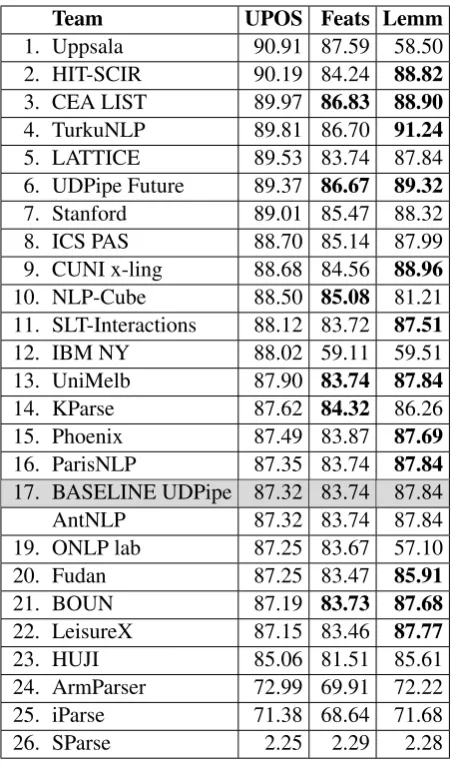
The complexity of the new metrics, especially
MLAS, is further underlined by Table10: Uppsala
is the clear winner in both UPOS tags and morpho-logical features, but 6 other teams had better de-pendency relations and better MLAS. Note that as with segmentation, morphology predicted by the baseline system was available, though only a few systems seem to have used it without attempting to improve it.
6.3 Partial Results
[image:10.595.307.533.61.450.2] [image:10.595.306.533.71.444.2]Team LAS MLAS BLEX
1. HIT-SCIR 84.37 70.12 75.05
2. Stanford 83.03 72.67 75.46
3. TurkuNLP 81.85 71.27 75.83
4. UDPipe Future 81.83 71.71 74.67
5. ICS PAS 81.72 70.30 74.42
6. CEA LIST 81.66 70.89 72.32
7. LATTICE 80.97 66.27 71.50
8. NLP-Cube 80.48 67.79 64.76
9. ParisNLP 80.29 65.88 70.95
10. Uppsala 80.25 68.81 36.02
11. SLT-Interactions 79.67 64.95 69.77
12. AntNLP 79.61 65.43 70.34
13. LeisureX 77.98 63.79 68.55
14. UniMelb 77.69 63.17 68.25
15. IBM NY 77.55 47.34 36.68
16. Fudan 75.42 62.28 62.90
17. KParse 74.84 62.40 63.84
18. BASELINE UDPipe 74.14 61.27 64.67
19. Phoenix 73.93 61.12 64.47
20. BOUN 72.85 60.00 62.99
21. CUNI x-ling 71.54 58.33 61.63
22. ONLP lab 67.08 55.20 33.08
23. iParse 66.55 55.37 58.80
24. HUJI 62.07 53.20 56.90
25. ArmParser 58.14 45.87 49.25
[image:11.595.72.535.60.445.2]26. SParse 2.63 2.26 2.30
Table 11: Average LAS on the 61 “big” treebanks (ordered by LAS F1 scores; out-of-order scores in
the other two columns are bold).
test data, development data available). Higher
scores reflect the fact that models for these test sets are easier to learn: enough data is available, no cross-lingual or cross-domain learning is nec-essary (the extra test sets are not included here). Regarding ranking, the Stanford system makes a remarkable jump when it does not have to carry the load of underresourced languages: from rank 8 to 2 in LAS, from 3 to 1 in MLAS and from 5 to 2 in BLEX.
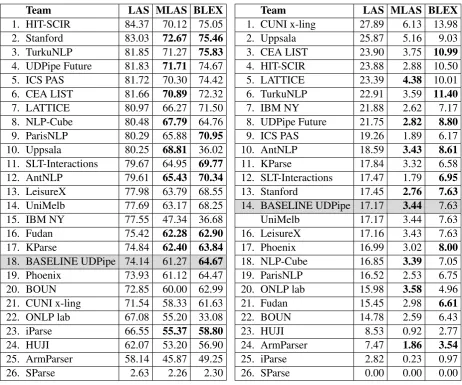
Table 12 gives the LAS F1 score on the nine
low-resource languages only. Here we have a true specialist: The team CUNI x-ling lives up to its name and wins in all three scores, although in the overall ranking they fall even slightly behind the baseline. On the other hand, the scores are ex-tremely low and the outputs are hardly useful for any downstream application. Especially
morphol-Team LAS MLAS BLEX
1. CUNI x-ling 27.89 6.13 13.98
2. Uppsala 25.87 5.16 9.03
3. CEA LIST 23.90 3.75 10.99
4. HIT-SCIR 23.88 2.88 10.50
5. LATTICE 23.39 4.38 10.01
6. TurkuNLP 22.91 3.59 11.40
7. IBM NY 21.88 2.62 7.17
8. UDPipe Future 21.75 2.82 8.80
9. ICS PAS 19.26 1.89 6.17
10. AntNLP 18.59 3.43 8.61
11. KParse 17.84 3.32 6.58
12. SLT-Interactions 17.47 1.79 6.95
13. Stanford 17.45 2.76 7.63
14. BASELINE UDPipe 17.17 3.44 7.63
UniMelb 17.17 3.44 7.63
16. LeisureX 17.16 3.43 7.63
17. Phoenix 16.99 3.02 8.00
18. NLP-Cube 16.85 3.39 7.05
19. ParisNLP 16.52 2.53 6.75
20. ONLP lab 15.98 3.58 4.96
21. Fudan 15.45 2.98 6.61
22. BOUN 14.78 2.59 6.43
23. HUJI 8.53 0.92 2.77
24. ArmParser 7.47 1.86 3.54
25. iParse 2.82 0.23 0.97
[image:11.595.76.536.63.446.2]26. SParse 0.00 0.00 0.00
Table 12: Average LAS, MLAS and BLEX on the 9 low-resource languages: Armenian (hy), Bre-ton (br), Buryat (bxr), Faroese (fo), Kazakh (kk), Kurmanji (kmr), Naija (pcm), Thai (th) and Upper
Sorbian (hsb) (ordered by LAS F1scores;
out-of-order scores in the other two columns are bold).
Team LAS MLAS BLEX
1. HIT-SCIR 69.53 45.94 53.30
2. LATTICE 68.12 45.03 51.71
3. ICS PAS 66.90 49.24 54.89
4. TurkuNLP 64.48 47.63 53.54
5. UDPipe Future 64.21 47.53 49.53
6. AntNLP 63.73 42.24 48.31
7. Uppsala 63.60 46.00 29.25
8. ParisNLP 60.84 40.71 46.08
9. CEA LIST 57.34 39.97 43.39
10. KParse 57.32 39.20 43.61
11. NLP-Cube 56.78 37.13 38.30
12. SLT-Interactions 56.74 35.73 42.90
13. IBM NY 56.13 26.51 25.23
14. UniMelb 56.12 36.09 42.09
15. BASELINE UDPipe 55.01 38.80 41.06
LeisureX 55.01 38.80 41.06
17. Phoenix 54.63 38.38 40.72
Fudan 54.63 38.15 40.07
19. CUNI x-ling 54.33 38.10 40.70
20. BOUN 50.18 34.29 36.75
21. Stanford 48.56 34.86 38.55
22. ONLP lab 47.49 32.74 22.39
23. iParse 38.79 28.03 29.62
24. HUJI 36.74 24.47 27.70
25. ArmParser 34.54 22.94 25.26
26. SParse 0.00 0.00 0.00
Table 13: Average attachment score on the 7 small treebanks: Galician TreeGal, Irish, Latin Perseus, North S´ami, Norwegian Nynorsk LIA, Russian Taiga and Slovenian SST (ordered by
LAS F1 scores; out-of-order scores in the other
two columns are bold).
surprise languages and had higher scores there.13 This is because in 2017, the segmentation, POS tags and morphology UDPipe models were trained on the test data, applied to it via cross-validation, and made available to the systems. Such an ap-proach makes the conditions unrealistic, therefore it was not repeated this year. Consequently, pars-ing these languages is now much harder.
In contrast, the results on the 7 treebanks with “small” training data and no development data
(Table 13) are higher on average, but again the
variance is significant. The smallest treebank
13The fourth surprise language, North S´ami, has now ad-ditional training data and does not fall in the low-resource category.
Team LAS MLAS BLEX
1. HIT-SCIR 74.20 55.52 62.34
2. Stanford 73.14 58.75 61.96
3. LATTICE 72.34 55.60 60.42
4. Uppsala 72.27 57.80 29.73
5. ICS PAS 72.18 58.07 60.97
6. TurkuNLP 71.78 57.54 63.25
7. UDPipe Future 71.57 57.93 61.52
8. CEA LIST 70.45 54.99 57.83
9. NLP-Cube 69.83 55.01 54.15
10. IBM NY 69.40 46.59 38.12
11. AntNLP 68.87 53.47 57.71
12. UniMelb 68.72 52.05 56.77
13. Phoenix 66.97 52.26 55.69
14. BASELINE UDPipe 66.63 51.75 54.87
15. KParse 66.55 51.29 54.45
16. SLT-Interactions 64.73 48.47 54.90
17. CUNI x-ling 64.70 49.71 52.72
18. ParisNLP 64.09 48.79 53.16
19. Fudan 63.54 45.54 50.73
20. LeisureX 61.05 41.95 50.60
21. BOUN 56.46 41.91 45.12
22. HUJI 56.35 46.52 50.10
23. iParse 44.20 33.43 38.18
24. ONLP lab 43.33 30.20 20.08
25. ArmParser 0.00 0.00 0.00
[image:12.595.73.534.60.445.2]SParse 0.00 0.00 0.00
Table 14: Average attachment score on the 5 addi-tional test sets for high-resource languages: Czech PUD, English PUD, Finnish PUD, Japanese
Mod-ern and Swedish PUD (ordered by LAS F1scores;
out-of-order scores in the other two columns are bold).
[image:12.595.75.534.64.445.2]com-parable to Nynorsk LIA but much better than SST. ICS PAS is the most successful system in the do-main of small treebanks, especially when judged by MLAS and BLEX.
Table 14 gives the average LAS on the 5
ex-tra test sets (no own ex-training data, but other tree-banks of the same language exist). Four of them come from the Parallel UD (PUD) collection in-troduced in the 2017 task (Zeman et al., 2017). The fifth, Japanese Modern, turned out to be one of the toughest test sets in this shared task. There is another Japanese treebank, GSD, with over 160K training tokens, but the Modern dataset seems al-most inapproachable with models trained on GSD. A closer inspection reveals why: despite its name, it is actually a corpus of historical Japanese, al-though from the relatively recent Meiji and Taish¯o
periods (1868–1926). An average sentence in
GSD is about 1.3×longer than in Modern. GSD
has significantly more tokens tagged as auxiliaries,
but more importantly, the top ten AUX lemmas
in the two treebanks are completely disjoint sets. Some other words are out-of-vocabulary because their preferred spelling changed. For instance, the
demonstrative pronounsoreis written using
hira-gana in GSD, but a kanji character is used in Mod-ern. Striking differences can be observed also in dependency relations: in GSD, 3.7% relations are
nsubj(subject), and 1.2% arecop (copula). In Modern, there is just 0.13% of subjects, and not a single occurrence of a copula.
See Tables 15, 16 and 17 for a ranking of all
test sets by the best scores achieved on them by any parser. Note that this cannot be directly inter-preted as a ranking of languages by their parsing difficulty: many treebanks have high ranks simply because the corresponding training data is large.
Table 18 compares average LAS and MLAS for
each treebank.
Finally, Tables 19 and 20 show the treebanks
where word and sentence segmentation was ex-tremely difficult (judged by the average parser score). Not surprisingly, word segmentation is dif-ficult for the low-resource languages and for lan-guages like Chinese, Vietnamese, Japanese and Thai, where spaces do not separate words. No-tably the Japanese GSD set is not as difficult, but whoever trusted it, crashed on the “Modern” set. Sentence segmentation was particularly hard for treebanks without punctuation, i.e., most of the classical languages and spoken data.
Treebank LAS Best system Avg StDev
1. pl lfg 94.86 HIT-SCIR 85.89 ±6.97 2. ru syntagrus 92.48 HIT-SCIR 79.68 ±9.09 3. hi hdtb 92.41 HIT-SCIR 85.16 ±5.32 4. pl sz 92.23 HIT-SCIR 81.47 ±7.27 5. cs fictree 92.02 HIT-SCIR 82.10 ±7.26 6. it isdt 92.00 HIT-SCIR 87.61 ±4.12 7. cs pdt 91.68 HIT-SCIR 82.18 ±6.91 8. ca ancora 91.61 HIT-SCIR 83.61 ±6.01 9. cs cac 91.61 HIT-SCIR 82.69 ±6.93 10. sl ssj 91.47 HIT-SCIR 75.00 ±9.13 11. no bokmaal 91.23 HIT-SCIR 79.80 ±7.29 12. bg btb 91.22 HIT-SCIR 82.52 ±5.88 13. no nynorsk 90.99 HIT-SCIR 78.55 ±7.88 14. es ancora 90.93 HIT-SCIR 82.84 ±6.17 15. fi pud 90.23 HIT-SCIR 68.87±15.61 16. fr sequoia 89.89 LATTICE 80.55 ±5.91 17. el gdt 89.65 HIT-SCIR 80.65 ±6.05 18. nl alpino 89.56 HIT-SCIR 77.76 ±7.42 19. sk snk 88.85 HIT-SCIR 76.53 ±7.24 20. fi tdt 88.73 HIT-SCIR 73.55 ±9.39 21. sr set 88.66 Stanford 79.84 ±6.57 22. sv talbanken 88.63 HIT-SCIR 77.71 ±6.50 23. fi ftb 88.53 HIT-SCIR 76.89 ±7.60 24. uk iu 88.43 HIT-SCIR 72.47 ±8.25 25. fa seraji 88.11 HIT-SCIR 78.71 ±6.04 26. en pud 87.89 LATTICE 74.51 ±8.28 27. pt bosque 87.81 Stanford 80.49 ±5.46 28. hr set 87.36 HIT-SCIR 78.37 ±6.42 29. fro srcmf 87.12 UDPipe Future 74.38±16.74 30. la ittb 87.08 HIT-SCIR 77.00 ±7.42 31. ko kaist 86.91 HIT-SCIR 77.10 ±8.72 32. fr gsd 86.89 HIT-SCIR 79.43 ±5.47 33. ro rrt 86.87 HIT-SCIR 75.77 ±7.66 34. nl lassysmall 86.84 HIT-SCIR 75.08 ±6.59 35. da ddt 86.28 HIT-SCIR 75.02 ±6.47 36. cs pud 86.13 HIT-SCIR 73.24 ±9.97 37. af afribooms 85.47 HIT-SCIR 76.61 ±6.17 38. et edt 85.35 HIT-SCIR 72.08 ±8.71 39. ko gsd 85.14 HIT-SCIR 71.88±10.53 40. en gum 85.05 LATTICE 74.20 ±6.27 41. en ewt 84.57 HIT-SCIR 75.99 ±5.40 42. eu bdt 84.22 HIT-SCIR 72.08 ±8.83 43. sv lines 84.08 HIT-SCIR 73.76 ±5.98 44. lv lvtb 83.97 HIT-SCIR 67.76 ±9.01 45. ur udtb 83.39 HIT-SCIR 75.89 ±4.69 46. ja gsd 83.11 HIT-SCIR 73.68 ±4.55 47. gl ctg 82.76 Stanford 72.46 ±7.13 48. hu szeged 82.66 HIT-SCIR 67.05 ±8.63 49. en lines 81.97 HIT-SCIR 72.28 ±5.59 50. de gsd 80.36 HIT-SCIR 70.13 ±7.14 51. sv pud 80.35 HIT-SCIR 67.02 ±9.23 52. id gsd 80.05 HIT-SCIR 73.05 ±4.69 53. it postwita 79.39 HIT-SCIR 64.95 ±6.88 54. grc perseus 79.39 HIT-SCIR 59.01±15.56 55. grc proiel 79.25 HIT-SCIR 65.02±14.58 56. ar padt 77.06 Stanford 64.07 ±6.41 57. zh gsd 76.77 HIT-SCIR 60.32 ±6.14 58. he htb 76.09 Stanford 58.73 ±5.29 59. fr spoken 75.78 HIT-SCIR 64.66 ±5.35 60. cu proiel 75.73 Stanford 62.64 ±6.98 61. gl treegal 74.25 UDPipe Future 64.65 ±5.61 62. ru taiga 74.24 ICS PAS 56.27 ±9.16 63. la proiel 73.61 HIT-SCIR 61.25 ±6.87 64. la perseus 72.63 HIT-SCIR 46.91±11.12 65. ga idt 70.88 TurkuNLP 58.37 ±7.05 66. no nynorsklia 70.34 HIT-SCIR 50.33 ±9.28 67. sme giella 69.87 LATTICE 51.10±14.32 68. got proiel 69.55 Stanford 60.55 ±4.93 69. ug udt 67.05 HIT-SCIR 54.27 ±6.90 70. tr imst 66.44 HIT-SCIR 55.61 ±6.49 71. sl sst 61.39 HIT-SCIR 47.07 ±5.84 72. vi vtb 55.22 HIT-SCIR 40.40 ±4.43 73. fo oft 49.43 CUNI x-ling 27.87 ±9.75 74. hsb ufal 46.42 SLT-Interactions 26.48 ±8.90 75. br keb 38.64 CEA LIST 13.27 ±8.77 76. hy armtdp 37.01 LATTICE 22.39 ±7.91 77. kk ktb 31.93 Uppsala 19.11 ±6.34 78. kmr mg 30.41 IBM NY 20.27 ±6.14 79. pcm nsc 30.07 CUNI x-ling 13.19 ±5.76 80. ja modern 28.33 Stanford 18.92 ±5.14 81. bxr bdt 19.53 AntNLP 11.45 ±4.28 82. th pud 13.70 CUNI x-ling 1.38 ±2.83
[image:13.595.340.491.81.697.2]Treebank MLAS Best system Avg StDev
1. pl lfg 86.93 UDPipe Future 73.73 ±7.29 2. ru syntagrus 86.76 UDPipe Future 71.63 ±9.36 3. cs pdt 85.10 UDPipe Future73.61 ±6.32 4. cs fictree 84.23 ICS PAS 69.91 ±7.77 5. ca ancora 84.07 UDPipe Future74.62 ±7.69 6. es ancora 83.93 Stanford 74.61 ±7.43 7. it isdt 83.89 Stanford 77.14 ±8.89 8. fi pud 83.78 Stanford 62.38±14.83 9. no bokmaal 83.68 UDPipe Future70.75 ±8.92 10. cs cac 83.42 UDPipe Future71.39 ±6.89 11. bg btb 83.12 UDPipe Future73.18 ±7.15 12. fr sequoia 82.55 Stanford 70.42 ±9.04 13. sl ssj 82.38 Stanford 62.41 ±9.18 14. no nynorsk 81.86 UDPipe Future68.62 ±9.45 15. ko kaist 81.29 HIT-SCIR 70.18 ±9.36 16. ko gsd 80.85 HIT-SCIR 63.73±16.02 17. fi tdt 80.84 Stanford 65.27 ±9.22 18. fa seraji 80.83 UDPipe Future71.23 ±7.77 19. pl sz 80.77 Stanford 64.80 ±8.49 20. fro srcmf 80.28 UDPipe Future65.19±16.58 21. la ittb 79.84 ICS PAS 67.77 ±8.37 22. fi ftb 79.65 TurkuNLP 66.11 ±8.86 23. sv talbanken 79.32 Stanford 68.05 ±8.49 24. ro rrt 78.68 TurkuNLP 67.43 ±7.24 25. el gdt 78.66 Stanford 64.29 ±8.28 26. fr gsd 78.44 Stanford 69.33 ±8.59 27. hi hdtb 78.30 UDPipe Future 68.48 ±5.88 28. sr set 77.73 UDPipe Future 67.33 ±5.96 29. da ddt 77.31 Stanford 65.00 ±6.89 30. et edt 76.97 TurkuNLP 63.59 ±8.34 31. nl alpino 76.52 Stanford 62.82 ±9.81 32. en ewt 76.33 Stanford 66.84 ±5.86 33. pt bosque 75.94 Stanford 66.22 ±6.76 34. cs pud 75.81 UDPipe Future 60.47±11.36 35. af afribooms 75.67 UDPipe Future63.76 ±7.06 36. sk snk 75.01 Stanford 56.82 ±8.32 37. en pud 74.86 Stanford 63.05 ±7.89 38. nl lassysmall 74.11 Stanford 61.95 ±9.12 39. hr set 73.44 Stanford 60.08 ±7.07 40. en gum 73.24 ICS PAS 61.72 ±7.69 41. ja gsd 72.62 HIT-SCIR 59.52 ±6.20 42. uk iu 72.27 UDPipe Future 55.45 ±8.08 43. en lines 72.25 ICS PAS 62.35 ±8.04 44. eu bdt 71.73 UDPipe Future 58.49 ±8.62 45. gl ctg 70.92 Stanford 57.92±14.10 46. ar padt 68.54 Stanford 53.28 ±6.12 47. it postwita 68.50 Stanford 51.72 ±8.80 48. id gsd 68.36 Stanford 61.03 ±6.49 49. lv lvtb 67.89 Stanford 53.31 ±7.96 50. hu szeged 67.13 UDPipe Future 53.08 ±8.01 51. zh gsd 66.62 HIT-SCIR 50.42 ±5.87 52. sv lines 66.58 Stanford 57.40 ±7.43 53. fr spoken 64.67 HIT-SCIR 53.17 ±5.61 54. he htb 63.38 Stanford 45.22 ±4.94 55. cu proiel 63.31 Stanford 50.28 ±6.69 56. ru taiga 61.59 ICS PAS 37.16 ±7.53 57. gl treegal 60.63 UDPipe Future47.35 ±5.93 58. grc proiel 60.27 Stanford 47.62±11.82 59. la proiel 59.36 Stanford 47.79 ±6.90 60. de gsd 58.04 TurkuNLP 39.13±10.35 61. ur udtb 57.98 TurkuNLP 49.64 ±4.21 62. no nynorsklia 57.51 ICS PAS 37.08 ±7.78 63. sme giella 57.47 TurkuNLP 38.29±12.37 64. got proiel 56.45 UDPipe Future46.18 ±5.36 65. tr imst 55.73 Stanford 45.26 ±6.15 66. grc perseus 54.98 HIT-SCIR 35.65±12.31 67. sv pud 51.74 TurkuNLP 39.41 ±7.78 68. la perseus 49.77 ICS PAS 28.67 ±8.06 69. vi vtb 47.61 HIT-SCIR 32.45 ±7.28 70. sl sst 45.93 ICS PAS 33.12 ±5.33 71. ga idt 45.79 TurkuNLP 33.70 ±5.18 72. ug udt 45.78 UDPipe Future35.08 ±5.96 73. br keb 13.91 Uppsala 1.52 ±3.34 74. hy armtdp 13.36 CUNI x-ling 5.94 ±2.92 75. ja modern 11.82 Uppsala 6.45 ±2.59 76. hsb ufal 9.09 LATTICE 4.66 ±2.37 77. kk ktb 8.93 CUNI x-ling 5.04 ±2.34 78. kmr mg 7.98 IBM NY 4.01 ±1.96 79. th pud 6.29 CUNI x-ling 0.42 ±1.27 80. pcm nsc 5.30 KParse 3.00 ±1.30 81. bxr bdt 2.98 AntNLP 1.33 ±0.72 82. fo oft 1.07 CUNI x-ling 0.37 ±0.21
Table 16: Treebank ranking by best parser MLAS.
Treebank BLEX Best system Avg StDev
[image:14.595.333.489.97.722.2]1. pl lfg 90.42 TurkuNLP 72.81±16.96 2. ru syntagrus 88.65 TurkuNLP 68.57±18.07 3. cs pdt 87.91 HIT-SCIR 74.41±14.88 4. cs fictree 87.81 ICS PAS 71.10±16.26 5. cs cac 86.79 TurkuNLP 71.61±18.18 6. hi hdtb 86.74 HIT-SCIR 75.80 ±9.28 7. pl sz 86.29 TurkuNLP 67.33±17.15 8. no bokmaal 85.82 UDPipe Future69.52±13.54 9. ca ancora 85.47 UDPipe Future72.60±12.31 10. es ancora 84.92 HIT-SCIR 72.10±12.71 11. it isdt 84.76 ICS PAS 75.42±10.72 12. fr sequoia 84.67 ICS PAS 70.63±11.66 13. no nynorsk 84.44 TurkuNLP 67.43±14.10 14. la ittb 84.37 TurkuNLP 68.10±17.85 15. bg btb 84.31 TurkuNLP 68.13±15.02 16. fro srcmf 84.11 UDPipe Future70.46±16.40 17. sr set 83.28 TurkuNLP 65.62±17.61 18. sl ssj 83.23 Stanford 62.54±17.20 19. fi ftb 82.44 TurkuNLP 59.66±16.50 20. fi pud 82.44 TurkuNLP 52.25±18.50 21. sv talbanken 81.44 TurkuNLP 66.45±13.18 22. fi tdt 81.24 TurkuNLP 54.70±17.25 23. fr gsd 81.18 HIT-SCIR 69.61±10.58 24. ro rrt 80.97 TurkuNLP 63.53±15.84 25. sk snk 80.74 TurkuNLP 58.35±15.07 26. pt bosque 80.62 TurkuNLP 68.71±11.27 27. en pud 80.53 LATTICE 64.73±10.88 28. cs pud 80.53 ICS PAS 64.62±16.03 29. hr set 80.50 TurkuNLP 64.64±17.13 30. fa seraji 80.44 Stanford 68.38 ±7.39 31. el gdt 80.09 TurkuNLP 63.26±15.60 32. ko kaist 79.55 TurkuNLP 57.32±20.78 33. et edt 79.37 TurkuNLP 57.06±16.14 34. nl alpino 79.15 HIT-SCIR 64.29±10.83 35. en ewt 78.44 HIT-SCIR 67.53 ±8.47 36. uk iu 78.38 TurkuNLP 57.78±15.95 37. eu bdt 78.15 TurkuNLP 60.52±15.24 38. da ddt 78.07 TurkuNLP 63.16±11.41 39. sv lines 77.01 ICS PAS 63.13±11.72 40. id gsd 76.56 Stanford 62.52 ±7.89 41. nl lassysmall 76.54 HIT-SCIR 60.92±11.93 42. af afribooms 76.44 TurkuNLP 63.87 ±9.62 43. ko gsd 76.31 TurkuNLP 54.13±17.78 44. en lines 75.29 HIT-SCIR 62.29 ±9.27 45. gl ctg 75.14 Stanford 60.86±10.82 46. ur udtb 73.79 TurkuNLP 62.93 ±6.42 47. ja gsd 73.79 HIT-SCIR 60.87 ±6.04 48. en gum 73.57 ICS PAS 61.02 ±8.59 49. hu szeged 73.17 TurkuNLP 55.42±10.95 50. zh gsd 72.97 HIT-SCIR 55.66 ±6.26 51. lv lvtb 72.40 TurkuNLP 53.42±14.56 52. de gsd 71.40 HIT-SCIR 54.86±14.99 53. cu proiel 71.31 Stanford 51.27±15.35 54. ar padt 70.06 Stanford 49.13±18.98 55. it postwita 69.34 HIT-SCIR 50.97 ±8.76 56. grc proiel 69.03 TurkuNLP 48.58±19.91 57. la proiel 67.60 TurkuNLP 51.03±14.56 58. sv pud 66.12 TurkuNLP 50.20±11.30 59. fr spoken 65.63 HIT-SCIR 52.57 ±7.29 60. he htb 65.04 Stanford 47.22 ±6.60 61. ru taiga 64.36 ICS PAS 39.32±10.49 62. gl treegal 64.29 UDPipe Future49.38 ±8.18 63. got proiel 63.98 Stanford 48.79±13.77 64. no nynorsklia 60.98 ICS PAS 41.20 ±8.64 65. tr imst 60.13 TurkuNLP 45.39±10.38 66. sme giella 60.10 TurkuNLP 35.76±12.68 67. grc perseus 58.68 TurkuNLP 36.48±16.03 68. ug udt 55.42 HIT-SCIR 41.64 ±8.09 69. ga idt 55.18 TurkuNLP 37.83 ±7.61 70. la perseus 52.75 ICS PAS 30.16±11.05 71. sl sst 50.94 ICS PAS 37.20 ±6.87 72. vi vtb 44.02 Stanford 35.50 ±3.74 73. pcm nsc 26.04 CUNI x-ling 12.07 ±5.63 74. hsb ufal 21.09 LATTICE 11.26 ±4.97 75. br keb 20.70 TurkuNLP 4.19 ±4.93 76. hy armtdp 19.04 CUNI x-ling 10.68 ±4.37 77. fo oft 14.40 CUNI x-ling 7.32 ±3.33 78. ja modern 13.79 Stanford 7.70 ±2.86 79. kmr mg 13.66 LATTICE 8.44 ±3.11 80. kk ktb 11.33 CUNI x-ling 6.75 ±2.95 81. th pud 10.77 CUNI x-ling 0.91 ±2.11 82. bxr bdt 6.65 AntNLP 3.39 ±1.61
Treebank LAS MLAS Diff Language
1. de gsd 70.13 39.13 31.01 German 2. sv pud 67.02 39.41 27.61 Swedish 3. fo oft 27.87 0.37 27.50 Faroese 4. ur udtb 75.89 49.64 26.25 Urdu 5. ga idt 58.37 33.70 24.66 Irish 6. grc perseus 59.01 35.65 23.36 Ancient Greek 7. hsb ufal 26.48 4.66 21.82 Upper Sorbian 8. sk snk 76.53 56.82 19.71 Slovak 9. ug udt 54.27 35.08 19.20 Uyghur 10. ru taiga 56.27 37.16 19.12 Russian 11. hr set 78.37 60.08 18.29 Croatian 12. la perseus 46.91 28.67 18.24 Latin 13. grc proiel 65.02 47.62 17.40 Ancient Greek 14. gl treegal 64.65 47.35 17.30 Galician 15. uk iu 72.47 55.45 17.01 Ukrainian 16. hi hdtb 85.16 68.48 16.68 Hindi 17. pl sz 81.47 64.80 16.67 Polish 18. hy armtdp 22.39 5.94 16.45 Armenian 19. el gdt 80.65 64.29 16.36 Greek 20. sv lines 73.76 57.40 16.36 Swedish 21. kmr mg 20.27 4.01 16.26 Kurmanji 22. nl alpino 77.76 62.82 14.95 Dutch 23. gl ctg 72.46 57.92 14.55 Galician 24. lv lvtb 67.76 53.31 14.45 Latvian 25. got proiel 60.55 46.18 14.37 Gothic 26. pt bosque 80.49 66.22 14.27 Portuguese 27. ja gsd 73.68 59.52 14.16 Japanese 28. kk ktb 19.11 5.04 14.07 Kazakh 29. hu szeged 67.05 53.08 13.96 Hungarian 30. sl sst 47.07 33.12 13.95 Slovenian 31. eu bdt 72.08 58.49 13.59 Basque 32. he htb 58.73 45.22 13.51 Hebrew 33. la proiel 61.25 47.79 13.46 Latin 34. no nynorsklia 50.33 37.08 13.25 Norwegian 35. it postwita 64.95 51.72 13.22 Italian 36. nl lassysmall 75.08 61.95 13.14 Dutch 37. af afribooms 76.61 63.76 12.84 Afrikaans 38. sme giella 51.10 38.29 12.82 North S´ami 39. cs pud 73.24 60.47 12.77 Czech 40. sl ssj 75.00 62.41 12.59 Slovenian 41. sr set 79.84 67.33 12.50 Serbian 42. en gum 74.20 61.72 12.48 English 43. ja modern 18.92 6.45 12.47 Japanese 44. cu proiel 62.64 50.28 12.36 Old Church Slavonic 45. cs fictree 82.10 69.91 12.19 Czech
[image:15.595.308.523.63.237.2]46. pl lfg 85.89 73.73 12.17 Polish 47. id gsd 73.05 61.03 12.02 Indonesian 48. br keb 13.27 1.52 11.75 Breton 49. fr spoken 64.66 53.17 11.49 French 50. en pud 74.51 63.05 11.46 English 51. cs cac 82.69 71.39 11.29 Czech 52. ar padt 64.07 53.28 10.79 Arabic 53. fi ftb 76.89 66.11 10.78 Finnish 54. it isdt 87.61 77.14 10.47 Italian 55. tr imst 55.61 45.26 10.34 Turkish 56. pcm nsc 13.19 3.00 10.19 Naija 57. fr sequoia 80.55 70.42 10.13 French 58. bxr bdt 11.45 1.33 10.12 Buryat 59. fr gsd 79.43 69.33 10.10 French 60. da ddt 75.02 65.00 10.02 Danish 61. no nynorsk 78.55 68.62 9.93 Norwegian 62. en lines 72.28 62.35 9.93 English 63. zh gsd 60.32 50.42 9.90 Chinese 64. sv talbanken 77.71 68.05 9.66 Swedish 65. bg btb 82.52 73.18 9.34 Bulgarian 66. la ittb 77.00 67.77 9.23 Latin 67. fro srcmf 74.38 65.19 9.18 Old French 68. en ewt 75.99 66.84 9.15 English 69. no bokmaal 79.80 70.75 9.05 Norwegian 70. ca ancora 83.61 74.62 8.99 Catalan 71. cs pdt 82.18 73.61 8.57 Czech 72. et edt 72.08 63.59 8.50 Estonian 73. ro rrt 75.77 67.43 8.33 Romanian 74. fi tdt 73.55 65.27 8.28 Finnish 75. es ancora 82.84 74.61 8.23 Spanish 76. ko gsd 71.88 63.73 8.15 Korean 77. ru syntagrus 79.68 71.63 8.05 Russian 78. vi vtb 40.40 32.45 7.95 Vietnamese 79. fa seraji 78.71 71.23 7.48 Persian 80. ko kaist 77.10 70.18 6.92 Korean 81. fi pud 68.87 62.38 6.49 Finnish 82. th pud 1.38 0.42 0.96 Thai
Table 18: Treebank ranking by difference between average parser LAS and MLAS.
Treebank Best Best system Avg StDev
70. bxr bdt 99.24 IBM NY 88.64 ±8.09 71. fi pud 99.69 Uppsala 88.13 ±10.81 72. zh gsd 96.71 HIT-SCIR 86.91 ±3.83 73. fo oft 99.47 CUNI x-ling 86.76 ±10.68 74. ar padt 96.81 Stanford 86.62 ±7.00 75. kmr mg 96.97 Uppsala 86.61 ±7.16 76. kk ktb 97.40 Uppsala 85.55 ±7.45 77. br keb 92.45 TurkuNLP 83.76 ±7.37 78. he htb 93.98 Stanford 82.45 ±3.80 79. vi vtb 93.46 HIT-SCIR 81.71 ±3.73 80. pcm nsc 99.71 CEA LIST 79.94 ±10.69 81. ja modern 75.69 HIT-SCIR 59.40 ±7.70 82. th pud 69.93 Uppsala 17.16 ±20.57
Table 19: Treebanks with most difficult word seg-mentation (by average parser F1).
Treebank Best Best system Avg StDev
[image:15.595.102.259.83.714.2]73. grc proiel 51.84 HIT-SCIR 42.46 ±7.33 74. cu proiel 48.67 Stanford 35.54 ±4.02 75. la proiel 39.61 Stanford 33.40 ±5.39 76. got proiel 38.23 Stanford 27.22 ±4.47 77. it postwita 65.90 Stanford 25.25 ±14.30 78. sl sst 24.43 NLP-Cube 20.92 ±4.70 79. fr spoken 24.17 Stanford 20.43 ±2.89 80. th pud 12.37 TurkuNLP 1.75 ±3.68 81. pcm nsc 0.93 Stanford 0.06 ±0.19 82. ja modern 0.23 Stanford 0.01 ±0.04
Table 20: Treebanks with most difficult sentence segmentation (by average parser F1).
7 Analysis of Submitted Systems
Table21 gives an overview of 24 of the systems
evaluated in the shared task. The overview is
based on a post-evaluation questionnaire to which 24 of 25 teams responded. Systems are ordered alphabetically by name and their LAS rank is in-dicated in the second column.
Looking first at word and sentence segmenta-tion, we see that, while a clear majority of systems (19/24) rely on the baseline system for segmenta-tion, slightly more than half (13/24) have devel-oped their own segmenter, or tuned the baseline segmenter, for at least a subset of languages. This is a development from 2017, where only 7 out of 29 systems used anything other than the baseline segmenter.
[image:15.595.309.524.289.426.2]base-System R Segment Morph Syntax WEmb Additional Data MultiLing
AntNLP 9 Base Base Single-G FB None OwnS
ArmParser 25 Base Own Single FB None None
BOUN 21 Base Base Single-T Base None None
CEA LIST 6 Base BL/Own Single-G/T B/FB OPUS/Wikt OwnL
CUNI x-ling 20 B/Own B/Own Single/Ens FB/None O/UM/WALS/Wiki OwnL,S
Fudan 17 Base Base Ensemble None None OwnL,S
HIT-SCIR 1 B/Own Base Ensemble B/FB/Crawl None OwnL,S
HUJI 24 Base Base Single-T FB None OwnL
IBM NY 13 B/Own B/Joint Ensemble-T B/FB Wiki OwnL,S
ICS PAS 3 Base Own Single-G FB/None None None
KParse 16 B/Own Own Single Other None OwnL
LATTICE 3 Base OwnU Single-G/Ens B/FB/Crawl OPUS/Wiki OwnL,S
LeisureX 15 Base Own Single Base None OwnL
NLP-Cube 9 Own Own Single FB None OwnL
ONLP lab 22 Base Base Single-T None UML None
ParisNLP 11 B/Own B/Own Single-G FB UML OwnL
Phoenix 19 Own OwnU Single Train None OwnL
SLT-Interactions 12 B/Own Own Single Crawl None OwnL
SParse 26 B/Own Own Single-G Crawl None OwnL
Stanford 7 Own Own Single-G B/FB None None
TurkuNLP 2 B/Own Own Single-G B/FB OPUS/Aper OwnL
UDPipe Future 3 Own Joint Single-G B/FB None None
UniMelb 14 Base Joint Single Base None Base
[image:16.595.81.522.61.404.2]Uppsala 7 Own OwnU,F Single-T B/FB/Wiki OPUS/Wiki/Aper OwnL,S
Table 21: Classification of participating systems.R= LAS ranking.Segment= word/sentence
segmen-tation.Morph= morphological analysis, including universal POS tags [U], features [F] and lemmas [L],
with subscripts for subsets [Joint = morphological component trained jointly with syntactic parser].
Syn-tax= syntactic parsing [Single = single parser; Ensemble (or Ens) = parser ensemble; G = graph-based;
T = transition-based].WEmb= pre-trained word embeddings [FB = Facebook; Crawl = trained on web
crawl data provided by the organizers; Wiki = trained on Wikipedia data; Train = trained on treebank
training data].Additional Data= data used in addition to treebank training sets [OPUS (or O) = OPUS,
Aper = Apertium morphological analysers, Wikt = Wiktionary, Wiki = Wikipedia, UM = UniMorph,
UML = Universal Morphological Lattices, WALS = World Atlas of Language Structures].MultiLing=
multilingal models used for low-resource (L) or small (S) languages. In all columns, Base (or B) refers to the Baseline UDPipe system or the baseline word embeddings provided by the organizers, while None means that there is no corresponding component in the system.
line UDPipe system. This is again quite different from 2017, where more than half the systems ei-ther just relied on the baseline tagger (13 systems) or did not predict any morphology at all (3 sys-tems). We take this to be primarily a reflection of the fact that two out of three official metrics included (some) morphological analysis this year, although 3 systems did not predict the lemmas re-quired for the BLEX metric (and 2 systems only predicted universal POS tags, no features). As far as we can tell from the questionnaire responses,
only 3 systems used a model where morphology and syntax were predicted jointly.14
For syntactic parsing, most teams (19) use a sin-gle parsing model, while 5 teams, including the winning HIT-SCIR system, build ensemble mod-els, either for all languages or a subset of them. When it comes to the type of parsing model, we observe that graph-based models are more popu-lar than transition-based models this year, while the opposite was true in 2017. We hypothesize that
this is due to the superior performance of the Stan-ford graph-based parser in last year’s shared task, and many of the high-performing systems this year either incorporate that parser or a reimplementa-tion of it.15
The majority of parsers make use of pre-trained word embeddings. Most popular are the Facebook embeddings, which are used by 17 systems, fol-lowed by the baseline embeddings provided by the organizers (11), and embeddings trained on web crawl data (4).16 When it comes to additional data, over and above the treebank training sets and pre-trained word embeddings, the most striking obser-vation is that a majority of systems (16) did not use any at all. Those that did primarily used OPUS (5), Wikipedia dumps (3), Apertium morpholog-ical analyzers (2), and Universal Morphologmorpholog-ical Lattices (2). The CUNI x-ling system, which fo-cused on low-resource languages, also exploited UniMorph and WALS (in addition to OPUS and Wikipedia).
Finally, we note that a majority of systems make use of models trained on multiple languages to improve parsing for languages with little or no training data. According to the questionnaire re-sponses, 15 systems use multilingual models for the languages classified as “low-resource”, while 7 systems use them for the languages classified as “small”.17 Only one system relied on the baseline delexicalized parser trained on data from all lan-guages.
8 Conclusion
The CoNLL 2018 Shared Task on UD parsing, the second in the series, was novel in several respects. Besides using cross-linguistically consistent lin-guistic representations, emphasizing end-to-end processing of text, and in using a multiply paral-lel test set, as in 2017, it was unusual also in fea-turing an unprecedented number of languages and treebanks and in integrating cross-lingual learning for resource-poor languages. Compared to the first edition of the task in 2017, this year several lan-guages were provided with little-to-no resources, whereas in 2017, predicted morphology trained on
15
This is true of at least 3 of the 5 best performing systems. 16The baseline embeddings were the same as in 2017 and therefore did not cover new languages, which may partly ex-plain the greater popularity of the Facebook embeddings this year.
17We know that some teams used them also for clusters involving high-resource languages, but we have no detailed statistics on this usage.
the language in question was available for all of the languages. The most extreme example of these is Thai, where the only accessible resource was the Facebook Research Thai embeddings model and the OPUS parallel corpora. This year’s task also introduced two additional metrics that take into account morphology and lemmatization. This en-couraged the development of truly end-to-end full parsers, producing complete parses including mor-phological features and lemmas in addition to the syntactic tree. This also aimed to improve the util-ity of the systems developed in the shared task for later downstream applications. For most UD lan-guages, these parsers represent a new state of the art for end-to-end dependency parsing.
The analysis of the shared task results has so far only scratched the surface, and we refer to the sys-tem description papers for more in-depth analysis of individual systems and their performance. For many previous CoNLL shared tasks, the task it-self has only been the starting point of a long and fruitful research strand, enabled by the resources created for the task. We hope and believe that the 2017 and 2018 UD parsing tasks will join this tra-dition.
Acknowledgments
We are grateful to all the contributors to Universal Dependencies; without their effort a task like this simply wouldn’t be possible.
The work described herein, including data
preparation for the CoNLL 2018 UD Shared
Task, has been supported by the following
grants and projects: “CRACKER,” H2020 Project No. 645357 of the European Commission; “MANYLA,” Grant No. GA15-10472S of the Grant Agency of the Czech Republic; FIN-CLARIN; and the LINDAT/CLARIN research in-frastructure project funded by the Ministry of Ed-ucation, Youth and Sports of the Czech Republic,
Project. No. LM2015071. The data for theCoNLL
2018 UD Shared Task are available also via the LINDAT/CLARIN repository.
References
Gor Arakelyan, Karen Hambardzumyan, and Hrant
Khachatrian. 2018. Towards JointUD:
Part-of-speech tagging and lemmatization using recurrent
neural networks. InProceedings of the CoNLL 2018