Proceedings of the CoNLL 2018 Shared Task: Multilingual Parsing from Raw Text to Universal Dependencies, pages 216–222 216
SParse: Koc¸ University Graph-Based Parsing System for the CoNLL 2018
Shared Task
Berkay Furkan ¨Onder Can G ¨umeli Deniz Yuret
Koc¸ University
Artificial Intelligence Laboratory ˙Istanbul, Turkey
bonder17,cgumeli,[email protected]
Abstract
We present SParse, our Graph-Based Pars-ing model submitted for the CoNLL 2018 Shared Task: Multilingual Parsing from Raw Text to Universal Dependencies (
Ze-man et al., 2018). Our model
ex-tends the state-of-the-art biaffine parser (Dozat and Manning,2016) with a struc-tural meta-learning module, SMeta, that combines local and global label predic-tions. Our parser has been trained and run on Universal Dependencies datasets (Nivre et al.,2016,2018) and has 87.48% LAS, 78.63% MLAS, 78.69% BLEX and 81.76% CLAS (Nivre and Fang, 2017) score on the Italian-ISDT dataset and has 72.78% LAS, 59.10% MLAS, 61.38% BLEX and 61.72% CLAS score on the Japanese-GSD dataset in our official sub-mission. All other corpora are evaluated after the submission deadline, for whom we present our unofficial test results.
1 Introduction
End-to-end learning with neural networks has proven to be effective in parsing natural language (Kiperwasser and Goldberg, 2016). Graph-based dependency parsers (McDonald et al.,2005) repre-sent dependency scores between words as a matrix representing a weighted fully connected graph, from which a spanning tree algorithm extracts the best parse tree. This setting is very compatible with neural network models that are good at pro-ducing matrices of continuous numbers.
Compared to transition-based parsing (Kırnap et al., 2017; Kiperwasser and Goldberg, 2016), which was the basis of our university’s last year entry, graph-based parsers have the disadvantage of producing n2 entries for parsing an n-word
sentence. Furthermore, algorithms used to parse these entries can be even more complex than O(n2). However, graph-based parsers allow easy-to-parallelize static architectures rather than se-quential decision mechanisms and are able to parse non-projective sentences. Non-projective graph-based parsing is the core of last year’s win-ning entry (Dozat et al.,2017).
Neural graph-based parsers can be divided into two components: encoder and decoder. The en-coder is responsible for representing the sentence as a sequence of continuous feature vectors. The decoder receives this sequence and produces the parse tree, by first creating a graph representation and then extracting the maximum spanning tree (MST).
We use a bidirectional RNN (bi-RNN) to pro-duce a contextual vector for each word in a sen-tence. Use of bi-RNNs is the defacto standard in dependency parsing, as it allows representing each word conditioned on the whole sentence. Our main contribution in the encoder part is to the word embeddings feeding the bi-RNN. We use word vectors coming from a language model pre-trained on very large language corpora, similar to Kırnap et al.(2017). We extend word embeddings with learnable embeddings for UPOS tags, XPOS tags and FEATs where applicable.
learning framework (Yuret, 2016) in Julia lan-guage (Bezanson et al., 2017). Our code will be made available publicly.
We could only get official results for two cor-pora due to an unexpected software bug. There-fore, we present unofficial results obtained after the submission deadline as well.
2 Related work
Kiperwasser and Goldberg (2016) use trainable BiLSTMs to represent features of each word, in-stead of defining the features manually. They for-mulated the structured prediction using hinge loss based on the gold parse tree and parsed scores.
Dozat and Manning (2016) propose deep bi-affine attention combined with the parsing model ofKiperwasser and Goldberg(2016), which sim-plifies the architecture by allowing implementa-tion with a single layer instead of two linear layers. Stanford’s Graph-based Neural Dependency Parser (Dozat et al., 2017) at the CoNLL 2017 Shared Task (Zeman et al.,2017) is implemented with four ReLU layers, two layers for finding heads and dependents of each word, and two lay-ers for finding the dependency relations for each head-dependent pair. The outputs are then fed into two biaffine layers, one for determining the head of the word, and another for determining the de-pendency relation of head-dependent pair.
We propose a dependency parsing model based on the graph-based parser byDozat and Manning (2016). We are adding a meta-biaffine decoder layer, similar to the tagging model proposed by Bohnet et al.(2018), for computing the arc labels based on the full tree constructed from the unla-beled arc scores instead of computing them inde-pendently.
Our parsing model uses pretrained word em-beddings from Kırnap et al. (2017). Our parser uses the same language model withKırnap et al. (2017), in which graph based-parsing algorithms are applied. However, a transition-based parsing model is given in Kırnap et al. (2017). There-fore, some adaptations are made on the features proposed by Kırnap et al. (2017) in order to use them in a graph based parsing model. We did not use contextual features coming from the language model or features related to words in stack and buffer. Instead, we trained a three-layer BiLSTM from scratch to encode contextual features.
3 Model
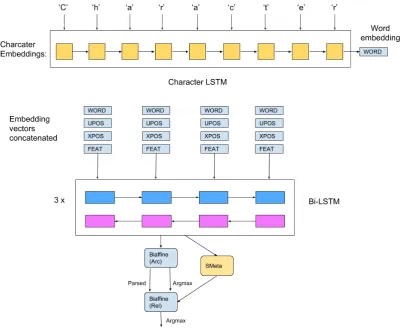
In this section, we depict important aspects of our architecture which is shown in Figure1. We dis-cuss encoder and decoder separately and then give the model hyper-parameters used.
3.1 Encoder
Word Model
We used four main features to represent each word in a sentence: a pre-trained word embedding, UPOS tag embedding, XPOS tag embedding and FEAT embedding.
Pre-trained words come from the language model in Kırnap et al. (2017). This model rep-resents each word using a character-level LSTM, which is a suitable setting for morphologically rich languages, as shown inDozat et al.(2017). We use the word vectors without further training.
UPOS and XPOS tag embeddings are repre-sented by vectors randomly initialized using unit Gaussian distribution.
Morphological features, also called FEATs, are different in the sense that there are zero or more FEATs for each word. We follow a simple strat-egy: we represent each FEAT using a randomly initialized vector and add all FEAT embeddings for each word. We simply used zero for word vec-tors without any morphological features.
For practical reasons, we also needed to repre-sent ROOT word of a repre-sentence. We do so by ran-domly initializing a word embedding and setting all other embeddings to zero.
At test time, we used tags and morphological features produced by MorphNet (Dayanık et al., 2018). For languages where this model is not available, we directly used UDPipe results (Straka et al.,2016).
Sentence Model
We used a three-layer bidirectional LSTM to rep-resent a sentence. We used the hidden size of 200 for both forward and backward LSTMs. Dropout (Srivastava et al.,2014) is performed at the input of each LSTM layer, including the first layer. Our LSTM simply usenth hidden state fornth word, different from the language model inKırnap et al. (2017).
Figure 1: Overall model architecture.
using various concatenation and addition strate-gies, but we observed poorer performance in terms of generalization. Also, using the language model directly as a feature extractor led to unsatisfactory performance, different from last years’ transition-based entry of our institution (Kırnap et al.,2017).
3.2 Decoder
Structured Meta-Biaffine Decoder (SMeta)
Deep biaffine decoder (Dozat and Manning,2016) is the core of last year’s winning entry (Dozat et al.,2017), so we used this module as our start-ing point. Biaffine architecture is computationally efficient and can be used with easy-to-train soft-max objective, different from harder-to-optimize hinge loss objectives as inKiperwasser and Gold-berg(2016).
Similar to (Dozat et al.,2017), we produce four different hidden vectors, two for arcs and two for relations (or labels). Formally
(1)
h(iarc−dep)=MLP(arc−dep)(hi)
(2)
h(iarc−head)=MLP(arc−head)(hi)
(3)
h(irel−dep)=MLP(rel−dep)(hi)
(4)
h(irel−head)=MLP(rel−head)(hi)
where hi represents ith hidden state of the
bi-LSTM embedding. The vectors correspond to arcs seeking their dependents, arcs seeking their heads, and corresponding relations. MLPcan be any neural network module. Here, we simply use dense layers followed by ReLU activations, as in (Dozat et al.,2017).
Now, we perform the biaffine transformation to compute the score matrix representing the graph,
(5)
s(iarc)=H(arc−head)W(arc)hi +H(arc−head)bT(arc)
where H(arc−head) represents matrix of
Up to this point, our decoder is identical to the one in (Dozat et al.,2017). The difference is in the computation of predicted arcs. We compute two different predictions:
(6) yi0l(arc)= arg max
j s
(arc)
ij
(7)
p=parse(S(arc))
(8) y
0s(arc)
i =pi
Here S(arc) is the matrix of arc scores and parse is a spanning tree algorithm that com-putes the indices of the predicted arcs. Now, we compute label scores using these two predictions. First, we compute coefficient vector k using the bi-RNN encodings,
(9)
h0 = Pn
i=1hi
n
(10)
k=W(meta)h0+b(meta)
where nis the number of words in the sentence, W andbare learned parameters. Averaging over time is inspired by the global average pooling op-erator in the vision literature (Lin et al., 2013), transforming temporal representation to a global one.
We now compute the weighted sum of label pre-dictions using coefficient vectork.
sli(rel)=hT(rel−head)
yi0l(arc) U
(rel)h(rel−dep)
i
+W(rel)cat(hi(rel−dep),h(rel−head)
yi0l(arc) ) +b(rel)
(11)
ssi(rel)=hT(rel−head)
y0is(arc) U
(rel)h(rel−dep)
i
+W(rel)cat(hi(rel−dep),h(rel−head)
yi0s(arc) ) +b(rel)
(12)
(13)
si(rel)=k1sil(rel)+k2ssi(rel)
(14) y0i(rel)= arg max
j s
(rel)
ij
whereU(rel),W(rel)andb(rel)are learned param-eters.
Our model is trained using sum of softmax losses similar to (Dozat et al.,2017).
Parsing algorithms
In our parsing model, Chu-Liu-Edmonds algo-rithm (Chu, 1965; Edmonds, 1967) and Eisner (1996)’s algorithm are used interchangeably, dur-ing both the traindur-ing of parser models and parsdur-ing phase of test datasets. On the languages whose training dataset consists of more than 250,000 words, Chu-Liu-Edmonds algorithm is used for parsing since it has a complexity ofO(n2), where nis the number of words.
This approach allows us to train our models on relatively larger datasets in less amount of time, compared to the Eisner’s algorithm whose time complexity isO(n3).
On training datasets having at most 250,000 words, Eisner’s algorithm is used during both training and parsing phase. Eisners algorithm produces only projective trees and Chu-Liu-Edmonds algorithm produces both projective and non-projective trees. This means the number of possible trees Eisner’s algorithm can gener-ate is fewer compared to Chu-Liu-Edmonds al-gorithm, so even though Eisner’s algorithm has higher time complexity than Chu-Liu-Edmonds algorithm, parsing models are trained faster when Eisner’s algorithm is used.
3.3 Hyperparameters
We used a 150-dimensional tag and feature em-beddings and 350-dimensional word emem-beddings for the word model. Bi-RNN sentence model has the hidden size of 200 for both forward and back-ward RNNs, producing 400-dimensional feature context vectors. We used the hidden size of 400 for arc MLPs and 100 for relation MLPs.
4 Training
We used Adam optimizer (Kingma and Ba,2014) with its standard parameters. Based on dataset size, we trained the model for 25 to 100 epochs and selected the model based on its validation la-beled attachment accuracy.
Dataset LAS MLAS BLEX Dataset LAS MLAS BLEX
ar padt 67.57% 56.22% 58.84% hu szeged 73.84% 56.03% 63.31%
bg btb 85.85% 76.28% 74.73% id gsd 76.88% 65.34% 64.89%
ca ancora 87.60% 79.05% 79.49% it isdt 87.51% 78.81% 78.75%
cs cac 86.05% 73.54% 80.14% it postwita 69.48% 56.20% 56.73%
cs fictree 84.21% 71% 76.86% ja modern 22.91% 8.47% 9.73%
cs pdt 86.07% 76.54% 81.39% ko gsd 75.52% 69.15% 63.18%
cs pud 81.80% 68.19% 75.10% ko kaist 81.64% 74.46% 68.86%
cu proiel 67.80% 56.51% 60.93% la ittb 77.66% 68.09% 73.91%
da ddt 77.90% 68.14% 68.64% la perseus 47.45% 29.99% 32.47%
de gsd 70.65% 34.50% 60.40% la proiel 64.29% 51.80% 58.05%
el gdt 83.65% 66.76% 70.14% lv lvtb 71.52% 57.26% 60.20%
en ewt 77.87% 68.57% 70.83% nl alpino 78.28% 63.38% 66.08%
en gum 75.51% 63.95% 63.52% nl lassysmall 78.10% 65.73% 66.77%
en lines 73.97% 65.15% 66.06% pl lfg 88.21% 75.40% 79.25%
en pud 81.31% 69.85% 73.18% pl sz 83.01% 65.10% 73.34%
es ancora 86.94% 79.14% 79.58% pt bosque 84.32% 70.27% 75.29%
et edt 77.45% 69.58% 66.05% ro rrt 82.74% 74.19% 74.60%
eu bdt 73.84% 60.49% 66.38% ru syntagrus 88.22% 80.16% 81.05%
fa seraji 81.74% 75.15% 71.93% ru taiga 40.01% 23.92% 25.44%
fi ftb 76.62% 66.28% 62.88% sk snk 77.81% 56.11% 62.23%
fi tdt 79.30% 71.07% 64.37% sl ssj 78.46% 64.93% 70.50%
fr gsd 82.32% 72.91% 74.97% sl sst 43.63% 31.14% 35.41%
fr sequoia 82.60% 73.07% 76.07% sv lines 74.87% 59.32% 67.25%
fr spoken 64.62% 53.15% 54.18% sv pud 71.66% 43.65% 55.60%
ga idt 35.84% 13.07% 16.77% sv talbanken 79.06% 70.55% 71.16%
gl ctg 80.31% 67.77% 70.72% tr imst 60.19% 49.57% 51.02%
got proiel 62.40% 49.19% 55.15% ug udt 58.48% 38.18% 45.94%
grc perseus 61.82% 34.17% 41.16% uk iu 75.93% 57.81% 64.84%
grc proiel 68.03% 49.40% 55.62% ur udtb 78.41% 51.28% 64.94%
he htb 60.09% 46.32% 49.19% vi vtb 41.27% 34.73% 36.95%
hi hdtb 87.66% 70% 80.47% zh gsd 59.51% 49.33% 54.33%
[image:5.595.95.503.166.631.2]hr set 80.86% 60.65% 72.36%
We saved best models with corresponding con-figurations, scores and optimization states during training for recovery. We then re-create the model files for the best models of each corpus by remov-ing the optimization states.
MorphNet is the morphological analysis and disambiguation tool proposed by Dayanık et al. (2018), which we used while training our pars-ing model. Durpars-ing trainpars-ing of the parser, CoNLL-U formatted training dataset files, which are pro-duced by UDPipe (Straka et al., 2016), are given to MorphNet as input. Then, MorphNet applies its own morphological analysis and disambigua-tion, and new CoNLL-U formatted files produced by MorphNet are used by our parser.
Even though we used lemmatized and tagged outputs generated by MorphNet while training our parser, we run our parser on outputs generated by UDPipe, due to time constrains during parsing.
5 Results and Discussion
Short after the testing period ended, our parser ob-tained results on 64 treebank test sets out of 82, which are shown in Table1. According to the re-sults announced including the unofficial runs, we had an average LAS score of 57% on the 64 test sets on which our model is run and ranked 24th among the best runs of 27 teams. The MLAS score of our model is 46.40% and our model is ranked 22nd out of the submissions of 27 models. And, the BLEX score of our model is 49.17% and our model is ranked 21st out of the best BLEX results of all 27 models including unofficial runs.1
According to the results, our model performs better at datasets with comparably larger training data. For instance, our model has around 90% LAS score on Catalan, Indian, Italian, Polish and Russian languages which have higher number of tokens in training data. Furthermore, our model performs relatively well in some low-resource lan-guages like Turkish and Hungarian. However, on the datasets with very small or no training data, such as Japanese Modern, Russian Taiga and Irish IDT, we get lower scores. Hence, our model bene-fits from large amount of data during training pro-cess, but prediction with low resources remains as an issue for our model.
1
Best results of each team including unofficial runs are
an-nounced in http://universaldependencies.org/conll18/
results-best-all.htmlOur results and rankings announced in the paper are taken from the CoNLL 2018 best results webpage in September 2, 2018 and may change with the inclusion of new results of participated teams later.
6 Contributions
In this work, we proposed a new decoding mecha-nism, called SMeta, for graph-based neural depen-dency parsing. This architecture attempts to com-bine structured and unstructured prediction meth-ods using meta-learning. We coupled this archi-tecture with custom training methods and algo-rithms to evaluate its performance.
Acknowledgments
This work was supported by the Scientific and Technological Research Council of Turkey (T ¨UB˙ITAK) grants 114E628 and 215E201. Spe-cial thanks to ¨Omer Kırnap and Erenay Dayanık for sharing their experiences with us.
References
Jeff Bezanson, Alan Edelman, Stefan Karpinski, and Viral B Shah. 2017. Julia: A fresh approach to nu-merical computing. SIAM review59(1):65–98.
Bernd Bohnet, Ryan McDonald, Goncalo Simoes, Daniel Andor, Emily Pitler, and Joshua Maynez. 2018. Morphosyntactic tagging with a meta-bilstm model over context sensitive token encodings. arXiv preprint arXiv:1805.08237.
Yoeng-Jin Chu. 1965. On the shortest arborescence of a directed graph. Scientia Sinica14:1396–1400.
Erenay Dayanık, Ekin Aky¨urek, and Deniz Yuret. 2018. Morphnet: A sequence-to-sequence model that combines morphological analysis and disam-biguation. arXiv preprint arXiv:1805.07946.
Timothy Dozat and Christopher D Manning. 2016. Deep biaffine attention for neural dependency pars-ing.arXiv preprint arXiv:1611.01734.
Timothy Dozat, Peng Qi, and Christopher D Manning. 2017. Stanford’s graph-based neural dependency parser at the conll 2017 shared task. Proceedings of the CoNLL 2017 Shared Task: Multilingual Pars-ing from Raw Text to Universal Dependenciespages 20–30.
Jack Edmonds. 1967. Optimum branchings. Journal of Research of the national Bureau of Standards B 71(4):233–240.
Jason M Eisner. 1996. Three new probabilistic models for dependency parsing: An exploration. In Pro-ceedings of the 16th conference on Computational linguistics-Volume 1. Association for Computational Linguistics, pages 340–345.
Eliyahu Kiperwasser and Yoav Goldberg. 2016. Sim-ple and accurate dependency parsing using
bidi-rectional LSTM feature representations. CoRR
abs/1603.04351. http://arxiv.org/abs/1603.04351.
¨
Omer Kırnap, Berkay Furkan ¨Onder, and Deniz Yuret. 2017. Parsing with context embeddings. Proceed-ings of the CoNLL 2017 Shared Task: Multilingual Parsing from Raw Text to Universal Dependencies pages 80–87.
Min Lin, Qiang Chen, and Shuicheng Yan. 2013. Net-work in netNet-work. arXiv preprint arXiv:1312.4400 .
Ryan McDonald, Fernando Pereira, Kiril Ribarov, and Jan Hajiˇc. 2005. Non-projective dependency pars-ing uspars-ing spannpars-ing tree algorithms. InProceedings of the conference on Human Language Technology and Empirical Methods in Natural Language Pro-cessing. Association for Computational Linguistics, pages 523–530.
Joakim Nivre, Marie-Catherine de Marneffe, Filip Gin-ter, Yoav Goldberg, Jan Hajiˇc, Christopher Man-ning, Ryan McDonald, Slav Petrov, Sampo Pyysalo, Natalia Silveira, Reut Tsarfaty, and Daniel Zeman. 2016. Universal Dependencies v1: A multilingual treebank collection. InProceedings of the 10th In-ternational Conference on Language Resources and Evaluation (LREC 2016). European Language Re-sources Association, Portoro, Slovenia, pages 1659– 1666.
Joakim Nivre and Chiao-Ting Fang. 2017. Univer-sal dependency evaluation. In Proceedings of the NoDaLiDa 2017 Workshop on Universal Dependen-cies (UDW 2017). pages 86–95.
Joakim Nivre et al. 2018. Universal Dependencies 2.2. LINDAT/CLARIN digital library at the Insti-tute of Formal and Applied Linguistics, Charles Uni-versity, Prague, http://hdl.handle.net/ 11234/SUPPLYTHENEWPERMANENTIDHERE!
Martin Potthast, Tim Gollub, Francisco Rangel, Paolo Rosso, Efstathios Stamatatos, and Benno Stein. 2014. Improving the reproducibility of PAN’s shared tasks: Plagiarism detection, author
iden-tification, and author profiling. In Evangelos
Kanoulas, Mihai Lupu, Paul Clough, Mark Sander-son, Mark Hall, Allan Hanbury, and Elaine Toms, editors, Information Access Evaluation meets Mul-tilinguality, Multimodality, and Visualization. 5th International Conference of the CLEF Initiative (CLEF 14). Springer, Berlin Heidelberg New York, pages 268–299. https://doi.org/10.1007/978-3-319-11382-1 22.
Nitish Srivastava, Geoffrey Hinton, Alex Krizhevsky, Ilya Sutskever, and Ruslan Salakhutdinov. 2014. Dropout: a simple way to prevent neural networks from overfitting. The Journal of Machine Learning Research15(1):1929–1958.
Milan Straka, Jan Hajiˇc, and Jana Strakov´a. 2016. UD-Pipe: trainable pipeline for processing CoNLL-U files performing tokenization, morphological anal-ysis, POS tagging and parsing. In Proceedings of the 10th International Conference on Language Resources and Evaluation (LREC 2016). European Language Resources Association, Portoro, Slovenia.
Deniz Yuret. 2016. Knet: beginning deep learning with 100 lines of julia. In Machine Learning Systems Workshop at NIPS 2016.
Daniel Zeman, Jan Hajiˇc, Martin Popel, Martin Pot-thast, Milan Straka, Filip Ginter, Joakim Nivre, and Slav Petrov. 2018. CoNLL 2018 Shared Task: Mul-tilingual Parsing from Raw Text to Universal De-pendencies. In Proceedings of the CoNLL 2018 Shared Task: Multilingual Parsing from Raw Text to Universal Dependencies. Association for Computa-tional Linguistics, Brussels, Belgium, pages 1–20.