Shallow Discourse Parsing Using Convolutional Neural Network
Lianhui Qin1,2, Zhisong Zhang1,2, Hai Zhao1,2,∗ 1Department of Computer Science and Engineering, Shanghai Jiao Tong University, Shanghai, 200240, China
2Key Laboratory of Shanghai Education Commission for Intelligent Interaction and Cognitive Engineering, Shanghai Jiao Tong University, Shanghai, 200240, China
{qinlianhui, zzs2011}@sjtu.edu.cn,[email protected]
Abstract
This paper describes a discourse parsing system for our participation in the CoNLL 2016 Shared Task. We focus on the sup-plementary task: Sense Classification, es-pecially the Non-Explicit one which is the bottleneck of discourse parsing system. To improve Non-Explicit sense classifica-tion, we propose a Convolutional Neural Network (CNN) model to determine the senses for both English and Chinese tasks. We also explore a traditional linear model with novel dependency features for Ex-plicit sense classification. Compared with the best system in CoNLL-2015, our sys-tem achieves competitive performances. Moreover, as shown in the results, our sys-tem has higher F1 score on Non-Explicit sense classification.
1 Introduction
This paper presents the Shanghai Jiao Tong Uni-versity discourse parsing system for the CoNLL 2016 Shared Task (Xue et al., 2016) on Shallow Discourse Parsing and the supplementary tasks of sense classification for English and Chinese.
As shown by the results of the same task in CoNLL 2015 (Xue et al., 2015), sense classifica-tion has been found more difficult than other sub-tasks, especially determining Non-Explicit senses which is the bottleneck of the end-to-end discourse ∗Corresponding author. This paper was partially sup-ported by Cai Yuanpei Program (CSC No. 201304490199 and No. 201304490171), National Natural Science Founda-tion of China (No. 61170114 and No. 61272248), NaFounda-tional Basic Research Program of China (No. 2013CB329401), Major Basic Research Program of Shanghai Science and Technology Committee (No. 15JC1400103), Art and Sci-ence Interdisciplinary Funds of Shanghai Jiao Tong Univer-sity (No. 14JCRZ04), and Key Project of National Society Science Foundation of China (No. 15-ZDA041).
parsing system. Without the discourse connec-tives which provide strong indications, the Non-Explicit relations between adjacent sentences are difficult to figure out. Therefore, our primary work is to improve sense classification components, es-pecially on Non-Explicit relations. For other com-ponents such as connectives detection and argu-ments extraction, we just follow the top ranked system (Wang and Lan, 2015) in CoNLL-2015, which is as the baseline system in this paper.
In CoNLL-2015, various approaches were ex-plored to conquer the sense classification problem, which is a straightforward multi-category classi-fication task (Okita et al., 2015; Wang and Lan, 2015; Chiarcos and Schenk, 2015; Song et al., 2015; Stepanov et al., 2015; Yoshida et al., 2015; Sun et al., 2015; Nguyen et al., 2015; Laali et al., 2015). Typical data-driven machine learn-ing methods, like Maximum Entropy and Support Vector Machine, were adopted. Some of them se-lected lexical and syntactic features over the ar-guments, including linguistically motivated word groupings such as Levin verb classes and polarity tags. Brown cluster features, surface features and entity semantics were also effective to enhance sense classification. Additionally, paragraph em-beddings were also used to determine the senses (Okita et al., 2015). In other previous work of im-plicit sense classification, Chen et al (2015) used word-pair features for predicting missing connec-tives, Zhou et al. (2010) attempted to insert dis-course connectives between arguments with the use of a language model, Lin et al. (2009) applied various feature selection methods. Although tra-ditional methods have performed well on seman-tic tasks through feature engineering (Zhao et al., 2009a; Zhao et al., 2009b; Zhao et al., 2013), they still suffer from data sparsity problems.
Recently, Neural Network (NN) methods have shown competitive or even better performance
than traditional linear models with hand-crafted sparse features for some Nature Language Pro-cess (NLP) tasks (Wang et al., 2013; Wang et al., 2014; Cai and Zhao, 2016; Wang et al., 2016; Zhang and Zhao, 2016), such as sentence mod-eling (Kalchbrenner et al., 2014; Kim, 2014). In Non-Explicit sense classification, due to the ab-sence of discourse connectives, the task is exactly to classify a sentence pair, where CNN could be utilized.
For Explicit sense classification which has strong discourse relation information provided by the connectives, we will use traditional linear methods with novel dependency features.
The rest of the paper is organized as follows: Section 2 briefly describes our system, Section 3 introduces the CNN model for modeling sentence pairs, Section 4 discusses our main works includ-ing Explicit sense classification and Non-Explicit sense classification, Section 5 shows our experi-ments on sense classification and Section 6 reports our results on the final official evaluation. Section 7 concludes this paper.
2 System Overview
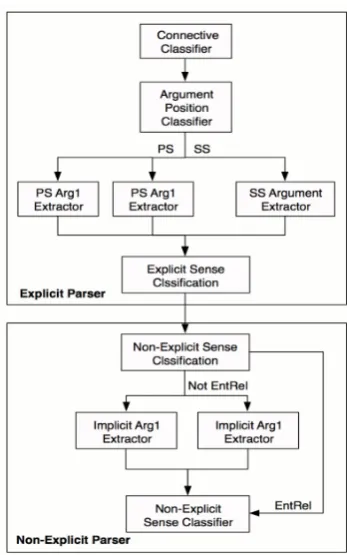
[image:2.595.328.502.61.339.2]Our parsing system uses the sequential pipeline following by (Lin et al., 2014; Wang and Lan, 2015). Figure 1 shows the system pipeline. The system can be roughly split into two parts: the Ex-plicit parser and the Non-ExEx-plicit parser. We will give a brief introduction for every components. The overall parser starts from detecting discourse connectives for the Explicit Parser. Then the types of relative location of Argument1 (Arg1) and Ar-gument2 (Arg2) are identified: Arg1 located in the exact previous sentence of Arg2 (noted as PS) or both arguments are within the same sentence (noted as SS). For the last part of Explicit parser, the tuples (Arg1, Connective, Arg2) are classi-fied into one of the Explicit relation senses. For the Non-Explicit parser, it classifies the senses of Non-Explicit with original arguments and then ex-tracts the arguments of the argument pairs. Fi-nally, the senses of Non-Explicit argument pairs are again decided with refined arguments. Among all subtasks, we will focus on sense classification the other parts have been done relatively well in previous work.
Figure 1: System pipeline for the discourse parser
3 Convolutional Neural Network
Each sentence could obtain a sentence vector through CNN and the final classification is based on the transformations of the sentence vectors. Al-though both Explicit and Non-Explicit tasks could utilize the neural model, CNN might be more ap-posite for the Non-Explicit one because of lacking indicating connectives.
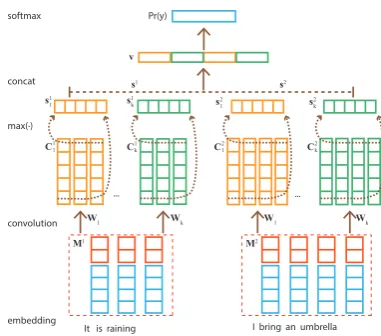
The architecture of our CNN model, is illus-trated in Figure 2. Firstly, a look-up table is uti-lized to fetch the embeddings of words and part-of-speech (POS) tags, forming two sentence em-beddings which will be the input of the convo-lutional layer. Through the convolution and max pooling operations, two sentence vectors are ob-tained. Finally, these vectors will be sent to the final softmax layer after concatenated.
Embedding For a sentence S=w1w2. . .wn and POS sequenceP=p1p2. . .pn, the sentence embedding M is formed through projection and concatenating. Following the jargons in the task, the input sentences will be called “Arguments” and the two arguments are represented as follows:
M1= [w1
1⊕p11;w12⊕p21;. . .;wn1 ⊕p1n]
Here wij ∈ Rdw is the word vector
correspond-ing to the i-th word in the j-th argument, and
pji ∈ Rdp is the POS vector for wj
i, where dw and dp respectively stand for the dimensions of word and POS vectors. ⊕ and ; are the concate-nation operators on different dimensions. Consid-ering the efficiency, we specialize a max sentence length for both arguments, and apply truncating or zero-padding when needed.
Convolutional layer Filter matrices [W1, W2, . . . ,Wk] with several variable sizes [l1, l2, . . . , lk] are utilized to perform the convolution opera-tions for the sentence embeddings. Via parameter sharing, this feature extraction procedure become same for both arguments. For the sake of sim-plicity, ignoring the superscripts, we will explain the procedure for only one argument. The sen-tence embedding will be transformed to sequences
Cj(j∈[1, k]):
Cj = [. . .; tanh(Wj·M[i:i+lj−1]+bj);. . .]
Here,[i:i+lj−1]indexes the convolution win-dow. Additionally, We apply wide convolution op-eration between embedding layer and filter matri-ces, because it ensures that all weights in the fil-ters reach the entire sentence, including the words at the margins.
Max Pooling A one-max-pooling operation is adopted after convolution and the sentence vector
s is obtained through concatenating all the map-pings for thosekfilters.
s= [s1⊕ · · · ⊕sj ⊕ · · · ⊕sk]
sj =max(Cj)
In this way, the model can capture the most impor-tant features in the sentence with different filters.
Concatenating and Softmax Now adding the superscripts and considering the two arguments (s1, s2), they are concatenated to form the argument-pair representation vectorvas below:
v=s1⊕s2
For the final labeling decision, a softmax layer will be applied using the argument-pair vectorv.
concat
max(·)
convolution
embedding
It is raining I bring an umbrella
W1 v
M1
s1 s2
M2 W1
Wk Wk
··· ···
softmax Pr(y)
C11
sk1 s12
s11 sk2
[image:3.595.317.508.82.250.2]Ck1 C12 Ck2
Figure 2: Our neural model for sentence classifi-cation.
Training The training objectJwill be the cross-entropy errorEwithL2regularization:
E(ˆy, y) =−
l X
j
yj×log(P r(ˆyj))
J(θ) = 1 m
m X
k
E(ˆy(k), y(k)) + λ 2 kθk2
whereyj is the gold label andyˆj is the predicted one. For the optimization process, we apply the diagonal variant of AdaGrad (Duchi et al., 2011) with mini-batches.
4 Sense Classification
Now we will discuss about the sense classification task. Both the Explicit and Non-Explicit labeling are typical classification tasks with the argument-pair as the input and the CNN model could be ap-plied to both of them. However, the Explicit task provides the connectives which are the crucial in-dicators and we find that CNN performs slightly poorly on this task even if embeddings for indica-tors are concatenated. Thus, for the Explicit task, we will adopt the traditional linear model consid-ering only the features related with the indicators and CNN model will be applied to the more diffi-cult Non-Explicit task.
4.1 Explicit Sense Classification
data set baseline C+C POS add C-HP
English 90.14 91.35 92.11
[image:4.595.349.488.62.159.2]Chinese - 96.15 97.43
Table 1: Explicit Sense Classification on English and Chinese development sets without error prop-agation.
data set baseline CNN model
English 42.92 45.50
[image:4.595.78.288.62.106.2]Chinese - 71.57
Table 2: Non-Explicit Sense Classification on En-glish and Chinese development sets without error propagation.
feature, as connectives are ambiguous as pointed out in Pitler et al. (2008), and the majority of the ambiguous connectives is highly skewed toward certain senses (Lin et al., 2014). Thus, the task is in fact to disambiguate the connective under dif-ferent contexts.
Although the provided context contains the two whole arguments, the most crucial indicators are still the words that near the connectives or the ones that have close syntactic dependency rela-tions with the connectives. This might explain why plain CNN model performs poorly on this task without these key features.
Thus, for the Explicit task, we will adopt the tra-ditional method, using Support Vector Machines (SVM) with linear kernel and manually selected features. We consider only three features which are all related to Connective C: (1) C string (2) C POS (3) C string combined with POS of C’s parent node in dependency tree (noted as C-HP).
We will use an example in the Chinese task to explain the influence of the third feature which utilizes the dependency tree.
(1) 男选手的成绩是近10年来最差的一
次,说明水平在下降[Arg1] 而[Connective] 罗罗罗 莉
莉
莉、、、乔乔乔娅娅娅和和和莫莫莫惠惠惠兰兰兰333名名名女女女选选选手手手都都都是是是第第第一一一次次次参参参 加
加
加世世世界界界大大大赛赛赛,,,均均均表表表现现现不不不错错错。。。[Arg2]
(Contrast - CHTB 0310)
In Chinese, ‘而’ is a connective with ambigu-ity relations of‘Contrast’and‘Conjunction’. Be-cause ‘Conjunction’ accounts for a large part of these instances, the classifier will tend to predict ‘而’ as‘Conjunction’if just using connective fea-tures. Like in this example, the sense of the
in-filter-size on original Args
(2,3,3) 38.45
(2,4,5) 38.86
(2,6,12) 38.45
(3,3,3) 39.40
(4,8,12) 40.08
(6,8,18) 38.99
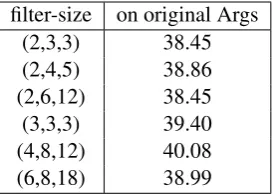
Table 3: F1 scores (%) with different CNN filter sizes for Non-Explicit on originalarguments on development set.
filter-size on refined Args
(1,2,3) 45.11
(2,3,4) 44.18
(2,5,10) 44.97
(2,8,16) 43.25
(3,3,3) 45.50
(3,5,9) 43.92
Table 4: F1 scores (%) with different CNN filter sizes for Explicit onrefinedarguments on devel-opment set.
stance is‘Contrast’but is predicted as ‘Conjunc-tion’if considering only the connective itself. But if we add the third feature, which means the com-bination feature ‘而-VC’ will be added (C is ‘而’ and POS of C’s parent node is ‘VC’), the classifier will correctly decide the right sense.
4.2 Non-Explicit Sense Classification
The situations for the Non-Explicit task are quite different. Without the information of connectives, we have to extract the discourse relations through the two arguments, which might need semantic comprehensions sometimes. This might be hard for traditional methods because it is not easy to ex-tract hand-craft features. The neural models which can automatically extract features may be another solution.
We apply the CNN model described in Section 3 for this task. To simplify model building and pa-rameter tuning, and also due to the similar archi-tectures, the model structures for sense classifica-tion components in English and Chinese are iden-tical.
5 Experiments
[image:4.595.350.485.217.316.2]Components baseline WSJ Test our parser
P R F P R F
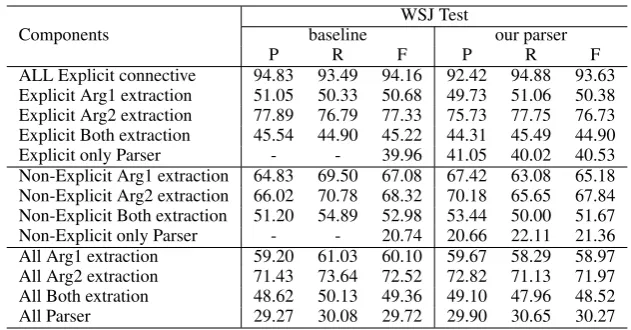
[image:5.595.140.456.60.225.2]ALL Explicit connective 94.83 93.49 94.16 92.42 94.88 93.63 Explicit Arg1 extraction 51.05 50.33 50.68 49.73 51.06 50.38 Explicit Arg2 extraction 77.89 76.79 77.33 75.73 77.75 76.73 Explicit Both extraction 45.54 44.90 45.22 44.31 45.49 44.90 Explicit only Parser - - 39.96 41.05 40.02 40.53 Non-Explicit Arg1 extraction 64.83 69.50 67.08 67.42 63.08 65.18 Non-Explicit Arg2 extraction 66.02 70.78 68.32 70.18 65.65 67.84 Non-Explicit Both extraction 51.20 54.89 52.98 53.44 50.00 51.67 Non-Explicit only Parser - - 20.74 20.66 22.11 21.36 All Arg1 extraction 59.20 61.03 60.10 59.67 58.29 58.97 All Arg2 extraction 71.43 73.64 72.52 72.82 71.13 71.97 All Both extration 48.62 50.13 49.36 49.10 47.96 48.52 All Parser 29.27 30.08 29.72 29.90 30.65 30.27 Table 5: Results of the Shallow Discourse Parsing task on English WSJ test set.
Components baseline Blind Test our parser
P R F P R F
ALL Explicit connective 93.48 90.29 91.86 88.67 93.73 91.13 Explicit Arg1 extraction 49.16 47.48 48.31 47.12 49.81 48.43 Explicit Arg2 extraction 75.61 73.02 74.29 71.58 75.56 73.57 Explicit Both extraction 42.09 40.65 41.35 40.29 42.59 41.40 Explicit only Parser - - 30.38 32.57 30.76 31.64 Non-Explicit Arg1 extraction 58.66 63.25 60.87 64.01 59.38 61.61 Non-Explicit Arg2 extraction 71.88 77.49 74.58 80.86 75.00 77.82 Non-Explicit Both extraction 48.58 52.37 50.41 55.44 51.42 53.35 Non-Explicit only Parser - - 18.87 18.32 19.75 19.01 All Arg1 extraction 55.12 56.58 55.84 56.91 55.93 56.42 All Arg2 extraction 73.49 75.43 74.45 76.59 75.28 75.93 All Both extration 45.77 46.98 46.37 48.47 47.64 48.05 All Parser 23.69 24.32 24.00 24.41 24.81 24.61 Table 6: Results of the Shallow Discourse Parsing task on English Blind test set.
sets for the shared task: Section 23 of the PDTB, and a blind test prepared especially for this task. We participate in the closed track, so only two resources (Brown Clusters and MPQA Subjectiv-ity Lexicon) are used. test platform of CoNLL-2016 still adopts still the TIRA evaluation plat-form (Potthast et al., 2014).
Non-Explicit relations contains three types: Im-plicit, EntRel and AltLex. Originally EntRel is not treated as discourse relation in Penn Discourse TreeBank (PDTB) (Prasad et al., 2008), but this category has been included in this task and we also count it as one sense. Some instances are anno-tated with two senses, so the predicted sense for a relation must match one of the two senses if there is more than one sense. We compare with the best system in the competition of CoNLL 2015 (Wang and Lan, 2015), which is regarded as the baseline.
5.1 Explicit Sense Classification
Table 1 reports our results of the Explicit sense classifier on both English and Chinese
develop-ment sets. Compared with the baseline, our meth-ods obtain progress and the overall F1 score of Ex-plicit Sense classification increases by 1.97% for English task.
For both English and Chinese sense classifica-tion, the C string and C POS features can clas-sify most of the relations correctly. Moreover, the new combination feature based on dependency re-lations helps effectively disambiguate senses.
5.2 Non-Explicit Sense Classification
components P WSJ TestR F P En Blind TestR F P CTB TestR F P CH Blind TestR F Explicit Sense Classification 89.59 89.59 89.59 75.95 75.54 75.74 93.68 92.71 93.19 75.82 73.67 74.73 Non-Explicit Sense Classification 38.20 38.20 38.20 35.38 35.38 35.38 67.41 67.41 67.41 56.35 56.35 56.35 All Parser 62.69 62.69 62.69 53.94 53.85 53.89 72.91 72.75 72.83 61.02 61.02 61.02
Table 7: Results of the supplementary task on English and Chinese.
On Original Arguments The input for this classifier will be two adjacent sentences without Explicit discourse relations. The maximum input length for both sentences is set to 80, the dimen-sions for word embeddings and POS embeddings are 300 and 50 respectively. The word embeddings are initialized with pre-trained word vectors using word2vec1 (Mikolov et al., 2013) and other
pa-rameters are randomly initialized including POS embeddings. We employ three categories of CNN filters, and choose 512 as the number of feature maps. About the filter region sizes, Zhang and Wallace (2015) have concluded that each dataset has its own optimal range. We set the three filter sizes to 4,8,12 separately according to the empiri-cal results in Table 3.
On Refined Arguments This module is sim-ilar to the above one but with some differences. The input will be the refined arguments and corre-spondingly, golden argument pairs are utilized for training. Thus, we adopt slightly different hyper-parameters. The number of feature maps for each filter categories is set to 1024, and the final filter region sizes are 3,3,3 accordingly to the empirical results in Table 4. For the choice of filter region sizes, we have attempted a lot of combinations, but only the best ones are shown.
Results of classification The trained model on refined arguments could be directly utilized for part of Non-Explicit sense classification in the supplementary task and Table 2 reports the results on English and Chinese development sets. Com-pared to the Explicit task, the Non-Explicit task is indeed much more difficult. Using CNN, we achieve an improvement of 2.58% compared to the baseline. This result fully illustrates that CNN model is suitable to determine the Non-Explicit re-lations.
6 Results
We report our official results and comparisons on Shallow Discourse Parsing task on English and the
1http://www.code.google.com/p/word2vec
supplementary tasks of sense classification on En-glish and Chinese.
Table 5 and 6 show the performance on two test sets for English: i) (Official) Blind test set; ii) Standard WSJ test set. Our parsers give higher F1 scores than baselines: 0.55% higher on WSJ test set and 0.61% on Blind Test set, though our Ex-plicit connective detection F1 is less than theirs at the beginning of the pipeline, which might intro-duce more error propagations. This might suggest that our sense classifiers play key roles in the sys-tem.
To see the performances of the sense classi-fiers, Table 7 shows the results for English and Chinese supplementary tasks (sense classifications on golden argument pairs without errors propaga-tion). For Explicit sense classification, the features we proposed are proved to be effective. For Non-Explicit sense classification, our CNN model also works well on the test sets. Compared to the per-formance of discourse parsing sense classification components (with error propagation), the subtask results are higher. The reasons include: i) Con-nective detection serves as the first component of the pipeline and plays an important role, because it has a major influence on Explicit sense classi-fication which relies heavily on discourse connec-tives. ii) Arguments extraction also have important effects on the classifications for both Explicit and Non-Explicit relations.
7 Conclusions
References
Deng Cai and Hai Zhao. 2016. Neural word segmen-tation learning for Chinese. InProceedings of ACL, Berlin, Germany, August.
Changge Chen, Peilu Wang, and Hai Zhao. 2015. Shallow discourse parsing using constituent pars-ing tree. InProceedings of the Nineteenth Confer-ence on Computational Natural Language Learning - Shared Task, pages 37–41, Beijing, China, July. Association for Computational Linguistics.
Christian Chiarcos and Niko Schenk. 2015. A min-imalist approach to shallow discourse parsing and implicit relation recognition. InProceedings of the Nineteenth Conference on Computational Natural Language Learning - Shared Task, pages 42–49, Beijing, China, July. Association for Computational Linguistics.
John Duchi, Elad Hazan, and Yoram Singer. 2011. Adaptive subgradient methods for online learning and stochastic optimization. The Journal of Ma-chine Learning Research, 12:2121–2159.
Nal Kalchbrenner, Edward Grefenstette, and Phil Blunsom. 2014. A convolutional neural net-work for modelling sentences. arXiv preprint arXiv:1404.2188.
Yoon Kim. 2014. Convolutional neural net-works for sentence classification. arXiv preprint arXiv:1408.5882.
Majid Laali, Elnaz Davoodi, and Leila Kosseim. 2015. The clac discourse parser at CoNLL-2015. In Pro-ceedings of the Nineteenth Conference on Compu-tational Natural Language Learning - Shared Task, pages 56–60, Beijing, China, July. Association for Computational Linguistics.
Ziheng Lin, Min-Yen Kan, and Hwee Tou Ng. 2009. Recognizing implicit discourse relations in the penn discourse treebank. InProceedings of the 2009 Con-ference on Empirical Methods in Natural Language Processing: Volume 1-Volume 1, pages 343–351. Association for Computational Linguistics.
Ziheng Lin, Hwee Tou Ng, and Min-Yen Kan. 2014. A pdtb-styled end-to-end discourse parser. Natural Language Engineering, 20(02):151–184.
Tomas Mikolov, Ilya Sutskever, Kai Chen, Greg S Cor-rado, and Jeff Dean. 2013. Distributed representa-tions of words and phrases and their compositional-ity. InAdvances in neural information processing systems, pages 3111–3119.
Son Nguyen, Quoc Ho, and Minh Nguyen. 2015. Jaist: A two-phase machine learning approach for identi-fying discourse relations in newswire texts. In Pro-ceedings of the Nineteenth Conference on Compu-tational Natural Language Learning - Shared Task, pages 66–70, Beijing, China, July. Association for Computational Linguistics.
Tsuyoshi Okita, Longyue Wang, and Qun Liu. 2015. The dcu discourse parser: A sense classification task. In Proceedings of the Nineteenth Confer-ence on Computational Natural Language Learning - Shared Task, pages 71–77, Beijing, China, July. Association for Computational Linguistics.
Emily Pitler, Mridhula Raghupathy, Hena Mehta, Ani Nenkova, Alan Lee, and Aravind K Joshi. 2008. Easily identifiable discourse relations.
Martin Potthast, Tim Gollub, Francisco Rangel, Paolo Rosso, Efstathios Stamatatos, and Benno Stein. 2014. Improving the Reproducibility of PAN’s Shared Tasks: Plagiarism Detection, Author Iden-tification, and Author Profiling. In Evangelos Kanoulas, Mihai Lupu, Paul Clough, Mark Sander-son, Mark Hall, Allan Hanbury, and Elaine Toms, editors, Information Access Evaluation meets Mul-tilinguality, Multimodality, and Visualization. 5th International Conference of the CLEF Initiative (CLEF 14), pages 268–299, Berlin Heidelberg New York, September. Springer.
Rashmi Prasad, Nikhil Dinesh, Alan Lee, Eleni Milt-sakaki, Livio Robaldo, Aravind K Joshi, and Bon-nie L Webber. 2008. The penn discourse treebank 2.0. InLREC. Citeseer.
Yangqiu Song, Haoruo Peng, Parisa Kordjamshidi, Mark Sammons, and Dan Roth. 2015. Improv-ing a pipeline architecture for shallow discourse parsing. In Proceedings of the Nineteenth Confer-ence on Computational Natural Language Learning - Shared Task, pages 78–83, Beijing, China, July. Association for Computational Linguistics.
Evgeny Stepanov, Giuseppe Riccardi, and Ali Orkan Bayer. 2015. The unitn discourse parser in CoNLL 2015 shared task: Token-level sequence labeling with argument-specific models. In Proceedings of the Nineteenth Conference on Computational Natu-ral Language Learning - Shared Task, pages 25–31, Beijing, China, July. Association for Computational Linguistics.
Jia Sun, Peijia Li, Weiqun Xu, and Yonghong Yan. 2015. A shallow discourse parsing system based on maximum entropy model. In Proceedings of the Nineteenth Conference on Computational Natu-ral Language Learning - Shared Task, pages 84–88, Beijing, China, July. Association for Computational Linguistics.
Jianxiang Wang and Man Lan. 2015. A refined end-to-end discourse parser. InProceedings of the Nine-teenth Conference on Computational Natural Lan-guage Learning - Shared Task, pages 17–24, Bei-jing, China, July. Association for Computational Linguistics.
InProceedings of EMNLP, pages 845–850, Seattle, Washington, USA, October.
Rui Wang, Hai Zhao, Bao-Liang Lu, Masao Utiyama, and Eiichiro Sumita. 2014. Neural network based bilingual language model growing for statistical ma-chine translation. InProceedings of EMNLP, pages 189–195, Doha, Qatar, October.
Peilu Wang, Yao Qian, Frank Soong, Lei He, and Hai Zhao. 2016. Learning distributed word representa-tions for bidirectional lstm recurrent neural network. InProceedings of NAACL, June.
Nianwen Xue, Hwee Tou Ng, Sameer Pradhan, Rashmi PrasadO Christopher Bryant, and Attapol T Ruther-ford. 2015. The CoNLL-2015 shared task on shal-low discourse parsing. In Proceedings of CoNLL, page 2.
Nianwen Xue, Hwee Tou Ng, Sameer Pradhan, Bon-nie Webber, Attapol Rutherford, Chuan Wang, and Hongmin Wang. 2016. The CoNLL-2016 shared task on multilingual shallow discourse parsing. In
Proceedings of the Twentieth Conference on Compu-tational Natural Language Learning - Shared Task, Berlin, Germany, August. Association for Computa-tional Linguistics.
Yasuhisa Yoshida, Katsuhiko Hayashi, Tsutomu Hirao, and Masaaki Nagata. 2015. Hybrid approach to pdtb-styled discourse parsing for CoNLL-2015. In
Proceedings of the Nineteenth Conference on Com-putational Natural Language Learning - Shared Task, pages 95–99, Beijing, China, July. Association for Computational Linguistics.
Ye Zhang and Byron Wallace. 2015. A sensitiv-ity analysis of (and practitioners’ guide to) convo-lutional neural networks for sentence classification.
arXiv preprint arXiv:1510.03820.
Zhisong Zhang and Hai Zhao. 2016. Probabilistic graph-based dependency parsing with convolutional neural network. InProceedings of ACL, Berlin, Ger-many, August.
Hai Zhao, Wenliang Chen, and Chunyu Kit. 2009a. Semantic dependency parsing of NomBank and PropBank: An efficient integrated approach via a large-scale feature selection. In Proceedings of EMNLP, pages 30–39, Singapore, August.
Hai Zhao, Wenliang Chen, Chunyu Kity, and Guodong Zhou. 2009b. Multilingual dependency learning: A huge feature engineering method to semantic de-pendency parsing. InProceedings of CoNLL, pages 55–60, Boulder, Colorado, June.
Hai Zhao, Xiaotian Zhang, and Chunyu Kit. 2013. In-tegrative semantic dependency parsing via efficient large-scale feature selection. Journal of Artificial Intelligence Research, 46:203–233.