Experiments on Morphological Reinflection: CoNLL 2018 Shared Task
Rishabh Jain IIT (BHU), Varanasi, India [email protected]
Anil Kumar Singh IIT (BHU), Varanasi, India
Abstract
We present a system for the task of logical inflection, i.e., finding a target morpho-logical form, given a lemma and a set of tar-get tags. System is trained on datasets of three sizes: low, medium and high. The system uses a simple Long Short-Term Memory (LSTM) based encoder-decoder based model. The per-formance for low size dataset is poor in general while it improves significantly for medium and high sized training dataset. The average per-formance over all languages is poor as pared to baseline for low dataset, it is com-parable for medium dataset, and significantly more for high dataset.
1 Introduction
The CoNLL-SIGMOPRHON 2018 shared task consists of two subtasks out of which we partic-ipate only in the first subtask, which involves gen-erating a target inflected form from a given lemma with its morphosyntactic descriptions (MSDs) provided as a set of features. For instance, the word thinking is the present continuous inflected form of the lemma think. The models were trained on three differently-sized datasets. The low-sized datasets had around 100 training samples, the medium-sized datasets had around 1000 training samples and the high-sized datasets had around 10000 samples for most languages. Datasets were provided for a total of 103 languages including surprise data.
2 Background
Prior to neural network based approaches to mor-phological reinflection, most systems used a 3-step approach to solve the problem:
1) String alignment between the lemma and the target (morphologically transformed form), 2) Rule extraction from spans of the aligned
strings and
3) Rule application to previously unseen lemmas to transform them.
(Durrett and DeNero, 2013) and (Ahlberg et al.,
2014,2015) used the above approaches, with each of them using different string alignment algo-rithms and different models to extract rules from these alignment tables. However, in these kinds of systems, the types of rules to be generated must be specified, which should also be engineered to take into account language-specific transforma-tional behaviour.
(Faruqui et al.,2016) proposed a neural network based system which abstracts away the above steps by modeling the problem as one of generating a character sequence, character-by-character. (Kann and Sch¨utze,2016) proposed a highly competetive implementation in previous year tasks (Cotterell et al.,2016,2017).
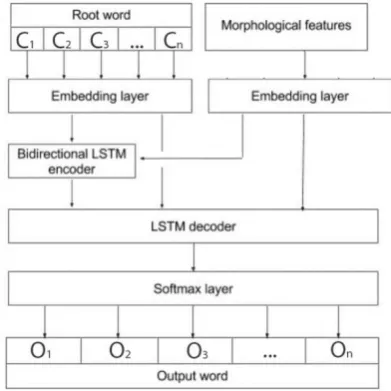
Akin to machine translation systems, this sys-tem uses an encoder-decoder LSTM model as pro-posed by (Hochreiter and Schmidhuber, 1997). The encoder is a bidirectional LSTM, while the decoder LSTM feeds into a softmax layer for ev-ery character position in the target string. Decoder predicts the output sequence character by charac-ter using feedback until stop is predicted. This model takes into account the fact that the target and the root word are similar, except for the parts that have been changed due to inflection, by feed-ing the root word directly to the decoder as well. A separate neural net is trained for every language.
3 System Description
We have modelled our system based on the system proposed by (Faruqui et al., 2016), as described in the previous section. However we have made some modifications to the above system, to ac-count for the three different sizes of datasets and to
account for the behaviour of morphological trans-formations of independent languages.
In the model, some structural and hyper-parameter features remain the same. The charac-ters in the root word and morphological features of the tatrget word are represented using one hot vectors. The major change in our model is the size of LSTM layers which is kept variable (depend-ing on vocabulary size) as opposed to fixed as in system proposed by (Faruqui et al., 2016) based on assumption that bigger vocabulary would re-quire bigger layers to extract features and system is trained for more epochs.
The embedding size for each language is differ-ent depending upon the alphabet set of that lan-guage available in the given dataset and similarly for morphological tags which are split into indi-vidual components. We use a bidirectional en-coder to which we feed the input word embed-dings. The output of the encoder, concatenated with the root word embedding and morphological features, feeds into the decoder. All recurrent units have variable hidden layer dimensions depending upon the embedding size of root word and mor-phological features. Over the decoder layer is a softmax layer that is used to predict the character that must occur at each character position of the target word. In order to maintain a constant word length, we use paddings of 0 characters. All mod-els use categorical cross-entropy as the loss func-tion and the RMSProp optimizer for optimizafunc-tion. The model was trained for 100 epochs for each size. Keras API (Chollet et al.,2015) was used for writing neural networks. For low dataset, batch size of 10 was used, for medium 100, and for high 250/500 depending of hardware limitations.
Submission
Following are tables showing top 5 accuracies ob-tained by our system on test data as opposed to baseline model.
3.1 Low-sized Dataset
Language Baseline Enc-Dec
Telugu 70 94
Uzbek 52 82
Karelian 24 80 Mapudungun 64 74
[image:2.595.318.508.69.163.2]Kazakh 26 68
Table 1:Top 5 Accuracies for languages for low data
3.2 Medium-sized Dataset
Language Baseline Enc-Dec
Uzbek 96 100
Classical-syriac 99 99 Crimean-tatar 78 98
Khakas 84 98
Mapudungun 82 98
Table 2:Top 5 Accuracies for languages for medium data
3.3 High-sized Dataset
Language Baseline Enc-Dec Classical-syriac 97 100
Crimean-tatar 95 100
Haida 66 100
[image:2.595.320.508.208.296.2]Swahili N/A 100 Kannada 66 100
Table 3:Top 5 Accuracies for languages for high data
Figure 1: C1, .., Cn represent characters of the root word while O1, ..,On represent characters of the output word.
4 Evaluation
4.1 Results on Test Set
The evaluation results were obtained using the evaluation script and the test set provided by the shared task organizers.
The best five baseline accuracies, accuracies for the first submission and accuracies for the second submission can be found in Table 1, Table 2 and Table 3 for each of the three dataset sizes: low, medium and high respectively.
[image:2.595.321.517.330.526.2] [image:2.595.77.268.646.746.2]4.2 Observations
We performed some experiments, where the choice of hyperparameters was guided by intu-itions developed from analysis of the dataset and results obtained on smaller subsets of the data. We have presented some key observations from our analysis in the ensuing sub-sections.
4.2.1 Number of layers
We observed that increasing number of layers does not result in significant increase in performance, even reduced performance in some cases whereas increased computation time significantly. So in-stead of adding more layers, adding more com-plexity and features in current layer is bound to improve performance.
4.2.2 Embedding of Morphological features
Multiple types of embedding to represent morpho-logical features was tried some of which were: bi-nary vectors, one hot vectors, integer vectors. One hot vectors resulted in best performance for our model.
4.2.3 Size of encoder layer
Increasing size of encoder after certain multiple of total embedding size (∼5) results in saturation of performance.
4.2.4 Hyperparameter Optimization
Various hyperparameters need to be optimized such as batch-size, dropout rate, number of epochs etc. which may be different for each language, to obtain optimal performance.
5 Conclusions
There are two main conclusions. One is that differ-ent configurations of deep neural networks work well for different languages. The second is that deep learning may not be the right approach for low-sized data or some other pre-processing and post-processing may need to be done to increase performance. Data augmentation is one alterna-tive to deal with low resource languages.
Results for low-size were poor for almost all lan-guages. So, deep learning cannot extract features adequately from low resources without data aug-mentation. It is to be noted that we used purely deep learning. If deep learning is augmented with other transduction, rule-based or knowledge-based methods, the results for low-size could perhaps be improved.
Very high accuracies (>95%) are observed for some languages in high sized datasets, neural net-works is probably the best choice for processing such languages.
References
Malin Ahlberg, Markus Forsberg, and Mans Hulden. 2014. Semi-supervised learning of morphological paradigms and lexicons. In Proceedings of the 14th Conference of the European Chapter of the Association for Computational Linguistics: Language Technology (Computational Linguistics), pages 569–578.
Malin Ahlberg, Markus Forsberg, and Mans Hulden. 2015. Paradigm classification in supervised learning of morphology. In Proceedings of the 2015 Confer-ence of the North American Chapter of the Associa-tion for ComputaAssocia-tional Linguistics: Human Language Technologies, pages 1024–1029.
Franc¸ois Chollet et al. 2015. Keras. https:// keras.io.
Ryan Cotterell, Christo Kirov, John Walther, Sylak-Glassman G´eraldine, Ekaterina Vylomova, Patrick Xia, Manaal Faruqui, Sandra K¨ubler, David Yarowsky, Ja-son Eisner, and Mans Hulden. 2017. The conllsigmor-phon 2017 shared task: Universal morphological rein-flection in 52 languages. InProceedings of the CoNLL-SIGMORPHON 2017 Shared Task: Universal Morpho-logical Reinflection.
Ryan Cotterell, Christo Kirov, John Walther, Sylak-Glassman G´eraldine, Ekaterina Vylomova, Patrick Xia, Manaal Faruqui, David Yarowsky, Jason Eisner, and Mans Hulden. 2016. The sigmorphon 2016 shared taskmorphological reinflection. In Proceedings of the 14th SIGMORPHON Workshop on Computational Research in Phonetics, Phonology, and Morphology. ACL.
Greg Durrett and John DeNero. 2013. Supervised learning of complete morphological paradigms. In
Proceedings of the 2013 Conference of the North Amer-ican Chapter of the Association for Computational Lin-guistics: Human Language Technologies, pages 1185– 1195.
Manaal Faruqui, Yulia Tsvetkov, Graham Neubig, and Chris Dyer. 2016. Morphological inflection generation using character sequence to sequence learning. In Pro-ceedings of NAACL.
A Appendix
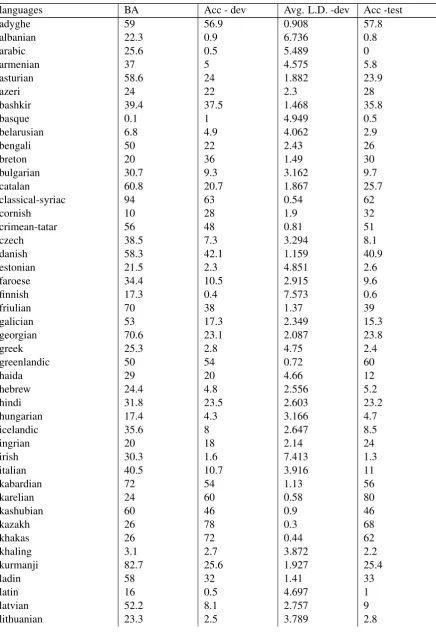
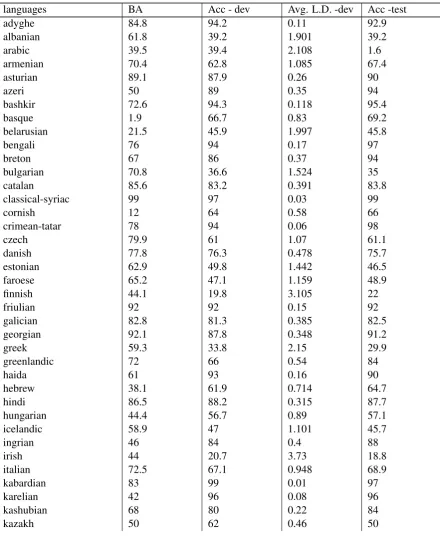
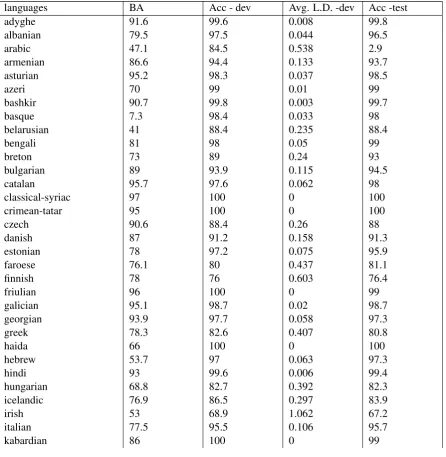
[image:4.595.83.520.144.785.2]In Tables 4 to 6 (on this page and the next), BA stands for baseline accuracy, L.D. for Levenshtein Distance, Acc for Accuracy, dev for development data.
Table 4:Results for all languages for low data.
languages BA Acc - dev Avg. L.D. -dev Acc -test
adyghe 59 56.9 0.908 57.8
albanian 22.3 0.9 6.736 0.8
arabic 25.6 0.5 5.489 0
armenian 37 5 4.575 5.8
asturian 58.6 24 1.882 23.9
azeri 24 22 2.3 28
bashkir 39.4 37.5 1.468 35.8
basque 0.1 1 4.949 0.5
belarusian 6.8 4.9 4.062 2.9
bengali 50 22 2.43 26
breton 20 36 1.49 30
bulgarian 30.7 9.3 3.162 9.7
catalan 60.8 20.7 1.867 25.7
classical-syriac 94 63 0.54 62
cornish 10 28 1.9 32
crimean-tatar 56 48 0.81 51
czech 38.5 7.3 3.294 8.1
danish 58.3 42.1 1.159 40.9
estonian 21.5 2.3 4.851 2.6
faroese 34.4 10.5 2.915 9.6
finnish 17.3 0.4 7.573 0.6
friulian 70 38 1.37 39
galician 53 17.3 2.349 15.3
georgian 70.6 23.1 2.087 23.8
greek 25.3 2.8 4.75 2.4
greenlandic 50 54 0.72 60
haida 29 20 4.66 12
hebrew 24.4 4.8 2.556 5.2
hindi 31.8 23.5 2.603 23.2
hungarian 17.4 4.3 3.166 4.7
icelandic 35.6 8 2.647 8.5
ingrian 20 18 2.14 24
irish 30.3 1.6 7.413 1.3
italian 40.5 10.7 3.916 11
kabardian 72 54 1.13 56
karelian 24 60 0.58 80
kashubian 60 46 0.9 46
kazakh 26 78 0.3 68
khakas 26 72 0.44 62
khaling 3.1 2.7 3.872 2.2
kurmanji 82.7 25.6 1.927 25.4
ladin 58 32 1.41 33
latin 16 0.5 4.697 1
latvian 52.2 8.1 2.757 9
livonian 28 6 3.51 6
lower-sorbian 32.1 7.1 2.705 9.9
macedonian 49.8 16.1 1.884 16.7
maltese 9 4 2.73 8
mapudungun 64 82 0.3 74
middle-french 76.9 33.3 1.728 32.8
middle-high-german 38 60 0.86 56
murrinhpatha 2 26 1.98 28
navajo 0 0.6 5.847 0.9
neapolitan 79 46 1.27 45
norman 30 62 0.9 52
northern-sami 16.4 2.2 4.433 1.5
norwegian-bokmaal 67.8 43.7 1.012 40.8
norwegian-nynorsk 48.9 22.4 1.749 22
occitan 72 43 1.5 31
old-armenian 31 2 3.7 1.9
old-church-slavonic 39 24 1.95 21
old-french 32.5 6 3.315 7
old-irish 8 4 3.68 2
old-saxon 22.8 3.7 3.016 5.6
pashto 35 7 2.64 11
persian 26.3 6.4 4.253 6.3
portuguese 62.6 20 1.981 19.9
quechua 15.9 15.9 3.963 15
romanian 44.8 4.3 4.352 4.6
sanskrit 33.7 6 3.339 6.7
scottish-gaelic 46 38 2.02 48
serbo-croatian 21.7 3.9 4.542 4.1
slovak 37.7 9.8 2.241 9.6
slovene 32.3 12.2 2.064 0.4
sorani 19.3 2.5 4.466 1.3
spanish 61.8 12.2 3.076 13
swahili 0 6 3.06 4
swedish 51.1 33.2 1.383 32.8
tatar 52 40 1.07 44
telugu 70 100 0 94
tibetan 34 36 1.2 36
turkish 13.2 9.4 4.398 10.7
turkmen 34 62 0.68 64
ukrainian 38.7 8.6 2.485 9
urdu 32.7 30.9 2.203 32.6
uzbek 52 83 0.36 82
venetian 71.8 29 1.457 31.1
votic 17 20 1.92 20
welsh 30 9 3.04 11
west-frisian 50 22 2.14 26
yiddish 78 29 2.15 33
zulu 0.1 1.3 5.114 1.1
dutch 50.8 9 2.665 8.9
english 77.6 58.9 0.78 61.8
german 49.2 19.6 1.991 19.9
kannada 33 17 3.65 29
middle-low-german 18 24 2.5 14
north-frisian 31 14 3.65 18
old-english 17.6 7.1 2.879 8.6
polish 40.4 4.5 3.403 4.7
[image:6.595.79.520.233.778.2]russian 43.4 6.5 3.398 7.5
Table 5:Results for all languages for medium data.
languages BA Acc - dev Avg. L.D. -dev Acc -test
adyghe 84.8 94.2 0.11 92.9
albanian 61.8 39.2 1.901 39.2
arabic 39.5 39.4 2.108 1.6
armenian 70.4 62.8 1.085 67.4
asturian 89.1 87.9 0.26 90
azeri 50 89 0.35 94
bashkir 72.6 94.3 0.118 95.4
basque 1.9 66.7 0.83 69.2
belarusian 21.5 45.9 1.997 45.8
bengali 76 94 0.17 97
breton 67 86 0.37 94
bulgarian 70.8 36.6 1.524 35
catalan 85.6 83.2 0.391 83.8
classical-syriac 99 97 0.03 99
cornish 12 64 0.58 66
crimean-tatar 78 94 0.06 98
czech 79.9 61 1.07 61.1
danish 77.8 76.3 0.478 75.7
estonian 62.9 49.8 1.442 46.5
faroese 65.2 47.1 1.159 48.9
finnish 44.1 19.8 3.105 22
friulian 92 92 0.15 92
galician 82.8 81.3 0.385 82.5
georgian 92.1 87.8 0.348 91.2
greek 59.3 33.8 2.15 29.9
greenlandic 72 66 0.54 84
haida 61 93 0.16 90
hebrew 38.1 61.9 0.714 64.7
hindi 86.5 88.2 0.315 87.7
hungarian 44.4 56.7 0.89 57.1
icelandic 58.9 47 1.101 45.7
ingrian 46 84 0.4 88
irish 44 20.7 3.73 18.8
italian 72.5 67.1 0.948 68.9
kabardian 83 99 0.01 97
karelian 42 96 0.08 96
kashubian 68 80 0.22 84
khakas 84 94 0.1 98
khaling 17.9 60.6 0.956 59.4
kurmanji 85.2 85.4 0.401 86.1
ladin 86 91 0.15 91
latin 37.6 28.3 1.56 31.3
latvian 85.5 73.7 0.591 73.7
lithuanian 52.2 44.9 1.216 46.8
livonian 51 60 0.84 62
lower-sorbian 68.9 65.7 0.644 69.8
macedonian 82.6 77.6 0.408 75.1
maltese 20 90 0.17 85
mapudungun 82 100 0 98
middle-french 90.3 91.2 0.242 89.4
middle-high-german 54 98 0.08 92
murrinhpatha 0 96 0.08 96
navajo 0 16.4 3.227 19.5
neapolitan 94 98 0.02 98
norman 46 20 2.18 26
northern-sami 34.8 41.6 1.554 39.4
norwegian-bokmaal 80.7 80.5 0.321 81.5
norwegian-nynorsk 61.1 56 0.746 57.5
occitan 92 94 0.15 93
old-armenian 67.3 53.7 1.168 57.3
old-church-slavonic 76 83 0.32 87
old-french 63.1 61.5 0.989 60.6
old-irish 16 30 1.7 24
old-saxon 39 63.2 0.715 64.7
pashto 69 70 0.68 73
persian 65.7 70.1 0.899 70.9
portuguese 92.4 33.5 1.858 37.3
quechua 70.9 76.7 0.693 77.3
romanian 69.4 48 1.752 48.5
sanskrit 59.7 65.9 0.645 68.8
scottish-gaelic 50 80 0.5 86
serbo-croatian 68.2 39.1 1.866 43.4
slovak 71.1 58 0.76 58.7
slovene 72.3 68 0.575 9.9
sorani 51.7 52.4 1.22 55.9
spanish 86.3 76.6 0.744 75.7
swahili 0 87 0.36 87
swedish 76.5 32 1.572 31.4
tatar 89 93 0.07 96
tibetan 36 30 1.42 22
turkish 32.8 78.9 0.661 79.2
turkmen 68 92 0.16 96
ukrainian 74.1 44.6 1.041 46.6
urdu 87.6 88.7 0.306 87.5
uzbek 96 100 0 100
venetian 89.1 92.3 0.116 91.9
votic 34 81 0.32 78
west-frisian 65 95 0.12 94
yiddish 87 83 0.47 88
zulu 0.1 57 1.387 52.6
dutch 72.4 69.4 0.644 71
english 90.5 90.1 0.205 90.9
french 73.2 68.2 0.881 69.3
german 71.7 69.7 0.827 65.5
kannada 55 92 0.21 85
middle-low-german 38 94 0.06 92
north-frisian 33 85 0.36 85
old-english 27.8 41.4 1.3 42.4
polish 73.5 56.9 1.151 55.1
[image:8.595.78.525.316.774.2]russian 76.4 60.7 1.212 59.9
Table 6:Results for all languages for high data.
languages BA Acc - dev Avg. L.D. -dev Acc -test
adyghe 91.6 99.6 0.008 99.8
albanian 79.5 97.5 0.044 96.5
arabic 47.1 84.5 0.538 2.9
armenian 86.6 94.4 0.133 93.7
asturian 95.2 98.3 0.037 98.5
azeri 70 99 0.01 99
bashkir 90.7 99.8 0.003 99.7
basque 7.3 98.4 0.033 98
belarusian 41 88.4 0.235 88.4
bengali 81 98 0.05 99
breton 73 89 0.24 93
bulgarian 89 93.9 0.115 94.5
catalan 95.7 97.6 0.062 98
classical-syriac 97 100 0 100
crimean-tatar 95 100 0 100
czech 90.6 88.4 0.26 88
danish 87 91.2 0.158 91.3
estonian 78 97.2 0.075 95.9
faroese 76.1 80 0.437 81.1
finnish 78 76 0.603 76.4
friulian 96 100 0 99
galician 95.1 98.7 0.02 98.7
georgian 93.9 97.7 0.058 97.3
greek 78.3 82.6 0.407 80.8
haida 66 100 0 100
hebrew 53.7 97 0.063 97.3
hindi 93 99.6 0.006 99.4
hungarian 68.8 82.7 0.392 82.3
icelandic 76.9 86.5 0.297 83.9
irish 53 68.9 1.062 67.2
italian 77.5 95.5 0.106 95.7
khaling 53.7 99.3 0.016 98.4
kurmanji 92.9 92.1 0.127 93.5
ladin 92 98 0.07 98
latin 47.6 59.6 0.652 61.5
latvian 92.8 92.8 0.162 92.8
lithuanian 64.2 86.7 0.234 88.1
livonian 67 92 0.2 97
lower-sorbian 88.1 95.9 0.078 94.3
macedonian 91.2 96.1 0.111 94.6
maltese 16 80 0.37 69
middle-french 95.1 98.6 0.038 96.7
navajo 0 79.9 0.603 75.3
neapolitan 95 98 0.02 97
northern-sami 62.3 94 0.145 92.6
norwegian-bokmaal 91 90.1 0.159 89
norwegian-nynorsk 74.8 83.6 0.295 82.6
occitan 96 100 0 99
old-armenian 79.2 84.1 0.381 87.3
old-church-slavonic 80 94 0.11 97
old-french 80.7 83.8 0.431 86.5
old-saxon 60.1 97.1 0.055 96.3
pashto 72 100 0 100
persian 80.7 98.5 0.028 98.9
portuguese 96.7 97.7 0.06 98.5
quechua 95.1 99.4 0.009 99.4
romanian 79.8 80.8 0.742 79
sanskrit 80.6 92.4 0.151 92.1
serbo-croatian 83 83.4 0.439 84.1
slovak 83.1 91.3 0.164 92.8
slovene 84.9 94.5 0.113 34.6
sorani 63.6 88.4 0.206 89
spanish 92.4 93.2 0.166 93.4
swahili 0 87 0.36 100
swedish 84.7 85.2 0.325 87.2
tatar 95 100 0 99
turkish 73.2 97.4 0.088 97.3
ukrainian 86.3 91.1 0.151 92.5
urdu 95.9 99.7 0.004 99.7
uzbek 96 99.3 0.012 98
venetian 93 95 0.14 99.1
votic 34 68 0.58 66
welsh 72 96 0.08 94
west-frisian 67 80 0.43 74
yiddish 94 98 0.08 99
zulu 0.2 97.8 0.055 97.2
dutch 87.7 94.8 0.102 93.1
english 95.9 94.7 0.133 95.8
french 83 80 0.514 81.1
german 81.1 85.8 0.395 83.7
kannada 66 99 0.01 100
old-english 40.9 84.9 0.307 83.4
polish 87.1 85.5 0.379 82.8