A Non-negative Tensor Factorization Model for
Selectional Preference Induction
Tim Van de Cruys University of Groningen
The Netherlands
Abstract
Distributional similarity methods have proven to be a valuable tool for the in-duction of semantic similarity. Up till now, most algorithms use two-way co-occurrence data to compute the mean-ing of words. Co-occurrence frequencies, however, need not be pairwise. One can easily imagine situations where it is desir-able to investigate co-occurrence frequen-cies of three modes and beyond. This pa-per will investigate a tensor factorization method called non-negative tensor factor-ization to build a model of three-way co-occurrences. The approach is applied to the problem of selectional preference in-duction, and automatically evaluated in a pseudo-disambiguation task. The results show that non-negative tensor factoriza-tion is a promising tool forNLP.
1 Introduction
Distributional similarity methods have proven to be a valuable tool for the induction of semantic similarity. The aggregate of a word’s contexts gen-erally provides enough information to compute its meaning, viz. its semantic similarity or related-ness to other words.
Up till now, most algorithms use two-way co-occurrence data to compute the meaning of words. A word’s meaning might for example be computed by looking at:
• the various documents that the word appears in (words×documents);
• a bag of words context window around the word (words×context words);
• the dependency relations that the word ap-pears with (words×dependency relations).
The extracted data – representing the co-occurrence frequencies of two different entities – is encoded in a matrix. Co-occurrence fre-quencies, however, need not be pairwise. One can easily imagine situations where it is desirable to investigate co-occurrence frequencies of three modes and beyond. In an information retrieval context, one such situation might be the investiga-tion ofwords×documents×authors. In an NLP
context, one might want to investigatewords× de-pendency relations×bag of word context words, orverbs×subjects×direct objects.
Note that it is not possible to investigate the three-way co-occurrences in a matrix represen-tation form. It is possible to capture the co-occurrence frequencies of a verb with its sub-jects and its direct obsub-jects, but one cannot cture the co-occurrence frequencies of the verb ap-pearing with the subject and the direct object at the same time. When the actual three-way co-occurrence data is ‘matricized’, valuable informa-tion is thrown-away. To be able to capture the mu-tual dependencies among the three modes, we will make use of a generalizedtensorrepresentation.
Two-way co-occurrence models (such as la-tent semantic analysis) have often been augmented with some form of dimensionality reduction in or-der to counter noise and overcome data sparseness. We will also make use of a dimensionality reduc-tion algorithm appropriate for tensor representa-tions.
2 Previous Work
2.1 Selectional Preferences & Verb Clustering
Selectional preferences have been a popular re-search subject in the NLP community. One of
synsets as clusters. He then calculates the se-lectional preference strengthof a specific verb in a particular relation by computing the Kullback-Leibler divergence between the cluster distribu-tion of the verb and the aggregate cluster distri-bution. The selectional association is then the contribution of the cluster to the verb’s prefer-ence strength. The model’s generalization relies entirely on WordNet; there is no generalization among the verbs.
The research in this paper is related to previous work on clustering. Pereira et al. (1993) use an information-theoretic based clustering approach, clustering nouns according to their distribution as direct objects among verbs. Their model is a one-sided clustering model: only the direct objects are clustered, there is no clustering among the verbs.
Rooth et al. (1999) use an EM-based
cluster-ing technique to induce a clustercluster-ing based on the co-occurrence frequencies of verbs with their sub-jects and direct obsub-jects. As opposed to the method of Pereira et al. (1993), their model is two-sided: the verbs as well as the subjects/direct objects are clustered. We will use a similar model for evalua-tion purposes.
Recent approaches using distributional similar-ity methods for the induction of selectional pref-erences are the ones by Erk (2007), Bhagat et al. (2007) and Basili et al. (2007).
This research differs from the approaches men-tioned above by its use of multi-way data: where the approaches above limit themselves to two-way occurrences, this research will focus on co-occurrences for multi-way data.
2.2 Factorization Algorithms
2.2.1 Two-way Factorizations
One of the best known factorization algorithms is principal component analysis (PCA, Pearson (1901)). PCA transforms the data into a new co-ordinate system, yielding the best possible fit in a least square sense given a limited number of di-mensions. Singular value decomposition (SVD) is the generalization of the eigenvalue decompo-sition used inPCA(Wall et al., 2003).
In information retrieval, singular value decom-position has been applied in latent semantic analy-sis (LSA, Landauer and Dumais (1997), Landauer
et al. (1998)). In LSA, a term-document matrix is created, containing the frequency of each word in a specific document. This matrix is then
de-composed into three other matrices withSVD. The most important dimensions that come out of the
SVD allegedly represent ‘latent semantic dimen-sions’, according to which nouns and documents can be represented more efficiently.
LSA has been criticized for a number of rea-sons, one of them being the fact that the factor-ization contains negative numbers. It is not clear what negativity on a semantic scale should des-ignate. Subsequent methods such as probabilistic latent semantic analysis (PLSA, Hofmann (1999)) and non-negative matrix factorization (NMF, Lee
and Seung (2000)) remedy these problems, and indeed get much more clear-cut semantic dimen-sions.
2.2.2 Three-way Factorizations
To be able to cope with three-way data, sev-eral algorithms have been developed as multilin-ear generalizations of theSVD. In statistics, three-way component analysis has been extensively in-vestigated (for an overview, see Kiers and van Mechelen (2001)). The two most popular methods are parallel factor analysis (PARAFAC, Harshman (1970), Carroll and Chang (1970)) and three-mode principal component analysis (3MPCA, Tucker (1966)), also called higher order singular value decomposition (HOSVD, De Lathauwer et al.
(2000)). Three-way factorizations have been ap-plied in various domains, such as psychometry and image recognition (Vasilescu and Terzopou-los, 2002). In information retrieval, three-way fac-torizations have been applied to the problem of link analysis (Kolda and Bader, 2006).
One last important method dealing with multi-way data is non-negative tensor factorization (NTF, Shashua and Hazan (2005)).NTFis a gener-alization of non-negative matrix factorization, and can be considered an extension of the PARAFAC
model with the constraint of non-negativity (cfr. infra).
One of the few papers that has investigated the application of tensor factorization forNLP is Tur-ney (2007), in which a three-mode tensor is used to compute the semantic similarity of words. The method achieves 83.75% accuracy on the TOEFL
3 Methodology
3.1 Tensors
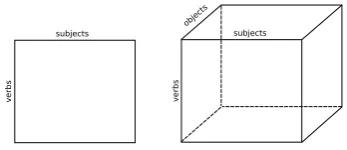
[image:3.595.313.518.222.278.2]Distributional similarity methods usually repre-sent co-occurrence data in the form of a matrix. This form is perfectly suited to represent two-way co-occurrence data, but for co-occurrence data be-yond two modes, we need a more general repre-sentation. The generalization of a matrix is called atensor. A tensor is able to encode co-occurrence data of any n modes. Figure 1 shows a graphi-cal comparison of a matrix and a tensor with three modes – although a tensor can easily be general-ized to more than three modes.
Figure 1: Matrix representation vs. tensor repre-sentation
3.2 Non-negative Tensor Factorization
In order to create a succinct and generalized model of the extracted data, a statistical dimensional-ity reduction technique called non-negative tensor factorization (NTF) is applied to the data. TheNTF
model is similar to thePARAFACanalysis – popu-lar in areas such as psychology and bio-chemistry – with the constraint that all data needs to be non-negative (i.e.≥0).
Parallel factor analysis (PARAFAC) is a multi-linear analogue of the singular value decomposi-tion (SVD) used in latent semantic analysis. The key idea is to minimize the sum of squares be-tween the original tensor and the factorized model of the tensor. For the three mode case of a tensor
T ∈RD1×D2×D3 this gives equation 1, wherek is the number of dimensions in the factorized model and◦denotes the outer product.
min xi∈RD1,yi∈RD2,zi∈RD3
kT−
k
∑
i=1
xi◦yi◦zik2F (1)
With negative tensor factorization, the non-negativity constraint is enforced, yielding a model like the one in equation 2:
min xi∈RD≥10,yi∈R≥D20,zi∈RD≥30
kT−
k
∑
i=1
xi◦yi◦zik2F (2)
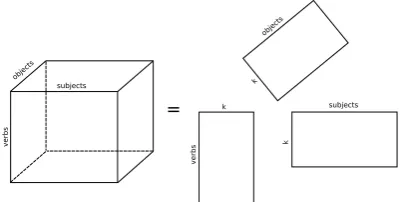
The algorithm results in three matrices, indicat-ing the loadindicat-ings of each mode on the factorized dimensions. The model is represented graphically in figure 2, visualizing the fact that thePARAFAC
[image:3.595.94.268.265.340.2]decomposition consists of the summation over the outer products ofn(in this case three) vectors.
Figure 2: Graphical representation of the NTF as
the sum of outer products
Computationally, the non-negative tensor fac-torization model is fitted by applying an alternat-ing least-squares algorithm. In each iteration, two of the modes are fixed and the third one is fitted in a least squares sense. This process is repeated until convergence.1
3.3 Applied to Language Data
The model can straightforwardly be applied to lan-guage data. In this part, we describe the fac-torization of verbs × subjects × direct objects
co-occurrences, but the example can easily be substituted with other co-occurrence information. Moreover, the model need not be restricted to 3 modes; it is very well possible to go to 4 modes and beyond — as long as the computations remain feasible.
The NTF decomposition for the verbs × sub-jects×direct objectsco-occurrences into the three loadings matrices is represented graphically in fig-ure 3. By applying the NTF model to three-way
(s,v,o)co-occurrences, we want to extract a gen-eralized selectional preference model, and eventu-ally even induce some kind of frame semantics (in the broad sense of the word).
In the resulting factorization, each verb, subject and direct object gets a loading value for each fac-tor dimension in the corresponding loadings ma-trix. The original value for a particular (s,v,o)
1The algorithm has been implemented inMATLAB, using
Figure 3: Graphical representation of theNTFfor language data
triple xsvo can then be reconstructed with equa-tion 3.
xsvo= k
∑
i=1
ssivviooi (3)
To reconstruct the selectional preference value for the triple (man,bite,dog), for example, we look up the subject vector forman, the verb vector forbiteand the direct object vector fordog. Then, for each dimensioniin the model, we multiply the
ith value of the three vectors. The sum of these values is the final preference value.
4 Results
4.1 Setup
The approach described in the previous section has been applied to Dutch, using the Twente Nieuws Corpus (Ordelman, 2002), a 500M words corpus of Dutch newspaper texts. The corpus has been parsed with the Dutch dependency parser Alpino (van Noord, 2006), and three-way co-occurrences of verbs with their respective subject and direct object relations have been extracted. As dimen-sion sizes, the 1Kmost frequent verbs were used, together with the 10Kmost frequent subjects and 10K most frequent direct objects, yielding a ten-sor of 1K × 10K ×10K. The resulting tensor is very sparse, with only 0.0002% of the values be-ing non-zero.
The tensor has been adapted with a straight-forward extension of pointwise mutual informa-tion (Church and Hanks, 1990) for three-way co-occurrences, following equation 4. Negative val-ues are set to zero.2
2This is not just an ad hoc conversion to enforce
non-negativity. Negative values indicate a smaller co-occurrence probability than the expected number of co-occurrences. Set-ting those values to zero proves beneficial for similarity cal-culations (see e.g. Bullinaria and Levy (2007)).
MI3(x,y,z) =log p(x,y,z)
p(x)p(y)p(z) (4)
The resulting matrix has been factorized intok
dimensions (varying between 50 and 300) with the
NTFalgorithm described in section 3.2.
4.2 Examples
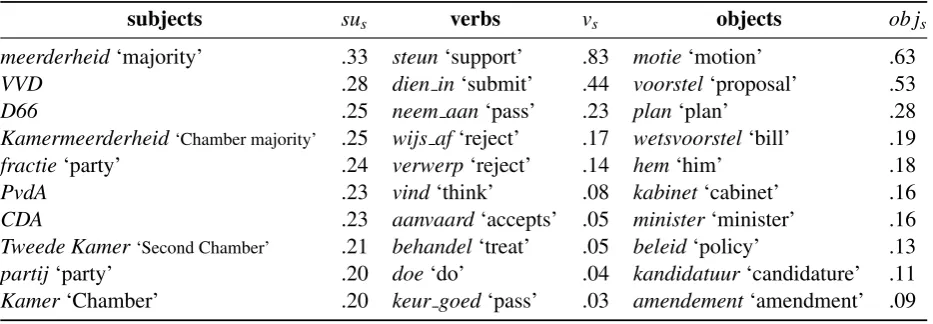
Table 1, 2 and 3 show example dimensions that have been found by the algorithm with k=100. Each example gives the top 10 subjects, verbs and direct objects for a particular dimension, to-gether with the score for that particular dimension. Table 1 shows the induction of a ‘police action’ frame, with police authorities as subjects, police actions as verbs and patients of the police actions as direct objects.
In table 2, a legislation dimension is induced, with legislative bodies as subjects3, legislative ac-tions as verbs, and mostly law (proposals) as direct objects. Note that some direct objects (e.g. ‘min-ister’) also designate persons that can be the object of a legislative act.
Table 3, finally, is clearly an exhibition dimen-sion, with verbs describing actions of display and trade that art institutions (subjects) can do with works of art (objects).
These are not the only sensible dimensions that have been found by the algorithm. A quick qual-itative evaluation indicates that about 44 dimen-sions contain similar, framelike semantics. In an-other 43 dimensions, the semantics are less clear-cut (single verbs account for one dimension, or different senses of a verb get mixed up). 13 dimen-sions are not so much based on semantic character-istics, but rather on syntax (e.g. fixed expressions and pronomina).
4.3 Evaluation
The results of theNTF model have been quantita-tively evaluated in a pseudo-disambiguation task, similar to the one used by Rooth et al. (1999). It is used to evaluate the generalization capabilities of the algorithm. The task is to judge which subject (s ors0) and direct object (ooro0) is more likely for a particular verbv, where(s,v,o)is a combi-nation drawn from the corpus, ands0 ando0 are a subject and direct object randomly drawn from the corpus. A triple is considered correct if the algo-rithm prefers bothsandoover their counterparts
3Note that VVD, D66, PvdA and CDA are Dutch political
subjects sus verbs vs objects ob js
politie‘police’ .99 houd aan‘arrest’ .64 verdachte‘suspect’ .16
agent‘policeman’ .07 arresteer‘arrest’ .63 man‘man’ .16
autoriteit‘authority’ .05 pak op‘run in’ .41 betoger‘demonstrator’ .14
Justitie’Justice’ .05 schiet dood‘shoot’ .08 relschopper‘rioter’ .13
recherche‘detective force’ .04 verdenk‘suspect’ .07 raddraaiers‘instigator’ .13
marechaussee‘military police’ .04 tref aan‘find’ .06 overvaller‘raider’ .13
justitie‘justice’ .04 achterhaal‘overtake’ .05 Roemeen‘Romanian’ .13
arrestatieteam‘special squad’ .03 verwijder‘remove’ .05 actievoerder‘campaigner’ .13
leger‘army’ .03 zoek‘search’ .04 hooligan‘hooligan’ .13
[image:5.595.68.535.255.417.2]douane‘customs’ .02 spoor op‘track’ .03 Algerijn‘Algerian’ .13
Table 1: Top 10 subjects, verbs and direct objects for the ‘police action’ dimension
subjects sus verbs vs objects ob js
meerderheid‘majority’ .33 steun‘support’ .83 motie‘motion’ .63
VVD .28 dien in‘submit’ .44 voorstel‘proposal’ .53
D66 .25 neem aan‘pass’ .23 plan‘plan’ .28
Kamermeerderheid‘Chamber majority’ .25 wijs af‘reject’ .17 wetsvoorstel‘bill’ .19
fractie‘party’ .24 verwerp‘reject’ .14 hem‘him’ .18
PvdA .23 vind‘think’ .08 kabinet‘cabinet’ .16
CDA .23 aanvaard‘accepts’ .05 minister‘minister’ .16
Tweede Kamer‘Second Chamber’ .21 behandel‘treat’ .05 beleid‘policy’ .13
partij‘party’ .20 doe‘do’ .04 kandidatuur‘candidature’ .11
Kamer‘Chamber’ .20 keur goed‘pass’ .03 amendement‘amendment’ .09
Table 2: Top 10 subjects, verbs and direct objects for the ‘legislation’ dimension
s0 ando0 (so the(s,v,o)triple – that appears in the test corpus – is preferred over the triples(s0,v,o0),
(s0,v,o)and(s,v,o0)). Table 4 shows three exam-ples from the pseudo-disambiguation task.
s v o s0 o0
[image:5.595.73.292.524.607.2]jongere drink bier coalitie aandeel ‘youngster’ ‘drink’ ‘beer’ ‘coalition’ ‘share’ werkgever riskeer boete doel kopzorg ‘employer’ ‘risk’ ‘fine’ ‘goal’ ‘worry’ directeur zwaai scepter informateur vodka ‘manager’ ‘sway’ ‘sceptre’ ‘informer’ ‘wodka’
Table 4: Three examples from the pseudo-disambiguation evaluation task’s test set
Four different models have been evaluated. The first two models are tensor factorization models. The first model is the NTF model, as described
in section 3.2. The second model is the original
PARAFACmodel, without the non-negativity con-straints.
The other two models are matrix factorization models. The third model is the non-negative
ma-trix factorization (NMF) model, and the fourth model is the singular value decomposition (SVD). For these models, a matrix has been constructed that contains the pairwise co-occurrence frequen-cies of verbs by subjects as well as direct objects. This gives a matrix of 1K verbs by 10K subjects
+ 10Kdirect objects (1K ×20K). The matrix has been adapted with pointwise mutual information.
The models have been evaluated with 10-fold cross-validation. The corpus contains 298,540 dif-ferent (s,v,o) co-occurrences. Those have been randomly divided into 10 equal parts. So in each fold, 268,686 co-occurrences have been used for training, and 29,854 have been used for testing. The accuracy results of the evaluation are given in table 5.
subjects sus verbs vs objects ob js
tentoonstelling‘exhibition’ .50 toon‘display’ .72 schilderij‘painting’ .47
expositie‘exposition’ .49 omvat‘cover’ .63 werk‘work’ .46
galerie‘gallery’ .36 bevat‘contain’ .18 tekening‘drawing’ .36
collectie‘collection’ .29 presenteer‘present’ .17 foto‘picture’ .33
museum‘museum’ .27 laat‘let’ .07 sculptuur‘sculpture’ .25
oeuvre‘oeuvre’ .22 koop‘buy’ .07 aquarel‘aquarelle’ .20
Kunsthal .19 bezit‘own’ .06 object‘object’ .19
kunstenaar‘artist’ .15 zie‘see’ .05 beeld‘statue’ .12
dat‘that’ .12 koop aan‘acquire’ .05 overzicht‘overview’ .12
hij‘he’ .10 in huis heb‘own’ .04 portret‘portrait’ .11
Table 3: Top 10 subjects, verbs and direct objects for the ‘exhibition’ dimension
dimensions
50 (%) 100 (%) 300 (%)
NTF 89.52±0.18 90.43±0.14 90.89±0.16
PARAFAC 85.57±0.25 83.58±0.59 80.12±0.76
NMF 81.79±0.15 78.83±0.40 75.74±0.63
[image:6.595.96.504.63.222.2]SVD 69.60±0.41 62.84±1.30 45.22±1.01
Table 5: Results of the 10-fold cross-validation for the NTF, PARAFAC, NMFand SVD model for 50, 100 and 300 dimensions (averages and standard deviation)
ThePARAFACresults indicate the fitness of ten-sor factorization for the induction of three-way se-lectional preferences. Even without the constraint of non-negativity, the model outperforms the ma-trix factorization models, reaching a score of about 85%. The model deteriorates when more dimen-sions are used.
Both matrix factorization models perform worse than their tensor factorization counterparts. The NMF still scores reasonably well, indicating the positive effect of the non-negativity constraint. The simpleSVDmodel performs worst, reaching a score of about 70% with 50 dimensions.
5 Conclusion and Future Work
This paper has presented a novel method that is able to investigate three-way co-occurrences. Other distributional methods deal almost exclu-sively with pairwise co-occurrences. The ability to keep track of multi-way co-occurrences opens up new possibilities and brings about interesting results. The method uses a factorization model – non-negative tensor factorization – that is suitable for three way data. The model is able to generalize among the data and overcome data sparseness.
The method has been applied to the problem of selectional preference induction. The results indicate that the algorithm is able to induce se-lectional preferences, leading to a broad kind of frame semantics. The quantitative evaluation shows that use of three-way data is clearly benefi-cial for the induction of three-way selectional pref-erences. The tensor models outperform the sim-ple matrix models in the pseudo-disambiguation task. The results also indicate the positive ef-fect of the non-negativity constraint: both mod-els with non-negative constraints outperform their non-constrained counterparts.
The results as well as the evaluation indicate that the method presented here is a promising tool for the investigation ofNLPtopics, although more research and thorough evaluation are desirable.
There is quite some room for future work. First of all, we want to further investigate the useful-ness of the method for selectional preference in-duction. This includes a deeper quantitative eval-uation and a comparison to other methods for se-lectional preference induction. We also want to include other dependency relations in our model, apart from subjects and direct objects.
much more adequately. We specifically want to stress this second line of future research as one of the most promising and exciting ones.
Finally, the model presented here is not only suitable for selectional preference induction. There are many problems in NLP that involve
three-way co-occurrences. In future work, we want to apply the NTF model presented here to other problems inNLP, the most important one
be-ing word sense discrimination.
Acknowledgements
Brett Bader kindly provided his implementation of non-negative tensor factorization for sparse ma-trices, from which this research has substantially benefited. The three anonymous reviewers pro-vided fruitful comments and remarks, which con-siderably improved the quality of this paper.
References
Brett W. Bader and Tamara G. Kolda. 2006. Efficient MATLAB computations with sparse and factored tensors. Technical Report SAND2006-7592, Sandia National Laboratories, Albuquerque, NM and Liver-more, CA, December.
Brett W. Bader and Tamara G. Kolda. 2007.
Mat-lab tensor toolbox version 2.2. http://csmr.ca.
sandia.gov/∼tgkolda/TensorToolbox/, Jan-uary.
Roberto Basili, Diego De Cao, Paolo Marocco, and Marco Pennacchiotti. 2007. Learning selectional preferences for entailment or paraphrasing rules. In
Proceedings of RANLP 2007, Borovets, Bulgaria.
Rahul Bhagat, Patrick Pantel, and Eduard Hovy. 2007. Ledir: An unsupervised algorithm for learning
di-rectionality of inference rules. In Proceedings of
Conference on Empirical Methods in Natural Lan-guage Processing (EMNLP-07), pages 161–170, Prague, Czech Republic.
John A. Bullinaria and Joseph P. Levy. 2007. Ex-tracting semantic representations from word
co-occurrence statistics: A computational study.
Be-havior Research Methods, 39:510–526.
J. D. Carroll and J.-J. Chang. 1970. Analysis of in-dividual differences in multidimensional scaling via an n-way generalization of ”eckart-young”
decom-position. Psychometrika, 35:283–319.
Kenneth Ward Church and Patrick Hanks. 1990. Word association norms, mutual information & lexicogra-phy. Computational Linguistics, 16(1):22–29.
Lieven De Lathauwer, Bart De Moor, and Joos Vande-walle. 2000. A multilinear singular value
decompo-sition. SIAM Journal on Matrix Analysis and
Appli-cations, 21(4):1253–1278.
Katrin Erk. 2007. A simple, similarity-based model
for selectional preferences. InProceedings of ACL
2007, Prague, Czech Republic.
R.A. Harshman. 1970. Foundations of the parafac pro-cedure: models and conditions for an ”explanatory”
multi-mode factor analysis. InUCLA Working
Pa-pers in Phonetics, volume 16, pages 1–84, Los An-geles. University of California.
Thomas Hofmann. 1999. Probabilistic latent semantic
analysis. InProc. of Uncertainty in Artificial
Intelli-gence, UAI’99, Stockholm.
H.A.L Kiers and I. van Mechelen. 2001. Three-way component analysis: Principles and illustrative
ap-plication. Psychological Methods, 6:84–110.
Tamara Kolda and Brett Bader. 2006. The TOPHITS
model for higher-order web link analysis. In
Work-shop on Link Analysis, Counterterrorism and Secu-rity.
Thomas Landauer and Susan Dumais. 1997. A so-lution to Plato’s problem: The Latent Semantic Analysis theory of the acquisition, induction, and
representation of knowledge. Psychology Review,
104:211–240.
Thomas Landauer, Peter Foltz, and Darrell Laham. 1998. An Introduction to Latent Semantic Analysis.
Discourse Processes, 25:295–284.
Daniel D. Lee and H. Sebastian Seung. 2000. Al-gorithms for non-negative matrix factorization. In
NIPS, pages 556–562.
R.J.F. Ordelman. 2002. Twente Nieuws Corpus
(TwNC), August. Parlevink Language Technology Group. University of Twente.
K. Pearson. 1901. On lines and planes of closest fit to
systems of points in space. Philosophical Magazine,
2(6):559–572.
Fernando Pereira, Naftali Tishby, and Lillian Lee. 1993. Distributional clustering of English words. In
31st Annual Meeting of the ACL, pages 183–190.
Philip Resnik. 1996. Selectional Constraints: An
Information-Theoretic Model and its Computational
Realization.Cognition, 61:127–159, November.
Mats Rooth, Stefan Riezler, Detlef Prescher, Glenn Carroll, and Franz Beil. 1999. Inducing a semanti-cally annotated lexicon via em-based clustering. In
37th Annual Meeting of the ACL.
Amnon Shashua and Tamir Hazan. 2005.
Non-negative tensor factorization with applications to
statistics and computer vision. InICML ’05:
Machine learning, pages 792–799, New York, NY, USA. ACM.
L.R. Tucker. 1966. Some mathematical notes on
three-mode factor analysis. Psychometrika, 31:279–311.
Peter D. Turney. 2007. Empirical evaluation of four tensor decomposition algorithms. Technical Report ERB-1152, National Research Council, Institute for Information Technology.
Gertjan van Noord. 2006. At Last Parsing Is Now Operational. In Piet Mertens, Cedrick Fairon, Anne
Dister, and Patrick Watrin, editors,TALN06. Verbum
Ex Machina. Actes de la 13e conference sur le traite-ment automatique des langues naturelles, pages 20– 42, Leuven.
M. Alex O. Vasilescu and Demetri Terzopoulos. 2002. Multilinear analysis of image ensembles:
Tensor-faces. InECCV, pages 447–460.
Michael E. Wall, Andreas Rechtsteiner, and Luis M.
Rocha, 2003. Singular Value Decomposition and