26
Introduction
Stroke remains one of the major public health problems in Nigeria today, and is currently the main cause of neurological disability1-3. In
most tertiary hospitals in Nigeria, stroke accounted for 0.92 – 4% of hospital admissions, 2.83 – 4.52% of total deaths and is reportedly the leading cause of neurological admissions2,4. The impact can be
devastating, leaving a person with residual impairment of physical, psychological, and social functions5,6. During the sub acute phase
of stroke, when potential for further functional gain is limited, the psychosocial consequences of stroke become increasingly important determinants of health-related quality of life7,8. Although about
one-third of individuals with stroke may develop post stroke depression, perceived social support may prevent either onset or duration of depressed mood9.
In stroke survivors, social support is believed to affect the quality of patient care and disease outcome, as well as patients’ physical and psychosocial well-being8,10. Studies have consistently
demonstrated a link between low levels of social support and poor mental and physical health outcomes and have subsequently fuelled the development and evaluation of interventions designed to improve social support for those deprived of this resource7,8,11,12.
Apart from disability, psychosocial factors such as emotional re-sponses and social support determine Health Related Quality of Life (HRQOL) in stroke survivors1. In the broadest sense, social
support cuts across any process through which social relationships might promote health and well-being13 and moderates the impact
of functional status on well-being10, 14. Improvement of accessible
social support could be an essential plan in mitigating psychiatric distress and averting post stroke depression9.
Social support as a coping resource, and its association to stress-ors and mental and physical well being, has generated increased interest in recent years12. The Multidimensional Scale of Perceived
Social Support (MSPSS), initially though not exclusively was devel-oped in English for adolescents to assess their perceptions of the adequacy of their social support from three different sources: family, friends, and significant others. There is also a growing impetus in the use of the MSPSS to evaluate perceived social support across cultures15. As there were no developed tools or translated scales for
the assessment of social support among stroke survivors in Nigeria, it was deemed necessary to carry out a translation and transcultural adaptation of the questionnaire so that the tool could be used with the Nigerian population. Therefore, the aim of this study was to carry out a linguistic validation and transcultural adaptation processes of the MSPSS for future use in clinical research and practice in Nigeria.
Methods
Ethical approval to conduct this study was obtained from the Medical Ethics committee of the University of Malaya (Eth. Comm./IRB Ref number 830.7) and the Ministry of Health, Kano
ABSTRA
CT
Key words: Stroke, assessment, social support, linguistic validation
Measuring percieved social support in stroke survivors: linguistic
validation of the Multidimensional Scale of Percieved Social
Support (MSPSS) in Hausa (Nigerian) language
Ashiru Hamza BSc Physio (Bayero University Nigeria), MMedPH (University of Malaya, Malysia),
(University of Malaya, Malaysia)
PhD student, Center for Population Health. Department of Social and Preventive Medicine, University of Malaya, Kuala Lumpur, Malaysia
Nabilla Al-sadat Abdul Mohsein, MBBS (University of Malaya, Malaysia), MPH (UM) (University of Malaya),
MSc HelaTH Planning and Financing (London School of Economics, UK), PhD (Curtin University of
Technology, Australia)
Associate Professor, Department of Social and Preventive Medicine, Faculty of Medicine, University of Malaya, Malaysia
Loh siew Yim, BSc (Hon) Applied rehab, University of Teeside, UK), MSc Medical Education, (University
of Wales, UK), Master Counselling (University of Malaya, Malaysia), PhD (Curtain University of Technology
Australia)
Senior Lecturer, Department of Rehabilitation Medicine, Faculty of Medicine, University of Malaya, Malaysia
Background and Aims: In stroke survivors, social support is believed to affect the quality of patient care and the disease outcome, as well as patients’ physical and psychosocial well-being. Assessment is therefore essential for the development and evaluation of interventions designed to improve social support for those deprived of this resource. The aim of the linguistic validation of the Multidimensional Scale of Perceived Social Support (MSPSS) was to produce a translated version in Hausa language with “conceptual, semantic and operational equivalence” to the original U.S. English version for use in clinical practice and research in Nigeria.
Methods: A multiprofessional committee that consisted of five experts carried out the translation process in accordance with the Mapi Research Institute format and guidelines for cultural adaptation of questionnaires. This included the steps of forward translations, synthesis, back translation, expert committee review, pre-testing (with 10 hemiplegic subjects) and finalisation.
Results: During the translation processes of the MSPSS into Hausa, concerns were raised pertaining to some linguistic and semantic issues including the appropriateness of certain terms used. The literal translation of some of the items and expressions used was not viable in Hausa language; hence, researchers had to find culturally agreeable linguistic equivalents. Pilot testing revealed the MSPSS to be easily understandable, simple, clear and appropriate for the evaluation of social support among these stroke survivors.
Conclusion and Recommendation: The processes involved in the translation served to ensure that the Hausa-MSPSS was measuring the same circumstances as the original scale, thereby enabling comparisons between different cultures. Nevertheless, further in-depth psychometric testing on a larger sample is proposed to be carried out among Hausa speakers.
27 state Nigeria (HMB/GEN/488/11). The researchers obtained
permission for the cultural adaptation and linguistic validation of the MSPSS in Hausa from the original questionnaire developers and the copyright owners (Canty-Mitchell and Zimet 1988)16,17.
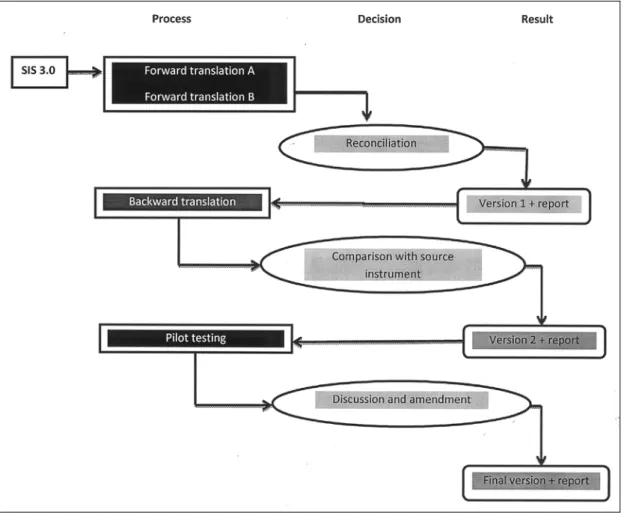
The translation and cultural adaptation of MSPSS into Hausa lan-guage necessitated successive procedures in order to preserve the measurement equivalence of the MSPSS. These processes served to ensure that the Hausa-MSPSS was measuring the same criteria as the original scale, thereby enabling comparisons be-tween different cultures. This was achieved through a process called linguistic validation and cultural adaptation following the flowchart and guidelines put forward by the Mapi Research Insti-tute’s methodology18. This was the process chosen because of its
general simplistic procedures as well as it being an internationally accepted methodology17,19,20 as presented in the Figure 1. This
process is similar to the Beaton et al19 guidelines for cross-cultural
adaptation of self report measures.
Description of the instrument (MSPSS)
MSPSS is a well validated and psychometrically rigorous 12 item concise instrument used for measuring the hierarchical structure of perceived social support from family (items 3, 4, 8 and 11), friends (items 6, 7, 9, and 12), and a significant others (items 1, 2, 5, and 10). As already mentioned, it was developed for adolescents, but is suitable for other groups. It has a number of properties which suggests that it may be a valuable tool for use in research involving a variety of populations, including cardiovascular disease populations and the elderly17.Studies indicate that MSPSS has a good internal
reliability, test-retest reliability, and strong factorial validity17. In
addition, good construct validity of the significant other, family, and friend subscales were also demonstrated12,17,21. The perceived
social support is graded on a 7-point likert-type scale (from very strongly disagree to very strongly agree) as follows: respondents are required to circle 1, very Strongly disagree; 2 strongly disagree; 3 mildly disagree; 4 Neutral; 5 mildly agree; 6 strongly agree; 7 very Strongly agree (see Appendix 1).
Translation and Transcultural Adaptations (the
linguistic Validation Process)
Using the Mapi’s 5 stage recommendation18 which consists of
transla-tion, synthesis (reconciliation), backward translatransla-tion, expert committee review and comparison with the source document and pilot testing, the adaptation of the concepts to the identified target population’s culture and the original connotative meaning can be attained. The MSPSS vali-dation was conducted in close collaboration between the translation committee and the copyright owner/developers of the questionnaire.
Forward Translations
The aim of the Forward Translation step was to obtain a version in Hausa language with “conceptual, semantic and operational equiva-lence” to the original U.S. English version in meaning. The MSPSS was translated into Hausa by two professional translators from the Freedom Radio Nigeria muryar jama’a 99.5FM (an independent radio). The translators were selected on the basis of their cognate experi-ences and track record of success in linguistic validation. Their mother tongues were Hausa and they were proficient in English. The two bilingual translators worked inde-pendently, so that neither of them would influence the other’s translation. One of them (with ex-perience working as a professional translator in health related areas) was acquainted with the aims and general ideas that were being assessed by the instrument, whereas the other did not, nor had had any prior knowledge of the instrument’s objec-tives.
Once the translations were completed, com-parison and reconciliation of the translations were carried out in a series of meetings between the in-vestigators and the trans-lators. Linguistic issues that arose were resolved by way of further consul-tations and consensus. The first reconciled version was developed in Hausa based on these two forward translations and the reconciliation.
Backward Translation
A backward translation of the reconciled language version was obtained in the source language (U.S. English) by a professional translator who was a native Hausa speaker and fluent in English, and had no prior knowledge of the instrument (a third translator). The backward translated version was compared with the original MSPSS by the five multidisciplinary team. The translation discrepancies that resulted were rectified during this process to ensure semantic and conceptual equivalence leading to the second Hausa version.
Clinical Review and Cognitive Debriefing (Pilot testing)
✥ Cognitive debriefing - Feedback from experts in the medicalfield, i.e. two psychologists familiar with both the subject mat-ter of the research and the two languages was obtained. This feedback was incorporated in to the second Hausa reconciled version of MSPSS.
28
✥ Clinical review - Pilot testing was conducted on a sample of 10 stroke survivors who had at least one year of a confirmed history of a first ever stroke, were at least 18 years of age and above and consented to participate. The sample was randomly selected based on a sampling frame available at the physio-therapy department of Murtala Muhammad Hospital Kano, Nigeria. The interviews (face-to-face) were conducted by investigators from the translation team using both rephrasing and probing techniques. The aim of this step was to ensure that the translation (instructions, items and response choices) was acceptable, understood in the way intended, and the lan-guage used was simple and appropriate for the target future users of the scale. The respondents who had a mean age of 51.5 took an average of about 5-10 minutes to complete the questionnaire.
The third reconciled Hausa version was produced based on the results obtained from the clinicians’ review and psychologists’ feed-back. At each of the above stages, a summary report was compiled and reports were sent to and accepted by the copyright owners.
Finalisation
In our attempts to ensure that the final version was free from ty-pographical, spelling and grammatical errors, the third reconciled version was proof-read by 2 professional, native and bilingual Hausa speakers who were not members of the expert group. Thus, the final version of the MSPSS questionnaire in Hausa was obtained (see Appendix 2) for use in clinical research and practice in Nigeria.
Summary of experts involved in producing the final
Hausa-MSPSS
✥ Forward translation- by two professional translators – first version.
✥ Reconciliation – above two translators and the investigators leading to version 1.
✥ Backward translation – a professional translator (third transla-tor) leading to version 2.
✥ Backward translation examined for accuracy by the 5 person multidisciplinary team.
✥ Pilot testing – a) 2 Psychologists, the investigators and b) 10 stroke patients leading to version 3.
✥ Third reconciled version proof-read by 2 professional, native and bilingual Hausa speakers who were not members of the expert group leading to the final version (See Appendix 2).
Results
Title of the Instrument: “Multidimensional Scale of Perceived Social Support”
No problems were encountered pertaining to the title of the instru-ment throughout the linguistic validation process.
Instruction and reply options
The 2 psychologists involved in the cognitive debriefing did not practically identify any misconceptions regarding the instructions including the items.
Terms and expression within the items
All the terms used within the original items were found to be culturally applicable. However, the expressions used in the items were changed by the professional translators and investigators to more culturally acceptable linguistic equivalents. Respondents better comprehend the meaning of the expressions when they are alternatively stated as the phrases following the arrows as illustrated below:
✥ Item 1: There is a special person who is around when I am in need ➝There is always a person taking care of my needs (Akwai
mutum na musamman dake kula da bukatu na).
✥ Item 2: There is a special person with whom I can share my joys and sorrows ➝ I have someone I can confide in on my happiness and despair (Akwai mutumin da ya nake iya fadawa
damuwata da farin ciki na).
✥ Item 3: My family really tries to help me ➝My family is doing great in assisting me (Iyalina na kokari matuka a wajen
taimaka-min).
✥ Item 4: I get the emotional help and support I need from my family ➝ My family show care and concern for all my needs (Iyali na nuna tausayawarsu a gare ni tare da bani duk wani tallafi
da nake bukata).
✥ Item 5: I have a special person who is a real source of comfort to me ➝I have someone who is an antecedent of my wellbeing (Ina da mutum na musamman wanda ya kasance yana farantamin
sosai).
✥ Item 6: My friends really try to help me ➝My friends are doing great in assisting me (Abokaina na kokari sosai wajen taimakamin). ✥ Item 7: I can count on my friends when things go wrong ➝I
am confident my friends’ support even in cases of emergency (Na amince abokai na zasu tsaya min a duk lokacin da wata
matsala ta taso).
✥ Item 8: I can talk about my problems with my family ➝I can discuss my predicaments with my family (Ina iya tattauna
mat-salata da iyalaina).
✥ Item 9: I have friends with whom I can share my joys and sor-rows
➝
I have friends I can confide in on my happiness and sorrows (Ina da abokai da nake fadawa damuwata da farin ciki na). ✥ Item 10: There is a special person in my life that cares aboutmy feelings ➝I have someone who cares about my life needs (akwai mutum na musamman a rayuwata da ya damu da bukatuna). ✥ Item 11: My family is willing to help me make decisions
➝
My family is ever ready to assist me in whatever I may need to decide (Iyali na a shirye suke su taimaka min a kan duk watashawara da nake son yankewa).
✥ Item 12: I can talk about my problems with my friends
➝
I can discuss my problems with my friends (zan iya tattaunamatsalolina da abokaina).
Pilot testing
This step aimed to obtain feedback from the experts in the relevant medical field. The comments from the feedback were incorporated into the second Hausa version. Two clinicians with experience in stroke rehabilitation reviewed the second Hausa version of MSPSS. Respondents that participated in this process did not encounter problems with understanding the contents of the Hausa version of the MSPSS, but provided some suggestions and a consensus was reached after providing appropriate supplementary explanatory sentences as previously discussed under the “Terms and expressions within the items”. For example five of the respondents involved in this stage raised concern that in Item 4: “I get the emotional help and support I need from my family”, the nature of emotional help and support did not sound specific enough to them. Based on the discussions during the cognitive debriefing, the committee agreed to modify the item which was changed to “My family show care and concern for all my needs” which translates to “Iyali na nuna
tausayawarsu a gare ni tare da bani duk wani tallafi da nake bukata”.
The instrument was found to be easily conceivable, simple, clear and appropriate for the assessment of social support among this group of stroke survivors.
Discussion
During the sub acute phase of stroke, when potential for further functional gain is limited, the psychosocial consequences of stroke become increasingly important determinants of health-related qual-ity of life7, 8. Cultural adaptation of quality of life instruments using
standard procedures is becoming increasingly important in different countries and across different cultures. This is to ensure the optimal transfer of the original message and measuring what is intended to be measured. In stroke survivors, social support is believed to affect the quality of patient care and disease outcome, as well as patient’s physical and psychosocial well-being8, 10. There is a recent growing
impetus in the use of the MSPSS to evaluate perceived social support across cultures15. The translated instrument must be understood
by the intended targeted study population (in this case Natives and speakers of Hausa language), even of a low education level.
29
❒
In this study, linguistic validation of MSPSS in Hausa was car-ried out in agreement with the internationally accepted guidelines stipulated by the Mapi Research Institute’s methodology18. The
processes involved consultations and collaborations with experts in stroke rehabilitation, linguistics and the original developers. This supports the credibility of a strict translation method to en-sure conceptual equivalence. In addition, sources of meaen-surement error that would be introduced through the translation process was minimised by detection of questionable items, terms, or response options that were either hard to understand or mis-conceived by the respondents during their interview. Because the wording of the response choices may affect the translation of the items, and vice-versa, the questionnaire should always be considered as a whole.
Despite the high incidence and prevalence of stroke in Nige-ria, evaluation of the impact of stroke and stroke interventions has been limited20. Availability and usage of the Hausa version of
MSPSS may prove valuable for the assessment of social support as well as the evaluation of interventions designed to improve social support for those deprived of this resource7,8,11,12 and thereby
improving the quality of life of stroke survivors. It may also prove valuable in providing researchers and professionals with a global picture of recovery following stroke, development of more com-prehensive rehabilitation interventions, resource allocation, policy formulation, planning of rehabilitation services as well as specific therapeutics1,20,22. The authors recommend that all clinicians should
use this tool as part of routine clinical practice for the assessment of social support in Nigeria.
Conclusion
These cognitive processes (translation and cultural adaptation of MSPSS into the Hausa language) required a rigorous procedure in order to preserve the measurement equivalence of the MSPSS. These cognitive processes served as steps that ensured that the Hausa-MSPSS was measuring the same circumstances as the original scale, thereby enabling comparisons between different cultures. However, further psychometric testing should be conducted to ensure the validity and reliability of the translation and its appro-priateness among the Nigerian population. Finally, we proposed that further in-depth psychometric testing be followed up on larger sample of Hausa speakers.
Competing interests
The authors declare that they have no competing interests.
Acknowledgements
The authors would like to thank the staff of the Freedom Radio Nigeria muryar jama’a 99.5FM, Kano particularly Halima Umar Sani (the Chief Editor) for her valuable support and contribution in the translation process. We are also grateful to staff and the volunteered stroke patients of the Aminu Kano Teaching Hospital, Nigeria for their active involvement in the translation process.
References
1. Owolabi M. O. Determinants of health-related quality of life in Nigerian stroke survivors. Royal Society of Tropical Medicine and Hygiene, 2008;102(12):1219—25.
2. Olubunmi A. O, velyn U. Serum Lipids in Patients with Stroke— A Cross-Sectional Case-Control Study. Journal of the National Medical Association, 2008;100(9):986-90.
3. Wahab K. W, et al. Awareness of warning signs among suburban Nigerians at high risk for stroke is poor: A cross-sectional study. BMC Neurology, 2008;8(18):1-5.
4. Njoku C. H, Aduloju A. B. Stroke in Sokoto, Nigeria: a Five Year Retrospective Study. Annals of African Medicine. 2004;3(2): 73 - 6. 5. Sue-Min Lai, et al. Physical and Social Functioning After Stroke:
Comparison of the Stroke Impact Scale and Short Form-36. Stroke, 2003;34:488-93.
6. Maree L. Hackett, et al. Health-Related Quality of Life Among Long-Term Survivors of Stroke : Results From the Auckland Stroke Study, 1991-1992. Stroke, 2000;31:440-7.
7. Katherine S, Norine F, Robert T. Social support interventions and
mood status post stroke: A review. International Journal of Nursing Studies, 2010;47:616–25.
8. Lyncha T. R, Mendelsonb T, Robinsa C. J, Krishnana K R. R, George L. K, Johnson C. S, et al. Perceived social support among depressed elderly, middle-aged, and young-adult samples: cross-sectional and longitudinal analyses. Journal of Affective Disorders, 1999;55:159– 70.
9. Salter K, Foley N, Teasell R. Social support interventions and mood status post stroke: A review. International Journal of Nursing Studies, 2010;47:616–25.
10. Tsouna-Hadjis E, Vemmos K. N, Zakopoulos N, Stamatelopoulos S. First-Stroke Recovery Process: The Role of Family Social Support. Arch Phys Med Rehabil, 2000;81:881-7.
11. Brenda E, Hogana B. E, Lindena W, Najarianb B. Social sup-port interventions Do they work? Clinical Psychology Review, 2002;22:381–440.
12. Bruwer B, et al. Psychometric properties of the Multidimensional Scale of Perceived Social Support in youth. Comprehensive Psy-chiatry, 2008; 49:195–201.
13. Kolella T. J. F, King K. M. Peer support. An under-recognized resource in cardiac recovery. European Journal of Cardiovascular Nursing, 2004;3:211–7.
14. Clarke P, et al. Well-Being After Stroke in Canadian Seniors Findings From the Canadian Study of Health and Aging. Stroke, 2002;33:1016-21.
15. Cheng S-T, Chan A. C. M. The multidimensional scale of perceived social support: dimensionality and age and gender differences in adolescents. Personality and Individual Differences. 2004.
16. Zimet GD, Dahlem NW, Zimet SG, Farley GK. The Multidimensional Scale of Perceived Social Support. Journal of Personality Assessment, 1988;52:30-41.
17. Canty-Mitchell J, Zimet G. D. Psychometric properties of the Multi-dimensional Scale of Perceived Social Support in Urban Adolescents. Am J Community Psychol, 2000;28:391-400.
18. Acquadro C, Conway K, Girourdet C, Mear I. Linguistic validation manual for patient-reported outcomes (PRO) instruments. Lyon: MAPI Research Trust. 2004.
19. Beaton D. E, Bombardier C, Guillemin F, Ferraz M. B. Guidelines for the process of cross-cultural adaptation of self-report measures. Spine, 2000;25(24):3186-91.
20. Doyle P. J. Measuring Health Outcomes in Stroke Survivors. Arch Phys Med Rehabil, 2002;83(2):S39-S43.
21. Jennifer H. W, et al. Community-Dwelling Stroke Survivors: Func-tion Is Not the Whole Story With Quality of Life. Arch Phys Med Rehabil, 2007;88:1140-6.
22. Geyh S, et al. ICF Core Sets for Stroke. J Rehabil Med, 2004;Suppl. 44:135–41.
Corresponding Author
Ashiru Hamza Mohammad
30
Appendix 1: English Version of the Multidimensional Scale of Perceived Social Support (MSPSS)
Multidimensional Scale of Perceived Social Support
Instructions: We are interested in how you feel about the following statements. Read each
statement carefully. Indicate how you feel about each statement.
Circle the “1” if you Very Strongly Disagree Circle the “2” if you Strongly Disagree Circle the “3” if you Mildly Disagree Circle the “4” if you are Neutral
Circle the “5” if you Mildly Agree Circle the “6” if you Strongly Agree Circle the “7” if you Very Strongly Agree
Perceived Support from Family, Friends Very Strongly Mildly Neutral Mildly Strongly Very
and Significant Others Strongly Agree Agree Disagree Disagree Strongly
Agree Disagree
1. There is a special person who is around 7 6 5 4 3 2 1
when I am in need.
2. There is a special person with whom I 7 6 5 4 3 2 1
can share my joys and sorrows.
3. My family really tries to help me 7 6 5 4 3 2 1
4. I get the emotional help and support I 7 6 5 4 3 2 1
need from my family
5. I have a special person who is a real 7 6 5 4 3 2 1
source of comfort to me.
6. My friends really try to help me 7 6 5 4 3 2 1
7. I can count on my friends when things go 7 6 5 4 3 2 1
wrong.
8. I can talk about my problems with my 7 6 5 4 3 2 1
family.
9. I have friends with whom I can share my 7 6 5 4 3 2 1
joys and sorrows.
10. There is a special person in my life that 7 6 5 4 3 2 1
cares about my feelings.
11. My family is willing to help me make 7 6 5 4 3 2 1
decisions.
12. I can talk about my problems with my 7 6 5 4 3 2 1
31
Appendix 2: Hausa Language version of the Multidimensional Scale of Percieved Social Suppot
Hanyoyi Daban Daban Na Gwajin Gano Tallafin Da Ake Jin
a Na Samu
Umarni: Muna so ne mu san yadda ka/ki ka amince dangane da wadannan bayanai. Karanta
kowane bayani sannan ka/ki nuna yadda ka/kika amince dangane da kowanne bayanin.
Kewaye “1” idan Sam baka amince baKewaye “2” idan Baka/ki amince ba Kewaye “3” idan Da Dama dama Kewaye “4” idan Tsaka tsaki
Kewaye “5” idan Ba laifi Kewaye “6” idan Ka amince Kewaye “7” idan Ka amince sosai
Irin tallafin da ake samu daga ‘yan Na Na Ba Tsaka Da Ban Sam ban
uwa ko abokai ko sauran jama’a amince amince laifi tsaki Dama amince amince
sosai dama ba ba
1. Akwai mutum na musamman dake 7 6 5 4 3 2 1
kula da bukatu na
2. Akwai mutumin da ya nake iya fadawa 7 6 5 4 3 2 1
damuwata da farin ciki na
3. Iyali na na kokari matuka a wajen 7 6 5 4 3 2 1
taimakamin
4. Iyali na nuna tausayawarsu a gare ni tare 7 6 5 4 3 2 1
da bani duk wani tallafi da nake bukata
5. Ina da mutum na musamman wanda 7 6 5 4 3 2 1
ya kasance yana farantami sosai
6. Abokaina na kokari sosai wajen 7 6 5 4 3 2 1
taimakamin
7. Na amince abokai na zasu tsaya min a 7 6 5 4 3 2 1
duk lokacin da wata matsala ta taso
8. Ina iya tattauna matsalata da iyalaina 7 6 5 4 3 2 1
9. Ina da abokai da nake fadawa 7 6 5 4 3 2 1
damuwata da farin ciki na
10. Akwai mutum na musamnan a 7 6 5 4 3 2 1
rayuwata da ya damu da bukatuna
11. Iyali na a shirye suke su taimaka min a 7 6 5 4 3 2 1
kann duk wata shawara da nake son yankewa
12. zan iya tattauna matsalolina da 7 6 5 4 3 2 1