Volume computed tomography dose index (CTDI
vol)
and size-specific dose estimate (SSDE) for tube
current modulation (TCM) in CT scanning
INTRODUCTION
The use of CT scanners is continually
increasing (1, 2), because they provides high
quality image in 3D (3) with very fast acquisition
time (4). The quality of the images are
characterized by high spatial resolution, low noise level, and high contrast to differentiate
between different tissues (5). CT scan is
considered a powerful modality, but
unfortunately it contributes most of the medical dose experienced by patients. The International Atomic Energy Agency (IAEA) reported that CT scans were used for approximately 25% of all radiological examinations and contributed to approximately 60 to 70% of the total dose from
radiological examinations (1). Bauhs et al. (6)
reported that the effective dose from a thoracic CT examination was about 5-7 mSv, while the effective dose from a conventional thoracic X-ray
C. Anam
1, 2*, F. Haryanto
2, R. Widita
2, I. Arif
2, G. Dougherty
3,
D. McLean
41Department of Physics, Faculty of Mathematics and Natural Sciences, Diponegoro University, Indonesia 2Department of Physics, Faculty of Mathematics and Natural Sciences, Bandung Institute of Technology, Indonesia
3Department of Applied Physics and Medical Imaging, California State University Channel Islands, Camarillo, CA 93012, USA
4Department of Medical Physics and Radiation Engineering, The Canberra Hospital, Australia
ABSTRACT
Background: In the tube current modulation (TCM) technique, tube current is changed dynamically during the scanning process. To quantify the effect of a dynamic tube current, a distinct calculator is needed to estimate the CT output radiation dose in terms of volume CT dose index (CTDIvol) and individual patient
dose in terms of size-specific dose estimate (SSDE). This study developed a specific calculator for CT scanning using the TCM technique. Materials and Methods: The tube current was extracted from the DICOM header for every slice, and averaged over the scan length. The water equivalent diameter (Dw) and SSDE values were
calculated for each tube rotation. The software was retrospectively applied to 57 patients who had undergone abdominal and thoracic CT examinations using a multi -detector CT, the Somatom Emotion 6. Results: The differences between the calculated CTDIvol and the CTDIvol reported by the CT scanner were 4.4 ± 1.2%
and 6.0 ± 2.0% for abdominal and thoracic examinations, respectively. The average tube current was found to be linearly correlated with Dw with R2
values of 0.707 and 0.696 for abdominal and thoracic examinations, respectively. The average tube current was also linearly and strongly correlated with the SSDE with R2 values of 0.941 and 0.887 for abdominal and thoracic examinations, respectively. Conclusion: Calculator for estimating CTDIvol
and SSDE specifically for TCM in CT scanning has been successfully developed. The difference between calculated CTDIvol values using this calculator and reported
CTDIvol values were less than 10%.
Keywords: Volume CT dose index (CTDIvol), size-specific dose estimate (SSDE), water equivalent diameter (Dw), tube current modulation (TCM).
*Corresponding authors: Dr. C. Anam,
Fax: +62 247 4680822 E-mail:
Revised: May 2017
Accepted: June 2017
Int. J. Radiat. Res., July 2018; 16(3): 289-297
►
Original article
DOI: 10.18869/acadpub.ijrr.16.3.289
examination was only 0.1-0.2 mSv. It is well known that the risk of cancer increases with
increasing radiation dose (7), so that the high
dose from CT is very concerning (8-14).
There are at least two responses to the high dose and prolific use of CT scanning. The first is
to reduce the CT dose to as small as possible (15),
and the second is to estimate patient doses
accurately and efficiently (16, 17). Many
approaches have been developed to reduce the
CT patient dose (18). Tube current optimization is
the most common. The tube current is proportional to the number of X-ray photons produced and directly proportional to the dose. If the tube current decreases by a half, the dose
will be decreased by approximately 50% (19).
However, reduction of tube current will result in
increased image noise. Consequently,
optimization of tube current should be carefully managed, i.e. the tube current should be adjusted to be as small as possible, commensurate with an acceptable noise level. An alternative approach is to use a noise
reduction algorithm (20, 21) to reduce the noise,
but the spatial resolution is likely to be
compromised (21).
A fundamentally different approach is to use
dynamic tube current during the scanning process. The tube current is dynamically
changed based on the attenuating region: the tube current decreases in low attenuating regions, and increases in high attenuating regions. This technique is called tube current
modulation (TCM) (22-24). It allows the user to
select a desired noise level or mAs reference. The technique can be used in the axial plane (angular or XY-axis TCM), along the Z-axis (longitudinal TCM), or in a combination of both
(25). Using the TCM method the dose can be
reduced by 10 - 60% (15).
Another response is to accurately estimate
patient dose. Estimating accurate dose is important for evaluating patient cancer-risk and
optimization of protocols. The standard descriptor for estimating the output dose of a CT scanner is the volume CT dose index (CTDIvol), and the descriptor for estimating individual patient dose is the size-specific dose estimate (SSDE). CTDIvol is measured using a 100 mm
290
pencil ionization chamber and using a standardized PMMA phantom. It is measured in
the one axial mode (26, 27), although it has also
been validated for estimating the output dose in
spiral CT after being corrected for pitch (28, 29).
CTDIvol is accepted as an international standard (1, 2, 30-32). The SSDE was established by AAPM report no. 204 in 2011 as a descriptor for estimating patient dose. It is the product of the output dose of the CT scanner (CTDIvol) and a conversion factor based on patient size and attenuation.
Up until now, CTDIvol has been calculated
us-ing proprietary software, e.g. ImPACT (33) and CT
-Expo (34). CTDIvol is calculated based on specific
exposure parameters, e.g. tube current, time rotation, pitch, slice width, CT manufacturer, type of scanner and so on. One of the most important exposure parameters is tube current. Because the dynamic tube current is variable in
the TCM technique (35), current software is
unable to estimate CTDIvol correctly, and cannot
estimate patient dose in terms of the size-specific dose estimate (SSDE). The aim of
this study is to develop a specific calculator for estimating CTDIvol and SSDE in a CT scanner using the TCM technique. The study also will evaluate the relationships between water equivalent diameter (Dw) and average tube current; between average tube current and CTDIvol; and between average tube current and SSDE.
MATERIALS AND METHODS
Patient and CT scanner
We retrospectively studied 57 patients who had undergone CT examinations using the TCM technique. Twenty-seven patients underwent abdominal examination and thirty patients underwent thoracic examination. In the abdominal examination there were 10 female and 17 male patients, and in the thoracic examination there were 14 female and 16 male patients. The age of patients for the abdominal examinations was 48.5 ± 13.9 years, and the age for the thoracic examinations was 55.5 ± 15.9
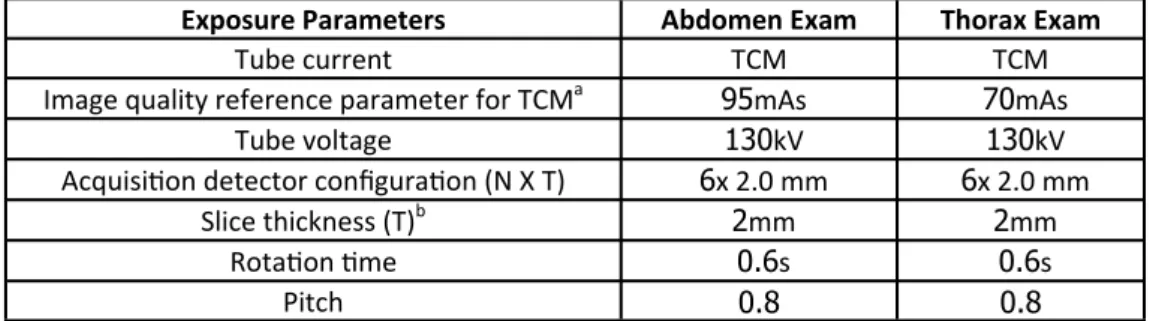
years. All patients were scanned using a Siemens Somatom Emotion 6 CT scanner. The exposure parameters used are listed in table 1. During the scanning process, the tube current was
modulated with a quality reference of mAs (noise level) of 95 mAs for abdominal examinations and 70 mAs for thoracic examinations.
Figure 1. Captured CT dose summary from Siemens Somatom Emotion 6 showing the CDTIvol, DLP, mAs, and reference tube
current (ref) for the scan range. The rotation time (TI) and collimated slice thickness (cSL) are also shown.
Exposure Parameters Abdomen Exam Thorax Exam
Tube current TCM TCM
Image quality reference parameter for TCMa 95mAs 70mAs
Tube voltage 130kV 130kV
Acquisition detector configuration (N X T) 6x 2.0 mm 6x 2.0 mm
Slice thickness (T)b 2mm 2mm
Rotation time 0.6s 0.6s
Pitch 0.8 0.8
aFor Siemens scanners this is known as the Quality reference mAs. bFor this Siemens scanner this is known as collimated slice width (cSL).
From table 1, the acquisition detector configuration is the product of the number of
detector rows (N) and the slice thickness (T). Pitch is the ratio of the table movement per rotation and the detector configuration. The pitch factor can be freely adapted from 0.45 to 2.0. In this study, the pitch was 0.8 for both abdominal and thoracic examinations.
CTDIvol value
We obtained CTDIvol values using two
different approaches. In the first approach, CTDIvol values were taken from the CT scanner dose summary as depicted in figure 1. These values were considered reference values. The CT scanner dose summary showed not only the CTDIvol value, but also showed dose length product (DLP), the number of scans (Scan), tube voltage (kV), product of tube current-time (mAs), value of reference tube current for the range (ref), time rotation (TI) and collimated slice thickness (cSL).
In the second approach, CTDIvol values were calculated from normalized CTDIvol values obtained from proprietary software (ImPACT CT Patient Dosimetry Calculator version 1.0.1a). The unit of normalized CTDIvol is mGy/100 mAs.
The normalized CTDIvol is dependent on manufacturer, type of scanner, tube voltage,
pitch, collimation width, and so on. If the tube current (mA) and time rotation (s) values are known, then the CTDIvol can be determined.
The CTDIvol value depends on the average tube current (mA). The tube currents in the TCM technique were taken from the DICOM headers
and then averaged using equation (1) (35).
(1) Figure 2 is a screenshot form for calculating average tube current and CTDIvol. The images of all the slices were opened using the TCM button,
and all respective tube current values were extracted from the DICOM header and averaged. Figure 2 shows the profile tube current along the longitudinal axis and the average value of tube current (next to TCM button).
292
Figure 2. Screenshot form for calculating average tube current and CTDIvol.
Water-equivalent diameter (Dw) and
size-specific dose estimate (SSDE)
In the TCM technique, the tube current was dynamically changed to fit the attenuating patient expressed in water-equivalent diameter (Dw). The Dw value was calculated for every slice using equation (2):
(2)
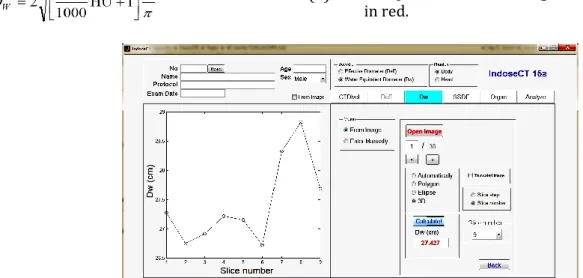
The average Dw value was estimated using 9 positions, the central slice and 4 slices to the
right and left of it. A previous study (17) showed
that estimating the average Dw using 9 positions was similar to the average of all slices to within less than 1%. The screenshot form for calculating average Dw is shown in figure 3. It shows the profile Dw along the longitudinal axis at 9 positions. The average Dw value is indicated in red.
Figure 3. Screenshot form for calculating average Dw. It shows the profile of Dw along the longitudinal axis at 9 positions.
Estimating the dose for a specific patient should take into consideration the CTDIvol and
conversion factor as a function of
water-equivalent diameter (k(Dw)). This
conversion factor was taken from AAPM report
204. The equation for estimating SSDE is equation (3).
(3)
A screenshot form for calculating SSDE is shown in figure 4. It shows the conversion factor as a function of water-equivalent diameter based on a body PMMA phantom. In this example, Dw was 27.43 cm, k(Dw) was 1.35, CTDIvol was 5.66 mGy, and the estimated SSDE was 7.63 mGy.
Figure 4. Screenshot form for estimating SSDE.
RESULTS
Dw and tube current
The aim of the TCM technique is to reduce the dose to a small patient. The technique is carried out by reducing tube current in low attenuating
regions. The attenuation of the body is characterized by water-equivalent diameter
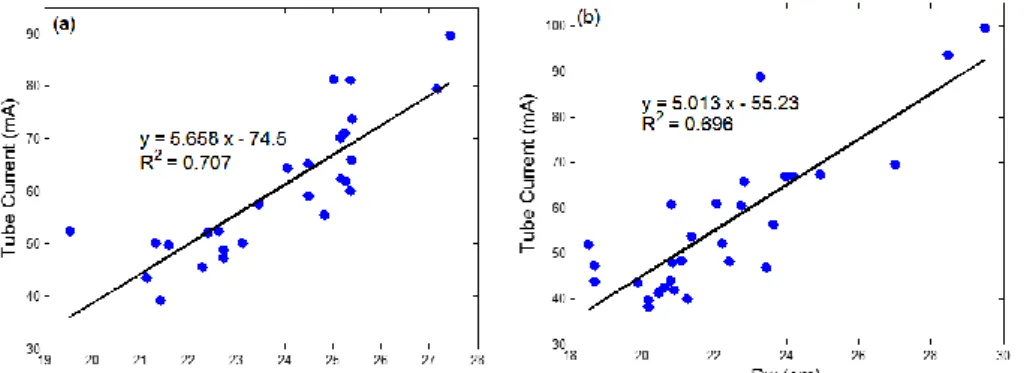
(Dw) which takes into consideration both the size and composition. The relationships between average Dw and average tube current are shown
in figure 5. As expected there is a linear correlation between average Dw and average
tube current. Values of R2 were 0.707 and 0.696
for abdominal and thoracic examinations, respectively. The average Dw value for the abdomen was 23.9 ± 1.9 cm, and the average Dw for the thorax was 22.2 ± 2.7 cm. The average tube current for the abdomen was 60.5 ± 12.9 mA, and the average tube current for the thorax was 56.0 ± 16.0 mA.
Figure 5. The relationships between average water-equivalent diameter (Dw) and average tube current for (a) abdomen and (b)
thorax.
Tube current and CTDIvol
The relationships between average tube current and reported CTDIvol are shown in figure 6. It shows linear correlations between average
tube current and CTDIvol with R2 values of 0.997
and 0.992 for abdominal and thoracic regions, respectively.
Reported and calculated CTDIvol
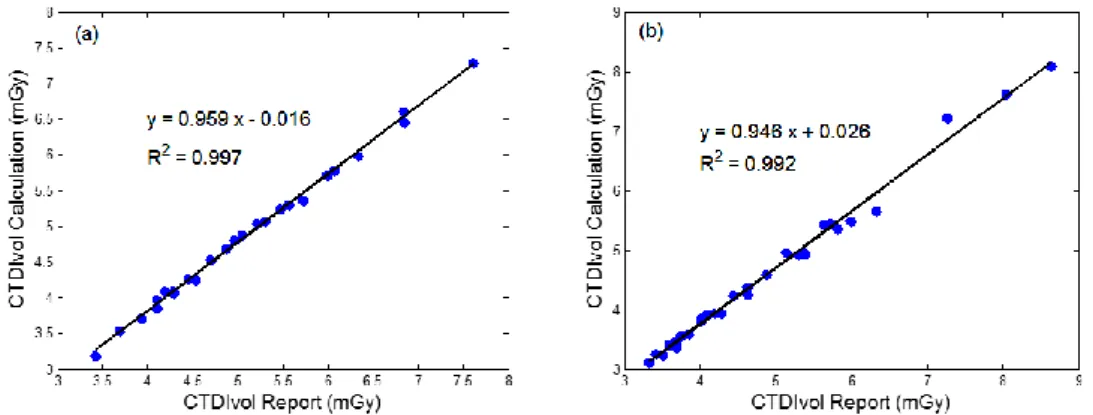
The relationships between reported CTDIvol and calculated CTDIvol are shown in figure 7. It
shows linear correlations with R2 values of
0.997 and 0.992 for abdominal and thoracic
regions, respectively. The values of calculated and reported CTDIvol are listed in table 2.
Tube current and SSDE
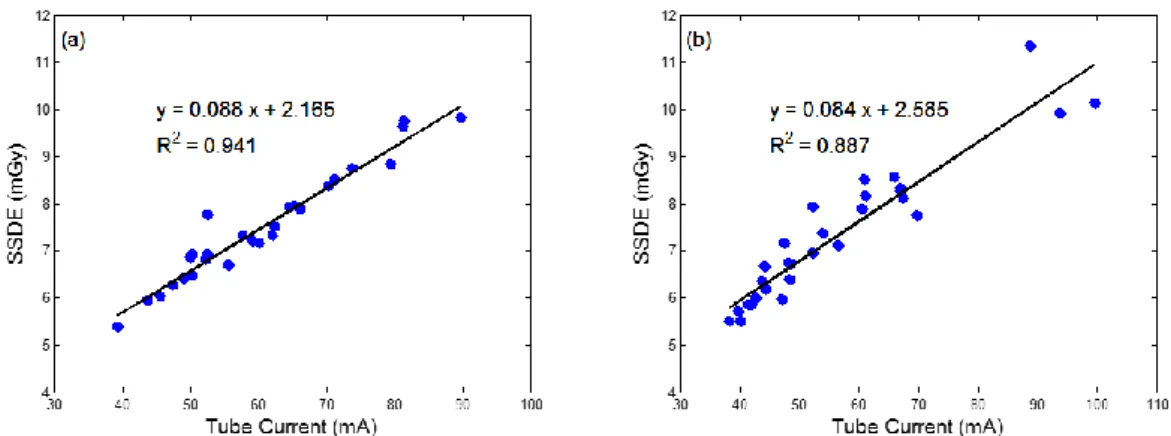
The relationships between average tube current and SSDE are shown in figure 8. It shows linear correlations between average tube
current and SSDE with R2 values of 0.941 and
0.887 for abdominal and thoracic regions, respectively. The SSDE values were 7.6 ± 1.2 mGy for the abdomen, and 7.3 ± 1.4 mGy for the thorax.
Figure 6. The relationships between average tube current and reported CTDIvol by scanner for (a) abdomen and (b) thorax.
Figure 7. The relationships between reported CTDIvol by scanner and calculated CTDIvol for (a) abdomen and (b) thorax.
Examination CTDIvol (mGy) Percentage
Difference (%)
Report Calculation
Abdomen 5.1 ± 1.1 4.9 ± 1.1 4.4 ± 1.2
Thorax 4.8 ± 1.4 4.6 ± 1.3 6.0 ± 2.0
Table 2. The values of calculated and reported CTDIvol for abdominal and thoracic regions
be estimated prior to the scanning process. Direct Dw calculation is not trivial. However, it can easily be estimated using the effective diameter (Deff) calculated as the square root of the product lateral diameter (LAT) and the
anterior-posterior (AP) diameter (16). The
conversion factors from Deff to Dw are available (12, 36, 37), so that it is possible to estimate the average tube current using Dw and Deff in the TCM technique prior to the scanning process.
By using average tube current, it is also possible to estimate the output CT dose in terms
of CTDIvol. We have shown that there is a strong linear correlation between the average tube
current and CTDIvol, with R2 values of 0.997 and
0.992 for abdominal and thoracic regions, respectively. However, CTDIvol is a metric which measures the output CT scan dose, and it was not intended to measure the dose to the patient. The patient dose should take into consideration both CTDIvol and the attenuation of the patient in terms of water equivalent diameter (Dw). The metric used for estimating the patient dose is size-specific dose estimate (SSDE). It was shown in this study that there is a strong correlation
between average tube current and SSDE, with R2
values of 0.941 and 0.887 for abdominal and thoracic regions respectively.
The relationships between average tube current, CTDIvol and SSDE were interesting. When the tube current varied by a factor of 2.5 the CTDIvol also varied by a factor of 2.5, but the
SSDE only varied by a factor of 2 for both abdominal and thoracic regions. Relationships
between Deff, CTDIvol and SSDE have also been
reported by others(38-40). Israel et al. (38) showed
DISCUSSION
This study estimates the values of CTDIvol and SSDE in a CT scanner equipped with TCM. To calculate the CTDIvol, the exposure parameters, e.g. tube current, should be known. Since the tube current fluctuates during the TCM scanning process, the tube currents were averaged after being extracted from the DICOM headers for every slice. With this approach, it was possible
to estimate CTDIvol accurately. The calculated
CTDIvol was compared to the CTDIvol reported by the CT scanner. The percentage differences for CTDIvol were 4.4 ± 1.2% and 6.0 ± 2.0% for abdominal and thoracic regions respectively. Our calculated results of CTDIvol are acceptable, since the percentage differences from reported CTDIvol were less than 10%. The calculation of CTDIvol in the TCM technique using ImPACT software and extracting the tube current from the DICOM header had been previously
proposed by Lin et al. (35). However they tested
the methodology only for the thoracic region of one patient. Their calculated CTDIvol using the ImPACT software was 5.7 mGy and the value reported by the scanner was 5.03 mGy (i.e. a
percentage difference of 13.3 %) (35).
In the TCM technique, the tube current dynamically fluctuates based on the attenuating
region in terms of the water-equivalent diameter (Dw). This study showed that there is a
linear relation between Dw and the average tube
current with R2 values of 0.707 and 0.696 for
abdominal and thoracic examinations
respectively. Therefore, the average tube current can be estimated by using Dw, and it can
Figure 8. The relationships between average tube current and SSDE for (a) abdomen and (b) thorax.
that the exposure varied by a factor of three between individuals who weighed 60 kg and those who weighed 100 kg, and that the dose to the liver varied by a factor of two when TCM (GE Healthcare, Milwaukee, Wis) was used.
Schindera et al. (39) also showed a similar
relationship between radiation exposure and dose with the same scanner. However, Christner et al (40) reported that although the exposure was proportional to patient size, SSDE was independent of patient size using TCM with a
different scanner (Siemens Healthcare,
Forchheim, Germany). Specifically, CTDIvol increased from 12 to 26 mGy as the sum of AP and LAT dimensions increased from 42 to 84 cm. However, this result reflects the different
noise level used. Christner et al (40) explained
that the TCM in their work required lower noise values in children and allowed higher noise values in obese adults compared to adults of standard size. By contrast, the TCM systems
used by Israel et al (38) and Schindera et al (39)
produced a constant level of image noise regardless of patient size.
Our study has shown that CTDIvol and SSDE in
the TCM technique can be estimated using average tube current extracted from the DICOM
headers, and the average tube current can be estimated by the water-equivalent diameter (Dw). There are a number of limitations to our study. Firstly, the study is limited to only two anatomic regions, namely the abdomen and thorax. It will be interesting to evaluate the examination of other regions. Secondly, the effect of TCM is affected by noise level (reference mAs) as the results of previous
studies (38-40). Our study is limited to only one
reference mAs in the abdominal examination (95 mAs) and one reference value in the thoracic examinations (70 mAs). It will be useful to evaluate the effect of different noise levels (reference mAs) in the future. Thirdly, this study is limited to only one particular scanner.
CONCLUSION
We successfully developed a calculator for estimating CTDIvol and SSDE from a CT scanner
equipped with the TCM technique. The calculator used the average tube current from all slices, which is obtained from the DICOM headers. Our study showed that the percentage differences between calculated and reported CTDIvol values were less than 10%. We demonstrated that SSDE can be estimated using average tube current and the water-equivalent diameter (Dw).
ACKNOWLEDGEMENTS
This work was funded by RIK (Riset & Inovasi KK), LPPM, Institut Teknologi Bandung (ITB), No. 006n/I1.C01/PL/2016 and Penelitian Disertasi Doktor, Kementerian Riset, Teknologi, dan Pen-didikan Tinggi, Republik Indonesia. The authors would like to thank Dr. Sue Edyvean from ImPACT and Mr. Masdi from Prof. Dr. Margono Hospital, Indonesia.
Conflicts of interest: Declared none.
REFERENCES
1. IAEA (2009) Dose reduction in CT while maintaining diagnostic confidence: a feasibility/demonstration study, IAEA-TECDOC-1621
2. IAEA (2011) Status of computed tomography: dosimetry for wide cone beam scanners, IAEA-Human Health Reports No. 5.
3. Goldman LW (2007) Principles of CT: radiation dose and image quality. J Nucl Med Technol, 35: 213-225.
4. Castellano I and Geleijns J (2007) Computed tomography, in physics for medical imaging applications, edited by Lemoigne Y, Caner A, and Rahal G, Springer.
5. Seram E (2001) Computed tomography: physical principles, clinical application and quality control, W.B. Saunders Company.
6. Bauhs JA, Vrieze TJ, Primak AN, Bruesewitz MR, and McCollough CH (2008) CT dosimetry: comparison of measurement techniques and devices. RadioGraphics,28: 245-253.
7. Brenner DJ and Hall EJ (2007) Computed tomography˗An increasing source of radiation exposure. N Engl J Med,
357: 2277-2284.
8. Kim S, Song H, Samei E, Yin F, Yoshizumi TT (2011) Com-puted tomography dose index and dose length product for cone-beam CT: monte carlo simulations of a commercial system. J Appl Clin Med Phys,12: 84-95.
296
9. Li J, Udayasankar UK, Toth TL, Seamans J, Small WC, and Kalra MK (2006) Automatic patient centering for MDCT: effect on radiation dose. AJR Am J Roentgenol,188: 547– 552.
10.Li X, Samei E, Segars WP, Sturgeon GM, Colsher JG, Frush DP (2008) Patient-specific dose estimation for pediatric chest CT. Med Phys, 35 (12): 5821–5828.
11.Anam C, Haryanto F, Widita R, Arif I, Dougherty G, McLean D (2017) The impact of patient table on size-specific dose estimate (SSDE). Australas Phys Eng Sci Med,40: 153-158. 12.Anam C, Haryanto F, Widita R, Arif I, Dougherty G (2016) A
fully automated calculation of size-specific dose estimates (SSDE) in thoracic and head CT examinations. J Phys Conf Ser,694: 012030.
13.Nasir M, Pratama D, Anam C, Haryanto F (2016) Calcula-tion of size specific dose estimates (SSDE) value at cylindrical phantom from Varian OBI CBCT v1.4 X-ray tube EGSnrc Monte Carlo simulation based. J Phys Conf Ser,
694: 012040.
14.Anam C, Haryanto F, Widita R, Arif I (2015) Automated estimation of patient’s size from 3D image of patient for size specific dose estimates (SSDE). Adv Sci Eng Med,7: 892-896.
15.Kalender WA (2014) Dose in X-ray computed tomography.
Phys Med Biol,59: R129–R150.
16.AAPM (2011) Size-specific dose estimates (SSDE) in pediatric and adult body CT examinations, AAPM Report No 204.
17.Anam C, Haryanto F, Widita R, Arif I, Dougherty G (2016) Automated calculation of water equivalent iameter (DW)
based on AAPM report TG. 220. J Appl Clin Med Phys, 17: 320-333.
18.McCollough CH, Bruesewitz MR, Kofler JM (2006) CT dose reduction and dose management tools: overview of available options. RadioGraphics, 26: 503–512.
19.Kalra MK, Maher MM, Toth TL, Hamberg LM, Blake MA, Shepard J, Saini S (2004) Strategies for CT radiation dose optimization. Radiology, 230: 619-628.
20.Kalra MK, Wittram C, Maher MM, Sharma A, Avinash GB, Karau K, Toth TL, Halpern E, Saini S, Shepard J (2003) Can noise reduction filters improve low-radiation-dose chest CT images? pilot study. Radiology, 228: 257-264.
21.Anam C, Haryanto F, Widita R, Arif I (2015) New noise reduction method for reducing CT scan dose: combining wiener filtering and edge detection algorithm. AIP Conf Proc,1677: 040004.
22.Kalender WA, Wolf H, Suess C (1999) Dose reduction in CT by anatomically adapted tube current modulation. II. Phantom measurements. Med Phys, 26: 2248-2253. 23.Kalra MK, Maher MM, Toth TL, Kamath RS, Halpern EF,
Saini S (2004) Comparison of Z-axis automatic tube current modulation technique with fixed tube current CT ccanning of abdomen and pelvis. Radiology,232: 347-353.
24.McCollough CH (2005) Automatic exposure control in CT: are we done yet? Radiology,237: 755-756.
25.Khatonabadi M, Kim HJ, Lu P, McMillan KL, Cagnon CH, DeMarco JJ, McNitt-Gray MF (2013) The feasibility of a regional CTDIvol to estimate organ dose from tube current
modulated CT exams. Med Phys, 40: 051903.
26.Shope TB, Gagne RM, Johnson GC (1981) A method for describing the doses delivered by transmission X-ray computed tomography. Med Phys,8: 488–495.
27.Anam C, Haryanto F, Widita R, Arif I, Dougherty G (2016) Profile of CT scan output dose in axial and helical modes using convolution. J Phys Conf Ser,694: 012034.
28.Kalender WA, Seissler W, Klotz E, Vock P (1990) Spiral volumetric CT with single-breath-hold technique, continuous transport, and continuous scanner rotation.
Radiology,176: 181-183.
29.Wang G and Vannier MW (1999) The effect of pitch in multislice spiral/helical CT. Med Phys,26: 2648-2653. 30.AAPM (1993) Specification and acceptance testing of
computed tomography scanners. Report of TG 2 Diagnostic X-Ray Imaging Committee No 2, AAPM Report No. 39
31.AAPM (2008) The measurement, reporting, and management of radiation dose in CT. Report of AAPM TG of the Diagnostic Imaging Council CT Committee No. 23, AAPM Report No. 96.
32.IAEA (2007) Dosimetry in diagnostic radiology: an international code of practice. IAEA-Technical Report Series No. 457.
33.Zhang D, Cagnon CH, Villablanca JP, McCollough CH, Cody DD, Zankl M, Demarco JJ, McNitt-Gray MF (2013) Esti-mating peak skin and eye lens dose from neuroperfusion examinations: use of Monte Carlo based simulations and comparisons to CTDIvol, AAPM report No. 111, and ImPACT dosimetry tool values. Med Phys, 40: 091901. 34.Lee C, Kim KP, Long DJ, a Bolch WE (2011) Organ doses for
reference adult male and female undergoing computed tomography estimated by Monte Carlo simulation. Med Phys, 38: 1196–1206.
35.Lin PP, Kubo T, Krishnapillai R (2010) Extraction of tube current values from DICOM CT images for patient dose estimation. Med Phys, 37: 2951-2955.
36.Ikuta I, Warden GI, Andriole KP, Khorasani R, Sodickson A (2014) Estimating patient dose from X-ray tube output metrics: automated measurement of patient size from CT images enables large-scale size-specific dose estimates.
Radiology, 270: 472-480.
37.McMillan K, Bostani M, Cagnon C, Zankl M, Sepahdari AR, McNitt-Gray MF (2014) Size-specific, scanner-independent organ dose estimates in contiguous axial and helical head CT examinations. Med Phys, 41: 121909.
38.Israel GM, Cicchiello L, Brink J, Huda W (2010) Patient size and radiation exposure in thoracic, pelvic, and abdominal CT examinations performed with automatic exposure control. AJR Am J Roentgenol, 195: 1342–1346.
39.Schindera ST, Nelson RC, Toth TL, Nguyen GT, Toncheva GI, DeLong DM, Yoshizumi TT (2008) Effect of patient size on radiation dose for abdominal MDCT with automatic tube current modulation: phantom study. AJR Am J Roentgenol, 190: W100–W105.
40.Christner JA, Braun NN, Jacobsen MC, Carter RE, Kofler JM, McCollough CH (2012) Size-specific dose estimates for adult patients at CT of the torso. Radiology, 265: 841–847.