Expression-robust 3D Face Recognition using Bending Invariant Correlative
Features
Yue Ming and Qiuqi Ruan Senior Member, IEEE
Institute of Information Science, Beijing JiaoTong University, Beijing 100044, P.R. China E-mail: [email protected]
Keywords:3D face recognition, 3D bending invariant correlative features (3D BI-LBP), spectral regression (SR)
Received:July 1, 2010
In this paper, a novel 3D Bending Invariant Correlative Features (3D BI-LBP) is used for 3D face recog-nition to overcome some of the unsolved problems encountered with 3D facial images. In this challenging topic, large expression and pose variations along with data noise are three major obstacles. We first ex-ploit an automatic procedure regarding face area extraction, and then process it to minimize the effect of large pose variations and effectively improve the total 3D face recognition performance. To overcome the large expression variations, the key idea in the proposed algorithm is a representation of the facial surface, by what is called a Bending Invariant (BI), which is invariant to isometric deformations resulting from changes in expression and posture. In order to encode relationships in neighboring mesh nodes, 3D LBP is used for the obtained geometric invariant, which own more potential power to describe the structure of faces than individual points and effectiveness in characterizing local details of a signal. The signature images are then decomposed into their principle components based on Spectral Regression (SR) resulting in a huge time saving. Our experiments were based on the CASIA and FRGC 3D face databases which contain large expression and pose variations. Experimental results show our proposed method provides better effectiveness and efficiency than many commonly used existing methods for 3D face recognition and handles variations in facial expression quite well.
Povzetek: Razvita je nova metoda za prepoznavanje 3D obrazov.
1
Introduction
Information and Communication Technologies are gradu-ally entering all aspects of our life. They are also opening a world where people unprecedentedly interact with elec-tronic devices embedded in environments sensitive and re-sponsive to the presence of users. These scenarios offer the opportunity to exploit the potential of faces as a non-intrusive biometric identifier to not just regulate access to a controlled environment but also to adapt provided services to the preferences of a recognized user.
Automatic human face recognition is an important re-search area within the field of biometric identification. Compared with other biometric features, face recognition has the advantages of pro-active, non-invasiveness and user-friendliness and has gained great attention during the last decade [1]. While, currently, most efforts are devoted to face recognition using 2D images, they continue to en-counter difficulties in handling large facial variations due to head pose, lighting conditions and facial expressions. 2D face recognition systems have a strict constrain on improv-ing accuracy. So far it is still quite difficult to build a robust automatic human face recognition system.
Many researchers are committed to utilizing of three-dimensional information to overcome some of the diffi-cult issues associated with face recognition. Range images
which contain texture and shape information are very effec-tive for recognition of a face image, when comparing one face with another face. There is evidence that range images have the potential to overcome problems inherent in inten-sity and color images. Some advantages of range images are explicit representation of the 3D shape, invariance un-der change of illumination, pose and reflectance properties of objects.
In view of the shortcomings of the 2D approaches, a number of 3D and 3D+2D multi-modal approaches have recently been proposed. We extensively examined the prior literature on 3D face recognition, which can be catego-rized into methods using point cloud representations, depth images, facial surface features or spherical representations [2]. A priori registration of the point clouds is commonly performed by ICP algorithms with 92.1% rank-one identifi-cation on a subset of FRGC v2 [3]. Based on depth images, Faltemier et al. [4] introduced concentrate dimensional re-duction based on the fusion of results from group regions that have been independently matched. Facial surface fea-tures, such as curvature descriptors [5], have also been pro-posed for 3D face recognition.
addition, Kakadiaris et al. [9] used an annotated face model to fit the changes of the face surface and then ob-tained the deformation image by a fitting model. A mul-tistage alignment algorithm and advanced wavelet analy-sis resulted in robust performance. They reported a best performance of 97.0% verification as a 0.1% FAR. Face recognition combining 3D shape and 2D intensity/color in-formation is a developing area of research. Mian et al. [10] handled the expression problem using a fusion scheme in which three kinds of methods, spherical face representa-tion (SFR), scale-invariant feature transform (SIFT)-based matching and a modified ICP were combined to achieve the final result. Their results showed the potential of appearance-based methods for solving the expression prob-lem in 3D face recognition. Because of the extremely high dimensionality of the Gabor features for depth and intensity images, Xu et al. [11] proposed a novel hierarchical selec-tion scheme with embedded LDA and AdaBoost learning for dimensionality reduction. With this scheme an effec-tive classifier can be built. However, some details in these approaches are ignored on how depth and intensity infor-mation contributes to recognition with expression and pose variations.
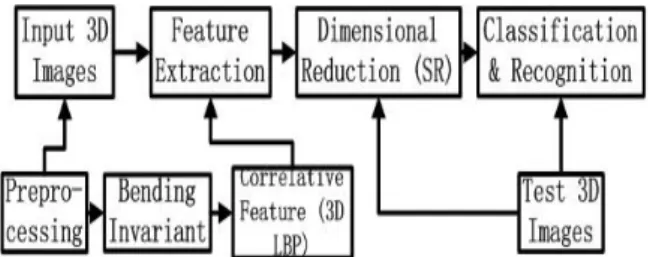
In this paper, we address the major challenges of 3D field-deployable face recognition systems. We propose a novel framework for expression-robust 3D face recogni-tion. The flowchart is shown in Fig.1. Our method can be divided into feature extraction, dimension reduction and classification sections. For all sections, because expres-sion variations and data noise are major obstacles to good system performance, we preprocess the raw 3D data and extract the face area which is least affected by expression changes. In the feature extraction section, the Bending In-variant and its statistical codebook analysis of correlative features are used to describe the intrinsic geometric infor-mation, denoted as 3D BI-LBP. This procedure very ef-fectively eliminates the effect of the expression variations. With dimensional reduction based on Spectral Regression, more useful and significant features can be produced for a face than can be produced by current methods, resulting in a huge saving in computational cost. Finally, we achieve face recognition using Nearest Neighbor Classifiers. The
Figure 1: The Framework of 3D Face Recognition
rest of this paper is organized as follows. First, we de-scribe the automatic face registration process that permits alignment the 3D point clouds before analysis in section 2.
Section 3 describes the Bending Invariant Correlative Fea-tures (3D BI-LBP) used in our framework. Section 4 intro-duces Spectral Regression (SR) for reducing dimensions and classifier construction. Section 5 reports the experi-mental results and gives some comparisons with existing algorithms. Finally, the paper is concluded in section 6.
2
Automatic preprocessing of 3D
face data
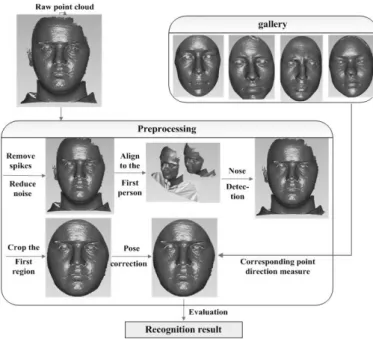
In this paper, one face is described by one 3D scattered point cloud from one 3D laser scanner as illustrated in Fig.2. The preprocessing scheme is based on three main tasks, respectively the extraction of the facial region, the registration of the 3D face, and the acquisition of the nor-malized depth and intensity images. They are fully auto-mated; handling noisy and incomplete input data are im-mune to rotation and translation and suitable for different resolutions.
The main purpose of face extraction is to remove irrel-evant information from the 3D point clouds, such as data corresponding to shoulders or hair, and spikes obtained by a laser scanner. First in face extraction, we estimate a verti-cal projection curve from the point cloud by computing the column sum of the valid point’s matrix [2, 12]. Then, we define two lateral thresholds on the left and right inflexion points of the projection curve for removing data points on the subject’s shoulders beyond these thresholds. We further remove the data points corresponding to the subject’s chest by thresholding of the histogram of depth values. Finally, we remove outlier points that remain in regions discon-nected from the main facial area and treat only the largest region as the facial region.
After extracting the main facial region from a 3D scan, registration (pose correction) is performed. We present a multistage approach for automatic registration that offers robust and accurate alignment even in the presence of fa-cial expression variations. First, we compute the orthogo-nal eigenvectors,v1,v2,v3, of the covariance matrix of the
point cloud, as the three main axis of the point cloud. We rotate the point cloud so that v1,v2,v3 are parallel to Y-,
Figure 2: Main steps in facial region preprocessing.
3
Feature extraction
3.1
Bending invariant
The core of our 3D face recognition framework is the repre-sentation of a facial surface which is invariant to isometric deformations, by bending invariants (BI) [16, 17]. This pa-per extends our previous work [18-20]. The class of trans-formations that a facial surface can undergo is not arbitrary, and empirical observations show that facial expressions can be modeled as isometric (or length-preserving) transforma-tions [21]. Therefore, we introduced an efficient feature for constructing a signature for isometric surfaces, referred to as a bending invariant. The Bending Invariant is a poly-hedral approximation of the facial surface obtained by per-forming an Isomap on a reduced set of points and interpo-lating on the full set of points.
Given a facial surfaceM(x,y,z)∈R3, the bending invari-antIM(x,y,z)∈R3is the output of an Isomap algorithm. A
geodesic isometric is formally a mappingψ: M→M′such that
dM(x,y,z) =dM′(ψ(x),ψ(y),ψ(z)),
∀(x,y,z)∈M3 (1)
One of the crucial practical requirements for the con-struction of the invariant feature of a given surface, is an efficient algorithm for the computation of the geodesic dis-tance on the surface, that is,dM(x,y,z). Computation of the
geodesic distance can effectively reflect the facial shape in-formation and overcome some of the unsolved problems encountered with 3D facial images, such as large expres-sion and pose variations along with data noise. A numer-ically consistent algorithm for the computation of the dis-tance between a surface vertex and the rest of the n
sur-face vertices on a regular triangulated domain inO(n) op-erations is referred to as fast marching on triangulated do-mains (FMTD) [16]. After distance computation, we can obtain an approximation of the geodesic distance by sam-pling the continuous surface on a finite set of points and making discrete the metric associated with the surface.
The metric is invariant under isometric surface deforma-tion, depending on an arbitrary ordering of the points. We would like to obtain a geometric invariant, which is both unique for isometric surfaces and allows using simple rigid surface matching to compare the invariants.
Based on the discussion above, this is equivalent to find-ing a mappfind-ing between two metric spaces,φ:(M,dM)→
(Rm,d);φ(pi) =xiwhich minimizes the embedding error,
ε=f(|dM−d|);d=xi−xj2 (2)
d is the distance to embed the surface into a low-dimensional Euclidean space Rm based on Isomap [21]. The m-dimensional representation obtained is a set of points xi ∈Rm(i=1, ...,n) corresponding to the surface
pointspi.
The embedding inRmis performed by double-centering the matrix ∆:B=−12J∆J(hereJ=I−12U,I is ann×n
identity matrix, andU is a matrix consisting entirely of one’s). The first meigenvectors ei, corresponding to the mlargest eigenvalues ofB, are used as the embedding co-ordinates
xij=eij;i=1, ...n,j=1, ...,m (3)
where xij denotes the j−th coordinate of the vector
xi. Eigenvectors are computed using a standard
eigen-decomposition method. Since onlymeigenvectors are re-quired (usually,m=3), the computation can be done effi-ciently.
Through an Isomap, 3D face samples are mapped to a lower dimensional feature space from a higher dimensional observation space via non-linear mapping, thereby build-ing a mutual mappbuild-ing between the higher dimensional data manifold space and the lower dimensional representative space. This brings out intrinsic lower dimensional struc-ture hidden in the higher dimensional observational data. This has many positive benefits, such as compressing data thereby reducing storage requirements, removing unneces-sary noise, extracting effective features for recognition and providing visualization of higher dimensional data.
Finally, interpolation is used to obtain a geometric in-variant on the full set of points. The primary property of bending invariants is that up to rigid motion, IM they are
invariant to geodesic isometrics.
IM(x,y,z) =ν+U IM′(ψ(x,y,z)),
U∈O(3),ν∈R3 (4)
sampling can nicely inherit the ability of local preserva-tion and at the same time increase separability, which over-comes expression and pose variations to some extent.
Next we can describe the Bending Invariant (BI) of each mesh point using the following vector,
BI={b1,b2,· · ·,bn} (5)
where bi is the Bending Invariant of each mesh point i.
Then all Bending Invariants are normalized to [0, 255]. This vector is a representation of the surface that is invari-ant under geodesic isometrics, effectively extracting the in-formation about rigid objects and overcoming the problems associated with facial expression variations.
3.2
Correlative features
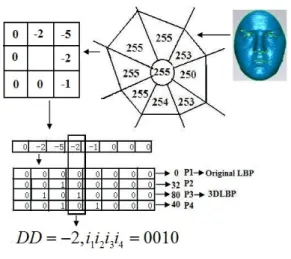
Local Binary Pattern (LBP) operator is first proposed by Ojala et al. [22] for texture analysis and has been success-fully applied to 2D face recognition by Timo et al. [23]. Based on the LBP operator, only encoding signs of the Bending Invariant differences of mesh nodes is not ade-quate for describing 3D faces. This is because different Bending Invariant differences on the same point of a facial surfaces distinguishes different faces. For example nose tips with depth 255 [24]. As a result, if two facial regions of different persons on the same place have the same trends of Bending Invariant variation, we further encode the ex-tract values of differences into binary patterns as shown in Fig. 3. To obtain local correlative features of facial sur-face, 3D Local Binary Patterns (3D LBP) is introduced to 3D face recognition. 3D LBP not only enhances local prop-erties and details the texture information of facial images, but also extracts local details effectively improving recog-nition, in addition to being intensive to expression, pose and illumination variations.
First, the Bending Invariant of each node in 3D face mesh model is subtracted by their neighbors and the dif-ferences are converted to binary units: 0 or 1 according to their signs. Then, binary units are arranged clockwise and a set of binary units as the local binary pattern of the node is obtained.
According to our statistical analysis, more than 91% of the Bending Invariant differences between points are small than 7. Three binary units ({i2i3i4}) can correspond to the
binary number of the absolute value of the Bending Invari-ant difference (DD): [0, 7] and are assigned to Layer 2, Layer 3 and Layer 4 respectively. The head binary units (i1)
is the original LBP codebook. Four binary units are divided into four layers and each of them is assigned clockwise. The binary pattern of each layer is further transformed to decimal number:P1,P2,P3,P4at each node point as its
cor-relative feature representation. Finally, histograms of the four maps are concatenated as geometric statistics of cor-relative features for recognition.
i1=
{
1,DD≥0 0,DD<0 ,
|DD|=i2·22+i3·21+i4·20
(6)
The method also enhance image low-level features like edges, peaks, valleys, and ridges, which is equal to enhanc-ing key facial element information such as the nose, eyes, and mouth plus local characteristics like dimples, melan-otic nevus and scars. They not only preserve global facial information but also enhance local characteristics. When the pose, expression and position of a face change, local changes are smaller than global changes, resulting are a very effective face representation.
Figure 3: The Flowchart of 3DLBP
4
Spectral regression (SR)
In learning section Spectral Regression is adopted to learn principle components from each 3D facial image based on 3D Bending Invariant Correlative Features (3D BI-LBP) and these components are stored into the corresponding sub-codebook. Suppose we have m face range images. Let{xi}mi=1⊂Rn(n=1024)denote their vector
representa-tions. Dimensionality reduction aims at finding{zi}mi=1⊂ Rd,d≪n, wherezi can "represent"xi. In order to reflect
the relationship of 3D face data among different samples better, Spectral Regression (SR) is introduced to reduce di-mensions [25]. The algorithm divides into two steps.
The first one is regularized least squares. Findc−1 vec-torsa1, ...,ac−1∈Rn(k=1, ...,c−1)is the solution of
reg-ularized least square problem
ak=arg min a
(
m
∑
i=1(aTxi−yki)2+α∥a∥2) (7)
whereyki is thei−thelement ofyk. It is easy to check that akis the solution of linear equations system:
whereIis an×nidentity matrix. The canonical Gaussian elimination method can be used to solve this linear equa-tions system [25]. WhenXis large, some efficient iterative algorithms (eg., LSQR [26]) can be used to directly solve the above regularized least square problem.
The second one is SR Embedding. LetA= [a1, ...,ac−1], Ais an×(c−1)transformation matrix. The samples can be embedded intoc−1 dimensional subspace by
x→z=ATx (9)
Computational complexity is shown [25] that Spectral Regression decreases the complexity from cubic-time to linear-time which is a huge speed-up. The dimensionality reduction process and subspace projection based on Spec-tral Regression preserve the discriminated facial informa-tion which is able to capture salient facial characteristics and is further enhanced for improved recognition perfor-mance by effective matching in the reduced space.
5
Experimental and analysis
In this paper, we present our results evaluating the perfor-mance of our framework using the Face Recognition Grand Challenge (FRGC) data corpus, which is organized in 2004 by NIST [12]. FRGC data contain a variety of facial ex-pressions. Therefore it allows design of additional experi-ments to evaluate the effect of such variation. In this sec-tion, we demonstrate the excellent performance of our pro-posed scheme by comparing experiments in terms of differ-ent algorithms and differdiffer-ent reducing dimension schemes. All of our experiments have been implemented in Matlab 7.5 and run on a P4 2.1 GHz Windows XP machines with 2GB memory.
5.1
Experiments with different algorithms
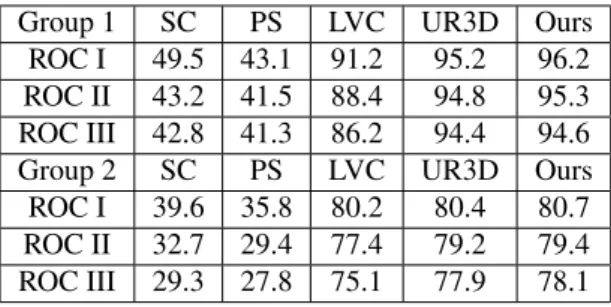
In this experiment, we make detailed comparisons with some existing methods for 3D face recognition to show the performance of the proposed algorithm. The considered features include surface curvature (SC) [5], point signature (PS) [27], Learned Visual Codebook (LVC) [28], UR3D [9] and our proposed framework for 3D face recognition. The different features are extracted for each node. In the FRGC verification, three mask are defined over the square simi-larity matrix which holds the simisimi-larity value between all subject sessions. Each mask produces three different Re-ceiver Operating Characteristic (ROC) curves, which will be referred to as ROC I, II and III. In ROC I all the data are within semesters, in ROC II they are within the year, while in ROC III the samples are between semesters. The FRGC data corpus can be divided into two disjoint sub-sets, depending on whether the subset has a neutral facial expression or not. Table 1 shows the verification rates for ROC I, II and III.
From these results, we can draw the following conclu-sions: The highest verification rates is up to 96.2% which
Table 1: Verification Rates (%) for ROC I, II and III (FAR=10−3)
Group 1 SC PS LVC UR3D Ours ROC I 49.5 43.1 91.2 95.2 96.2 ROC II 43.2 41.5 88.4 94.8 95.3 ROC III 42.8 41.3 86.2 94.4 94.6 Group 2 SC PS LVC UR3D Ours ROC I 39.6 35.8 80.2 80.4 80.7 ROC II 32.7 29.4 77.4 79.2 79.4 ROC III 29.3 27.8 75.1 77.9 78.1 group 1: 5 images with only neutral expression group 2: 10 images with non-neutral expression
was obtained by our framework. Shape variation is the im-portant information for characterizing an individual and the depth feature vector reflecting shape variation improves the verification rates distinctly in Table 1; Expression varia-tions affect performance strongly and BI, a novel feature can obtain a representation of the surface which is invari-ant under geodesic isometries and decrease the influence of expression effectively; Statistical codebook analysis (3D LBP) can encode relationships between neighboring mesh nodes and 3D LBP based on BI are likely to be correlated for nearby nodes. Experiment results show that our frame-work yields consistently better performance than existing methods in only neutral. If we increase the node number, the performance will be improved significantly. Although due to expression variations, our performance is not better than UR3D [9], we use a simpler method which spends less time and memory.
Second, we made a comparison between 3D BI-LBP and two appearance based methods, which contain local binary pattern (LBP)[23] and learned visual code-book (LVC) [28]. LBP is an efficient texture descriptor and has been successfully used for face recognition. LVC is a method which chooses K-means clustering to learn basic facial ele-ments. K-fold cross validation was used on three methods. Because of the large face database, we did two groups of experiments. In the first, 10 images of each person consist-ing of 5 neutral images and 5 images with different expres-sions were divided into 10 groups and used for K-fold cross validation. In the second, all of the expression images were divided into 10 groups for K-fold cross validation. The re-sults are presented in Table.2. It shows that our method outperformed other methods.
Table 2: Comparison of recognition rates using K-fold cross validation
Size group1(FRGC) group2(FRGC) LBP 83.32% 85.29% LVC 91.87% 92.35% 3D BI-LBP 96.75% 97.68%
Size group1(CASIA) group2(CASIA) LBP 85.17% 88.05% LVC 93.12% 94.56% 3D BI-LBP 97.08% 98.15% group 1: 5 images with neutral expression and 5 image
with different expression
group 2: 10 images with different expression
5.2
Experiments with different dimension
reducing schemes
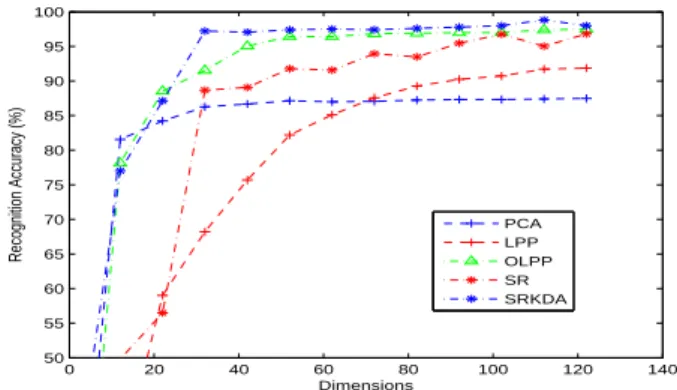
Here, we make detailed comparisons between Spectral Regression (SR) [25] and PCA [29], LPP [30], OLPP [31], SRKDA [32] to show the efficiency of our proposed method for 3D face recognition, especially where there are expression variations. In view of the recognition accuracy curves in Fig.4, we can see PCA gives a good representa-tion, which has a good recognition result in 36 dimensions. With the increase of dimensionality of the related feature vector, the recognition rate also rapidly increases. But when the dimensionality reaches 50 or higher, the recogni-tion rate nearly stabilizes at a certain level (about 90.4%). LPP obtained a better accuracy when the dimensions are more than 50 and with increasing dimensions up to 100 dimensions. This is mainly because in LPP models the local structure of a face manifold has a better discrimi-nate. When the dimensions are lower, the representation ability of LPP is worse than PCA since its basic functions are non-orthogonal. In order to overcome the limitation of LPP, OLPP was introduced based on the orthogonal basic functions. It has better representation and discriminates. As a result, it shows better recognition performance in the lower dimensions. On the other hand, OLPP is expen-sive in both time and memory. The Spectral Regression (SR) approach solves the optimization problem for linear graph embedding which reducing the cubic-time complex-ity to linear-time complexcomplex-ity [25], while Spectral Regres-sion Kernel Discriminate Analysis (SRKDA) is quadratic-time complexity. We have performed extensive experimen-tal comparisons of the state-of-the-art approaches, which demonstrate the effectiveness and efficiency of our method. In this experiment, The algorithm SR is analyzed, and used in 3D face recognition. Spectral methods have cently emerged as a powerful tool for dimensionality re-duction and manifold learning. These methods use in-formation contained in the eigenvectors of a data affinity matrix to reveal low dimensional structure in high dimen-sional data. SR casts the problem of learning an embed-ding function into a regression framework, which avoids
eigen-decomposition of dense matrices. From the experi-mental results, we can intuitively see that the actual 3D in-formation has no relation to view and illumination. Finally, compared to 2D face recognition, 3D face recognition has higher accuracy and can overcome the existing problems associated with 2D face recognition.
0 20 40 60 80 100 120 140 50
55 60 65 70 75 80 85 90 95 100
Dimensions
Recognition Accuracy (%)
PCA LPP OLPP SR SRKDA
Figure 4: The Results of Different Reducing Dimension Schemes
6
Conclusion
In this paper,we propose a novel method for 3D face recog-nition. We connect a depth feature, Bending Invariant and its statistical codebook analysis (3D BI-LBP) as an intrinsic features. Spectral Regression is used for selecting effective features and combining them to a classification. Experi-mental results show that our framework reflects the shape and geometric properties of 3D data and describes the rela-tional properties of a local shape in a neighborhood. Com-pared to the existing methods, it has demonstrated excel-lent performance. All these reasons make face very suited for Ambient Intelligence applications. Such suitability is especially true for biometric identifier such as 3D face recognition, which is the most common method used in vi-sual interactions and allows recognizing the user in a non-intrusive way without any physical contact with the sensor.
Acknowledgement
This work is supported by the Fundamental Research Funds for the Central Universities (2009YJS025). Por-tions of the research in this paper use the CASIA 3D Face Database collected by institute of Automation, Chinese Academy of Sciences.
References
[2] Llonch, R. S., Kokiopoulou, E., Tosic, I., Frossard, P. (2010) 3D face recognition with sparse spherical rep-resentations,Pattern Recognition, Elsevier, pp. 824-834.
[3] Lu, X., Jain, A. (2006) Deformation modeling for ro-bust 3D face matching,in Proceedings of IEEE Com-puter Vision and Pattern Recognition, IEEE Com-puter Society, New York, pp. 1391-1398.
[4] Faltemier, T. C., Bowyer, K. W., Flynn, P. J. (2008) A region ensemble for 3D face recognition,IEEE Trans-actions on Information Forensics and Security, IEEE Computer Society, pp. 62-73.
[5] Gordon, G. (1991) Face recognition based on depth and curvature features,in Proceedings of IEEE Com-puter Vision and Pattern Recognition, IEEE Com-puter Society, Champaign, pp. 234-247.
[6] Wang, H., Wei, H., Wang, Y. (2003) Face represen-tation under different illumination conditions,in Pro-ceedings of IEEE International Conference on Multi-media and Expo, IEEE Computer Society, Maryland, pp. 285-288.
[7] Ramamoorthi, R. (2002) Analytic PCA construc-tion for theoretical analysis of lighting variability in images of a Lambertian object, IEEE Transactions on Pattern Analysis and Machine Intelligence, IEEE Computer Society, pp. 1322-1333.
[8] Yue, Z., Zhao, W., Chellappa, R. (2008) Pose-encoded spherical harmonics for face recognition and synthesis using a single image,EURASIP Journal on Advances in Signal Processing, Hindawi Publishing Corporation, pp. 1-18.
[9] Kakadiaris, I. A., Passalis, G., Toderici, G., Mur-tuza, N., Lu, Y., Karampatziakis, N., Theoharis, T. (2007) 3D face recognition in the presence of fa-cial expressions: an annotated deformable model ap-proach, IEEE Transactions on Pattern Analysis and Machine Intelligence, IEEE Computer Society, pp. 640-649.
[10] Mian, A. S., Bennamoun, M., Owens, R. (2007) An efficient multimodal 2D-3D hybrid approach to auto-matic face recognition,IEEE Transactions on Pattern Analysis and Machine Intelligence, IEEE Computer Society, pp. 1927-1943.
[11] Xu, C., Li, S., Tan, T., Quan, L. (2009) Automatic 3D face recognition from depth and intensity Gabor fea-tures,Pattern recognition, Elsevier, pp. 1895-1905.
[12] Phillips, P. J., Flynn, P. J., Scuggs, T., Bowyer, K. W., Chang, J., Hoffman, K., Marques, J., Jaesik Min, Worek, W. (2005) Overview of the face recognition grand challenge,in Proceedings of Computer Vision and Pattern Recognition, IEEE Computer Society, San Diego, pp. 947-954.
[13] Xu, C., Wang, Y., Tan, T., Quan, L. (2006) A robust method for detecting nose on 3D point cloud,Pattern Recognition Letters, Elsevier, pp. 1687-1497.
[14] Besl, P., Mckey, N. (1992) A method of registration of 3D shapes,IEEE Transactions on Pattern Analysis and Machine Intelligence, IEEE Computer Society, pp. 239-256.
[15] Siarry, P., Berthiau, G., Durbin, F., Haussy, J. (1997) Enhanced simulated annealing for globally minimiz-ing functions of many-continuous variables, ACM Transactions on Mathematical Software, Association for Computing Machinery, pp. 209-228.
[16] Lu, X., Colbry, D., Jain, A. (2004) Three-dimensional model based face recognition,in Proceedings of In-ternational Conference on Pattern Recognition, IEEE Computer Society, Cambridge, pp. 362-366.
[17] Bronstein, A. M., Bronstein, M. M., Kimmel, R. (2003) Expression-Invariant 3D Face Recognition,in Proceedings of Audio- and Video-Based Biometric Person Authentication, Springer, Guildford, pp. 62-70.
[18] Wu, J. Y., Ruan, Q. Q., An G. Y. (2009) A joint-diffused inpainting model for underexposure image preserving the linear gemetric structure,Informatica, Slovenian Society Informatika, pp. 151-163.
[19] Wu, J. Y., Ruan, Q. Q., An G. Y. (2009) Exemplar-based image completion model employing PDE cor-rections,Informatica, Slovenian Society Informatika, pp. 259-276.
[20] Ming, Y., Ruan, Q. Q., Ni, R. R., LEARNING EF-FECTIVE FEATURES FOR 3D FACE RECOGNI-TION,Accepted by ICIP 2010, Hong Kong.
[21] Balasubramanian, M., Shwartz, E. L., Tenenbaum, J. B., de Silva, V., Langford, J. C. (2002) The Isomap Algorithm and Topological Stability, Science, Sci-ence Publisher Inc., pp. 9-11.
[22] Ojala, T., Pietikainen, M., Bunke, H. (2002) Multi so-lution gray-scale and rotation invariant texture classi-fication with local binary patterns,IEEE Transactions on Pattern Analysis and Machine Intelligence, IEEE Computer Society, pp. 971-987.
[23] Timo, A., Abdenour, H., Matti, P. (2004) Face recog-nition with Local Binary Patterns,in Proceedings of European Conference on Computer Vision, Springer, pp. 469-481.
[25] Cai, D., He, X., Han, J. (2007) Spectral regression for dimensionality reduction,Technical report, Com-puter Science Department, UIUCDCS-R-2007-2856, UIUC.
[26] Paige, C. C., Saunders, M. A. (1982) Algorithm 583 LSQR: Sparse linear equations and least squares problems,ACM Transactions on Mathematical Soft-ware, Association for Computing Machinery, pp. 195-209.
[27] Chua, C., Han, F., Ho, Y. (2000) 3D human face recognition using point signature,in Proceedings of IEEE International Conference on Automatic Face and Gesture Recognition, IEEE Computer Society, Grenoble, pp. 233-238.
[28] Zhong, C., Sun, Z., Tan, T. (2007) Robust 3D face recognition using Learned Visual Codebook,in Pro-ceedings of IEEE Conference on Computer Vision and Pattern Recognition, Minneapolis, pp. 1-6.
[29] Turk, M., Pentland, A. (1991) Eigenfaces for recog-nition,Journal of Cognitive Neuroscience, American Psychological Association, pp. 71-86.
[30] Cai, D., He, X. F., Han, J. W. (2005) Using graph model for face analysis, Technical Report, UIUCDCS-R-2005-2636, UIUC.
[31] Cai, D., He, X. F., Han, J. W., Zhang, H. J. (2006) Orthogonal Laplacianfaces for face recognition,IEEE Transactions on Image Processing, IEEE Computer Society, pp. 3608-3614.
[32] Cai, D., He, X. F., Han, J. W. (2007) Spectral Re-gression for efficient regularized subspace learning,