Research Article
a
May
2018
Computer Science and Software Engineering
ISSN: 2277-128X (Volume-8, Issue-5)
Designing an Authentication Mechanism using Biometric
System
Er. Anju
M.Tech Student, SIET Ambala, Haryana, India
Er. Anuradha Saini
A.P. CSE Department, SIET Ambala, Haryana, India
Abstract--Biometrics" designates "life quantification" but the term is conventionally associated with the utilization of unique physiological characteristics to identify an individual. The application to which most people associate with biometrics is security. A number of biometric traits have been developed and are habituated to authenticate the identity of a person. The conception is to utilize the special characteristics of a person to identify him. By utilizing these special characteristics, we mean utilizing the features such as iris, face, dactylogram, signature etc. The method of identification predicated on biometrics characteristics is preferred over traditional passwords and PIN predicated methods for sundry reasons such as: The person to be identified is required to be physically present at the time-of-identification. Here we have utilized dactylogram and iris traits at feature level extraction. The features are extracted from the pre-processed images of iris and dactylogram. The main goal of optimization in this scenario is to enhance the technique of feature extraction by utilizing better steps.
Keywords—Fusion techniques, fingerprint and iris recognition, feature extraction, fuzzy logic, multimodal, encryption.
I. INTRODUCTION
Traditionally, passwords (erudition-predicated security) and ID cards (token-predicated security) have been used to restrict access to secure systems. However, security can be facilely cracked in these systems when a password is revealed to an unauthorized utilizer or a card is glommed by an imitator. Furthermore, simple passwords are facile to conjecture by an imitator and arduous passwords may be hard to recall by a legitimate utilizer. [18]. The term “biometrics” is derived from the Greek words “bio” which designates life and “metrics” which denotes to quantify. Automated biometric systems have only become available over the very last not many decades, due to consequential advances in the field of computer processing. Many of these incipient techniques, however, are predicated on methods that were pristinely conceived hundreds, even thousands of years ago. [27]. Biometrics is the science of establishing the identity of a person predicated on the physical, chemical as well as behavioral attributes of the person. Biometric systems are more convenient than traditional authentication systems since there is no password to be forgotten or keenly intellective card to be disoriented [6]. Biometric system is a pattern apperception system that operates by getting biometric data from an individual, extracting some feature set from the acquired data, and then comparing this feature set against the stored template set in the database.
A. Modules of Biometric System
1. Sensor module: It captures the biometric data of an individual. Dactylogram sensor is an example of sensor module, it captures the ridge and valley structure of the finger of the utilizer.
2. Feature extraction: In this module captured biometric data is processed and features sets are extracted. 3. Matcher module: In this module to engender matching score during apperception, features are compared
against the stored templates.
4. System database module: This module stores the templates of users. It stores the sundry templates of utilizer to account for variations observed in biometric data & templates in database are updated over time. [7]
B. Architecture of Biometric System
ISSN(E): 2277-128X, ISSN(P): 2277-6451, pp. 124-131
directly; instead the pertinent characteristics are first extracted from the data to compose a template. This has two advantages: the volume of data to be stored is condensed, and more preponderant anonymity is achieved in data storage (because it is not possible to instauration the pristine signal by referring to these characteristics). The role of the cognition module is to engender a model of a given person by reference to one or more recordings of the item considered. A substantial amount of the models used are statistical models, which make it possible to sanction for a certain erraticism in individual data. The apperception unit enables a result to be taken. In identification mode, the system compares. The quantified signal with the sundry models contained in the data base and culls the model corresponding most proximately to the signal. In the verification mode, the system will compare the quantified signal with just one of the data base models and then sanction the person or reject him. Identification may be a very arduous assignment if the data base contains thousands of individuals. Access time quandaries then become crucial. [2]
Fig1. Architecture of biometric system
C. Drawbacks of Biometrics Systems
1) Noise in sensed data A dactylogram with a cicatrix and a voice distorted by a cold are examples of strepitous inputs. Strepitous data could withal outcome from defective or unacceptably maintained sensors (for example, accumulation of dirt on a dactylogram sensor) and adverse ambient conditions (for example, poor lighting of a user’s face in a face apperception system). Strepitous biometric data may be mistakenly matched with templates in the database resulting in a utilizer being inaccurately abnegated.Intra-class variations. The biometric data acquired from an individual during authentication may be very different from the data used to generate the template during enrollment, thereby moving the matching process. This dissimilarity is typically caused by a user who is incorrectly interacting with the sensor, or when sensor characteristics are customized (for example, by varying sensors, that is, the sensor interoperability problem) during authentication.
2) Distinctiveness. While a biometric character is expected to transmute significantly across individuals, there may be prodigiously and sizably voluminous kindred attributes in the feature sets used to represent the traits. Thus, each and every biometric trait has some theoretical upper bound in terms of its intolerance capability.
3) Non-universality. While every utilizer is liable to have, the biometric trait being acquired, in authenticity it is possible for a subset of the users to not acquire that particular biometric. Let us take an example that is a dactylogram biometric system may be maladroit to extract features from the dactylograms of certain individuals, due to the poor preponderation of the ridges. Thus, there is a failure to enroll (FTE) rate associated with utilizing a single biometric character. There is experimental evidence that about 4% of the population may have poor quality dactylograms that cannot be facilely imaged by some of the subsisting sensors.
4) Spoof attacksAn impostor may endeavor to spoof the biometric trait of a justifiably enrolled utilizer in order to circumvent the system. This type of assailment is especially applicable when behavioral traits such as signature and voice are utilized. However, physical character like dactylograms are additionally susceptible to spoof attacks.
ISSN(E): 2277-128X, ISSN(P): 2277-6451, pp. 124-131
D. Why Multimodal Biometrics?
Uni-modal biometric system performs person recognition based on a single source of biometric information. Such systems are often affected by the subsequent problems:
1. Noisy sensor data 2. Non- universality 3. Lack of individuality
4. Lack of invariant representation 5. Susceptibility to circumvention
Such factors escort to the utilization of multimodal biometric for identifying individuals. Cumulating the proof obtained from different modalities utilizing an efficacious fusion scheme can significantly ameliorate the customarily precision of the biometric system. A multimodal biometric system can decrement the FTE/FTC rates and provide more battle against spoofing because it is arduous to simultaneously spoof multiple biometric sources. [8]
II. LITERATURE SURVEY
1) Kankrale R.N., Jawale M.A “Fuzzy Logic Concatenation in Fingerprint and Iris Multimodal Biometric
Identification System”, (2017),The author aims on concatenating two biometric features that is iris and dactylogram at decision level with Fuzzy logic. Multimodal biometric identification system is utilized for concatenating two or more physical traits to minimize Mendacious Accept Rate (FAR) as well as Mendacious Reject Rate (FRR). In more preponderant aspect, fuzzy logic predicated approach by decision level is utilized for concatenation and each biometric result is then weighted for participate in final decision. Fuzzy logic is mainly utilized for the effect of each biometric result cumulation. This proposed multimodal system achieves remarkable results with several commonly used databases. For example, the author had obtained an intriguing working point by FAR = 0% and FRR=3.43% utilizing entire CASIA Dactylogram and a desultorily extracted same size subset of the CASIA Iris database.
2) Mohamad Abdolahi, Majid Mohamadi, Mehdi Jafari”Multimodal Biometric system Fusion Using
Fingerprint and Iris with Fuzzy Logic”, (2016)Single biometric systems have a range of quandaries such as spoof attacks, strepitous data, non-universality and unacceptable error rate. These constraints can be solved by utilizing multimodal biometric systems. Multimodal biometric systems uses two or more individual modalities, such as face, iris, retina and dactylogram. Multimodal biometric systems develop the apperception precision more than uni-modal methods. In this research, the author had utilized two biometrics, iris and dactylogram are utilized as multi-biometrics and illustrate utilizing these biometrics has excellent result with high precision. Decision level was utilized for fusion and each biometric result was weighted for participate in final decision. Fuzzy logic was utilized for the effect of each biometric result amalgamation.
3) N. Radha, A. Kavitha(2016) “Rank Level Fusion Using Fingerprint And Iris Biometrics”. Authentication
of users is an essential and arduous to achieve in all systems. Shared secrets like Personal Identification Numbers (PIN) or Passwords and key contrivances such as Astute cards are not presently adequate in little situations. The biometric ameliorates the capability to apperceive the persons. A biometric identification system is an automatic apperception system that apperceives a person predicated on the physiological (e.g., dactylograms, face, retina, iris, auditory perceiver) or behavioral (e.g., gait, signature, voice) characteristics. In many authentic-world applications, uni-modal biometric systems often face has consequential constraints due to sensitivity to noise, intra class variability, data quality and other factors. Multimodal biometric systems overcome a number of these constraints. Multimodal biometric system provides supplementary precision when compared to unimodal biometric system. The main goal of multimodal biometric system is to develop the security system for the areas that require high caliber of security. The proposed system mainly fixated on developing a multimodal biometrics system, which uses biometrics such as dactylogram and iris. Fusion of biometrics were performed by the expedient of rank level fusion. The features from the biometrics are obtained by utilizing the FLD (Fisher Linear Discriminant). The experimental result shows the performance of the proposed multimodal biometrics system. In this paper, the decision is made utilizing rank level fusion and the ranks of individual persons are calculated utilizing the Borda count, and Logistic regression approaches.
ISSN(E): 2277-128X, ISSN(P): 2277-6451, pp. 124-131
physical or behavioral traits are utilized. Multimodal biometric identification system aims towards fuse two or more physical or behavioral characteristics. Multimodal biometric system is utilized in order to develop the correctness. Multimodal biometric identification system predicated on iris & dactylogram trait is projected. In a multimodal biometric system, each biometric character processes its information discretely. The processed information is coalesced utilizing a felicitous fusion scheme. In succession, the relationship of data base template and the input data is done with the avail of Euclidean-distance matching algorithm. If the templates would matched, the author can sanction the person to access the system. Multimodal biometric system withal provides optimal Mendacious Acceptance Rate (FAR) & Mendacious Abnegation Rate (FRR), ergo amending system precision & reliability.
5) Rupesh Wagh and Arti P Choudhary (2015) “Analysis of Multimodal Biometrics with Security Key”,
Multimodal biometrics used two modalities that is Dactylogram and Iris biometrics characteristics. The paramount features were taken from biometric template. That features were stored utilizing feature level fusion and that fused vector is then encrypted utilizing different security technologies. The author had withal done the fusion utilizing extracting consequential features of modalities. Author had discussed that how their system was secured when they have utilized selective encryption method to encrypt the biometric template. Authors took the biometrics samples tested from two databases denominated Virtual database and authentic database. Virtual database designates the database that is engendered from doing the operation whereas the authentic database is the database for testing of the biometric system. The authors concluded that Multimodal biometrics gives precision in providing results as compared to unimodal system. By experimental results it was proved that precision of multimodal system was ameliorated than dactylogram and Iris unimodal system. They utilize utilizing digital image processing with cryptography i.e. two technologies were cumulated.
III. METHODOLOGY
A. MATLAB
MATLAB (matrix laboratory) is a multi-paradigm numerical computing environment and fourth-generation programming language, a high-level language and interactive environment for numerical calculation, visualization, and programming. Utilizing MATLAB, you can examine data, engender models and applications and, develop algorithms. The implements, languages and built-in math functions sanction you to explore multiple ways and reach a solution more expeditious than with spreadsheets or traditional programming languages, such as C/C++ or Java. You can additionally use MATLAB for a variety of applications, including image and video processing, control systems, test and quantification, signal processing and communications, computational biology and computational finance. Many engineers and scientists in industry and academia use MATLAB, the language of technical computing. Developed by Math Works, MATLAB sanctions plotting of functions and data, implementation of algorithms, matrix manipulations, engenderment of utilizer interfaces, as well as interfacing with programs indited in other languages, including C, C++, and Java. MATLAB is widely utilized in academic and research institutions as well as industrial enterprises.
B. Fuzzy logic
Fuzzy logic is utilized for the fusion of two feature extracted templates. Fuzzy logic enables us to process iambuses information in a way like human mentally conceiving, i.e. sizably voluminous versus diminutive or high versus low. It makes intermediate values to be defined between true and mendacious by partial set memberships. As a primary step, we consider fuzzy variables and fuzzy sets in a fuzzy inference system for iris and dactylogram images. Utilizing fuzzy logic for fusion at decision level has many advantages like soft inputs while the crisp outputs are achieved. Fuzzy system utilized in this paper with simplest way gives an brilliant result. This system gives an acceptable percentage output for every acceptable range of inputs for which utilizing a threshold for the best states are accepted.
IV. PROPOSED ARCHITECTURE
The fundamental conception abaft the quandary is to amend the performance and feature extraction of multimodal biometric systems utilizing different methods. In the propose approach, the two-biometric template will fuse afore matching to engender multimodal biometric template. The template stored in the database is not secure as a number of assailments are possible like modification of template etc. In order to provide database security different technique will be habituated to engender secure template. This secure template will be encrypted utilizing algorithm to increment the security at this caliber.
ISSN(E): 2277-128X, ISSN(P): 2277-6451, pp. 124-131
Step 3: Fusion of both extracted features will take place at this level (i.e fusion at feature extraction level) using neural network or fuzzy vault or genetic algorithm. The feature sets originating from multiple biometric algorithms will consolidate into a single feature set by the application of appropriate attribute normalization, reduction and transformation schemes.
Step 4: Generated template will be stored in the database.
Step 5: Above stored template will be protected via Cancellable Biometric.
Step 6: Security will further increase by encrypting the template using cryptography.
Fig. 2 Proposed Architecture
V. RESULTS & DISCUSSION
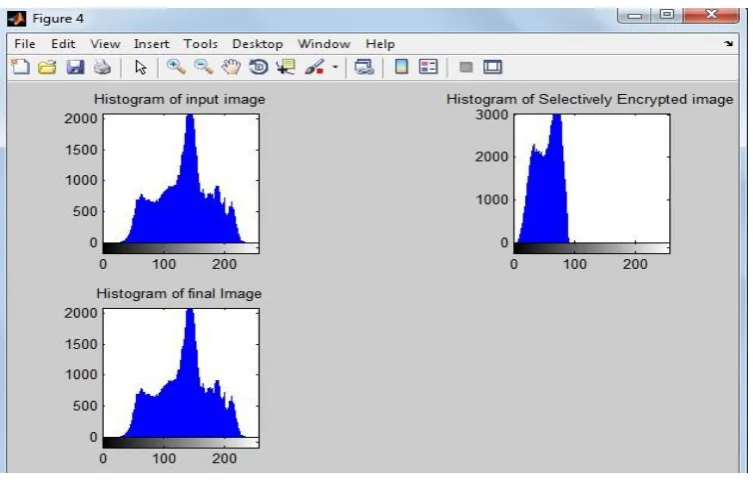
We work in the MATLAB to get the extracted features of fingerprint and iris. Both the extracted characteristics are then fused using fuzzy logic and encryption is done by using AES technique.
Fig3 minutia extraction of fingerprint fig4 segmented image of iri s. Fingerprint feature
extraction
Iris feature extraction
Encryption of fused image Fusion using fuzzy logic
ISSN(E): 2277-128X, ISSN(P): 2277-6451, pp. 124-131
Fig 5 fused image
Fig 6 encrypted image
Fig7. Histogram of Images
VI. CONCLUSION
ISSN(E): 2277-128X, ISSN(P): 2277-6451, pp. 124-131
authentication purposes, but the uni-modal biometric system has some inhibitions like strepitous sensor data, be deficient in of individuality, non-universality, susceptibility to circumvention and lack of invariant representation. So, to surmount these disadvantages, multimodal biometric system is utilized. Multi biometrics is an incipient technique used to precise identification of the person. This paper presents some multimodal biometrics amalgamating dactylogram and iris with feature extraction level and fusion is done by fuzzy logic. Efficient security system by utilizing iris and dactylogram traits has been design. The extraction is such that we have many dactylogram apperception steps and iris apperception steps. These steps increase the extraction of features from both the features. Then the extracted features are then coalesced utilizing fuzzy logic. This fused template is then encrypted utilizing AES technique and we can additionally match the pristine fused image and the encrypted image to check whether it is encrypted or not.
REFERENCES
[1] Kankrale R.N. , Jawale M.A” Fuzzy Logic Concatenation in Fingerprint and Iris Multimodal Biometric Identification System”, International Journal of Advanced Research in Computer Science and Software Engineering , Volume 3, Issue 10, January 2017
[2] Mohamad Abdolahi, Majid Mohamadi, Mehdi Jafari” Multimodal Biometric system Fusion Using Fingerprint and Iris with Fuzzy Logic”, International Journal of Engineering (IJE) ISSN: 2231-2307, Volume-2, Issue-6, April 2016
[3] N. Radha , A. Kavitha “Rank Level Fusion Using Fingerprint And Iris Biometrics” Indian Journal Of Computer Science And Engineering (IJCSE), ISSN : 0976-5166 Vol. 2 No. 6 Dec 2011-Jan 2016
[4] P.U.Lahane, S.R.Ganorkar “ Fusion of Iris & Fingerprint Biometric for Security Purpose” International Journal of Scientific & Engineering Research Volume 3, Issue 8, August-2016 ISSN 2229-5518
[5] Rupesh Wagh and Arti P choudhary “Analysis of Multimodal Biometrics with Security Key”, International Journal of Research in Computer Science Engineering, Volume 3, Issue 8, August 2015
[6] Taruna Panchal and Ajit Singh “Multimodal Biometric System”, International Journal of Advanced Research in Computer Science and Software Engineering, Volume 3, Issue 5, May 2014
[7] Shweta Malhotra “A Novel approach for securing biometric template” ,Global Journal of Computer Engineering Research , Volume 3, Issue 5, May 2014
[8] Kande Archana1,A .Govardhan “Enhance the Security in the ATM System with Multimodal Biometrics and TwoTier Security”, International Journal of Advanced Research in Computer Science and Software Engineering , Volume 3, Issue 10, October 2013
[9] Shanthini, B. and S. Swamynathan “Multimodal Biometric-based Secured Authentication System using Steganography” , Journal of Computer Science 8 (7) 2012 Science Publications
[10] K P Tripathi “A Comparative Study of Biometric Technologies with Reference to Human Interface”, International Journal of Computer Applications (0975 – 8887) Volume 14– No.5, January 2011
[11] Ajay Kumar, Vivek Kanhangad , David Zhang “A New Framework For Adaptive Multimodal Biometrics Management” IEEE Transactions on Information Forensics and Security vol. 5, pp. 92-102, Mar. 2010
[12] Nageshkumar.M, Mahesh.PK and M.N. Shanmukha Swamy, “An Efficient Secure Multimodal Biometric Fusion Using Palmprint and Face Image”,IJCSI International Journal of Computer Science Issues, Vol. 2, 2009 [13] K.Sasidhar, Vijaya L Kakulapati, Kolikipogu Ramakrishna & K.KailasaRao, “Multimodal Biometric Systems –
Study To Improve Accuracy And Performance”, International Journal of Computer Science & Engineering Survey (IJCSES) Vol.1, No.2, November 2010
[14] Eugen Lupu ,Petre G. Pop, “Multimodal Biometric Systems Overview”, Acta Technica Napocensis ,Volume 49, Number 3, 2011
[15] Tobias Scheidat, Claus Vielhauer, “Analyzing A Multimodal Biometric System Using Real And Virtual Users”,SPIE Vol. 6505, 650512, © 2011 SPIE-IS&T · 0277-786X/07/$18
[16] Anil Jaina, Karthik Nandakumara, Arun Rossb , “Score Normalization In Multimodal Biometric Systems”,
Pattern Recognition , The Journal Of The Pattern Recognition Society,18 January 2011
[17] Kresimir Delac , Mislav Grgic, “A Survey Of Biometric Recognition Methods”, 46th International Symposium Electronics in Marine, ELMAR-2004, 16-18 June 2013
[18] Anil K. Jain And Arun Ross, “Multibiometric Systems”Communications Of The ACM ,January 2009/Vol. 47, No.1,
ISSN(E): 2277-128X, ISSN(P): 2277-6451, pp. 124-131
[20] Michael Goh Kah Ong, Tee Connie, Andrew Teoh Beng Jin, David Ngo Chek Ling, “A Single-Sensor Hand Geometry And Palmprint Verification System” , WBMA ’03, November 8, 2010, ACM 1-58113-779-6/03/00011
[21] Robert Snelick, Mike Indovina, James Yen, Alan Mink,“ Multimodal Biometrics: Issues In Design And Testing” ICMI’03, November 5–7, 2010,ACM 1-58113-621-8/03/0011