Genome-wide admixture and association
study of subclinical atherosclerosis in the
Women’s Interagency HIV Study (WIHS)
Aditi Shendre1¤a, Howard W. Wiener1, Marguerite R. Irvin1, Bradley E. Aouizerat2,3, Edgar T. Overton4, Jason Lazar5, Chenglong Liu6, Howard N. Hodis7, Nita A. Limdi8, Kathleen M. Weber9, Stephen J. Gange10, Degui Zhi11¤b, Michelle A. Floris-Moore12,
Ighovwerha Ofotokun13, Qibin Qi14, David B. Hanna14, Robert C. Kaplan14, Sadeep Shrestha1*
1 Department of Epidemiology, University of Alabama at Birmingham, Birmingham, Alabama, United States of America, 2 Bluestone Center for Clinical Research, New York University, New York, New York, United States of America, 3 Department of Oral and Maxillofacial Surgery, New York University, New York, New York, United States of America, 4 Division of Infectious Diseases, Department of Medicine, University of Alabama at Birmingham, Birmingham, Alabama, United States of America, 5 Department of Medicine, State University of New York, Downstate Medical Center, Brooklyn, New York, United States of America, 6 Department of Medicine, Georgetown University Medical Center, Washington, DC, United States of America, 7 Atherosclerosis Research Unit, University of Southern California, Los Angeles, California, United States of America, 8 Department of Neurology, University of Alabama at Birmingham, Birmingham, Alabama, United States of America, 9 Cook County Health and Hospital System/Hektoen Institute of Medicine, Chicago, Illnois, United States of America, 10 Department of Epidemiology, Johns Hopkins Bloomberg School of Public Health, Baltimore, Maryland, United States of America, 11 Department of Biostatistics, University of Alabama at Birmingham, Birmingham, Alabama, United States of America, 12 Division of Infectious Diseases, Department of Medicine, University of North Carolina School of Medicine, Chapel Hill, North Carolina, United States of America, 13 Department of Medicine/Infectious Diseases, Emory University, and Grady Healthcare System, Atlanta, Georgia, United States of America, 14 Department of Epidemiology and Population Health, Albert Einstein College of Medicine, Bronx, New York, United States of America
¤a Current address: Richard M. Fairbanks School of Public Health, Indianapolis University–Purdue University Indianapolis, Indianapolis, Indiana, United States of America
¤b Current address: School of Biomedical Informatics, The University of Texas Health Science Center at Houston, Houston, Texas, United States of America
Abstract
Cardiovascular disease (CVD) is a major comorbidity among HIV-infected individuals. Common carotid artery intima-media thickness (cCIMT) is a valid and reliable subclinical measure of atherosclerosis and is known to predict CVD. We performed genome-wide asso-ciation (GWA) and admixture analysis among 682 HIV-positive and 288 HIV-negative Black, non-Hispanic women from the Women’s Interagency HIV study (WIHS) cohort using a combined and stratified analysis approach. We found some suggestive associations but none of the SNPs reached genome-wide statistical significance in our GWAS analysis. The top GWAS SNPs were rs2280828 in the region intergenic to mediator complex subunit 30 and exostosin glycosyltransferase 1 (MED30 | EXT1) among all women, rs2907092 in the catenin delta 2 (CTNND2) gene among HIV-positive women, and rs7529733 in the region intergenic to family with sequence similarity 5, member C and regulator of G-protein signal-ing 18 (FAM5C | RGS18) genes among HIV-negative women. The most significant local European ancestry associations were in the region intergenic to the zinc finger and SCAN
a1111111111 a1111111111 a1111111111 a1111111111 a1111111111
OPEN ACCESS
Citation: Shendre A, Wiener HW, Irvin MR,
Aouizerat BE, Overton ET, Lazar J, et al. (2017) Genome-wide admixture and association study of subclinical atherosclerosis in the Women’s Interagency HIV Study (WIHS). PLoS ONE 12(12): e0188725.https://doi.org/10.1371/journal. pone.0188725
Editor: Gualtiero I. Colombo, Centro Cardiologico
Monzino, ITALY
Received: September 2, 2016
Accepted: November 12, 2017
Published: December 4, 2017
Copyright:©2017 Shendre et al. This is an open
access article distributed under the terms of the Creative Commons Attribution License, which permits unrestricted use, distribution, and reproduction in any medium, provided the original author and source are credited.
Data Availability Statement: As described in the
re-domain containing 5D gene and NADH: ubiquinone oxidoreductase complex assembly fac-tor 1 (ZSCAN5D | NDUF1) pseudogene on chromosome 19 among all women, in the region intergenic to vomeronasal 1 receptor 6 pseudogene and zinc finger protein 845 (VN1R6P |
ZNF845) gene on chromosome 19 among HIV-positive women, and in the region intergenic
to the SEC23-interacting protein and phosphatidic acid phosphatase type 2 domain contain-ing 1A (SEC23IP | PPAPDC1A) genes located on chromosome 10 among HIV-negative women. A number of previously identified SNP associations with cCIMT were also observed and included rs2572204 in the ryanodine receptor 3 (RYR3) and an admixture region in the secretion-regulating guanine nucleotide exchange factor (SERGEF) gene. We report sev-eral SNPs and gene regions in the GWAS and admixture analysis, some of which are com-mon across HIV-positive and HIV-negative women as decom-monstrated using meta-analysis, and also across the two analytic approaches (i.e., GWA and admixture). These findings sug-gest that local European ancestry plays an important role in genetic associations of cCIMT among black women from WIHS along with other environmental factors that are related to CVD and may also be triggered by HIV. These findings warrant confirmation in independent samples.
Introduction
Early diagnosis and treatment of human immunodeficiency virus (HIV) has increased the life expectancy of infected individuals [1], and shifted the focus to the management of other comorbidities such as cardiovascular disease (CVD). CVD risk is higher among HIV-positive individuals compared to HIV-negative individuals [2–4]. HIV infection as well as certain antiretroviral therapies (ART) were shown to independently increase the risk of CVD [2]. Moreover, disparities in CVD risk by race and sex prevail, specifically, among HIV-positive individuals [5,6]. Higher rates of acute myocardial infarction were observed among Blacks as compared to Whites, and among women as compared to men [3–5]. Similarly, ischemic stroke rates were reported to be higher among HIV-positive women as compared to HIV-positive men [7].
Efforts to prevent CVD among HIV-positive individuals have led to the evaluation of sub-clinical atherosclerotic measures such as carotid artery intima-media thickness (CIMT). CIMT can predict future CVD events among HIV-negative individuals [8]. CIMT is a non-invasive measure obtained using B-mode ultrasound, with the common carotid artery measurements considered the most reliable and reproducible of all CIMT segments [9,10]. Common CIMT (cCIMT) measurements were reported to be thicker among HIV-positive as compared to matched HIV-negative individuals, and also independently associated with HIV infection and treatment [11,12]. Racial and sex differences have shown greater cCIMT thickness among Blacks as compared to Whites, and among women as compared to men beyond traditional CVD risk factors [13–15].
The role of genetics as a risk factor for subclinical atherosclerosis, specifically in genome-wide association studies (GWAS) of cCIMT, has been explored among the HIV-negative [16] and non-Black populations [16–18]. A recent study on subclinical atherosclerosis that con-ducted a exome-wide association analysis, reported two SNPs–rs7412 in the apolipoprotein E (APOE) gene and rs143873045 in the KN Motif and Ankyrin Repeat Domains 2 (KANK2) gene that were found significantly associated with cCIMT among HIV-negative Blacks [19]. Among HIV-positive individuals, the only GWAS in relation to cCIMT has been conducted approached to obtain informed consent for sharing
of their data. Thus, we are not currently permitted to release their genomic or phenotypic data. This has been consistent with other genomic studies in the WIHS cohort. Data are available from the WIHS WDMAC Institutional Data Access/Ethics Committee for researchers who meet the criteria for access to confidential data. Data requests can be made by contacting WIHS WDMAC atJHSPH. [email protected].
Funding: Data in this manuscript were collected by
by our group, among White men from the Fat Redistribution and Metabolic Change in HIV Infection (FRAM) Study [20]. We observed two single nucleotide polymorphisms (SNPs) in tight linkage disequilibrium (LD), rs2229116 and rs7177922, in the ryanodine receptor 3 (RYR3) gene on chromosome 15 to be associated with cCIMT. The association of rs2229116 was replicated in another group of HIV-positive White men from the Multicenter AIDS Cohort Study (MACS) [21]. Given the consistent association with cCIMT in HIV-positive White men, we further evaluated the association of SNPs within theRYR3gene among a racially diverse group of HIV-positive women from the Women’s Interagency HIV Study (WIHS) [22]. TheRYR3gene association with cCIMT was observed among different SNPs than those reported earlier, rs2572204 being most significant among Black HIV-positive women. Haplotype blocks observed among the Black HIV-positive women compared to the other two racial/ethnic groups were smaller and indicated that SNP associations are possibly different based on LD, warranting further evaluation specifically in the context of cCIMT related admixture.
Admixture mapping enables the identification of genetic variations differentially distrib-uted in ancestral populations associated with a disease–the premise being that associated variants are observed on chromosomal segments from ancestral populations with higher prev-alence of the disease/trait [23]. Thus, this approach takes advantage of the extended LD present in the recently admixed population to discover these variations. Admixture mapping has been considered a feasible and more powerful tool in contrast to GWAS among individuals of mixed continental ancestry [24], and advances in statistical techniques and their applications in a genome-wide set of markers has greatly increased the ability to detect disease loci. We recently performed genome-wide admixture mapping in relation to cCIMT among HIV-nega-tive Black individuals from two large prospecHIV-nega-tive cohorts and found a region in the secretion regulating guanine nucleotide exchange factor (SERGEF) gene that reached genome-wide sig-nificance [25]. Likewise, we have shown various genomic regions associated with clinical events in African Americans through admixture mapping [26].
Currently, methods based on principal components are commonly used to control for pop-ulation stratification in genetic association studies [27]. Recent studies have focused on admix-ture mapping and related techniques to incorporate ancestry information in association tests among admixed populations [28–32]. However, there is a lack of consensus in approaches and whether accounting for local and global ancestries alone or together would sufficiently control for both type I and type II error rates [31,32]. In this study, we performed genome-wide admixture and association analysis to determine single SNP and local European ancestry asso-ciations with cCIMT among Black women from the WIHS cohort.
Results
The HIV and CVD related characteristics of the 970 Black women included in the current study are presented inTable 1. In this study, 70% of the women were HIV-positive, and had similar cCIMT values as well as percent global European ancestry as compared to HIV-nega-tive women. CVD risk factors including hypertension, diabetes, and current smoking were similar across the two groups. HIV-positive women were older, had lower CD4 cell count and HDL cholesterol levels, and were more likely to take medications for hypertension compared to HIV-negative women.
Genome-wide association results
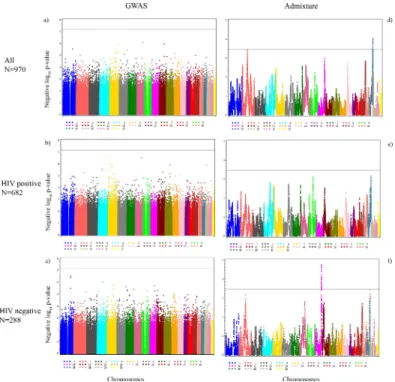
The genome-wide association results for cCIMT are presented for all women and after further stratification by HIV status, as shown in the Manhattan plots (Fig 1A–1C). None of the SNPs from WIHS (Pilot project PI: Shrestha) and
R56HL125061. The funders had no role in study design, data collection and analysis, decision to publish, or preparation of the manuscript.
Competing interests: The authors have declared
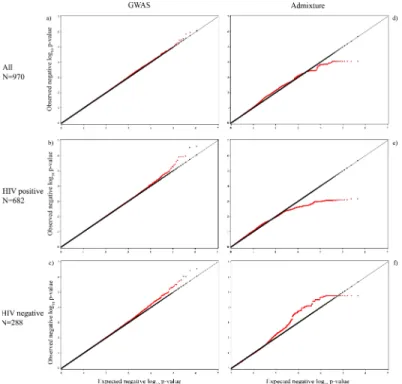
reached the genome-wide significance level (S1 Table), but we present the top 5 SNP-cCIMT associations for all three groups (Table 2) and the regionals plots for the top SNPs in each group (S1A–S1C Fig). The lambda values for each of the GWAS models were– 1.005 for the
combined model, 1.009 for the HIV-positive model, and 1.013 for the HIV-negative model (Fig 2A–2C). We also present the admixture analyses results for gene regions that include these significant GWAS SNPs to determine if local European ancestry at these regions is asso-ciated with cCIMT inTable 2. The top hit among all women was rs2280828 located in the intergenic region of mediator complex subunit 30 and exostosin glycosyltransferase 1 (MED30 |EXT1) genes on chromosome 8 (β= -0.0216, p = 8.01x10⁻⁷). The same SNP was also signifi-cantly associated with cCIMT among HIV-positive women (β= -0.0271, p = 2.89x10⁻⁷). The most significant SNP associated with cCIMT among HIV-positive women was rs2907092 in the catenin delta 2 (CTNND2) gene on chromosome 5 (β= 0.0250, p = 2.37x10⁻⁷). Local Euro-pean ancestry at the corresponding gene region of this SNP was also associated with cCIMT (β= 0.0089, p = 0.04). Local European ancestry was also associated with cCIMT at the gene region that includes the GWAS identified rs4761669 intergenic to the transmembrane and coiled-coil domain family 3 gene and the NADH: ubiquinone oxidoreductase subunit A12 (TMCC3|NDUFA12) genes on chromosome 12 (β= -0.0084, p = 0.04). Among HIV-negative women, rs7529733 intergenic to family with sequence similarity 5, member C and regulator of G-protein signaling 18 genes (FAM5C|RGS18) on chromosome 1 was the top SNP associated with cCIMT (β= 0.0431, p = 2.92x10⁻⁷).
Local ancestry association results
The local European ancestry (LEA) association with cCIMT is presented inTable 3for the top 5 gene regions for all women and then separately for HIV-positive and HIV-negative women, and the corresponding Manhattan plots are presented inFig 1D–1F. The regionals plots for
the top regions are presented inS1D–S1F Fig(all regions inS2 Table). The lambda values for each of the admixture models were– 1.001 for the combined model, 1.103 for the HIV-positive model, and 1.000 for the HIV-negative model (Fig 2D–2F). We also present the top GWAS hit located within the top ancestry gene regions if it was significant atαof 0.05 (Table 3). LEA at
17 gene regions reached genome-wide significance in relation to cCIMT among all women. These regions were largely located on chromosome 19 over a 3.07 Mb region but also included
Table 1. Characteristics of all women from the Women’s Interagency HIV Study (WIHS) cohort and by HIV status.
Characteristics All (N = 970) HIV positive (N = 682) HIV negative (N = 288)
cCIMT (mm), mean (SD) 0.74 (0.12) 0.75 (0.12) 0.74 (0.12)
Percent global European ancestry, mean (SD) 15.7 (8.5) 15.7 (8.4) 15.7 (8.6)
Age (years), mean (SD) 41.1 (9.3) 41.9 (8.8)** 39.1 (10.0)
CD4 cell count (cells/mm3), median (IQR) 577 (559) 436 (393)** 1029 (516)
Anti-retroviral therapy, n (%) - 633 (92.3)
-Hypertension, n (%) 343 (35.4) 250 (36.7) 93 (32.3)
Diabetes, n (%) 135 (13.9) 93 (13.6) 42 (14.6)
Current smoking, n (%) 504 (51.9) 352 (51.6) 152 (52.8)
HDL cholesterol (mg/dL), mean (SD) 51.3 (18.1) 49.2 (18.2)** 56.1 (16.7)
LDL cholesterol (mg/dL), mean (SD) 100.1 (33.7) 98.9 (33.1) 102.9 (35.0)
HIV: human immunodeficiency virus, SD: standard deviation, IQR: inter-quartile range, HDL: high density lipoprotein, LDL: low density lipoprotein
*P<0.01
**P<0.001
one gene region on chromosome 6 spanning 106.38 kb. There were no gene regions that re-ached genome-wide significance among HIV-positive women. Among HIV-negative women, a total of 48 LEA gene regions achieved genome-wide significance and were largely located on chromosome 10 over a span of 4.23 Mb. A single gene region each on chromosomes 2, 4, and 9 also achieved genome-wide significance among HIV-negative women. The most significant local European ancestry association among all women was observed in the region intergenic to the zinc finger and SCAN domain containing 5D gene and NADH: ubiquinone oxidoreduc-tase complex assembly factor 1 pseudogene (ZSCAN5D | NDUF1) on chromosome 19 (β= 0.0134, p = 8.87x10⁻⁵). The region on chromosome 6 in the leucine rich repeat containing 1 gene (LRRC1) achieved genome-wide significance among all women but was also observed among the top 5 regions in HIV-positive women (β= 0.0138, p = 8.42x10⁻⁴). The region inter-genic to the vomeronasal 1 receptor 6 pseudogene and zinc finger protein 845 gene (VN1R6P | ZNF845) on chromosome 19 was most significant among HIV-positive women (β= 0.0141, p = 6.86x10⁻⁴). Among HIV-negative women, the top association was observed in the region intergenic to the SEC23 interacting protein gene and phosphatidic acid phosphatase type 2 domain containing 1A gene located on chromosome 10 (SEC23IP | PPAPDC1A) (β= -0.0290, p = 1.71x10⁻⁵).
Meta-analysis and previously significant SNPs
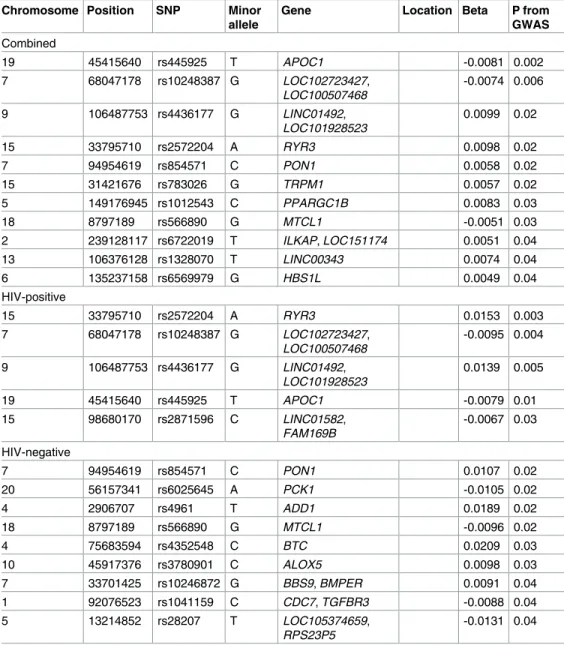
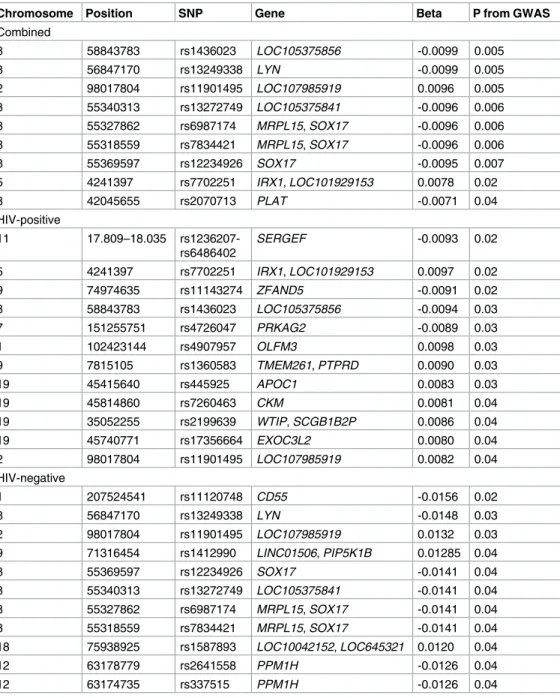
Previously significant SNPs associated with cCIMT that were found significant in the current GWAS and LEA association analysis are reported in the Tables4and5, respectively. A total of 25 SNPs in the GWAS and 31 SNPs in the admixture analysis were significantly associated with cCIMT. The most significant SNPs across the combined and stratified GWAS analyses
Fig 1. Manhattan plots for the genome-wide association (threshold p-value = 6.50×10⁻⁸) and admixture analyses (threshold p-value 3.42×10⁻⁴). a) All women (GWAS), b) HIV-positive women
(GWAS), c) HIV-negative women (GWAS), d) All women (admixture), e) HIV-positive women (admixture), and f) HIV-negative women (admixture). Negative log10p-values are plotted against each SNP’s respective
position on each chromosome.
were—rs445925 in the apolipoprotein C-1 (APOC1) gene among all women (β= -0.0081, p = 0.0018), rs2572204 in the ryanodine receptor 3 (RYR3) among HIV-positive women (β= 0.0153, p = 0.0027), and rs854571 in paraoxonase 1 (PON1) gene in the HIV-negative women (β= 0.0107, p = 0.02). The most significant SNPs in the LEA association included rs1436023 in LOC105375856gene in the combined analysis (β= -0.0099, p = 0.005), the region between 17.809 to 18.035 Mb in theSERGEFgene significantly associated with cCIMT among the HIV-positive women (β= -0.0093, p = 0.02) whereas the SNP rs11120748 in the CD55 molecule (Cromer blood groups) (CD55) gene was significant among HIV-positive women (β= -0.0156, p = 0.02).
Meta-analysis results for both GWAS and LEA associations reflect the results observed in the combined analyses (S1andS2Tables).
Discussion
The current study presents the genome-wide admixture and association findings for cCIMT among Black HIV-positive and HIV-negative women from the WIHS cohort. We ran separate analyses for the two methods but also noted whether any of the GWAS SNPs within the top admixture regions, and any of the admixture regions including the top GWAS SNPs were sig-nificant for cCIMT. We observed SNPs in the GWA that showed suggestive associations (p<10−6) with cCIMT (included inTable 2in bold). The comparison to the admixture results yielded two significant regions observed among HIV-positive women (included inTable 2in bold). Conversely, several regions with LEA associations revealed GWAS SNPs that were nom-inally significant. Meta-analysis results suggest that some SNPs and gene regions are common
Fig 2. QQ plots for the genome-wide association analyses and admixture analyses. a) All women (GWAS,λ= 1.005), b) HIV-positive women (GWAS,λ= 1.009), c) HIV-negative women (GWAS,λ= 1.013), d) All women (admixture,λ= 1.001), e) HIV-positive women (admixture,λ= 1.103), and f) HIV-negative women (admixture,λ= 1.000). Observed negative log10 p-values are plotted against the expected negative log10 p-values.
across HIV-positive and HIV-negative women and may therefore play a role in atherosclerosis beyond HIV associated risk factors. Lastly, we observed associations with SNPs that have been previously reported to have significant associations with cCIMT.
The top GWAS hit rs2280828 observed in the combined analysis was in the region inter-genic to theMED30andEXT1genes on chromosome 8, approximately 50 kb from theEXT1 gene. TheEXT1gene encodes for a transmembrane glycoprotein on the endoplasmic reticu-lum (ER) of the cell which is involved in the synthesis and polymerization of heparan sulfate [33,34]. Heterozygous loss of function mutation in theEXT1andEXT2genes have been pos-tulated to improve endothelial function by increasing the bioavailability of nitric oxide (NO) [35]. Calcium ion concentrations in the cell regulate the activity of nitric oxide synthase via cal-modulin, indirectly influencing the release of nitric oxide when shear stress is exerted on the endothelium [36]. The RYR3 receptor encoded by theRYR3gene is a calcium-ion channel
Table 4. Genome wide association results (GWA) for common carotid artery intima media thickness with previously significant single nucleotide polymorphisms (SNPs).
Chromosome Position SNP Minor allele
Gene Location Beta P from
GWAS Combined
19 45415640 rs445925 T APOC1 -0.0081 0.002
7 68047178 rs10248387 G LOC102723427,
LOC100507468
-0.0074 0.006
9 106487753 rs4436177 G LINC01492,
LOC101928523
0.0099 0.02
15 33795710 rs2572204 A RYR3 0.0098 0.02
7 94954619 rs854571 C PON1 0.0058 0.02
15 31421676 rs783026 G TRPM1 0.0057 0.02
5 149176945 rs1012543 C PPARGC1B 0.0083 0.03
18 8797189 rs566890 G MTCL1 -0.0051 0.03
2 239128117 rs6722019 T ILKAP, LOC151174 0.0051 0.04
13 106376128 rs1328070 T LINC00343 0.0074 0.04
6 135237158 rs6569979 G HBS1L 0.0049 0.04
HIV-positive
15 33795710 rs2572204 A RYR3 0.0153 0.003
7 68047178 rs10248387 G LOC102723427,
LOC100507468
-0.0095 0.004
9 106487753 rs4436177 G LINC01492,
LOC101928523
0.0139 0.005
19 45415640 rs445925 T APOC1 -0.0079 0.01
15 98680170 rs2871596 C LINC01582,
FAM169B
-0.0067 0.03
HIV-negative
7 94954619 rs854571 C PON1 0.0107 0.02
20 56157341 rs6025645 A PCK1 -0.0105 0.02
4 2906707 rs4961 T ADD1 0.0189 0.02
18 8797189 rs566890 G MTCL1 -0.0096 0.02
4 75683594 rs4352548 C BTC 0.0209 0.03
10 45917376 rs3780901 C ALOX5 0.0098 0.03
7 33701425 rs10246872 G BBS9, BMPER 0.0091 0.04
1 92076523 rs1041159 C CDC7, TGFBR3 -0.0088 0.04
5 13214852 rs28207 T LOC105374659,
RPS23P5
-0.0131 0.04
present on the ER and is involved in calcium homeostasis [37]. Thus,EXT1may play a role in atherosclerosis by regulating endothelial function in conjunction withRYR3. On the other hand, theMED30gene is part of a large group of genes that encode the mediator complex pro-teins, constituting a multi-subunit complex, known to regulate the RNA polymerase II enzyme [38]. Silencing of this gene was shown to inhibit the transcription of HIV, in part via the HIV-Tat protein [38]. The HIV-Tat protein causes endothelial dysfunction and brings about an inflammatory response as well as triggers loss of calcium through the RYRs on the ER [39]. These factors are part of the biological mechanisms that could contribute to atherosclerosis in HIV. Therefore,MED30gene-related functions may play a role in mitigating the downstream
Table 5. Admixture (LEA) results for common carotid-artery intima media thickness association with previously significant single nucleotide polymorphisms (SNPs).
Chromosome Position SNP Gene Beta P from GWAS
Combined
8 58843783 rs1436023 LOC105375856 -0.0099 0.005
8 56847170 rs13249338 LYN -0.0099 0.005
2 98017804 rs11901495 LOC107985919 0.0096 0.005
8 55340313 rs13272749 LOC105375841 -0.0096 0.006
8 55327862 rs6987174 MRPL15, SOX17 -0.0096 0.006
8 55318559 rs7834421 MRPL15, SOX17 -0.0096 0.006
8 55369597 rs12234926 SOX17 -0.0095 0.007
5 4241397 rs7702251 IRX1, LOC101929153 0.0078 0.02
8 42045655 rs2070713 PLAT -0.0071 0.04
HIV-positive
11 17.809–18.035 rs1236207-rs6486402
SERGEF -0.0093 0.02
5 4241397 rs7702251 IRX1, LOC101929153 0.0097 0.02
9 74974635 rs11143274 ZFAND5 -0.0091 0.02
8 58843783 rs1436023 LOC105375856 -0.0094 0.03
7 151255751 rs4726047 PRKAG2 -0.0089 0.03
1 102423144 rs4907957 OLFM3 0.0098 0.03
9 7815105 rs1360583 TMEM261, PTPRD 0.0090 0.03
19 45415640 rs445925 APOC1 0.0083 0.03
19 45814860 rs7260463 CKM 0.0081 0.04
19 35052255 rs2199639 WTIP, SCGB1B2P 0.0086 0.04
19 45740771 rs17356664 EXOC3L2 0.0080 0.04
2 98017804 rs11901495 LOC107985919 0.0082 0.04
HIV-negative
1 207524541 rs11120748 CD55 -0.0156 0.02
8 56847170 rs13249338 LYN -0.0148 0.03
2 98017804 rs11901495 LOC107985919 0.0132 0.03
9 71316454 rs1412990 LINC01506, PIP5K1B 0.01285 0.04
8 55369597 rs12234926 SOX17 -0.0141 0.04
8 55340313 rs13272749 LOC105375841 -0.0141 0.04
8 55327862 rs6987174 MRPL15, SOX17 -0.0141 0.04
8 55318559 rs7834421 MRPL15, SOX17 -0.0141 0.04
18 75938925 rs1587893 LOC10042152, LOC645321 0.0120 0.04
12 63178779 rs2641558 PPM1H -0.0126 0.04
12 63174735 rs337515 PPM1H -0.0126 0.04
effects of HIV in atherosclerosis and other cardiovascular complications. Spliced variants of the gene have been observed in circulating endothelial progenitor cells and are hypothesized to have potential diagnostic or therapeutic roles in cardiovascular disease in the future [40].
Rs2907092 was the top GWAS hit among HIV-positive women and is located in the intro-nic region of theCTNND2gene on chromosome 5. This gene encodes for theδ–catenin pro-tein, a neuronal protein that is also expressed in the vascular endothelium [41]. The protein binds cadherins to the cytoskeleton and is involved in pathways and mechanisms that modu-late vascular remodeling. They are responsible for endothelial cell motility, angiogenesis and wound repair regulated by inflammatory responses and are specifically observed during patho-logic states. This gene showed a strong association with cerebral malaria in an environmental correlation analysis (ECA), whereby the involved mechanisms such as luminal blockade by infected cells, increased shear stress, presence of reactive oxygen species (ROS) and the ensu-ing inflammatory response follow a pattern that is similar to atherosclerosis [42]. ECA identi-fies genes that are enriched as a result of local environmental effects within a population that has likely been isolated for a long period of time. As a result, theCTNND2gene may likely have an admixture component, which was precisely noted in our admixture results.
The most significant GWAS SNP among HIV-negative women was rs7529733 in the regions intergenic to theFAM5CandRGS18genes on chromosome 1. TheFAM5Cgene has been associated with myocardial infarction [43] and functional studies have shown that it increases the production of ROS, nuclear factor-kappaB (NF-κB) activity, and expression of the intercellular and vascular cell adhesion molecules, ICAM-1 and VCAM-1 [44]. These fac-tors induce vascular inflammation and facilitate monocyte adhesion to the endothelium. HIV proteins such as HIV-Tat trigger this mechanism indirectly by activating the monocyte che-moattractant protein-1 (MCP-1) resulting in migration of the monocytes and their transfor-mation into macrophages, steps integral to the atherosclerotic process [39]. The regulator of G-protein signaling 18 GTPase-activating protein is encoded by theRGS18gene. This protein is involved in the activation and inhibition of platelets through the G-α-q subunit of the het-erotrimeric G-protein [45]. The RGS18 protein is in turn regulated by thrombin resulting in the phosphorylation of one of its residues, and subsequent release of calcium ions to induce platelet aggregation. A similar process is involved during platelet inhibition whereby prostacy-clin and NO regulate RGS18 resulting in reduced intracellular calcium levels. Thus, the RGS18 effect on platelets is mediated through calcium homeostasis and therefore genetic interactions betweenRGS18andRYR3gene are possible, and may play a substantial role in atherosclerosis as platelets are involved in its inflammatory response.
muscle cells and were shown to regulate hypertension via Mg2+homeostasis. Reduced Mg2+ increases blood pressure by increasing the reactivity and contractility of the blood vessels and is also responsible for endothelial dysfunction, inflammation and vascular remodeling. All the above-mentioned mechanisms are involved in the ongoing process of atherosclerosis and subsequent CVD and therefore TRPM6 may play a part in the development of CVD. Among HIV-negative women, the top LEA region was on chromosome 10 and located in the intergenic region of theSEC23IPandPPAPDC1Agenes. The rs1571099 SNP inPPAPDC1A was significantly associated with interventricular septal wall thickness among African Ameri-cans in a recent GWAS using the Candidate Gene Association Resource (CARe) Study [48]. This gene is involved in pathways related to innate immunity, phagocytosis and triacylglycerol synthesis [49]. Therefore, this gene may also play a role in atherosclerosis, albeit an indirect one.
Replication revealed associations with some of the cCIMT-SNPs found significant in earlier studies. Previously, we had reported the association of two SNPs inRYR3–rs2229116 and rs7177922 that had achieved genome-wide significance among HIV-positive men of European ancestry [20], with successful replication of rs2229116 in another group of HIV-positive White men [21]. However, we did not find any association with these SNPs in the current analysis. Instead, we found another SNP–rs2572204 inRYR3that was associated with cCIMT among HIV-positive women of WIHS. We reported the same association among Black HIV-positive women in our previous candidate-gene study onRYR3in WIHS. The different SNP associa-tions within this gene may either be because of the differences in race or sex between the two studies. WIHS women are also noted to have different heart disease risk because of differences in their immunosuppression or duration of ART as compared to HIV-positive men [50,51]. Nonetheless,RYR3appears to play a role in HIV-related atherosclerosis risk based on some of the possible gene (or protein) interactions found significant in this study. The admixture asso-ciation of theSERGEFgene in the HIV-positive women provides further support for the role of this gene in atherosclerosis. However, the direction of association was opposite to that observed in the HIV-negative population in our previous study. The gene encodes a guanine nucleotide exchange factor that may play a role in atherosclerosis through immune or inflam-matory mechanisms via guanosine-triphosphatases and serotonin [25]. We speculate that lower cCIMT associated withSERGEFin the HIV-positive women may be a result of immuno-suppression because of ART or HIV itself or in conjunction with the gene as it appears to mediate atherosclerosis through immune-related mechanisms.
might perform better given a set of conditions where high signals of admixture associations were observed [30]. The BMIX test as proposed by Shriner et al. performs even better than the QSUM test with a power of ~72% to detect phenotype-genotype associations in the overall analysis [31]. Both results support the hypothesis that joint testing with adjustment for both local and global ancestries is more powerful than the current association tests in use. There-fore, we performed a secondary analysis using BMIX and present our results in the supplemen-talS4 Table. Of note, the top SNPs inTable 2showed similar significance after adjustment for local ancestry using BMIX (if available). Since BMIX uses the local ancestry information avail-able through admixture mapping, as such the two analyses are not independent of each other. In our study, we did not conduct the primary GWAS analyses using the BMIX method as we could only estimate local ancestry in 473,732 SNPs, and so adjustment with local ancestry would have dramatically reduced the number of informative SNPs available for GWAS. Never-theless, this approach of adjustment for both local and global ancestry has not been extensively explored and needs further validation to ensure broader application in future genetic studies among admixed populations and also tease shared traits across ancestries [53].
The advantage of using the WIHS cohort is that a higher proportion of women in the cohort were African American, especially among the HIV-positive subpopulation. It also pre-sented us with an opportunity to evaluate the common CIMT association exclusively among women. However, we recognize that the homogeneity of the population also reduces the gen-eralizability of our findings. As the WIHS participants are relatively young and the incidence of clinical CVD events is low, we could not assess the association of CVD events at the genome-wide level. Therefore, we assessed cCIMT which is a reliable and reproducible sub-clinical measure of atherosclerosis that has been shown to predict future CVD events. Most of the HIV-positive women were also on combination ART including multiple antiretroviral drugs which prevented us from evaluating the independent effect of specific ART agents on cCIMT. Furthermore, our admixture analysis only included a subset of the SNPs that were part of the GWAS (N = 473,732), and so we were limited in our ability to assess local ancestry associations at the excluded SNPs. This also limited our ability to adjust for both local and global ancestry during GWAS using the joint admixture and association testing method. We acknowledge that the sample size was small for a genome-wide analysis, however, WIHS is currently the largest prospective cohort of HIV-positive women in the U.S. with the cCIMT measurements since cCIMT is not readily available, specifically among HIV-positive women. The heterogeneity index I2(S1andS2Tables) also shows that there are some consistent results
(both in direction of association and significance) but also inconsistent ones between HIV-positive and HIV-negative groups. These results may suggest differences in underlying biologi-cal mechanism, i.e. some of the genes or pathways maybe specific in the context of HIV (virus itself or treatment) and others similar in both with or without infection, or they could be arti-facts as a result of the small sample size. While we cannot conclude the reason of heterogeneity in the two groups, the suggestive results should be examined in other populations.
Methods
Ethics statement
The parent WIHS study and this sub-study conformed to the procedures for informed written consent approved by institutional review boards (IRB) at all sponsoring organizations and to human-experimentation guidelines set forth by the United States Department of Health and Human Services, and finally reviewed and approved by the University of Alabama Institute Review Board.
Study population
WIHS is a large prospective cohort of HIV-positive and risk-matched HIV-negative women enrolled across six sites in the United States [54,55]. The women in the study were enrolled during the initiation phase in 1994/95 (2054 HIV-positive and 569 HIV-negative), the expan-sion phase in 2001/02 (737 HIV-positive and 406 HIV-negative), and most recently during 2011/2012 to replace the women who had died during follow-up (270 HIV-positive and 93 HIV-negative). The study was designed to comprehensively evaluate the impact of HIV infec-tion in U.S. women, and provide comparisons with the HIV-negative group having similar characteristics and a high risk of acquiring the infection themselves. The women in the expan-sion phase were included to examine the risks and benefits associated with ART. A vascular disease sub-study was initiated in April 2004 to examine the effect of HIV and ART on subclin-ical atherosclerosis over time, focusing specifsubclin-ically on inflammation, coagulation and lipid pathways [50]. The measurements for cCIMT were obtained among 1331 HIV-positive and 534 HIV-negative women in WIHS through the vascular sub-study. In the current study, 970 Black, non-Hispanic women (682 HIV-positive and 288 HIV-negative) with complete geno-type, phenotype and covariate information were included, after confirming the race/ethnicity for these women using the principal components method.
Data collection. The collection and processing of data in WIHS was standardized with
centralized training of all staff before initiation of enrollment. Interviews with structured ques-tionnaires were conducted to obtain participant-reported information on demographic, life-style, socio-economic and clinical factors. In addition, anthropometric measures such as weight and height; physiologic measures such as blood pressure (BP); laboratory measures such as markers of HIV, and lipid profile were obtained using standardized protocols; and gynecologic examinations were conducted. Follow-up every six months included collection of interview related information and medication use [54].
CIMT images were obtained via high-resolution ultrasound by sonographers trained cen-trally at the University of Southern California Atherosclerosis Research Unit Core Imaging and Reading Center using a standard protocol across all study sites [56]. CIMT was measured by the automated computerized edge-tracking method (patents 2005, 2006, 2011) [57]. The coefficient of variation was 1.8% (intraclass correlation = 0.98; n = 113) for repeated CIMT measurements with the initial images guiding the repeat scans. The complete ultrasound included: 1) standardized measurements of the far-right wall of the distal common carotid artery for CIMT, stiffness and lesions, and 2) scanning the proximal internal carotid, external carotid and right carotid bulb at the bifurcation for lesions [50]. In the current study, we uti-lized the common carotid artery measurements from the distal far right wall. The mean right wall cCIMT was log base 10 transformed for normalization.
Genotyping. DNA isolation, quantification and the microplate reading were performed
BioAssay Reader, respectively [58]. All samples were stored at -20oC. The genome-wide scan was performed using the Illumina HumanOmni2.5-quad beadchip (NCBI build 37, hg19, Illu-mina, San Diego).
Statistical analysis
Both the genome-wide and ancestry association analyses were initially conducted for all indi-viduals followed by stratified analyses among HIV-positive and HIV-negative Black women. Common CIMT was associated with all CVD risk factors except HDL cholesterol, and was also not associated with ART or CD4 cell count in bivariate analysis. However, HIV related risk factors such as ART and CD4 cell counts have been previously associated with cCIMT and were therefore included in the final analysis.[11,50] Analyses among all and the HIV-positive individuals were adjusted for age, CD4 cell count, ART use, hypertension (systolic BP140 mmHg, diastolic BP90 mmHg, antihypertensive medication use or self-report), diabetes mellitus (anti-diabetic medication use, fasting glucose126mg/dl, HgbA1C6.5%, or self-report), current smoking, low-density lipoprotein (LDL), and high-density lipoprotein (HDL) cholesterol. Covariate adjustment for HIV-negative individuals was the same except for ART use.
Quality control of genomic data and GWA analysis. Multivariable linear regression
analysis using an additive model was performed in PLINK (v1.9) with default settings [59]. In the current study, genotype information for a total of 1,590,141 SNPs was available. Quality control resulted in the removal of 2 SNPs because of missingness at>10%, 6,433 because of Hardy-Weinberg equilibrium<0.001, and 459,405 because of minor allele frequency (MAF)
<5%, leaving a total of 1,124,301 SNPs to be included in the genome-wide association analysis (S5 Table). Genetic ancestry components were evaluated with principal component (PC) anal-ysis using 168 ancestry informative markers (AIMs) as previously described [60]. Briefly, the number of PCs which distinguished the major racial/ethnic groups in the sample was sought by visual inspection of scatter plots of orthogonal PCs (i.e., PC 1 versus PC2, PC2 versus PC3). This procedure was repeated until no discernible clustering of individuals by their self-reported race/ ethnicity was possible (data not shown) [60,61]. Based on the scree plot (S2 Fig), GWAS analysis was adjusted for 2 principal components (PCs) in addition to the other covariates, described above. We also tested for genomic inflation of the GWAS results by obtaining the lambda values as well as QQ plots for both the combined as well as stratified models. Correction for multiple testing was performed using a method proposed by Shriner et al [31]. The method estimates the effective number of tests by fitting an autoregressive model to the additively coded genotypes and choosing the order of the model based on the lowest Akaike information criteria (AIC). The total number of independent tests estimated using this method were 769,204, resulting in a threshold significance level of 6.50 x 10⁻⁸.
Local ancestry estimation. Local ancestry was estimated using the Local Ancestry in
African ancestry, “1” means the chromosomal region is admixed, one with European ancestry and the other with African ancestry, and “2” means both chromosomal regions had European ancestry). Before ancestry estimation, the physical coordinates for the remaining 1,124,301 SNPs were converted from hg19 to hg18 build to match the coordinates with the HapMap phased data using the UCSC table browser [63]. As a result, 119 SNPs were lost during conver-sion. Furthermore, 648,814 SNPs were not available in HapMap, 1,259 had ambiguous A/T or G/C SNPs with MAF>35% and could not be resolved for strand annotation, and 63 were duplicates; this resulted in 473,732 autosomal SNPs remaining for inclusion in the admixture estimation and association analyses (S5 Table).
A SNP most significantly associated with the clinical events along with the block of neigh-boring SNPs with similar number of European ancestry (“0”, “1” or “2”) were denoted as a “LEA region”. Additionally, blocks of same ancestry LEA regions were further defined based on whether the SNPs were in the genic or intergenic regions. A genic region included the 5’ and 3’ untranslated regions, the exons and the introns; the intergenic regions were those that fell between two genic regions as described above. Gene nomenclatures were obtained from the National Center for Biotechnology Information’s (NCBI) Reference Sequence database through the web ANNOVAR program [64].
Local ancestry association with cCIMT. Association testing in relation to cCIMT was
performed using the PLINK (v1.9) software with default settings [59]. We conducted an addi-tive linear regression analysis to evaluate the association of local ancestry coded as homozy-gous European ancestry (11), heterozyhomozy-gous European/African ancestry (12) and homozyhomozy-gous African ancestry (22), controlling for global European ancestry in the model. Since ancestry estimates are highly correlated, it is necessary to calculate the total number of effective inde-pendent tests to arrive at a threshold genome-wide significance level. We calculated the total number of effective independent tests using the method proposed by Shriner et al for admix-ture analysis as well [31,65]. The total number of independent tests in our analyses was 146 resulting in a threshold significance level of 3.42 x 10⁻⁴.
Meta-analysis. Meta-analysis was performed on the results from the GWAS and
admix-ture analyses separately. The coefficients obtained from the stratified analyses of HIV-positive and HIV-negative women were combined to obtain a pooled estimate. The analysis was con-ducted using PLINK (v1.9) for quantitative traits with both fixed- and random-effects analysis, including the detection of heterogeneity of the results (between HIV-positive and HIV-nega-tive) using the heterogeneity index I2(S1andS2Tables).
Evaluation of previously significant cCIMT SNPs
We identified 377 SNPs based on previous cCIMT-genetic association studies (S6 Table). Of these, 145 SNPs were obtained from a combination of candidate gene, genome-wide (GWAS) or meta-analysis studies [16,19,20,22,66–87], 232 SNPs from a GWAS conducted by Melton et. al. [17]. We assessed the GWAS results and LEA regions that contained these SNPs and report the associations for those found significant at P<0.05 in our cCIMT analysis.
Supporting information
S1 File. Supplemental methods. Comparing test performance after ancestry adjustment.
(DOCX)
S1 Table. Genome-wide association (GWA) results for cCIMT in the combined, HIV-posi-tive, and HIV-negative models, including the meta-analysis results.
S2 Table. Genome-wide admixture (LEA) results for cCIMT in the combined, HIV-posi-tive, HIV-negative models, including the meta-analysis results.
(XLSX)
S3 Table. Comparing test performance after adjusting for global, local or both ancestries in the association tests. QATT: quantitative Armitage’s trend test adjusting for global
try, QSNP1: quantitative single nucleotide polymorphism association adjusting for local ances-try, QADM: quantitative admixture test, QSUM: sum of QSNP1 and QADM, BMIX: joint admixture and association test using a Bayesian approach, Score: minus log 10 p-values. (DOCX)
S4 Table. Joint association and admixture (LEA) results for cCIMT in the combined, HIV-positive, and HIV-negative models using the BMIX method.
(XLSX)
S5 Table. Quality control of the genome wide data from the Women’s Interagency HIV study (WIHS). SNP: single nucleotide polymorphism, MAF: minor allele frequency.
(DOCX)
S6 Table. List of SNPs previously significantly associated with cCIMT in candidate gene, genome-wide association or meta-analysis studies.Publications before the year 2004 are represented in two reviews by Manolio TA 2004 and Pollex RL 2006. Two or more publica-tions are referenced for some SNPs. Several SNP or gene associapublica-tions were common across studies but are only presented once in the table. Publications in bold were the only studies that included a HIV-positive population.
(XLSX)
S1 Fig. Regional plots for the topmost hit from the genome-wide association and admix-ture analyses. a) All women (GWAS), b) HIV-positive women (GWAS), c) HIV-negative
women (GWAS), d) All women (admixture), e) HIV-positive women (admixture), and f) HIV-negative women (admixture). Negative log10 p-values and recombination rates are plot-ted against SNPs and their chromosomal positions.
(PDF)
S2 Fig. Scree plot showing the eigenvalues plotted against the principal components.
(PDF)
Acknowledgments
Data in this manuscript were collected by the Women’s Interagency HIV Study (WIHS). The contents of this publication are solely the responsibility of the authors and do not represent the official views of the National Institutes of Health (NIH).
The funders had no role in study design, data collection and analysis, decision to publish, or preparation of the manuscript.
We would also like to thank Dr. Daniel Shriner for his input with the analysis.
Author Contributions
Conceptualization: Aditi Shendre, Robert C. Kaplan, Sadeep Shrestha.
Data curation: Howard W. Wiener, Bradley E. Aouizerat, Howard N. Hodis, Stephen J.
Gange, Degui Zhi, Qibin Qi, David B. Hanna, Sadeep Shrestha.
Funding acquisition: Sadeep Shrestha.
Investigation: Jason Lazar, Chenglong Liu, Kathleen M. Weber, Michelle A. Floris-Moore,
Ighovwerha Ofotokun, Robert C. Kaplan, Sadeep Shrestha.
Methodology: Aditi Shendre, Howard W. Wiener, Marguerite R. Irvin, Edgar T. Overton,
Nita A. Limdi, Degui Zhi, Robert C. Kaplan, Sadeep Shrestha.
Project administration: Stephen J. Gange.
Resources: Bradley E. Aouizerat, Jason Lazar, Chenglong Liu, Howard N. Hodis, Kathleen M.
Weber, Michelle A. Floris-Moore, Ighovwerha Ofotokun, Qibin Qi, David B. Hanna, Sadeep Shrestha.
Software: Howard W. Wiener, Degui Zhi, David B. Hanna.
Supervision: Marguerite R. Irvin, Edgar T. Overton, Nita A. Limdi, Robert C. Kaplan, Sadeep
Shrestha.
Validation: Marguerite R. Irvin, Bradley E. Aouizerat, Howard N. Hodis, Kathleen M. Weber,
Stephen J. Gange, Michelle A. Floris-Moore, Ighovwerha Ofotokun, Qibin Qi, Robert C. Kaplan, Sadeep Shrestha.
Visualization: Howard N. Hodis, Robert C. Kaplan, Sadeep Shrestha.
Writing – original draft: Aditi Shendre, Sadeep Shrestha.
Writing – review & editing: Aditi Shendre, Howard W. Wiener, Marguerite R. Irvin, Bradley
E. Aouizerat, Edgar T. Overton, Jason Lazar, Howard N. Hodis, Nita A. Limdi, Kathleen M. Weber, Degui Zhi, Robert C. Kaplan.
References
1. Farnham PG, Gopalappa C, Sansom SL, Hutchinson AB, Brooks JT, Weidle PJ, et al. Updates of life-time costs of care and quality-of-life estimates for HIV-infected persons in the United States: late versus early diagnosis and entry into care. J Acquir Immune Defic Syndr. 2013; 64(2):183–9. Epub 2013/04/ 26.https://doi.org/10.1097/QAI.0b013e3182973966PMID:23615000.
2. Triant VA. Cardiovascular Disease and HIV Infection. Curr HIV/AIDS Rep. 2013.https://doi.org/10.
1007/s11904-013-0168-6PMID:23793823.
3. Triant VA, Lee H, Hadigan C, Grinspoon SK. Increased acute myocardial infarction rates and cardiovas-cular risk factors among patients with human immunodeficiency virus disease. J Clin Endocrinol Metab. 2007; 92(7):2506–12.https://doi.org/10.1210/jc.2006-2190PMID:17456578; PubMed Central PMCID: PMCPMC2763385.
4. Lang S, Mary-Krause M, Cotte L, Gilquin J, Partisani M, Simon A, et al. Increased risk of myocardial infarction in HIV-infected patients in France, relative to the general population. AIDS. 2010; 24(8):1228– 30.https://doi.org/10.1097/QAD.0b013e328339192fPMID:20400883.
5. Oramasionwu CU, Hunter JM, Brown CM, Morse GD, Lawson KA, Koeller JM, et al. Cardiovascular Disease in Blacks with HIV/AIDS in the United States: A Systematic Review of the Literature. Open AIDS J. 2012; 6:29–35. Epub 2012/05/09.https://doi.org/10.2174/1874613601206010029PMID:
22563364; PubMed Central PMCID: PMCPmc3343316.
6. Oramasionwu CU, Morse GD, Lawson KA, Brown CM, Koeller JM, Frei CR. Hospitalizations for cardio-vascular disease in African Americans and whites with HIV/AIDS. Popul Health Manag. 2013; 16 (3):201–7. Epub 2012/12/01.https://doi.org/10.1089/pop.2012.0043PMID:23194035; PubMed Central PMCID: PMCPmc3840471.
7. Chow FC, Regan S, Feske S, Meigs JB, Grinspoon SK, Triant VA. Comparison of ischemic stroke inci-dence in HIV-infected and non-HIV-infected patients in a US health care system. J Acquir Immune Defic Syndr. 2012; 60(4):351–8.https://doi.org/10.1097/QAI.0b013e31825c7f24PMID:22580566; PubMed Central PMCID: PMC3670086.
8. Lorenz MW, Markus HS, Bots ML, Rosvall M, Sitzer M. Prediction of clinical cardiovascular events with carotid intima-media thickness: a systematic review and meta-analysis. Circulation. 2007; 115(4):459–
9. Kanters SDJM, Algra A, Van Leeuwen MS, Banga JD. Reproducibility of in vivo carotid intima-media thickness measurements: A review. Stroke. 1997; 28(3):665–71. PMID:9056629
10. Nambi V, Chambless L, He M, Folsom AR, Mosley T, Boerwinkle E, et al. Common carotid artery intima-media thickness is as good as carotid intima-media thickness of all carotid artery segments in improving prediction of coronary heart disease risk in the Atherosclerosis Risk in Communities (ARIC) study. Eur Heart J. 2012; 33(2):183–90.https://doi.org/10.1093/eurheartj/ehr192PMID:21666250; PubMed Central PMCID: PMC3258447.
11. Lorenz MW, Stephan C, Harmjanz A, Staszewski S, Buehler A, Bickel M, et al. Both long-term HIV infection and highly active antiretroviral therapy are independent risk factors for early carotid atheroscle-rosis. Atheroscleatheroscle-rosis. 2008; 196(2):720–6. Epub 2007/02/06.https://doi.org/10.1016/j.atherosclerosis. 2006.12.022PMID:17275008.
12. Hsue PY, Lo JC, Franklin A, Bolger AF, Martin JN, Deeks SG, et al. Progression of atherosclerosis as assessed by carotid intima-media thickness in patients with HIV infection. Circulation. 2004; 109 (13):1603–8. Epub 2004/03/17.https://doi.org/10.1161/01.CIR.0000124480.32233.8APMID:
15023877.
13. Stein JH, Brown TT, Ribaudo HJ, Chen Y, Yan M, Lauer-Brodell E, et al. Ultrasonographic measures of cardiovascular disease risk in antiretroviral treatment-naive individuals with HIV infection. AIDS. 2013; 27(6):929–37. Epub 2012/12/01.https://doi.org/10.1097/QAD.0b013e32835ce27ePMID:23196938; PubMed Central PMCID: PMCPmc3664137.
14. Delaney JA, Scherzer R, Biggs ML, Shliplak MG, Polak JF, Currier JS, et al. Associations of antiretrovi-ral drug use and HIV-specific risk factors with carotid intima-media thickness. AIDS. 2010; 24
(14):2201–9. Epub 2010/07/31.https://doi.org/10.1097/QAD.0b013e32833d2132PMID:20671544; PubMed Central PMCID: PMCPmc3224487.
15. Grunfeld C, Delaney JA, Wanke C, Currier JS, Scherzer R, Biggs ML, et al. Preclinical atherosclerosis due to HIV infection: carotid intima-medial thickness measurements from the FRAM study. AIDS. 2009; 23(14):1841–9.https://doi.org/10.1097/QAD.0b013e32832d3b85PMID:19455012; PubMed Central PMCID: PMCPMC3156613.
16. Bis JC, Kavousi M, Franceschini N, Isaacs A, Abecasis GR, Schminke U, et al. Meta-analysis of genome-wide association studies from the CHARGE consortium identifies common variants associated with carotid intima media thickness and plaque. Nat Genet. 2011; 43(10):940–7. Epub 2011/09/13.
https://doi.org/10.1038/ng.920PMID:21909108; PubMed Central PMCID: PMCPmc3257519.
17. Melton PE, Carless MA, Curran JE, Dyer TD, Goring HH, Kent JW Jr., et al. Genetic architecture of carotid artery intima-media thickness in Mexican Americans. Circ Cardiovasc Genet. 2013; 6(2):211– 21. Epub 2013/03/15.https://doi.org/10.1161/CIRCGENETICS.113.000079PMID:23487405; PubMed Central PMCID: PMCPmc3865281.
18. Wang D, Yang H, Quinones MJ, Bulnes-Enriquez I, Jimenez X, De La Rosa R, et al. A genome-wide scan for carotid artery intima-media thickness: the Mexican-American Coronary Artery Disease family study. Stroke. 2005; 36(3):540–5.https://doi.org/10.1161/01.STR.0000155746.65185.4ePMID:15692111. 19. Natarajan P, Bis JC, Bielak LF, Cox AJ, Dorr M, Feitosa MF, et al. Multiethnic Exome-Wide Association
Study of Subclinical Atherosclerosis. Circ Cardiovasc Genet. 2016; 9(6):511–20.https://doi.org/10.
1161/CIRCGENETICS.116.001572PMID:27872105.
20. Shrestha S, Irvin MR, Taylor KD, Wiener HW, Pajewski NM, Haritunians T, et al. A genome-wide asso-ciation study of carotid atherosclerosis in HIV-infected men. AIDS. 2010; 24(4):583–92. Epub 2009/12/
17.https://doi.org/10.1097/QAD.0b013e3283353c9ePMID:20009918; PubMed Central PMCID:
PMCPMC3072760.
21. Shrestha S, Yan Q, Joseph G, Arnett DK, Martinson JJ, Kingsley LA. Replication of RYR3 gene poly-morphism association with cIMT among HIV-infected whites. AIDS. 2012; 26(12):1571–3. Epub 2012/ 05/26.https://doi.org/10.1097/QAD.0b013e328355359fPMID:22627881; PubMed Central PMCID: PMCPMC3606588.
22. Shendre A, Irvin MR, Aouizerat BE, Wiener HW, Vazquez AI, Anastos K, et al. RYR3 gene variants in subclinical atherosclerosis among HIV-infected women in the Women’s Interagency HIV Study (WIHS). Atherosclerosis. 2014; 233(2):666–72. Epub 2014/02/25.https://doi.org/10.1016/j.atherosclerosis.
2014.01.035PMID:24561552; PubMed Central PMCID: PMCPMC3965606.
23. Winkler CA, Nelson GW, Smith MW. Admixture mapping comes of age. Annu Rev Genomics Hum Genet. 2010; 11:65–89.https://doi.org/10.1146/annurev-genom-082509-141523PMID:20594047. 24. Qin H, Zhu X. Power comparison of admixture mapping and direct association analysis in genome-wide
association studies. Genet Epidemiol. 2012; 36(3):235–43.https://doi.org/10.1002/gepi.21616PMID:
22460597; PubMed Central PMCID: PMC3589174.
Circ Cardiovasc Genet. 2017; 10(2).https://doi.org/10.1161/CIRCGENETICS.116.001569PMID:
28408707.
26. Shendre A, Irvin MR, Wiener H, Zhi D, Limdi NA, Overton ET, et al. Local Ancestry and Clinical Cardio-vascular Events Among African Americans From the Atherosclerosis Risk in Communities Study. J Am Heart Assoc. 2017; 6(4).https://doi.org/10.1161/JAHA.116.004739PMID:28396569.
27. Price AL, Patterson NJ, Plenge RM, Weinblatt ME, Shadick NA, Reich D. Principal components analy-sis corrects for stratification in genome-wide association studies. Nat Genet. 2006; 38(8):904–9.https://
doi.org/10.1038/ng1847PMID:16862161
28. Qin H, Morris N, Kang SJ, Li M, Tayo B, Lyon H, et al. Interrogating local population structure for fine mapping in genome-wide association studies. Bioinformatics. 2010; 26(23):2961–8.https://doi.org/10.
1093/bioinformatics/btq560PMID:20889494; PubMed Central PMCID: PMCPMC2982153.
29. Lettre G, Palmer CD, Young T, Ejebe KG, Allayee H, Benjamin EJ, et al. Genome-wide association study of coronary heart disease and its risk factors in 8,090 African Americans: the NHLBI CARe Proj-ect. PLoS Genet. 2011; 7(2):e1001300. Epub 2011/02/25.https://doi.org/10.1371/journal.pgen.
1001300PMID:21347282; PubMed Central PMCID: PMCPMC3037413
30. Pasaniuc B, Zaitlen N, Lettre G, Chen GK, Tandon A, Kao WH, et al. Enhanced statistical tests for GWAS in admixed populations: assessment using African Americans from CARe and a Breast Cancer Consortium. PLoS Genet. 2011; 7(4):e1001371.https://doi.org/10.1371/journal.pgen.1001371PMID:
21541012; PubMed Central PMCID: PMC3080860.
31. Shriner D, Adeyemo A, Rotimi CN. Joint ancestry and association testing in admixed individuals. PLoS Comput Biol. 2011; 7(12):e1002325.https://doi.org/10.1371/journal.pcbi.1002325PMID:22216000; PubMed Central PMCID: PMC3245293.
32. Zhang J, Stram DO. The role of local ancestry adjustment in association studies using admixed popula-tions. Genet Epidemiol. 2014; 38(6):502–15.https://doi.org/10.1002/gepi.21835PMID:25043967. 33. McCormick C, Leduc Y, Martindale D, Mattison K, Esford LE, Dyer AP, et al. The putative tumour
sup-pressor EXT1 alters the expression of cell-surface heparan sulfate. Nature genetics. 1998; 19(2):158– 61.https://doi.org/10.1038/514PMID:9620772.
34. Heinritz W, Huffmeier U, Strenge S, Miterski B, Zweier C, Leinung S, et al. New mutations of EXT1 and EXT2 genes in German patients with Multiple Osteochondromas. Annals of human genetics. 2009; 73 (Pt 3):283–91.https://doi.org/10.1111/j.1469-1809.2009.00508.xPMID:19344451.
35. Mooij HL, Cabrales P, Bernelot Moens SJ, Xu D, Udayappan SD, Tsai AG, et al. Loss of function in heparan sulfate elongation genes EXT1 and EXT 2 results in improved nitric oxide bioavailability and endothelial function. Journal of the American Heart Association. 2014; 3(6):e001274.https://doi.org/10.
1161/JAHA.114.001274PMID:25468659; PubMed Central PMCID: PMC4338717.
36. Mittal CK, Jadhav AL. Calcium-dependent inhibition of constitutive nitric oxide synthase. Biochemical and biophysical research communications. 1994; 203(1):8–15.https://doi.org/10.1006/bbrc.1994.2141
PMID:7521166.
37. Lanner JT, Georgiou DK, Joshi AD, Hamilton SL. Ryanodine receptors: structure, expression, molecu-lar details, and function in calcium release. Cold Spring Harb Perspect Biol. 2010; 2(11):a003996.
https://doi.org/10.1101/cshperspect.a003996PMID:20961976; PubMed Central PMCID: PMC2964179.
38. Ruiz A, Pauls E, Badia R, Riveira-Munoz E, Clotet B, Ballana E, et al. Characterization of the influence of mediator complex in HIV-1 transcription. J Biol Chem. 2014; 289(40):27665–76.https://doi.org/10.
1074/jbc.M114.570341PMID:25100719; PubMed Central PMCID: PMCPMC4183804.
39. Shrestha S, Irvin MR, Grunfeld C, Arnett DK. HIV, Inflammation, and Calcium in Atherosclerosis. Arter-ioscler Thromb Vasc Biol. 2014; 34(2):244–50.https://doi.org/10.1161/ATVBAHA.113.302191PMID:
24265418.
40. Schiano C, Casamassimi A, Vietri MT, Rienzo M, Napoli C. The roles of mediator complex in cardiovas-cular diseases. Biochim Biophys Acta. 2014; 1839(6):444–51.https://doi.org/10.1016/j.bbagrm.2014. 04.012PMID:24751643.
41. DeBusk LM, Boelte K, Min Y, Lin PC. Heterozygous deficiency of delta-catenin impairs pathological angiogenesis. J Exp Med. 2010; 207(1):77–84.https://doi.org/10.1084/jem.20091097PMID:
20048286; PubMed Central PMCID: PMCPMC2812534.
42. Mackinnon MJ, Ndila C, Uyoga S, Macharia A, Snow RW, Band G, et al. Environmental Correlation Analysis for Genes Associated with Protection against Malaria. Mol Biol Evol. 2016.https://doi.org/10.
1093/molbev/msw004PMID:26744416.
43. Connelly JJ, Shah SH, Doss JF, Gadson S, Nelson S, Crosslin DR, et al. Genetic and functional associ-ation of FAM5C with myocardial infarction. BMC Med Genet. 2008; 9:33.
44. Sato J, Kinugasa M, Satomi-Kobayashi S, Hatakeyama K, Knox AJ, Asada Y, et al. Family with sequence similarity 5, member C (FAM5C) increases leukocyte adhesion molecules in vascular endo-thelial cells: implication in vascular inflammation. PLoS One. 2014; 9(9):e107236.https://doi.org/10.
1371/journal.pone.0107236PMID:25251368; PubMed Central PMCID: PMCPMC4175995.
45. Gegenbauer K, Elia G, Blanco-Fernandez A, Smolenski A. Regulator of G-protein signaling 18 inte-grates activating and inhibitory signaling in platelets. Blood. 2012; 119(16):3799–807.https://doi.org/
10.1182/blood-2011-11-390369PMID:22234696.
46. Lang R, Gundlach AL, Kofler B. The galanin peptide family: receptor pharmacology, pleiotropic biologi-cal actions, and implications in health and disease. Pharmacology & therapeutics. 2007; 115(2):177– 207. Epub 2007/07/03.https://doi.org/10.1016/j.pharmthera.2007.05.009PMID:17604107.
47. Touyz RM. Transient receptor potential melastatin 6 and 7 channels, magnesium transport, and vascu-lar biology: implications in hypertension. Am J Physiol Heart Circ Physiol. 2008; 294(3):H1103–18.
https://doi.org/10.1152/ajpheart.00903.2007PMID:18192217.
48. Fox ER, Musani SK, Barbalic M, Lin H, Yu B, Ogunyankin KO, et al. Genome-wide association study of cardiac structure and systolic function in African Americans: the Candidate Gene Association Resource (CARe) study. Circ Cardiovasc Genet. 2013; 6(1):37–46.https://doi.org/10.1161/CIRCGENETICS.111.
962365PMID:23275298; PubMed Central PMCID: PMCPMC3591479.
49. GeneCards. Pathways & Interactions for PLPP4 Gene [cited 2016 03/23/2016]. Available from:http:// www.genecards.org/cgi-bin/carddisp.pl?gene=PLPP4-pathways_interactions.
50. Kaplan RC, Kingsley LA, Gange SJ, Benning L, Jacobson LP, Lazar J, et al. Low CD4+ T-cell count as a major atherosclerosis risk factor in HIV-infected women and men. AIDS. 2008; 22(13):1615–24. Epub 2008/08/02.https://doi.org/10.1097/QAD.0b013e328300581dPMID:18670221; PubMed Central PMCID: PMCPmc2624572.
51. Seaberg EC, Benning L, Sharrett AR, Lazar JM, Hodis HN, Mack WJ, et al. Association between human immunodeficiency virus infection and stiffness of the common carotid artery. Stroke. 2010; 41 (10):2163–70.https://doi.org/10.1161/STROKEAHA.110.583856PMID:20798374; PubMed Central PMCID: PMCPMC2972735.
52. Devlin B, Roeder K. Genomic control for association studies. Biometrics. 1999; 55(4):997–1004. PMID:
11315092
53. Yorgov D, Edwards KL, Santorico SA. Use of admixture and association for detection of quantitative trait loci in the Type 2 Diabetes Genetic Exploration by Next-Generation Sequencing in Ethnic Samples (T2D-GENES) study. BMC Proc. 2014; 8(Suppl 1):S6.https://doi.org/10.1186/1753-6561-8-S1-S6
PMID:25519335; PubMed Central PMCID: PMCPMC4143673.
54. Barkan SE, Melnick SL, Preston-Martin S, Weber K, Kalish LA, Miotti P, et al. The Women’s Inter-agency HIV Study. WIHS Collaborative Study Group. Epidemiology. 1998; 9(2):117–25. Epub 1998/03/ 21. PMID:9504278.
55. Bacon MC, von Wyl V, Alden C, Sharp G, Robison E, Hessol N, et al. The Women’s Interagency HIV Study: an observational cohort brings clinical sciences to the bench. Clin Diagn Lab Immunol. 2005; 12 (9):1013–9.https://doi.org/10.1128/CDLI.12.9.1013-1019.2005PMID:16148165; PubMed Central PMCID: PMC1235804.
56. Hodis HN, Mack WJ, Lobo RA, Shoupe D, Sevanian A, Mahrer PR, et al. Estrogen in the prevention of atherosclerosis. A randomized, double-blind, placebo-controlled trial. Ann Intern Med. 2001; 135 (11):939–53. PMID:11730394.
57. Selzer RH, Mack WJ, Lee PL, Kwong-Fu H, Hodis HN. Improved common carotid elasticity and intima-media thickness measurements from computer analysis of sequential ultrasound frames. Atherosclero-sis. 2001; 154(1):185–93.http://dx.doi.org/10.1016/S0021-9150(00)00461-5. PMID:11137099
58. Feldman DN, Feldman JG, Greenblatt R, Anastos K, Pearce L, Cohen M, et al. CYP1A1 genotype mod-ifies the impact of smoking on effectiveness of HAART among women. AIDS Educ Prev. 2009; 21(3 Suppl):81–93.https://doi.org/10.1521/aeap.2009.21.3_supp.81PMID:19537956; PubMed Central PMCID: PMC2754267.
59. Purcell S, Neale B, Todd-Brown K, Thomas L, Ferreira MAR, Bender D, et al. PLINK: a tool set for whole-genome association and population-based linkage analyses. Am J Hum Genet. 2007; 81:559– 75.https://doi.org/10.1086/519795PMID:17701901.
60. Frasco MA, Mack WJ, Van Den Berg D, Aouizerat BE, Anastos K, Cohen M, et al. Underlying genetic structure impacts the association between CYP2B6 polymorphisms and response to efavirenz and nevirapine. AIDS. 2012; 26(16):2097–106.https://doi.org/10.1097/QAD.0b013e3283593602PMID:
22951632.
62. Baran Y, Pasaniuc B, Sankararaman S, Torgerson DG, Gignoux C, Eng C, et al. Fast and accurate inference of local ancestry in Latino populations. Bioinformatics. 2012; 28(10):1359–67.https://doi.org/
10.1093/bioinformatics/bts144PMID:22495753; PubMed Central PMCID: PMC3348558.
63. Karolchik D, Hinrichs AS, Furey TS, Roskin KM, Sugnet CW, Haussler D, et al. The UCSC
Table Browser data retrieval tool. Nucleic Acids Res. 2004; 32(Database issue):D493–6.https://doi.org/
10.1093/nar/gkh103PMID:14681465; PubMed Central PMCID: PMCPMC308837.
64. Chang X, Wang K. wANNOVAR: annotating genetic variants for personal genomes via the web. J Med Genet. 2012; 49(7):433–6.https://doi.org/10.1136/jmedgenet-2012-100918PMID:22717648; PubMed Central PMCID: PMCPMC3556337.
65. Gomez F, Wang L, Abel H, Zhang Q, Province MA, Borecki IB. Admixture mapping of coronary artery calcification in African Americans from the NHLBI family heart study. BMC Genet. 2015; 16:42.https://
doi.org/10.1186/s12863-015-0196-xPMID:25902833; PubMed Central PMCID: PMCPMC4417236.
66. Hessler N, Geisel MH, Coassin S, Erbel R, Heilmann S, Hennig F, et al. Linkage and Association Analy-sis Identifies TRAF1 Influencing Common Carotid Intima-Media Thickness. Stroke. 2016; 47(12):2904– 9. Epub 2016/11/09.https://doi.org/10.1161/STROKEAHA.116.013943PMID:27827325.
67. Chen YC, Hsu KH, Chiou HY, Juang YL, Wu TW, Hung CL, et al. Associations of lipid-related genetic markers with elevated carotid intima-media thickness in middle-age adults and elders. Int J Cardiol. 2015; 189:264–6.https://doi.org/10.1016/j.ijcard.2015.04.034PMID:25902421.
68. Iemitsu M, Fujie S, Murakami H, Sanada K, Kawano H, Gando Y, et al. Higher cardiorespiratory fitness attenuates the risk of atherosclerosis associated with ADRB3 Trp64Arg polymorphism. Eur J Appl Phy-siol. 2014; 114(7):1421–8. Epub 2014/03/25.https://doi.org/10.1007/s00421-014-2862-5PMID:
24658877.
69. Bis JC, White CC, Franceschini N, Brody J, Zhang X, Muzny D, et al. Sequencing of 2 subclinical ath-erosclerosis candidate regions in 3669 individuals: Cohorts for Heart and Aging Research in Genomic Epidemiology (CHARGE) Consortium Targeted Sequencing Study. Circ Cardiovasc Genet. 2014; 7 (3):359–64. Epub 2014/06/22.https://doi.org/10.1161/CIRCGENETICS.113.000116PMID:24951662; PubMed Central PMCID: PMCPMC4112104.
70. Zhao J, Goldberg J, Vaccarino V. Leukotriene A4 hydrolase haplotype, diet and atherosclerosis: a twin study. Atherosclerosis. 2013; 226(1):238–44. Epub 2012/11/17.https://doi.org/10.1016/j.
atherosclerosis.2012.10.048PMID:23153620; PubMed Central PMCID: PMCPMC3630507.
71. Markus HS, Makela KM, Bevan S, Raitoharju E, Oksala N, Bis JC, et al. Evidence HDAC9 genetic vari-ant associated with ischemic stroke increases risk via promoting carotid atherosclerosis. Stroke. 2013; 44(5):1220–5. Epub 2013/03/02.https://doi.org/10.1161/STROKEAHA.111.000217PMID:23449258; PubMed Central PMCID: PMCPMC4206941.
72. Wang L, Beecham A, Zhuo D, Dong C, Blanton SH, Rundek T, et al. Fine Mapping Study Reveals Novel Candidate Genes for Carotid Intima-Media Thickness in Dominican Families. Circ Cardiovasc Genet. 2012. Epub 2012/03/17.https://doi.org/10.1161/circgenetics.111.961763PMID:22423143. 73. Wassel CL, Pankow JS, Rasmussen-Torvik LJ, Li N, Taylor KD, Guo X, et al. Associations of SNPs in
ADIPOQ and subclinical cardiovascular disease in the multi-ethnic study of atherosclerosis (MESA). Obesity. 2011; 19(4):840–7. Epub 2010/10/12.https://doi.org/10.1038/oby.2010.229PMID:20930713. 74. Rahman TJ, Walker EA, Mayosi BM, Hall DH, Avery PJ, Connell JM, et al. Genotype at the P554L vari-ant of the hexose-6 phosphate dehydrogenase gene is associated with carotid intima-medial thickness. PLoS One. 2011; 6(8):e23248.https://doi.org/10.1371/journal.pone.0023248PMID:21858044; PubMed Central PMCID: PMCPMC3155541.
75. Goodarzi MO, Taylor KD, Jones MR, Fang B, Guo X, Xiang AH, et al. Replication of calpain-10 genetic association with carotid intima-media thickness. Atherosclerosis. 2009; 205(2):503–5. Epub 2009/02/ 06.https://doi.org/10.1016/j.atherosclerosis.2008.12.038PMID:19193380; PubMed Central PMCID: PMCPMC2717175.
76. Debette S, Bevan S, Dartigues JF, Sitzer M, Lorenz M, Ducimetiere P, et al. Fractalkine receptor/ligand genetic variants and carotid intima-media thickness. Stroke. 2009; 40(6):2212–4. Epub 2009/04/18.
https://doi.org/10.1161/STROKEAHA.108.537159PMID:19372452.
77. Liao YC, Lin HF, Rundek T, Cheng R, Guo YC, Sacco RL, et al. Segment-specific genetic effects on carotid intima-media thickness: the Northern Manhattan study. Stroke. 2008; 39(12):3159–65. Epub 2008/09/13.https://doi.org/10.1161/STROKEAHA.108.522789PMID:18787196; PubMed Central PMCID: PMC2676928.
78. O’Donnell CJ, Cupples LA, D’Agostino RB, Fox CS, Hoffmann U, Hwang SJ, et al. Genome-wide asso-ciation study for subclinical atherosclerosis in major arterial territories in the NHLBI’s Framingham Heart Study. BMC Med Genet. 2007; 8 Suppl 1:S4. Epub 2007/10/16.