Performance Evaluations and Comparisons of
Several LDPC Coded MC-FH-CDMA Systems
H. Behroozi
, J. Haghighat
1, M. Nasiri-Kenari
2and S.H. Jamali
3In this paper, the application of regular Low-Density Parity-Check (LDPC) codes in Multi-Carrier Frequency-Hopping (MC-FH) CDMA systems is studied. To this end, dierent well-known constructions of regular LDPC codes are considered and the performance of LDPC coded MC-FH-CDMA systems, based on these constructions, are evaluated and compared in a frequency-selective slowly Rayleigh fading channel. These results are compared with those previously reported for super-orthogonal convolutionally coded MC-FH-CDMA systems. The simulation results indicate that the LDPC coded MC-FH-CDMA system signicantly outperforms the uncoded and super-orthogonal convolutionally coded schemes. To alleviate the restrictions imposed by well known LDPC construction methods when applied to the coded MC-FH-CDMA system considered, a new semi-random construction is proposed and its performance is evaluated in the coded scheme. The simulation results indicate that this new construction substantially outperforms other well-known construction methods in the application considered.
INTRODUCTION
Recently, a multicarrier frequency-hopping CDMA (MC-FH-CDMA) system, using the concept of fre-quency diversity on a phase-coherent Frefre-quency- Frequency-Hopping Spread Spectrum (FHSS) system [1], was pro-posed [2] as a candidate for future high-rate multimedia wireless multiple access communication systems [3,4]. In this system, the total given bandwidth is equally divided intoNssubbands, each containingNhdierent
orthogonal carrier frequencies. At each bit interval, i, for each user,k,Nscarriers are chosen fromNsdistinct
subbands. These Ns carriers are modulated with the
ith data bit of the user, using binary phase shift-keying (BPSK) modulation. These modulated carriers are then added together and transmitted through the channel. For the next signaling interval, each of these
Ns carriers independently hops in its subband and
*. Corresponding Author, Department of Electrical and Computer Engineering, Concordia University, Montreal, Quebec, Canada.
1. Department of Electrical and Computer Engineering, Concordia University, Montreal, Quebec, Canada.
2. Department of Electrical Engineering, Sharif University of Technology, Tehran, I.R. Iran.
3. Department of Electrical and Computer Engineering, University of Tehran, Tehran, I.R. Iran.
another frequency in the subband is chosen. The frequency-hopping pattern, which is determined by the dedicated signature sequence of the user, is assumed to be known in the receiver. After dehopping at the receiver side,Ns subband correlators separate the
signal transmitted in dierent subbands. These Ns
detected signals are used to make a decision on the transmitted data bit. To this end, the correlators' weighted outputs are simply combined and the result is compared to threshold zero to make a decision on the transmitted data bit. Note that the modulating and demodulating of theNscarriers simultaneously can be
implemented easily by using the Inverse Fast Fourier Transform (IFFT) and the Fast Fourier Transform (FFT), respectively.
In the MC-FH-CDMA system described above, the diversity is obtained via both multicarrier trans-mission and frequency-hopping. The conventional Fast Frequency-Hopping (FFH) systems, which transmit one carrier at a time and change it in a fraction of a bit duration, make coherent demodulation relatively dicult. However, the MC-FH-CDMA system allows slower carrier frequency hopping and imposes each carrier to hop solely in a fraction of the total given bandwidth. This system is thoroughly studied and analyzed in [5]. Thus, with slow frequency-hopping, with a period at least equal to the bit duration, a
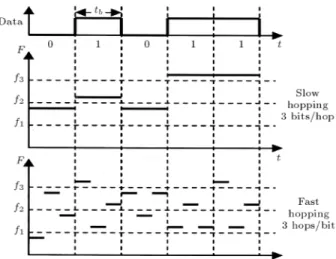
coherent reception will be feasible in a slowly fading channel [2]. (Note that in some applications, FFH systems are more plausible and desirable, such as military applications. With fast hopping, it is much more dicult for the transmission to be intercepted by an undesired user.) To visualize the dierence, the traditional slow and fast frequency hopping schemes are depicted in Figure 1.
Even though coherent detection gives a somewhat superior performance compared to the non-coherent case, in a case of fast fading, a non-coherent reception is inevitable. Single user performance of MC-FH and FFH systems using non-coherent detection has been evaluated in [6], in which it has been shown that the non-coherent MC-FH system outperforms the FFH system when the channel delay spread is severe, while the FFH system is superior to the MC-FH system for a fast fading channel. The multiuser performance of a MC-FH system, with coherent and non-coherent detections in additive white Gaussian noise (AWGN) and a frequency-selective slowly Rayleigh fading chan-nel, is evaluated in [7]. The results in [7] have shown that the coherent detection substantially outperforms the non-coherent detection. In addition, it has been shown that [8] the multiuser performance of MC-FH and FFH systems is almost identical, when utilizing non-coherent detection. In this paper, it is assumed that the coherent reception is feasible and the focus is on coherent detection.
To exploit the given bandwidth more eciently, in [5], the authors have proposed to use a practi-cal low rate error correcting code in the MC-FH-CDMA system, which does not require any additional bandwidth to that needed in an uncoded MC-FH-CDMA system. The idea is as follows: Instead of sending the Ns carriers at each bit interval with an
identical phase (0 or 180), which is determined by
the corresponding input data bit, these carriers can
Figure1. Slow and fast frequency hopping schemes.
be sent with dierent phases, the values of which are determined with output symbols of an encoder. In fact, with the above insight, the uncoded scheme is considered as a coded scheme with a repetition block code of rate 1=Ns. Since a repetition code is not
a good code, it is expected that applying a more powerful code with the same rate, 1=Ns, substantially
improves the system performance without requiring any bandwidth expansion in addition to that needed by the uncoded scheme. The error correcting code considered in [5] is a super orthogonal convolutional code [9], as its path generating function is available for performance evaluation. The authors have shown [5] that the super orthogonal convolutionally coded MC-FH-CDMA system substantially outperforms the un-coded scheme.
On the other hand, LDPC codes, originally intro-duced by Gallager [10] and rediscovered by MacKay and Neal [11], have received considerable attention recently and their applications in various communica-tion systems, including OFDMA, Mobile Satellite and CDMA systems, have been considered. The interest in these codes is due to their near Shannon limit perfor-mance and their simple descriptions, implementations and decoding algorithms.
In this paper, the application of a LDPC code in a MC-FH-CDMA system is considered and the performance of the LDPC coded system is evaluated, using the coded scheme introduced in [5] and de-scribed above, in a Rayleigh fading channel. Dier-ent constructions of regular LDPC codes, are exam-ined, namely Gallager [10], MacKay [11] and semi-random [12] constructions. It will be shown that for the application considered, these constructions have some practical limitations. To alleviate those limitations, a modied semi-random construction is proposed. The simulation results indicate that the LDPC coded sys-tems in the cases considered perform better than the super orthogonal coded systems. Furthermore, the results show that the proposed modied semi-random construction displays a better performance than the other well-known regular construction methods for the application considered, despite its very low encoding complexity.
The outline of the paper is as follows. In the following section, the LDPC coded MC-FH-CDMA sys-tem and its conventional single user receiver structure are described. Then, a brief description of LDPC codes and their dierent constructions are presented. After that, the performance of a LDPC coded MC-FH-CDMA system in Rayleigh fading channels is evaluated and some simulation results are provided. Then, the proposed modied semi-random construction of LDPC codes is described and its performance in the MC-FH-CDMA system is evaluated. Finally, the paper is concluded.
SYSTEM DESCRIPTION
In this section, rst, a brief description of the MC-FH-CDMA system is provided, as introduced in [1,5]. In this system, every transmitter sendsNs carriers for
each data bit using BPSK modulation. The carriers are spaced apart in sequential subbands. The total given frequency bandwidth is equally partitioned into Ns
subbands, where each subband contains Nh dierent
frequency carriers spaced apart by fd. fd is chosen
such that every pair of carriers is orthogonal, i.e.,
fd= 1=Ts, whereTsdenotes a bit time duration. Thus,
the total frequency carriers available for multiple-access communications areNsNh. In this system, the
equivalent baseband signal transmitted by user k can be written as follows:
s(k)(t) = X
i Ns 1
X
l=0 p
2Pwd(k)
l;iej2(fl+c (k)
l;ifd)(t iTs) PTs(t iTs); (1)
where index l indicates the subband number, Pw is
the transmit power of each carrier and fd (k)
l;ig is the
transmitted binary sequence of userk. This sequence modulates the dedicated carriers. fc
(k)
l;ig is the
pseu-dorandom sequence of user k, which determines the carrier frequency selected from each subband,l, during theith bit interval. The elements of this sequence are independent and identically distributed (i.i.d) random variables, which take on integer values in the interval [0;Nh 1]. P(t) is a rectangular pulse over the
interval [0;] with amplitude equal to 1. flis the rst
carrier frequency in subband l and is equal tolNhfd,
l= 0;1;2;;Ns 1.
In an uncoded scheme, sequenced(k)
l;i isNs
repeti-tions of the user information data sequence, i.e.,d(k)
l;i =
D(k)
i , for l = 0;1;;Ns 1, where D
(k) is the ith
information bit of user k. Thus, the uncoded scheme can be considered as a coded scheme with a simple repetition block code of rate 1=Ns. Since the repetition
code is not a good code, a more powerful code can be used to improve system performance. Use of a LDPC code is suggested with rate 1=Ns. In the coded scheme
considered, d(k)
l;i in Equation 1 is the lth code bit of
userkat information bit intervali. Thus, in this coded scheme, the phase of each carrier is determined by the corresponding coded symbol. Figure 2 presents a block diagram of the transmitter structure. In this gure, the LDPC encoder is implemented in the same way as any linear block code, by knowing its generator or parity-check matrix.
The channel is considered as a frequency-selective slowly Rayleigh fading channel with an AWGN. How-ever, each carrier is assumed to experience a frequency-non selective fading channel, i.e., fd <<(f)c, where
(f)c is the coherence bandwidth of the channel.
Since, with very high probability, the distance among adjacent carriers is large as they are located in dierent subbands, note that the average frequency distance between adjacent carriers is Nhfd.) it can well be
assumed that the dedicated carriers experience inde-pendent at fading. In addition, the Doppler shift is assumed to be small enough to have a slow fading. The above assumptions are reasonable for most practical applications. Propagation measurements in wireless environments, including indoor, open rural, suburban and urban areas, show that the delay spread is typically distributed over the range of [0.1 s, 3 s] [13]. So, for instance, at a bit rate equal to 1Mbps for indoor
environments, which has the delay spread of 0.1 s, the coherence bandwidth is larger than the symbol rate. As a result, each carrier experiences a at fading. Furthermore, for Nh greater than 20, the
average frequency distance between adjacent carriers (i.e., Nhfd) is greater than the coherence bandwidth
and, as a result, each carrier experiences independent fading. Note that for future very high rate wireless communication networks, to make the carriers experi-ence independent fading, a serial-to-parallel converter (like in OFDMA and MC-CDMA systems) might be required before MC-FH-CDMA modulation, in order to reduce the symbol rate in each parallel branch to much less than the coherence bandwidth of the channel.
Due to the random construction and very sparse property of the parity-check matrix of a LDPC code, the decoder of a LDPC code has a built-in \in-terleaver" [14]. So, one can well assume that the successive symbols transmitted by the same carrier in a subband also experience independent fading. Let
g(k)
l;i =(k)
l;iej(k)
l;i be the channel complex gain observed
by the lth carrier of user k at bit interval i. Then,
g(k)
l;is for dierent values ofk, land iare independent.
Furthermore, since the channel is assumed to be slowly-fading, i.e., the complex channel gain corresponding to each carrier does not change signicantly during several bit intervals, the channel gain can be well estimated at the receiver. However, in the current work, it is assumed that perfect estimations of the channel parameters are available and the eects of parameter estimation errors are not considered in the performance evaluations. Also, the eects of the synchronization errors are not considered. For some recent work on channel estimations and synchronization problems in a MC-FH CDMA system and their error eects on the system performance, please see [4,15].
As the channel is assumed to have Rayleigh distribution, (k)
l;i's are independent from (k)
l;i's, with
(k) 2
l;i ,. Also, (k)
l;i's will have a uniform distribution
over the interval [0;2]. The received signal, due to userk, is equal to:
s(k) rec(t) =
X
i Ns 1
X
l=0 g(k)
l;i
p
2Pwd(k)
l;iej2(fl+c (k)
l;ifd)(t iTs) PTs(t iTs); (2)
For simplicity of presentation, a synchronous system with perfect power control is assumed. Then, the total received signal can be written as:
r(t) =XNu
k=1 s(k)
rec(t) +(t); (3)
where Nu is the number of active users and (t) is
AWGN with a two sided power spectral density of
N0=2. By substituting Equation 2 in Equation 3, one
has:
r(t) =XNs
k=1 X
i Ns 1
X
l=0 p
2Pwg(k)
l;i d(k)
l;iej2(fl+c (k)
l;ifd)(t iTs) PTs(t iTs) +(t): (4)
In the following, the receiver structures for uncoded and coded schemes are described. Without any loss of generality, it is assumed that the desired user is user 1.
Uncoded Scheme
For this system, a single user Maximal Ratio Com-bining (MRC) receiver is considered. Let the desired user be user 1. The well-known MRC receiver makes a decision at each bit interval, i, according to the following rule:
Re
(
Ns 1 X
m=0
Zm;i
z }| {
g(1)
m;i
Subbandcorrelatoroutput
z }| {
1
Ts
Z (i+1)Ts
iTs r(t)e
j2(fm+c (1)
m;ifd)tdt )
| {z }
Decisionvariable,Zi
1 ?
0
0:
(5)
Coded Scheme
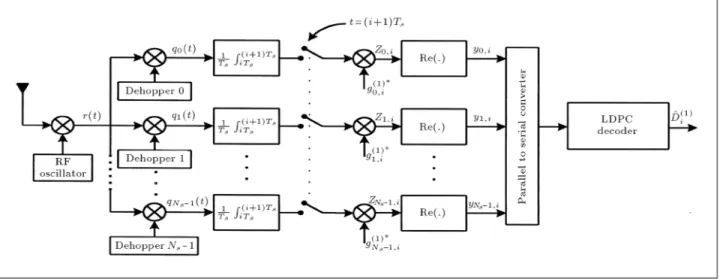
The block diagram of the receiver for user 1 is shown in Figure 3. In this receiver, at each information bit interval,i, theNsreceived coded symbol signals carried
by theNscarriers of that interval are rst demodulated
and, then, are given to the dehopper followed by a subband correlator. The subband correlator outputs, as dened in Relation 5, are multiplied by the conjugate of the channel gains g1)
m;i's. The real part of these
results, i.e., Re(Zm;i)'s in Relation 5, are given to
the parallel to serial converter and then passed to the LDPC decoder. In fact, Re(Zm;i) denotes the received
sample (the decoder soft input) corresponding to the
mth transmitted code bit at the ith information bit interval.
LDPC CODES
LDPC codes, originally invented and investigated by Gallager [10] in 1962, are linear block error-correcting codes based on very sparse parity check matrices.
A(N;dv;dc)-regular LDPC code is a linear binary
code determined by the condition that each code bit participates in exactly dv parity-check equations and
that each such check equation consists of exactly dc
code bits. In other words, the corresponding parity-check matrix, H, has dv ones in each column and
Figure3. Receiver block diagram (coded scheme) of user 1. dc ones in each row. Thus, the number of parity
bits and information bits are, respectively, equal to
M=N:dv=dc andK=M N, whereN is the length
of the code. In other words, as both N:dv and M:dc
represent the number of edges in the corresponding bipartite graph of the parity check matrix, they are equal. Therefore, the rate, R, of the code is given by
R= 1 (M=N) = 1 (dv=dc).
LDPC Encoding
In the following, the three well-known construction methods of regular LDPC codes are briey described, namely, Gallager, MacKay and semi-random construc-tions, which are applied to the coded MC-FH-CDMA systems in the next sections.
Gallager Construction
In this construction, the parity-check matrix is divided horizontally into dv equal size submatrices, each
con-taining a single `1' in each column. The rst submatrix is constructed as follows: the ith row contains 1's in columns (i 1)dc + 1 to idc. The subsequent
submatrices are merely random column permutations of the rst one.
MacKay Construction
MacKay has presented [11] several construction meth-ods for regular LDPC codes. The best one is used, for which the parity-check matrix, H, is generated randomly, with column Hamming weight dv, row
Hamming weight as uniform as possible, and overlap between any two columns is no greater than one.
Semi-Random Construction
The major problem with regular LDPC codes is their very high encoding complexity. Since the parity-check
matrix of the code is sparse, the associated generator matrix will be dense and, as a result, the encoding process requires a high number of computations. To overcome this problem, the concept of semi-random LDPC codes has been introduced [12]. In semi-random construction, to produce a (N;K) code, the following parity check matrix,HMN = [hij], is used:
HMN = 2 6 6 6 6 6 6 6 6 6 6 6 4
1 0 0 0
1
M0 K
1 1 0 0 ...
0 1 1 ... ...
... ... ... ... 0 ...
0 0 1 1 dM
0 K
| {z }
M
3 7 7 7 7 7 7 7 7 7 7 7 5 ;
where M = N K and M0 = M=d
v. Each
component matrix,iM0
K, has a random construction
with column weight equal to one and row weight equal to d0
c, where d0
c = Kd=M. As can be observed, in
this construction, the parity check matrix,H, consists of two parts, only one part of which is generated randomly. For the systematic codeword, i.e., V = (p1;
;pM;u 1;
;uk), parity bits are computed as: 8
> < > :
p1= PK
j=1ujh
1;M+j (mod 2) pm=pm 1+
PK
j=1ujhm;M
+j (mod 2)
2mM
(6) where hij is the element in the ith row and jth
column of the parity-check matrix andu1;
;uk are
information bits. Ecient encoding is achieved by di-rectly computing the parity-check bits from Equation 6 without any requirement to compute the generator matrix.
One of the advantages of the semi-random con-struction is its Unequal Error Protection (UEP). In [16], Davey has shown that in an irregular LDPC code, in which symbols do not all participate in the same number of parity-checks, those symbols partici-pating in the highest number of parity-check equations receive the most information during the decoding process. As a result, the value of those symbols is determined more quickly and more accurately than the \less privileged" symbols. This property is called as Unequal Error Protection (UEP). In the semi-random construction, information bits have a degree ofdv(dv>
2) and parity bits have a degree of 2, except the parity bit, pM, which is of degree one. Therefore,
the information bits participate in the highest number of parity-check equations and will be decoded more quickly with higher reliability. Because of this property, as seen later, the semi-random code gives a better performance in comparison with the other two regular LDPC codes when applied to MC-FH-CDMA systems, despite its lower encoding complexity.
LDPC Decoding
Iterative soft decoding of LDPC codes can be im-plemented using the Belief Propagation (BP) algo-rithm [11]. In this algoalgo-rithm, information is exchanged between neighboring nodes in the graph by passing messages along the edges. At the initial stage, this algorithm requires the knowledge of theapriori prob-ability of the transmitted code bit. Let P(dn =z) be
the a priori probability of code bit dn. The value of
this probability is fully related to the modulation used and the channel characteristics. In the following, in the Binary Phase Shift Keying (BPSK) modulation, it is assumed that 0 is mapped to -1 and 1 is mapped to 1. Letyn be the nth received sample at the LDPC
decoder input, i.e., the real part of Zm;i, as dened
in Relation 5, corresponding to code bit dn. Then,
the Log Likelihood Ratio (LLR) of yn is computed as
follows:
LLR = logpp((yynn=d=dnn= 0)= 1): (7) Then, from Equation 7, thea prioriprobability of the
corresponding code bit,dn, is easily obtained as:
P(dn=z) = 1=(1 + exp((2z 1)LLR)): (8)
In the following section, for performance evaluation, theaprioriprobabilityof the code bit is rst computed.
Then, by using these values at the initial stage of the BP algorithm, the performance of the coded system is evaluated by simulation.
PERFORMANCE EVALUATION
(RAYLEIGH FADING CHANNEL)
A Priori Probability Evaluation for the LDPC
Decoder
As mentioned before, a priori probabilities of the code bits are required by the LDPC decoder implemented by the BP algorithm. To this end, one must rst compute the distribution of the interference term in the received samples at the LDPC decoder input. Through this section and subsequent sections, similar to [5], the discrete moment generating function (mgf) approach is used for computing the distribution. Without any loss of generality, the received signal at the information bit interval is considered to be zero. So, the subindex zero is dropped from Zm;0, dened in Relation 5. From
Equation 4, the received signal at bit interval zero is equal to:
r(t) =XNu
k=1
Ns 1 X
l=0 g(k)
l d(k)
l
p
2Pwej2(fl+c (k)
l fd)t+(t);
(9) where, for the sake of simplicity,g(k)
l;0,d (k)
l;0 andc (k)
l;0 have
been replaced withg(k)
l ,d(k)
l andc(k)
l , respectively. For
the desired user (user 1), from Equations 4 and 5, the subband correlator output, i.e.,Zm, is simply obtained
as follows:
Zm= g
(1)
m
Ts
Z Ts 0
r(t)e j2(fm+c (1)
mfd)tdt
= g(1)
m
Ts
Z Ts 0
(
Nu
X
k=1
Ns 1 X
l=0 g(k)
l d(k)
l
p
2Pw
ej2(flfm+(c (k)
l c(1)
m)fd)t+(t)e j2(fm+c (1)
mfd)t )
dt:
(10) As the carriers are orthogonal, the integral in Equa-tion 10 is nonzero only for l=m. Consequently, one has:
Zm=jg (1)
m j 2d(1)
m
p
2Pw
+XNu
k=2 g(k)
m g(1)
m d(k)
m p
2Pw
Ts
Ts
Z 0
ej2(c (k)
m c(1)
m)fdtdt+
m;
(11) where m is the complex noise component. In
Equa-tion 11, the rst term is due to the desired user signal and the second and third terms are the multiple-access interference and white Gaussian noise components, respectively. The real part of the subband correlator's
output, i.e., Re(Zm), is simply obtained as:
ym= Re(Zm) =d(1)
m((1)
m)2 p
2Pw
+
I(k)
m
Nu
X
k=2
z }| {
(1)
m(k)
md(k)
mp
2Pwcos((k)
m (1)
m )
Ts
Ts
Z 0
ej2(c (k)
m c(1)
m)fdtdt
| {z }
Im
+m; (12)
where g(k)
m =(k)
m ej(k)
m ,I(k)
m is the interference caused
by interfering user k at mth subband correlator's output, and Im is the total interference due to all
interfering users at themth subband correlator output of user 1. In Equation 12,m, the noise component, is a
Gaussian random variable with zero mean and variance
2
equal to N0( (1)
m)2=T
s (or, equivalently, equal to
NsPw((1)
m)2=
b), where b is the received signal to
noise ratio per bit.
It is necessary to obtain the mgf ofImconditioned
ong(1)
m . To this end, the mgf of the interference caused
by each interfering userk must be determined. Then, as the interfering user components are independent, the mgf of the total interference is computed by multiplying the mgfs of dierent interfering users' components. Under the assumption of full power control, the mgfs of the interference, due to dierent users, are identical. Therefore, it is sucient to determine the mgf of the interference caused by only one user.
Since random variable (k)
m (1)
m has uniform
distribution on interval [ (1)
m ;2 (1)
m ] and(k)
m has
a Rayleigh distribution with (k)2
m = = 1 and, also,
(k)
m and(k)
m (1)
m are independent, it can be concluded
that (k)
m cos((k)
m (1)
m) has a Gaussian distribution
with zero mean and variance equal to 1/2 [17]. As a result, it can easily be shown that random variable
(1)
m d(k)
m p
2Pw(k)
m cos((k)
m (1)
m) has also a Gaussian
distribution with zero mean and variance equal to
Pw((1)
m)2. On the other hand, the integral in
Equa-tion 12 is equal to Ts for c(k)
m = c(1)
m and zero for
other values of c(k)
m . Considering the distribution of
fc (k)
m g's, the probability that c (k)
m is equal to c(1)
m is
= 1=Nh and the probability that c(k)
m is not equal
to c(1)
m is = 1 = 1 1=Nh. Consequently, the
moment generating function of I(k)
m , conditioned on
(1)
m = Re(g(1)
m ), is computed as:
I(k)
m jm(s) =+exp
s2P
w2
m
2
; (13)
where (1)
m has been replaced with m. Then, from
Equations 12 and 13, the mgf ofImis simply obtained
as:
Imjm(s) =
Nu
Y
k=2
I(k)
m jm(s)
=
+exp
s2P
w2
m
2
Nu 1
: (14) Now, from Equation 12, one can easily compute the conditional mgfs of the soft received samples, i.e.,ym,
conditioned onm and the corresponding transmitted
code symbol, i.e.,d(1)
m, as follows:
ymjm;d (1)
m (s) = ymjm;1(s) = exp(
s
2
m
p
2Pw)
:
+exp
s2P
w2
m 2 Nu 1 :exp s2P
w
2 :Nbs:
2
m
=Nu 1 X
i=0
Nu 1
i
Nu 1 iiexp s
p
2Pw
+ (iPw+Pw:Nbs)s
2
2
!
(2
m); (15)
where the second equality simply follows from poly-nomial expansion of the second multiplication term. Without loss of generality, p
2Pw = 1 is set. Since
m has a Rayleigh distribution,2
mhave a chi-square
distribution of order 2. Taking the expectation onm's
and using some algebraic manipulations lead to: ymj1(s) =
Nu 1 X
i=0
Nu 1
i
Nu 1 ii
1s
i+Ns b
s2 4
=Nu 1 X
i=0
Nu 1
i
Nu 1 ii q
1 +i+Ns b
1
s pi;1
+ 1pi;
2 s
; (16)
wherepi;1andpi;2are given, as follows: pi;1=
2
1 q
1 +i+Ns b
; pi;2=
2
1 + q
1 +i+Ns b
: (17)
pi;1s are all negative and pi;2s are all positive. Also,
includes the axis,s=j!. Therefore, from Equation 16, the conditioned probability density function (pdf) of soft received samples, i.e.,yms, can easily be obtained
using an inverse Laplace transform, as follows:
fym=1=
Nu 1 X
i=0
Nu 1
i
Nu 1 ii q
1 +i+Ns b
:exp i+2Ns
b
ym jymj: s
1+i+Nbs
!! :
(18) Now, one can easily use Equations 7, 8 and 18 to compute thea prioriprobability of a transmitted code
bit, which is required by the LDPC decoder.
Computation of a Priori Probabilities Under
the Gaussian Assumption
If one assumes that the distribution of interference at the output of the subband correlator is Gaussian, the mean and variance of this random variable should be determined, in order to compute the a priori probabilities. In terms of mgf, the mean and variance of an arbitrary random variable,X, can be expressed as:
X=EfXg=
dX(s)
ds jS =0;
and:
2
X =EfX 2
g (EfXg) 2
=d2
X(s)
ds2 jS
=0
dX(s)
ds jS =0
2
:
Using Equation 16, it can be shown that:
dImjm(s) ds jS
=0= 0;
and:
d2
Imjm(s) ds2
jS
=0=PW(Nu 1) 2
m:
So, at the weighted output of each subband correlator,
m, one has a Gaussian signal, with the following mean and variance:
(
ym= 2
mp
2Pw
2
ym =
(Nu 1) + Nbs
Pw2
m: (19)
Therefore: Imjm;d
(1)
m(s)=exp
s+ s2
4
(Nu 1)+Nbs
2
m
;
where p
2Pw = 1. After taking expectation on ms
and doing some manipulations, the conditional pdf of
ymcan be obtained, as follows:
fym=1=
1
q
1 +Nu 1
Nh +Nbs
:exp Nu 12
Nh +Nbs
ym jymj: s
1+NNuh1+Nbs
!! :
(20) This formula simplies the computational complexity of thea priori probability formula in Equation 18. In
the next subsection, the performance of LDPC codes in a MC-FH-CDMA system is evaluated, based on both exact and Gaussian approximated evaluations of the a priori probabilities.
Simulation Results
In this section, some simulation results are presented to evaluate the performance of LDPC coded MC-FH-CDMA systems. MacKay, Gallager and semi-random constructions of the LDPC codes are considered. The belief propagation algorithm is used for decoding of the LDPC codes, in which Equations 7, 8 and 18 are rst used to compute the a priori probability of the
transmitted code bit. Under Gaussian assumption, the
a priori probability is calculated, using Equation 20
instead of Equation 18. Then, the BP algorithm uses this apriori probability for its initial stage, to decode
the transmitted code bits.
A processing gain of NhNs = 320 and signal
to noise ratio per bit (b) of 12 dB are assumed.
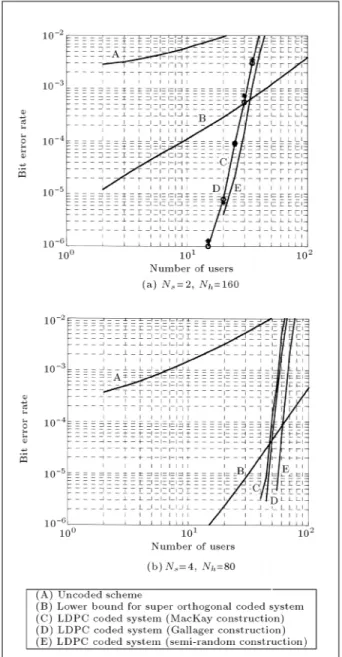
Figures 4a and 4b present the plots of the Bit Error Rate (BER) versus the number of users for uncoded and coded schemes in a Rayleigh fading channel at a number of subbands, i.e., Ns, equal to 2 and 4,
respectively. The Rayleigh parameter, , is set to one and the maximum number of decoding iterations (im)
for LDPC codes is set to 1000. To evaluate the bit error probability, 100000 blocks are transmitted. In these gures, the performance of LDPC coded schemes, with a data block length of 500 and dv = 3, is
compared with the lower bound of BER of the super-orthogonal convolutional coded schemes, as reported in [5]. (Note that the performance evaluation of the super-orthogonal coded schemes in [3] is based on the analytical results in which only the lower and upper bound of BER can be computed using the path generating function of the super-orthogonal code.) Even though the super-orthogonal codes show a good performance at BER=10 3, which is suitable for voices
at lower BER, required for high-quality services such as data, LDPC codes perform substantially better. For instance, at BER=10 5, the number of users supported
Figure4. Bit error rate versus the number of users in
MC-FH-CDMA system. bis set to 12dB. The average
number of decoding iterations is 214.407 for (a) and 339.518 for (b).
by the semi-random code is about 25 (for Ns = 2)
and 60 (forNs= 4), whereas, by the super-orthogonal
codes, it is, at most, 2 (forNs= 2) and 30 (forNs= 4).
From these gures, it can also be realized that the semi-random code, despite its encoding simplicity, performs better than the more complex Gallager and MacKay codes.
The performance of the Gaussian distribution assumption for multiuser interference at the output of the subband correlator is illustrated in Figure 5, where the bit error rate versus the number of users for Ns = 4 under MacKay construction is evaluated.
As can be realized, the Gaussian assumption, while simplifying the computation of a priori probabilities,
Figure 5. Bit error rate versus the number of users in
LDPC coded MC-FH-CDMA system (MacKay construction).
Figure 6. BER versus the number of users in LDPC
coded MC-FH-CDMA system (MacKay construction) parameterized by the maximum number of iterations (im).
The average numbers of decoding iterations forim= 1000,
200 and 50 are 214.407, 25.673, and 18.965, respectively.
performs well in the LDPC coded MC-FH-CDMA system.
To consider the eect of a maximum number of decoding iterations in the performance of a LDPC decoder, the BER versus the number of users parame-terized by the maximum number of iterations is shown in Figure 6. It can be realized that the performance of a LDPC decoder with im = 200 is close to the
MODIFIED SEMI-RANDOM
CONSTRUCTION
The well-known constructions of regular LDPC codes, briey described in the previous section, impose some restrictions. That is that M (the number of parity bits) must be divisible by dv. The semi-random
construction also requires the divisibility ofKdv by M. Furthermore, in the application considered (MC-FH-CDMA), the code rate must be equal to 1=Ns, in
order not to have any bandwidth expansion, due to the coding applied. Thus,
Kdv
M = Rdv
1 R = Nsdv 1; (21)
where the rst equality follows from denition of the code rate, R = KN = KK+M, and the second equality
follows from the requirement of the coded MC-FH-CDMA, i.e., R = 1
Ns. As a result, this requirement
imposes the limitation of the divisibility ofdvbyNs 1.
To overcome these restrictions for the applica-tion considered, a new construcapplica-tion will be presented, based on the semi-random code, which will be called \modied semi-random" construction. In this method, an appropriate value is chosen for dv (without any
restriction) andd0
v is computed as follows:
d0
v =
Kdv
M
: (22)
The deterministic part of the parity check matrix,H, is similar to that of the semi-random construction and the random part is generated by matrix H0
KM with
weightd0
v per column, using the MacKay construction.
So, the matrix, H, for this construction is given as follows:
HMN= 2 6 6 6 6 6 6 4
1 0 0 0 j
1 1 0 0 j
0 1 1 ... j H 0T
MK
... ... ... ... 0 j
0 0 1 1 j
3 7 7 7 7 7 7 5 :
Note that, in this construction, the value of dv does
not depend on the value of Ns. As a result, for the
application considered, its value can be selected small enough for good performance [10], even for high values ofNs.
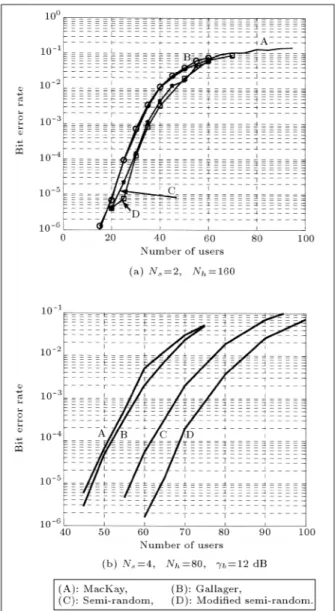
The performance of the LDPC coded MC-FH-CDMA system has been evaluated using the proposed construction by simulation. Figures 7a and 7b present the plots of BER versus the number of users for dierent constructions of LDPC codes. As can be realized, the simple modied semi-random construction outperforms the other constructions, especially at high values of Ns. For instance, at Ns = 4 and BER
Figure7. Performance of dierent construction methods
of regular LDPC codes for MC-FH-CDMA system.
equal to 10 5, the number of users supported by
MacKay, Gallager, random and modied semi-random constructions are about 46, 47, 57 and 65, respectively.
CONCLUSION
In this paper, a LDPC coded multi-carrier frequency-hopping CDMA scheme was rst considered, which does not require any additional bandwidth to that needed by an uncoded spread spectrum MC-FH-CDMA system. Then, the performance of the coded system was evaluated, using dierent constructions of LDPC codes in a Rayleigh fading channel. The simu-lation results have indicated that the coded schemes substantially outperform the uncoded scheme. Fur-thermore, it has been realized that the LDPC coded scheme performs substantially better than the
super-orthogonal convolutionally coded scheme (previously reported in [5]) at low BERs. It has also been observed that the semi-random LDPC codes perform very well, despite their simple encoding structures. Then, to overcome the restrictions imposed by the well-known constructions of LDPC codes for the application con-sidered, a modied semi-random construction has been proposed. Despite its encoding simplicity, which is the same as that of the semi-random construction, the proposed modied construction outperforms previous construction methods.
REFERENCES
1. Lance, E. and Kaleh, G.K. \A diversity scheme for a phase-coherent frequency-hopping spread-spectrum system",IEEE Trans. Commun.,45(9), pp 1123-1129
(Sept. 1997).
2. Shin, O.S. and Lee, K.B. \Performance comparison of FFH and MCFH spread-spectrum systems with optimum diversity combining in frequency-selective Rayleigh fading channels", IEEE Trans. Commun.,
49(3), pp 409-416 (March 2001).
3. Nikjah, R. and Nasiri-Kenari, M. \Unied perfor-mance analysis of several multicarrier spread-spectrum multiple-access systems in correlated Rayleigh fading channels", inProceedings of Fourth IEEE Conference on Mobile and Wireless Communications Networks, MWCN, Stockholm, Sweden (2002).
4. Nikjah, R. and Nasiri-Kenari, M. \Unied multiple-access performance analysis of several multi-rate mul-ticarrier spread-spectrum systems", in Proceedings of IEEE Vehicular Technology Conference (VTC) Fall 2004, Los Angeles, CA, USA (2004).
5. Ebrahimi, T.M. and Nasiri-Kenari, M. \Performance analysis of multicarrier frequency-hopping (MC-FH) code division multiple-access systems: Uncoded and coded schemes",55th IEEE Vehicular Technology Con-ference, 2002, 2, pp 630-634. Also appeared in IEEE
Trans. Vehicular Technology(July 2004).
6. Shin, O.S. and Lee, K.B. \Performance comparison of FFH and MCFH spread-spectrum systems with
optimum diversity combining in frequency-selective Rayleigh fading channels", IEEE Transactions on Communications,3, pp 409-416 (March 2001).
7. Zeinalpour Yazdi, Z. and Nasiri-Kenari, M. \Per-formance comparison of coherent and non-coherent multicarrier frequency-hopping code division multiple-access systems", inProceedings of IEEE International Symposium on Personal, Indoor and Mobile Radio Communications, PIMRC 2004, Spain (2004). 8. Zeinalpour Yazdi, Z. and Nasiri-Kenari, M. \Multiuser
performance comparisons of fast frequency hopping and multicarrier slow frequency hopping systems: Un-coded and Un-coded schemes", in Proceedings of IEEE Vehicular Technology Conference (VTC) Fall 2004, Los Angeles, CA, USA (2004).
9. Viterbi, A.J., CDMA Principles of Spread Spectrum Communication, MA, Addison-Wesley (1995). 10. Gallager, R.G., Low-Density Parity-Check Codes,
Cambridge, MA: MIT Press, USA (1963).
11. MacKay, D.J.C. \Good error correcting codes based on very sparse matrices", IEEE Trans. Inform. Theory,
45, pp 399-431 (Mar. 1999).
12. Ping, L., Leung, W.K. and Phamdo, N. \Low density parity check codes with semi-random parity check matrix", Electronics. Letter, 35(1,7), pp 38-39 (Jan.
1999).
13. Lee, W.C.Y., Mobile Communications Engineering, New York, McGraw-Hill, 2nd Ed. (1998).
14. Jilei, H., Siegel, P.H. and Milstein, L.B. \Performance analysis and code optimization of low density parity-check codes on Rayleigh fading channels", IEEE J. Select. Areas Commun.,19(5), pp 924-934 (May 2001).
15. Taghavi, Z. and Nasiri-Kenari, M. \Iterative multiuser receiver for coded MC-FH multiple access systems in the presence of partial-band interference," in Proceed-ings of IEEE Vehicular Technology Conference (VTC) Fall 2004, Los Angeles, CA, USA (2004).
16. Davey, M.C., Error Correcting Using Low-Density Parity Check Codes, Ph.D. Dissertation, Cambridge University (Dec. 1999).
17. Papoulis, A., Probability, Random Variables and Stochastic Processes, McGraw-Hill, 3rd Ed. (1991).