Machine learning: the new language for applications
V.Siddesh Padala1, Kathan Gandhi2, D.V.Pushpalatha31,2Liberty High School, Frisco, Texas, United States 3Frisco, Texas, United States
Article Info ABSTRACT
Article history: Received Aug 10, 2019 Revised Oct 28, 2019 Accepted Nov 11, 2019
Machine learning and artificial intelligence are becoming a significant influence on various research and commercial fields. This review attempts to equip the researchers and industrial practitioners with the knowledge of machine learning techniques and their applications in multiple fields. Challenges and future directions are also proposed, including data analysis suggestions, effective algorithms based on the situation, industrial implementation, organization’s risk tolerance, cost-benefit comparisons, and the future of machine learning techniques. Applications discussed in this paper range from technological development and health care to financial issues and sports analytics.
Keywords:
Artificial intelligence Classification Machine Learning Neural Networks Regression
Support Vector Machine
Copyright © 2019 Institute of Advanced Engineering and Science. All rights reserved. Corresponding Author:
V.Siddesh Padala, Liberty High School, Frisco, Texas, United States. Email: [email protected]
1. INTRODUCTION
The industry has recently seen the advent of artificial intelligence, a field that makes machines smart enough to carry out certain tasks by learning on their own. One of its domains is Machine Learning (ML). Experts describe it as the “study that gives computers the [power] to learn without… explicit programming” [1]. ML is particularly powerful in the presence of massive amounts of data, often called “big data.” Increasingly large datasets enable increasingly accurate learning during the training of ML; these datasets can no longer be grasped by the human eye but can be scanned by computers running ML algorithms. With the advent of big data, both the amount of data available and our ability to process it has increased exponentially. The ability of machines to learn and thus appear ever more intelligent has increased proportionally. Machine learning is particularly suited to problems where: applicable associations or rules might be intuited, but are not easily codified or described by simple logical rules; potential outputs or actions are defined, but which action to take is dependent on diverse conditions that cannot be predicted or uniquely identified before an event happens; accuracy is more important than interpretation or interpretability; the data is problematic for traditional analytic techniques in specifically, wide data and highly correlated data.
In this paper, we categorize how Machine Learning promises to assist or apply to problems in Engineering, Life Sciences, Finance, and Sports Analytics applications. It is making technology such as driver identification even better that has far-reaching implications into insurance and health safety [2]. Some neuroscience experts believe machine learning “should be in the toolbox of most systems neuroscientists.” [3] It is protecting us from “catastrophic consequences such as [market] blackouts,” due to cyber-attacks [4]. It’s also helping players improve in times where “top-class coaches are hard to find” [5]. Although ML has emerged as a widespread concept, its techniques and implementations remain known to a few. In this paper, we provide a review of various kinds of ML algorithms simplified for beginners. Additionally, we aim to demonstrate the versatility of these algorithms through a detailed explanation of specific examples to encourage all types of industrial practitioners and researchers to adopt these ideas into
their practices and gain better efficiency and accuracy. The rest of the paper is organized as follows: Section 2 provides an overview of learning methods in machine learning. Section 3 discusses various applications of machine learning techniques in various fields like Health Sciences, Business, Autonomous Vehicles, Fraud Detection, Sports Analytics. Section 4 provides some comments on the challenges and future directions of the machine learning applications, and the final section concludes the paper.
2. LEARNING ALGORITHMS
In ML, there are three main types of learning - supervised, unsupervised, and reinforcement learning. Supervised learning uses prior data as a reference to generate models for predictions. However, unsupervised learning involves the interpretation of given data and creating demonstrative patterns from it, e.g. clustering, dimensionality reduction, and compression. Nevertheless, both techniques involve similar strategies and ideas to learn intuitively. The program must be flexible and robust enough to understand different datasets and adapt accordingly for accuracy. Reinforcement learning allows a system to learn the best actions based on the reward that occurs at the end of a sequence of actions. Most ML algorithms work with the framework of a cost function and a gradient. The cost function is usually a mean squared error function of the distances between the predictions and the expected answers. The gradient measures the slope of the tangent to the cost function and indicates how the parameters should adjust for better performance [1]. 2.1. Supervised learning
Every supervised ML situation has a dataset 𝑋, parameters 𝛩, a hypothesis ℎ𝛩(𝑋) = 𝛩⊤𝑋, and an
output variable y. With every iteration in the program, the machine adjusts parameters 𝛩 to take ℎ𝛩(𝑋) as
close as possible to y. 𝛩 can also be obtained using the normal equation: 𝛩 = (𝑋⊤𝑋)−1𝑋⊤𝑦. This y serves
as an answer key, used by the algorithm to improve. To make sure 𝛩 doesn’t become overly complex and create models that try too hard to fit the data, we regularize 𝛩 using 𝜆. Large values of 𝛩 are penalized by adding values of 𝛩 to the cost function. As a result, 𝛩 takes on appropriate values. When the hypothesis predicts a rational value based on given data, it is called regression. On the other hand, if the hypothesis tries to label the data appropriately, it is called classification.
2.1.1. Linear regression
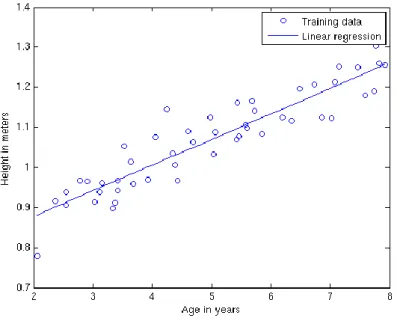
Linear regression is a popular technique for regression. Linear regression computes the cost function in (1) and the gradient in (2) on every iteration to reach the global minimum, a point where the cost function has the lowest value. This minimum value is achieved by adjusting 𝛩 using the cost function and gradient in (3). Once achieved, we can be certain that the program found the most accurate parameters 𝛩 to build the most accurate model [1], as shown in Figure 1.
𝐽(𝛩) = 1
2𝑚(∑ (ℎ𝛩(𝑋
𝑖) − 𝑦𝑖))2 𝑚
𝑖=1 + (
𝜆
2𝑚∑ 𝛩𝑗 2 𝑛
𝑗=1 ) (1)
𝜕𝐽 𝜕𝛩𝑗=
1
2𝑚∑ (ℎ𝛩(𝑋
𝑖) − 𝑦𝑖) ∗ 𝑋 𝑗𝑖 𝑚
𝑖=1 (2)
𝛩𝑗∶= 𝛩𝑗 − ɑ 𝜕𝐽
𝜕𝛩𝑗𝐽(𝛩) (3)
2.1.2. Classification
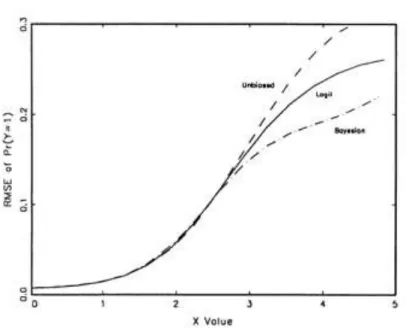
A slightly modified regression algorithm is referred as classification. Logistic regression works in the same way, but it has subtle differences in the specifics [6], as shown in Figure 2. While linear regression predicts continuous values, logistic regression must classify data into different types. So, it uses a probability model using the sigmoid function [7] as shown Figure 3.
Figure 2. Logistic regression example
Figure 3. Sigmoid Function
ℎ𝛩(𝑋) = 1
1+𝑒−𝛩⊤𝑋, which ranges from 0 to 1. Each 𝑋 has an associated 𝑦, which is a set of the probability that 𝑋 is of one of the possible types. The type with the highest probability for that 𝑋 is what 𝑋 will likely be as given in (4-6).
𝐽(𝛩) =−1
𝑚(∑ (𝑦
𝑖∗ 𝑙𝑜𝑔(ℎ
𝛩(𝑋𝑖)) + (1 − 𝑦𝑖) ∗ 𝑙𝑜𝑔(1 − ℎ𝛩(𝑋𝑖))) + ( 𝜆
2𝑚∑ 𝛩𝑗 2 𝑛
𝑗=1 )
𝑚
𝑖=1 (4)
𝜕𝐽 𝜕𝛩𝑗=
1
2𝑚∑ (ℎ𝛩(𝑋
𝑖) − 𝑦𝑖) ∗ 𝑋 𝑗𝑖 𝑚
𝑖=1 (5)
𝛩𝑗∶= 𝛩𝑗 − ɑ 𝜕𝐽
𝜕𝛩𝑗𝐽(𝛩) (6)
The most commonly used supervised classification algorithms include neural networks, support vector machines, decision trees. Both linear and logistic regression can be represented by neural networks whose properties allow modeling more complex functions.
Artificial neural networks (ANN)
ANN work like neurons in our body. They can take in various inputs and produce one output from the starting data or another neuron [8], as shown in Figure 4. In our situation, 𝛩 represents the connections between the neurons, and the neurons themselves contain data in some form. The output layer is used for comparison with 𝑦. Cost function and gradient are done based on the type of regression chosen. The processing of the neural networks is intricate, though. The algorithm must pass through forward once to get predictions and use them to calculate 𝐽(𝛩). The algorithm must also pass through backward to compute parameter errors and find 𝜕𝐽
𝜕𝛩.
Figure 4. Neural network architecture
Support vector machines (SVM)
Logistic regression rests on fine margins, so Support Vector Machines can be used instead to simplify the task and classify it with more confidence. Support Vector Machine is considerably different but uses the same approach as a logistic regression classifier. Instead of regularizing the parameters, the algorithm regularizes the theoretical cost with variable Cas in (7). In other words, the algorithm develops robust decision boundaries for classification by forcing the theoretical cost to be low while allowing parameters 𝛩 to adjust [9], as shown in Figure 5. The cost function is modified to make the cost 0 beyond a margin (usually 1) for positive and negative cases of 𝑧 = 𝛩⊤𝑋 [10], as given in Figure 6. In logistic regression, ℎ𝛩(𝑋) was one if 𝑧 ≥ 0 and 0 otherwise, but in SVMs, ℎ𝛩(𝑋) is one if 𝑧 ≥ 1 and 0 if 𝑧 ≤ -1.
𝐽(𝛩) = 𝐶(∑𝑚𝑖=1(𝑦𝑖∗ 𝑐𝑜𝑠𝑡1(ℎ𝛩(𝑋𝑖)) + (1 − 𝑦𝑖) ∗ 𝑐𝑜𝑠𝑡2(1 − ℎ𝛩(𝑋𝑖)))+ ( 1 2∑ 𝛩𝑗
2 𝑛
Figure 5. SVM decision boundary Figure 6. SVM cost function
2.2. Unsupervised learning
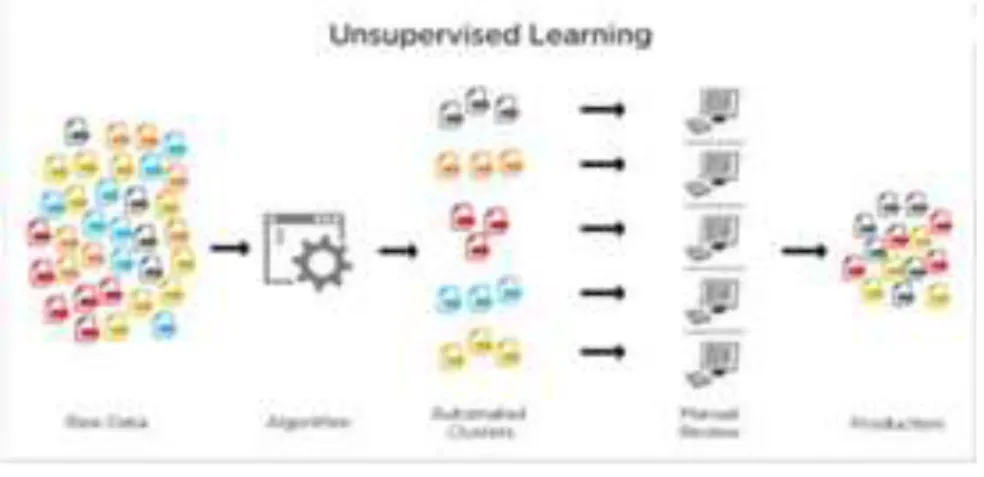
Every unsupervised ML problem builds a model around the data given and tries to use it for a specific purpose [11]. The machine studies data to identify different patterns as sown in Figure 7. The machine determines correlations and relations by parsing the available data. Unsupervised learning is similar to human behavior: drawing inferences through observation and experience. An unsupervised algorithm, however, has some disadvantages as it provides too little information on the relative advantage and absolute reliability of the operation. Different unsupervised algorithms like Clustering K-Means, Principal Component Analysis, Anomaly Detection, Recommender Systems, and other algorithms are developed.
Figure 7. Unsupervised learning
2.2.1. Clustering: K-means
The purpose here is to separate the data into clear groups called clusters. K-means, an iterative algorithm, are preferred for clustering. First, randomly initialize K centroids, which will be used to find K groups in the dataset [12]. The algorithm works by assigning data points to the closest centroid orthogonally, as shown in Figure 8. Then, the centroid is shifted to the mean of all the data points closest to it. In each iteration, we reduce 𝐽(𝛩) given in (8). Over many iterations, the results stabilize, and the centroid comes to a location that creates ideal clusters.
𝐽(𝛩) = 1
𝑚∑ ||𝑋
𝑖 − 𝑦𝑖||2 𝑚
Figure 8. Clustering visualization
2.2.2. Principal component analysis
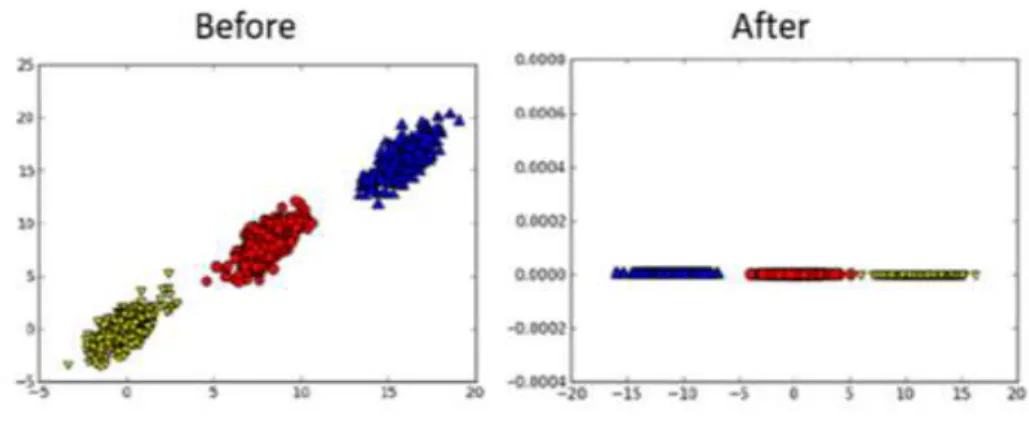
This algorithm reduces the dimensions of data by creating a lower-dimensional projection that captures the essence [13], as shown in Figure 9. It is imperative to do feature scaling and mean normalization before beginning in (9). Compute the mean µ and standard deviation σ before doing this to each element of each feature:
𝑋𝑗𝑖= 𝑋𝑗𝑖−µ𝑗
𝜎𝑗 (9)
The reduced feature vector can be obtained by using the eigenvectors of the covariance matrix in (10).
𝛴 = 1
𝑚∑ (𝑋
𝑖)⊤(𝑋𝑖) 𝑛
𝑖=1 (10)
The reduced feature vector obtained can be used to increase efficiency in other algorithms.
Figure 9. Deriving PCA Axes
2.2.3. Anomaly detection
Anomaly detection is a popular approach in detecting outliers or uncharacteristic data, as shown in Figure 10. Anomaly detection hinges on a probability model like logistic regression and finds anomalies if their probability is below the threshold ε in (11). Probabilities are commonly found by a Gaussian distribution that outputs the probability a data point is typical of the dataset when provided with the mean µ and variance σ2 [14]. Instead of using 𝐽(𝛩) to evaluate performance, we can use other metrics like precision,
recall, or F1-score.
𝑝(𝑋) = 1
√2𝜋𝜎𝑒 (−(𝑥−µ)2
𝑝(𝑋) = ∏ 1
√2𝜋∗𝜎𝑗𝑒
(−(𝑥𝑗−µ𝑗)
2𝜎𝑗2 )
𝑛
𝑗=1 for multiple features (11)
If p(X) ≥ ε, X is OK If p(x) < ε, X is an anomaly
Figure 10. Finding Anomalies
2.2.4. Recommender systems
Recommender systems, however, are a little different. In this algorithm, the machine first understands user preferences as the parameters 𝛩. Then, it uses it to fill the data 𝑋 that it can generate better 𝛩 from (12-14), then changes parameters again and so on until both reach high accuracy. The hypothesis is ℎ𝛩(𝑋) = (𝛩𝑗)⊤𝑋𝑖. To keep 𝛩 and 𝑋 in check from trying to fit the data too much and not generalizing, we
regularize both. For the cost function and gradient, we only consider the points that have data since we may have an incomplete data set.
𝐽(𝑋, 𝛩) =1
2∑ (ℎ𝛩(𝑋) − 𝑦
(𝑖,𝑗))2
(𝑖,𝑗):𝑟(𝑖,𝑗) = 1 +
𝜆
2∑ ∑ (𝛩𝑗
𝑘)2 𝑛 𝑘=1 𝑛𝑢
𝑗=1 +
𝜆
2∑ ∑ (𝑋𝑗
𝑘)2 𝑛 𝑘=1 𝑛𝑚
𝑗=1 (12)
𝜕𝐽
𝜕𝑋𝑘𝑗= ∑ (ℎ𝛩(𝑋) − 𝑦
(𝑖,𝑗)) 𝑚
𝑗:𝑟(𝑖,𝑗) = 1 ∗ 𝛩𝑘𝑖 + 𝜆𝑋𝑘𝑖 (13)
𝜕𝐽
𝜕𝛩𝑘𝑗 = ∑ (ℎ𝛩(𝑋) − 𝑦
(𝑖,𝑗)) 𝑚
𝑖:𝑟(𝑖,𝑗) = 1 ∗ 𝑋𝑘𝑖+ 𝜆𝛩𝑘𝑖 (14)
2.3. Reinforcement learning
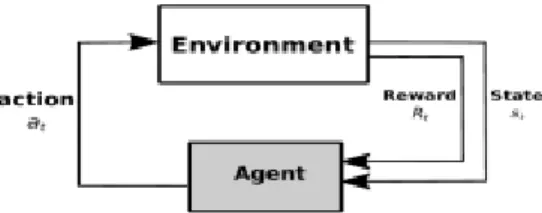
The concept of reinforcement learning has been taken from operant conditioning and behavioral psychology. Reinforcement learning is a part of ML concerned with maximizing reward from a given circumstance, as shown in Figure 11. In this particular area of ML, the machine is given a certain set of rules and regulations. By using these rules, the machine will look at a variety of actions to get the most optimal result [15], as shown in Figure 11. The process of obtaining the desired result, usually takes a lot of time, since it takes time for the machine to understand which action would lead to the desired outcome. Reinforcement learning is booming and being used by almost all software developers, including Oracle.
3. APPLICATIONS
Many potential ML applications become possible once the data, algorithms, and infrastructure are all in place. Some of the ML applications and conditions that must be paid attention to when applying these algorithms are discussed.
3.1. Life sciences (supervised learning)
Supervised ML has wide implications in the field of neuroscience due to its similarities with our learning methods and the ability to understand complex data [16]. Firstly, it can be used to improve the predictive performance of measurements generated from various methods. ML can be used to understand intention from information produced or predict future neural activity from past ones using techniques such as linear regression. Secondly, linear regression can also be used to find a correlation between measured variables, and logistic regression or SVM can determine how indicative a variable is of the desired variable. It can accurately identify what outside influences trigger what parts of the brain and vice-versa. Thirdly, supervised ML can also be a benchmark to compare simpler models against instead of R2, since they account
for random noise. It can also indicate how the components can be improved. Lastly, since the brain was the inspiration for artificial neural networks, they can also be used to model their teacher - the brain. Unsupervised learning techniques can assist the supervised learning methods by reducing dimensions, find clusters, or extract features.
Classification algorithms like logistic regression or SVMs can be convenient in physiotherapy, as well. It can be used in medical imaging to separate various “X-ray or MRI images” [17]. Patients can be classified into various categories based on the level of pain they feel, concluded from brain MRI data. Classification can also be applied in the risk prediction of injuries. Decision support systems can be built with a combination of recommender systems that extract features and then do classification. Unsupervised ML is less prevalent in the field. In most cases, it needs to be coupled with supervised ML and its accuracy by itself is not known. Lastly, cancer and other fatal diseases can be detected early in their onset by using ML. Particularly, using principal component analysis to reduce features and then implementing SVM-based algorithms for classification has produced very accurate results (0.96/1) in the case of breast cancer [18]. Implementing ML can make cancer detection faster and more efficient.
3.2. Sports (classification)
Creating an artificial training expert system to maximize the potential of basketball athletes is an intriguing prospect. ML can be used to monitor fitness and wellness, amongst many other aspects of the athlete. The use of low power wearable devices equipped with powerful embedded processors has been suggested as a possible training model. These wearable devices can be used to get information about the physiology, biomechanics, psychology, and sociology of a trainee. This application makes use of supervised learning, specifically Classification, to determine the most optimal training method for training basketball players [19]. After determining the different types of training methods, SVM classification algorithms can be used to classify the basketball training type. All athletes have potential and tendencies, which can be used as data that can be used to predict the performance in the future. This prediction can be achieved by automated machine learning and predicted modeling. Creating a training method based on opponents is the best way to optimize the performance of a player and get the best out of him. Machine Learning can also play a role in protecting the health of a player through wearable technology, providing all the necessary data to create his diet and fitness plan and improve his performance. ML also predicts the maximum capability of a player and predicting when it can hinder his performance. ML also analyzes off-field data and what can bring out the best out of a player. ML can identify the priorities and goals of a player, and when he/she would stay the most motivated and give their best. Also, ML can drastically improve operational efficiency by predicting how the event might unfold and make the right staffing and inventory decisions.
3.3. Finance (unsupervised learning)
ML has become a very common feature in the finance industry. It has been used for a wide range of applications, from bank and credit card fraud to process automation. In ML, problems like detecting financial fraud can be solved using classification - which involves coming up with a solution based on previous data. Examples of classification problems include Recommender Systems, Spam Detectors, and Loan Default Prediction. When it comes to credit card fraud detection, the classification problem involves creating models that have enough intelligence to properly classify transactions as either legit or fraudulent, based on transaction details such as amount, merchant, location, time, and others. Financial fraud accounts for a staggering amount of money. Hackers around the world are always exploring new ways of fraud in money matters. Putting your faith exclusively on traditional programmed systems for detecting financial fraud isn’t optimal. ML is a great solution to solve this problem [20]. Modeling financial fraud as classification can very
well be considered as an option. Investment in various fields of technology for financial fraud has increased significantly over the last decade or more.
Process automation is another application of ML in the financial industry, which is becoming popular by the day. The technology allows us to replace time-consuming work and increase efficiency and productivity. As a result, ML enables companies to optimize costs and improve some of the services they provide. Here are some of the automation applications of ML in Finance: (1) Virtual Assistants, (2) Automation in call centers, (3) Automation in paperwork, (4) Simulation of employee training. Security threats in finance are growing rapidly, mainly due to the number of transactions, users, and third-party integrations. ML algorithms prove to be extremely helpful in detecting financial fraud. For instance, banks can use this technology to monitor thousands of transactions using various parameters. Such a model proves to be pretty accurate in predicting fraudulent transactions. Financial monitoring is another case of ML used for financial security. Data scientists can train the system to detect a large number of micropayments and flag such money laundering techniques as smurfing. Data scientists make use of these models and train these systems to identify and stop illegal transactions. ML algorithms can play a significant role in enhancing network security. Data scientists train a system to identify cybersecurity threats, as ML is great in spotting some of these threats using thousands of parameters set. Technology can likely set a cornerstone for cybersecurity in the future.
3.4. Autonomous vehicles (reinforcement learning)
Driving involves only a certain set of actions, but these actions are dependent on various factors and situations, many of which cannot be predicted, including weather and road conditions. But, one of the biggest factors is dependent on the driving of other vehicles. A human can instinctively solve the problem based on the situation in front of him. A human has a certain set of actions that he can take based on the scenario in front of him. Capturing all these various permutations and combinations is almost impossible. ML can be used to predict the fastest route to any destination and also predict the most accurate time on travel based on road and traffic conditions. ML can drive a car without human input, mainly through reinforcement learning [21]. Reinforcement Learning involves providing the machine with a certain set of rules and regulations and also the optimal result. By using the rules, the machine must explore various actions to come up with a solution that provides the optimal outcome. Reinforcement learning is similar to teaching a game to someone. One explains how the game is played, and the machine has to find a way to win the game. It must also change strategy based on other players and destinations in the game.
4. FUTURE DIRECTIONS
Machine learning algorithms have to be constantly updated and altered based on current data so that it stays appropriate to the present situation. With the generation of a large volume of data, highly efficient data analysis methods are in great need of current biological studies [22]. The increasing amount of data needs fast and accurate analysis algorithms for the best results. Beyond data collection and recommendations, robots trained with supervised learning can one day perform surgeries instead of just assisting doctors. They may also be able to make medicine based on previous knowledge about drug-making procedures. A tremendous opportunity is present in the Autonomous Vehicle (AV) market. The market is predicted to reach $7 trillion annually by 2050 [20]. Regulators and legislators, who are attempting to support the development of intelligent infrastructure while protecting consumers, are churning out a patchwork of rules and regulations that differ by country and region. The volume of data produced by an autonomous vehicle every second is so huge, leading to challenges like recording this data, access to it, the right use of it, sharing this data with other vehicles, infrastructures, and finally, how the consent is collected from the end-user. An autonomous vehicle responds to driving scenarios based on its previous experiences. New or unexpected roadway or weather conditions, therefore, can lead to accidents and system failures [23]. Improved infrastructure like radio transmitters instead of traffic signals, implementation of advanced network systems in vehicles, and roads to gibe improved data on various conditions.
Another thing ML has to figure out is to integrate autonomous vehicles with human drivers. Different countries and regions are addressing AV challenges through a jumble of rules and regulations that make it more challenging for the manufacturers to identify a clear path forward [24]. A collaborative environment allows technical professionals to share knowledge, discuss issues and identify standards-related solutions to drive innovation and accelerate emerging technology adoption [25-26]. ML involves the use of a lot of data and can also prove to be time-consuming. So, there must be an evaluation of what models can be used and the most amount of time that can be used [27-28]. Alternate solutions like deep learning may be applied to the problems stated above. A modern, advanced machine learning technique that makes use of extremely sophisticated neural networks is called deep learning. The models generated through deep learning
involve a lot more advanced neural networks. It is a pillar of many advanced machine learning systems today. Cognitive Computing is another evolving field of AI and refers to computing that focuses on reasoning and understanding at a higher level. Cognitive computing finds application in areas that require to improve decisions, reduce costs, and optimize outcomes by leveraging natural language and evidence-based learning.
5. CONCLUSIONS
In this paper, machine learning is analyzed in the context of various industrial applications, as represented in recent academia. The provided summaries and detailed information serve as a useful tool for exploring relevant techniques in concerned areas and demonstrates the research’s utility. For the three main categories of application identified (Life Sciences, Sports Analysis, Fraud Detection, and Autonomous Vehicles), interesting techniques, challenges, and opportunities have been identified. Possible courses of action have been presented, which can encourage discussion amongst researchers and assist new researchers in the field to comprehend advanced concepts for their use. Hence, machine learning algorithms must be continuously refreshed and refined based on data that reflect current circumstances.
REFERENCES
[1] A. Ng, “Machine Learning by Stanford University,” Coursera, 2019
[2] Z. Li, K. Zhang, B. Chen , Yuhan Dong , Lin Zhang, “Driver identification in intelligent vehicle systems using machine learning algorithms”, IET Intelligent Transport Systems, Special Issue on Recent Advancements on Electrified, Low Emission and Intelligent Vehicle-Systems, ISSN 1751-956X, Vol. 13 , Issue. 1, pp. 40-47, 2019. [3] A. S. Benjamin, J. I. Glaser, K. P. Kording, & R. Faroodi, “The Roles of Supervised Machine Learning in Systems
Neuroscience,” February 2019 [Online].
[4] Y. Acikmese, B. Can Ustundag, E. Golubovic, “Towards an Artificial Training Expert System for Basketball”, 10th
International Conference on Electrical and Electronics Engineering (ELECO), IEEE, Nov 30- Dec 2, Bursa Turkey,2017.
[5] M. Pourfard, Mostafa et al., “Benchmark of machine learning algorithms on capturing future distribution network anomalies”, IET Generation, Transmission & Distribution, 13(8):1441, (2019).
[6] Bauwens, Dirk, and Katja Claus. "Intermittent reproduction, mortality patterns and lifetime breeding frequency of females in a population of the adder (Vipera berus)." PeerJ, 2019, Vol. 7
[7] G. King, L. Zeng, “Logistic Regression in Rare Events Data,” Political Analysis, 9(2), pp. 137-163, August 2019 [8] F. Bre, J. M. Gimenez, & V. D. Fachinotti, “Prediction of wind pressure coefficients on building surfaces using
Artificial Neural Networks,” in Energy and Buildings, November 2017
[9] A. Kannan, B. Kolovich, B. Lawrence, S. Rafiqi, “Predicting National Basketball Association Success: A Machine Learning Approach,” SMU Data Science Review, 2018, Vol. 1, No. 3, Article 7
[10] K. Bennett & C. Campbell, “Support Vector Machines: Hype or Hallelujah,” SIGKDD Explorations, Vol. 2, Issue 2, pp. 1-13, 2000
[11] A. Dey, “Machine Learning Algorithms: A Review,” International Journal of Computer Science and Information Technologies, 2016, Vol. 7, Issue 3, pp. 1174-1179
[12] A. Ben-Hur, D. Horn, H.T. Siegelmann, V. Vapnik, “Support Vector Clustering,” Journal of Machine Learning Research, 2001, Vol. 2, pp. 125-137
[13] P. Harrington, “Machine Learning in action,” Manning Publications Co., Shelter Island, New York, 2012 [14] V. Chandola, A. Banerjee, V. Kumar, “Anomaly Detection: A Survey,” ACM Computing Surveys, 2009
[15] R. Amiri, H. Mehrpouyan, L. Fridman, R. K. Malik, “A Machine Learning Approach for Power Allocation in HetNets Considering QoS,” IEEE International Conference on Communication, 2018, pp. 1-7,
[16] J. Faghmous, S. Basu, P. Doupe, “Machine Learning for Health Services Researchers,” The Professional Society for Health Economics and Outcomes Research, Volume 22, Issue 7, pp 808-815, July 2019
[17] C. Tack, “Artificial intelligence and machine learning | applications in musculoskeletal physiotherapy,” Musculoskeletal Science and Practice, pp. 164-169, vol. 39, February 2019
[18] B. Majhi, R. Dash, S. Beura, & S. Roy, “Classification of mammogram using two-dimensional discrete orthonormal S-transform for breast cancer detection,” in Healthcare Technology Letters, vol. 2, iss. 2, pp. 46-51, April 2015. [Online].
[19] Rory P.Bunker, Fadi Thabtah, “A machine learning framework for sport result prediction,” Applied Computing and Informatics, Volume 15, Issue 1, January 2019, Pages 27-33.
[20] L.Sadgali, N.Sael, F.Benabbou, “Performance of machine learning techniques in the detection of financial frauds”, Procedia Computer Science, Volume 148, 2019, Pages 45-54.
[21] Network News Wire, “$7 Trillion Annual Market Projected for Autonomous Autos by 2050”, PR Newsletter, 11 Jul 2018.
[22] J. Wu, & Y. Zhao, “Machine learning technology in the application of genome analysis: A systematic Review,” Gene, vol. 705, pp. 149-156, July 2019
[24] T. Calvard, K. Potočnik, N. Oliver, “To Make Self-Driving Cars Safe, We Also Need Better Roads and Infrastructure”, Harvard Business Review, 14 Aug 2018.
[25] Borden Ladner Gervais LLP, “The Sensor: The Legal Crystal Ball: Autonomous Vehicles Developments to Watch for”, Lexology, 2019.
[26] E. Tanenblatt & C. Schneider, “Biggest Roadblock to Autonomous Vehicles Isn’t Technology”, WardsAuto, 10 Jul 2019.
[27] H. Chen, “The Driverless Commute: Emergence of L4 autonomous driving in China”, Driverless Commute, Aug 2019.
[28] S. Joe Qina, L. H. Chiang, “Advances and opportunities in machine learning for process data analytics”, Computers and Chemical Engineering, Volume 126, pp 465-473, 12 July 2019.
BIOGRAPHIES OF AUTHORS
Siddesh Padala has strong analytical and research capability. He has finished AP Seminar and currently pursuing AP Research. Course to enhance his research skills. Being keen technology enthusiast, he pursued and completed a course from Stanford on Machine Learning. He is currently pursuing AP Computer Science, and he has a keen interest in Computer Programming, Embedded Systems, Statistics, and Machine Learning. He has a good understanding of the design thinking approach in building applications and has been able to use statistical tools for drawing empirical models.
https://www.linkedin.com/in/venkatsai-siddesh-padala-9b943a194/
Kathan Gandhi has obtained research experience in AP Seminar and AP Research at Liberty High School and has been certified with the AP Capstone Diploma. He pursued STEM throughout his high school career by taking 8 classes in the field. He has reached regionals in UIL Science and district in UIL Math. Additionally, Kathan participated in various coding competitions and learned machine learning from the Stanford Machine Learning Course at coursera.com. To find his creations in engineering classes, visit: https://kathangandhi.wixsite.com/portfolio
Dr.D.V.Pushpalatha holds a degree in Bachelor of Engineering (B.E.) with a specialization in Electrical & Electronics, Master of Engineering (M.E.) with a specialization in Control Systems Engineering from Andhra University and performed research in Control Systems resulting in a Ph.D. from Andhra University, India. Department of Science and Technology awarded her the Young Scientist, India, for the project titled “Implementation of Fuzzy Logic Controllers for the LIM based Magnetic Levitation.” She has a keen interest in the field of research spanning embedded systems, Machine Learning, and IoT
applications. Google scholar citation: