1
Lecture Outline Crystallography
o
Short and long range Order
o
Poly- and single crystals, anisotropy, polymorphy
o
Allotropic and Polymorphic Transitions
o
Lattice, Unit Cells, Basis, Packing, Density, and
Crystal Structures
o
Points, Directions, and Planes in the Unit Cell
o
Structures with more than one atoms per lattice
point
o
Interstitial Sites
o
Ionic Crystal Structures
o
Covalent Crystal Structures
o
Metallic Crystal structures
2
• Non dense, random packing
• Dense, regular packing
Dense, regular-packed structures tend to have lower
energy, of course everything depends on temperature, at
low enough temperatures many materials crystallize
Energy r typical neighbor bond length typical neighbor bond energy Energy r typical neighbor bond length typical neighbor bond energy
Lowest ENERGY state at each temperature
There is long range order in addition to short range order
There is still short range order
3
• atoms pack in periodic, 3D arrays
• typical of:
Crystalline materials...
-metals
-many ceramics
- semiconductors
-some polymers
• atoms have no periodic packing
• occurs for:
Noncrystalline materials...
-complex structures
- rapid cooling
Si
Oxygen
One of many forms of crystalline SiO2
noncrystalline SiO2
Quartz glass, a cold melt
"Amorphous" = Noncrystalline
MATERIALS AND PACKING
Glass is actually a cold melt, over long enough times, it crystallizes, old
church windows are thicker at the bottom
4
Classification of materials based on type of
atomic order.
5 Levels of atomic arrangements in materials: (a)Inert monoatomic gases have no regular ordering of atoms: (b,c) Some materials, including water vapor, nitrogen gas, amorphous silicon and silicate glass have short-range order.
(d) Metals, alloys, many ceramics, semiconductors and some polymers have regular ordering of atoms/ions that extends through the material
= crystals
6
Basic “
Si-0”
tetrahedron
in silicate glass. X-ray
diffraction shows only
short range order.
Note that this cannot exist in quartz at room
temperature, there the tetrahedron is distorted resulting in pronounced anisotropy effects such as piezoelectricity.
In ß-cristobalite, a high
temperature phase of
quartz, we have an
undistorted tetrahedron
again, X-ray diffraction
shows long range order
7
Again there
are different
crystallograp
hic phases,
i.e. long
range order
structures
until the
crystal melts
and only
short range
order
remains
8
Atomic arrangements in (a) Amorphous silicon with H
(b) Crystalline silicon. Note the variation in the
inter-atomic distance for amorphous silicon, but there still is
short-range order
9
•
Most
engineering materials are poly-crystalline !
• Nb-Hf-W plate with an electron beam weld.
• Each "grain" is a single crystal.
• If crystals are randomly oriented, component properties are
not directional,
but frequently we have texture, preferred
orientation of poly-crystals resulting in pronounced anisotropy
• Crystal sizes range from 1 nm to 2 cm
,
(i.e., from a few to millions of atomic layers).1 mm
10
• Single (Mono-)crystals
- Properties vary with
direction:
anisotropy
.
- Example: the modulus
of elasticity (E) in BCC iron:
• Poly-crystals
- Properties may/may not
vary with direction,
depending on
degree of texture.
- If grains are randomly
oriented: isotropic.
(Epoly iron = 210 GPa)- If grains are textured,
anisotropic.
E (diagonal) = 273 GPa
E (edge) = 125 GPa
200 µm
11
o
Allotropy - The characteristic of an element
being able to exist in more than one crystal
structure, depending on temperature and
pressure.
o
Polymorphism - Compounds exhibiting more
than one type of crystal structure.
o
Everything depends on temperature and
pressure, e.g. coefficient of thermal expansion
can, therefore, only be defined over a certain
region of temperature
Allotropic and Polymorphic
Transitions
12
Covalently bonded network of atoms
Cubic crystal
(a) Diamond unit cell
Covalently bonded layer Layers bonded by van der Waals bonding
Hexagonal unit cell Covalently bonded layer
(b) Graphite
Buckminsterfullerene (C60) molecule (the "buckyball" molecule)
The FCC unit cell of the
Buckminsterfullerene crystal. Each lattice point has a C60 molecule
14
U(X) = PE = mgh
X
System Coordinate, X = Position of Center of Mass
A
B
A*
U A* U A U B E A XA XA* XB MetastableUnstable (Activated State)
Stable
∆U
Fig. 1.27: Tilting a filing cabinet from state
A
to its edge in state
A*
requires an energy
E
A. After reaching
A*,
the cabinet spontaneously
drops to the stable position
B
.
PE
of state
B
is lower than
A
and
15
• Demonstrates "polymorphism"
The same group of atoms has more than one crystal structure.
The actual structure
depends on temperature and pressure.
Example: heating and cooling of a
hanging iron wire
Temperature, C
BCC Stable FCC Stable914
1391
1536
shorter longer! shorter! longerTc 768 magnet falls off
BCC Stable Liquid
heat up
16
o
Lattice - a 3D collection of points that divide space
into smaller equally sized units.
o
Basis - a group of atoms associated with a lattice
point. This may be one single atom or a group of
atoms.
o
Unit cell - a subdivision of the lattice that still retains
the overall characteristics of the entire lattice,
contains at least one atom may contain many
atoms.
o
Atomic radius - apparent radius of an atom, typically
calculated from the dimensions of the unit cell, using
close-packed directions (depends upon type of
bonding, coordination number, quantum mechanics).
o
Packing factor - The fraction of space in a unit cell
occupied by atoms.
Lattice, Unit Cells, Basis, and
Crystal Structures
17
The fourteen
types of Bravais)
lattices grouped
in seven crystal
systems:
triclinic monocline rhombohedral = (trigonal) orthorhombic tetragonal hexagonal cubic18 Definition of lattice parameters in cubic, orthorhombic, and hexagonal crystal systems.
Note that angles are not always 90° degrees and coordination axis lengths are not necessarily all equal, as you
know them to be from Cartesian coordinates
For cubic crystals, however, calculations are just like with Cartesian coordinates
20
o
Miller-indices - A shorthand notation to describe
certain crystallographic directions and planes in a
material.
Lattice directions are in direct space and are denoted
by [ ] brackets. A negative number is represented
by a bar over the number.
Directions of a form (also called family)
-Crystallographic directions that all have the same
characteristics, although their ‘‘sense’’ may be
different. Denoted by <> brackets, they are
symmetrically equivalent
Lattice Points
and Directions in
the Unit Cell
21
o
Miller-indices - A shorthand notation to describe
certain crystallographic directions and planes in a
material.
Lattice planes are represented by the vector that is
normal (perpendicular to them), these are 3D
vectors in reciprocal (or dual) space (reciprocal
space is nothing fancy - it is just a mathematical
convenience !)
Directions of a form (also called family) – lattice planes
that all have the same characteristics, although
their ‘‘sense’’ may be different. Denoted by {}
brackets, they are symmetrically equivalent.
Now if the lattice point represents more than one point the front side and the back side of one and the same plane may have very different chemical properties as different atoms will be exposed, e.g. ZnS structureLattice Planes
in the Unit Cell
are
an altogether different matter !
22
Coordinates of selected points in the unit cell. The number refers to the distance from the origin in terms of lattice parameters.
We start with the coordinates of
lattice points in order to define the Miller indices of lattice
23
Determining Miller Indices of Directions
Determine coordinates of two points that lie in direction of interest,
u1 v1 w1 and u2 v2 w2
calculations are simplified if the second point corresponds with the origin of the coordinate system
Subtract coordinates of second point from those of first point u’ = u1-u2, v’ = v1-v2, w’ = w1-w2
Clear fractions from the
differences to give indices in lowest integer values. Write indices in [] brackets. Negative integer values are indicated with a bar over the integer,
[uvw] and [uvw] are running in opposite directions
24
Direction A
1. Two points are 1, 0, 0, and 0, 0, 0 2. 1, 0, 0, - (0, 0, 0) = 1, 0, 0
3. No fractions to clear or integers to reduce 4. [100]
Direction B
1. Two points are 1, 1, 1 and 0, 0, 0 2. 1, 1, 1, - (0, 0, 0) = 1, 1, 1
3. No fractions to clear or integers to reduce 4. [111]
Direction C
1. Two points are 0, 0, 1 and 1/2, 1, 0 2. 0, 0, 1 –(1/2, 1, 0) = -1/2, -1, 1 3. 2 (-1/2, -1, 1) = -1,-2, 2
2]
2
1
[
.
4
25
Equivalency of crystallographic directions of a form in
cubic systems.
27
Determining Miller Indices of Planes
Identify the coordinateintersects of the plane, if plane is parallel to one of the axes, this intercept is taken to be infinite
Take the reciprocal of the intercept
Clear fractions, but do not reduce to lowest integers Cite in (h k l) parentheses Negative integer values are indicated with a bar over the integer
(h k l) is the same plane as (h k l) , just its back side
28 Plane A 1. x = 1, y = 1, z = 1 2.1/x = 1, 1/y = 1,1 /z = 1 3. No fractions to clear 4. (111) Plane B
1. The plane never intercepts the z axis, so x = 1, y = 2, and z = 2.1/x = 1, 1/y =1/2, 1/z = 0
3. Clear fractions: 1/x = 2, 1/y = 1, 1/z = 0
4. (210) Plane C
1. We shall move the origin, since the plane passes through 0, 0, 0. Let’s move the origin one lattice parameter in the y-direction. Then,
x = , y = -1, and z =
2.1/x = 0, -1/y = -1, 1/z = 0 3. No fractions to clear.
that seemed a bit arbitrary, we could have moved the origin in the – y direction as well, then we would have gotten (010), which is just the back side of
)
0
1
0
(
.
4
∞
∞
∞
) 0 1 0 (29 (100) (001) (110) Miller Indices (hkl) : 1 1 1 1 × (210) 1 2 z intercept at ∞ a b c x y x intercept at a/2 y intercept at b Unit cell z
(a) Identification of a plane in a crystal
(111) –z y x z x (110) z –y y (111) y z (010) (010) (010) (010) x (010) x z y
31
Drawing Direction and Plane
Draw (a) the direction and (b) the plane in a cubic unit cell.
[1
2
1]
[
2
10]
Construction of a (a) direction and (b) plane within a unit cell
32 SOLUTION
a. Because we know that we will need to move in the negative y-direction, let’s locate the origin at 0, +1, 0. The ‘‘tail’’ of the direction will be located at this new origin. A second point on the direction can be
determined by moving +1 in the x-direction, 2 in the negative y-direction, and +1 in the z direction.
b. To draw in the plane, first take reciprocals of the indices to obtain the intercepts, that is:
x = 1/-2 = -1/2 y = 1/1 = 1 z = 1/0 =
Since the x-intercept is in a negative direction, and we wish to draw the plane within the unit cell, let’s move the origin +1 in the x-direction to 1, 0, 0. Then we can locate the x-intercept at 1/2 and the y-intercept at +1. The plane will be parallel to the z-axis.
10]
2
[
33
Determining Miller-Bravais Indices for
Planes and Directions in hexagonal system
Miller-Bravais indices
are obtained for
crystallographic
planes, directions,
and points in
hexagonal unit cells
by using a four-axis
coordinate system.
For planes (hk
i
l), the
index
i
= -(h+k), i.e.
h+k = -
i
For directions [uv
t
w],
we have also
t
=
34
Miller-Bravais indices for planes are straightforward,
just as we obtained the intersects for 3 axes, we
have to obtain them now for 4 axes
SOLUTION Plane A 1. a1 = a2 = a3 = , c = 1 2. 1/a1 = 1/a2 = 1/a3 = 0, 1/c = 1 3. No fractions to clear 4. (0001) Plane B 1. a1 = 1, a2 = 1, a3 = -1/2, c = 1 2. 1/a1 = 1, 1/a2 = 1, 1/a3 = -2, 1/c = 1 3. No fractions to clear 4. ∞ ) 1 2 11 (
35
Determining directions in the hexagonal system
is a bit more challenging
it is easier to calculate
with 3 indices and then simply make up the forth
SOLUTION (Continued)
Direction C
1. Two points are 0, 0, 1 and 1, 0, 0. 2. 0, 0, 1, - (1, 0, 0) = -1, 0, 1
3. No fractions to clear or integers to reduce. 4.
Direction D
1. Two points are 0, 1, 0 and 1, 0, 0. 2. 0, 1, 0, - (1, 0, 0) = -1, 1, 0
3. No fractions to clear or integers to reduce.
4.
[
1
10
]
or
[
1
100]
extension to 4 indices looks easy, but is not !113]
2
[
or
]
01
1
[
How did we get the forth index ? All have to be relabeled, say [UVW] are the three indexes, u = 1/
3 (2U –V),
v = 1/
36
Typical directions in the hexagonal unit cell, using both three-and-four-axis systems. The dashed lines show that the
[1210] direction is equivalent to a [010] direction.
Miller-Bravais Indices of important directions
Densely packed lattice directions in the basal plane (0001), e.g. [100], [010], and [110] have similar Miller-Bravais
37
Now as we have coordinates for lattice points,
lattice directions and lattice planes, we can start
making crystallographic calculations
Good news:
everything is easy in the cubic system angle
between two different direct [uvw] (or reciprocal – (hkl))
space directions
So angle between planes is calculated as angle between
their normals, if you were to use a protractor (or contact
goniometer), you would just measure an angle 180 ° - ß
2 2 2 2 2 2 2 1 2 1 2 1 2 1 2 1 2 1
arccos
z
v
u
z
v
u
z
z
v
v
u
u
+
+
⋅
+
+
+
+
=
α
2 2 2 2 2 2 2 1 2 1 2 1 2 1 2 1 2 1arccos
l
k
h
l
k
h
l
l
k
k
h
h
+
+
⋅
+
+
+
+
=
β
38
Bad news:
everything gets a bit more difficult in non
cubic systems for two reasons, the coordinate axes
are no longer perpendicular to each other, the unit
vectors of coordinate axes have different length
No problem: we have the metric tensor G, a 3 by 3
matrix
2 2 2 cos cos cos cos cos cos c bc ac bc b ab ac ab a α β α γ β γ 2 2 2 0 0 0 0 0 0 a a aSo angle between lattice directions become
Gv
v
Gu
u
Gv
u
'
'
'
arccos
=
α
If cubic simply39
Example: what is the angle between [100] and
[111] in (tetragonal) ß-Sn?
a = 0.583 nm, c =0.318nm, Solution: 2 2 2 2 2 2 2)
0
0
1
(
1
1
1
0
0
0
0
0
0
)
0
0
1
(
a
c
a
a
c
a
a
=
=
nm
a
Gu
u
'
=
=
0
.
583
nm
c
a
a
G
0
.
8836
1
1
1
)
1
1
1
(
=
2+
2+
2=
⋅
⋅
40
Gv
v
Gu
u
Gv
u
'
'
'
arccos
=
α
Putting into relation from above
°
=
⋅
=
27
.
91
8836
.
0
arccos
2a
a
α
41
Same basic idea for lattice planes, i.e. their normals
which are vectors in reciprocal (or dual) space
everything is easy in cubic systems, in other crystal
systems we use reciprocal metric tensor, the
reciprocal 3 by 3 matrix of the metric tensor
2 2 2 1 0 0 0 1 0 0 0 1 a a a So angle between normals of lattice planes become
Gk
k
Gh
h
Gk
h
'
'
'
arccos
=
α
If cubic simply,this also
defines
the
reciproc
al lattice
−
−
−
−
−
−
γ
α
γ
β
β
γ
α
α
γ
β
β
γ
β
α
β
γ
α
γ
β
α
α
2 2 2 2 2 2 2 2 2 2 2 2 2 2 2sin
cos
cos
(cos
cos
cos
(cos
cos
cos
(cos
sin
)
cos
cos
(cos
cos
cos
(cos
cos
cos
(cos
sin
b
a
bc
a
c
ab
bc
a
c
a
abc
c
ab
abc
c
b
42
Metric tensor (and its reciprocal) also define
reciprocal lattice
a
b
a
b
c
c
a
c
a
b
c
b
c
b
a
×
=
=
×
=
=
×
=
=
− − − 1 2 2 2 1 2 2 2 1 2 2 2)
sin
(
*
)
sin
(
*
)
sin
(
*
γ
β
α
It is just a mathematical convenience, particularly
useful for interpretation of (X-ray and electron
diffraction) data
d* = H = h a
1* + ka
2* + l a
3*=
1/
dIn cubic systems simply:
2 2 2
l
k
h
a
d
hkl+
+
=
43
Other geometric considerations,
valid for all crystal systems, that is the great thing about Miller indices !!!When does a direction lie in a plane?
If their dot product is zero, e.g. and (111) , -1 + 0 +1 = 0 But does not lie in as 1 + 0 + 1 ? 0
What are the indices of the direction that
mediated the intersection of two plane?
We have to determine cross products
(111) x =
]
01
1
[
]
01
1
[
(
1
31
)
)
3
2
1
(
[
5
23
]
44 (a) Illustration
showing sharing of face and
corner atoms. (b) The models for
simple cubic (SC), body centered cubic (BCC), and face-centered cubic (FCC) unit cells,
assuming only
one atom per
lattice point
.
Centered lattices
and structures with more than one
lattice point per unit cell
45
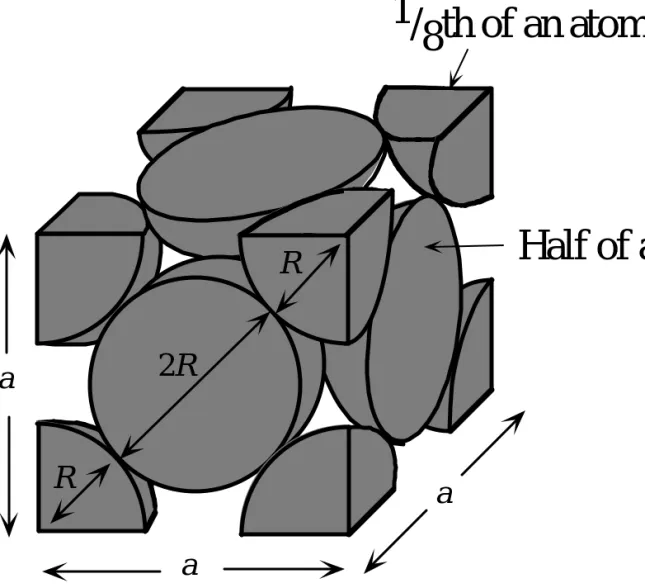
1/
8th of an atom
Half of an atom
2R a R R a aFig. 1.38: The FCC unit cell. The atomic radius is
R
and the lattice
parameter is
a
46 Determine the number of lattice points per cell in the cubic
crystal systems. If there is only one atom located at each lattice point, calculate the number of atoms per unit cell. SOLUTION
In the SC unit cell: lattice point / unit cell = (8 corners)1/8 = 1 In BCC unit cells: lattice point / unit cell = (8 corners)1/8 + (1 center)(1) = 2
In FCC unit cells: lattice point / unit cell = (8 corners)1/8 + (6 faces)(1/2) = 4
If there is only on atom per lattice point, as in typical metal structures, the number of atoms per unit cell would be 1, 2, and 4, for the simple cubic, body-centered cubic, and face-centered cubic, unit cells, respectively.
But there are also
many structures with more than one atom per
lattice point
Determining the Number of Lattice Points
in Cubic Crystal Systems
47 Determine the relationship between the atomic radius
and the lattice parameter in SC, BCC, and FCC structures when one atom is located at each lattice point.
Determining the Relationship between
Atomic Radius and Lattice Parameters
The relationships between the atomic radius and the lattice parameter in cubic systems
48 SOLUTION
Referring to Figure above, we find that atoms touch along the edge of the cube in SC structures.
3
4
0
r
a
=
In FCC structures, atoms touch along the face diagonal of the cube. There are four atomic radii along this
length—two radii from the face-centered atom and one radius from each corner, so:
2
4
0r
a
=
r
a
0=
2
In BCC structures, atoms touch along the body diagonal. There are two atomic radii from the center atom and one atomic radius from each of the corner atoms on the body diagonal, so
49
Example: Copper
ρ =
n
A
V
c
N
A
# atoms/unit cell
Atomic weight (g/mol)
Volume/unit cell
(cm3/unit cell)
Avogadro's number
(6.023 x 10²³ atoms/mol)
• crystal structure = FCC: 4 atoms/unit cell
• atomic weight = 63.55 g/mol (1 amu = 1 g/mol) • atomic radius R = 0.128 nm (1 nm = 10 cm)-7 Vc = a3 ; For FCC, a = 4R/ 2 ; Vc = 4.75 x 10⁻²³cm3
Compare to actual:
ρ
Cu = 8.94 g/cm3
Result: theoretical
ρ
Cu = 8.89 g/cm3
THEORETICAL DENSITY,
ρ
So there must be some real structure in addition !50
Determining the Density of BCC Iron
Determine the density of BCC iron, which has a lattice parameter of 0.2866 nm.
SOLUTION
Atoms/cell = 2, a0 = 0.2866 nm = 2.866 × 10⁻⁸ cm Atomic mass = 55.847 g/mol
Volume of unit cell = = (2.866 × 10⁻⁸ cm)3 = 23.54 × 10⁻²⁴ cm3/cell
Avogadro’s number NA = 6.023 × 10²³ atoms/mol 3 0
a
3 23 247
.
882
/
)
10
02
.
6
)(
10
54
.
23
(
)
847
.
55
)(
2
(
number)
s
adro'
cell)(Avog
unit
of
(volume
iron)
of
mass
)(atomic
atoms/cell
of
(number
Density
cm
g
=
×
×
=
=
−ρ
ρ
51
ρ
(g/cm
3
)
Graphite/ Ceramics/ Semicond Metals/ Alloys Composites/ fibers Polymers 1 2 20 30Based on data in Table B1, Callister
*GFRE, CFRE, & AFRE are Glass, Carbon, & Aramid Fiber-Reinforced Epoxy composites (values based on 60% volume fraction of aligned fibers
in an epoxy matrix). 10 3 4 5 0.3 0.4 0.5 Magnesium Aluminum Steels Titanium Cu,Ni Tin, Zinc Silver, Mo Tantalum Gold, W Platinum Graphite Silicon Glass-soda Concrete Si nitride Diamond Al oxide Zirconia HDPE, PS PP, LDPE PC PTFE PET PVC Silicone Wood AFRE* CFRE* GFRE* Glass fibers Carbon fibers Aramid fibers
Metals typically have
• close-packing(metallic bonding) • large atomic mass
Ceramics have
• less dense packing (covalent bonding) • often lighter elements
Polymers have...
• poor packing (parts often amorphous) • lighter elements (C,H,O)Composites have...
• intermediate values52
APF =
Volume of atoms in unit cell*
Volume of unit cell
*assume hard spheres
• APF for a simple cubic structure = 0.52
APF =
a3
4
3
π
(0.5a)3
1
atoms
unit cell
atom
volume
unit cell
volume
close-packed directionsa
R=0.5a
contains 8 x 1/8 = 1 atom/unit cell53
a
R
• APF for a body-centered cubic structure = 0.68
Close-packed directions:
length = 4R
= 3 a
Unit cell contains:
1 + 8 x 1/8
=
2 atoms/unit cell
ATOMIC PACKING FACTOR: BCC
APF =
a3
4
3
π
(
3a/4
)3
2
atoms
unit cell
volume
atom
unit cell
volume
54
APF =
a3
4
3
π
(
2a/4
)3
4
atoms
unit cell
volume
atom
unit cell
volume
Unit cell contains:
6 x 1/2 + 8 x 1/8
=
4 atoms/unit cell
a
• APF for a body-centered cubic structure = 0.74
Close-packed directions:
length = 4R
= 2 a
ATOMIC PACKING FACTOR: FCC
That is
the
highest
possible
packing
factor !!
55
The hexagonal close-packed (HCP) structure (left) and its unit cell. The packing factor is also 74 %, i.e. the highest possible, just as we had for FCC spheres
56
The
ABABAB
stacking
sequence of
close-packed
planes produces
the HCP
structure
.Stacking sequences of closed packed
structures,
i.e. those with 74 % Packing factor57
The
ABCABCABC
stacking sequence of
close-packed planes produces the FCC structure.
58
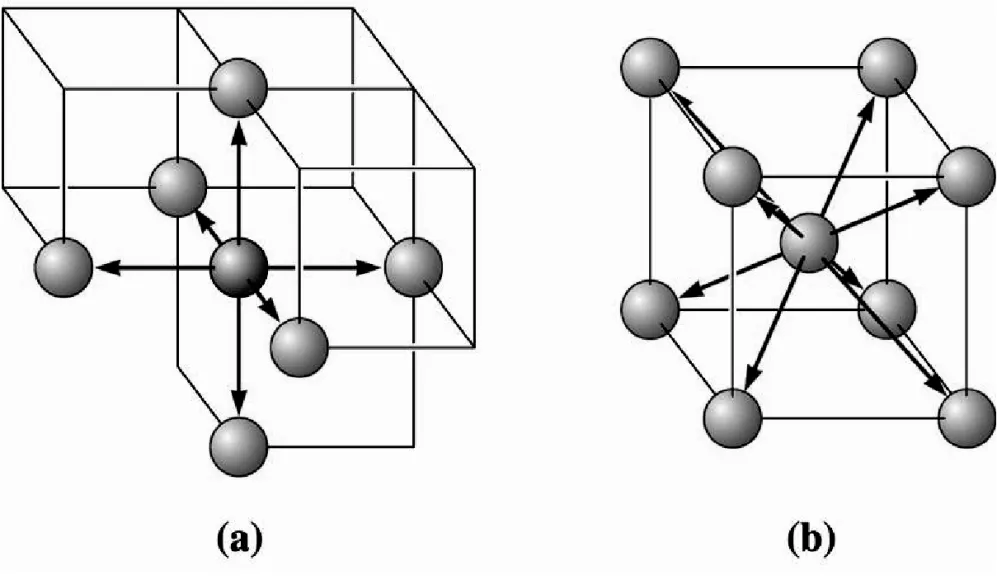
Illustration of coordinations in (a) SC- six fold and (b) BCC – 8 fold unit cells. Six atoms touch each atom in SC, while the eight atoms touch each atom in the BCC unit cell.
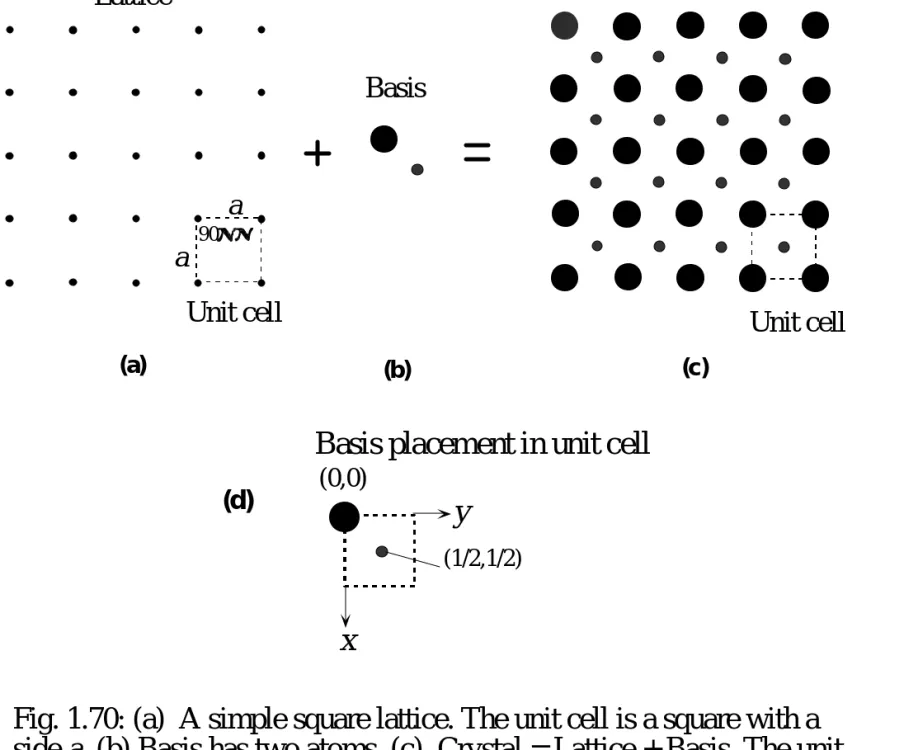
60 Lattice
Basis
Crystal
Unit cell Unit cell
a a (a) (b) (c) 90° x y
Basis placement in unit cell
(0,0)
(1/2,1/2)
(d)
Fig. 1.70: (a) A simple square lattice. The unit cell is a square with a side a. (b) Basis has two atoms. (c) Crystal = Lattice + Basis. The unit cell is a simple square with two atoms. (d) Placement of basis atoms in the crystal unit cell.
61
M.C. Escher’s two dimensional patterns are filling the
whole 2D space. We can determine a unit cell which
happened to be composed off many details, regardless of
which periodic detail we use for the choice of the unit cell,
these cells will always be identical. So we can think about
it in a way that all the details are shrunk into a lattice
points and all that remains is the geometrical array of
lattice points we had in the previous slide
67
o
Interstitial sites - Locations between the ‘‘normal’’
atoms or ions in a crystal into which another
-usually different - atom or ion is placed. Typically,
the size of this interstitial location is smaller than
the atom or ion that is to be introduced.
o
Cubic site - An interstitial position that has a
coordination number of eight. An atom or ion in
the cubic site touches eight other atoms or ions.
o
Octahedral site - An interstitial position that has a
coordination number of six. An atom or ion in the
octahedral site touches six other atoms or ions.
o
Tetrahedral site - An interstitial position that has a
coordination number of four. An atom or ion in the
tetrahedral site touches four other atoms or ions.
68
The location of the interstitial sites in cubic unit cells. Only
representative sites are shown.
69
Interstitial sites
are important
because we can
derive more
structures from
these basic FCC,
BCC, HCP
structures by
partially or
completely
different sets of
these sites
70
Calculating Octahedral Sites
How many octahedral sites are there in one FCC unit cell?
SOLUTION
The octahedral sites include the 12 edges of the unit cell, with the coordinates
2
1
1,
,
0
2
1
1,
,
1
2
1
0,
,
1
2
1
,
0
,
0
,1
2
1
,
0
,1
2
1
,
1
,0
2
1
,
1
,0
2
1
,
0
1,1
,
2
1
0,1
,
2
1
1,0
,
2
1
0,0
,
2
1
71 SOLUTION (Continued)
Each of the sites on the edge of the unit cell is shared between four unit cells, so only 1/
4 of each site belongs uniquely to each unit cell.
Therefore, the number of sites belonging uniquely to each cell is:
(12 edges) (1/
4 per cell) + 1 center location = 4 octahedral sites
72
How much space is there available to fill the
different sites with “hard sphere” atoms?
73
The radios ratios have to be of course the same
as the once we discussion in connection with
coordination
74
o
Factors that need to be considered in order to
understand crystal structures of ionically
bonded solids:
§
Ionic Radii for filling of various interstitial
sites
§
Electrical Neutrality as a structural principle
75
• Compounds:
Often have close-packed structures
– there is more than one atom per lattice point.
• FCC + octahedral
Interstitial site filled
• Structure of NaCl
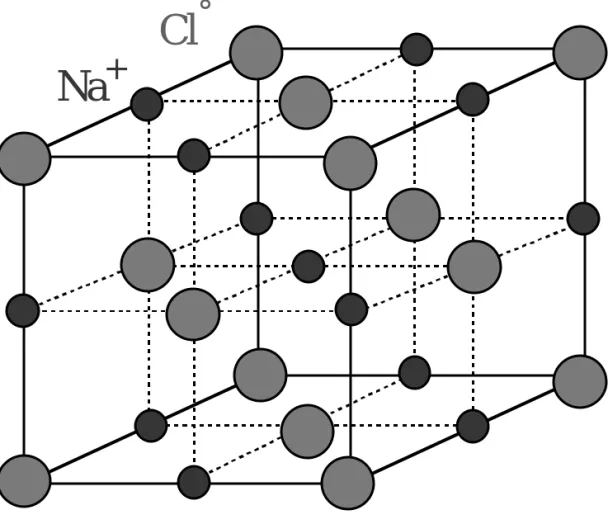
76
Cl
°Na
+Fig. 1.36: A possible reduced sphere unit cell for the NaCl (rock
salt) crystal. An alternative unit cell may have Na+ and Cl °
interchanged. Examples: AgCl, CaO, CsF, LiF, LiCl, NaF, NaCl,
KF, KCl, MgO
77
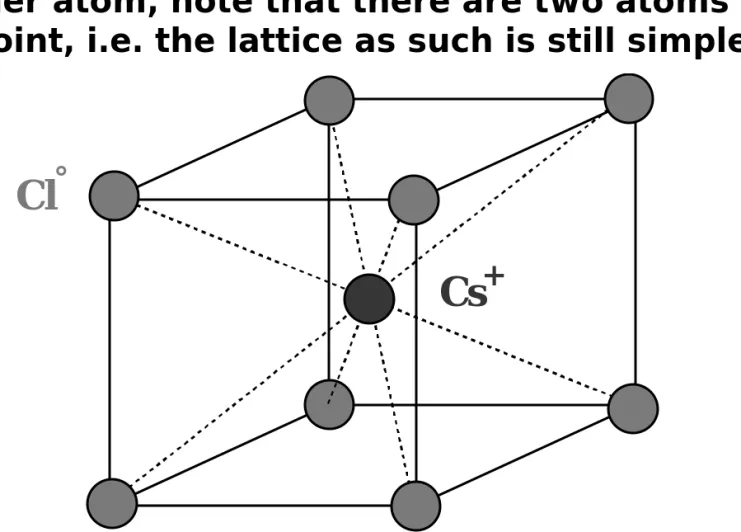
Cl
°Cs
+Fig. 1.37: A possible reduced sphere unit cell for the CsCl crystal.
An alternative unit cell may have Cs + and Cl ° interchanged.
Examples: CsCl, CsBr, CsI, TlCl, TlBr, TlI.
Simple cubic packing with the cube interstitial site filled by another atom, note that there are two atoms per
78
(a) The zinc blende unit cell, (b) plan view. There
is usually a large covalent contribution to these
79
(a) Fluorite unit cell, (b) plan view.
All 8 tetrahedral interstitial sites are filled by F anions, as the formula is CsF2, there is three atoms per lattice point. U)2, ThO2 and ZrO2 have the same structure, thereis also the “antifluorite” structure for Li2O, Na2O, K2O with cations and anions reversed
80
g
Corundum structure of alpha-alumina (a-AI203), O in
HCP and Al in some of the octahedral interstitial sites, possibly the most widely used ceramic
81
o
Covalently bonded materials frequently have
complex structures in order to satisfy the
directional restraints imposed by the bonding.
o
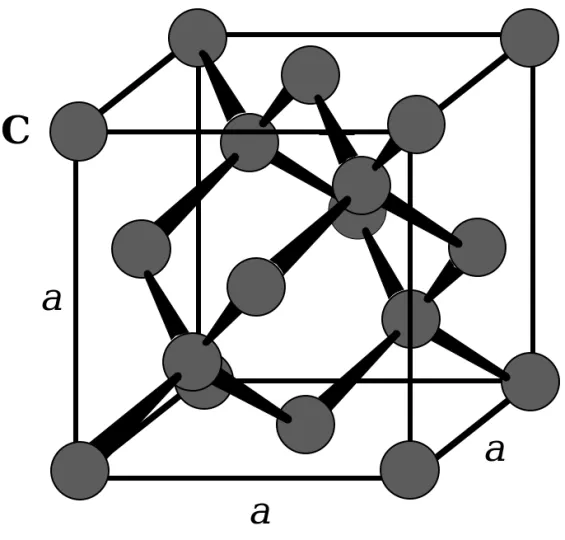
Diamond cubic (DC) - A special type of
face-centered cubic crystal structure found in
carbon, silicon,
α
-Sn, and other covalently
bonded materials.
82
a
C
a
a
Fig. 1.33: The diamond unit cell is cubic. The cell has eight atoms.
Grey Sn (
α
-Sn) and the elemental semiconductors Ge and Si have
this crystal structure.
83
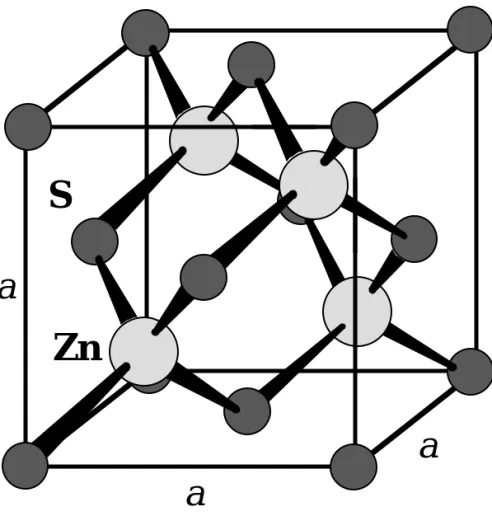
S
Zn
a
a
a
Fig. 1.34: The Zinc blende (ZnS) cubic crystal structure. Many
important compound crystals have the zinc blende structure.
84
The silicon-oxygen tetrahedron and the resultant
ß
-cristobalite form of silica. Note: there is six atom at
every lattice point, i.e. one Si in the center, 4 O
within the tetrahedron and 4 times ¼ Si at the
apexes of each tetrahedron
85
The unit cell of crystalline polyethylene,
Orthorhombic, there are typically many defects in
polymer crystals
86
• tend to be densely packed.
• have several reasons for dense packing:
-Typically, only one element is present, so all atomic
radii are the same.
-Metallic bonding is not directional.
-Nearest neighbor distances tend to be small in
order to lower bond energy.
• have the simplest crystal structures.
We will revisit the two closest packed
structures and give some examples for
each of them
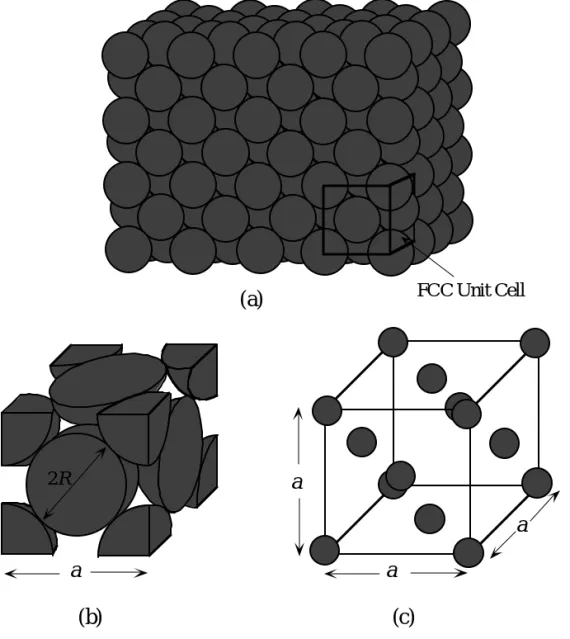
87 2R a a a a (c) (b) FCC Unit Cell (a)
Fig. 1.30: (a) The crystal structure of copper is Face Centered Cubic (FCC). The atoms are positioned at well defined sites arranged
periodically and there is a long range order in the crystal. (b) An FCC unit cell with closed packed spheres. (c) Reduced sphere representation of the FCC unit cell. Examples: Ag, Al, Au, Ca, Cu, γ-Fe (>912•C), Ni, Pd, Pt, Rh
88 Layer A Layer B Layer A (a) (b) Layer A Layer B Layer A c a (c) (d)
Examples: Be, Mg, α-Ti ( < 882°C ), Cr, Co, Zn, Zr, Cd
Fig. 1.32: The Hexagonal Close Packed (HCP) Crystal Structure. (a) The Hexagonal Close Packed (HCP) Structure. A collection of
many Zn atoms. Color difference distinguishes layers (stacks). (b) The stacking sequence of closely packed layers is ABAB
(c) A unit cell with reduced spheres (d) The smallest unit cell with reduced spheres.
Be very
careful,
the yellow
and blue
spheres
represent
one and
the same
type of
atoms
89
What is steel?
It’s not an element, it’s an intestinal alloy,
about 1 C atom every 50 Fe atoms, i.e. 0.4 weight % C
So the crystal structure is BCC, as it is Fe at room temperature, every now and then a much smaller c atom fits into one of the cubic interstitial sites and this increases the strength from
about 15 MPa to more than 1500 MPa
How is that little amount of C accomplishing so much ?
90
• Atoms typically assemble into crystals some
materials e.g. glass are amorphous,
i.e. have only short range order• We can predict the density of a material, provided
we know the atomic weight, atomic radius, and
crystal geometry (e.g., FCC, BCC, HCP).
• Material properties generally vary with single
crystal orientation (i.e., they are anisotropic),
but properties are frequently quite non-directional
(i.e., they are isotropic) in polycrystals with randomly
oriented grains as e.g. in steel and other engineering
materials
91
o
Diffraction - The constructive interference, or
reinforcement, of a beam of x-rays or electrons
interacting with a material. The diffracted beam
provides useful information concerning the
structure of the material.
o
Bragg’s law - The relationship describing the angle
? at which a beam of x-rays of a particular
wavelength diffracts from crystallographic planes of
a given interplanar spacing.
o
In a diffractometer a moving x-ray detector records
the 2? angles at which the beam is diffracted,
giving a characteristic diffraction pattern
Diffraction Techniques for Crystal
Structure Analysis
92
Lattice constants range from about 0.1 nm to some 50 - 100 nm. Most crystals’ lattice constants are in the 1-5 nm range, since crystals are periodic, they are the
ideal diffraction grating for X-rays, Max von Laue’s 1914
Nobel prize that proved both, crystals are periodic 3D arrangements of atoms and X-rays are waves (well wave-particles actually)
93
The diffraction angle is always 2? Bragg’s law: n
λ
= 2 d
hklsin ?
n – the order of reflection can be dropped by allowing indices for hkl that are not smallest integers, i.e. HKL94
95
Powder
diffractometers
(for polycrystalline
powder)
are less
sophisticated and
can be found in
many places
96
(a) sketch of a
diffractometer viewed
from above, showing
powder sample,
incident and diffracted
beams.
(b) diffraction pattern
obtained from a
sample of gold
powder, notice the
Miller indices of the
diffracting crystal
planes
97 d=nλ/2sinθc x-ray intensity (from detector)
θ
θ
c
• Measurement of:
“
reflection” angles
(Bragg angles),
θ
,
for X-rays provide
atomic spacing, d.
reflections must be in phase to detect signalspacing
between
planes
d
incoming
X-rays
outgoing
X-rays
detector
θ
θ
λ
extra distance travelled by wave “2”“1”
“2”
“1”
“2”
98
(a) Destructive
and (b) reinforcing
(constructive)
interference
between x-rays
“reflected on a set
of planes.
Reinforcement
occurs only at
angles that satisfy
Bragg’s law.
λ
= 2 d
HKLsin ?
No other X-ray
diffraction peaks
occur
99 The results of a x-ray diffraction experiment on some metal
powder found at a crime scene using characteristic x-rays with
?
= 0.7107 Å (a radiation obtained from molybdenum(Mo) target) show that diffracted peaks occur at the following 2? angles:
X-ray Diffraction for an forensic examination
Determine the indices of the plane producing each peak, and from that the lattice parameter of the material and from that identify the material (you know it is some metal so it is a
100 SOLUTION
λ
= 2 d
HKLsin ?
We first determine the sin2 ? value for each peak, then divide through by the lowest denominator, 0.0308, “guess” the indices
g
d
Lc
Kb
Ha
L
K
H
d
HKL=
+
+
=
HKL=
r
+
+
=
−1 * −1 2 2 2(
*
*
*)
(
)
1
θ
λ
2 2sin
)
2
(
=
HKLd
101 SOLUTION (Continued)
We could then use 2? values for any of the peaks to
calculate the interplanar spacing and thus the lattice parameter. Picking peak 8:
2? = 59.42 or ? = 29.71 Å Å
868
.
2
)
4
)(
71699
.
0
(
71699
.
0
)
71
.
29
sin(
2
7107
.
0
sin
2
2 2 2 400 0 400=
=
+
+
=
=
=
=
l
k
h
d
a
d
θ
λ
This is the lattice parameter for body-centered cubic iron.
Since out of all metals only Po has the simple cubic structure, and we do know our material was not radioactive and difficult to obtain, we didn’t check for an indexing scheme for a single cubic lattice, it would have gotten us nowhere anyway
So the gardener did steal the cookies – only kidding
102
There are certain systematic absences of
reflections
You may have noticed that there are no (hkl) triplets with h+k+l = odd.
Laue’s kinematical theory of X-ray diffraction (1912) explains why,
different structures have forbidden reflections, i.e. reflections that do not
show up in diffraction but these planes do of course exist in the crystals, it is just that diffraction on them is destructive
Simple cubic crystals have no forbidden reflections
103 A TEM micrograph of an aluminum alloy
(Al-7055) sample. The diffraction pattern at the right shows large bright spots that represent diffraction from the main
aluminum matrix grains. The smaller spots originate from the nano-scale crystals of another compound that is present in the aluminum alloy.
104
(In,Ga)P, an important semiconductor for visible light
lasers can show a variety of atomic ordering
The very same
thing, i.e. atomic
ordering exist in
metals as well
105
II-VI semiconductors with
atomic ordering, (Cd,Zn)Se
quantum dots in ZnSe, [001]
plan view
(Cd,Mn,Zn)Se quantum dots
in <110> cross section
106
Unknown crystallographic phase in (In,Ga)(Sb,As)
quantum dots in InAs matrix,
a Fourier transform power spectrum of a high resolution
TEM images replaces frequently a diffraction pattern as
much of the information is contained in such calculated
images
107
False color
convergent
beam electron
diffraction
pattern,
From the symmetry of the lines (Kikuchi lines), the crystal system can be determined
From the fine structure of the
diffraction disk, the space group can be determined
Works for extremely tiny specs of matter, perhaps 2 nm
108
Wow, what is that?
It can’t be a crystal as it
obviously has a five fold
symmetry, it is not
amorphous either as it
clearly has a diffraction
pattern?
It’s a
quasi-crystal, i.e.
and
entity with short range order
(as amorphous and crystalline
materials) and long range
order (as a crystal), the
crucial difference is, the long
109
Crystallographic work
can also be done in
modern SEMs !
Electron backscatter
(Kikuchi) diffraction
(EBSD), here of a Si
crystal
110
Atoms can be arranged and imaged!
Carbon monoxide molecules arranged on a platinum (111) surface.
Iron atoms arranged on a copper (111) surface. These Kanji characters represent the word “atom”.
scanning probe microscopy, STM, AFM, …
Something more useful, the square of the quantum mechanical wave function of an electron that is trapped in a