r e l a tio n s h i p b e t w e e n c o m m u n i ty, l a n d s c a p e a n d n a t u r a l
r e s o u r c e . R u r al L a n d s c a p e s : S o ci e ty, E n vi r o n m e n t , H i s t o ry, 3
( 1). p . 6 .
Do w n l o a d e d fr o m : h t t p ://i n si g h t . c u m b r i a . a c . u k /i d/ e p ri n t/ 2 5 1 6 /
U s a g e o f a n y i t e m s f r o m t h e U n i v e r s i t y o f C u m b r i a’ s i n s t i t u t i o n a l r e p o s i t o r y ‘I n s i g h t ’ m u s t c o n f o r m t o t h e f o l l o w i n g f a i r u s a g e g u i d e l i n e s .
Any it e m a n d it s a s s o ci a t e d m e t a d a t a h el d i n t h e U niv e r si ty of C u m b r i a ’s in s ti t u ti o n al r e p o si t o r y I n si g h t ( u nl e s s s t a t e d o t h e r wi s e o n t h e m e t a d a t a r e c o r d ) m a y b e c o pi e d , di s pl ay e d o r p e rf o r m e d , a n d s t o r e d i n li n e wi t h t h e JIS C f ai r d e a li n g g ui d eli n e s ( av ail a bl e h e r e) fo r e d u c a t i o n al a n d n o t-fo r-p r ofi t a c tiviti e s
p r o v i d e d t h a t
• t h e a u t h o r s , ti tl e a n d full bi blio g r a p h i c d e t ail s of t h e it e m a r e ci t e d cl e a rly w h e n a n y p a r t
of t h e w o r k is r ef e r r e d t o v e r b a lly o r i n t h e w ri t t e n fo r m
• a h y p e rli n k/ U RL t o t h e o ri gi n al I n si g h t r e c o r d of t h a t it e m is i n cl u d e d i n a n y ci t a ti o n s of t h e w o r k
• t h e c o n t e n t is n o t c h a n g e d i n a n y w a y
• all fil e s r e q ui r e d fo r u s a g e of t h e it e m a r e k e p t t o g e t h e r wi t h t h e m a i n it e m fil e.
Yo u m a y n o t
• s ell a n y p a r t of a n it e m
• r e f e r t o a n y p a r t of a n it e m wi t h o u t ci t a ti o n
• a m e n d a n y it e m o r c o n t e x t u ali s e it i n a w a y t h a t will i m p u g n t h e c r e a t o r ’s r e p u t a t i o n
• r e m ov e o r a l t e r t h e c o py ri g h t s t a t e m e n t o n a n it e m .
T h e full p oli cy c a n b e fo u n d h e r e.
* University of Cumbria, GB
† University of Derby, GB
Corresponding author: Darrell Smith ([email protected]) RESEARCH
An Expression of Multiple Values: The Relationship
Between Community, Landscape and Natural Resource
Darrell Smith
*, Ian Convery
*, Andrew Ramsey
†and Viktor Kouloumpis
*To aid political and institutional decision making in the sustainable use of natural resources the value of ecological, socio-cultural and economic assets has increasingly been communicated in terms of monetary units. Despite reliance upon natural resources, the impact of human activities has now reached a stage where cumulative losses are forcing society to re-appraise the evaluation process and how to better incorporate these values in to the decision-making process. This paper examines the attributes of value held by natural resources within ecological, socio-cultural and economic value domains from the perspective of a rural UK community. Here we reflect upon the continued primacy of monetary valuation of natural resource using two approaches, a scaled preference-based value typology and a place-based map measure. We demonstrate that the societal relationships which inform the evaluation of natural resources are both multi-faceted and hierarchical. Moreover, whilst aware of the utilitarian character of society’s relationship with natural resource, the societal value-for-natural-resource relationship is primarily expressed using social-ecological qualities. These results add weight to the call for a new approach towards natural resource evaluation and how these values contribute to the sustainability agenda. New methods of evaluation must adopt multiple values that extend beyond a solely economic-based commodification concern to encompass the human relationship with the resource itself. Wherein, a multi-faceted approach to attributing value to natural resource, set within an experiential framework, can provide a focal point for discussion and the decision-making process.
Keywords: Natural resource evaluation; Preference-based value; Map-based value; Value typology; Social-ecological systems; Economic value
Introduction
Despite human reliance upon natural resources and the capacity of ecosystems to provide essential goods and services (Vitousek et al. 1997; Haberl et al. 2007), the loss of biodiversity and degradation of ecosystems contin-ues on a large scale (Butchart et al. 2010). The impact of human activities on the planet has now reached a stage where the continuation of the current Holocene epoch is being challenged to the point where a new epoch, the Anthropocene, has been proposed (Crutzen 2002; Stef-fen et al. 2007). In some cases planetary boundaries are being pushed beyond safe levels and pose an inherent risk for stable, functioning and thriving societies (Steffen et al. 2015). The resultant degradation of and cumula-tive losses in the natural resources that provide the flow of ecosystem goods and services are forcing society to re-appraise their evaluation and how their values can be
better incorporated into institutional and societal deci-sion making (Daly 1991; de Groot et al. 2002).
of view (Diaz et al. 2015). Initiatives such as these aiming to incorporate natural resources via the ecosystem ser-vices concept into institutional and societal daily decision-making have developed two broad paradigms of approach (Raymond et al. 2014). The instrumental paradigm focuses on the quantification of objective measurements and spa-tially identifying social values, categorising these in terms of rank, monetary units, or other commensurable values that allow aggregation. The deliberative paradigm seeks to obtain stakeholder perspectives on and opinions about objects of value without claim to objectivity (Kenter et al. 2014; Raymond et al. 2014).
This paper examines the attributes of value given to natural resources within ecological, socio-cultural, and economic value domains from the perspective of a rural UK community. It attempts this primarily through an instrumental route but reflects upon the continued pri-macy of the monetary valuation and the shortcomings of market-based values (Plieninger 2015) for natural resources. Taking two approaches – a scaled preference-based value typology and a place-preference-based map measure – we investigate the multi-faceted nature of value through the relationship community holds with natural resource in a local landscape context. Here community describes a geographic situation where people meet their daily needs, with social and economic structure and a form of co-operatively engaged action such as local government (Brown et al. 2002). Landscape represents the place where natural resources exist; these natural resources become ecosystem goods and services when used by human soci-ety. Arguably, complex social-ecological systems can only be understood through a heterodox approach to science (Martinez-Alier et al. 1998; Spash 2012). Biological compo-nents are embedded within the physical world, like-wise the socio-cultural world is embedded within the biologi-cal and the economic world operates within the socio-cul-tural (Spash 2012).
Contemporary concepts of ecosystem valuation have primarily come from either ecological or economic dis-ciplines, and many use money as a common metric to translate environment and anthropogenic environmen-tal impacts for political and institutional decision mak-ers (Hicks et al. 2015). Natural resources, ecosystem components, structure, and processes become synony-mous with the monetary value that is given to ecosys-tem goods and services (Spangenberg and Settele 2010) and the commodification of nature (Schroter et al. 2014). However, natural and socio-economic systems and land-scapes are the result of many layers of natural process and human intervention. They are complex, adaptive, living co-evolving systems, and evaluation should com-pletely reflect ideas of interconnection and integration (Martinez-Alier et al. 1998; Spash 2012). Difference and incommensurability are also fundamental to any evalu-ation of system components, structure and process when described by ideas such as landscapes, communi-ties, resource and service provision, diversity gradients, historical and cultural meanings (Martinez-Alier et al. 1998). Systems that include humans can also be thought of as reflexively complex, in that awareness and purpose
are also system components and should be considered when explaining, describing, or forecasting their behav-iour (Martinez-Alier et al. 1998). Correspondingly, there is a need for an interdisciplinary approach to the evalua-tion of human-natural resource dynamics (Costanza et al. 1999; Baumgärtner et al. 2008).
The Lexicon of Value
In terms of natural resources, the concept of value is com-plex. The concise Oxford dictionary, tenth edition, (Pearsall 1999) describes value as ‘the regard that something is held to deserve; importance or worth’. Furthermore, the diction-ary refers to a ‘material or monetdiction-ary worth’; value is ascribed units that express its ‘regard, importance, usefulness or worth’. These units cover a wide lexicological range inter alia; ‘principals or standards of behaviour; a numerical amount; a magnitude, quantity, or number; the meaning of a word’ (Pearsall 1999). Through the act of evaluation, an estimation of importance or worth is carried out, a consideration of the ‘value, quality, importance or condition’ (Pearsall 1999).
Brown (1984) broadly summarises the conceptual sense of value as containing three elements: a preferential value, a numerical value, and a functional value. Values are also relatively abstract and situational; they hold spatial and temporal dimensions (Brown et al. 2002; Jorgensen and Stedman 2006), attitudes toward value are place spe-cific (Jorgensen and Stedman 2006; Howley 2011), they imply internal, subjective, user-specific goals, objectives, or conditions (Farber et al. 2002), and preferences can vary between users, residents, outsiders, and policy mak-ers (Leiserowitz et al. 2006). In such instances place-based social-ecological values can be seen as expressions of an underlying multi-dimensional network of factors involved in human-nature relationships (Convery et al. 2012). Values define or direct us to goals, frame our attitudes, and provide standards against which the behaviour of individuals and societies can be judged (Farber et al. 2002; Bardi et al. 2008).
In a definition of value that sought to encompass previ-ous work on value typologies Schwartz and Bilsky (1987) describe values as: concepts or beliefs; about desirable end states or behaviours; they transcend specific situations; they guide selection or evaluation of behaviour and events; and are ordered by relative importance. Concepts of a preference related value directly involve choice and desir-ability, the placing of one thing before another because of some perception of ‘better’ (Brown 1984). In this context individuals assign value based on perception of the object under evaluation, their held values, preferences, and also the context of the evaluation (Brown 1984).
and link to deep-rooted societal and cultural forces such as the domination of nature viewpoint inherent in Judeo Christian tradition (Bieling et al. 2014; Manfredo et al. 2015). Behaviours associated with these values have the potential to limit the post-industrial shift towards a more biocentric and mutualistic view of nature (Schwartz 2006; Manfredo et al. 2015).
Community and Natural Resource
Concepts of a value preference need a context in which to express the value, held values or underlying values (Brown 1984). Ideas designed to connect held values with the landscape describe relationships where humans are con-sidered as participative actors in the landscape; they live in it, work in it, visit it, and therefore value a landscape from this interactive perspective (Clement and Cheng 2011). Many environmental values have a spatial perspective that reflects commitment to a person’s home and community (Brown et al. 2002). Sustainability of natural resources will ultimately depend upon those values, local attitudes, cul-ture, behaviour, and planning. The importance of these values becomes more powerful when seeking to translate the value held by natural resources, which supports the generic processes of ecosystems services in a local cultural landscape context (Plieninger et al. 2014).
Socio-cultural values are expressed through cultural identity, belief systems, and attitudes that shape the nor-mative and moral frameworks a society develops with the landscape that it creates and surrounds itself with (Farber et al. 2002; Sauer and Fischer 2010). A sense of place develops around the relationships and experi-ences humans have with natural resource, land, land-scape, and ecosystems (Williams and Stewart 1998) and builds upon local knowledge and the connections people develop with their landscape (Borgstrom Hansson and Wackernagel 1999).
These experiences can be subjective, place specific and emotional (Schroeder 1996). Individuals can hold plural identities in different institutions, which may lead to different expressions of interest in their capaci-ties as both consumers and citizens (Plottu and Plottu 2007; Kumar and Kumar 2008; Epstein et al. 2015). In such instances preferences may appear mutable and subject to change through, for example, education, advertising, peer pressure, or legislation (Farber et al. 2002). Society’s approach to the evaluation of land-scapes should reflect connections between community and the local ecosystem and respect the significance of local lifestyles being adapted to a place-specific context (Borgstrom Hansson and Wackernagel 1999; Flint et al. 2013; Raymond et al. 2013).
Schroeder (1996) suggests that to understand how people are related to environments we need to under-stand how people experience these environments. However, modern societies have become removed from the local landscape as natural resources support eco-system goods and services that are increasingly sup-plied from distant ecosystems (Borgstrom Hansson and Wackernagel 1999). Signals that highlight the limits to human appropriation of natural resources
and their ability to support the provision of ecosystem goods and services are lost, local lifestyles become less adapted to extant circumstances (Borgstrom Hansson and Wackernagel 1999). Values become generic rather than specific as community becomes distanced from the consequences of its actions. Observation of commu-nity incorporates the context and dynamics of society’s direct relationships with landscape and land uses that influence the self-organisational properties and pattern formation of ecological systems (Haila, 1999; Flint et al. 2013). Currently, however, there are real challenges in terms of linking sustainability and effective natural resource management to the conventions of society and the institutions therein (Epstein et al. 2015).
Methods
Study area
The parish of Askham and Helton is located in Cumbria, in the north-west of the United Kingdom, the parish covers an area of approximately 18km2, of which 84 per cent is
classified as green space (ONS 2011) (Figure 1). Situated
on the north-eastern edge of the Lake District National Park, the parish is a mixture of farmland, parkland, and open fell, much of which is unenclosed common land, with a predominately agricultural and forestry focus (Askham Parish Council 2010). Within the parish there are two villages, Askham and Helton, that are composed of 356 residents in 184 households, of which 164 are full time residences (ONS 2011). Study at the parish level pro-vides an evaluative measure of community, a geographi-cally defined area of local governmental administration. Within the parish boundaries local social and economic structures interact with the ecological components of the surrounding landscape as the people who live there pro-vide for their daily needs.
Sampling
and maintain social, environmental and economic ben-efit. Participants self completed both elements; first the preference-based value questionnaire, second the map-based exercise.
A preference-based value questionnaire
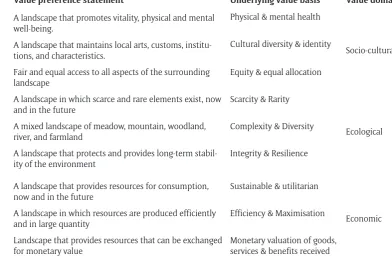
The questionnaire contained nine preference-based value statements, three within each value domain; socio-cultural, ecological, and economic. The tech-nique used sought to quantify individual attitudes towards statements designed to reflect a range of underlying value concepts across the three value domains (Table 1). Statements describe a value
typol-ogy contextualised to represent the relationship between community, their surrounding landscape, and the natural resources therein. The statements were constructed around descriptors used to express concepts of value associated with each value domain presented in Costanza and Folke (1997) and de Groot et al. (2002). Participants were asked to consider the qualities of their surrounding landscape, the areas, the buildings, and the facilities within it that contrib-ute most to the three value categories, as described by the value typology, and rate how closely each sug-gestion agreed with their own views. Preference-based value was indicated using a 5-point Likert scale: 5 –
Figure 1: Location of the study area, Askham and Helton parish, Cumbria in the UK; Askham and Helton parish
strongly agree, 4 – agree, 3 – neutral, 2 – disagree, and 1 – strongly disagree.
A map-based value measure
Following the preference-based value exercise, partici-pants were introduced to a mapping element for solicit-ing place-based value. This approach allows participants to characterise value in the context of local knowledge and connection to the physical components of the sur-rounding landscape. The method utilised is adapted from a series of projects by Brown (2005) that sought to identify and map landscape values to investigate human– landscape relationships. Participants were asked to iden-tify places which hold a high sense of value in each of the three described value domains within the Askham and Helton parish, three choices per value domain, and nine choices in total (Figure 2). Additionally participants
pro-vided a short descriptive sentence to capture the intended characteristics of each choice.
Analysis
A preference-based value questionnaire
Preference-based value statement data were nor-mally distributed (Kolmogorov-Smirnov p < 0.05) so non-parametric statistical tests were used. A Kruskal-Wallis test explored difference in attitudes towards value held in the surrounding landscape. Using the 5-point Likert scale, scores by participant grouped by value domain were aggregated. Participant scores indicate strength of agree-ment in each value domain; scores could range from 3 to 15. Post-hoc analysis, using the Nemenyi test, identifies value domains where strength of agreement differs sig-nificantly. The Nemenyi test uses the sum of ranks instead of means for multiple pair-wise comparisons in a manner that parallels the Tukey test (Zar 2009).
Ranking using the sum of ranks further examined community attitudes toward landscape value. To explore the possibility of an attitudinal structure for preference-based value statements, a Kruskal-Wallis test sought to identify difference in the strength of agree-ment between the nine value stateagree-ments. Post-hoc anal-ysis, using the Nemenyi test, identifies preference-based value statements where strength of agreement differs significantly.
A map-based value measure
In contrast to the ideologically focused preference-based value statements, the map-based exercise asks partici-pants to identify a physical and experiential reflection of the three value domain attributes, as defined by the pref-erence-based value statements. This approach identifies value from a perspective of local knowledge and connec-tion to the surrounding landscape.
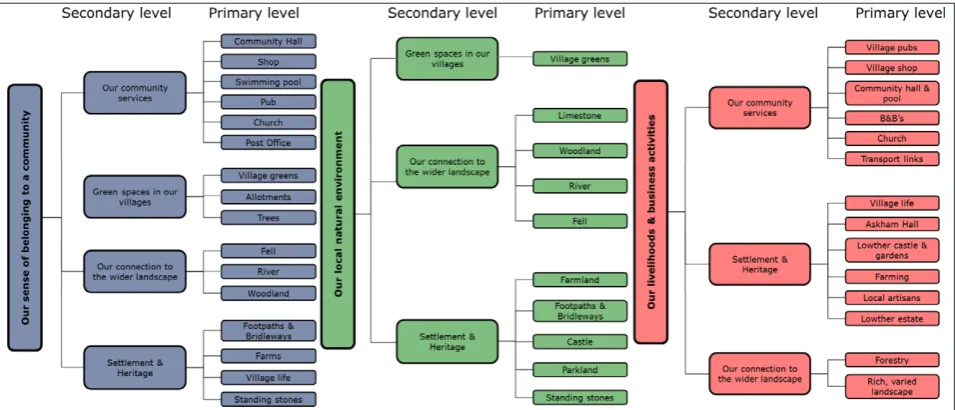
Descriptive data characterises individual choices build-ing primary groupbuild-ings identified by specific landscape feature, area, building and facility within each value domain. Further consolidation into secondary level the-matic groups builds a hierarchical model of participant’s spatial responses to the value exercise. To explore the Askham and Helton parish community life-scape rela-tionships, a Venn diagram visualises value connections. Intersections represent the connected nature of the com-munity–landscape–natural resource value relationship.
Results
In total 37 responses were collected from full-time resi-dents, these data describe a participation rate of 12.5 per cent from all residents, 15.2 per cent from households occupied on a full-time basis. Due to the small size of the local community, to ensure the anonymity of
par-Table 1: A preference-based value typology; value preference statement, value basis, and value domain. Value preference statement Underlying value basis Value domain
1 A landscape that promotes vitality, physical and mental
well-being.
Physical & mental health
Socio-cultural
2 A landscape that maintains local arts, customs,
institu-tions, and characteristics.
Cultural diversity & identity
3 Fair and equal access to all aspects of the surrounding
landscape Equity & equal allocation
4 A landscape in which scarce and rare elements exist, now
and in the future Scarcity & Rarity
Ecological
5 A mixed landscape of meadow, mountain, woodland,
river, and farmland
Complexity & Diversity
6 A landscape that protects and provides long-term
stabil-ity of the environment Integrity & Resilience
7 A landscape that provides resources for consumption,
now and in the future Sustainable & utilitarian
Economic
8 A landscape in which resources are produced efficiently
and in large quantity Efficiency & Maximisation
9 Landscape that provides resources that can be exchanged
for monetary value
ticipants, no detailed demographic data were collected. The relatively low participation rate suggests that these results may not describe a representative community view and precludes discussion regarding difference in experience based on specific demographic groups.
A preference-basedvalue questionnaire
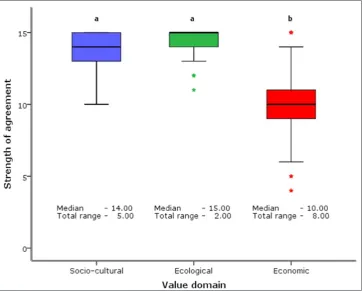
Responses to strength of agreement with the preference-based value statements, aggregated by value domain, were significantly different; χ2 = 52.993, df = 2, p < 0.001 ( Fig-ure 3). Based on participant evaluation of the
preference-based value statements, parish residents express a higher
Figure 2: Completion of the questionnaire and map exercise in Askham village hall.
Figure 3: Difference in the strength of agreement between value domains, χ2 = 52.993, df = 2, p < 0.001; agreement
and statistically significant different level of agreement with statements that reflect underlying socio-cultural and ecological values when compared against statements that reflect underlying economic values.
Not only did participants show higher overall agree-ment with socio-cultural and ecological value stateagree-ments, described by the median figures, the consensus about this expression of agreement was greater as evidenced by the smaller total range of these data: ecological value – 2.00, socio-cultural value – 5.00, and economic value – 8.00. The strength of participant consensus around agreement with socio-cultural and ecological value preference statements becomes evident when proportional data for participant expression of agreement is set against those of neutrality and disagreement (Table 2). Proportionally more than 92
per cent of participant responses express agreement with socio-cultural and ecological value preference statements, whilst only 44 per cent express agreement with economic value statements.
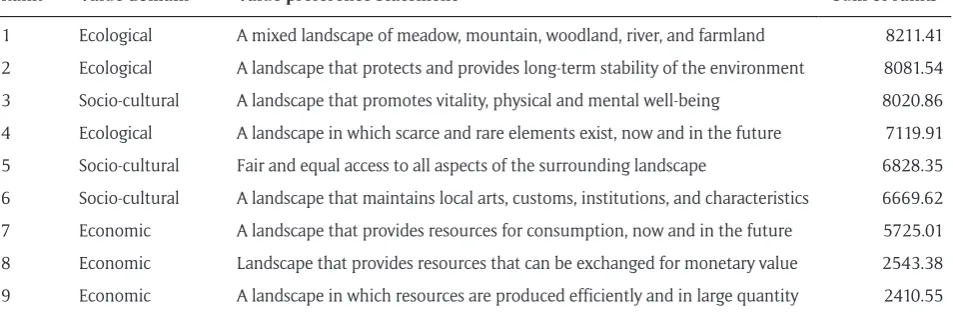
Ranking the individual preference-based value state-ments further demonstrates the strength of agreement around socio-cultural and ecological value statements over economic value statements (Table 3). Ecological
value-based statements, which characterise the under-lying values of complexity and diversity, integrity and resilience, and scarcity and rarity, occupy positions between ranks 1–4. Socio-cultural value statements, which characterise underlying values of physical and mental health, equity and equal allocation, and cultural
diversity and identity, occupy positions between ranks 3–6. Economic value statements, which are used to characterise underlying values of sustainability and utilitarianism, monetary valuation of goods, services and benefits received, and efficiency and maximisation, occupy ranks 7, 8, and 9.
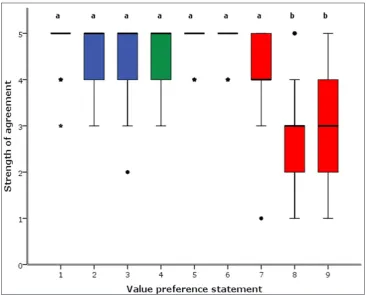
Participant strength of agreement with the nine indi-vidual preference-based value statements shows signifi-cant difference; χ2 = 145.738, df = 8, p < 0.001 (Figure 4). Parish residents express a higher and statistically signifi-cant level of agreement with statements that are charac-terised by socio-cultural and ecological values along with the economic value basis of sustainability and utilitarian-ism. Participant strength of agreement is of a statistically significant lower level for value statements that reflect the economic value basis of monetary valuation of goods, ser-vices and benefits received, and efficiency and maximisa-tion statements.
The strength of a participant consensus around agree-ment is further evidenced, for all individual socio-cultural and ecological value preference statements as well as the underlying economic value of sustainability and utilitar-ian, when proportional data for participant expression of agreement is set against those of neutrality and disagree-ment (Table 4). Proportionally more than 83 per cent of
participant responses express agreement with value pref-erence statements 1–7, whilst 73 per cent express a neu-tral view or disagree with statements 8 and 9.
A map-based value measure
Location and descriptive data were grouped thematically within each value domain. These data informed the con-struction of hierarchical models (Figure 5). Primary level
labels were taken directly from location identifications and descriptive text; secondary level labels were assigned during the post-hoc thematic grouping process. Thematic groupings begin to describe the interconnected relation-ship between community and landscape. Only four the-matic groups are required, across the secondary level, to capture all primary data from locations and descriptions over the three value domains. Further examination of the map-based value data describes the level of connectedness
Table 2: Proportional data for strength of agreement
responses by value domain. Participant responses for individual statement responses have been combined in to two groups, agree and neutral/disagree, for each value domain.
Value domain Agree (%) Neutral/Disagree (%)
Socio-cultural 92.8 7.2
Ecological 97.3 2.7
Economic 44.1 55.9
Rank Value domain Value preference statement Sum of ranks
1 Ecological A mixed landscape of meadow, mountain, woodland, river, and farmland 8211.41
2 Ecological A landscape that protects and provides long-term stability of the environment 8081.54
3 Socio-cultural A landscape that promotes vitality, physical and mental well-being 8020.86
4 Ecological A landscape in which scarce and rare elements exist, now and in the future 7119.91
5 Socio-cultural Fair and equal access to all aspects of the surrounding landscape 6828.35
6 Socio-cultural A landscape that maintains local arts, customs, institutions, and characteristics 6669.62
7 Economic A landscape that provides resources for consumption, now and in the future 5725.01
8 Economic Landscape that provides resources that can be exchanged for monetary value 2543.38
9 Economic A landscape in which resources are produced efficiently and in large quantity 2410.55
Table 3: Ranking preference-based value statements by strength of agreement; the sum of ranks is used for ranking
between value domains, value in the landscape is multi-faceted and interconnected (Figure 6).
Many of the selected landscape features, areas, buildings, and facilities that participants feel contribute most to a sense of value in their community landscape represent multiple value domains. This suggests that participant selections are thought to simultaneously hold multiple value qualities. Using proportional data from the map-based value exer-cise selections that express qualities of two or more value domains represent 86.5 per cent of all selections.
Discussion
This work examines value held in a landscape that sur-rounds a rural community through their strength of agree-ment for selected preference-based value stateagree-ments and a map-based landscape value. The approach was designed to describe an underlying value basis which reflects differ-ence in attitude towards natural resource and its use as described by three distinct value domains; socio-cultural, ecological, and economic. Ideas rooted in underlying val-ues and attitudes are often seen to direct the concrete
Figure 4: Difference between the strength of participant agreement for the nine preference-based value statements, χ2 = 145.738, df = 8, p < 0.0005; N = 333. Black lines show medians, boxes show interquartile range, and whiskers show total range (excluding outliers shown as stars). Letters denote homogenous subsets by value statement.
Table 4: Proportional data for strength of agreement responses for individual preference-based value preference.
Par-ticipant responses have been combined in to two groups, agree and neutral/disagree, for each value preference statement.
Value domain Underlying value basis Agree (%) Neutral/Disagree (%)
Socio-cultural
Physical & mental well-being 97.3 2.7
Cultural diversity & identity 89.2 10.8
Equity & equal allocation 91.2 8.8
Ecological
Scarcity & rarity 91.2 8.8
Diversity & complexity 100.0 0.0
Integrity & resilience 100.0 0.0
Economic
Sustainable & utilitarian 83.8 16.2
Efficiency & maximisation 21.6 78.4
Monetary valuation of goods, services & benefits received
decisions and actions taken by individuals and groups (Bardi et al. 2008). An important caveat, however, is that the sample size in this study was relatively small (37), and more work is required to substantiate these findings.
Through the expression of a community’s attitude towards its relationship with natural resource the primacy for monetary value as the basis for a landscape evaluation exercise is considered. Participants expressed strong agree-ment with preference-based value stateagree-ments that pro-mote socio-cultural and ecological value considerations to their surrounding landscape, over those that operate from
a specifically economic position. These value statements describe a physical and experiential sense of connection to the surrounding landscape which clearly illicit strong expressions of preference, for example ‘mixed landscapes’ where ‘diversity and complexity’ build environments with ‘integrity and resilience’ that ‘protects and provides long term stability’ in a manner ‘that promotes vitality, physical and mental well-being’.
Consideration of the economic-based value statements further confirms this view. Participants express a prefer-ence for a utilitarian interaction with landscape when coupled with the idea of ‘consumption now’ by the cur-rent community but also continued ‘consumption’ for community ‘in the future’. Whilst the utilitarian nature of use comes from a position of self interest in the current individual, here, the idea is tempered with thoughts of community and insurance of use for future generations. However, attitudes toward statements that describe a rela-tionship based on overt economic principals with a focus primarily on the current individual do not demonstrate a similarly high level of agreement, where ‘resources are produced efficiently and in large quantity’ and ‘can be exchanged for monetary value’.
Strength of agreement, with value statements, is further consolidated by consensus around the level of agreement. A high level of consensus for agreement with ecological and socio-cultural value-based statements demonstrates the importance of the physical nature of the underlying relationship society has with landscape and land-use. Levels of consensus around the three economic value statements further describe distinct difference between what maybe considered a physical and a transactional rela-tionship with landscape. A high level of consensus around agreement for a sustainable utilitarian interaction with landscape is expressed, whereas value statements that directly imply transactional principals illicit a wider range of views. Consensus of opinion for value statements that reflect ideas of ‘efficiency, maximisation’ and ‘exchange of
Figure 5: Results of map-based value exercise, participants identified areas of the surrounding landscape, specific areas
within it, buildings, or facilities that contribute to a perceived sense of value within each of the three value domains. Within each value domain the identified elements have been grouped thematically, post-hoc.
Figure 6: A Venn diagram displays location choices by
natural resource for monetary value’ operate from a posi-tion of neutrality/disagreement.
Additionally, if one considers the map-based illustration of value held in the landscape, expressions of multiple value characteristics are observed. For example, landscape components thought to hold high value are considerably more likely to display qualities associated with more than one value domain. Whilst participants did recognise an economic-based value component in both value exercises, primacy for any one value domain or underlying value concept was not observed in either exercise. Moreover while responses to the map-based exercise describe an economic component to individual expressions of value, the underlying values and attitudes, as characterised by the preference-based exercise, illustrate that overtly monetised concepts are not at the forefront of individual value-based decisions. Inclusion of a place-based focus to characterise thoughts of value held by natural resources, supported by contingent preference-based expressions, fosters acceptance of a broader range of values.
Increasingly, to address the consequences of our utilitar-ian relationship with the natural world, the importance of natural resources and ecosystems to human welfare is expressed by transactional concepts that produce a monetary valuation (Spangenberg and Settele 2010). Conventional monetary analyses convert both ecological and socio-cultural values to a currency based unit derived from artificial market solutions (Turner et al. 1994). Daly (1980) and Grant (2012) are amongst many who have written of the dangers of abstraction with respect to our relationships with natural resources. The creation of abstract entities, described by artificial market scenarios rather than concrete aspects of the physical environment, can work to separate behaviour from its physical conse-quences on environment (Grant 2012). For Daly (1991), economics in a finite world employed without account for natural capital stocks is ill conceived and ignores out-comes of the community–landscape–natural resource relationship.
Natural capital stocks become substitutable with human capital (Daly 1991) and traditional community-based soci-eties move to a modern society model that operates from a position of self-interest (Wackernagel and Rees 1997). The monetisation of natural resource feeds commercial interests and works to further the role of globalisation that introduces physical and emotional distance between production and consumption and extends the role of self-interested individualistic behaviour (Wackernagel and Rees 1997). This approach works to dis-embed cultural identity, belief systems, attitudes, and intentions of humankind from any relationship with the natural world (Borgstrom Hansson and Wackernagel 1999). Folke (2006) draws attention to the importance of considering human actions and their impacts upon ecosystem services, as part of a social–ecological system. Ecologists now recognise that most aspects of ecosystem components, structure, and processes cannot be understood without accounting for the strong, dominant influence of humanity (Ellis 2011).
Community, as a geographical context, describes an area in which social and economic structures interact
with ecological systems to meet the daily needs of its inhabitants (Brown et al. 2002). According to Brown et al. (2002), community can be a relatively distinct spatial area that reflects local values, attitudes and lifestyles. ‘Place is a powerful social influence in natural resource ... that can inform the study of natural resource politics’ (Cheng et al. 2003). Community presents a way to integrate the biophysical and ecological attributes of place with social and political processes, and social and cultural meaning (Cheng et al. 2003). ‘The concept of place embeds [natu-ral] resource attributes back into the system of which they are a part...’ (Williams and Patterson 1996).
Interaction with a local ecosystem provides a familiar institutional context, within which respondents can feel comfortable enough to express importance in a manner that reflects their preferred behaviour (Borgstrom Hansson and Wackernagel,1999; Meinard and Grill, 2011). This expression of value seeks to capture local distinctiveness and aims to incorporate the role of multiple stakeholder views (de Chazal et al. 2008). Society and the values it holds are an integral component of a wider social-ecological system; nature should not be viewed as external to the expression of socio-cultural values (Chiesura and de Groot 2003; Folke 2006). Utilisation of a socio-ecological cen-tred approach, where the explicit focus is on relationship between humans and nature, seeks to place the influence of society on landscape as a determinative element in the interactions between the ecological, societal, and economic value domains. Here the aim is to describe the nature and fabric of ecosystems by plurality of concept, attribute, and dimension, where complexity results from the multifac-eted nature of connections, relationships, and levels.
Conversion of ecological and socio-cultural values to a currency-based unit derived from artificial market sce-narios (Turner et al., 1994) gives primacy to monetary based value solutions. The effects of non-monetisation for many components of the environment are ignored, with the focus shifting towards economic self-interest (Spangenberg and Settele 2010; Gómez-Baggethun et al. 2010). Using monetary value as a measure of natural capital is misleading, change in market price imparts no information about changes to physical stocks and pro-cesses (Spangenberg and Settele 2010; Gómez-Baggethun et al. 2010).
Expressions of socio-cultural value need to consider the relationships between community, landscape and natural resource; they should capture attitudes that influence this relationship and interactions with landscape and natural resource. The evaluation of natural resources, e.g. also when expressed through the concept of ecosystem ser-vices, needs to consider a broader set of goals that includes ecological sustainability and a societal perspective, along-side a monetary-based economic component (Costanza 2000; Straton 2006; Spangenberg and Settele 2010).
practices, and institutional arrangements express the inherent adaptive capacity of social-ecological systems (de Chazal et al. 2008). And what we know about nature becomes shaped by society’s interaction with it (Meadows et al. 1972; Vitousek et al. 1997; Ellis 2011).
Conclusion
Value can give meaning to landscape; however, meaning is not an inherent component of the nature of things. Land-scape value as meaning needs a physical space and experi-ential knowledge, gathered through the process of living in it, to be fully expressed. Human perception, choice, and action drive political, economic, and cultural decisions that lead to or respond to change in ecological systems. This relationship is reciprocal; the physical nature of the environment will influence the socio-cultural interactions with it, but the nature of this interaction will influence the physical characteristics of the environment.
By necessity, such complex systems cannot be evalu-ated, analysed and understood from a single value-based perspective. Expansion of evaluation techniques which explicitly acknowledge the relationship between humans and nature, accommodating different values and interests, can provide models for sustainable landscape manage-ment in real landscapes by applying economic, ecologi-cal and socio-cultural balance. Landscape evaluation must extend beyond the economic concerns of resource com-modities to encompass the human relationship with the resource itself. Thus, a multi-faceted approach to attribut-ing value to landscape set within an experiential frame-work will provide a concrete focal point where discussion can begin.
Competing Interests
The authors declare that they have no competing interests.
References
Askham Parish Council. (2010). The Parish Plan.
Bardi, A., Calogero, R. M. & Mullen, B. (2008). A new
archival approach to the study of values and value-behavior relations: Validation of the value lexicon.
Journal of Applied Psychology 93: 483–496, DOI:
http://dx.doi.org/10.1037/0021-9010.93.3.483
Baumgärtner, S., Becker, C., Frank, K., Müller, B. & Quaas, M. (2008). Relating the philosophy and
prac-tice of ecological economics: the role of concepts, models, and case studies in inter-and transdiscipli-nary sustainability research. Ecological Economics
67: 384–393, DOI: http://dx.doi.org/10.1016/j.
ecolecon.2008.07.018
Bieling, C., Plieninger, T., Pirker, H. & Vogl, C. R.
(2014). Linkages between landscapes and human well-being: an empirical exploration with short interviews. Ecological Economics 105: 19–30, DOI: http://dx.doi.org/10.1016/j.ecolecon.2014.05.013
Borgstrom Hansson, C. & Wackernagel, M. (1999).
Rediscovering place and accounting space: how to re-embed the human economy. Ecological
Econom-ics 29: 203–213, DOI: http://dx.doi.org/10.1016/
S0921-8009(99)00010-5
Brown, G. G. (2005). Mapping Spatial Attributes in
Survey Research for Natural Resource Manage-ment: Methods and Applications. Society and
Natural Resources 18: 17–39, DOI: http://dx.doi.
org/10.1080/08941920590881853
Brown, G. G., Reed, P. & Harris, C. C. (2002). Testing a
place-based theory for environmental evaluation: an Alaska case study. Applied Geography 22: 49–76, DOI: http://dx.doi.org/10.1016/S0143-6228(01)00019-4
Brown, T. C. (1984). The concept of value in resource
allo-cation. Land Economics 60: 231–246, DOI: http:// dx.doi.org/10.2307/3146184
Butchart, S. M., Walpole, M., Collen, B., van Strien, A., Scharlemann, J. P. W., Almond, R. E. A., Baillie, J. E. M., Bomhard, B., Brown, C. & Bruno, J. (2010).
Global biodiversity: indicators of recent declines. Science 328: 1164–1168, DOI: http://dx.doi.
org/10.1126/science.1187512
Cheng, A. S., Kruger, L. E. & Daniels, S. E. (2003). ‘Place’
as an Integrating Concept in Natural Resource Politics: Propositions for a Social Science Research Agenda. Society & Natural Resources 16: 87–104, DOI: http://dx.doi.org/10.1080/08941920309199
Chiesura, A. & de Groot, R. (2003). Critical natural
capi-tal: a socio-cultural perspective. Ecological
Econom-ics 44: 219–231, DOI: http://dx.doi.org/10.1016/
S0921-8009(02)00275-6
Clement, J. M. & Cheng, A. S. (2011). Using analyses of
public value orientations, attitudes and preferences to inform national forest planning in Colorado and Wyoming. Applied Geography 31: 393–400, DOI: http://dx.doi.org/10.1016/j.apgeog.2010.10.001
Convery, I., Corsane, G. & Davis, P. (2012). Making Sense
of Place: Multidisciplinary Perspectives. Woodbridge:
Boydell & Brewer Ltd.
Costanza, R. (2000). Social Goals and the Valuation of
Ecosystem Services. Ecosystems 3: 4–10, DOI: http:// dx.doi.org/10.1007/s100210000002
Costanza, R., Cleveland, C. & Perrings, C. (1999). The
Development of Ecological Economics. Journal of
Business Administration and Policy Analysis 27/29:
87–110.
Costanza, R., D’Arge, R., de Groot, R., Farber, S., Grasso, M., Hannon, B., Limburg, K., Naeem, S., O’Neill, R. V., Paruelo, J., Raskin, R. G., Sutton, P. & van den Belt, M. (1997). The value of the world’s
ecosys-tem services and natural capital. Nature 387: 253– 260, DOI: http://dx.doi.org/10.1038/387253a0
Costanza, R. & Folke, C. (1997). Valuing ecosystem
ser-vices with efficiency, fairness and sustainability as goals. In: Daily, G. C., (Ed), Nature’s services: societal
dependence on natural ecosystems (pp 49–70).
Wash-ington D C: Island Press.
Crutzen, P. J. (2002). Geology of mankind. Nature, 415:
23, DOI: http://dx.doi.org/10.1038/415023a
Daily, G. C., Söderqvist, T., Aniyar, S., Arrow, K., Dasgupta, P., Ehrlich, P. R., Folke, C., Jansson, A., Jansson, B., Kautsky, N., Levin, S., Lubchenco, J., Mäler, K., Simpson, D., Starrett, D., Tilman, D. & Walker, B.
Science 289: 395–396, DOI: http://dx.doi.org/10.1126/
science.289.5478.395
Daly, H. E. (1980). Growth Economics and the Fallacy of
Misplaced Concreteness Some Embarrassing Anoma-lies and an Emerging Steady-State Paradigm. American
Behavioral Scientist 24: 79–105, DOI: http://dx.doi.
org/10.1177/000276428002400105
Daly, H. E. (1991). Steady-State Economics Second Edition
with New Essays. Washington DC: Island Press.
de Chazal, J., Quétier, F., Lavorel, S. & Van Doorn, A.
(2008). Including multiple differing stakeholder values into vulnerability assessments of socio-ecological systems. Global Environmental Change
18: 508–520, DOI: http://dx.doi.org/10.1016/j.
gloenvcha.2008.04.005
de Groot, R. S., Wilson, M. A. & Boumans, R. M. J. (2002). A typology for the
classifica-tion, description and valuation of ecosys-tem functions, goods and services. Ecological
Economics 41: 393–408, DOI: http://dx.doi.org/
10.1016/S0921-8009(02)00089-7
Díaz, S., Demissew, S., Carabias, J., Joly, C., Lonsdale, M., Ash, N., Larigauderie, A., Adhikari, J. R., Arico, S., Báldi, A., Bartuska, A., Baste, I. A., Bilgin, A., Brondizio, E., Chan, K. M. A., Figueroa, V. E., Duraiappah, A., Fischer, M., Hill, R., Koetz, T., Leadley, P., Lyver, P., Mace, G. M., Martin-Lopez, B., Okumura, M., Pacheco, D., Pascual, U., Pérez, E. S., Reyers, B., Roth, E., Saito, O., Scholes, R. J., Sharma, N., Tallis, H., Thaman, R., Watson, R., Yahara, T., Hamid, Z. A., Akosim, C., Al-Hafedh, Y., Allahverdiyev, R., Amankwah, E., Asah, S. T., Asfaw, Z., Bartus, G., Brooks, L. A., Caillaux, J., Dalle, G., Dar-naedi, D., Driver, A., Erpul, G., Escobar-Eyzaguirre, P., Failler, P., Fouda, A. M. M., Fu, B., Gundimeda, H., Hashimoto, S., Homer, F., Lavorel, S., Lichtenstein, G., Mala, W. A., Mandivenyi, W., Matczak, P., Mbizvo, C., Mehrdadi, M., Metzger, J. P., Mikissa, J. B., Moller, H., Mooney, H. A., Mumby, P., Nagendra, H., Nesshover, C., Oteng-Yeboah, A. A., Pataki, G., Roué, M., Rubis, J., Schultz, M., Smith, P., Sumaila, R., Takeuchi, K., Thomas, S., Verma, M., Yeo-Chang, Y. & Zlatanova, D. (2015). The IPBES Conceptual Framework –
connect-ing nature and people. Current Opinion in Environmental
Sustainability 14: 1–16. DOI: http://dx.doi.org/10.1016/j.
cosust.2014.11.002
Ellis, E. C. (2011). Anthropogenic transformation of the
terrestrial biosphere. Philosophical Transactions
of the Royal Society A: Mathematical Physical and Engineering Sciences 369: 1010–1035, DOI: http://
dx.doi.org/10.1098/rsta.2010.0331
Epstein, G., Pittman, J., Alexander, S. M., Bordej, S., Dyck, T., Kreitmair, U., Rathwell, K. J., Villamayor-Tomas, S., Vogt, J. & Armitage, D. (2015)
Institu-tional fit and the sustainability of social-ecological systems. Current Opinion in Environmental
Sustain-ability 14: 34–40. http://dx.doi.org/10.1016/j.
cosust.2015.03.005
Farber, S. C., Costanza, R. & Wilson, M. A. (2002).
Economic and ecological concepts for valu-ing ecosystem services. Ecological Economics
41: 375–392, DOI: http://dx.doi.org/10.1016/
S0921-8009(02)00088-5
Flint, C. G., Kunze, I., Muhar, A., Yoshida, Y. & Pen-ker, M. (2013). Exploring empirical typologies
of human–nature relationships and linkages to the ecosystem services concept. Landscape and
Urban Planning 120: 208–217, DOI: http://dx.doi.
org/10.1016/j.landurbplan.2013.09.002
Folke, C. (2006). Resilience: The emergence of
a perspective for social–ecological systems analyses. Global Environmental Change 16: 253–267, DOI: http://dx.doi.org/10.1016/j. gloenvcha.2006.04.002
Gómez-Baggethun, E., de Groot, R., Lomas, P. L. & Montes, C. (2010). The history of ecosystem
ser-vices in economic theory and practice: From early notions to markets and payment schemes.
Ecologi-cal Economics 69: 1209–1218, DOI: http://dx.doi.
org/10.1016/j.ecolecon.2009.11.007
Grant, L. K. (2012). Does Abstracting Threaten a
Sustain-able Future? Psychological Record 62: 337–350.
Haberl, H., Erb, K. H., Krausmann, F., Gaube, V., Bon-deau, A., Plutzar, C., Gingrich, S., Lucht, W. & Fischer-Kowalski, M. (2007). Quantifying and
mapping the human appropriation of net primary production in earth’s terrestrial ecosystems.
Pro-ceedings of the National Academy of Sciences 104:
12942–12947, DOI: http://dx.doi.org/10.1073/ pnas.0704243104
Haila, Y. (1999). Biodiversity and the divide between
culture and nature. Biodiversity and
Con-servation 8: 165–181, DOI: http://dx.doi.
org/10.1023/A:1008877628720
Hicks, C. C., Cinner, J. E., Stoeckl, N. & McClanahan, T. R. (2015). Linking ecosystem services and
human-values theory. Conservation Biology 29: 1471–1480, DOI: http://dx.doi.org/10.1111/cobi.12550
Howley, P. (2011). Landscape aesthetics:
Assess-ing the general publics’ preferences towards rural landscapes. Ecological Economics 72: 161–169, DOI: http://dx.doi.org/10.1016/j. ecolecon.2011.09.026
Jorgensen, B. S. & Stedman, R. C. (2006). A comparative
analysis of predictors of sense of place dimensions: Attachment to, dependence on, and identification with lakeshore properties. Journal of
environmen-tal management 79: 316–327, DOI: http://dx.doi.
org/10.1016/j.jenvman.2005.08.003
Kenter, J. O., Reed, M. S., Irvine, K. N., O’Brien, E., Brady, E., Bryce, R., Christie, M., Church, A., Cooper, N., Davies, A., Hockley, N., Fazey, I., Jobstvogt, N., Molloy, C., Orchard-Webb, J., Ravenscroft, N., Ryan, M. & Watson, V. (2014). UK National
Eco-system Assessment Follow-on. Work Package Report 6: Shared, Plural and Cultural Values of Ecosystems.
Cambridge: UNEP-WCMC.
Kumar, M. & Kumar, P. (2008). Valuation of the
eco-system services: A psycho-cultural perspective.
Ecological Economics 64: 808–819, DOI: http://
Leiserowitz, A. A.,Kates, R. W. & Parris, T. (2006).
Sustain-ability Values, Attitudes, and Behaviors: A Review of Multinational and Global Trends. Annual Review of
Envi-ronment and Resources 31: 413–444, DOI: http://dx.doi.
org/10.1146/annurev.energy.31.102505.133552
Lele, S., Springate-Baginski, O., Lakerveld, R., Deb, D. & Dash, P. (2013). Ecosystem Services: Origins,
Contributions, Pitfalls, and Alternatives.
Conserva-tion and Society 11: 343–358, DOI: http://dx.doi.
org/10.4103/0972-4923.125752
Manfredo, M. J., Teel, T. L. & Dietsch, A. M. (2015)
Impli-cations of human value shift and persistence for bio-diversity conservation. Conservation Biology, DOI: http://dx.doi.org/10.1111/cobi.12619
Martinez-Alier, J., Munda, G. & O’Neill, J. (1998). Weak
comparability of values as a foundation for ecological economics. Ecological Economics 26: 277–286, DOI: http://dx.doi.org/10.1016/S0921-8009(97)00120-1
Meadows, D. H., Meadows, D. L., Randers, J. & Behrens III, W. W. (1972). The Limits to Growth. New York:
Universe Books.
Meinard, Y. & Grill, P. (2011). The economic
valua-tion of biodiversity as an abstract good.
Ecologi-cal Economics 70: 1707–1714, DOI: http://dx.doi.
org/10.1016/j.ecolecon.2011.05.003
ONS (2011). Homepage Office for National Statistics,
Neighbourhood Statistics. Retrieved 23 December
2013, from http://neighbourhood.statistics.gov.uk/ dissemination/LeadSByASelectScotNI.do?a=7&c=as kham&d=16&i=1001x1002&o=230&m=0&r=1&s= 1387214124618&enc=1&areaId=11120172&OAAre aId=6412065.
Pearsall, J., Ed. (1999). The concise Oxford dictionary 10th
edn. Oxford: Oxford University Press.
Plieninger, T., Bieling, C., Fagerholm, N., Byg, A., Hartel, T., Hurley, P., López-Santiago, C. A., Nagabhatla, N., Oteros-Rozas, E., Raymond, C.M. & van der Horst, D. (2015). The role of cultural ecosystem
ser-vices in landscape management and planning. Current
Opinion in Environmental Sustainability 14: 28–33,
DOI: http://dx.doi.org/10.1016/j.cosust.2015.02.006
Plottu, E. & Plottu, B. (2007). The concept of Total
Eco-nomic Value of environment: A reconsideration within a hierarchical rationality. Ecological
Econom-ics 61: 52–61, DOI: http://dx.doi.org/10.1016/j.
ecolecon.2006.09.027
Raymond, C. M., Kenter, J., Plieninger, T., Turner, N. & Alexander, K. A. (2014).
Com-paring instrumental and deliberative para-digms underpinning the assessment of social values for cultural ecosystem services. Ecological
Economics 107: 145–156, DOI: http://dx.doi.org/
10.1016/j.ecolecon.2014.07.033
Raymond, C. M., Singh, G. G., Benessaiah, K., Bern-hardt, J. R., Levine, J., Nelson, H., Turner, N. J., Norton, B., Tam, J. & Chan, K. M. (2013).
Ecosys-tem services and beyond: Using multiple metaphors to understand human–environment relation-ships. BioScience 63: 536–546, DOI: http://dx.doi. org/10.1525/bio.2013.63.7.7
Sauer, U. & Fischer, A. (2010). Willingness to pay,
atti-tudes and fundamental values – On the cogni-tive context of public preferences for diversity in agricultural landscapes. Ecological
Econom-ics 70: 1–9, DOI: http://dx.doi.org/10.1016/j.
ecolecon.2010.03.026
Schroeder, H. W. (1996). Ecology of the heart:
Under-standing how people experience natural environ-ments. In Ewert, A. W., Editor, Natural resource
management: The human dimension (pp 13–27).
Boulder: Westview Press.
Schröter, M., van der Zanden, E. H., van Oudenhoven, A. P. E., Remme, R. P., Serna-Chavez, H. M., de Groot, R. S. & Opdam, P. (2014). Ecosystem Services
as a Contested Concept: a Synthesis of Critique and Counter-Arguments. Conservation Letters 7: 514– 523, DOI: http://dx.doi.org/10.1111/conl.12091
Schwartz, S. H. (1992). Universals in the content and
structure of values: Theoretical advances and empir-ical tests in 20 countries. Advances in
experimen-tal social psychology 25: 1–65, DOI: http://dx.doi.
org/10.1016/S0065-2601(08)60281-6
Schwartz, S. H. (2006). Basic human values: Theory,
measurement, and applications. Revue française de
sociologie, 47: 249–288.
Schwartz, S. H. & Bilsky, W. (1987). Toward a universal
psychological structure of human values. Journal of
personality and social psychology 53: 550–562, DOI:
http://dx.doi.org/10.1037//0022-3514.53.3.550
Spangenberg, J. H. & Settele, J. (2010). Precisely
incor-rect? Monetising the value of ecosystem services.
Ecological Complexity 7: 327–337, DOI: http://
dx.doi.org/10.1016/j.ecocom.2010.04.007
Spash, C. L. (2012). New foundations for ecological
economics. Ecological Economics 77: 36–47, DOI: http://dx.doi.org/10.1016/j.ecolecon.2012.02.004
Steffen, W., Crutzen, P. J. & McNeill, J. R. (2007). The
Anthropocene: are humans now overwhelming the great forces of nature. AMBIO: A Journal of the
Human Environment 36: 614–621, DOI: http://
dx.doi.org/10.1579/0044-7447(2007)36[614:taahn o]2.0.co;2
Straton, A. (2006). A complex systems approach to the
value of ecological resources. Ecological
Econom-ics 56: 402–411, DOI: http://dx.doi.org/10.1016/j.
ecolecon.2005.09.017
TEEB. (2010). The Economics of Ecosystems and Biodiversity:
Mainstreaming the Economics of Nature: A Synthesis of the Approach, Conclusions and Recommendations of TEEB. Retrieved 16 December 2015 from http://
doc.teebweb.org/wp-content/uploads/Study%20 and%20Reports/Reports/Synthesis%20report/ TEEB%20Synthesis%20Report%202010.pdf
Turner, R. K., Pearce, D. & Bateman, I. (1994).
Envi-ronmental Economics: An elementary introduction.
Hemel Hempstead: Harvester Wheatsheaf.
Vitousek, P. M., Mooney, H. A., Lubchenco, J. & Melillo, J. M. (1997). Human domination of Earth’s
Wackernagel, M. & Rees,W. E. (1997). Perceptual and
structural barriers to investing in natural capital: Economics from an ecological footprint perspective.
Ecological Economics 20: 3–24, DOI: http://dx.doi.
org/10.1016/S0921-8009(96)00077-8
Williams, D. R. & Patterson, M. E. (1996). Environmental
mean-ing and ecosystem management: Perspectives from envi-ronmental psychology and human geography. Society &
Natural Resources 9: 507–521, DOI: http://dx.doi.org/
10.1080/08941929609380990
Williams, D. R. & Stewart, S. I. (1998). Sense of place: An
elusive concept that is finding a home in ecosystem management. Journal of Forestry 96: 18–23.
Zar, J. H. (2009). Chapter 11 Multiple comparisons. In Zar,
J. H., Biostatistical Analysis 5th edn. (pp 226–248). Upper Saddle River: Prentice-Hall Inc.
How to cite this article: Smith, D. Convery, I. Ramsey, A. and Kouloumpis, V. (2016). An Expression of Multiple Values: The Relationship Between Community, Landscape and Natural Resource. Rural Landscapes: Society, Environment, History, 3(1): 6, 1–14, DOI: http://dx.doi.org/10.16993/rl.31
Submitted: 13 July 2015 Accepted: 27 September 2016 Published: 24 October 2016
Copyright: © 2016 The Author(s). This is an open-access article distributed under the terms of the Creative Commons Attribution 4.0 International License (CC-BY 4.0), which permits unrestricted use, distribution, and reproduction in any medium, provided the original author and source are credited. See http://creativecommons.org/licenses/by/4.0/.
OPEN ACCESS Rural Landscapes: Society, Environment, History is a peer-reviewed open access journal