R E S E A R C H
Open Access
A feature selection framework for video
semantic recognition via integrated
cross-media analysis and embedded learning
Jianguang Zhang
1,2, Yahong Han
3, Jianmin Jiang
2*, Zhongrun Zhou
4, Da An
1, JieJing Liu
5and Zhifei Song
6Abstract
Video data are usually represented by high dimensional features. The performance of video semantic recognition, however, may be deteriorated due to the irrelevant and redundant components included into the high dimensional representations. To improve the performance of video semantic recognition, we propose a new feature selection framework in this paper and validate it through applications of video semantic recognition. Two issues are considered in our framework. First, while those labeled videos are precious, their relevant labeled images are abundant and available in the WEB. Therefore, a supervised transfer learning is proposed to achieve the cross-media analysis, in which the discriminative features are selected by evaluating feature’s correlation with the classes of videos and relevant images. Second, the labeled videos are normally rare in real-world applications. In our framework, therefore, an unsupervised subspace learning is added to retain the most valuable information and eliminate the feature redundancies by leveraging both labeled and unlabeled videos. The cross-media analysis and embedded learning are simultaneously learned in a joint framework, which enables our algorithm to utilize the common knowledge of cross-media analysis and embedded learning as supplementary information to facilitate decision making. An efficient iterative algorithm is proposed to optimize the proposed learning-based feature selection, in which convergence is guaranteed. Experiments on different databases have demonstrated the effectiveness of the proposed algorithm.
Keywords: Feature selection, Cross-media analysis, Embedded learning
1 Introduction
Video semantics recognition [1] is a fundamental research problem in computer vision [2,3] and multimedia analy-sis [4,5]. However, video data are always represented by high dimensional feature vectors [6], which often incur higher computational costs. The irrelevant and redundant features may also deteriorate the performance of video semantic recognition. In addition, feature selection [7] is able to reduce redundancy and noise information in the original feature representation, thus facilitating subse-quent analysis tasks such as video semantic recognition.
Depending on whether the class label information are available, feature selection algorithms can be roughly
*Correspondence:[email protected]
2College of Computer Science & Software Engineering, Shenzhen University, Shenzhen, China
Full list of author information is available at the end of the article
divided into two groups [8], i.e., supervised feature selection [9] and unsupervised feature selection [10]. Supervised feature selection is able to select discrimina-tive features by evaluating features’ correlation with the classes. Thus, supervised feature selection usually yields better and more reliable performances by using the label information. However, most of the supervised feature selection methods require sufficient labeled training data in order to learn reliable model [11]. Since it is difficult to collect high-quality labeled training data in real-world applications [12], it is normally not practical to provide sufficient labeled videos for existing supervised feature selection methods to achieve satisfactory performances of feature selection. Recently, some cross-media analy-sis methods [13,14] have been proposed to address the problem of insufficient number of labeled videos by trans-ferring knowledge from other relevant types of media (e.g., images). Therefore, this type of cross-media analysis
method can be considered as a kind of transfer learn-ing. Moreover, some relevant labeled images are available and easier to collect, which can be leveraged to enhance the feature selection for video semantic recognition. To this end, we propose a supervised transfer learning in our framework, in which the knowledge from images are adapted to improve feature selection for video semantic recognition. Specifically, we use the available images with relevant semantics as our auxiliary resource and feature selection is performed on the target videos. To transfer the information from images to videos, we use the same type of still features to represent both videos and images.
Unsupervised feature selection exploits data variance and separability to evaluate feature relevance without labels. A frequently used criterion is to select the features which best preserve the data distribution or local struc-ture derived from the whole feastruc-ture set [15]. Recently, some unsupervised feature selection methods based on embedded learning have been proposed. The main advan-tage of utilizing embedded learning is that it can use the manifold structure of both labeled and unlabeled data to enhance the performance of feature selection. Fur-ther, most transfer learning algorithms require that the features extracted from the source domain should have the same type as that in the target domain. In prac-tice, the videos and images in transfer learning usually need to be represented by still features such as SIFT [16]. For example, many videos are key frame-based so they cannot be represented by motion features such as STIP [17], which results in losing the underlying tem-poral information. To completely represent the video semantics and to effectively use the unlabeled videos, we add an unsupervised embedded learning into our pro-posed framework, based on augmented feature represen-tations. To take full advantages of cross-media analysis and embedded learning, we assemble them into a joint
optimization framework by introducing the joint 2,1
-norm regularization [18]. In this way, the information from cross-media analysis and embedded learning can be transferred from one domain to another. Moreover, the problem of over-fitting can be alleviated, and thus, the performance of feature selection can be improved. We call the proposed feature selection framework as joint-ing cross-media analysis and embedded learnjoint-ing (JCAEL). We summarize the main contributions of this paper as follows:
(1) As JCAEL can transfer the learned knowledge from relevant images to videos for improving the video fea-ture selection, it can directly use some labeled images to address the problem of an insufficient label informa-tion. Such a merit ensures that our method is able to uncover the common discriminative features in videos and images of the same class, which provides us with better interpretability of the features.
(2) Our method contains unsupervised embedded learning, which utilizes both labeled and unlabeled videos for feature selection. This advantage guarantees that JCAEL can exploit the variance and separability of all training videos to find the common irrelevant or noisy fea-tures and thus generating optimal feature subsets. Mean-while, videos can be represented by augmented features during the process of embedded learning, and the aug-mented features present more complete representation of videos, providing us the space to select the precise features of video semantics.
(3) To take the advances of cross-media analysis and embedded learning, we propose to ensemble them by
adding a joint 2,1-norm regularization. In this way,
our algorithm is able to evaluate the informativeness of features jointly , where the correlation of features is employed. In addition, our proposed also enables cross-media analysis and embedded learning to share the com-mon components/knowledge of features, so as to uncover common irrelevant features, which results in improving the performance of feature selection for video semantic recognition.
The rest of this paper is organized as follows. The proposed method and its corresponding optimization approach are proposed in Section 2. In Section 3, the experimental results are reported. The conclusion is shown in Section4.
2 Proposed method
In this section, we present the framework of JCAEL. To construct this framework efficiently, we develop an iterative algorithm and prove its convergence.
2.1 Notations
To adapt knowledge from images to videos, let us denote the representations of the labeled training videos as a still feature: Xv =
x1v,x2v,. . .,xnl v
∈ Rds×nl where d s is the
still feature dimension andnlis the number of the labeled
training videos. LetYv =
y1v,y2v,. . .,ynl v
∈ {0, 1}cv×nl be
the labels for the labeled training videos, where cv
indi-cates that there arecvdifferent classes in videos. Similarly,
we denote the representations of the images by a still fea-ture: Xi = x1i,x2i,. . .,xnii ∈ Rds×ni, where ni is the
number of the images.Yi =
y1i,y2i,. . .,yni i
∈ {0, 1}ci×ni
is the label matrix of images, whereciindicates that there
are ci different classes in images, ykjv andykji denote the
jth datum ofykv andyki,ykjv = 1 andykji = 1 ifxkv andxki
belong to thejth class; otherwise, we haveykjv = 0 and
ykji = 0. To fully utilize labeled and unlabeled videos, we
use an augmented feature to denotenvideos, which can
be represented asZv =
z1v,zv2,. . .,znv∈Rda×n, whered a
by its low dimensional embedding, i.e.,pj ∈ Rde, where
deis the dimensionality of the embedding. As a result, the
embedding ofZvcan be denoted asPv=
p1v,p2v,. . .,pnv∈ Rde×n.
2.2 The proposed framework of JCAEL
We first demonstrate how to exploit the knowledge from labeled videos. To achieve this objective, learning algo-rithms usually use labeled training videos xjv,yjv
nl
j=1 to learn a prediction functionf that can correlateXvwithYv.
A common approach to establish such a mechanism is to minimize the following regularized empirical error:
min
f loss(f(Xv),Yv)+α(f) (1)
where loss(.)is the loss function andα(f)is the regular-ization withαas its parameter.
It has been shown in [19] that the least square loss func-tion gains comparable or better performance to other loss functions, such as the hinge loss, and consequently, we use the least square loss in our algorithm. The2,1-norm regularized feature selection algorithms [20, 21] utilize
2,1-norm to control classifiers’ capacity and also ensure there are sparse in rows, making 2,1-norm particularly suitable for feature selection. Therefore, we use the2,1 -norm to define the regularization, and thus, Eq. (1) can be written as
min
Wv
WvTXv−Yv
2
F+αWv2,1 (2)
where Wv ∈ Rds×cv is the transformation matrix of the
labeled videos with respect to the still feature, and.F
denotes the Frobenius norm of a matrix.αis the regular-ization parameter. As indicated in [1, 22], the2,1-norm
ofWv is defined asWv2,1 =
ds
j=1
cv
k=1
Wvjk 2
, where
Wvjk is thejth row and the kth column element of Wv.
When minimizing the2,1-norm ofWv, some rows ofWv
shrink to zero, makingWvparticularly suitable for feature
selection.
Now, we show how to exploit the knowledge from labeled images. The fundamental step is to obtain the correlation between the images Xi and labels Yi.
Simi-lar to Eq. (2), we achieve that by the following objective function:
min
Wi
WiTXi−Yi
2
F+αWi2,1 (3)
whereWi∈Rds×ciis the transformation matrix of labeled
images with respect to the still feature. When the images and videos share relevant knowledge, we can learn some shared components. Taking the semantics “playing violin” as an example, we may learn shared components about the object “violin,” human action “playing,” and human
appearance from both videos and images. To adapt the shared information of feature selection from images to videos, we proposeW2,1to uncover the common infor-mation shared byWvandWi, whereW =[Wv,Wi]. By
minimizing W2,1, we can get sparse rows of W and
uncover the common irrelevant or noisy components in both Wv andWi. To this end, we propose the following
objective function:
min
Wv,Wi
WvTXv−Yv
2
F+αWv2,1+
WiTXi−Yi
2
F
+αWi2,1+λW2,1 (4)
whereλis the regularization parameter.
To fully exploit both the labeled and the unlabeled videos with respect to the augmented feature represen-tation, we show how to add the unsupervised subspace learning into Eq. (4). As it has been shown in [23] that the graph Laplacian performs well in unsupervised fea-ture learning, we use graph Laplacian to characterize the manifold structure among the labeled and unlabeled videos. We first construct the similarity matrixS, where for theith pointziv, its weight can be determined as:Sij=
exp −
ziv−z
j v 2 2 δ
if and only ifzjv∈N
zviorzvi ∈N
zjv
,
whereδis the width parameter andNztvis thek-nearest neighborhood set ofztv. Otherwise,Sij=0. As a result, the
unsupervised subspace learning can be described as:
arg min
PvPTv=Ide×de,Wz n i=1
piv−
n j=1
Sijpjv
2
2
+n
i=1
WzTziv−piv22
= arg min
PvPTv=Ide×de,Wz
trPvLPTv
+WT
z Zv−Pv2F
(5)
wherepiv ∈ Rdeis the low dimensional embedding of the
original dataziv, de is the dimensionality of the
embed-ding, Ide×de is the identity matrix, Wz ∈ Rda×de is the
transformation matrix of videos with respect to the aug-mented feature,L = (In×n−S)T(In×n−S)is the graph
Laplacian, andPv=
p1v,p2v,. . .,pnvandtr(.)represent the trace operator. In Eq. (5), the most valuable information is retained and the feature redundancies are eliminated by using the low dimensional embeddingpivto represent the original dataziv. To achieve the feature selection, we use Wz2,1as the regularization term of Eq. (5). Therefore, the feature selection for unsupervised subspace learning can be written as:
arg min
PvPTv=Ide×de,Wz
tr
PvLPvT
+WzTZv−Pv
2
F+αWz2,1
As the augmented feature is the combination of still fea-ture and motion feafea-ture, the still feafea-ture representation is a part of augmented feature representation. Since the still feature representation doesnt have motion features, we set
Xv=[Xv; 0]∈Rda×nlandXi =[Xi; 0]∈Rda×ni, so thatWv
andWidoes not affect the loss onWz. In addition, we set
W =[Wv,Wi,Wz] and integrate the unsupervised
sub-space learning in Eq. (6) into the knowledge adaptation in Eq. (4). Finally, we arrive at the whole framework of JCAEL as follows:
min
PvPTv=Ide×de,Wi,Wv,Wz
WvTXv−Yv 2
F+αWv2,1
+WiTXi−Yi 2
F+αWi2,1
+trPvLPvT
+WzTZv−Pv 2
F +αWz2,1+λW2,1
(7)
In Eq. (7), with the term W2,1, our algorithm is able to evaluate the informativeness of the features jointly for both knowledge adaptation and low dimensional embedding. Our algorithm further enables different fea-ture selection functions to share the common compo-nents/knowledge across knowledge adaptation and low dimensional embedding. In this way, the information from knowledge adaptation and low dimensional embedding can be transferred from one domain to the other. On the other hand,W2,1enablesWv,Wi, andWz to have the
same sparse patterns and share the common components, which can result in an optimal W for feature selection. Since there are four parameters (i.e.,Wi,Wz,Pv, andWv)
to be estimated in Eq. (7), the objective function in Eq. (7) is not jointly convex with respect to the four parameters, but it is convex with respect to one parameter when we fix the other parameters. Thus, we propose an alternat-ing optimization algorithm [24] to solve the optimization problem of JCAEL.
2.3 Optimization
In this section, we introduce an optimization algorithm for the objective function in Eq. (7). As there exist a num-ber of variables to be estimated, we propose an alternating optimization algorithm to solve the optimization prob-lem in Eq. (7). Denote Wv =
w1v;w2v;. . .wda v
, Wi =
w1i;w2i;. . .wda i
, Wz =
w1z;w2z;. . .wda z
, and W =
w1;w2;. . .wda, whered
ais the number of features.
(1) By fixingWi,Wz,Pv, and optimizingWv, the
objec-tive function in Eq. (7) can be rewritten as:
min
Wv
WvTXv−Yv
2
F+αWv2,1+λW2,1 (8)
According to [25], Eq. (8) is equivalent to
min
Wv
WvTXv−Yv
2
F+αtr
WvTDvWv
+λtrWvTDWv
(9)
whereDvandDare diagonal matrices with each element
on the diagonal, i.e., dkkv anddkk (k = 1, 2,. . .,da), are
respectively defined asdvkk= 1
2wkv 2
anddkk = 21
wk 2
. By
setting the derivative of Eq. (9) w.r.t.Wvto 0, we have
2XvXvTWv−2XvYvT+2αDvWv+2λDWv=0 (10)
Therefore,Wvcan be derived by:
Wv=
XvXvT+αDv+λD −1
XvYvT (11)
(2) Similarly, by fixingWv,Wz,Pv, and optimizing Wi,
the objective function in Eq. (7) can be rewritten as:
min
Wi
WiTXi−Yi
2
F+αWi2,1+λW2,1 (12)
Similar to Eq. (8), we first denote Di as a diagonal
matrix with each element on the diagonal, i.e.,dkki (k =
1, 2,. . .,da), is defined asdkki = 1
2wk i2
. Then, Eq. (12) can
be rewritten as
min
Wi
WiTXi−Yi
2
F+αtr
WiTDiWi
+λtrWiTDWi
(13)
By setting the derivative of Eq. (13) w.r.t.Wito 0, we have
2XiXiTWi−2XiYiT+2αDiWi+2λDWi=0 (14)
Therefore,Wican be optimally determined as:
Wi=
XiXiT+αDi+λD −1
XiYiT (15)
(3) By fixingWv,Wi,Pv, and optimizingWz, the
objec-tive function in Eq. (7) can be rewritten as:
min
Wz
WzTZv−Pv
2
F+αWz2,1+λW2,1 (16)
Similar to Eq. (8), we first denote Dz as a diagonal
matrix with each element on the diagonal, i.e.,dkkz (k =
1, 2,. . .,da), is defined asdkkz = 1
2wkz 2
. Then, Eq. (16) can
be rewritten as
min
Wz
WzTZv−Pv
2
F+αtr
WzTDzWz
+λtr
WzTDWz
(17)
By setting the derivative of Eq. (17) w.r.t.Wzto 0, we have
2ZvZvTWz−2ZvPTv +2αDzWz+2λDWz=0 (18)
Therefore, we haveWzto be optimally determined as:
Wz=
ZvZvT+αDz+λD −1
(4) By fixing Wv,Wi and substituting above Wz of
Eq. (19) into Eq. (7), we will optimize Pz. Denote
A= ZvZvT +αDz+λD, the objective function in Eq. (7)
can be rewritten as:
min
PvPTv=Ide×de
trPv
L+In×n−ZvTA−1Zv
PvT (20)
Considering the objective function in Eq. (20) and the con-straintPvPvT =Ide×de, the optimization problem becomes
min Pv tr Pv
L+In×n−ZvTA−1Zv
PvT
s.t.PvPvT =Ide×de
(21)
IfAandLare fixed, the optimization problem in Eq. (21) can be solved by Eigen-decomposition of the matrix
L+In×n−ZvTA−1Zv
. We pick up the eigenvectors cor-responding to thedesmallest eigenvalues.
Based on the above mathematical deduction, we pro-pose an alternating algorithm to optimize the objective function in Eq. (7), which is summarized in Algorithm 1. OnceWis obtained, we sort thedafeatures according to wkF(k= 1, 2,. . .,da)in a descending order and select
the top ranked ones.
Algorithm 1Jointing Cross-media Analysis and Embed-ded Learning
Input: The labeled training videos with respect to the still feature and label information:Xv=
x1v,x2v,. . .,xnl v
∈
Rds×nl and Y v =
y1v,y2v,. . .,ynl v
∈ {0, 1}cv×nl. The
labeled training images with respect to the still feature and label information:Xi =
x1i,x2i,. . .,xni i
∈Rds×ni
andYi=
y1i,y2i,. . .,yni i
∈ {0, 1}ci×ni. The labeled and
unlabeled videos with respect to the augmented fea-ture:Zv =
zv1,z2v,. . .,zvn ∈ Rda×nParameters:α,λ,
de.
Output: OptimizedWv∈Rda×cv,Wi∈Rda×ciandWz∈
Rda×de
1: InitializeWv,WiandWzrandomly.
2: ComputeW according toW =[Wv,Wi,Wz].
3: Construct the graph Laplacian matrixL∈Rn×n. 4: repeat
5: Compute diagonal matrices Dv, Di, Dz and D
respectively.
6: ComputeWvaccording to Eq. (11).
7: ComputeWiaccording to Eq. (15).
8: ComputePvaccording to Eq. (21).
9: ComputeWzaccording to Eq. (19).
10: ComputeWaccording toW =[Wv,Wi,Wz].
11: untilConvergence 12: return Wv,Wi,WzandW
2.4 Convergence and computational complexity 2.4.1 Convergence
In this section, we theoretically show that Algorithm 1 proposed in this paper converges. We begin with the following lemma [22].
Lemma 1For any nonzero vectors w andw, the following inequality holds:
w2− w
2 2
2w2 ≤ w2−
w22
2w2 (22)
As a result, the second lemma can be derived as described below.
Lemma 2By fixing Wi and Wv, we obtain the global
solutions for Wzand Pvin Eq. (7). Yet, by fixing Wi, Wz,
and Pv, we obtain the global solutions for Wvin Eq. (7). In
the same manner, by fixing Wv, Wz, and Pv, we obtain the
global solutions for Wiin Eq. (7).
ProofWhen Wi and Wv are fixed, the optimization
problem in Eq. (7) is equivalent to the problem described in Eq. (17) and Eq. (21). We can solve the convex optimiza-tion problem with respect toWzby setting the derivative
of (17) to zero. Further, we can derive the global solution forPv by solving the Eigen-decomposition problem with
respect toPv. WhenWz,Pv, and Wi are fixed, the
opti-mization problem in Eq. (7) is equivalent to the problem described in Eq. (9). We can solve the convex optimiza-tion problem with respect toWvby setting the derivative
of Eq. (9) to zero. Thus, we derive the global solution for
Wvin Eq. (7), provided thatWz,Pv, andWiare fixed.
Sim-ilarly, we can also derive the same conclusion whenWiis
fixed.
Theorem 1The proposed algorithm monotonically decreases the objective function value of Eq. (7) in each iteration. Next, we prove Theorem1as follows.
ProofLetWv,Wi,Pv, andWzdenote the updatedWv,
Wi,Pv, andWz, respectively. The loop to updateWv,Wi,
Pv, andWzin the proposed algorithm corresponds to the
optimalWv,Wi,Pv, andWzof the following problem:
min
PvPTv=Ide×de,Wi,Wv,Wz
WvTXv−Yv
2
F +αWv2,1
+WiTXi−Yi
2
F+αWi2,1
+tr
PvLPvT
+WzTZv−Pv
2
F
+αWz2,1+λW2,1
(23)
SinceW2,1=
da
WT vXv−Yv
2
F+αWv2,1+ WT
i Xi−Yi 2
F+αWi2,1+tr
PvLPTv
+WzTZv−Pv 2
F+αWz2,1+λ
k wk2
2 2wk 2
≤WvTXv−Yv 2
F+αWv2,1+
WiTXi−Yi 2
F+αWi2,1
+tr
PvLPTv
+WT zZv−Pv
2
F+αWz2,1+λ
k wk2
2 2wk 2
(24)
Then, we have the following inequality:
WT vXv−Yv
2
F+αWv
2,1+ WT
i Xi−Yi 2
F+αWi
2,1
+tr
PvLPTv
+WzTZv−Pv 2
F+αWz 2,1 +λ k wk
2−λ k wk 2− k wk2
2 2wk 2
≤WvTXv−Yv 2
F+αWv2,1+
WiTXi−Yi 2
F+αWi2,1 +trPvLPTv
+WT
zZv−Pv 2
F+αWz2,1
+λ
k wk
2−λ k wk 2− k wk22
2wk 2
(25)
According to Lemma1, another inequality can be estab-lished as follows:
WT vXv−Yv
2
F+αWv2,1+ WT
i Xi−Yi 2
F+αWi2,1+tr
PvLPTv
+WzTZv−Pv 2
F+α
Wz2,1+λ
k wk
2
≤WvTXv−Yv 2
F+αWv2,1+
WiTXi−Yi 2
F+αWi2,1 +trPvLPTv
+WT
zZv−Pv 2
F+αWz2,1+λ k wk 2 (26)
This indicates that, with the updating rule in the pro-posed algorithm, the objective function value for Eq. (7) monotonically decreases until a convergence is reached.
2.4.2 Computational complexity
For the computational complexity of Algorithm 1, com-puting the graph Laplacian matrix L is On2. During the training, learning Wv, Wi, and Wz involves
cal-culating the inverse of a number of matrices, among
which the most complex part is Oda3. To
opti-mize the Pv, the most time-consuming operation is
to perform eigen-decomposition of the matrix ED =
L+In×n−ZTvA−1Zv
. Note thatED ∈ Rn×n. The time
complexity of this operation is On3 approximately.
Thus, the computational complexity of JCAEL can be
worked out as maxOt×n3,Ot×d3
a
, where t is the number of iterations required for convergence. From the experiments, we observe that the algorithm converges within 10 ∼ 15 iterations, which indicates that our pro-posed algorithm is efficient in feature selection for video semantics recognition.
3 Experimental results and discussion
In this section, we propose the video semantic recognition experiments which evaluate the performance of our joint-ing cross-media analysis and embedded learnjoint-ing (JCAEL) for feature selection.
3.1 Experimental datasets
In order to evaluate the contribution from
cross-media analysis, we construct three couples of
video and image datasets, which include HMDB13
(video dataset)←“Extensive Images Databases” (EID,
image dataset), UCF10 (video dataset)← Actions
Images Databases (AID, image dataset), UCF (video
dataset)←PPMI4 (image dataset), where “←” denotes
the direction of adaptation from images to videos. The
videos and images of HMDB13←EID and UCF10←AID
have the same semantic classes, and UCF←PPMI4 has
different semantic classes for videos and images.
3.1.1 HMDB13←EID
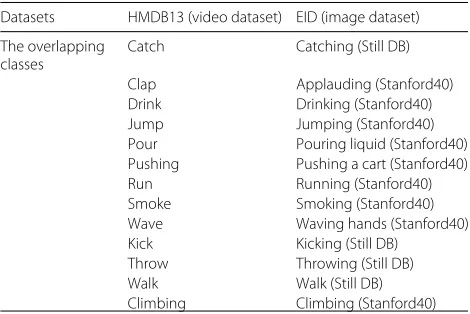
The HMDB51 dataset [27] is collected from a variety of sources ranging from digitized movies to YouTube videos. It contains 6766 video sequences that are categorized into 51 classes. This dataset contains simple facial actions, gen-eral body movements, and human interactions. In order to increase the number of overlapping classes, we select 13 overlapping classes between HMDB51 and another image datasets as Extensive Images Databases (EID), which includes two open benchmark datasets (i.e., Stanford40 [28] and Still DB [29]). As a result, we call the video dataset as “HMDB13.” Table1provides the details of the overlapping classes from EAD to HMDB51.
Table 1The classes of HMDB13←EID
Datasets HMDB13 (video dataset) EID (image dataset)
The overlapping classes
Catch Catching (Still DB)
Clap Applauding (Stanford40)
Drink Drinking (Stanford40)
Jump Jumping (Stanford40)
Pour Pouring liquid (Stanford40)
Pushing Pushing a cart (Stanford40)
Run Running (Stanford40)
Smoke Smoking (Stanford40)
Wave Waving hands (Stanford40)
Kick Kicking (Still DB)
Throw Throwing (Still DB)
Walk Walk (Still DB)
3.1.2 UCF10←AID
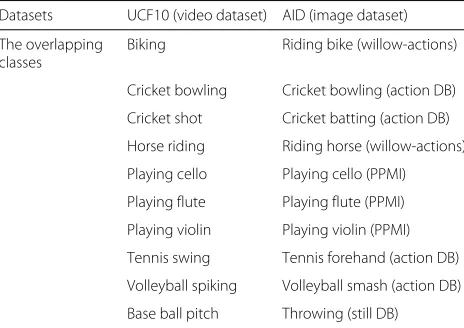
The UCF101 [30] is a dataset of realistic action videos collected from YouTube, which has 101 action categories. It gives the largest diversity in terms of actions with the presence of large variation in subject appearances, including scale and pose, related objects, cluttered back-ground, and illumination conditions. Such a challenging diversity is suitable for verifying the effect of informa-tion learned from images on video semantics recogniinforma-tion. To further evaluate whether images coming from vari-ous sources contribute to the feature selection or not, we select ten overlapping classes between UCF101 and the action image dataset, referred to as Actions Images Databases (AID), which includes four open benchmarking datasets (i.e., action DB [31], PPMI [32], willow-actions [33], and still DB). For the convenience of our experi-ments design and description, we call the video dataset as UCF10. In Table2, we show the chosen categories of UCF10←AID, which are taken as video dataset and image dataset, respectively.
3.1.3 UCF←PPMI4
The PPMI dataset [32] consists of 7 different musical instruments: bassoon, erhu, flute, French horn, guitar, saxophone, and violin. In order to assess the performance of the proposed algorithm when the image dataset has dif-ferent classes from that in the video dataset, we choose ten classes from UCF101 and then select four overlap-ping image categories from PPMI. To this end, we call the video dataset as UCF and image dataset as PPMI4. Table3 summarizes the selected classes of UCF←PPMI4.
3.2 Experiment setup
For all the datasets, we select 30 images from each over-lapping categories for knowledge adaption as the number of images is relatively small. We sample videos for labeled training data and take the remaining videos as the test-ing data. To evaluate the contribution from unsupervised
Table 2The classes of UCF10←AID
Datasets UCF10 (video dataset) AID (image dataset)
The overlapping classes
Biking Riding bike (willow-actions)
Cricket bowling Cricket bowling (action DB)
Cricket shot Cricket batting (action DB)
Horse riding Riding horse (willow-actions)
Playing cello Playing cello (PPMI)
Playing flute Playing flute (PPMI)
Playing violin Playing violin (PPMI)
Tennis swing Tennis forehand (action DB)
Volleyball spiking Volleyball smash (action DB)
Base ball pitch Throwing (still DB)
Table 3The classes of UCF←PPMI4
Datasets UCF (video dataset) PPMI4 (image dataset)
The overlapping classes Playing cello Playing cello (PPMI)
Playing flute Playing flute (PPMI)
Playing guitar Playing guitar (PPMI)
Playing violin Playing violin (PPMI)
Rock climbing in door NULL
Rowing NULL
Tennis swing NULL
Volleyball spiking NULL
Walking with dog NULL
Writing on board NULL
subspace learning, we conduct experiments to study the performance variance when only a few labeled training samples are provided, and the ratios of labeled video data are set to 5%. For each dataset, we repeat the sampling for 10 times and report the average results. We extract SIFT features [16,34] from the key frames of videos and images.
The STIP features [17] are extracted from videos. We
use the standard Bag-of-Words (BoW) method [35, 36]
to generate the BoW representation of SIFT and STIP fea-tures, where the number of visual words of Bag-of-Words is set to 600. For videos, we obtain a still feature with 600 dimensions and an augmented feature with 1200 dimen-sions, and for images, we obtain a still feature with 600 dimensions.
3.3 Comparison algorithms
To benchmark our proposed jointing cross-media analysis and embedded learning (JCAEL), we select a number of representative existing state of the arts for performance comparisons, details of which are highlighted below:
– Full features (FF) which adopts all the features for classification. It is used as baseline method in this paper.
– Fisher score feature selection (FSFS) [37]: a supervised feature selection method built by depending on fully labeled training data to select features with the best discriminating ability. – Feature selection via joint2,1-norms minimization
(FSNM) [22]: a supervised feature selection method built by employing joint2,1-norms minimization on both loss function and regularization to realize feature selection across all data points.
– 2,1-norm least square regression (LSR21) [22]: a
supervised feature selection method built upon least square regression by using the2,1-norm as the regularization term.
built upon SVM by using the2,1-norm as the regularization term.
– Ensemble feature selection (EnFS) [25]: a supervised feature selection method based on transfer learning, which transfer the shared information between different classifiers by adding a joint2,1-norm on multiple feature selection matrices.
– Joint embedding learning and sparse regression (JELSR) [26]: a unsupervised feature selection method built by using the local linear approximation weights and2,1-norm regularization.
– Jointing cross-media analysis and embedded learning (JCAEL): our proposed method which is designed for feature selection by adapting knowledge from images based on still feature and utilizing both labeled and unlabeled videos based on augmented feature.
During the process of training and predicting, we use the augmented feature to represent the videos for the baseline methods, including FSFS, FSNM, LSR21, SVM21, and JELSR as these methods cannot use the information adapted from images. For EnFS and JCAEL, we use the still features to represent the image data and use the aug-mented feature to represent the videos. To fairly compare different feature selection algorithms, we use a “grid-research” strategy from10−6, 10−5,. . ., 105, 106to tune the parameters for all the compared algorithms. By setting the number of selected features as{120, 240,. . ., 1200}, we report the best results obtained from different parame-ters. For the K-nearest neighbors of Laplacian matrix L, the parameter is set tok = 10. In our experiment, each feature selection algorithm is first performed to select fea-tures. Then, three classifiers, i.e., linear multi-class SVM (LMCSVM), least square regression (LSR), and multi-class kNN(MCkNN), are performed based on the selected features respectively to assess the performance of feature selection. For the classifier of least square regression, we learn a threshold from the labeled training data to quan-tize the continuous label prediction scores to binary. To measure the feature selection performances, we use the average accuracy (AA) over all semantic classes as the evaluation metric, which is defined as:
AA=
cv
k=1
acck
cv
(27)
where cv is the number of action classes. acck is the
accuracy for thekth class. 3.4 Experimental results
In order to evaluate the effectiveness of JCAEL, we com-pare JCAEL with FF, FSFS, FSNM, LSR21, SVM21, EnFS,
and JELSR on both HMDB13←EID and UCF10←AID
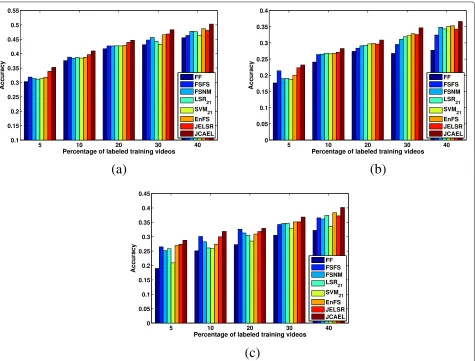
dataset. The comparison results are summarized in Tables4and5, where the best and the second best results are highlighted in bold and italic, correspondingly. We also conduct a number of experiments to study the per-formance variance when the ratios of labeled video data are set to 5%, 10%, 20%, 30%, and 40%, and the results are displayed in Figs.1and2.
From the experimental results in Tables 4–5 and
Figs.1–2, we can make the following observations:
(1) The results of feature selection algorithms are generally better than that of full features (FF). As the classification could be much faster by reducing the feature number, feature selection proves to be more crucial in practical applications.
(2) As the number of labeled training videos increases, the performance of all methods is improved. This is consistent with the general principle as more information is made available for training. (3) The classification using multi-class SVM and
multi-class kNN achieve better performance than the least square regression when the ratio of labeled video data are set to 5%. The main reason is that the threshold learned from the small size of training data leads to a bias in the quantization of continuous label prediction scores.
(4) When the ratio of labeled video data are set to 5%, JELSR is generally the second most competitive algorithm. This indicates that incorporating the additional information contained in the unlabeled training data through unsupervised embedded learning is indeed useful.
(5) As shown in Figs.1–2, supervised methods based on transfer learning (EnFS) always achieve better performances than other compared methods when the number of labeled training videos is enough (e.g., the ratio of labeled video data are set to 40%), since EnFS can uncover common irrelevant features by transferring the relative information between different classifiers.
Table 4Comparisons of feature selection algorithms on HMDB13←EID in terms of average accuracy using three classifiers when the ratio of labeled video data are set to 5%
Classifiers FF FSFS FSNM LSR21 SVM21 EnFS JELSR JCAEL
LMCSVM 0.3032 0.3187 0.3137 0.3117 0.3137 0.3182 0.3387 0.3526
LSR 0.1763 0.2138 0.1898 0.1903 0.1873 0.2003 0.2233 0.2318
Table 5Comparisons of feature selection algorithms on UCF10←AID in terms of average accuracy using three classifiers when the ratio of labeled video data are set to 5%
Classifiers FF FSFS FSNM LSR21 SVM21 EnFS JELSR JCAEL
LMCSVM 0.4340 0.4448 0.4715 0.4355 0.4340 0.4348 0.5061 0.5299
LSR 0.2906 0.3136 0.3043 0.3057 0.3028 0.3064 0.3180 0.3302
MCkNN 0.3360 0.3684 0.3670 0.3360 0.3360 0.3381 0.3756 0.4001
(6) As shown in Figs.1–2, our proposed JCAEL remains to be the best performing algorithm among different methods and different cases. The main reason is that our method can take advantages of both transfer learning and embedded learning. We can also see from Tables4–5that JCAEL algorithm achieves the best results when only a small number of labeled training videos are available. This advantage is especially desirable for real-world problems since precisely annotated videos are often rare.
3.5 Experiment on convergence
In this section, we study the convergence of the pro-posed JCAEL as described in Algorithm 1. Due to the fact that we solve our objective function using an alternat-ing approach, how fast our algorithm converges is crucial for the whole computational efficiency in practice. Hence, we conduct an experiment to test the convergence of the proposed JCAEL algorithm according to the objec-tive function value in Eq. (7) on both HMDB13←EID and
UCF10←AID datasets, where the ratio of labeled video
(a)
(b)
(c)
(a)
(b)
(c)
Fig. 2Classification results of different methods on UCF10←AID when the ratios of labeled video data are different.aLMCSVM as classifier.bLSR as classifier.cMCkNN as classifier
data are set to 5%. All the results are illustrated as conver-gence curves, and when the ratio of labeled video data are set to 40%, all the results are summarized in Fig.3, where all the parameters involved are fixed at their optimal val-ues. From the results shown in Fig.3, it can be seen that our algorithm converges within a few iterations. For exam-ple, it takes no more than 10 iterations for UCF10←AID
and no more than 15 iterations for HMDB13←EID.
3.6 Experiment on parameter sensitivity
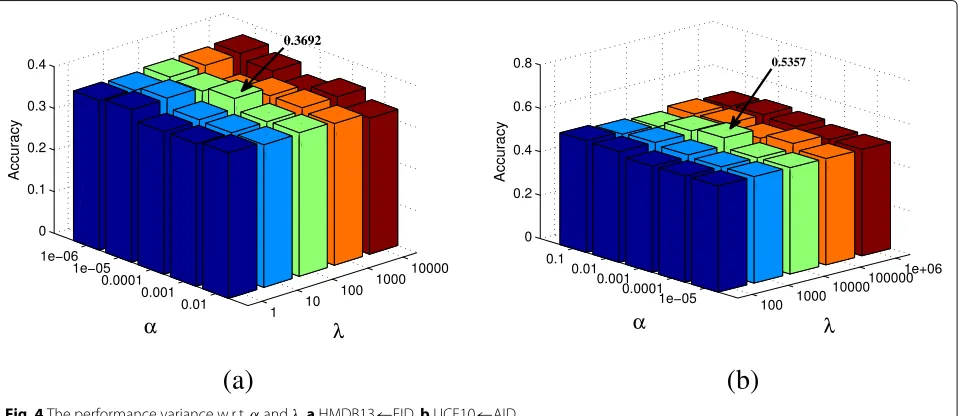
There are two regularization parametersαandλin Eq. (7). To learn how they affect the performances, we conduct an experiment to test the parameter sensitivity, where LMCSVM is used to classify the videos. We show the
results on both HMDB13←EID and UCF10←AID in
Fig.4, where the ratio of labeled video data are set to 5%.
It can be seen that, for HMDB13←EID, the performance
is sensitive to the two parameters. For UCF10←AID
the performance does not change much. In general, our
proposed can perform well for these datasets when α
and λ are comparable. For example, good performance
is obtained when α = 0.0001 and λ = 100 for
HMDB13←EID and α = 0.001 and λ = 10000 for
UCF10←AID.
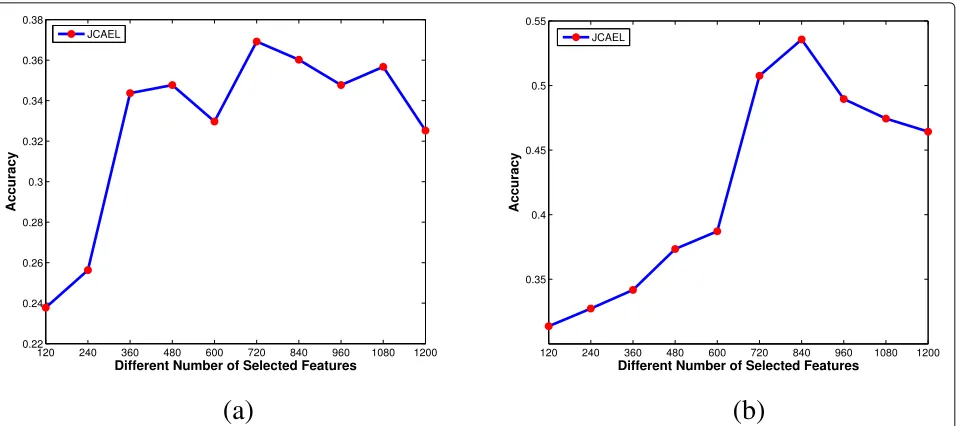
3.7 Experiment on selected features
As feature selection is aimed at both accuracy and computational efficiency, we perform an experiment to study how the number of selected features can affect the performance. We construct the experiments on both
HMDB13←EID and UCF10←AID when the ratio of
(a)
(b)
Fig. 3Convergence curves of the objective function value in Eq. (7) using Algorithm 1.aHMDB13←EID.bUCF10←AIDHMDB13←EID, the result is worse than using all features. (2) The results arrive at the peak level when using 720
features for HMDB13←EID and using 840 features for
UCF10←AID. The variance shown on the two datasets
are related to the properties of the datasets. (3) After all the features are selected, the results are lower than
select-ing 720 features for HMDB13←EID and 840 features for
UCF10←AID. In conclusion, our method reduces noises,
as the results improve on both databases.
3.8 Experiment on embedding features
In this section, we would like to investigate the influ-ence of embedding features with different dimensions.
We conduct the experiment on both HMDB13←EID and
UCF10←AID when the ratio of labeled video data is set
to 5%. With videos being classified by LMCSVM, Fig.6
shows the performance variation w.r.t the number of selected features. From the illustrated results, two obser-vations can be made: (1) the result arrives at the peak level
when using 390 embedding features for HMDB13←EID
and 10 embedding features for UCF10←AID. The
vari-ance shown on the two datasets are seen to be related to the properties of the datasets. (2) Without embedded learning, the results is lower than using 390 embedding
features for HMDB13←EID and 10 embedding features
for UCF10←AID, even when all the features are used. In conclusion, our proposed JCAEL can achieve good perfor-mance due to the fact that the most valuable information
(a)
(b)
(a)
(b)
Fig. 5The performance variation w.r.t the number of selected features using our feature selection algorithm.aHMDB13←EID.bUCF10←AID
is retained and the feature redundancies are eliminated in embedded learning.
3.9 Influence of cross-media analysis and embedded learning
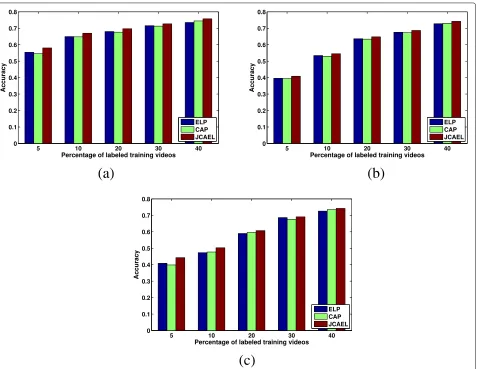
To further investigate the effectiveness of the integrated cross-media analysis and embedded learning, we con-struct three new algorithms: (1) embedded learning part (ELP), which is the unsupervised embedded learning part of JCAEL (i.e., Eq. (6)). ELP utilizes both labeled and unla-beled videos as the training dataset, and the augmented feature is used to represent each video by ELP. (2) Cross-media analysis part (CAP), which is the transfer learning
part of JCAEL (i.e., Eq. (4)). CAP transfers the knowledge from images to labeled videos, and only the still feature is used to transfer the knowledge by CAP.
We construct a new experiment to compare JCAEL with
ELP and CAP on UCF←PPMI4 dataset. Other
experi-ment setup is similar to those described in Section 3.2,
and the comparison results are shown in Table 6
and Fig.7.
From the results presented in Table 6 and Fig. 7, we can make the following observations: (1) Among differ-ent methods and differdiffer-ent labeled ratios, JCAEL per-form best. It achieves the highest accuracy in most cases, especially when only few labeled training videos
(a)
(b)
Table 6Comparisons of feature selection algorithms on UCF←PPMI4 in terms of average accuracy using three classifiers when the ratio of labeled video data are set to 5%
classifiers ELP CAP JCAEL
LMCSVM 0.5537 0.5456 0.5804
LSR 0.3958 0.3944 0.4085
MCkNN 0.4085 0.3988 0.4433
are provided. This is mainly due to the fact that (1) JCAEL benefits from the unsupervised embedded learn-ing which can utilize both labeled and unlabeled data, (2) JCAEL leverages the knowledge from images to boost its performances, and (3) JCAEL integrates transfer learn-ing and embedded learnlearn-ing into a joint optimization framework. In this way, gains from optimization are augmented. (2) The performance of JCAEL is generally better than that of ELP for all the labeled ratios, indicat-ing that the JCAEL is able to use the extra knowledge
from images to achieve higher accuracy. (3) JCAEL generally outperforms CAP, indicating that it is beneficial to utilize unlabeled videos for video semantic recogni-tion, especially when the number of labeled data is not sufficient.
To show the influence of the knowledge transferred from images, we shown the confusion matrices of ELP, CAP, and JCAEL when the ratio of labeled video data are set to 5%. The confusion matrices are shown in Fig. 8. Compared with ELP and CAP, JCAEL obtains better results on “playing cello,” “playing flute,” “playing guitar,” and “playing violin.” The main reasons can be highlighted as follows: (1) the extra-related semantic knowledge is adapted from images to videos and used to obtain the coherent semantics in videos. (2) The unlabeled videos also include more relevant information, which plays pos-itive roles in improving the performance of semantics recognition.
(a)
(b)
(c)
(a)
(b)
(c)
Fig. 8Confusion matrices of ELP, CAP, and JCAEL on UCF←PPMI4 when the ratio of labeled video data are set to 5%.aConfusion matrices of ELP. bConfusion matrices of CAP.cConfusion matrices of JCAEL
4 Conclusions
There are many labeled images and unlabeled videos in real world. To achieve good performance for video seman-tic recognition, we propose a new feature selection frame-work, which can borrow the knowledge transferred from images to achieve its performance improvements. Mean-while, it can utilize both labeled and unlabeled videos to enhance the performance of semantic recognition in videos. Extensive experiments validate that the knowledge transferred from images and the information contained in unlabeled videos can be used indeed to select more discriminative features, leading to the enhancement of recognition accuracies of semantics inside videos. In com-parison with the existing state of the arts, the experimental results show that the proposed JCAEL has better perfor-mances in video semantics recognition. Even under the circumstance that only a few labeled training videos are available, our proposed JCAEL still performs competitive among all the compared existing state of the arts, lead-ing to a high level of flexibility for its applications in real world.
Abbreviations
AA: Average accuracy; BoW: Bag-of-words; EnFS: Ensemble feature selection; FSFS: Fisher score feature selection; FSNM: Feature selection via joint2,1-norm
minimization; JCAEL: Jointing cross-media analysis and embedded learning; JELSR: Joint embedding learning and sparse regression; LMCSVM: Linear multi-class SVM; LSR: Least square regression; LSR21:2,1-norm least square
regression; MCkNN: Multi-class kNN; PCA: Principal component analysis; SIFT: Scale-invariant feature transform; STIP: Space-time interest points; SVM21:
Multi-class2,1-norm support vector machine
Acknowledgements Not applicable.
Funding
This work was supported in part by National Science Foundation of China (under Grant No. 61620106008, 61702165, U1509206, 61472276, 61876130). This work was supported in part by the Hebei Provincial Natural Science Foundation, China (under Grant No. F2016111005). This work was supported in part by the Foundation for Talents Program Fostering of Hebei Province (No. A201803025). This work was supported in part by Shenzhen Commission for Scientific Research & Innovations (under Grant No. JCYJ20160226191842793). This work was supported in part by Tianjin Natural Science Foundation (No. 15JCYBJC15400). This work was supported in part by the Project of Hebei Province Higher Educational Science and Technology Research (under Grant No. QN2017513). This work was supported in part by the Research Foundation for Advanced Talents of Hengshui University (under Grant No. 2018GC01).
Authors’ contributions
All authors took part in the work described in this paper. The team conducted literature reading and discussion together. The author JZ designed the proposed algorithm and made the theoretical derivation of mathematics. The author ZZ collected the image and video datasets and preprocessed them, then DA, JL, and ZS together programed to implement and verify the proposed algorithm. The author JZ wrote the first version of this paper, and then, the author YH and JJ repeatedly revised the manuscript. To accomplish the final manuscript submitted, all authors participated into discussion. All authors read and approved the final manuscript.
Authors’ information Not applicable.
Competing interests
The authors declare that they have no competing interests.
Publisher’s Note
Springer Nature remains neutral with regard to jurisdictional claims in published maps and institutional affiliations.
Author details
1College of Mathematics and Computer Science, Hengshui University,
Hengshui, China.2College of Computer Science & Software Engineering,
Shenzhen University, Shenzhen, China.3College of Intelligence and Computing, Tianjin University, Tianjin, China.4Hong Kong Applied Science
and Technology Research Institute, Shatin, Hong Kong.5Office of Academic Affaires, Hengshui University, Hengshui, China.6Office of Academic Research,
Hengshui University, Hengshui, China.
Received: 2 November 2018 Accepted: 16 January 2019
References
1. Y. Han, Y. Yang, Y. Yan, Z. Ma, N. Sebe, X. Zhou, Semisupervised feature selection via spline regression for video semantic recognition. IEEE Trans. Neural Netw. Learn. Syst.26(2), 252–264 (2015)
2. L. Maddalena, A. Petrosino, Stopped object detection by learning foreground model in videos. IEEE Trans. Neural Netw. Learn. Syst.24(5), 723–735 (2013)
3. Y. Xu, Y. Han, R. Hong, Q. Tian, Sequential video vlad: Training the aggregation locally and temporally. IEEE Trans. Circ. Syst. Video Technol. 27(10), 4933–4944 (2018)
4. X. Zhen, L. Shao, D. Tao, X. Li, Embedding motion and structure features for action recognition. IEEE Trans. Circ. Syst. Video Technol.23(7), 1182–1190 (2013)
5. S. Zhao, Y. Liu, Y. Han, R. Hong, Pooling the convolutional layers in deep convnets for action recognition. IEEE Trans. Circ. Syst. Video Technol. 28(8), 1839–1849 (2018)
6. Y. Han, Y. Yang, F. Wu, R. Hong, Compact and discriminative descriptor inference using multi-cues. IEEE Trans. Image Process.24(12), 5114–5126 (2015)
7. G. Lan, C. Hou, F. Nie, T. Luo, D. Yi, Robust feature selection via simultaneous sapped norm and sparse regularizer minimization. Neurocomputing.283, 228–240 (2018)
8. Y. Yang, Z. Ma, A. G. Hauptmann, N. Sebe, Feature selection for multimedia analysis by sharing information among multiple tasks. IEEE Trans. Multimedia.15(3), 661–669 (2013)
9. Z. Ma, Y. Yang, N. Sebe, A. G. Hauptmann, Knowledge adaptation with partiallyshared features for event detectionusing few exemplars. IEEE Trans. Pattern. Anal. Mach. Intell.36(9), 1789–1802 (2014)
10. C. Hou, F. Nie, H. Tao, D. Yi, Multi-view unsupervised feature selection with adaptive similarity and view weight. IEEE Trans. Knowl. Data Eng.29(9), 1998–2011 (2017)
11. Z. Ma, F. Nie, Y. Yang, J. R. Uijlings, N. Sebe, A. G. Hauptmann,
Discriminating joint feature analysis for multimedia data understanding. IEEE Trans. Multimedia.14(6), 1662–1672 (2012)
12. C. Deng, X. Liu, C. Li, D. Tao, Active multi-kernel domain adaptation for hyperspectral image classification. Pattern Recogn.77, 306–315 (2018) 13. Y. Yang, Y. Yang, H. T. Shen, Effective transfer tagging from image to video.
ACM Trans. Multimed. Comput. Commun. Appl. (TOMM).9(2), 14 (2013)
14. L. Duan, D. Xu, I. W.-H. Tsang, J. Luo, Visual event recognition in videos by learning from web data. IEEE Trans. Pattern. Anal. Mach. Intell.34(9), 1667–1680 (2012)
15. W. Zhuge, C. Hou, F. Nie, D. Yi, inPattern Recognition (ICPR), 2016 23rd International Conference On. Unsupervised feature extraction using a learned graph with clustering structure (IEEE, Cancun, 2016), pp. 3597–3602
16. J. Zhang, Y. Han, J. Tang, Q. Hu, J. Jiang, inProceedings of the 22nd ACM International Conference on Multimedia. What can we learn about motion videos from still images? (ACM, Orlando, 2014), pp. 973–976
17. J. Zhang, Y. Han, J. Jiang, Tensor rank selection for multimedia analysis. J. Vis. Commun. Image Represent.30, 376–392 (2015)
18. Y. Han, J. Zhang, Z. Xu, S.-I. Yu, inProceedings of the 17th AAAI Conference on Late-Breaking Developments in the Field of Artificial Intelligence. Discriminative multi-task feature selection (AAAI Press, Bellevue, 2013), pp. 41–43
19. S. Ji, L. Tang, S. Yu, J. Ye, A shared-subspace learning framework for multi-label classification. ACM Trans. Knowl. Disc. Data.4(2), 1–29 (2010) 20. X. Cai, F. Nie, H. Huang, C. Ding, inIEEE International Conference on Data
Mining. Multi-class l2,1-norm support vector machine (IEEE, Brussels, 2012), pp. 91–100
21. J. Zhang, Y. Han, J. Tang, Q. Hu, J. Jiang, Semi-supervised image-to-video adaptation for video action recognition. IEEE Trans. Cybern.47(4), 960–973 (2016)
22. F. Nie, H. Huang, X. Cai, C. Ding, inInternational Conference on Neural Information Processing Systems. Efficient and robust feature selection via joint l2,1-norms minimization (Curran Associates Inc, Vancouver, 2010), pp. 1813–1821
23. X. He, D. Cai, P. Niyogi, inAdvances in Neural Information Processing Systems. Laplacian score for feature selection (Curran Associates Inc, Vancouver, 2006), pp. 507–514
24. J. Zhang, J. Jiang, Rank-optimized logistic matrix regression toward improved matrix data classification. Neural Comput.30(2), 1–21 (2018) 25. Y. Han, Y. Yang, X. Zhou, inIJCAI, vol. 13. Co-regularized ensemble for
feature selection, (Beijing, China, 2013), pp. 1380–1386 26. C. Hou, F. Nie, D. Yi, Y. Wu, inIJCAI Proceedings-International Joint
Conference on Artificial Intelligence, vol. 22. Feature selection via joint embedding learning and sparse regression, (Barcelona, 2011), pp. 1324–1329
27. H. Kuehne, H. Jhuang, R. Stiefelhagen, T. Serre, inIEEE International Conference on Computer Vision, ICCV 2011, November. Hmdb51: A large video database for human motion recognition (IEEE, Barcelona, 2012), pp. 2556–2563
28. B. Yao, X. Jiang, A. Khosla, A. L. Lin, L. Guibas, F. F. Li, inInternational Conference on Computer Vision. Human action recognition by learning bases of action attributes and parts (IEEE, Barcelona, 2011), pp. 1331–1338 29. N. Ikizler, R. G. Cinbis, S. Pehlivan, P. Duygulu, inInternational Conference
on Pattern Recognition. Recognizing actions from still images (IEEE, Tampa, 2008), pp. 1–4
30. O. Deniz, I. Serrano, G. Bueno, T. K. Kim, inInternational Conference on Computer Vision Theory and Applications. Fast violence detection in video (IEEE, 2015), pp. 478–485
31. A. Gupta, A. Kembhavi, L. S. Davis, Observing human-object interactions: using spatial and functional compatibility for recognition. IEEE Trans. Pattern. Anal. Mach. Intell.31(10), 1775–89 (2009)
32. B. Yao, F. F. Li, inComputer Vision and Pattern Recognition. Grouplet: A structured image representation for recognizing human and object interactions (IEEE, San Francisco, 2010), pp. 9–16
33. V. Delaitre, I. Laptev, J. Sivic, inBritish Machine Vision Conference, BMVC 2010, August 31 - September 3, 2010. Proceedings. Recognizing human actions in still images: a study of bag-of-features and part-based representations, (Aberystwyth, 2010), pp. 1–11
34. X. Liu, Z. Li, C. Deng, D. Tao, Distributed adaptive binary quantization for fast nearest neighbor search. IEEE Trans. Image Process.26(11), 5324–5336 (2017)
35. X. Liu, J. He, B. Lang, Multiple feature kernel hashing for large-scale visual search. Pattern Recog.47(2), 748–757 (2014)
36. X. Liu, J. He, S. F. Chang, Hash bit selection for nearest neighbor search. IEEE Trans. Image Process.26(11), 5367–5380 (2017)