301 | P a g e
AN IMAGE AUTHENTICATION BASED ON DWT
DCT AND SVD
1
Ashwini B.M,
2Dr Y.P Gowramma
1
Mtech IV Sem, Kalpataru Institute of Technology, Tiptur (India)
2
Proff and HOD of CS&E, Kalpataru Institute of Technology, Tiptur (India)
ABSTRACT
Digital watermarking techniques are developed to shield the copyright of multimedia system objects like text, audio, video, etc. during this paper, we tend to propose a replacement digital watermarking formula with grey image supported distinct wavelet remodel (DWT), a pair of dimensions distinct cosine transform (DCT) and singular worth decomposition (SVD) for robust watermarking of digital pictures so as to shield digital media copyright expeditiously. One among the key blessings of the proposed theme is that the hardiness of the technique on wide set of attacks. Experimental results ensure that the projected scheme provides smart image quality of watermarked pictures. Digital watermarking has become an accepted technology for sanctioning multimedia system protection schemes. Whereas most efforts concentrate on user authentication, recently interest in information authentication to make sure information integrity has been increasing. Existing concepts address primarily image information.Therefore, the theme is in and of itself secures to block based local attacks and retains hi-fi of the watermarked image.
Index Terms: Digital image watermarking, DWT, DCT, PSNR, SVD, Multimedia security.
I. INTRODUCTION
In the gift economic process, the provision of the net and numerous image process tools disclose to a bigger
degree, the likelihood of downloading a picture from the Internet, Manipulating it while not the permission of
the rightful owner. Embedding watermarks in each signals and pictures will cause distortion in them.
Multimedia knowledge manipulation has become additional and additional simple and undetectable by the
human hear able and visual system because of technology advances in recent years. While this enables various
new applications and usually makes it convenient to figure with image, audio, or video knowledge, a certain loss
of trust in media knowledge is determined.
In general, a successful watermarking scheme should satisfy the following fundamental requirements.
1) Imperceptibility: the perceptual difference between the watermarked and the original documents should be unnoticeable to the human eye, i.e. watermarks should not interfere with the media being protected.
302 | P a g e
3) Robustness:an unauthorized person should not be able to destroy the watermark without also making the document useless, i.e., watermarks should be robust to signal processing and intentional attacks. In particular,
after common signal processing operations have been applied to the watermarked image like filtering,
re-sampling, cropping, scaling, geometric transformation, rotation, etc., they should still be detectable.
Generally, watermarking can be classified into two groups: spatial domain methods and transform domain
methods.
In the spatial domain approaches, the watermark is embedded directly to the constituent locations. Embedding
the watermark within the spatial domain is that the direct methodology. It has various blessings like less
procedure price, high capability, more sensory activity quality however less sturdy and it principally suits for
authentication applications. It has lot of robust, less management of sensory activity quality and principally suits
for copyright application. the foremost frequent used strategies area unit discrete circular function remodel
(DCT) domain , discrete wavelet remodel (DWT) domain , singular worth decomposition (SVD) domain. They
currently acquire more widespread used as they forever have smart lustiness to common image process. In this
paper a DCT DWT SVD primarily based blind watermarking technique has been used for embedding
watermark. Moreover, the algorithm is strong to the common image method cherish Filtering, mathematician
noise, Rotation and Salt and Pepper.
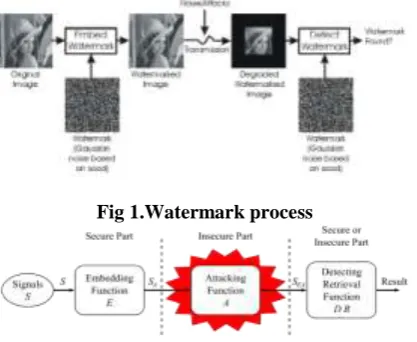
Fig 1.Watermark process
Fig 2.Watermark Lifecycle
II.OVERVIEW
The most frequent used methods are discrete cosine transform (DCT) domain, discrete wavelet transform
(DWT) domain, and singular value decomposition (SVD) domain.
2.1 Discrete Wavelet Transform
The basic idea of discrete wavelet transform (DWT) in image process is to multi-differentiated decompose the
image into sub-image of different spatial domain and independent frequency district. After the original image
has been DWT transformed, the image is decomposed into four sub band images by DWT: three high frequency
parts (HL, LH and HH, named detail sub images) and one low frequency part (LL, named approximate
303 | P a g e
Fig 3.
Wavelet decomposition
In Fig. 3, a pair of level ripple rework method of the image is shown, HL, LH, HH square measure the
horizontal high frequency, the vertical high frequency and also the diagonal high frequency half severally and
LL is that the approximation low frequency half. The energy of the high-frequency half (horizontal, vertical and
diagonal part) is a smaller amount, that represent the knowledge of the first image, similar to the feel, edge, etc.
2.2 Separate Circular Function Remodel
The separate operate circular function remodel may be a extremely popular remodel function that transforms a
proof from spatial domain to frequency domain and it's been utilized in JPEG commonplace for compression
thanks to smart performance. As a true remodel, DCT transforms real information into real spectrum and thus
avoids the matter of redundancy. The popular block-based DCT remodel segments a picture non-overlapping
block and applies DCT to every block.
2.3 Singular Value Decomposition
It’s a factorisation of a true or complicated matrix, with several helpful applications in signal process and
statistics. The basic properties of SVD from the perspective of image process applications are: i) the singular
values (SVs) of a picture have excellent stability, i.e., once a little perturbation is further to a picture, its SVs
don't modification significantly; and ii) SVs represent intrinsic pure mathematics image properties. During this
section, we have a tendency to describe a watermark casting and detection theme supported the SVD.
2.4 Image Authentication
Every extracted watermark bit is compared with the embedded one generated by the key. For every group, if the
extracted bit doesn't match the embedded one, the entire cluster is taken into account unproved and each group
member is marked as associate unproved constant. All the coefficients square measure then mapped back to
their original positions within the riffle sub bands by the inverse permutation. The unproved coefficients can
willy-nilly scatter over the sub bands. If there's a tampered region in the watermarked image, in each sub band
there'll be a region with abundant higher density of unproved coefficients at the situation comparable to the
tampered region, as a result of all unproved teams contain one or a lot of coefficients from the tampered region.
III.LITERATURE SURYEY
The digital revolution, the explosion of communication networks, and also the progressively growing passion of
the final public for brand spanking new data technologies result in exponential growth of transmission document
traffic (image, text, audio, video, etc.). This development is currently therefore necessary that insuring
LL HL
304 | P a g e
protection and management of the changed knowledge has become a significant issue. Indeed, from their digitalnature, transmission documents are often duplicated, modified, remodelled, and subtle terribly simply [1].
During this context, it's necessary to develop systems for copyright protection, protection against duplication,
and authentication of content. The aim of watermarking is to incorporate imperceptible data (i.e., imperceptible)
in a very transmission document to confirm an international intelligence agency or just a labelling application
[2].
3.1 Notions of Integrity: In the security community, associate degree integrity service is unambiguous outlined jointly, that insures that the sent and received knowledge area unit identical [3l.
3.2 Classical examples of malicious manipulations: It is well-known saying that an image is worth a thousand words. Images tend to have more impact on people than text, as it is easier to disregard the content of
textual information than to question the origin and authenticity of a photograph [4].
3.3 Generic image authentication system: Various formulations have been proposed by Wu and Liu and Lin
and Chang [5]
.
However, we propose a generic image authentication system. To be effective, a system mustsatisfy the following criteria:
Sensitivity: the system must be sensitive to malicious manipulations (e.g., modifying the image
meaning) such as cropping or altering the image in specific areas.
Tolerance: the system must tolerate some loss of information (originating from loss compression
algorithms) and more generally no malicious manipulations (generated, e.g., by multimedia providers
or fair users).
Localisation of altered regions: the system should be able to locate precisely any malicious alteration
made to the image and verify other areas as authentic.
Reconstruction of altered regions: the system may need the ability to restore, even partially, altered or
destroyed regions in order to allow the user to know what the original content of the manipulated areas
was.
In addition, some technical features must be taken into account:
Storage: authentication data should be embedded in the image, such as a watermark, rather than in a
separate file, as is the case with an external signature .
Mode of extraction: depending on whether authentication data is dependent or not on the image, a
full-blind or a semi blind mode of extraction is required.
Asymmetrical algorithm: contrary to classical security services such as copyright protection, an
authentication service requires an asymmetrical watermarking (or encryption) algorithm.
Visibility: authentication data should be invisible under normal observation. It is a question of making
sure that the visual impact of watermarking is as weak as possible.
IV.EXISTING SYSTEM
305 | P a g e
troublesome thanks to advancing technology). Further, digital watermarks that square measure invisibleshouldn’t cause abundant, if any, distortion to a given file or image. Also, “Another, somewhat a lot of
appropriate demand is that the proper owner ought to have in his possession a replica of the first image that
shouldn't have the other watermark except probably own. With these needs of what's required to make a decent
digital watermark, the owner of the file or image can need to decide what sort of computer code is important.
For instance, if someone needs to infix associate degree invisible digital watermark on a picture, he/she can need
to decide however robust of a watermark must be imbedded. The stronger the digital watermark, the alot of
probability of image distortion.
V. PROPOSED SYSTEM
This section presents the ways for embedding and extraction of hidden information. During this paper a DCT
DWT SVD primarily based blind watermarking technique has been used for embedding watermark. We have a
tendency to use the DCT DWT SVD for host image and that we choose the centre frequency to implant
watermark. The main task of this work has performed into following steps:
5.1 Watermark Embedding
1) Apply one-level Haar DWT to decompose the host image A, into four sub-bands i.e. ALL, AHL, ALH, and AHH.
2) Consider AHLand is divided into 8×8 square blocks. Perform 2D DCT to each block, collect the DC value of each DCT coefficient matrix D1(x, y) together to get a new matrix M1.
3) Now consider ALHand find the Coefficient matrix D2(x, y) and another new matrix M2, same as step 2.
4) Apply SVD to M1 and M2, obtain M1=U1S1V1T and M2=U2S2V2T.
5) Let B of size 64×64 to represent the watermark image. Divide the B into two parts: B1 and B2. 6) Modify the singular values S1 and S2 (in step 5) with B1and B2 respectively and apply SVD to them, S1+αB1=U1*S1*V1T* and S2+αB2=U2*S2
*
V2T*7) For the coefficient matrix D1(x, y) in step 2 and D2(x, y) in step 3, change each DC value to M1*(x, y) and M2*(x, y), obtain new coefficient matrix D1*(x, y) and D2
*
(x, y) respectively. Apply inverse DCT to each D1*(x, y) andD2*(x, y) to produce the watermarked middle frequency band AHL* and ALH*
8) The watermarked image, AW is obtained by performing the inverse DWT using two sets of modified DWT
coefficient (AHL* and ALH*) and two sets of non-modified DWT coefficient (ALL and AHH).
5.2 Watermark Extraction
1) Apply one-level Haar DWT to decompose the Watermarked image (possibly attack) AW into four sub-bands:
306 | P a g e
2) Divide both of AHL**and ALH**
into 8×8 square blocks separately, apply DCT to each block. Collect the DC value to get matrix M1**
for AHL** and M2** for ALH**.3) Apply SVD to M1** and M2**, i.e. M1**=U1**S1**V1T** and M2 **= U2 **S2 **V2 T**. 4) Compute C1 = U1 *S1 **V1 T* and C2 = U2*S2 **V2T*.
5) Extract the watermark image from each sub-band, i.e., B1*= (C1- S1)/ α and B2*= (C2-S2). 6) We get the watermark image by combining the results of step 5: B*= B1*+ B2*.
VI. SIMULATION AND ANALYSIS
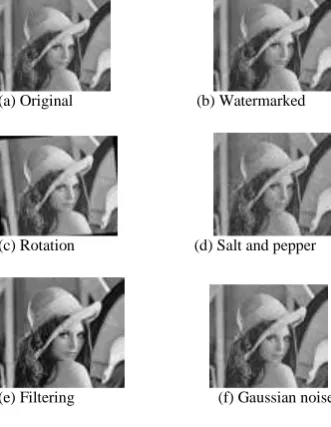
In order to testing the hardiness of the projected rule, substantial testing is performed. Within the simulation, we
tend to check totally different manipulations on the four well-known and normal grey scales image that are
“Lena”. The initial pictures (host image) are shown in Fig.4 (a), and therefore the watermarked are shown in
Fig. 4(b) severally. The watermark, as shown in Fig. 5(a), is employed in our simulation. Simulation results
show that the standard of watermarked image is promising. To check and verify the hardiness of our
watermarking rule, the watermarked image is attacked by mathematician Noise, Filtering, Rotation and Salt and
Pepper. These are shown in Fig.4.Perceptual quality of the watermarked image is measured by scheming PSNR
between host and watermarked image, at the receiver facet, watermark is extracted from the Watermarked
image. The PSNR price is calculated at totally different gain issue, once the gain issue price is to be high the
PSNR price of the image will increase (Shown in Table I).
(a) Original (b) Watermarked
(c) Rotation (d) Salt and pepper
(e) Filtering (f) Gaussian noise
Fig 4: Greyscale image "Lena".
TABLE I: DIFFERENT VALUE OF PSNR FOR DIFFERENT IMAGES
307 | P a g e
VII. CONCLUSION
In this paper, a unique watermarking technique supported DWT-DCT-SVD is projected. This novel technique
offers eminent results scrutiny to ways victimisation totally different cowl pictures. Results show that the new
technique is incredibly strong against totally different attacks like mathematician Noise, Salt and Pepper,
filtering and Rotation. Therefore, the projected algorithmic program could be a smart technique for
authentication of image materials.
REFERENCES
[1] C. Rey and J. L. Dugelay, “A survey of watermarking algorithms for image authentication,”, 2002.
[2] G. Voyatzis, N. Nikolaidis, and I. Pitas, “Digital watermarking: an overview,” in Proc. Ninth European Signal Processing Conference, Rhodes, Greece, September 8–11, 1998.
[3] V. Potdar, S. Han, and E. Chang, “A survey of digital image Watermarking techniques,” in Proc. 3rd IEEE-International Conference on Industrial Informatics, Frontier Technologies for the Future of Industry and Business, Perth, WA, August 10, 2005, pp.709-716.
[4] N. J. Harish, B. B. S. Kumar, and A. Kusagur, “Hybrid robust watermarking technique based on DWT, DCT and SVD,” International Journal of Advanced Electrical and Electronics Engineering, .
[5] L. T. Qiao and K. Nahrstedt, “Watermarking schemes and protocols for protecting rightful ownership and