R E S E A R C H
Open Access
WildSpan: mining structured motifs from protein
sequences
Chen-Ming Hsu
1, Chien-Yu Chen
2*and Baw-Jhiune Liu
3Abstract
Background:Automatic extraction of motifs from biological sequences is an important research problem in study of molecular biology. For proteins, it is desired to discover sequence motifs containing a large number of wildcard symbols, as the residues associated with functional sites are usually largely separated in sequences. Discovering such patterns is time-consuming because abundant combinations exist when long gaps (a gap consists of one or more successive wildcards) are considered. Mining algorithms often employ constraints to narrow down the search space in order to increase efficiency. However, improper constraint models might degrade the sensitivity and specificity of the motifs discovered by computational methods. We previously proposed a new constraint model to handle large wildcard regions for discovering functional motifs of proteins. The patterns that satisfy the proposed constraint model are called W-patterns. A W-pattern is a structured motif that groups motif symbols into pattern blocks interleaved with large irregular gaps. Considering large gaps reflects the fact that functional residues are not always from a single region of protein sequences, and restricting motif symbols into clusters corresponds to the observation that short motifs are frequently present within protein families. To efficiently discover W-patterns for large-scale sequence annotation and function prediction, this paper first formally introduces the problem to solve and proposes an algorithm named WildSpan (sequential pattern mining across large wildcard regions) that incorporates several pruning strategies to largely reduce the mining cost.
Results:WildSpan is shown to efficiently find W-patterns containing conserved residues that are far separated in sequences. We conducted experiments with two mining strategies, protein-based and family-based mining, to evaluate the usefulness of W-patterns and performance of WildSpan. The protein-based mining mode of WildSpan is developed for discovering functional regions of a single protein by referring to a set of related sequences (e.g. its homologues). The discovered W-patterns are used to characterize the protein sequence and the results are compared with the conserved positions identified by multiple sequence alignment (MSA). The family-based mining mode of WildSpan is developed for extracting sequence signatures for a group of related proteins (e.g. a protein family) for protein function classification. In this situation, the discovered W-patterns are compared with PROSITE patterns as well as the patterns generated by three existing methods performing the similar task. Finally, analysis on execution time of running WildSpan reveals that the proposed pruning strategy is effective in improving the scalability of the proposed algorithm.
Conclusions:The mining results conducted in this study reveal that WildSpan is efficient and effective in
discovering functional signatures of proteins directly from sequences. The proposed pruning strategy is effective in improving the scalability of WildSpan. It is demonstrated in this study that the W-patterns discovered by WildSpan provides useful information in characterizing protein sequences. The WildSpan executable and open source codes are available on the web (http://biominer.csie.cyu.edu.tw/wildspan).
* Correspondence: [email protected]
2
Department of Bio-Industrial Mechatronics Engineering, National Taiwan University, Taipei, 106, Taiwan
Full list of author information is available at the end of the article
Background
As sequencing projects generate biological sequences at an astonishing rate, identifying functional signatures directly from sequences is of particular value in func-tional biology [1,2]. These signatures can then be used to predict function or functionally important residues of a novel protein. The functionally important residues of proteins are generally conserved during evolution [3]. Conserved regions of a protein sequence can be identi-fied by aligning the query protein with its homologues in protein databases. Alternatively, pattern mining (also called motif discovery) is an effective approach for iden-tifying conserved regions [4-7].
Motif finding algorithms have been widely used in this field for finding sequence signatures when given a set of related sequences (pattern mining). The resultant motifs are then employed in predicting protein function and functional sites when given a novel sequence (pattern matching). We previously employed motif finding in a hybrid way: detecting functional regions of a novel sequence directly by mining its sequence along with a set of homologues found in sequence database (MAGIIC-PRO, [8]). Similar to multiple sequence align-ment (MSA), MAGIIC-PRO can be invoked as long as the query protein can find sufficient homologues from databases (this can be easily achieved after the comple-tion of abundant sequencing projects). In this way, func-tional residues of the query protein can be predicted even when the function of the collected homologues is still left unknown. MAGIIC-PRO identified a set of resi-dues that are concurrently conserved during evolution. This can supplement the conservation information pro-vided by MSA.
PROSITE language is one of the formal ways to express a pattern [9]. A capital letter in a pattern is called an exact symbol. For example, the pattern‘ K-x-L-x(2)-E-x(2,3)-G’have four exact symbols. In addition to capital letters, a pattern also contains wildcards, expressed by the symbol‘x’. A wildcard can match any letters in a biological sequence. This pattern matches any sequence containing a substring which starts with
‘K’, followed by an arbitrary letter, followed by‘L’, fol-lowed by two arbitrary letters, folfol-lowed by ‘E’, followed by two to three arbitrary letters, and ends with‘G’. Both
‘x’and‘x(2)’are called rigid gaps, a gap of fixed length. A rigid gap can match a certain number of successive residues on which mutations are allowed. On the other hand, x(2,3) is a flexible gap, a gap of irregular length. A flexible gap can match a number of residues on which not only mutations are present but also insertions or deletions are allowed.
For proteins, the residues associated with a functional site are not necessarily found in a local region of the sequence [5,7,10,11]. Rather, the residues of a functional
site are commonly clustered into several local regions that together constitute an important substructure when the protein is folded. It is observed that within protein families, only limited flexibility is allowed in such local conserved regions, while large irregular gaps may be present in between these regions as long as the inserted or deleted segments do not affect the functionality of the proteins [3,12-14]. In Figure 1, we provide an exam-ple of such structured motifs. A structured motif ‘ R-x-Y-S-x(54,96)-G-x-G-x(2)-P-x(65,111)-Y-x-C-G’ is observed on the protein Ferredoxin-NADP [Swiss-Prot accession number: P10933] and additional 150 Oxidore-ductase FAD/NAD(P)-binding proteins belonging to the same protein family [InterPro entry: IPR001433] with P10933. This motif contains three blocks, and two inter-block gaps, ‘x(54,96)’ and ‘x(65,111)’, are quite large and flexible. It is shown in Figure 1 that the three pattern blocks, though largely apart in sequence, are clustered together in three-dimensional space and cor-porately form a binding region associated with the bind-ing of flavin adenine dinucleotide (FAD) and nicotinamide adenine dinucleotide phosphate (NADP) ligands. This observation motivates the current study to develop an algorithm for discovering sequence motifs that contain large flexible gaps in between the clusters of exact symbols. Though such structured motifs have been introduced and analyzed in studies related to cis-regulatory elements in DNA [15-18], few algorithms have been particularly designed for protein sequence analysis [15,19].
words for locally conserved regions limits their applica-tion in the analysis of protein sequences, in which con-servative substitutions are frequently observed. In addition, the unlimited gap flexibility in model 4 also results in noises.
The model 5 presented in Table 1 was previously pro-posed in our recent work [24] The algorithm MAGIIC utilizes a combination of intra- and inter-block gap con-straints to discover structured motifs like ‘ A-x-C-x(2,3)-D-F-x(10,198)-R-G-x(0,1)-D’. Such patterns have its Figure 1An example of structued motifsThis motif is observed on the protein Ferredoxin-NADP reductase [Swiss-Prot: P10933] and additional 150 Oxidoreductase FAD/NAD(P)-binding proteins from the InterPro entry [InterPro: IPR001433]. The motif is consisted of three local conserved regions‘R-x-Y-S’,‘G-x-G-x(2)-P’, and‘Y-x-C-G’, interleaved by two large gaps x(54,96) and x(65,111). When these three pattern blocks are mapped onto the 3D structure of Ferredoxin-NADP reductase, it is shown that all the three blocks are close to the FAD/NAD(P) binding site. Pattern blocks are plotted insticksusing different colors. The long gap between the first and the second blocks (the second and the third blocks) is plotted withribbonsin orange (purple). The ligands FAD and NADP are shown asball-and-stickin blue and red, respectively.
Table 1 Constraint models of gapped motifs employed in previous studies
Gap constraint models
Descriptions Examples of existing
algorithms
Model 1 At least L non-wildcards should be present in a pattern of maximum length of W. (e.g.‘A-x-K-H-x(2)- E’) Teiresias [6] and SPLASH [4]
Model 2 A gap with a maximum flexibility FL is allowed between any pair of pattern symbols; related constraints: maximum number of flexible gaps, maximum product of each flexibility. (e.g.‘
A-x(2,3)-W-x-H-(4,6)-E’)
Pratt [19]
Model 3 A gap with a minimum length of LB (e.g. LB = 1) and a maximum length UB (e.g. UB = 10) is allowed in between any pair of pattern symbols. (e.g.‘A-W-x(1,5)-H-x(4,10)-E’)
Ref. [35,36]
Model 4 A gap of any length (denoted as *) is allowed in between any pair of continuous words in a pattern; related constraints: minimum length of continuous words. (e.g.‘A-W-D-A-x(*)-H-E-D-x(*)-K-R’)
Ref. [7,11,14]
Model 5 a gap with a minimum length of LB and a maximum length of UB is allowed in between any pair of symbols in a pattern block; a gap with a minimum length of LB”and a maximum length of UB”is allowed in between any pair of pattern blocks; related constraints: minimum length of pattern block; (e. g. MAGIIC [24]:’A-W-x(2,3)-H-x(45, 60)-E-x-D-x(1,2)-K’, a pattern block is underscored), RISOTTO [15] (e.g.
R-G-I-T-I-T-x(16,18)-P-G-H-A-D-F, one mismatch is allowed in a pattern block).
symbols clustered into many pattern blocks, where the gaps within a pattern block are called intra-block gaps and the gaps between two successive blocks are called inter-block gaps. We have demonstrated in the previous study [24] that using the combination of intra- and inter-block gap constraints greatly improves mining effi-ciency. The MAGIIC patterns are similar to the struc-tured motifs proposed for discovering cis-regulatory elements [15]. Though initially developed for mining DNA sequences, the package RISOTTO can also be used for mining protein sequences.
After largely using MAGIIC to identify functional motifs of protein sequences, we observed that restricting intra-block gaps to only rigid gaps can further refine the mining results greatly. In this regard, the later proposed web server MAGIIC-PRO simply employs rigid intra-block gaps to handle local mutations. In MAGIIC-PRO, the maximum length of a rigid intra-block gap is set to a small value, such as two or three. Regarding the inter-block gaps, both MAGIIC and RISOTTO set the mini-mum (a lower bound) and maximini-mum (an upper bound) distances between blocks in advance. When developing MAGIIC-PRO, we observed that setting the minimum and maximum distances between blocks prior to motif discovery is very difficult. This problem can be resolved when a query protein is involved during pattern mining. That is, the minimum and maximum distances between blocks can be set dynamically according to the gaps pre-sent in the query sequence. With the length of the gaps observed in the query sequence, a novel constraint named ‘maximum relative flexibility’was designed to calculate the lower and upper bounds that are allowed among the homologues for this particular gap. Patterns satisfying the constraint model proposed in MAGIIC-PRO are called W-patterns.
This study aims at introducing the algorithm Wild-Span for efficiently discovering W-patterns. In this paper, we demonstrated that the constraint ‘maximum relative flexibility’has some good properties, and thus aggressive pruning strategies can be employed by Wild-Span to improve efficiency. The performance of WildSpan is evaluated in two ways. Comparison of W-patterns to annotated motifs in existing databases reveals that W-patterns can capture the functional sig-natures of proteins well. Comparison of WildSpan to existing algorithms that perform the similar task reveals that W-patterns are more powerful in detecting protein functional regions than currently existing constraint models.
In this paper, we also illustrate how WildSpan can be invoked as the protein-based or family-based mining mode for future proteomics applications. The mining results of protein-based mining reveal that WildSpan can efficiently and effectively identify functional or
structural signatures of the query protein directly from the protein sequences. On the other hand, the mining results of family-based mining reveal that WildSpan can be used to identify sequence signatures of protein families for future function prediction and sequence annotation. The idea of protein-based mining has been integrated in our web servers MAGIIC-PRO [8] in 2006 and iPDA [25] in 2007 for annotating protein sequences. On the other hand, the idea of family-based mining has been integrated in the web server E1DS in 2008 [26] for predicting enzyme catalytic sites and residues. In sum-mary, though several independent studies have success-fully shown the usefulness of the constraint model W-patterns, the design of the WildSpan algorithm has not been previously addressed and published elsewhere. In addition, the standalone package and open source codes of WildSpan are now ready for downloading and can be used for large-scale proteome studies in the future.
Results and Discussion
This section evaluates the efficiency and effectiveness of WildSpan in identifying functional regions of protein sequences. First, we conduct experiments on a protein-protein docking benchmark [27] for evaluating the per-formance of the protein-based mining mode of Wild-Span in identifying functionally important regions of proteins. By this dataset we demonstrate that WildSpan is capable of identifying sequence motifs that usually contribute to forming local structures of proteins and are related to functional interfaces. Next, we execute WildSpan in family-based mining mode, and investigate the potential of the W-patterns to serve as diagnostic patterns for a protein family. After that, we investigate the effect of algorithm parameters on the mining results, and finally the scalability of WildSpan is evaluated using datasets containing different numbers of input sequences as well as with different maximum lengths. All the experiments are conducted on a 3.4 GHz Intel PC machine with 2 GB main memory, running Linux Fedora 9 operating system.
Experiments on detection of protein functional regions
evaluated by investigating the accuracy of function clas-sification by using W-patterns, compared with the curated patterns provided in PROSITE and the patterns discovered by three existing motif finding packages.
Protein-based mining
For protein-based mining, it has been demonstrated in our previous study [28] that the W-patterns can be used to facilitate identifying the binding interface of protein-protein complexes. Here, we repeated the same evalua-tion procedure by using the same benchmark, the protein-protein docking benchmark 2.0 established by the ZDOCK team [27], but recollect the homologue set for each query protein from a newer version of sequence databases (Oct. 10, 2008).
The complete procedures for identifying interacting interfaces for a query protein are as follows:
(1) For a query protein chain, the input data (homolo-gues of the query, 150 at most) fed to WildSpan was obtained by performing PSI-BLAST [29] against Swiss-Prot database [30] using BLOSUM62 substitution matrix and an E-value cut-off of 0.01. The sequences nearly identical to the query protein (sequence identity > 90%) or with a low identity (sequence identity < 30%) were excluded from the input data. If the homologues of query protein are not sufficient in Swiss-Prot database (< 5 homologues), the process of collecting homologues was executed one more time against the non-redundant (NR) database [29].
(2) Invoking WildSpan for pattern mining: at least one W-pattern with five blocks is discovered for each query protein. Different settings regarding the number of blocks in a W-pattern have been tested from two to six, while the setting ‘five’ achieved the best performance (data not shown). The maximum relative flexibility is set as 50%. Other parameter settings remain as default. The discussions regarding how the default settings of Wild-Span were determined can be found in Additional file 1. Like other motif finding algorithms, it is challenging to have all the parameters set to proper values in a single run of WildSpan. A loose setting of parameters results in too many patterns that confuse the users, while a tight setting results in no patterns at all. To achieve the goal of delivering a five-block W-pattern with a support as high as possible for each query protein, we follow a procedure of automated parameter tuning when invok-ing WildSpan. A flowchart illustratinvok-ing how WildSpan was invoked with different parameter settings to com-plete the mining task was provided in Figure A1.2 of Additional file 1.
(3) In the end of motif finding, a consensus motif that merges all the discovered W-patterns is examined for evaluating the mining results for each query protein.
Among the 220 protein chains in this benchmark, 217 protein chains can find sufficient (≥5) homologues for
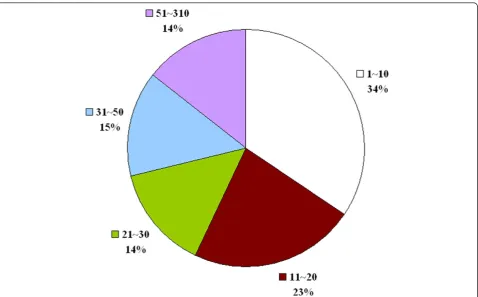
motif discovery. For all the 217 query proteins, Wild-Span successfully found at least one motif containing five blocks. There are in total 1011 motif blocks discov-ered by WildSpan. Each block contains 10 residues in average, including positions that allow for mutations. In Figure 2, the distribution of the length of inter-block gaps observed on the 217 query proteins is provided. More than one-fourth (29%) of the inter-block gap have a length longer than 30 residues. Though these blocks are interleaved with long gaps in sequence, it is shown in Table 2 that the conserved blocks in W-patterns usually cluster together in space (92.7% of the discov-ered pattern blocks contains an atom that is within 5Å to an atom of another block belonging to the same W-pattern). This proportion is significantly higher than that of a randomly generated motif (80.1%) containing five blocks, which each contains 10 residues.
The results above reveal that some of the residues in W-patterns might be conserved for structure conforma-tion. The next question to answer is whether the resi-dues in W-patterns are conserved for function conservation. In this regard, we further evaluate the quality of a W-pattern by calculating the proportion of interface residues in a W-pattern. It is shown in Table 3 that 23.6% of the residues in the W-patterns are close to the binding partner in protein-protein complexes within 5Å. Since MSA is widely adopted to discover conserved residues for the query protein with respect to its homo-logues, the conserved residues detected by techniques based on MSA were compared here. To compare with MSA, we calculated the conservation scores based on the alignment of Clustal-W using the iPDA web server. In Table 3, it is shown that only 18.7% of the conserved residues detected by MSA are interface residues. This reveals that WildSpan is able to discover more con-served residues that are related to protein function.
Family-based mining
of an inter-block gap is set asfmax= 50% and the other parameters are set as default.
The protein sequences of each family in PA10F were collected based on the functional annotation in an ear-lier release of Swiss-Prot database as shown in Table A2.1 of Additional file 2. Meanwhile, all the protein sequences collected from a recent release of Swiss-Prot database were adopted as the testing data. A sequence is categorized as a positive sample as long as it matches any of the patterns derived by WildSpan. The sensitivity (TP/(TP+FN)), precision (TP/(TP+FP)) and specificity (TN/(TN+FP)) of the selected patterns are compared with those of the diagnostic pattern from the PROSITE database, where TP, FP, TN, and FN denote the number of true positives, false positives, true negatives, and false negatives, respectively. It should be noted that the train-ing and testtrain-ing procedures adopted here are not like a
standard machine learning approach in two ways. First, no negative samples are involved in the training proce-dure. With the positive sequences only, motif finding algorithms are expected to achieve the maximum sensi-tivity rate over the input set under the user-specified constraints. Second, most of the training samples are included in the testing data as well. In this regard, it is expected that the sensitivity rates should be high, but obviously not all the methods fulfil this expectation. Another focus will be on how good the specificity rates can be achieved by different methods.
Table 4 reveals that W-pattern is good in characteriz-ing new proteins (eliminatcharacteriz-ing false positives while keep-ing satisfied sensitivity rates). The predictions are compared to PROSITE patterns and the motifs discov-ered by motif-finding algorithms, RISOTTO, Pratt, and Teiresias. While providing a competitive predicting
Table 2 Comparison of W-patterns with randomly generated patterns
Number of predicted blocks
Number of blocks in average
Length of predicted blocks in average
Cluster propensity
W-patterns 1011 4.7 10 92.7%
Randomly generated patterns (average of 10 rounds)
1041 4.8 9.4 80.1%
The clustering propensity of W-patterns generated by WildSpan was compared with randomly generated patterns. The experiments were tested on the 217 of 220 protein chains (PP220) in the protein-protein benchmark (no homologues can be found for the three cases: 1ml0_A, 1ml0_B, 1udi_I).
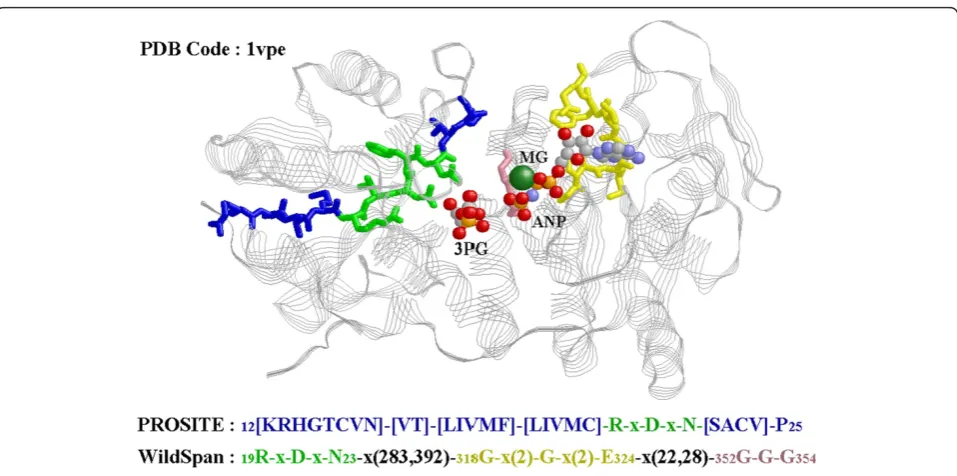
ability when compared to the PROSITE patterns, we observed that the W-patterns derived by WildSpan pro-vide more complete and precise signatures regarding the binding regions than the PROSITE patterns, as exempli-fied in Figure 3. Complete results for protein function classification are shown in Table A2.2 of Additional file 2. It is concluded that W-patterns perform similarly to the curated patterns in PROSITE and outperforms the motifs discovered by the other three constraint models.
We observed that the false positives reported in Table 4 are not really wrong predictions. For example, most of proteins are annotated in another database (i.e. Pfam) as the target function. In Table 5, we provided the details about the number of false positives that can actually find annotation from another database. These results show the potential of the W-patterns in predicting pro-tein functions with both high sensitivity and specificity. This also explains why the E1DS server [26] performs well in predicting catalytic sites and residues when invoking the family-based mining mode of WildSpan to construct the signature database.
Performance analysis
In this section, we investigate the efficiency of WildSpan in identifying W-patterns based on the ten datasets in PA10F.
Performance study on pattern pruning
To evaluate the efficiency of WildSpan with the pro-posed pruning strategy, we evaluated the performance of two versions of WildSpan algorithm as follows.
(a) WildSpan: the WildSpan algorithm with pruning strategies in the second phase.
(b) WildSpan-NP: the WildSpan algorithm with exhaustive search in the second phase by enumerating all combinations.
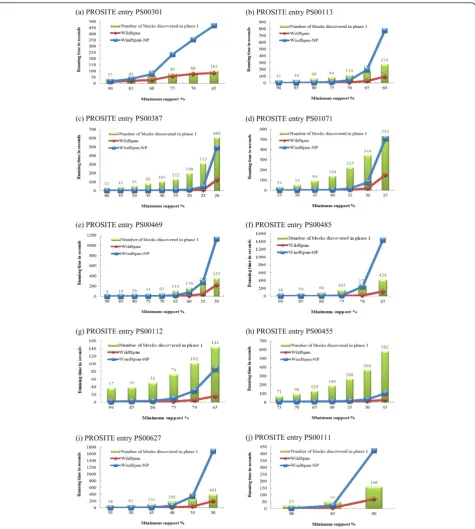
The experimental results on PA10F with different minimum support thresholds are shown in Figure 4. For each dataset, the other parameters were set as:
min = 3, gmax = 3, nmin= 2, and fmax = 50%, which denote the minimum size of a block, the maximum length of an intra-block gap, the minimum number of blocks in a W-pattern, and the relative flexibility con-straint, respectively. As depicted in the Figure 4, Wild-Span is in several orders of magnitude faster than WildSpan-NP for all the cases. When the support threshold is high, the performance curves of WildSpan and WildSpan-NP are close. This is because fewer can-didates of blocks exist for higher values of minimum support. However, WildSpan with lower supports achieves a better reduction in terms of search space and consequently provides a better speedup, since there are many candidate blocks and WildSpan-NP enumerates all the combinations, which is computa-tionally expensive.
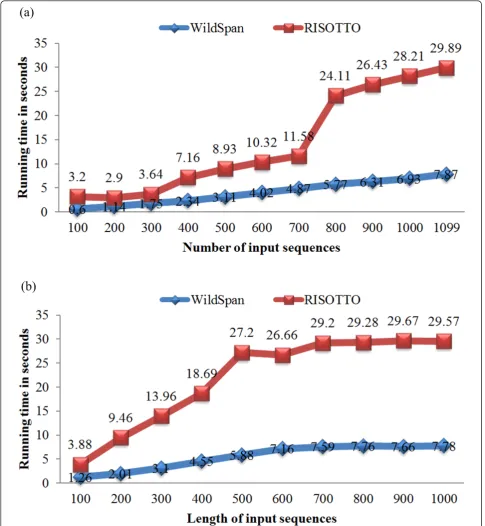
On the other hand, the scalability of WildSpan is investigated by studying the effect of varying length and input size of input datasets. The employed dataset is the largest family PS00301 of PA10F, which contains 1099 protein sequence members, {s1, s2,..., s1099}. We randomly selected x proteins from PS00301 as the input data,x Î{100, 200, ..., 1000, 1099}. These eleven input sets were used to test the scalability of WildSpan versus the number of input sequences. Figure 5(a) shows the analysis, and the scalability of WildSpan is
Table 3 Comparison of the conservation information provided by WildSpan with that of MSA
Total number of residues characterized as conserved
Number of interface residues in the group of residues categorized as conserved
Proportion of interface residues in the group of residues categorized as conserved
W-patterns
10268 2351 23.6%
MSA 10638 2058 18.7%
We investigated the property of W-patterns at residue level by calculating the proportion of interface residues in W-patterns. The results are compared with the conserved residues assigned by Clustal-W (MSA). The experiments were tested on the 217 of 220 protein chains (PP220) in the protein-protein benchmark (no homologues can be found for the three cases: 1ml0_A, 1ml0_B, 1udi_I).
Table 4 Experimental results for protein family classification
Method/Database Time used in seconds Sensitivity Precision Specificity MCC1
PROSITE - 85.717 93.043 99.996 0.857
RISOTTO 18.635 47.003 99.957 100 0.470
Pratt 1598.3 81.507 94.159 99.995 0.815
Teiresias 0.908 76.798 0.2523 41.163 0.030
WildSpan (Family-based) 89.782 99.042 97.481 99.993 0.990
The table shows the performance of family-based mining of WildSpan on protein family classification based on PA10F. The results were compared to PROSITE annotated patterns and three other pattern mining methods: RISOTTO, Teiresias, and Pratt. The input data was prepared by collecting proteins in the release 50.9 of UniProtKB/Swiss-Prot (235673 entries), and the discovered patterns were verified through all protein sequences in the release 2010/08 of UniProtKB/Swiss-Port (518415 entries). Fragment and partially matches were excluded in both training and testing data. The parameter values of all the methods were set as default
1
compared with RISOTTO. We also generated another test sets in which the maximum length y of input sequences is restricted, y Î {100, 200, ..., 1000}. These ten input sets were used to test the scalability of Wild-Span when the length of input sequences is increasing. Again, the result was compared with RISOTTO, as shown in Figure 5(b). For both RISOTTO and Wild-Span, the minimum support threshold is set as a proper value such that a pattern with a support as high as possible can be found. We have validated that all of W-patterns with the maximum support are directly associated with the functional sites of the query protein by examining locations of the discovered patterns on available protein structures.
Conclusions
This paper presents an algorithm WildSpan for disco-vering W-patterns. Discodisco-vering W-patterns is impor-tant in analyzing protein sequences because protein functional motifs are usually composed of many con-served blocks that are separated in primary sequences but are often close to each other in 3-D structures. The constraint model (W-patterns) and the developed mining and pruning strategies (incorporated in Wild-Span) is shown to efficiently and effectively deliver information concerning co-occurred sequence conser-vation. The derived W-patterns was previously shown to be useful in predicting intra-molecular interactions, identifying hot regions of protein-protein complexes, Figure 3A W-pattern versus the PROSITE pattern for a family of interest. The W-pattern derived by WildSpan for Phosphoglycerate kinase (PS00111) versus the PROSITE pattern. The small numbers in patterns are the residues IDs in the PDB structure.
Table 5 Many false positives of WildSpan are not really false positives
PROSITE family False positives (FPs)/the number of FPs that actually are annotated as the target function by other databases
WildSpan (Family-based) PROSITE RISOTTO Pratt Teiresias
PS00301 196/196 0/0 1/1 8/5 341227/NA
PS00469 1/1 6/0 0/0 0/0 0/0
PS00455 115/6 23/0 0/0 0/0 350060/NA
PS00111 1/1 0/0 2/1 10/1 263012/NA
PS00113 4/2 0/0 0/0 109/7 0/0
PS01071 0/0 2/0 0/0 0/0 380979/NA
PS00627 17/4 3/0 0/0 0/0 381040/NA
PS00387 0/0 102/0 0/0 0/0 31339/NA
PS00112 0/0 0/0 0/0 0/0 31339/NA
PS00485 1/1 20/0 0/0 150/0 350533/NA
and detecting binding regions of protein-ligand inter-actions [8,31-33]. To facilitate using the proposed algorithm in future application, we implemented a stand-alone program and provided a user-friendly web server for WildSpan to help the biological community in discovering functional regions of protein sequences
in a large scale. WildSpan was developed using C/C++ with the support of C++ Standard Template Library under Linux, and has been tested on various GNU/ Linux platforms, including Red Hat 9.0 and Fedora 5 or higher. It should also work well with other UNIX-like operating systems.
Methods
This work introduces a two-phase algorithm (called WildSpan) to efficiently discover W-patterns when given a query sequence along with a set of homologous sequences. In the first phase, WildSpan constructs the
process to improve the performance. This section first formally describes the problem statement and the asso-ciated terminology. After that, the algorithm WildSpan is described step by step.
Problem Statement
Given a query sequence Sq, a sequence databaseD, and a parameter set θ regarding pattern block, W-pattern and gap constraints, the algorithm will find the com-plete set of closed W-patterns (the definition of closed patterns is provided in Additional file 3) present in the sequence databaseDsuch that each W-pattern satisfies the constraints inθand its matched sequences include the query sequence Sq. The parameter setθincludes the minimum support (minimum occurrences) of the pattern, the minimum number of blocks in a W-pattern, the minimum number of exact symbols in a block, the maximum length of an intra-block gap between two adjacent exact symbols in a block, and the maximum flexibility of an inter-block gap between two adjacent blocks in a W-pattern.
A block or W-pattern is called ‘satisfied’if it agrees with all the user-specified constraints. Each constraint will be defined when it is first used in the description of the algorithm.
Definition 1. (Sequence and sequence database)
A sequence over an alphabet Σis a finite sequence of symbols belonging to Σ, e.g., protein sequence is sequence over a 20-letter alphabet. For any sequenceS=
〈a1...am〉, a sequenceSx is called a subsequence ofS, if Sx can be obtained by deleting zero or more symbols from sequence S. We useS[i..j] to denote the substring
〈ai...aj〉(contiguous subsequence) ofS, which starts at position iand ends at positionjof S, for 1≤i ≤j≤ m. In particular,S[1..i] is the prefix of sequence Sthat ends at positioni, andS[i..m] is the suffix of sequenceS that begins at position i. The length of sequence S, denoted as m, is defined as the number of symbols in S. An input sequence databaseDcontains a set of sequences.
In general, the input sequence database is a set of pro-tein sequences that are presumed to be functionally or evolutionarily related to the query protein (the first sequence inD). Patterns found in protein sequences can be expressed in PROSITE language. For our purpose we need a more formal definition as below.
Definition 2. (Pattern)
A pattern P can be written asP =a1-x(i1, j1)-a2- x(i2,
j2)-...-x(ip-1,jp-1)-apin PROSITE language, wherea1,...,ap are the exact symbols ofP, and x(ix,jx) are the wildcard regions (i.e. gaps) ofPfor ix≤jx(1≤x<p). A patternQ is a sub-pattern of P if Qcan be obtained by deleting one or more exact symbol(s) fromP. Conversely, Pis a super-pattern ofQ. We say that a sequenceS matches the pattern P if S contains a substring that can be
derived fromPby substituting each wildcard symbol ‘x’ by an arbitrary symbol fromΣ. The setS/P stands for all the substrings ofS that match patternP. The nota-tion x(n,m), 0≤n<m, is used for a wildcard region with minimum length gap of nand maximum length gap of
m, and x(n) stands for a rigid-lengthn gap. The wild-card “-x(n)-” is simplified as“-” if n = 0, and is repre-sented as x ifn= 1.
The first constraint of the algorithm WildSpan is the minimum support constraintl.
Definition 3. (Minimum support constraint)
The support of a satisfied pattern P (block or W-pat-tern) is defined as the percentage of the distinct input sequences SÎ Dsuch that SmatchesP under the con-straints inθ. Such matched sequences are called sup-porting sequences of P. On the other hand, the non-matched sequences of P in D are called excluded sequences ofP. A patternPwill be reported if and only if its support is greater than or equal to the minimum support constraintland satisfy all constraints inθ.
The minimum support constraint is critical to the quality of mining results, but it is difficult to determine in advance since the minimum support of satisfied pat-terns cannot be accessed before they are discovered. A lower value on this constraint yields more patterns. In this regard, this parameter can be set in the following way: WildSpan begins with a large support, e.g. 100%, and decreases this setting gradually until a desired num-ber of satisfied patterns have been found.
Phase 1: identifying rigid-gapped blocks The first phase of the WildSpan algorithm finds all of the closed blocks with a support >l and which satisfy the con-straints concerning a block. The definitions of a block and related constraints are as follows.
Definition 4. (Block and intra-block gap)
A block (short for pattern block) Ψ=a1-x(i1)-a2-x(i2 )-...-x(ib-1)-abis a short pattern in which only rigid-length gaps are allowed. The size of a block is defined as the number of exact symbols inside it. The gap between any two adjacent symbols within a block is called an intra-block gap. The maximum length of an intra-block gap is set by the constraint gmax and the minimum size of a block is specified by the constraintmin.
To grow a block from scratch when gaps are consid-ered, we invoke a procedure called prefix-growth with bounded gaps (C-bounded-prefix-growth). The procedure grows the prefix of a pattern and makes it longer by building and scanning its projected database under the rigid-length gap constraints.
Definition 5. (Projected database)
Let Ψbe a growing block, the projected database ofΨis a complete collection of suffix of sequences ξ, where
〈cξ〉is a suffix of a given sequence S Î D, andcÎ
The technique of projected database is used recur-sively to project a sequence database into a smaller search space with respect to the growing patternΨ as prefix, and then the mining procedure scans the pro-jected database with the consideration of gap constraints to count the support of symbols. A symbol is called a frequent symbol if the number of its occurrences satis-fies the minimum support threshold. All of the locally frequent symbol a are appended to Ψ with a gapi to constitute a longer pattern:Ψ’=Ψ-x(i)-a.
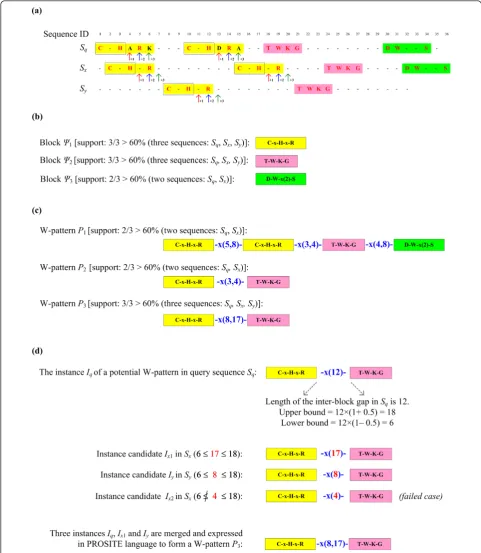
The arguments of C-bounded-prefix-growthinclude a blockΨ and its projected database. Here, we present an example of scanning a projected database in Figure 6(a). This procedure takes a patternΨ=‘C-x-H’as input and tries to extend it under the user-specified intra-block gap constraints. In each call ofC-bounded-prefix-growth, the search space of finding the next pattern symbol is bounded by the maximum length of an intra-block gap. A symbol inΣis regarded as the candidate of the next symbol if the number of its occurrences in the projected database satisfies the minimum support thresholdland its supporting sequences include the query proteinSq. Each symbol is appended to the current pattern one at a time, and the resulting new blockΨ1 (in this example,
Ψ1 =‘C-x-H-x-R’) is used as the argument for the next call ofC-bounded-prefix-growth, along with a possibly smaller projected database, because adding one more symbol to the current pattern reduces the size of the projected database. The process is recursively repeated until no satisfied symbol can be found in the current projected database.
Phase 2: growing long W-patternsThe second phase of the WildSpan aims to grow long patterns (W-patterns) that are composed of two or more blocks spanning large wildcard regions in protein sequences. Here we formally define what a W-pattern is.
Definition 6. (W-Pattern and inter-block gap)
A W-patternP =Ψ1-x(s1,e1)-...- x(sp-1,ep-1)-Ψp, whereΨ1,
Ψ2 andΨpare the rigid-gapped blocks derived in phase 1. Any pair of adjacent blocks is connected by an inter-block gap, x(si,ei) forsi≤ei(1≤i<p), which matches at leastsi and at mosteiarbitrary residues between blocks
Ψi andΨi+1. The flexibility of an inter-block gap x(si,ei) is defined asei-si+ 1.
When the flexibility of an inter-block gap x(si,ei) between two adjacent blocks is large, it implies that the patternPspans a wildcard region and the length of the region is variant in its supporting sequences. It can be imagined that the mining results would be noisy if the growth of long patterns were not well confined. How-ever, determining the extent of the flexibility of a wild-card region in advance is difficult. Fortunately, in the problem considered herein, this issue can be tackled by considering a relative flexibility constraint with respect
to the length of the inter-block gap observed in the query sequence.
Definition 7. (Relative flexibility constraint of inter-block gaps)
A blockΨi+1 is going to be appended to an existing W-pattern of which the last block is Ψi. Letlbe the length of an inter-block gap in the query sequenceSq, connect-ing blocksΨi andΨi+1. The lower and upper bounds of this inter-block gap are defined as (1 - fmax)×l and (1 +
fmax)×l, respectively, wherefmax is called the relative flexibility constraint. The resultant new W-pattern is satisfied if the number of supporting sequences that satisfies the lower and upper bounds of the inter-block gaps is equal to or exceeds the minimum support con-straintl.
Here we present an example of growing W-patterns when the constraint of relative flexibility is adopted. Let the minimum support threshold l be 60%, the
minimum length of block min be 3, the maximum
intra-block gapsgmaxbe 2, the maximum relative flex-ibility fmax be 50%, and the minimum number of blocks in a W-pattern nminbe 2. Following the exam-ple used in Figure 6(a), the input sequence database has three satisfied blocks as shown in Figure 6(b): ‘ C-x-H-x-R’, ‘T-W-K-G’, ‘D-W-x(2)-S’. An advantage of specifying a query sequence in advance is that the repeats present in protein sequences can be properly dealt with. As presented in Figure 6(a), the two instances of block ‘C-x-H-x-R’ will be treated as two distinct block instances and they are distinguished by their starting positions, 1 and 10, in the query sequence Sq. There are three satisfied W-patterns, as shown in Figure 6(c), according to the relative flexibil-ity with respect to the query sequence Sq. The first W-pattern has four blocks with supporting sequences Sq
andSx; and the second W-pattern has two blocks with
supporting sequences Sq, and Sx; the third W-pattern has two blocks with supporting sequences Sq, Sx, and
Sy. Finally, the example of maximum relative flexibility for the third W-pattern is shown in Figure 6(d).
Pruning strategy
Figure 6A running example. (a) A sample input sequence database (SDB) containingSq(reference sequence/query sequence),SxandSy. The
solid arrows show the scanning range of thebounded-prefix-growthprocedure under the intra-block gap constraint (gmax= 2) with respect to
the pattern block‘C-x-H’(C - H) marked by black frames. The red, blue and green solid arrows denote the scanning residues with‘C-x-H’as the prefix and with gap lengths of zero, one, and two, respectively. Two other satisfied pattern blocks are marked by distinct background colours. The symbol‘-’in the sequences represents the residues that cannot contribute to forming any patterns in this example; (b) Three satisfied pattern blocks; (c) Three satisfied W-patterns; (d) An example of how the maximum relative flexibility with respect to the reference sequenceSq
usually large. Aggressive pruning strategies are desired to achieve high efficiency of the proposed algorithm. These are described as below.
BothC-bounded-prefix-growthand B-bounded-prefix-growth grow patterns by searching the solution space in a depth-first manner. In this case, an algorithm must know when a branch can be pruned to reduce searching cost. The pruning strategies described in this subsection can be adjusted respectively for different phases of the WildSpan algorithm, in which different building compo-nents and constraints are considered. A node in a pat-tern tree of the solution space is promising if it corresponds to a substructure (a sub-pattern) of a valid solution (a pattern) without violating the user-specified constraints. To achieve high efficiency, a growing pat-tern should be pruned immediately as soon as it has been detected as a non-promising node.
The pruning of a node is based on exploiting the anti-monotonic property of this problem [34]. A constraint
Cis anti-monotonic if a sequenceb that satisfiesChas the property that every non-empty subsequence of b also satisfiesC. The minimum support constraint serves as a good example to illustrate the anti-monotonic property. If a pattern P =Ψ1-x(s1,e1)-...-x(sp-1,ep-1)-Ψp satisfies the minimum support constraint, then a sub-pattern that is composed of any subsets of the blocks in
P also satisfies the minimum support constraint. Since our scanning procedureB-bounded-block-growthgrows a W-pattern from a single block and tries to extend it by appending another block to it as the suffix of a new longer W-pattern, the anti-monotonic property can be exploited in the following way.
Pruning strategy 1
Let a pattern Pbe satisfied. If P’=P-x(sp’,ep’)-Ψp’fails to be a satisfied pattern, then all of the patterns usingP’
as the prefix,P-x(sp’,ep’)-Ψp’-x(sp“, ep“)-Ψp“ also fail to be satisfied. Thus, all the prefix-tree descendants nodes ofP’can be pruned.
Peiet al. [34] proved that the minimum support con-straint is anti-monotonic. The proof is straightforward, since a sub-pattern always matches more sequences in the database. Accordingly, this constraint works well with pruning strategy 1 in both phases of the WildSpan algorithm. The proposed relative flexibility constraint of inter-block gaps also has the anti-monotonic property.
Theorem 1. The relative flexibility constraint on the inter-block gaps is an anti-monotonic constraint. Given a patternP =Ψ1-x(s1,e1)-...-x(sp-1,ep-1)-Ψp, ifP satisfies inter-block flexibility constraint, then so do all of its sub-patternsP’(P’can be obtained by deleting one or more blocks from patternP.)
Proof: If Psatisfies the relative flexibility constraint of inter-block gapsfmax, it implies that every inter-block gap inPsatisfies the same constraint. For a sub-pattern
P’, which is derived by deleting one block of length c
from P in between two inter-block gaps of lengths a
and b and of relative flexibilitiesfa andfbrespectively, the maximum length of the resultant new inter-block gap equals to a×(1 +fa) + b×(1 +fb) +c, and the mini-mum length of the resultant inter-block gap equalsa×(1 - fa) +b×(1 -fb) +c. Given thatfa ≤fmaxandfb≤ fmax, we havea×(1 + fa) +b×(1 +fb) +c≤ (a+b +c)×(1 +
fmax) anda×(1 - fa) +b×(1 - fb) +c ≥(a +b +c)×(1
-fmax), which means the sub-pattern P’also satisfy the same constraint fmax. This induction can be applied recursively if more than one block is deleted from Pto formP’. Hence we can deduce that the relative flexibility constraint of inter-block gaps is an anti-monotone constraint.
The anti-monotonic property can be exploited more aggressively in the way described below.
Pruning strategy 2
Let a pattern P be satisfied. IfP’=P-x(sp’,ep’)-Ψp’fails to be a satisfied pattern, all patterns in the form of P-x (sp“, ep“)-Ψp“-x(sp’’’,ep’’’)-Ψp’also fail. Thus, for all other branches of the growing patternP, for example, growing
P-x(sp“,ep“)-Ψp“, Ψp’is no longer a candidate block. The upper bound constraint of a gap is not anti-monotonic, but it is prefix anti-monotonic [35]. A con-straint Cp is called prefix anti-monotonic if for a sequenceb that satisfiesCp, it implies that every prefix of balso satisfiesCp[34]. Therefore, in the first phase, the procedureC-bounded-prefix-growthadopts a prefix-spanning mechanism, ensuring that the prefix of pattern
P will be explored before pattern P. If a pattern does not satisfy the maximum gap constraint, then any pat-tern with that patpat-tern as the prefix cannot satisfy the same constraint. Hence, pruning strategy 1 can be applied. Furthermore, when a query protein is involved during the mining process, it is regarded as one of the constraints. This constraint can also be easily proven to be anti-monotonic. In summary, pruning strategy 1 is adapted in both phases of WildSpan and pruning strat-egy 2 is applied only in the second phase.
WildSpan algorithm
large irregular gaps is ensured by exploiting the prefix anti-monotone characteristic of the new constraint model.
Based on the above algorithm description, we have the pseudo-code of WildSpan as shown in Figure A4.1 of Additional file 4, and two sub-proceduresC- bounded-prefix-growth and B-bounded-prefix-growth are pre-sented in Figure A4.2 and A4.3, respectively.
Protein-based mining
The protein-based mining is designed for discovering protein functional regions of the query protein by refer-ring to a set of its homologues. The default settings for W-patterns is: containing at least three blocks in one W-pattern and at least three conserved symbols in each block; requiring the length an intra-block gap is at most three, and the flexibility of an inter-block gap is no more than 50% with respect to the gap length observed on the query sequence. It is illustrated in Additional file 1 why this setting is suggested. WildSpan starts mining with the goal of finding the most highly supported W-patterns. For example, a support of 100% means that all the input set, including the query protein, satisfy the W-pattern. If such W-patterns do not exist, WildSpan decreases the setting gradually until at least one satisfied W-pattern has been found. All the results reported in this study are based the default settings, though the users can tighten or relax the constraints to improve the mining quality in different applications.
Family-based mining
For applications of finding family signatures, the limita-tion of the proposed constraint model is that it might not be possible to find a satisfied W-pattern that matches all of the input sequences in a single run of protein-based mining. Hence, we proposed an iteratively mining strategy, family-based mining, for collecting a set of satisfied W-patterns that together serve as the diag-nostic W-patterns for the input sequences. It is designed to proceed in the following manner: in the first run of WildSpan, the sequence of median length is selected from the input set as the query sequence. At the end of the first run, the W-pattern with the maximum support is picked. If not all of the input sequences match the selected W-pattern (such remaining sequences that do not match any of the selected W-patterns are called excluded sequences), the median-length sequence from the excluded sequences are assigned as the query sequence in the next call of WildSpan. In the second run, the W-pattern that matches the most excluded sequences of the first run will be picked. This procedure is repeated until the set of selected W-patterns covers all of the input sequences or no more W-patterns can be found from the remaining sequences.
Availability and requirements Project name: WildSpan
Project home page: http://biominer.csie.cyu.edu.tw/ wildspan
Mirror site: http://biominer.bime.ntu.edu.tw/wildspan Operating system(s): Linux
Programming language: C/C++ Other requirements: none License: GNU GPL
Additional material
Additional file 1: The analysis on the effect of changing parameter settings. This file provides the analysis on the effect of changing parameter settings of WildSpan on the mining results.
Additional file 2: Experimental datasets and results for protein family classification. This file provides the information of input datasets and complete results for the experiments of protein family classification.
Additional file 3: Closure checking schema. This file provides the description of the closure checking schema employed by WildSpan to generate concise results.
Additional file 4: The complete pseudo codes for the WildSpan algorithm.This file provides the complete pseudo codes for the WildSpan algorithm.
Acknowledgements
The authors thank the financial support of National Science Council under contract number 98-2221-E-002-137-MY2, 99-2627-B-002-004, and 99-2221-E-231-030.
Author details
1
Department of Computer Science and Information Engineering, Ching Yun University, Jung-Li, 320, Taiwan.2Department of Bio-Industrial Mechatronics
Engineering, National Taiwan University, Taipei, 106, Taiwan.3Department of Computer Science and Engineering, Yuan Ze University, Jung-Li, 320, Taiwan.
Authors’contributions
CMH designed and implemented the algorithm, performed all experiments and drafted the manuscript. CYC provided guidance on design of the methodology, participated in the discussion of biological significances and revised the manuscript. BJL aided in the guidance on the study and provided financial support. All authors read and approved the final manuscript.
Competing interests
The authors declare that they have no competing interests.
Received: 15 April 2010 Accepted: 31 March 2011 Published: 31 March 2011
References
1. Livingstone CD, Barton GJ:Protein sequence alignments: a strategy for the hierarchical analysis of residue conservation.Comput Appl Biosci1993, 9(6): 745-756.
2. Casari G, Sander C, Valencia A:A method to predict functional residues in proteins.Nat Struct Biol1995,2(2): 171-178.
3. Schueler-Furman O, Baker D:Conserved residue clustering and protein structure prediction.Proteins2003,52(2): 225-235.
4. Califano A:SPLASH: structural pattern localization analysis by sequential histograms.Bioinformatics2000,16(4): 341-357.
6. Rigoutsos I, Floratos A:Combinatorial pattern discovery in biological sequences: The TEIRESIAS algorithm.Bioinformatics1998,14(1): 55-67. 7. Wang JT, Marr TG, Shasha D, Shapiro BA, Chirn GW:Discovering active
motifs in sets of related protein sequences and using them for classification.Nucleic Acids Res1994,22(14): 2769-2775.
8. Hsu CM, Chen CY, Liu BJ:MAGIIC-PRO: detecting functional signatures by efficient discovery of long patterns in protein sequences.Nucleic Acids Res2006,34(Web Server issue): W356-61.
9. Hulo N, Bairoch A, Bulliard V, Cerutti L, De Castro E, Langendijk-Genevaux PS, Pagni M, Sigrist CJ:The PROSITE database.Nucleic Acids Res 2006,34(Database issue): D227-30.
10. Wang J, Han J:BIDE: Efficient Mining of Frequent Closed Sequences.In ICDE‘04: Proceedings of the 20th International Conference on Data Engineering.Edited by: Anonymous. Washington, DC, USA: IEEE Computer Society; 2004: 79.
11. Wang K, Xu Y, Yu JX:Scalable sequential pattern mining for biological sequences.InProceedings of the thirteenth ACM international conference on Information and knowledge management.Edited by: Anonymous. Washington, D.C., USA: ACM; 2004: 178-187.
12. Chakrabarti S, Anand AP, Bhardwaj N, Pugalenthi G, Sowdhamini R: SCANMOT: searching for similar sequences using a simultaneous scan of multiple sequence motifs.Nucleic Acids Res2005,33(Web Server issue): W274-6.
13. Keskin O, Ma B, Nussinov R:Hot regions in protein–protein interactions: the organization and contribution of structurally conserved hot spot residues.J Mol Biol2005,345(5): 1281-1294.
14. Ogiwara A, Uchiyama I, Seto Y, Kanehisa M:Construction of a dictionary of sequence motifs that characterize groups of related proteins.Protein Eng 1992,5(6): 479-488.
15. Pisanti N, Carvalho AM, Marsan L, Sagot M, Lisbon I, France IR:RISOTTO: Fast Extraction of Motifs with Mismatches.InProceedings of the 7th Latin American Theoretical Informatics Symposium, 3887 of LNCS.Edited by: Anonymous. Valdivia, Chile: Springer-Verlag; 2006: 757-768.
16. Marsan L, Sagot MF:Algorithms for extracting structured motifs using a suffix tree with an application to promoter and regulatory site consensus identification.J Comput Biol2000,7(3-4): 345-362.
17. Carvalho AM, Freitas AT, Oliveira AL, Rhône-alpes I, Bernard UC, I L:A highly scalable algorithm for the extraction of cis-regulatory regions.In Proceedings of the 3rd Asia Pacific Bioinformatics Conference, volume 1 of Advances in Bioinformatics and Computational Biology.Edited by: Anonymous. Imperial College Press; 2005: 273-282.
18. Klepper K, Sandve GK, Abul O, Johansen J, Drablos F:Assessment of composite motif discovery methods.BMC Bioinformatics2008,9: 123. 19. Jonassen I:Efficient discovery of conserved patterns using a pattern
graph.Comput Appl Biosci1997,13(5): 509-522.
20. Saqi MA, Sternberg MJ:Identification of sequence motifs from a set of proteins with related function.Protein Eng1994,7(2): 165-171. 21. Blekas K, Fotiadis DI, Likas A:Greedy mixture learning for multiple motif
discovery in biological sequences.Bioinformatics2003,19(5): 607-617. 22. Frith MC, Saunders NF, Kobe B, Bailey TL:Discovering sequence motifs
with arbitrary insertions and deletions.PLoS Comput Biol2008,4(4): e1000071.
23. Narasimhan G, Bu C, Gao Y, Wang X, Xu N, Mathee K:Mining protein sequences for motifs.J Comput Biol2002,9(5): 707-720.
24. Hsu C, Chen C, Hsu C, Liu B:Efficient Discovery of Structural Motifs from Protein Sequences with Combination of Flexible Intra- and Inter-block Gap Constraints.Advances in Knowledge Discovery and Data Mining2006, 530-539.
25. Su CT, Chen CY, Hsu CM:iPDA: integrated protein disorder analyzer.
Nucleic Acids Res2007,35(Web Server issue): W465-72.
26. Chien TY, Chang DT, Chen CY, Weng YZ, Hsu CM:E1DS: catalytic site prediction based on 1D signatures of concurrent conservation.Nucleic Acids Res2008,36(Web Server issue): W291-6.
27. Mintseris J, Wiehe K, Pierce B, Anderson R, Chen R, Janin J, Weng Z: Protein-Protein Docking Benchmark 2.0: an update.Proteins2005,60(2): 214-216.
28. Hsu CM, Chen CY, Liu BJ, Huang CC, Laio MH, Lin CC, Wu TL:Identification of hot regions in protein-protein interactions by sequential pattern mining.BMC Bioinformatics2007,8(Suppl 5): S8.
29. Altschul SF, Madden TL, Schaffer AA, Zhang J, Zhang Z, Miller W, Lipman DJ:Gapped BLAST and PSI-BLAST: a new generation of protein database search programs.Nucleic Acids Res1997,25(17): 3389-3402. 30. Bairoch A, Apweiler R, Wu CH, Barker WC, Boeckmann B, Ferro S,
Gasteiger E, Huang H, Lopez R, Magrane M, Martin MJ, Natale DA, O’Donovan C, Redaschi N, Yeh LS:The Universal Protein Resource (UniProt).Nucleic Acids Res2005,33(Database issue): D154-9. 31. Chien TY, Chang DT, Chen CY, Weng YZ, Hsu CM:E1DS: catalytic site
prediction based on 1D signatures of concurrent conservation.Nucleic Acids Res2008,36(Web Server issue): W291-6.
32. Su CT, Chen CY, Hsu CM:iPDA: integrated protein disorder analyzer.
Nucleic Acids Res2007,35(Web Server issue): W465-72.
33. Hsu CM, Chen CY, Liu BJ, Huang CC, Laio MH, Lin CC, Wu TL:Identification of hot regions in protein-protein interactions by sequential pattern mining.BMC Bioinformatics2007,8(Suppl 5): S8.
34. Pei J, Han J, Wang W:Mining sequential patterns with constraints in large databases.InProceedings of the eleventh international conference on Information and knowledge management.Edited by: Anonymous. McLean, Virginia, USA: ACM; 2002: 18-25.
35. Orlando S, Perego R, Silvestri C:A new algorithm for gap constrained sequence mining.InSAC‘04: Proceedings of the 2004 ACM symposium on Applied computing. Nicosia, Cyprus edition.Edited by: Anonymous. New York, NY, USA: ACM; 2004: 540-547.
36. Lin M, Lee S, Wang S:DELISP: Efficient Discovery of Generalized Sequential Patterns by Delimited Pattern-Growth Technology.Advances in Knowledge Discovery and Data Mining2002, 198-209.
doi:10.1186/1748-7188-6-6
Cite this article as:Hsuet al.:WildSpan: mining structured motifs from protein sequences.Algorithms for Molecular Biology20116:6.
Submit your next manuscript to BioMed Central and take full advantage of:
• Convenient online submission
• Thorough peer review
• No space constraints or color figure charges
• Immediate publication on acceptance
• Inclusion in PubMed, CAS, Scopus and Google Scholar
• Research which is freely available for redistribution
![Figure 1 An example of structued motifs This motif is observed on the protein Ferredoxin-NADP reductase [Swiss-Prot: P10933] andadditional 150 Oxidoreductase FAD/NAD(P)-binding proteins from the InterPro entry [InterPro: IPR001433]](https://thumb-us.123doks.com/thumbv2/123dok_us/347264.1527248/3.595.56.539.563.732/structued-observed-ferredoxin-reductase-andadditional-oxidoreductase-interpro-interpro.webp)